Abstrak
Pengaruh merokok sigaret terhadap reJleks otonom diteliti para 25 perol,ak
pia
dibandingkan dengan 25 bukan perokok yang komparabel. Tidak didapat perbedaan berrnakna dalam frekuensi denyut jantung, tekanan darah dan variabel lain pada kedua kelompok sebelum merokok. Namun pada keLompok perokok, sesudah merokok, denyut jantung basal, tekanan darah basal (< 0,001 ), tekanan diastolik (p < 0,05 ) dengan perubahan posisi, tekanan sistolik 9p < 0,0 I ) pada cold pressure test semuanya meningknt. Rasio el<spirasi : inspirasi (p < 0,01) dan S:L (p < 0,01) menurun. Observasi ini menunjukknn peningkatan akut pada linns simpatik dengan pengaruh pada aktivitas vagal. (Med J Indones 2001; 10: 95-7)Abstract
Effect of cigarette smoking on autonomic reflexes was tested in 25 maLe smokers and compared with 25 age, sex matched non smokers. There was insignificant difference betvveen heart rate (HR), blood pressure (BP) and other variables between non smokers and smokers (before smoking). But in smokers after cigarette smoking, the basal HR, basal BP
(<
0.001), diastolic BP (p<
0.05) with change of posture (lying to standing), systolic BP (p<
0.01) on coldpressure test wereall
increased, while expiration: inspiration (E:I) ratio (p
< 0.01) and S: L ratio (p < 0.05) were reduced. These observations indicate acute rise in sympathetictrffic
with some effect on vagal activity. (Med J Indones 2001; 10: 95-7)Key w o r ds : s mo kin g, au t on o mi c reJl e xe s, symp at h e t i c, v a g us VoI 10, No 2, April
-
June 2001Effect of smoking
on
autonomic
reflexes
K.
Singh,
S. SoodDuration
andnumber
of
cigarettes smokedper
day aredirectly
proportional
to
cardiac morbidity
andmortality. kr
addition to 4000
substances,nicotine
andcarbon monoxide components
of
cigarette smoke
aresupposed
to
affect
cardiovascular
system,t increase
arterial
pressure
and heart rate
acutely.2
Effects
of
smoking
on sympathetic
activity
arc
not
well
understood.
Smoking
or
nicotine infusion
mayincrease,
decreaseor
may
not
have any
change in
epinephrine levels.3
Nicotine
has
been
found
to decreaseaor
to have
no
effect-son directly
recordedmuscle
sympatheticnerve
activity. We
conducted thisstudy
to find
out
acute
autonomous consequencesof
smoking
in
asymptomatic
smokers and comparedwith
non smokers.Department of Physiology, Pt, B.D, Sharma Postgraduate Institute of Medical Sciences (PGIMS), Rohtak- 124001, Haryana, India
Autonomic reflexes 95
The
present study wascarried out
in
25 male
smokersand
compared
with
25
age,sex, height and
weight
matched nonsmokers.
A
detailed
history
of
smoking
was gatheredfrom
eachsmoker
with
special referenceto
duration
of
smoking, number
of
bidi/cigarette
smoked/day and the
ageof
starting smoking.
All
thesubjects
were examined
clinically
to
exclude
anyunderlying
cardiac disease. Subjectswith
haemoglobinlevel
lessthan
10 gEowere excluded
from
the
study.Subjects
were
asked
to
abstain
from
smoking
for
2 hoursbefore
the tests.All
the testswere performed in
morning. Smoking
of one cigarette
(Red
and white,
Marcitch,
nonfilter) was followed
by
smoking of
another cigarette.
Both the
cigarettes
were
finished
within
l0 minutes
(range 5.2to 7.5
min,
averagetime
5.35
mrnute).
Each cigarette was
smoked
to
a butt
length
of
4.2
cm
(total length 6.7 cm). Data
werecollected
in
nonsmokers, and
in smokers
before
and after smoking.Autonomic
reflexes:
Following
noninvasive tests
were carried out:96
SinghandSoodto take
6
deepbreaths each
of
10
sec.The
E:I
ratio
then was calculated as:
Maximum R-R interval during expiration
E:I ratio
=Minimum
R-R interval during inspiration
(2) Effect
of
posture: Effect
of
change of
posturefrom lying
to
standing was
recorded
on
heart
rate(HR)
andblood
pressure (BP).(3)
S:L
ratio:
It
is
the ratio
of
longest R-R
interval
during five
beatsbefore
lying down
to
the
shortestR-R
interval during the
l0
beats after lying down
(standing to
lying
ratio).
(4) Valsalva manoeuvre
(YM):
All
the subjects were shown the procedureof VM.
Then
theywere
asked toexpire forcefully
in
a
tube
against closed
glottis
toraise and maintain
pressureof
40 mmHg for 15
sec.Valsalva
ratio
and blood
pressure
were
recordedduring strain (Phase
II)
and after
release
of
strain(Phase
IV).
l.ongest
R-R interval
after manoeuvre(phase
IV)
Valsalva
=Ratio
ShortestR-R interval during
manoeuvre(phase
II)
(5) Cold pressure test
(CPI):
Subject was
asked toimmerse
his
lett hand
in
cold
water
(5-8oC)
uptowrist
for
I
min. Heart rate (HR) and blood
pressure(BP)
were
recordedjust
after
withdrawl of
handfrom
cold
water.oHeart rate recording
was
taken
on
physiographcontinuously
at
speedof
25 mm/sec. Blood
pressurewas
recorded
by
sphygmomanometer.
Data
were analysedstatistically
by
using paired
andunpaired
't'
test.RESULTS
Subjects we
studied indicated
that they
smoked 7
to30
(mean 14.5) beedis/cigarettes
daily
for 2 to
15years (mean
10.6
years)
(Table
l).
There
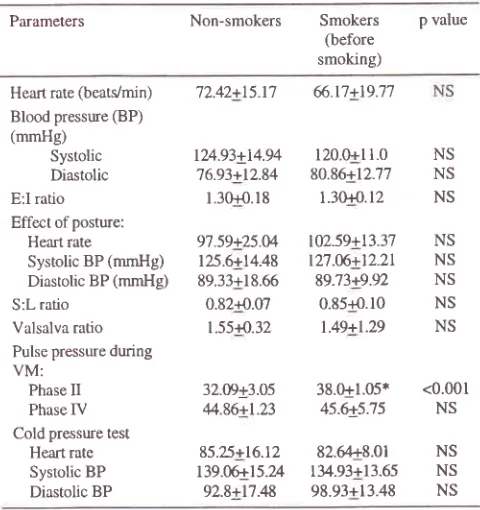
wasinsignificant difference
between
HR, BP
and
othervariables between nonsmokers
andin
smokers beforesmoking (Table
2).
In
smokers,on cigarette smoking
(i)
the
basalHR
andBP were
increasedsignificantly
(p < 0.001),
(ii)
with
changeof
posturefrom lying to
Med J Indones
standing the diastolic
BP (p
<
0.05) and on CPT
thesystolic BP (p <
0.01) were elevated,
(iii)
while E:I
ratio (p < 0.01)
andS:L ratio
(p< 0.05) were
reduceci(Table 3). Effect
of
VM
on
HR
and BP
is
given
in
Table
1 and 3.Table
l.
Physical characteristics ofsubjectsCharacteristics Nonsmokers (n=25)
Smokers (n=25)
Age (years) Quetelet Index No. of beedi/cigarette Duration of smoking Age at which smoking was started
31.6+9.17 2.29+0.34
34+'1.33 2.22+O.37 14.58+9.20 10.66+5.92
18.41+2.21
Table
2.
Comparison of autonomic function tests between nonsmokers and smokers (before smoking)Parameters Non-smokers
Smokers
p value(before smoking)
Heart rate (beatVmin) Blood pressure (BP) (mmHg)
Systolic
Diastolic E:I ratio Effect of posture:
Hefft rate
Systolic BP (mmHg)
Diastolic BP (mmHg) S:L ratio
Valsalva ratio Pulse pressure during VM:
Phase
II
Phase [V Cold pressure testHeârt rate Systolic BP Diastolic BP
72.42+15.17
66.17+19;17124.93+14.94 '76.93+12.84
1.30r{.18
97.59+25.M
125.6+14.48 89.33+18.66
0.82rO.07
1.55r{.32
32.09+3.05 d4.86+1.23
85.25+16.12
139.6+15.24
92.8+l'1.48
120.0+11.0 80.86+12;17
1.30{O.12
lU2-59+13.37 127.M+12.21 89.73+9.92
0.85{O.10
1.49+1.29
38.0+1.05* 45.6+5.75
82.64+8.01 134.93+13.65
98.93+13.48
NS NS
NS
NS
NS NS
NS
NS
<0.001
NS
NS
NS
NS
* <0.001 Highly significant VM = Valsalva manouwe
DISCUSSION
Most
of
the cardiovascular
effects
of
smoking
arethought to
be mediatedby sympathetic stimulation.
In
the
presentstudy
abattery
of
autonomic provocative
manouvres
were performed
to find effect
of
smoking,while
most otherworkers
have usedonly
few of
them. [image:2.612.308.545.176.283.2] [image:2.612.307.547.329.584.2]Vol 10, No 2,
April-
June 2001nonsmokers and smokers
before smoking
as has beenreported
earlier.T-8 Increasein HR
andBP
in
smokersafter smoking
as seenin this
study, is
consistentwith
other
reports.*-toThis
increase
may due
to
elevatedsympathetic
activity. Smoking
speedsup HR in
partby
reducing vagal
restraints.r0This fact is
supportedby
the
finding
that
E:I ratio
andS:L
ratio
are reducedin
this study. Hayano
and
coworkersrr also
showedthat R-R interval spectral power at
the
respiratory
frequency
is reducedby smoking.
After
smoking
in
PhaseII of
valsalva
manouvre pulse pressureis
increasedsharply
indicating
the
increasedsympathetic response.
In
phase
fV
sympatheticactivity
is
silenced causing
reducedpulse
pressure asreported
by
otherworkers.lo
On
CPT,
rise
in
systolic
blood
pressure
is
morecompared
to
diastolic after smoking showing
an increased sympathetictraffic
to
the cutaneous vascular bedl2 andprovokes skin
vasoconstriction.l3
Conclusion:
From this
study,it
is
clear that responsesto
the same
stimuli are
similar
in
smokers
andnonsmokers
including basal heart
rate and
blood
pressure.
But smoking
acutely
increases sympathetidoutflow
with
some
restrain on vagal activity
which
needs
further exploration.
REFERENCES
1.
HolbrookJH.
Nicotine addiction.In:
Isselbacher KJ,Braunwald E, Wilson JD, Martin JB, Fauci AS, Karper
DL
editors. Harrison's Principlesof
Internal Medicine,13th ed, vol 2, New York, McGraw-Hill lnc, 1994:2433-7.
Autonomic
reflexes
97Lakier JB. Smoking and cardiovascular disease.
Am
JMed 1992; 93: 1A-8S-125.
Cinciripini PM, Benedict CE, Van Vunakis H, Mace R,
Lapitsky L, Kitchens K, et al. The effects of smoking on
the mood, cardiovascular and adrenergic reactivity or heavy and light smokers in a non stressfull environment. B iol Psychol 1989 ; 29 :27 3 -89.
Grassi G, Seravalle G, Calhoun DA, Bolla GB, Zanchetti
A,
ManciaG.
Alterationin
sympathetic nerve traffic during cigarette smoking in man: a preliminary report. J Hypertens 1991; 9 (Suppl 6): 552-53.Mosqueda-Garcia R, Bioggioni
I,
Haile V, Robertson R,Robertson D. Effects of nicotine infusion on sympathetic nerve
traffic
and baroreflex responsein
man. Clin Res1990; 38:2594 (Abstract).
Mishra
N
and MahajanKK.
Cardiovascular response toorthostatic stress following cold challenge. Bio Med Res 1995;61(l):103-7.
Gofin
R,
Kark JD, FriedlanderY.
Cigarette smoking. blood pressure and pulse ratein
the Jerusalem LipidResearch. Clinic Prevalence Study. Isr J Med Sci 1982;
18:1217.
Green MS, Jucha E, Luz
Y.
Blood pressurein
smokersand nonsmokers: Epidemiologic hndings.
Am
Heart J 1986;l1l
(5):932-40.Benowitz NL, Kuyt F, Jacob P. Influence of nicotine on
cardiovascular and hormonal effects of smoking. Niedermaier
N,
SmithML,
BeightolLA,
Grojec ZZ, GoldsteinDS,
EckbergDL,
Influenceof
cigarette smokingon
human autonomicfunction.
Circulation I 993; 88;562-7 I .Hayono
J,
YamadaM,
SakakibaraY,
Fujinami
T, YokoyamaK,
WatanabeY,
et al. Short and long term effects of cigarette smoking on heart rate variability. Am J Cardiol 1990; 65:84-8.Delius
W,
HogbarthKE,
Hongell
A,
Wallin
BG.Manoeuvers affecting sympathetic outflow in human skin
nerves. Acta Physiol Scand 1972; 84:177-86.
Benowitz
NL,
Jacob
P,
JonesRT,
Rosenberg J.Interindividual
variability
in
the
metabolism andcardiovascular effects
of
nicot'inein
man.J
PharmacolExp Ther 1982; 221 :3 68 -7 2. 2
7.
8. 5
6
l0
11
12