SEPTEMBER
2013
n.
Je-LKS
The Italian e-Learning Association Journal
Società Italiana di e-Learning
Journal of e-Learning and Knowledge Society
www.sie-l.it www.je-lks.it
The Journal is issued online three times per year. Je-LKS is an Open Access Online publication. This means that everybody can free access online to abstracts and full lenght articles.
Libraries or researchers, can subscribe a Reprint Service Subscription. The Reprint Service Subscription is on a yearly basis and you can receive the three printed year issues for a 121€ annual fee (including taxes and shipping expenses).
Associate and members of the SIe-L (Italian e-Learning Association) will receive free printed copies. In order to join SIe-L:
- [email protected] - Tel. +39 052 2522521 For more information visit www. sie-l.it
Registration at the Rome Court in the pipeline.
eISSN: 1971 - 8829 (online)
ISSN: 1826 - 6223 (paper)
Resp. dir. Aurelio Simone
Editor
SIe-L The Italian e-Learning Association www.sie-l.it
Agostinelli Serge- Université Paul Cézanne, France; Anderson Terry - Athabasca University, Canada; Angiletta Salvatore-Pasqua - DG Education & Culture, EC, Belgium; Bagnara Sebastiano - Politecnico di Milano, Italy; Battistelli Adalgisa - Università di Verona, Italy; Biondi Giovanni - Indire, Miur, Italia; Calvani Antonio - Università di Firenze, Italy; Campi Alessandro- Giunti Labs; Cantoni Lorenzo - Università di Lu-gano, Switzerland; Cartelli Antonio – Università di Cassino; Ceri Stefano - Politecnico di Milano, Italy; Cerri Renza - Uni-versità di Genova, Italy; Cesareni Donatella - UniUni-versità di Roma, Italy; Clark Paul - Open University, UK; Colazzo Luigi - Università di Trento, Italy; Colorni Alberto - Politecnico di Milano, Italy; Cullen Joe - Tavistock Institute, London, UK; Delino Manuela - C.N.R. I.T.D di Genova, Italy; DellaVigna Pierluigi - Politecnico di Milano, Italy; Eletti Valerio - Università La Sapienza, Rome, Italy; Falcinelli Floriana - Università di Perugia, Italy; Federici Giorgio - Università di Firenze, Italy; Ferri Paolo - Università di Milano-Bicocca, Italy; Frignani Pa-olo - Università di Ferrara, Italy; Fuschi David Luigi – Giunti; Galliani Luciano - Università di Padova, Italy; Gallino Luciano - Università di Torino Italy; Garrison D.Randy - University of Calgary, Canada; Gassner Otmar - Pädagogische Akademie Feldkirch, Austria; Ghislandi Patrizia - Università di Trento, Italy; Giuli Dino - Università di Firenze, Italy; Guerin Eliza-beth - Università di Firenze, Italy; Guerin Helen - University College Dublin Ireland; Guerra Luigi - Università di Bologna, Italy; Hakkarainen Kai - University of Helsinki, Finland; Ho-lotescu Carmen - University of Timisoara, Romania; Jerman Patrick - Craft, Ecole Polytechnique Fédérale de Lausanne, Switzerland; Karacapilidis Nikos - University of Patras,
Gree-ce; Karlsson Goran - University of Stockholm, Sweden; Kess Pekka - University of Oulu, Finland; Khan Badrul - University of Washington, USA; Ligorio Beatrice - Università di Salerno, Italy; Longo Giuseppe - Università di Trieste, Italy; Manca Stefania - CNR ITD, Genova, Italy; Mandl Heinz - Universität München, Germany; Mantovani Giuseppe - Università di Pa-dova, Italy; Mari Giovanni - Università di Firenze; McConnel David - University of Shefield, UK; Michelini Marisa - Univer -sità di Udine, Italy; Moore Michael - The Pennsylvania State University, USA; Musumeci Alessandro - Miur, Italy; Occhini Giulio - AICA, Olimpo Giorgio - C.N.R. I.T.D, Genova, Italy; Oliver Martin - Institute of Education UK; Orei ce Paolo - Uni -versità di Firenze, Italy; Palloff Rena - Crossroads Consulting Group, USA; Parisi Domenico - C.N.R., Roma, Italy; Peraya Daniel - TECFA, Ginevra, Switzerland; Persico Donatella - C.N.R. I.T.D, Genova, Italy; Pettenati M.Chiara - Università di Firenze, Italy; Pezzè Mauro - Università di Milano-Bicocca, Italy; Pillan Margherita, Politecnico di Milano, Italy; Pratt Keith - Northwest Arkansas Community College, USA; Ri-voltella P.Cesare - Università Cattolica di Milano, Italy; Rizzo Antonio - Università di Siena, Italy; Rossi P.Giuseppe - Univer-sità di Udine, Italy; Rotta Mario - UniverUniver-sità di Firenze, Italy; Salmon Gilly - Open University, UK; Sangrà Albert - Universitat Oberta de Catalunya (UOC); Sarti Luigi - C.N.R. I.T.D, Genova, Italy; Schaerf Mirella - CNIPA, Area Formazione e Regolazione, Italy, Milano, Italy; Simone Aurelio – Università di Roma Tor Vergata; Simons Robert Jan - University of Utrecht, Holland; Striano Maura - Università di Firenze, Italy; Tammaro A.Maria - Università di Parma, Italy; Tanoni Italo - Università di Urbino, Italy; Trentin Guglielmo - C.N.R. I.T.D, Genova, Italy; Trinchero Roberto - Università di Torino, Italy; Vertecchi Benedetto - Università Roma3, Italy; Wischnewsky Manfred - Universität Bremen, Germany.
Reviewers
Giovanni Adorni, Adalgisa Battistelli, Raffaella Bombi, Giovanni Bonaiuti, Antonio Calvani, Lorenzo Cantoni, Car-lo Cappa, Nicola Capuano, Antonella Carbonaro, Milena Casagranda, Mirella Casini Shaerf, Roberto Caso, Alessio Ceccherelli, Donatella Cesareni, Angelo Chianese, Luigi Colazzo, Alberto Colorni, Valentina Comba, Madel Crasta, Vincenzo D’Andrea, Ciro D’Apice, Marinella De Simone, Nicoletta Dessì, Pierpaolo Di Bitonto, Liliana Dozza, Va-lerio Eletti, Filomena Faiella, Giorgio Federici, Paolo Ferri, Rita Francese, Paolo Frignani, Luciano Galliani, Patrizia Ghislandi, Carlo Giovannella, Stefano Lariccia, Roberto Laschi, Maria Laterza, Beatrice Ligorio, Stefania Manca, Giuseppina Rita Mangione, Paolo Maresca, Giada Mari-nensi, Elvis Mazzoni, Luisa Mich, Tommaso Minerva, Gior-gio Olimpo, Giovanni Pascuzzi, Marco Pedroni, Donatella Persico, Maria Chiara Pettenati, Giuseppe Pirlo, Giorgio Poletti, Maria Ranieri, Emanuale Rapetti, Pierfranco Ra-votto, Pier Cesare Rivoltella, Teresa Roselli, Veronica Ros-sano, Pier Giuseppe Rossi, Susanna Sancassani, Luigi Sar-ti, Dario Simoncini, Aurelio Simone, Angela Spinelli, Sara Tomasini, Guglielmo Trentin, Roberto Trinchero, Nicola Villa, Giuseppe Visaggio, Fabio Vitali, Alessandro Zorat
Editing
Nicola Villa
©2013 SIe-L - Italian e-Learning Association
J
e
-
LKS
Journal of e-Learning and Knowledge Society
To the authors:
N. Villa pag. 5 In this number
V. Eletti pag. 7 Editorial
Focus on: Complexity Education
V. Castello, E. Guglielman, M. Guspini, L. Vettraino
pag 29 Complex Learning Frame and evidences
J. Wright
pag 41 Can You Tell Me How to Get, How to Get to e-Learning: Development and Complexity N. Carlomagno, P. A. Di Tore, M. Sibilio
pag 55 Motor activities teaching and complexity: a reversal of the classical description of the
mechanisms of perception and action
Peer Reviewed Papers
D. Purbohadi, L. Nugroho, I. Santosa, A. Kumara
pag 67 GaMa Feedback Learning Model: Basic Concept and Design
G. Lotito, G. Pirlo
pag 79 Item Response Theory for Optimal Questionnaire Design
M. I. Cascio, V. C. Botta, V. E. Anzaldi
pag 95 The role of self eficacy and internal locus of control in online learning
A. Acar
pag 107 Attitudes toward Blended Learning and Social Media Use for Academic Purposes: An Exploratory Study
P. Maresca, L. Stanganelli
pag 127 Building courses for the training in Jazz: which educational resources for the future?
P. Cassai
pag 139 The human side of knowledge management: knowledge sharing in a community of
practice
P. Kafchehi, K. taherkhoyani, K. Hasani, S. Sheikhesmaeili, A. abdi
pag 151 The relationship between knowledge management with the improving professional activities of the Customs
Vol. 9, n. 3, 2013
Journal of e-Learning and Knowledge Society
J
e
-LKS
Peer Reviewed Communications R. Ojino, L. Mich, P. Ogao, S. Karume
pag 169 The Quality of Kenyan University Websites: A Study for the Re-engineering of the Ma -sinde Muliro University Website
To the authors
www.sie-l.it www.je-lks.org
Editor
SIe-L - The Italian e-Learning Association www.sie-l.it
Partners
University’s Centers
CATTID – “Sapienza” Università di Roma
CEA – Università degli Studi di Modena e Reggio Emilia
CELFI – Università degli Studi di Macerata
CENTRO DI CALCOLO ELETTRONICO - Università degli Studi di Napoli “Parthenope”
CENTRO METID – Politecnico di Milano
CISI – Università degli Studi di Torino
CISUS – Università degli Studi di Salerno
CRMPA – Università degli Studi di Salerno
CSI Napoli – Università degli Studi di Napoli “Federico II”
CTU – Università degli Studi di Milano
D.I.S.A – Università degli Studi di Trento
IUL - Italian University on Line
Rete di Ricerca ELGOV
Rete Puglia – Università degli Studi di Bari “Aldo Moro”
Scuola IaD – Università degli Studi di Roma Tor Vergata
Unitel Sardegna – Università di Cagliari, Università di Sassari
Uficio didattica on-line - Università di Trento Other Institutions
AICA, Associazione Italiana per l’Informatica e il Calcolo Distribuito AIF, Associazione Italiana Formatori - Milano
ALLIANZ S.p.A. - Trieste
Agenzia Nazionale per lo Sviluppo dell’ Autonomia Scolastica – Ex INDIRE Aracne Editrice - Roma
BAICR Sistema Cultura – Roma
CNIPA – Roma
CSI Piemonte – Regione Piemonte e Università
De Agostini Editore Ellediemme Libri dal Mondo ITD CNR – Genova
J&B Servizi Organizzazione e Metodo S.r.l Salerno Software Srl
Universus CSEI
©2013 SIe-L - Italian e-Learning Association
J
e
-
LKS
In this number
by Nicola Villa
This number is partially focused on Complexity Education.
Thanks for the Guest Editor Valerio Eletti for his idea, explained in the Editorial that opens the number.
The irst three papers are connected to the focus of this number. In particular the paper of Valentina Castello, Eleonora Guglielman, Marco Guspini and
Laura Vettraino (Complex Learning Frame and evidences), Juson Wright
(Can You Tell Me How to Get, How to Get to e-Learning: Development and Complexity) and Nadia Carlomagno, Pio Alfredo Di Tore and Maurizio Sibilio (Motor activities teaching and complexity: a reversal of the classical description of the mechanisms of perception and action).
The other papers are “out of number” and complete this issue.
Dwijoko Purbohadi, Lukito Nugroho, Insap Santosa, Amitya Kumara
(GaMa Feedback Learning Model: Basic Concept and Design) propose a ma-stery learning model using e-learning that applies control mechanism to solve the problem of limited time for the teacher to monitor and help students.
Giuseppina Lotito and Giuseppe Pirlo (Item Response Theory for Optimal Questionnaire Design) present a technique for automatic design of optimal questionnaires that uses a Genetic Algorithm for multiple-choice item selection, according to the Item Response Theory.
Maura Ignazia Cascio, Valentina Concetta Botta, Vanda Esmeralda Anzaldi (The role of self eficacy and internal locus of control in online lear -ning) analyse the structure of the relations among training goals achievement and some psychological features considered signiicant in Distance Learning.
Adam Acar (Attitudes toward Blended Learning and Social Media Use for Academic Purposes: An Exploratory Study) describes a survey study inside a Japapese college about the use of social media and blended learning for aca-demic purposes.
6
The last two papers are more connected to the Knowledge Management, one of the topics of this journal.
The work by Paolo Cassai (The human side of knowledge management: knowledge sharing in a community of practice) investigates the interpersonal process by which knowledge is shared in the HRD Ofice’s communities of practice of an Italian Bank.
Parviz Kafchehi, Kayvan taherkhoyani, Kaveh Hasani, Saman Sheikhe-smaeili, Aref abdi (The relationship between knowledge management with the improving professional activities of the Customs) talk about the relationship between knowledge management with the improving professional activities in Customs ofice, in particular the Custom Center of Iran.
The number is closed by a peer reviewed communication by Ronald Ochieng Ojino, Luisa Mich, Patrick Ogao, Simon Maina Karume (The Quality of Kenyan University Websites: A Study for the Re-engineering of the Masinde Muliro University Website).
This is the last number of 2013. In this year the ranking and relevance of Je-LKS is increased; in particular the journal is now indexed by EdITLibrary, one of the most important Digital Libray dedicated do Education and Infor -mation Technology (http://www.editlib.org/j/JELKS) and we have started the evaluation required by ISI index.
The bibliometric H-Index of Je-LKS (based on Publish or Perish and Google Scholar) is now 13.
We are ready for the next year (the tenth anniversary) with some news;
the irst is the call for paper for the next number (Recommender systems for learning) edited by Antonella Carbonaro and Demetrios G. Sampson: please
visit the journnal website (www.je-lks.org) for all the information. The deadli-ne for paper submission is 15th October.
GaMa Feedback Learning
Model: Basic Concept and
Design
Journal of e-Learning and Knowledge Society Vol. 9, n. 3, September 2013 (pp. 67 - 77) ISSN: 1826-6223 | eISSN: 1971-8829
Dwijoko Purbohadi1, Lukito Nugroho2, Insap
Santosa2, Amitya Kumara2
1Information Technology Department, Universitas Muhammadiyah
Yogyakarta, Indonesia - [email protected]
2Post Graduate Program, Universitas Gadjah Mada, Indonesia
[email protected], [email protected], amitya@psichology. ugm.ic.id
Keywords: Control mechanism; LMS; ITS; instructional design
Peer Reviewed Papers
Ideally, in teaching and learning activity, there should be one teacher for
one student, supported by suficient instruments, and appropriate methods. Currently, a teacher assists a number of students. Teachers have limited time to monitor and help a student overcome their learning problems. This
paper proposes a mastery learning model using e-learning that applies control
mechanism to solve above problems. The model is applied in group learning, but the actual target is individual learning. Teachers have plenty of time to supervise, evaluate, and take necessary actions when inding a student with learning problems. The principles of control mechanism can be operated if
it is already equipped with Learning Management System (LMS), in which it has been enriched with Intelligent Tutoring System (ITS) and appropriate
instructional. The students will be more autonomous and the teachers serve
more as monitors and assistants to promote a bigger number of students
who can achieve mastery.
|
for citations:
68
Peer Reviewed Papers -Vol. 9, n. 3, September 2013
|
1 Introduction
The key to mastery learning model is that every student is given indivi-dual opportunities to achieve the mastery level in a graindivi-dual and effective way (Ozden, 2008). Self-assessment is essential since it can be used for learning evaluation (Visentin et al., 2013). Communication is also an important part of
the learning process (Vui, 2008). Those requirements are dificult to fulill due
to some factors: (a) all students are given the same allocation of study time and type of activities, although they have different learning speeds; (b) learning is teacher-centered or teacher still dominates the activities; (c) students tend to be a passive learner; and (d) examinations are only twice in a semester and merely function as an assessment.
Achieving mastery needs an effort to help the students become continuously active. The lectures’ roles are to monitor, to detect students’ problems, and to provide proper treatment. This principle is similar to controlling principles using feedback in engineering; therefore, this learning model is designed using the principle of feedback mechanism in order that each student achieves mastery. This principle will properly work when e-learning is applied with an appropriate
model. E-learning shows a potential to help accomplish an effective and eficient
learning in mastery learning.
2 The Approach of Mastery Learning
Mastery learning is an instructional philosophy based on the belief that all students can achieve the learning objectives if they are given an amount of lear-ning time and an appropriate instructional (Ozden, 2008). The mastery learlear-ning concept was introduced by Washburne in 1922 and then by Morrison in 1926, it was received as instructed in 1950, as a model of the school developed by Carroll in 1963, and as a working model by Bloom in 1968. In the middle of 1970’s, mastery learning has been applied wider. Other important researches were done by Guskey and Piggot in 1988 and by Anderson in 1994. Of their works can be concluded that the essential elements of mastery learning are:
• The amount of time needed by learners to achieve mastery.
• The quality of learning resources and instruction.
• Student’s motivation (willing to spend the time and to understand). The mastery learning can be applied easily if it is supported by e-learning (Karrer, 2007). Learning process based on appropriate educational technology increases the possibility to realize the mastery learning goal (Liu & Yang, 2008). Learning Management System (LMS) is an important tool in e-learning (Davis,
et al., 2009) and it can be used for such purposes to manage and to monitor
activi-Dwijoko Purbohadi, Lukito Nugroho, Insap Santosa, Amitya Kumara - GaMa Feedback Learning Model: Basic Concept and Design
69
ties and progresses (Simic et al., 2009). LMS is useful in developing a learning process that uses student mastery learning approach (Yasuyuki, 2005). Due to LMS is not a teaching tool, it needs tutorial tools. Intelligent Tutoring System (ITS) is one of the online tutorials tools which can accommodate different le-arning characteristics. Combination of LMS and ITS can be used to encourage students to become more autonomous learner.
3 e-Learning
The deinition of e-learning, according to Clark and Mayer (2008), its con -tents and instructional method. Mastery learning cannot be accomplished if the principles, such as motivation, are not well practiced since motivation is one among other factors which determines the success of e-learning imple-mentation (Richter et al., 2012). Mathews and Mitrovic (2007) proposed that it is necessary to conduct advanced research on ITS to accelerate the success of the mastery learning. Nevertheless, the implementation of e-learning for mastery learning should be employed appropriately (Knight, 2004; Huffaker, 2003; Berman, 2007).
The principles of mastery learning are learning time, learning techniques, feedback, challenges, strong connection to the real world, monitoring; communi-cation, and assessment (Barrett, 2005). Learning tools must be able to accommo-date the principles of student differences, also should have assessment features and communication media as well. In addition, the features should be effective (Godwin et al., 2010). The evaluation process will be better and more useful for the improvement of learning when using technology (Richter et al., 2012).
4 The Feedback Control System
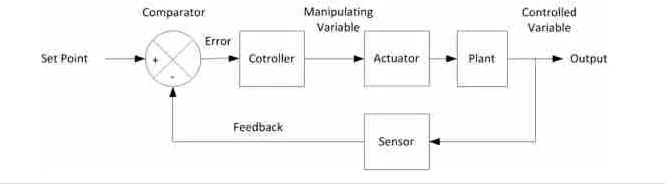
Control is the use of algorithms and feedback in engineering systems (Mur-ray & Amstrom, 2008), the objective is to make the process run as desired. The feedback control system (Figure 1) consists of: input, output, comparator, controller element, actuators, plant, as well as feedback elements. Input or set point is a variable to reach in, while output is the result variable aimed by the controlling system (Dunn, 2005). Control process starts with measuring the output using the sensor to get feedback signal. Then, the feedback signal is compared with the input to get the error signal using a comparator. Furthermore, the error signal is processed by the controller to set the manipulating variable. The actuator will manipulate the process to reduce errors. This process runs continuously to minimize the error. This process becomes a cycle of feedback control which runs continuously to minimize errors and get the stability in a quick and proper way. If the controlled variable is close to set point value for
70
Peer Reviewed Papers -Vol. 9, n. 3, September 2013
|
Fig. 1 - The Model of Feedback Controlling System (Dunn, 2005)
5 Formulation of The Model
The mastery is highly possible when students are continuously active to learn under the teachers’ supervision (Kazu et al., 2005). Regarding to mastery learning practice, Clark and Mayer (2008) suggested to: (a) plan and carry out
the instructions well; (b) give suficient time to students; (c) regularly monitor.
If a learning problem appears, immediately a teacher should provide actions for learning improvement. This method is similar to the principles of a feedback controlling system. This model adapts the principles of feedback controlling system to help learners achieve their mastery learning. The model can be de-scribed as follows: input is the learning objective; the process is the learning activity; and output is the students’ learning achievements. The adaptation of the control system requires a humanity factor since this model will be applied to humans who have different characteristics of tools or machines. To develop the
model, the e-learning deinition proposed by Clark and Mayer (2008) is chosen
because it contains engineering and education elements.
Dwijoko Purbohadi, Lukito Nugroho, Insap Santosa, Amitya Kumara - GaMa Feedback Learning Model: Basic Concept and Design
71
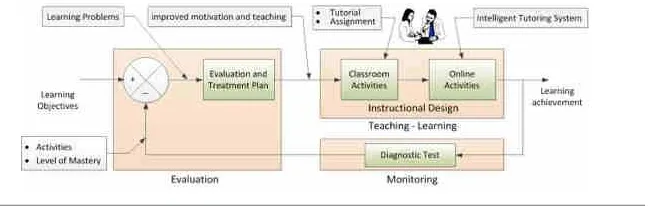
this model was written by Guskey (2005) which explains that to help the stu-dents achieve their mastery level; their activities should be monitored by using assessments and also be controlled, but it did not provide further explanations about the controlling process in an e-learning. Figure 2 shows the basic design of GFLM as adapting of feedback control system.
Fig. 2 - The Basic Design of GFLM
GFLM model also considers the mastery learning principles where students
are given freedom to learn, monitored, helped to ind their problems in the lear -ning process, and provided with proper treatments for solutions. GFLM provide solutions for the learning success regarding the mastery..
TABLE 1
Feedback Control and GFLM Comparison
Parameter Feedback Control GFLM
Input Set point Learning objective(s) Output Controlled Variable Learning achievements Feedback Measured Variable Activities and score Feed forward Manipulating Variable Learning treatment Comparator output Error Learning problems Feedback element Using sensor Using assessment tools Object Process Classroom and online activities
Error inder Using comparator Using evaluation process Goal Stability Mastery
Table 1 shows the comparison between the feedback control system and its adaptation in the GFLM. Motivation can serve as the driving force for GFLM since it creates enthusiasm in doing activities. The students’ willingness to con-tinuously use the facility is the key factor. The motivation can be from internal or external sources. William and William (2011) described learning interest and
motivation through ive components: student, teacher, content, method/process,
72
Peer Reviewed Papers -Vol. 9, n. 3, September 2013
|
to draw learners’ attention. To improve self-conidence, a positive comment to
encourage learners also can be used as one of the strategies.
6 Discussion
GFLM is divided into three levels: (a) tools level consists of LMS and ITS. LMS types can be used in a wide range; the most important is the LMS must be able to present the data for assessment. ITS can use a variety of technologies and approaches; the important thing is how the ITS module can be integrated with the LMS and can be used effectively and independently by students, (b) teaching and learning level, can use a hybrid model with a variety of learning methods, as long as the teacher is still possible to treat the learning process either on a group or individual. The control characteristics on GFLM are at (c) the ma-nagement level which refers to the interactive four-step mama-nagement P-D-C-A. In this model, “Plan” means the design of instructional planning and teaching material, “Do” means implementing an appropriate learning, “Check” includes assessment, evaluation, and improvement plans, and the “Action” means con-ducting discussion and giving motivation, assignments, or additional tutorial.
Two major issues related to ITSs development are “what to teach” and “how to teach” (Santhi et al., 2013). The typical ITS architecture consists of the knowledge-based model, student model, teaching model, and expert model. The main part is teaching model because it deals with the uncertainty of reasoning. It is associated with the decision-making process, that is to determine the most appropriate learning material to be given and the best kind of teaching method
for students. There are many approaches in Artiicial Intelligence that have
been proposed for uncertainty reasoning, including: rule-based systems, Markov decision processing, fuzzy logic, Bayesian networks, Kohonen map networks, and neural networks. GFLM can be developed by using ITS which uses many approaches as long as it is an effective learning manner to the student. The web is at today’s learning environment which makes it possible to construct an ITS that support the student to learn through free discovery (hypermedia), instructed system, or combination of both (Saleh & Papy, 2001). GFLM can be developed by any technology as long as it meets the instructional needs.
Dwijoko Purbohadi, Lukito Nugroho, Insap Santosa, Amitya Kumara - GaMa Feedback Learning Model: Basic Concept and Design
73 Fig. 3 - The Implementation Design of GFLM
6.1 Learning Objectives and Learning achievement
Learning objectives showed the learner’s already-acquired competency that can be measured using a diagnostic test. When the measured area is only within the cognitive domain, the basic assumption is that the number of the correct answers should indicate the level of the learning achievement (Whiteley, 2008). The learners are considered to have achieved the mastery of learning, if they can answer minimal 70% of the diagnostic test (Leonard, 2008).
6.2 Learning problems
A learning problem is any dificulty experienced by a learner to achieve an
intended mastery. Two groups of students undergo this problem. First, they are
students who nearly achieved mastery but encountered dificulties in a particular
topic, and the second group, it is comprised of students who have not achieved mastery because they do not master the basic concepts.
6.3 Evaluation and Improvement Plan
Improvement plan is carried out after inding out the learning problems and
its evaluation. One of the learning improvements is giving motivation to the student and it is highly important in GFLM. If students are motivated, they are willing to participate in activities such as instructional design. Other learning improvement is conducting a discussion or repeating the tutorial.
6.4 Classroom-based teaching
GFLM is not to replace face-to-face learning model, but to combine classro-om activities with online activities (hybrid models). The classroclassro-om-based mee-ting model has been there forever for any level of schooling, from the
elemen-tary to the university level. Consequently, indeed it is dificult to thoroughly
74
Peer Reviewed Papers -Vol. 9, n. 3, September 2013
|
e-learning (Moodie & Kunz, 2005).
6.5 Out-of-classroom learning (online activity)
Intelligent Tutoring System (ITS) can help increase the time allotment of student’s self-learning. LMS and ITS can work together to serve the students so that they can learn outside of class through an online environment.
6.6 Instructional Design
The instructional design is created in such a way to ensure that the learning process complies with the e-learning model (Clark & Mayer, 2008). The core concept of GFLM is to provide a closed-cyclical process (Picture 3) and an instructional design should help students get a chance to gradually achieve a learning objective and also to provide a reliable monitoring system.
7 Implementation
The experiment was conducted at a nursing department of health science. GFLM applied in the English course which instructional objectives are mastery of grammar. The course consists of 15 themes. Each theme consists of 1 hour of watching the video tutorial and using ITS, 2 hours of practicing and collabo-rating in the classroom, and 2 hours of explanation by the lecturer. This model
is similar to lipping classroom in which the typical lecture and homework
elements of a course are reversed (Johnson & Renner, 2012).
The total number of participants is 109. The results are very signiicant, the
students in the experimental group who achieved mastery are 100%, and it is greater than Bloom’s criteria (95%). Students in the control group who achieved
mastery are 40%. The experimental group had a signiicant increase in achie -vement compared to the control group. The pre-test between those two groups
was homogeneous because grammatical knowledge showed no signiicant dif
-ferences, while the post-test after using the model shows signiicant difference. The experimental group had a signiicant increase in achievement compared to
the control group. The effect size of GFLM in this experiment is 2.3.
8 Conclusion
Dwijoko Purbohadi, Lukito Nugroho, Insap Santosa, Amitya Kumara - GaMa Feedback Learning Model: Basic Concept and Design
75
process and its improvement. GFLM process control consists of the measure-ment of learning achievemeasure-ments through giving assessmeasure-ment to get scores and
activity, comparing the learning objectives with learning achievements, in -ding learning problems, evaluating the learning problem to select improvement strategies, and providing motivation and improvement actions. The principles of control mechanism with GFLM can be operated if it is already equipped with LMS, ITS, and an appropriate instructional designs. By using GFLM, the teachers act as a learning partner to help more students achieve mastery in all objectives. It means that, mastery can be achieved because each student has a
lexible learning time, followed the continuous learning process, accompanied
by a teacher, and is always being motivated.
REFERENCES
Barrett, H. C. (2005), Researching Electronic Port Folio: Learning, Engagement and Collaboration through Technology, REFLECT Initiative.
Berman, P. (2007), E-learning Concepts and Techniques, Institute for Interactive Technologies, Bloomsburg University of Pennsylvania, USA.
Clark, R. C., Mayer R. E. (2008), e-Learning Science of and the Instruction: Proven Guidelines for Consumers and Designers of Multimedia Learning, Pfeiffer, San Francisco, USA, Third Edition, 8-11.
Davis, B., Carmean, C., Wagner E. D. (2009), The Evolution of the LMS: From Management to Learning: Deep Analysis of Trends Shaping the Future of e-Learning, eLearning Guild. http://www.eLearningGuild.com. (accessed on 9th May 2013).
Dunn, W. C. (2005), Fundamentals of Industrial Instrumentation and Process Control, The McGraw-Hill Companies, Inc., 1-12.
Guskey, T. R. (2005), Formative Classroom Assessment: Theory, Research, and Implications, College of Education, University of Kentucky, Lexington, USA. Godwin, J., hepherd, E. (2010), Assessment Through The Learning Process,
Questionmark Corporation. http://www.questionmark.com (accessed on 24th April
2013).
Huffaker, D. (2003), The e-Learning Design Challenge Technology: models and design principles, Georgetown University, USA.
Johnson, L. W., Renner J. D. (2012), Effect of the flipped classroom model on a secondary computer application course student and teacher perceptions, questions, and student achievement, Department of Leadership, Foundations & Human Resource Education University of Louisville, Kentucky.
76
Peer Reviewed Papers -Vol. 9, n. 3, September 2013
|
Technologies” Course. Educational Technology & Society, 8 (4). 233-243. Kinshuk, Huang H. W., Sampson D., Chen N. S. (2013), Trends in Educational
Technology through the Lens of the Highly Cited Articles Published in the Journal of Educational Technology and Society. Educational Technology & Society, 16 (2). 3–20.
Leonard W. J., HollotC. V., Gerace W. J. (2008), Mastering Circuit Analysis: An innovative approach to a foundational sequence. 38th ASEE/IEEE Frontiers in Education Conference October 2008, Saratoga Springs New York, USA. 22 – 25. Liu C. L., Yang H. L. (2008), A Process-Oriented E-learning System: From Mastery
Learning Perspective, Cheng Chi University, Taiwan.
Moodie P, Kunz P (2005), Recipe for an Intelligent Learning Management System (iLMS), Waikato Innovation Centre for eEducation (WICED), The University of Waikato, Hamilton, New Zealand.
Murray R. M., Amstrom K. J. (2008), Feedback System: An Introduction for Scientists and Engineers, Princeton University Press, New Jersey, USA, 1-23.
Mathews, M., Mitrovic, A. (2007), The Effect of Problem Templates on Learning in Intelligent Tutoring Systems, Intelligent Computer Tutoring Group, University of Canterbury, Christchurch, New Zealand.
Özden M. (2008), Improving Science and Technology Education Achievement Using Mastery Learning Model, Mustafa World Applied Sciences Journal 5 (1), 62-67. Richter K., Konert J., Bruder R., Göbel S., Steinmetz R. (2012), Supervising Knowledge
Sharing in the classroom: Supporting Teachers’ Individual Diagnosis and Instruction in a Peer Education Scenario, 12th IEEE International Conference on Advanced Learning Technologies (ICALT), IEEE Computer Society Publications, Rome, Italy, 12 (1).
Saleh, I., Papy, F. (2001), A support architecture proposal to hypermedia intelligent tutoring systems development in the internet, 12th European Association for Education in Electrical and Information Engineering (EAEEIE) Conference proceedings.
Santhi, R., Priya, B., Nandhini, J. M. (2013), Review of intelligent tutoring systems using Bayesian approach, Cornell University, New York, USA.
Šimić, G., Gašević, D., Devedžić, V. (2004), Semantic Web and Intelligent Learning Management Systems, FON – School of Business Administration, University of Belgrade, Serbia and Montenegro.
Vui, T. (2008), Enhancing Classroom Communication to Develop Student Mathematical Thinking, Center for Research on International Cooperation in Educational Development (CRICED), University of Tsukuba, Japan.
Visentin S., Ermondi G., Vallaro M., Scalet G., Caron G. (2013), Blended-learning for courses in Pharmaceutical Analysis, Journal of e-Learning and Knowledge Society, 9 (1), 93-102.
Whiteley, W. (2008), Artiicially Intelligent Adaptive Tutoring System, Stanford School
of Engineering, Stanford, California, USA.
Dwijoko Purbohadi, Lukito Nugroho, Insap Santosa, Amitya Kumara - GaMa Feedback Learning Model: Basic Concept and Design
77
motivation, Research in Higher Education Journal, Vol. 12, St. Mary’s University of Minnesota, USA, 1-23.