General concept of wound healing, revisited
Theddeus O.H. Prasetyono
Division of Plastic Surgery, Department of Surgery, Faculty of Medicine University of Indonesia/ Cipto Mangunkusumo Hospital, Jakarta, Indonesia
Abstract
Wound healing is a transition of processes which is also recognized as one of the most complex processes in human physiology. Complex series of reactions and interactions among cells and mediators take place in the healing process of wound involving cellular and molecular events. The inlammatory phase is naturally intended to remove devitalized tissue and prevent invasive infection. The proliferative phase is characterized by the formation of granulation tissue within the wound bed, composed of new capillary network, ibroblast, and macrophages in a loose arrangement of supporting structure. This second phase lasts from day 8 to 21 after the injury is also the phase for epithelialisation. The natural period of proliferative phase is a relection for us in treating wound to reach the goal which ultimately deines as closed wound. The inal maturation phase is also characterized by the balancing between deposition of collagen and its degradation. There are at least three prerequisites which are ideal local conditions for the nature of wound to go on a normal process of healing i.e. 1) all tissue involved in the wound and surrounding should be vital, 2) no foreign bodies in the wound, and 3) free from excessive contamination/infection. The author formulated a step ladder of thinking in regards of healing intentions covering all acute and chronic wounds. Regarding the “hierarchy” of healing intention, the irst and ideal choice to heal wounds is by primary intention followed by tertiary intention and lastly the secondary intention. (Med J Indones 2009; 18: 208-16)
Abstrak
Penyembuhan luka merupakan sebuah proses transisi yang merupakan salah satu proses paling kompleks dalam
isiologi manusia yang melibatkan serangkaian reaksi dan interaksi kompleks antara sel dan mediator. Fase peradangan bertujuan untuk membuang jaringan mati dan mencegah infeksi. Fase proliferasi bercirikan terbentuknya jaringan granulasi yang disertai kekayaan jaringan pembuluh darah baru, ibroblast, dan makrofag dalam jaringan penyangga yang longgar. Fase kedua yang berlangsung sejak hari ke-8 hingga ke-21 pascaluka merupakan fase terjadinya epitelisasi dan sekaligus memberikan releksi dalam perawatan luka untuk dapat mencapai kondisi luka yang telah tertutup dengan epitel. Fase terakhir adalah fase maturasi yang bercirikan keseimbangan antara proses pembentukan dan degradasi kolagen. Setidaknya terdapat 3 prasyarat kondisi lokal agar proses penyembuhan luka dapat berlangsung dengan normal, yaitu: 1) semua jaringan di area luka dan sekitarnya harus vital, 2) tidak terdapat benda asing, 3) tidak disertai kontaminasi eksesif atau infeksi. Penulis mengusulkan formulasi pola hirarkis dalam intensi penyembuhan luka yang mengikuti urutan intensi primer sebagai intensi ideal, diikuti intensi tersier, dan yang Vsekunder. (Med J Indones 2009; 18: 208-16)
Key words: inlammatory mediator, epithelialisation, growth factor, wound healing
A wound is generally recognized as a raw surface on the skin caused by various type of injury or disease. The most universal concept of wound is related to raw surface while we understand that not every wound has lost its surface epithelial coverage as we may see on skin e.g. with bruises due to direct injury. According to such a concept, once the epithelial coverage of skin is destroyed, then a wound is formed because of some area of skin losses its outer epithelial layers regardless the cause.
How long would be the best time to have wound epi-thelialised? The question can be transformed to a more
A subsequent question may arise: how long would be the best time to get a wound healed? A healed wound is actually in the end stage of healing. It is to be considered whenever we are treating any wound as plastic surgeon will always look in the future whenever they are manag-ing defects. In other words, we need to foresee the future end result of the scar as a result of the current treatment we are giving. Anatomical location and region has a role in the length of healing time which naturally needs much longer than a raw surface needs (time) to get epithelial cover. This article will provide the reader with a practical overview of wound healing that spread from the initial injury to the end stage of scar.
SKIN AND PHASES OF WOUND HEALING
Skin and the Role of Its Epithelial Cells
As the widest organ of human body which has no least than 1-2 m2, skin in regards of cutaneous healing acts
as a general representation of tissue healing because it is easily seen on its surface. Skin has multi functions besides its main function as general protector to cover the tissue structure and organ from any potential injury e.g. mechanically against pressure and friction, protec-tor against chemical injury, thermally against heat, cold and radiation injury, and defensive structure against microbes, as well as to reduce water and heat loss. Be-yond its function as protector, skin has unique func -tion in terms of regulator of circula-tion and temperature and sensor for pressure, touch, pain, and temperature. Through its pores and extensive vascular plexuses, skin has a tremendous capacity in regulating the body temperature and circulation. In a low temperature, the pores shrink and vascular plexuses constrict to reduce the heat loss and keep the body in its optimum tem -perature. On the other hand when the body is in an en-vironment with relatively high temperature, the pores open and the vessels dilate to keep the body from heat stroke. Another unique function that the skin bears is its use in sensing stimuli of pressure, touch, pain, and temperature which give comfort and advancement in many aspects of human being’s life.
Histologically skin has two functional layers compring of the dermis and epidermis. The epidermal layer as the outermost layer is exactly the layer that we discussed in the above as the epithelial coverage. Whenever disrup-tion of epidermal layers goes deeper than the keratin layer exposing the lucidum, granulosum, spinosum, and basal layers, it produces wound. This supericial
wound heals fast involving their owned epithelial pro-genitor cells rich layers. The epithelial cells from those layers migrate and proliferate, healing the wound in 2-3 days, leaving relatively inconspicuous scar. The more supericial the disruption, the more perfect the scar re-sulted. Among those epidermal layers, the basal layer is the main healing source of epithelial cells especially in terms of cell replication. In clinical practice, this kind of supericial wound would heal secondarily without spe-cial treatment. The nature heals the wound nicely. Practi-tioner may apply vaseline or parafin only if needed. A disruption that goes deeper reaching the dermis will need more effort, energy, and longer time of healing. In this deeper healing, the basal layer still plays very important role because of its capacity to migrate cov-ering the raw surface from periphery. If the wound is small, less than 1 cm in diameter, then the wound will be completely covered by epithelial layer in approxi-mately a week to become a “closed” wound. In the case of much wider area of supericial wound involving su-pericial dermis, the wound may be covered by epithe-lial layer in the same time or a slightly longer. Anyhow, the process in terms of epithelial cells role is different. Cells from the deeper dermis play important role in the epithelialization. The sources of epithelial cells are the skin appendages i.e. hair follicles, sweat glands, and sebaceous glands. Furthermore, they take over the role of basal layer because the cells from this layer migrate slowly and shortly only.
Phases of Wound Healing
Understanding wound healing involves much more ef-fort than simply stating there are three phases: inlam-mation, proliferation, and maturation. New mediators are discovered each year and our understanding of in-lammatory mediators and cellular interactions grows.1
Inlammatory mediators involved in wound healing comprise 1) eicosanoids (prostaglandins, prostacy-clins, thromboxanes, leukotriens, lipoxins), 2) cytokins (chemokines, lymphokines, monokines, interleukins, colony-stimulating factors, interferons, tumor necrosis factor), 3) nitric oxide, and 4) growth factors.2 Briely,
wound healing is a transition of processes which is also recognized as one of the most complex processes in human physiology. Complex series of reactions and interactions among cells and mediators take place in the healing process of wound,3,4 which needs more attention
heal-ing which are distinct but overlappheal-ing is still important to understand and universally considered because it may provide us a guidance of physiology of wound healing and a frame of time to refer.
Inlammation phase
The irst phase of wound healing starts from immedi-ately upon injury and may last until four to six days.1
In other literature, the phases of healing are classiied into four phases by differentiating the hemostasis as the irst phase,4 meanwhile generally it is known as part of
the inlammatory phase. This initial phase is naturally intended to remove devitalized tissue and prevent inva-sive infection5 and characterized by an increase in
vas-cular permeability by thrombin following hemostasis, secretion of chemotactic cytokines that facilitate the migration of cells.6 Wounding disrupt tissue vascular
supply and the body initiates a cascade of events that allows itself to heal.6 Collagen exposed during wound
formation activates the clotting cascade, both the in-trinsic and exin-trinsic pathways,1 that culminates in the
formation of a ibrin clot and hemostasis5 initiating the
inlammatory phase.1,6 The ibrin clot serves as
scaf-folding for arriving cells, such as neutrophils, mono-cytes, ibroblasts, and endothelial cells.1 Polymorpho
-nuclear leucocytes and macrophages are the dominant cell types during this initial stage.6 The ibrin clots/
provisional matrix also serves to concentrate the cytok-ines and growth factors1 that are released by platelet,
thrombin, and ibronectin. Removal of provisional i-brin matrix will impair wound healing.5
Neutrophils are the irst responders to the cellular distress signal and the chemotactic signal (by the cy-tokines) arriving into the ibrin clot.1 Furthermore the
nearby blood vessels vasodilate and more neutrophils are drawn into the injured area by interleukin (IL)-1, tumor necrosis factor (TNF)-α, platelet factor (PF)-4, transforming growth factor (TGF)-β, platelet derived growth factor (PDGF)1,4 and “bacterial products.”1
These PMN leucocytes begin clearing the invading bacteria and cellular debris.1 Monocytes will be
attract-ed to the injurattract-ed area and transform into macrophage in around 48 to 72-96 hours after injury.1,5 Macrophages
phagocytose debris and bacteria , but are critical for the orchestrated productions of growth factors necessary for production of the extracellular matrix by ibroblasts and the production of the new blood vessels.5 This is
in accordance with un understanding that an activated macrophage is also important for the transition into the proliferative phase because it will mediate
angio-genesis, ibroplasias, and synthesize nitric oxide.1 In
summary, the healing process begins with hemostasis, platelet deposition, and interactions of soluble media -tors and growth fac-tors with the extracellular matrix.4
Proliferation phase
Proliverative phase is characterized by the formation of granulation tissue within the wound bed, composed of new capillary network, ibroblast, and macrophages in a loose arrangement of supporting structure.6 Besides
formation of granulation tissue with its collagen and connective tissue proteins deposition and angiogenesis, epithelialization is also the principal step1,7 in this build
-ing part of wound heal-ing. This second phase will start on day 45-7 concurrent with the waning of the inlamma-tory phase and go on until 146-215 days after the injury.
Angiogenesis is marked by endothelial cell migra -tion and capillary forma-tion.1 It is a natural response
of healing to replace the injured microcirculation and involves the movement of endothelial cells in response to the three waves of growth factors i.e. PDGF, TGF-β, insulin-like growth factor during the inlammatory phase; ibroblast growth factor (FGF) released from normal binding sites on connective tissue molecules as the second wave; and vascular endothelial growth fac-tor (VEGF) delivered by macrophages as the third and dominant wave.7 Angiogenesis progresses proportional
to blood perfusion and arterial partial pressure of oxy -gen.7 New blood vessel grow into the collagen matrix
formed by ibroblast.
PDGF and epidermal growth factor (EGF) which are derived from platelets and macrophages are the main signals to ibroblasts.1,5 Fibroblasts migrate into the
wound site from the surrounding tissue, begin to syn-thesize collagen and proliferate. In response to PDGF, ibroblast synthesize provisional matrix composed of collagen type-III, glycosaminoglycans, and ibronec-tin1 that provides a platform for keratinocytes migra-tion.5 Another type of ibroblasts is “wound ibroblasts”
which already located in the wound site. This type of i-broblasts will transform into myoii-broblasts which plays role for wound contraction.1 Myoibroblast is no other
than ibroblast with intracellular actin microilaments capable of force generation and matrix contraction.5
Myoibroblast contract the wound through speciic in-tegrin interactions with the collagen matrix.5 Clinically,
from all negative impacts of wounding. Wounds that heal by itself without special care show this powerful action of wound contraction.
Actually epithelialization start to occur immediately after wounding and stimulated by the inlammatory cy-tokins.1 IL-1 and TGF-α upregulate keratinocyte growth factor (KGF) gene expression in ibroblast. Fibroblast will then synthesize and secrete KGF-1, KGF-2 (most important in human being), and IL-6 which stimulate neighboring keratinocytes to migrate in wound area, proliferate and differentiate in the epidermis.1 Lastly,
epithelialization is characterized by replication and mi-gration of epithelial cells across the skin edges.
Maturation/ remodeling phase
The inal but longest phase of wound healing is the maturation process, which involves ongoing remod-eling of granulation tissue beneath the newly formed epithelial layer and increasing wound tensile strength.7
This phase is recognized to start in overlapping with the proliferative phase from 81 to 215 days after the in
-jury until one year afterwards. The main characteristics of this important phase is the deposition of collagen in a well-mannered nerwork1 which imply to collagen
remodeling and scar contraction.5 The movement of
ibroblasts pulls collagen ibers together, promoting contraction of the scar tissue.7
Type III collagen that is produced and deposited by i-broblast during the proliferative phase will be replaced by type I collagen over the next few months through a slow process of type III collagen degradation.5 The
degradation is mediated through matrix metallopro -teinases (MMP) secreted by macrophages, ibroblasts, and endothelial cells.5 The tensile strength (a strength
to resist breaking) of a healing scar improves slowly, relecting the turnover of the collagen subtypes and in-crease collagen crosslinking. At 3 weeks, the beginning of maturation phase, wounds only have approximately 20%5 to 30%1 of the strength of normal skin, and will
eventually only posses 70%4 to 80%1 of the normal
strength at the end of the remodeling phase.
This inal phase is also characterized by the balancing between deposition of collagen and its degradation. When collagen deposition or synthesis is impaired, then it will compromise the scar tissue tensile strength.
An atrophic scar might be the end result after the com -pletion of the maturation phase. On the contrary, when the collagen degradation is impaired or its synthesis is excessive, the scar tissue may become hyperthrophic scar or even keloid. The ideal condition would be the balance between degradation and synthesis or deposi-tion of collagen to produce a normal scar tissue.
IDEAL CONDITIONS TO HEALING WOUND
There are at least three pre-requisites which are ideal conditions for the nature of wound to go on a normal process of healing. Eventually these pre-requisites are not the only factors to allow wounds to heal normally as there are other factors that affect physiologic re -sponse and cellular function in the vulnerable healing wounds. Those pre-requisites are 1) all tissue involves in the wound and surrounding should be vital, 2) no foreign bodies in the wound, and 3) free from excessive contamination/ infection.
All tissue involved is viable
It is a general rule that necrotic tissue should be re-moved in order not to inhibit wound healing1,8 because
the energy to heal the wound will be exhaustedly drifted into the effort of autolysis the necrotic tissue by the body itself. Consequently the wound will be more vulnerable to more interruption e.g. by infection, and local and systemic metabolic disorders. A clinical situation such as traumatic crush or degloving injury on lower extremity might be an example of discuss-ing this irst pre-requisite. (Figure 1) Durdiscuss-ing a thor-ough debridement in the emergency setting, we may ind dificulties in assessing the viability of all injured tissue. This might be easier if the team is capable to do extensive debridement under the principals of “no touch technique” like dealing with cancer surgery with a strong team of microsurgery where a huge defect can be closed easily with free lap transfer.9 Beyond that
Tissue ischemia is the main enemy we are facing in such a case which give complexity in assessing the viability of the tissue involved in the wound and its surrounding tissue. Physiologic response of the vascular endothelium to localized hypoxia or ischemia is to precipitate vaso-dilation, stimulate ibrin deposition, and increase pro-inlammatory activity, capillary leak, and neovasculari-sation.1 Vasodilation, capillary leak due to disturbance of
its permeability, together with the activity of pro-inlam-matory mediators causing edema. Edema and increased locally pressure associated with ischemic injured tissue will further compromise perfusion.1 Effective cell
mi-gration and molecular exchange will be disturbed. The endothelial cell response to sustain hypoxia will result in endothelial cell apoptosis.1 It means that more
microvasculatures will stop from their function sup-plying nutrients and oxygen. Unsustainable anaerobic condition will position the wound away from the ATP as the energy currency needed by energy-dependant healing. The condition will be even more deteriorated in the case of ischemia and necrosis.
Most of oxygen consumed in a wound is used for oxy-dant production (for bacterial killing), with a signiicant contribution as well for collagen synthesis, angiogen-esis, and epithelialization.7 Nutrients and oxygen
sup-plied by the capillaries are essential in the formation of granulation tissue,1 leading to the need to ensure the ad -equate oxygen delivery to the wound.10 Not only
nutri-ents and oxygen, but the migration of cells and enzymes are also lacking in the wound. Failure of such supply to occur will result in chronically unhealed wound. Be-sides growth factors, lactate and hypoxia induce col-lagen mRNA synthesis and procolcol-lagen production. Hydroxylases is required to allow collagen peptides to aggregate into triple helical structure because collagen can only be exported from the cells in this structure.7
The activity of hydroxilases is critically dependent on vitamin C and tissue oxygen tension. Wound strength, which results from collagen deposition, is, therefore, highly vulnerable to wound hypoxia.7 One other thing to be considered is that epithelialization depends on local oxygen in vivo.7
No foreign bodies
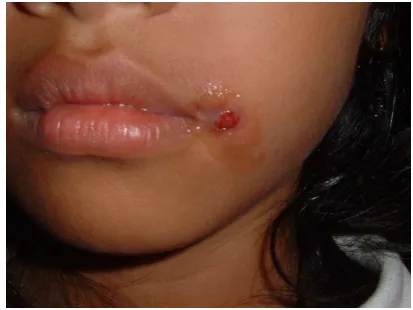
Wound with foreign bodies cannot contract, repopu-late the area with capillaries, or completely epitheli-alize (depending on the size and location of the for-eign bodies).1 The author has an experience on a 12
year-old female patient who came with small ulcer just next the left commissural. (Figure 2) She had been suf-fering from that recalcitrant granuloma for a year and been shopping for doctors and clinics but never healed. Exudation and pustulation had been waving on the pre-sentation of the chronic granulating tissue that never healed. Simple excision of the ulcer revealed two piec-es of bamboo in the chronic wound, and simple sutur-ing healed the wound uneventfully. Other example that quite common encountered by plastic surgeons is the infected implant in situ. The only treatment that is ef-fective to heal the wound is to remove the implant with subsequent repair of the resulting defect.
Figure. 1. A patient with history of crush injury has undergone initial debridement in the emergency setting. Some dificulties including the assessment on tissue viability were encountered by the medical team. On the next day after initial debridement, it revealed that more necrotic tissue appeared on the surrounding skin and underlying muscular tissue
Free from excessive contamination/ infection Although bacterial colonization can be found in any wounds, especially chronic wounds, usually normal heal-ing can occur. An infected wound has different history; it does not progress through the stages of wound healing6 be
-cause the energy to heal the wound is exhaustedly used to ight bacterial burden. Wound will suffer from metabolic load imposed by bacteria (bacterial bioburden). It remains in the inlammatory phase1,6 and interfere with the
epi-thelialization, contraction, and collagen deposition.1 The
endotoxins that are released when the bacteria is killed, will stimulate phagocytosis and the release of collagenase, which contribute to collagen degradation and destruction of surrounding, previously normal tissue.1
In a more clinical comprehensive wound management factors that should be considered are the systemic factors, not only those three pre-requisites which refer mostly the local factors. Local factors may include also radiation and neoplasm, while systemic factors that are also detri-mental to wound healing are diabetes, hypothyroidism, smoking, nutrition, aging, medications (chemotherapy), exogenous steroid administration,1,6 major trauma, sep -sis, speciic organ failure, and radiation.1
ACUTE AND CHRONIC WOUND
An acute wound is simply recognized as a wound that has occurred within the past 3 weeks or in some lit-erature it may be to 4 weeks.5 Wounds that persist
un-til more than 3 to 4 weeks are considered as chronic wounds. The same term is used for any wounds that last longer, months to years, as it happens on diabetic foot ulcers and gangrene, pressure sores, ulcers due to chronic vein insuficiency or occlusive arterial diseas-es, radiation injury. Non healing wounds and delayed healing wounds are the terms interchangeably used to describe no other than chronic wounds.5 Inadequately
healing wound seems to refer to supposedly normal healing wound but external and technical factors nega-tively impact the process as we can see on wound de-hiscence. Use of the term dificult to treat wounds11
may comprise both the acute and chronic wounds. The last mentioned here is not referring the period of time that has elapsed for wound to heal, rather the future and natures of wounds that potentially need sophisticated surgical technique to cover the wound, acute wounds accompanied with non supportive local and systemic factors to heal, or chronic wounds that has been proven to be dificult to treat.
In the old paradigm of understanding wound healing, an acute wound is seen easily to heal which is right,
but looking at the many factors involved in the healing then we consider an acute wound should be treated in-tensively as chronic wounds from the onset, if systemic and local factors are expected to impact the healing.10
Chronic wounds are often referred to as a “granulat-ing” pointing to the appearance in the wound cavity or surface of granulation tissue which appear to be red and fragile (easily to bleed).5 Such an appearance of
granu-lation tissue is a sign that suggest that the wound is progressing, albeit slowly.5
CHARATERISTIC OF CHRONIC WOUNDS Pathological response to injury will end up with chronic wounds where the normal healing process is disrupted. Independent assessment on every wound may reveal the factors, systemically and locally, for which they play role in disturbing the healing process. Of those factors, wound infection is implicated most commonly as a cause for poor wound healing12 and may complicate
the inheritance of wound which has already had predis-posing factors to develop chronic wound such as in dia-betic foot, pressure sore, venous and arterial ulcers. Eventually, once a wound is created there is a 100% probability of it being contaminated13 within 48 hours.14 Based on bacterial presence, wound can be classiied into four levels i.e. 1) contaminated wounds which have non-proliferating bacteria, 2) colonized wounds within which proliferating bacteria present, 3) critically colonized wounds where the proliferating bacteria have reached a level that interferes with healing, but without classic signs of infection, 4) infected wounds which have multiplying bacteria in the presence of host reaction.14
Chronic wounds is always contaminated and even inher-it bacterial colonization which may become infection on a later stage if not well managed.
Most patients with normal immune systems can heal wounds contaminated with up to 105 organisms per
gram of tissue1,12 Other literature showed the amount of bacteria to cause infection is greater than 104 per gram
of tissue13 or with a density of more than 105
colony-forming bacterial units per cubic millimeter of tissue.14
Wounds will not heal by any means, including primary suture, skin graft placement, or lap closure, if bacte-rial count exceeds the above mentioned critical amount or if any β-hemolytic Streptococcus is present.1 The
healing in decubitus ulcers is inhibited if the bacterial load is greater than 106 CFU (colony forming units)/
ml of wound luid.13 Characteristics of infected wounds
of exudate both in terms of quantity and quality. The amount of exudate may be greater when previously colonization becomes infection. Excessive amount of exudate will be more prominent as a sign of infection as well as its quality which is previously serous, that change into e.g. pustulation or serohemorhagic luid. Other signs of local inlammation will accordingly be the signs of infection.
Repeated injury and ischemia due to any insults includ-ing infection will stimulate pro-inlammatory cytokins to inhibit the wound healing.13 TNF-α and IL-1 will
increase their activity causing subsequent increasing level of proteases including MMPs (matrix metallopro-teninases) and elastase and decreasing level of TIMPs (tissue inhibitor of matrix metalloproteinases).13 Chron
-ic wounds have a cycle of cellular activity that does not support healing, proteolytic activity can be inappropri-ate, levels of MMPs and serine proteases increase while TIMP decrease, lactate level falls down, albumin, total proteins and glucose levels in the wound rise. All those conditions will result in the decrease level and activities of growth factors/ receptors, connective tissue deposi-tion, cell migradeposi-tion, and ECM (extracellular matrix) degradation.13 Of those deterioration can be relected
in the study of chronic wound exudate. Thus, exudate which is a “healing balsam” in the acute wounds, is not a healing agent in terms of chronic wounds. Exudate in the chronic wounds should be well treated in order not to further stop the wound from healing.
THE STEP LADDER OF THINKING FOR WOUND CLOSURE
The goal of wound management should be a closed healing wound with functional and aesthetically sat-isfactory scar. The achievement can be elaborated to become good or excellent scar when we deal with acute wound in normal healing. The nomenclature of both scientiic and clinical wound healing research is impre-cise and confusing.5 To reduce the complexity of dif
-ferent various terms in wound healing, the author will provide a simple discussion on this matter.
As mentioned above, a new laceration will be best treated by cleansing and suturing it which also means to end up as a “closed” wound. Wound closure at the initial presentation is classiied as healing by primary intention as it is usually elaborated by surgeon deal -ing with incisional wounds.5 Primary healing without
complications would be always the main healing inten-tion for every wound made purposively. A big wound
resulting from tumor removal that cannot be closed by primary suturing will need skin graft or lap to close it. The irst intention of this type of wound closure follow the same principal as the healing by primary intention as long as it will end up without complications. Gen-erally such wounds do not require special wound care after the success of skin graft or lap.
The above mentioned primary healing is in contrast to wounds that are not reapproximated for any reason and the subsequent defect is “illed in” with granulation tis-sue and then reepithelialised.5 The history of the heal
-ing mode of such wounds without surgical intervention follows the secondary intention which usually results in a delay of “closed” wound. The timing for the heal-ing by secondary intention is apparently limited to 3 weeks in a normal healing process regarding the pro-liferation phase which is included with epithelializa-tion. Often these wounds would not heal by themselves fulilling the process in 3 weeks to become “closed” wounds without dressings and treatments. Special care to unique wounds would be needed unless they will easily become chronic.
Where would be the place for wound to heal by ter-tiary intention? Surgeons frequently deal with wounds needed treatment under this mode of tertiary healing. For example a shearing force injury producing big non non-viable avulsion lap on the cruris would need exci-sion. For some reasons not all the wound area can be closed primarily in the emergency setting. After several days of conservative management through wound bed preparation, then further surgery would be needed to close the wound by any means in the armamentarium of plastic reconstructive surgery, including bioengi-neered skin product. Wounds that undergo some period of secondary healing or becoming chronic wounds be-fore surgical intervention to produce “close” wounds are healed by tertiary intention.
needs weeks, months, or even years to become “close” wounds under the intention to heal them secondarily. No one would prefer to take this possibility which elaborates only conservative wound management involving either “old fashion” or advance interactive dressings. Dressing and all wound bed preparation are the technique to guide and facilitate wounds, especially chronic wounds, to be ready for tertiary intention healing. Secondary intention of healing is in the lowest step ladder of wound man-agement. But eventually, not every chronic wound is suitable to be treated by surgical interventions by any reasons; in this case, we would prefer to heal them by secondary intention.
UNIVERSAL CONCEPT OF MOIST WOUND HEALING
In the old paradigm of wound management, wounds were traditionally managed by the concept of wet to dry dressings which has changed in turn into wet to moist dressing. With the advanced progress of technol-ogy, the old paradigm has shifted to become a new one elaborating the moist wound healing alleviating the need to be wet at the beginning. Gauze as the previously uni-versal surgical dressing has been changed into advance wound dressings tailored to wounds to suit the dynamic process of healing, especially in regards of various levels of exudate and colonization–infection.
Moist dressing has been an advance elaboration of the traditional concept to prevent wounds from bacterial invasion, further mechanical-thermal-chemical trauma, and heat and water loss, while keeping its semiperme-ability. It protects the wounds from dehydration and fur-ther desiccation. A “ilm of moisture,” instead of scab formation, produced by a moist dressing facilitates epithelialization to take place and keeps the vascular plexuses where they have started since the beginning of wound creation. On the contrary where the wound situation is without moisture and scab develops from desiccation, the vascular plexuses in the dermis will be eroded and lost. Further advantage of ideal moist dress-ing is its ability to keep the amount of exudate normal, where water soluble substances such as amino acids, sugar, and electrolytes, are available for new cells for-mation. The transport of mediators will also run nor-mally, and it can provide ideal condition for immune defense response.
The concept of moist wound healing has facilitated chronic wound management, and led to numerous
dressing materials to control surface moisture.15 This
moisture concept has been elaborated in the principals of managing wound to prepare its bed; it is called as TIME which refer to T for the removal of unhealthy and non-viable tissue, I for the control of infection and reduction of bacterial load, M for the maintenance of moisture balance, and E for advancing the wound edge.15 In terms of moisture balance, the wound should
be kept moist but not overly exudative. Furthermore, moist wound healing should be in accordance with the concept of exudate removal in the management of chronic wounds.
REFERENCES
1. Broughton II G, Janis JE, Attinger CE. Wound healing: an overview. Plast Reconstr Surg. 2006; 117 (Suppl): 1eS-32eS. 2. Leahy PJ, Lawrence T. biologic enhancement of wound
healing. Clin Plast Surg. 2007; 34(4): 659-71.
3. Rumalla VK, Borah GL. Cytokines, growth factors, and plastic surgery. Plast Reconstr Surg. 2001; 108(3): 719-33. 4. Chin GA, Diegelmann RF, Schultz GS. Cellular and molec-ular regulation of wound healing. In: Falabella AF, Kirsner RS, editors. Wound healing. Boca Raton: Taylor & Francis Group; 2005.p. 17-38.
5. Gurtner GC. Wound healing: normal and abnormal. In: Thorne CH, Beasley RW, Aston SJ, Barlett SP, Gurtner GC, Spear SL, editors. Grabb and Smith’s plastic surgery. 6th ed. Philadel-phia: Lippincott Williams & Wilkins; 2007.p. 15-22.
6. Myers WT, Leong M, Phillips LG. Optimizing the patient for surgical treatment of the wound. Clin Plast Surg.2007; 34(4): 607-20.
7. Ueno C, Hunt TK, Hopf HW. Using physiology to improve surgical wound outcomes. Plast Reconstr Surg. 2006; 117 (Suppl): 59S-71S.
8. Steed DL. Debridement. Am J Surg. 2004; 187(5): S71-4. 9. Prasetyono TOH, Aniko G. Severe soft tissue damage
accom-panying open fracture of the lower extremity: plastic surgery point of view. Indones J Plast Surg 2003; 2(2): 66-72. 10. Galiano RD, Mustoe T. Wound care. In: Thorne CH,
Bea-sley RW, Aston SJ, Barlett SP, Gurtner GC, Spear SL, edi-tors. Grabb and Smith’s plastic surgery. 6th ed. Philadel-phia: Lippincott Williams & Wilkins; 2007.p. 23-32. 11. Prasetyono TOH. Negative-pressure wound therapy for
dif-icult to treat wounds. J I Bedah Indones (Indones J Surg). 2005; 33(2): 55-61.
12. Knox KR, Datiashvilli RO, Granick MS. Surgical wound bed preparation of chronic and acute wounds. Clin Plast Surg.2007; 34(4): 633-41.
13. Schultz GS. The physiology of wound bed preparation. In: Granick MS, Gamelli RL. Surgical wound healing and man-agement. New York: Informa Health Care; 2007.p. 1-16 14. Morin RJ, Tomaselli NL. Interactive dressings and topical
agents. Clin Plast Surg.2007; 34(4): 643-58.