Antiproliferative Effect of
Eupatorium riparium
Reg. Leaves
Benzene Extract Against C2C12 and MKN45 Cell line In Vitro
Linus Yhani Chrystomo 1,2*, Aditya Krishar Karim 1,2, L. Hartanto Nugroho 1 Subagus Wahyuono 3, Tsutomu Nohno 4
1
Department of Biology, Faculty of Biology UGM Yogyakarta, Indonesia
2
Department of Biology, Faculty of Science and Mathematic, Universitas Cenderawasih, Papua,Indonesia
3
Department of Pharmacy Biology, Faculty of Pharmacy UGM Yogyakarta Indonesia
4
Departement Moleculer and Development Biology, Kawasaki Medical School, Jepang
*Correrponding author. E-mail: chrysyanka@ yahoo.com
Abstract
Eupatorium riparium Reg. belongs to Asteraceae family. Cytotoxic activity of E. riparium leaves has been demonstrated to have an in vitro cytotoxic effect on cancer cell
lines. The aim of this research was to know antiproliferative activity of benzene extract of E.
riparium leaves against C2C12 (adherent mouse myoblast cell line) and MKN45 (gastric cell line). Leaves powder was extracted using benzene. Antiproliferative effect was determined by Cell Proliferation Reagents WST-1 Test for 1h, 2h, and 4h after incubation for 72h. The result
showed that benzene extract of E. riparium leaves possessed remarkable antiproliferative
effect against C2C12 cell line with IC50 values of 119.14µg/ml (1h), 100.74 µg/ml (2h) and
70.65 µg/ml (4h), and MKN45 cell line with IC50 values of 201.74µg/ml (1h), 135.06 µg/ml
(2h) and 124.54µg/ml (4h) respectively. The result indicated that benzene extract of E.
riparium leaves possess potentials antiproliferative against C2C12 and MKN45 cell. Further study is necessary to know the anticancer mechanisme on C2C12 and MKN45 cell line.
Key words: Eupatorium riparium Reg, Antiproliferative, C2C12, MKN45, WST-1
INTRODUCTION
Plants produce a diverse range of bioactive molecules, making them rich sources of different types of medicines. Most of the drugs today are obtained from natural sources or semi synthetic deriva-tives of natural products used in the traditional systems of medicine. Thus it is a logical approach in drug discovery to screen traditional natural products.
A large number of the plants are claimed to possessed the antimalarial, cancer, antimicrobial, antifungal, anti-inflammatory, antibiotic properties in the traditional system and they are also used extensively by the tribal people worldwide (Ananil et al., 2000; Rahmatulla et al.,
2010; Aranda et al., 2011).
The genus Eupatorium belongs to the Eupatorieae, one of the 13 tribes of the Asteraceae and comprises of nearly 1.200 species distribute mainly in tropical region of America, Europe, Africa and Asia (Zhang et al., 2008; Chakraborty et al.,
2011).
In Java, Indonesia, the genus Eupatorium is represented by approxi-mately seven species, one of these species
is Eupatorium riparium Reg. This Plant is
0.5-1.3 cm long. Inflorescences lax, involucral bracts 4-5 mm long, puberulent, corollas white, 3-3.5 mm long. Achenes black, 1.5-2 mm long, puberulent on the angles. This plant grows in humid tropical or subtropical rainforests, favours shaded riverbanks or steep, south-facing hill sides, and other sheltered moist places and a troublesome and invasive weed growing in some tropical countries (Hidayat, 2002; Fakhrudin, 2006).
Plant species of this genus have also been used for many decades in folk medicine as antimalaria, antibacteria, anti-oxidant, antifungi, antiimflamation and anticancer (Habtemariam, and Angela, 2000; Suksamran et al., 2004, Begum et contains methyl chavicol, bornyl acetate, camphene and cis-cadin-4-en-7-ol (Dung
et al., 1998). Chrystomo et al., (2011)
reported that the methylripariochromene-A
from E. riparium was only found in leaf,
and the highest content of methylripario-chromene-A in benzene extract of E.
riparium leaf was in those originated from
Menoreh Mountain in Samigaluh, compared to those originated from Tawangmangu Karanganyar and Merapi Mountain in Kaliurang. Yunita et al.,
(2009) reported that leaf extract of E.
riparium, which contained saponin, tannin,
quinon and steroid and this plant showed cytotoxicity on A. aegypti larvae and significant effect on percentage of pupae's development.
Other studies reported that E.
riparium had alelopathy effect towards
population of weeds Galinsoga ciliata Raf.
and Galinsoga parviflora Cav. The water
extract of E. riparium can inhibit the germination of seeds and the growth of radicule and plumulae of Galinsoga ciliate
Raf. and Galinsoga parviflora Cav. (Kunwar 2003; Rai and Tripathi (2005).
Fakhrudin (2006) isolated methyl-ripariochromene-A from chloroform extract of E. riparium and this compound showed had cytotoxic activity against HeLa and Vero cell line.
In this research, the antiproliferative activity of benzene extract of E. riparium
leaves from Menoreh Mountain in Samigaluh was examined in vitro, against C2C12 and MKN45 cell line.
MATERIALS AND METHODS
Preparation of E. Riparium Benzene Extract
E. riparium Reg. plants were
collected from Menoreh mountains in Samigaluh. The plant was identified by Taxonomy Laboratorium, Gadjah Mada University. The leaves were washed, dried and chopped finely using a blender. Dried materials were exhaustively extracted with benzene maseration. The benzene extract was filtered and concentrated using a rotary evaporator and then evaporated to dry.
Preparation of Cell Line
MKN45 cell line (human gastric cell line) was obtained from Yamamura, Ph.D, Laboratorium Onkologi, Kawasaki Medi-cal School, Jepang. MKN45 cell line was grown on Dulbecco’s Modified Eagle Media (DMEM, Sigma) containing 10% v/v Fetal Bovine Serum (FBS) (Sigma) and 1% v/v kanamicin (Sigma). C2C12 cell
line (adherent mouse myoblast cell line)
was obtained from Laboratory stock of Department Moleculer and Developmental Biology, Kawasaki Medical School, Japan. C2C12 was grown on DMEM (Sigma) medium containing 10% v/v Fetal Bovine Serum (FBS) (Sigma) and 1% v/v kana-micin (Sigma). The cultures were main-tained at 37oC in humidified atmosphere of 5% CO2.
In vitro assay for antiproliferative
activity
differ-rent concentration of benzene extract isolated from E. riparium leaves, in a serial dilution (500, 250, 125, 62.50, 31.25 dan 15.625, 7.8125 µg/ml). Following treat-ment, plates were incubated in CO2
incubator at 37oC for 72h. Medium was removed by aspirator and add medium with 10µl cell proliferation reagent WST-1 for 1h, 2h and 4h and incubated in CO2
incubator at 37oC. The absorbance was read at wavelength of 450 nm using ELISA reader type Varioskan Flash (Thermo scientific). The percentage cellu-lar viability was calculated with appropri-ate control taken into account. The concentration which inhibited 50% of cellular growth (IC50) was determined. The
inhibitory rate of cell proliferation was calculated by the following formula:
RESULTS AND DISCUSSION
In this study, toxicity data are expressed as IC50, a concentration of
extracts that causes 50% cell survival and was obtained by plotting the percentage of survive cell versus concentration of benzene extract samples (Francoeur and Assalian, 1996). The extract that gave a IC50 value of 1000 µg/ml or less was
considered to have chemoprenventif activities (Doyle and Griffiths, 2000).
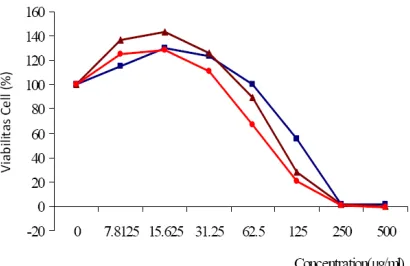
The results showed that the benzene extract of E. riparium possessed antiproli-ferative effect against cell C2C12 and MKN45, respectively. It indicated that benzene extract of E. riparium leaves possessed potential antiproliferative effect against C2C12 and MKN45 cell line. The cytotoxicity result indicated time- and dose-dependent concentration of the extract.
The activities of these extract against C2C12 and MKN45 cell line might be due to the presence of highly complex compounds that are present in E. riparium. Different compound might influence different biochemical processes or stages in different manners.
Several study have reported that Genus Eupatorium contains sesquiterpene lactones, diterpene lactones, flavonoid, terpenoid and sterol. Sesquiterpene lactones and diterpene lactones showed cytotoxic activity on cell lines (Suksamran
et al., 2004; Huo et al., 2004; Shen et al.,
2005; Zhang et al., 2008).
Sesquiterpene lactones and diterpene lactones isolated from E. kiirunense
showed cytotoxic activity on HeLa cell line (Shen et al., 2005) and eupanilia C isolated from E. lidleyanum had cytotoxic activity against p-338 and A-549 cell line (Huo et al., 2004).
Chemical compounds composition of
Chromolaena odorata (synonym; E.
odoratum) extract consists of flavonoids,
saponins, tannins and steroids.
Chromolaena odorata extracts revealed to
have antibacterial activities, ability to inhibit the growth of Bacillus subtilis,
Staphylococcus aureus, as well as to have
antiprotozoa activity. Cytotoxicity assays against parasites indicated that it can reduce the number of parasites
Trichomonas vaginalis and Blastocystis
hominis (Vital and Rivera, 2009).
Chrystomo et al., (2011) reported that the methylripariochromene-A have been isolated from benzene extract of E.
riparium. Fakhrudin (2006) showed that
the methylripariochromene-A isolated from chloroform extract of E. riparium had cytotoxic activity toward Hela and Vero cell line with IC50 of 58.32 µg/ml, and
80.95 µg/ml, respectively. Other studies have reported that methylripariochromene-A had antifungal activity (Sharma et al.,
1998). Methylripariochromene-A isolated from of E. riparium has antifungal activity towards pathogenic fungi Colletotrichum
Studied by Hidayat (2002) reported that hexane extract of E. triplinerve had cytotoxic activity against myeloma cell line with ED50 of 5.85 µg/ml using Brine
Shrimp Lethality Test. Therefore, the
presence of the methylripariochromene-A, sesquiterpene lactones, diterpene lactones, flavonoid, terpenoid and sterol could be assumed to be responsible for the antiproliferative activities of benzene extract of E. riparium in this study.
Figure 1. Correlation survival cell (%) of C2C12 cell line with extract concentration (µg/ml) after incubation for 72h at 37OC with 5% CO2. and after addition WST-1reagent for 1h ( - blue), 2h ( -brown) and 4h ( -red).
Several study have reported many compounds from herbal or compounds from extract to have different cytotoxicity activity on different cell line. Arkadiusz et al., (2001) reported that quercetin and DMSO modulated and changed Bcl-2 gene expression (Apoptosis regulating proteins) during myogenesis on C2C12 cell line.
Shao et al., (2005) reported that Arsenic trioxide (As2O3), a major ingredient of traditional Chinese medicine showed cytotoxic activity in MTT assay and induced apoptosis of human gastric carcinoma cells (MKN45), indicated by the presence of cell shrinkage, membrane blebbing, fragmentation of nuclei, and formation of apoptotic bodies on MKN45 and other study by Yu et al. (2006) showed that antitumor effect of Chinese compound Jinlongshe (JLS) granules on sarcoma 180
and MKN-45 human gastric cancer cell lines in vivo.
In this study, the ability of benzene extract to inhibit proliferation of C2C12 and MKN45 cell line was estimated by analyzing its effect on the growth of the cells. The growth of the untreated (control) and treated cell line after incubation for 72 hours was photographed using a phase contrast microscope (data not shown). In the untreated cells, after 72h of incubation, cells were growing normally as indicated by the presence of formazan dye formed. The higher the extract concentration, the lower the formazan dye. The formation of formazan dye directly correlated to the number of metabolically active cells in the culture (Francouer, and Assalian. 1996). It is indicated that benzene extract of E.
riparium leaves was proved to possess
antiproliferative properties against C2C12 and MKN45 lines tested. Therefore, it may have potential as a chemotheraupetic agent since it has IC50 values less than 1000
µg/ml (Doyle and Griffiths, 2000).
Figure 2. Correlation survival cell (%) of MKN45 cell line with extract concentration (µg/ml) after incubation for 72h at 37oC with 5% CO2. and after addition of WST-1reagent for 1h ( - ), 2h ( -brown) and 4h ( -red).
Further investigation is needed to know about inhibitory mechanism on C2C12 and MKN45 cell line.
CONCLUSION
The benzene extract of E riparium
activity againts C2C12 and MKN45. This plant have potential as anticancer agent.
ACKNOWLEDGMENT Myogenesis from C2C12 Skeletal Muscle Cells with Special Reference to PKB/Akt Activity, Myogenin and 2000, Investigation of Medicinal Plants of Togo for Antiviral and Antimicrobial Activities. Pharmac. Biol. 38(1): 40-45.
Amatya, S, and Tuladhar, S.M., 2011, In vitro Antioxidant Activity of Extract from Eupatorium odoratum L.
Res.J.Medic.Plant.5(1): 78-84.
Aranda, R.S., Lopez, L.A.P., Arroyo, J.L., Garza, B.A.A., and de Torres, N.W., 2011, Original Article: Antimicrobial and Antioxidant Activities of Plants from Northeast of Mexico. Evidence-Based Complementary and Alternative Medicine. Hindawi Publishing Corporation, pp: 1-6.
Bandara, B.M.R., Hewage, C.M., Karunaratne, V., Wannigama, G.P., and Adikaram, N.K.B., 1992, An Antifungal Chromene from
Eupatorium riparium Reg.
Phytochemistry. 31(6): 1983-1985.
Begum, J, Yusuf, M., Chowdhury, J.U., Khan,, S., and Anwar, M.N, 2007, Antifungal Activity of Forty Higher Plants Against Phytopathogenic Fungi.
Bangladesh. J.Microbiol. 24(1): 76-matory Potential of Ethanolic Leaf Extract of Eupatorium adenophorum
Spreng. Through Alteration in Pro-duction of TNF- , ROS and Expres-sion of Certain Genes.
Evidence-Based Complementary and Alternative
Medicine. Hindawi Publishing
Corporation, pp: 1-10.
Chrystomo, L.Y, Sumardi, I., Hartanto, L.N dan Wahyuono, S., 2011, Penetapan Kadar Metilripariokromen-A pada Organ Eupatorium riparium
Reg. dari Daerah yang Berbeda. Biota 16(1): 107-113. Constituents of the Stem and Leaf Oils
of Eupatorium coelestinum L. from
Vietnam. J. Essential Oil. Res. 10(5): 478-482.
Francouer, A.M., and Assalian, A., 1996, Microcat: A Novel Cell Proliferation and Cytotoxicity Assay Based on WST-1. Biochem. 3:19-25.
Fakhrudin, N., 2006, Skrining Senyawa Sitotoksik dari Tumbuhan Asal Taman Nasional Gunung Merapi Yogyakarta: Kajian Terhadap Eupatorium riparium
Reg. (#04-KU-01-06). [Thesis]. Fakul-tas Farmasi UniversiFakul-tas Gadjah Mada, Yogyakarta, 79 p.
Habtemariam, S., and Angela M. Mac-pherson, A.M., 2000, Cytotoxicity and Antibacterial Activity of Ethanol Extract from Leaves of A Herbal Drug, Boneset (Eupatorium
perfolia-tum). Phytother. Res.14: 575–577.
Vahl. Terhadap sel kanker Mieloma. J.
Ilmu Dasar. 3(2): 92-97.
Huo, J., Yang, S.P., Ding, J., and Yue, J.M., 2004, Cytotoxic Sesquiterpen Lactones from Eupatorium
lindleyan-um. J.Nat.Prod.68(1): 156-161.
Kupchan, S.M. and Knox, J.R, 1965, Tumor Inhibition VIII, Eupatorin, New Cytotoxic Flavone from
Eupa-torium semiserratum. J. Pharm. Sci.
54(6): 929-930.
Kunwar, R.P., 2003, Invasive Alien Plants
and Eupatorium: Biodiversity and
Livelihood Himalayan. J.Scie.1(2): 129-133.
Mulyani, S.M., 1995, Isolasi dan Eludasi Struktur kandungan Daun Eupatorium
inulifolium yang bersifat sitotoksik.
[Dissertation]. Fakultas Farmasi Uni-versitas Gadjah Mada, Yogyakarta. Rai, J.P.N. and R.S. Tripathi., 2005,
Allelopathy as a Factor Contributing to Dominace of Eupatorium. Ind. J. Ecol. 9:14-20.
Rahmatullah, M., Rahman, L., Rehana, F., Kalpana, M.A., Khatun, A., Jahan, R., Rahman, MT., Bashar, A.B.M., and Azad, A.K., 2010, A Scientific Eva-luation of Medicinal Plants Used in the Folk Medicinal System of Five Villages in Narsinghdi District, Bang-ladesh. J. American-Eurasian.
Sus-tainable Agriculture. 4(1): 55-64.
Sharma, O.P., Dawra, R.K., Kurade, N.P., Sharma, P.D., 1998, A Review of The Toxicosis and Biological Properties of The Genus Eupatorium. Nat.Toxin.
6:1-14.
Suksamran, A., Chotiphong, A., Suavansri, T., Boongird, S., Timsuksai, P., Vimuttipong, S., and Chuaynugul, A., 2004, Antimycobacterial Activity and Cytotoxicity of Flavonoids From Flowers of Chromolaena odorata.
Arch. Pharm. Res.27(5): 507-511.
Shen, Y.C., Lo, K.L., Kuo, Y.H., and Khail, A.T., 2005, Cytotoxic Sesqui-terpen Lactones from Eupatorium
kiirunense, A Coastal Plant of Taiwan.
J. Nat.Prod.68:745-750.
Shao, Q.S., Ye, Z.Y., Ling, Z.Q., and Ke, J.J., 2005, Cell Cycle Arrest and Apoptotic Cell Death in Cultured Human Gastric Carcinoma Cells Mediated by Arsenic Trioxide. World.
J. Gastroenterol. 11(22): 3451-3456.
Sukanya, S.L., Sudisha, J., Hariprasad, P., Niranjana, S.R., Prakash, H.S., and Fathima, S.K,. 2009, Antimicrobial Activity of Leaf Extracts of Indian Medicinal Plants Against Clinical and Phytopathogenic Bacteria. African J.
Biotech. 8(23): 6677-6682.
Vital, P.G and Rivera W.L., 2009, Antimicrobial Activity and Cytotoxi-city of Chromolaena odorata (L.f.) King and Robinson and Uncaria
perrottetii (A.Rich) Merr. Extracts.
J.Medic.Plants. Res. 3(7): 511-518.
Yu, Z.H., Wei, P.K., Xu, L., Qin, Z.F. and Shi, J., 2006, Anticancer Effect of Jinlongshe Granules on In Situ-Transplanted Human MKN-45 Gastric Cancer in Nude Mice and Xenografted Sarcoma 180 in Kunming Mice and Its Mechanism. World.J. Gastroenterol. 12(18): 2890-2894.
Yunita, E.A., Suprapti, N.H., dan Hidayat, J.W., 2009, Pengaruh Ekstrak daun Teklan (Eupatorium riparium) Terha-dap Mortalitas dan Perkembangan Larva Aedes aegypti. Bioma. 11(1): 11-17.
Zhang, M.L., Wu, M., Zang, J.J., Irwin, D., Gu, Y.C., and Shi, Q.W., 2008, Review: Chemichal Contituents of Plant From The Genus Eupatorium.