THE ACOUSTIC FEATURES OF EMPHATICITY IN INDONESIAN
Sugiyono
Pusat Bahasa Indonesia, Jakara Email: [email protected]
ABSTRACT
This study describes prosodic features which marked the emphatic meaning in Indo-nesian from IndoIndo-nesian speaker whose mother tongue is, for instance, Javanese, Sundanese, Betawi, Bataknese, Bugisnese, Minangnese, Ma’anyanese, Balinese, and Mandailing. This study is conducted by applying experimental phonetic approach that is by selecting imperative sentences Tutup pintu! ‘Close the door!’ as a target sentence. The data are collected by asking a subject to commend and to repeat the same com-mand to a child or someone who is of the same age of his child to close the door. All collected data are measured in terms of its frequency, intensity, and duration. Those three features are then analyzed statistically to find out the significance differences of acoustic feature difference on every level of utterance emphaticity. The results of this study shows that frequency, intensity, and duration are significant markers which dif-ferentiate emphaticity level. In terms of frequency, the higher the emphaticity level of the utterance is, the higher the frequency of the base pitch, final pitch, and pitch range of that utterance will be. From the sound intensity point of view, the emphaticity of utterance is marked by base intensity and intensity range. The utterance with high emphaticity level is marked by high base intensity and wider range intensity. From duration point of view, the utterance emphaticity is marked by the duration of all vow-els. The height of emphaticity level is marked by the length of time needed by the vowels to be uttered. The emphaticity markers show meaningful correlation.
Keywords: acoustic phonetics; experimental phonetics; speech perception; and
prosodie feature
ABSTRAK
1. Introduction
The relationship between stimulus and response is always interesting and has never been completed to be studied. Even, closely observed, every linguistics study is not other than a study of symbol which is related to stimulus and response of the verbal symbols. If stimulus and response could be well con-nected by speaker, then the symbol delivered by this speaker will be well accepted by the hearer. If stimulus could not be well responded, either verbally or behaviorally, then stimulus is often repeated until the expected response is achieved. In this paper, the repetition of stimu-lus in order to get response is called emphaticity. Basically, emphaticity is an effort to pro-vide emphatic content for stimulus in order to get certain response. To emphasize means to show or state that something is particularly important or worth giving attention to or to make something more obvious. If lexicon used in utterance is unchanging, emphaticity will be carried out by acoustic features, either by frequency, intensity, or duration. In some languages, emphaticity is carried out by the increase of the utterance frequency, intensity, or duration. In some other languages, this emphaticity may be also marked by the de-crease of those three features. The basic ques-tion is that how does speaker carry out emphaticity within his utterance and how does hearer perceive emphaticity in someone’s ut-terance. This study describes prosodic features
which marked the emphatic meaning in Indo-nesian from IndoIndo-nesian speaker whose mother tongue is, for instance, Javanese, Sundanese, Betawi, Bataknese, Bugisnese, Minangnese, Ma’anyanese, Balinese, and Mandailing. This study is conducted by applying experimental phonetic approach that is by selecting impera-tive sentences tutup pintu as a target sentence.
2. Research Method
The data are collected by asking a sub-ject to commend and to repeat the same com-mand to a child or someone who is of the same age of his child to close the door. The acoustic features of the utterances are measured by using the last version of Praat program (2007). All collected data are measured in terms of its frequency, intensity, and duration. Those three features are then analyzed statistically to find out the significance differences of acoustic fea-ture difference on every level of utterance emphaticity. correlations between a certain acoustic feature and other acoustic features. This correlation is analyzed by using biphariat correlation with Pearson Product Moment (PPM) which shows correlation index (R) and its significance.
The subject is asked to recommend the child once more because the child has not closed the door yet. Then, again the subject is asked to command the child one more time since the child still has not closed the door yet. The target sentence which is uttered by penanda yang signifikan yang membedakan tingkat empati. Berkaitan dengan frekuensi, semakin tinggi tingkat empati ujaran, semakin akan tinggi frekuensi nada dasar, nada akhir dan tingkat nada ujaran. Dari aspek intensitas bunyi, empati ujaran ditandai oleh intensitas dasar dan tingkat nada. Ujaran dengan tingkat empati tinggi ditandai oleh intensitas dasar tinggi dan intensitas tingkat nada yang lebih lama. Dari aspek durasi, empati ujaran ditandai oleh durasi semua vokal. Tingginya tingkat empati ditandai oleh lamanya waktu yang diperlukan untuk mengucapkan vokal. Penanda empati menunjukkan korelasi yang signifikan.
the subject for the first time is the sentence without emphatic label or [- emphatic], the tar-get sentence which is uttered for the second time is the utterance with a single emphatic content with [+ emphatic] symbol, and the tar-get sentence which is uttered for the last time is the utterance with double emphatic content with [++ emphatic] symbol.
From 44 subjects (16 males and 28 fe-males), there are 264 utterances collected. All utterance is analyzed into three steps: sound segmentation which aims to measure the du-ration of segmental sounds of the utterance; sound intensity measurement of the utterance; pitch stylization which aims to measure the sig-nificant pitch that forms the utterance.
3. Finding and Discussion
3.1 Acoustic Features Measurement And Significances
The acoustic features of the utterances are measured by using the last version of Praat program (2007). All collected data are mea-sured in terms of its frequency, intensity, and duration. Those three features are then ana-lyzed statistically by using SPSS version 12 in order to find out the significance of the mea-surement differences, the focus is the signifi-cance of acoustic feature difference on every level of emphatic utterance.
The measurement of the utterance fre-quency is preceded by close copy analysis in order to find out distinctive pitch within the ut-terance. From this distinctive pitch is then mea-sured (1) base pitch, the first distinctive pitch frequency within the utterance ; and (2) final pitch, the last distinctive pitch frequency within the utterance, (3) lower pitch, the lowest dis-tinctive pitch within the utterance; (4) upper pitch, the highest distinctive pitch within the utterance. Those acoustic features are firstly measured by Hertz (Hz), but then converted into semitone (st) unit by using c natural fre-quency of piano (130.7749 Hz) as its refer-ence. With semitone unit, the frequency
analy-sis is comparable, not only from one pitch to another pitch within the utterance melodic structure, but also as pitch which is known by people, pitches in music. Based on the mea-surement attained, then the pitch range, pitch excursion, and pitch changes tendency will also be measured.
The utterance intensity is measured by us-ing decibel (dB) unit. This measurement is done after simplifying or removing intensity points which are not distinctive within the utterance. Based on utterance intensity, the things mea-sured are (1) base intensity, the first distinctive intensity within the utterance; (2) final intensity, the last distinctive intensity within the utterance; (3) lower intensity, the lowest distinctive sity within the utterance; and (4) upper inten-sity, the highest distinctive intensity within the utterance. Based on the measurement attained, then the utterance intensity range and the inten-sity changes tendency will also be measured.
Duration is firstly measured by second. However, in order to simplify the analysis, this unit is then converted into millisecond (ms). The duration measurement is preceded by seg-menting the utterance into singles utterances. The next duration measurement is focused on vowel duration since vowel is the core of syl-lable. Therefore, for the target utterance tutup pintu is identified based on four vowels dura-tion, they are /u/ as the first vowel, /u/ as the second vowel, /i/ as the third vowel, and /u/ as the fourth vowel.
3.2 Frequency Significance
Picture 1: Base pitch, Final Pitch, and Pitch Range based on emphaticity level
Base pitch of the utterance without em-phatic is around 7.75 st (221.29 Hz). On [+ emphatic], this base pitch increases less than 1.1 st to become 8.81 (227.72 Hz) which then on [++emphatic] increases less than 1.3 st to become 10.55 st (251.23 Hz). On every emphaticity change, it increases pitch from 1.1 st to 1.3 st with a meaningful significance. A similar significance difference is also found in final pitch comparison. The final pitch of the utterance [- emphatic] is around 2.55 st (157.84 Hz) which becomes 5.03 st (187.20 Hz) on [+ emphatic] utterance and increases into 5.87 st (199.64 Hz) on [++ emphatic] utterance.
This is shown by graphic on Picture 1. On that picture, it can be seen a significant dif-ference between base pitch and final pitch. On every emphaticity level, final pitch is much lower than base pitch, the mean point is 9.04 st ratio 4.48 st. Both pitches have strong and significant positive correlation. In this case, an evidence found is that the higher the base pitch is, the higher the final pitch is (r=0.667; p<0.01).
The comparison between the highest pitch range and the lowest pitch range within utter-ance shows that emphaticity has significant impact to the pitch range (p<0.01). The pitch range before obtaining emphatic stress is shorter than the pitch range of [+emphatic] utterance and both pitch ranges are much shorter than the pitch range of [++emphatic]
utterance. The measurement shows that the pitch range of the utterance without emphaticity is 8.51 st, the pitch range of the utterance with emphaticity is 8.96 st, and the pitch range of the utterance with double emphaticity is 10.49 st. Although the average difference of those three pitch ranges is around 0.99 st, this dif-ference has a very high significance.
Unlike pitch range, the trend of pitch changes within utterance shows different ten-dency. Graphic on Picture (2) shows that the trend of pitch change of the utterance without emphaticity is (5.20 st) bigger than the trend of pitch change of the utterance with emphaticity, either with single emphaticity (3.78 st) or with double emphaticity (4.68 st). Be-sides, it is also interesting to find out that the trend of utterance with double emphaticity is slightly higher than the trend of utterance with single emphaticity though both do not show significant differences. Based on post hoc analysis, the difference pattern of this trend follows the pattern that the trend of utterance without emphaticity is higher than the trend of utterance with emphaticity. If this trend is re-lated to the base pitch, it seems that the higher the base pitch is, the trend formed will not be very big. The trend of utterance with emphaticity is smaller because its base pitch is higher.
3.3 Intensity Significance
Role of intensity as emphaticity marker is not as significant as frequency. Intensity is
sig-Picture 2: Base, Final, and Intensity Range based on emphaticity Level
0 10 20 30 40 50 60 70 80 90
[- emphat ic] [+ emphat ic] [++ emphat ic]
In
te
n
si
ty
(
d
B
)
Base
Final
Range 0
2 4 6 8 10 12
[ - emphat ic] [ + emphat ic] [ ++ emphat ic]
p
it
c
h
(
st
)
Base
Final
nificantly found only on the initial (base) inten-sity realization, on the highest inteninten-sity, and on the intensity range (P < 0.01). The final inten-sity realization (p=0.20), the lowest inteninten-sity (p=0.995), and the intensity trend (p=0.74) do not show meaningful differences.
The base intensities within [-emphatic] and [+emphatic] utterances tend to be the same (p=0.99), but both of them are much lower than the base intensity of [++emphatic] utter-ance (p=0.04). From this point of view, gen-erally the speakers will increase their base in-tensity for about 3.2 dB out of the average rate 75.1 dB in order to express their highest empathy. In this case, the base intensity of males tends to be 1.2 dB lower than females. The final intensity based on emphaticity level does not show any significant differences (p=0.20). If it is compared to the base inten-sity, the final intensity is much lower with more or less 4 dB (p<0.01) difference. It can be seen that there is a parallelization between fi-nal intensity and fifi-nal pitch, that is either fifi-nal intensity or final pitch is always lower that its base point. On the previous studies (Sugiyono, 2003) the negative excursion of the final pitch marks modus, the final intensity which is lower than its base intensity may mark a certain modus. The comparison between base pitch and final pitch as well as base intensity and final intensity will be analyzed by using acous-tic feature trend analysis.
The average rate of the utterance inten-sity range is around 26.3 dB. This inteninten-sity range becomes a very significant difference of the utterance emphaticity (p=0.01). The inten-sity range of [-emphatic] utterance is around 23.8 dB, the intensity range of [+emphatic] utterance is around 26.48 dB, but the intensity range of [++emphatic] utterance is around 28.7 dB. Post hoc analysis shows that the intensity ranges of [-emphatic] and [+emphatic] utter-ances have similar tendencies, although both ranges are smaller than the intensity range of [++emphatic] utterance.
From the above analysis, it can be seen that the sound intensity has not changed much at the first command repetition. It seems that the repetition is done with consideration that the hearer does not listen to or does not pay attention to the utterance well. The stress of emotion appears at the second repetition. Emotion implied because it seems that the speaker believes that the hearer has listened and understood the command well, but he/she does not want to respond the command inten-tionally. Therefore, the base intensity and the intensity range of [++emphatic] utterance are significantly different from the base intensity and the intensity range of the other utterance emphaticity levels. However, difference inten-sity feature is not valid for male utterance. Male speakers do not apply intensity feature as a media of emphaticity within their utterances. With or without emphatic utterance are both carried out by the same level of emphaticity, the base intensity is about 75.3 dB and the intensity range is about 22.1 dB.
The utterance intensity trend does not show a significant difference (p=0.74). The average rate of intensity trend is 4.0 dB, the intensity trend of [-emphatic] utterance is 4.0 dB, the intensity trend of [+emphatic] utter-ance is 3.4 dB, and the intensity trend of [++emphatic] utterance is 4.6 dB.
3.4 Duration Significance
In relation with emphaticity, vowel dura-tion has a huge significance difference. Gener-ally, it can be said that vowel or syllable is the core of a syllable wherever position it takes and it can also be an emphaticity marker in Indonesian (p<0.01).
Picture 3: Vowel Duration within Utterance based on emphaticity Level
The duration of vowel /u/ at the first syl-lable of tutup on [-emphatic] utterance is around 70.6 ms which then increase to 80.6 ms on [+emphatic] utterance, and claim up again to 101.7 ms on [++emphatic] utterance. /u/ vowel at the second syllable of tutup by most of subjects is carried out as [U] whose duration is around 60.4 ms on [-emphatic ut-terance], which then increase to 70.3 ms on [+emphatic] utterance, which then claim up to 81.9 ms on [++emphatic] utterance. The du-ration of /i/ vowel at pintu is around 71.3 ms on [-emphatic] utterance, which becomes 78.7 ms on [+emphatic] utterance, which then in-crease to 83.0 ms on [++emphatic] utterance. The initial duration of /u/ vowel at pintu is 240.9 on [-emphatic] utterance, which becomes 288.8 ms on [+emphatic] utterance, but then slightly decrease to 270.9 ms on [++emphatic] utterance.
The significant difference pattern of vowel duration which is summarized from the post hoc analysis strengthens the difference pattern of the previous acoustic features that is vowel duration of [-emphatic] utterance tends to be
similar to vowel duration of [+emphatic] ut-terance. Both durations are smaller that vowel duration of [++emphatic] utterance.
Picture 4: The Comparison of Vowel Dura-tion Linearlly within Utterance
Syntagmatically, the vowel duration within utterance shows similar tendency or tends to be shorter at the first three syllables, which then extend at the last syllable on all levels of emphaticity. As it can be seen at Picture (4) above, generally, the duration of [-emphatic] utterance tends to be shorter than the duration of [+emphatic] utterance, and both durations are shorter than the duration of [++emphatic] utterance. A significant exception is that the duration of /u/ vowel at the last [+emphatic] utterance is longer or even also longer than the duration of /u/ vowel on [++emphatic] utter-ance. This fact implies that the extension of vowel at the last syllable within utterance is al-ways carried out, but the quantity of the dura-tion length does not marked the emphaticity difference individually.
3.5 Acoustic Features Correlation The next question arises is that is there are any correlations between a certain acous-tic feature realization and other acousacous-tic fea-tures. This question will convey a further analy-sis that is an interdependency correlation be-tween one acoustic feature and others. The analysis of biphariat correlation with Pearson
0 50 100 150 200 250 300 350
/ u/ / U/ / i/ / u/
d
u
ra
ti
o
n
(
m
s)
[- emphat ic] [+ emphat ic] [++ emphat ic]
0 50 100 150 200 250 300 350
[- emphat ic] [+ emphat ic] [++ emhpat ic]
d
u
ra
ti
o
n
(
m
s)
)
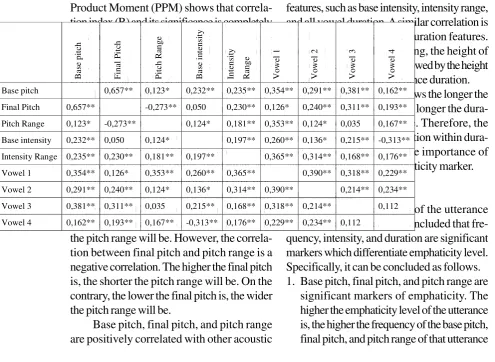
Product Moment (PPM) shows that correla-tion index (R) and its significance is completely illustrated on the following table. The correla-tion analysis is carried out only on features which are distinctively proved as different mark-ers of emphaticity levels.
From the whole features of the utterance frequency which becomes the emphaticity marker, all of them are correlated. A positive correlation of significant utterance frequency— either of 0.01 or of 0.05 levels—shows a cor-relation between base pitch, final pitch, and pitch range. This means that the higher the base pitch is, the higher the final pitch and the pitch range will be. On the contrary, that the lower the base pitch is, the lower the final pitch and the pitch range will be. However, the correla-tion between final pitch and pitch range is a negative correlation. The higher the final pitch is, the shorter the pitch range will be. On the contrary, the lower the final pitch is, the wider the pitch range will be.
Base pitch, final pitch, and pitch range are positively correlated with other acoustic
features, such as base intensity, intensity range, and all vowel duration. A similar correlation is also found in intensity and duration features. Therefore, generally speaking, the height of frequency features will be followed by the height of sound intensity and utterance duration.
The above data also shows the longer the duration of one vowel is, the longer the dura-tion of other vowels will be. Therefore, the consistency of vowel realization within dura-tion feature really marks the importance of duration feature as an emphaticity marker.
4. Conclusion
Based on the analysis of the utterance acoustic features it can be concluded that fre-quency, intensity, and duration are significant markers which differentiate emphaticity level. Specifically, it can be concluded as follows. 1. Base pitch, final pitch, and pitch range are
significant markers of emphaticity. The higher the emphaticity level of the utterance is, the higher the frequency of the base pitch, final pitch, and pitch range of that utterance
B
as
e pi
tc
h
F
in
al P
itc
h
P
itch
R
an
g
e
Ba
se
i
n
te
n
si
ty
Int
ens
it
y
Ra
ng
e
Vo
we
l 1
Vo
we
l 2
Vo
we
l 3
Vo
we
l 4
Base pitch 0,657** 0,123* 0,232** 0,235** 0,354** 0,291** 0,381** 0,162**
Final Pitch 0,657** -0,273** 0,050 0,230** 0,126* 0,240** 0,311** 0,193**
Pitch Range 0,123* -0,273** 0,124* 0,181** 0,353** 0,124* 0,035 0,167**
Base intensity 0,232** 0,050 0,124* 0,197** 0,260** 0,136* 0,215** -0,313**
Intensity Range 0,235** 0,230** 0,181** 0,197** 0,365** 0,314** 0,168** 0,176**
Vowel 1 0,354** 0,126* 0,353** 0,260** 0,365** 0,390** 0,318** 0,229**
Vowel 2 0,291** 0,240** 0,124* 0,136* 0,314** 0,390** 0,214** 0,234**
Vowel 3 0,381** 0,311** 0,035 0,215** 0,168** 0,318** 0,214** 0,112
Vowel 4 0,162** 0,193** 0,167** -0,313** 0,176** 0,229** 0,234** 0,112
[image:7.595.21.517.399.761.2]
Table 1: Correlation of Significant Acoustic Marker within Utterance
BIBLIOGRAPHY
Ebing, Ewald. 1997. Form and Function of Pitch Movements in Indonesian. Leiden: Re-search School CNWS.
Fujimura, Osamu dan Donna Erickson. 1999. “Acoustics Phonetics”. Dalam Hardcastle, Wil-liam J. and John Laver. 1999. The Handbook of Phonetics Sciences. Oxford: Basil Blackwell.
Mozziconacci, S.J.L. 1998. Speech in Variability and Emotion: Production and Percep-tion. Disertasi Eindhoven University of Technology.
Odé, Cecilia and Vincent J. van Heuven (eds.). 1994. Experimental Studies of Indonesian Prosody (Semaian 9). Leiden: Rijksuniversiteit te Leiden.
Sugiyono. 2002. “Pitch Marker of Interrogativity in Indonesian: Psychoachoustics Approach”. Paper of International Symposium of Linguistics and Speech-Hearing Sciences 2002, Kuala Lumpur, 21–22 October 2002.
Sugiyono. 2003. Pemarkah Prosodik Kontras Deklaratif dan Interogatif Bahasa Melayu Kutai: Kajian Fonetik Eksperimental dan Psikoakustik. Thesis.
Van Heuven, Vincent J. van dan Ellen van Zanten. 1994. “Effects of Substate Language on the Localization and Perceptual Evaluation of Pitch Movement in Indonesian”. Dalam Odé, Cecilia dan Wim Stokhof (eds.). 1997:63—80.
Van Zanten, Ellen dan Vincent J. van Heuven. 1994. “Effect of Word Length and Substrate Language on the Temporal Organisation of Words in Indonesian”. Dalam Odé, Cecilia dan Wim Stokhof (eds.). 1997:201—216.
will be.
2. From the sound intensity point of view, the emphaticity of utterance is marked by base intensity and intensity range. The utterance with high emphaticity level is marked by high base intensity and wider range inten-sity.
3. From duration point of view, the utterance emphaticity is marked by the duration of all vowels. The height of emphaticity level is marked by the length of time needed by the vowels to be uttered.