UNIVERSITI TEKNIKAL MALAYSIA MELAKA
BORANG PENGESAHAN STATUS LAPORAN PSM
JUDUL:
“Design and Development of CCTV Using Webcam”
SESI PENGAJIAN: Semester 2 2007/ 2008
Saya Mohammad Noor Khairul Azrin Bin Adnan
mengaku membenarkan l aporan PSM / t esi s (Sarj ana/ Dokt or Fal saf ah) i ni disimpan di Perpust akaan Uni versit i Teknikal Mal aysi a Mel aka (UTeM) dengan syarat -syarat kegunaan sepert i berikut :
1. Laporan PSM / t esis adal ah hak mil ik Universit i Teknikal Mal aysi a Mel aka dan penul is.
2. Perpust akaan Uni ver sit i Teknikal Mal aysia Mel aka dibenarkan membuat sal inan unt uk t uj uan pengaj ian sahaj a dengan izin penul is.
3. Perpust akaan dibenar kan membuat sal i nan l aporan PSM / t esis ini sebagai bahan pert ukaran ant ara inst it usi pengaj ian t i nggi.
4. *Sil a t andakan (√)
SULIT
TERHAD
√ TIDAK TERHAD
(Mengandungi maklumat yang berdarj ah kesel amat an at au kepent ingan Mal aysia yang t ermakt ub di dal am AKTA RAHSIA RASMI 1972)
(Mengandungi maklumat TERHAD yang t el ah dit ent ukan ol eh organisasi/ badan di mana penyel idikan dij alankan)
DECLARATION
I hereby, declare this thesis entitled “Design and Development of CCTV using Webcam” is the result of my own research
except as cited in the references.
Signature : ...
Author’s Name : MOHAMMAD NOOR KHAIRUL AZRIN BIN ADNAN
UNIVERSITI TEKNIKAL MALAYSIA MELAKA
Design and Development of CCTV using Webcam
Thesis submitted in accordance with the partial requirements of the
Universiti Teknikal Malaysia Melaka for the
Bachelor of Manufacturing Engineering (Manufacturing Design) with Honours
By
Mohammad Noor Khairul Azrin Bin Adnan
Faculty of Manufacturing Engineering
DESIGN AND DEVELOPMENT
OF
CCTV USING WEBCAM
MOHAMMAD NOOR KHAIRUL AZRIN BIN ADNAN
APPROVAL
This PSM submitted to the senate of UTeM and has been as partial fulfillment of the requirements for the degree of Bachelor of Manufacturing Engineering (Manufacturing
Design) with Honours. The members of the supervisory committee are as follow:
... (NURAZUA BINTI MOHD YUSOP)
ABSTRACT
ABSTRAK
DEDICATION
ACKNOWLEDGEMENT
TABLE OF CONTENTS
List of Abbreviations, Symbols, Specialized Nomenclature...xii
List of Appendices...xiii
2.2.5 Closed Circuit Digital Photography (CCDP)...8
2.2.6 Traffic Monitoring...9
2.2.8 Recent Development...12
2.2.9 Retention, Storage and preservation...15
2.2.10 CCTV Countermeasure...17
2.2.11 Types of CCTV...18
2.2.11.1 Box...18
2.2.11.2 Bullet...18
2.2.11.3 Dome...18
2.2.11.4 PTZ (Pan Tilt and Zoom)...19
2.2.12 Example of CCTV System...20
2.4.4.2Components...38
3.5.1 Camera Lens (Webcam) Device...55
3.5.2 USB (Universal Serial Bus)...55
3.6 Material Selection...56
4.
ANALYSIS AND RESULT...584.1 Introduction...58
4.2 Angle Of View...58
4.2.1 Calculation for Vertically Line Angle...59
4.2.2 Calculation for Horizontally Line Angle...60
4.3.2 Side of the Door...65
4.3.3 At the Door...66
4.4 Display Analysis Between Different Pixels of Webcam...67
5.
DISCUSSION...695.1 Angle of View...69
5.2 Pixel...73
5.3 NetBeans...75
5.3.1 Coding for Interface...76
6.
CONCLUSION...836.1 Conclusion...83
6.2 Recommendation...83
REFERENCES...85
LIST OF FIGURES
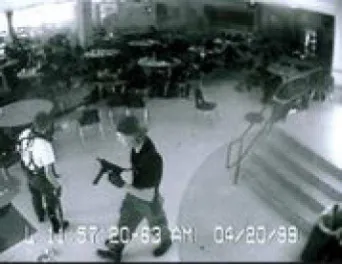
2.1 Columbine High School Massacre via CCTV cameras 3
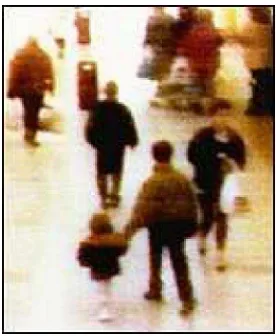
2.2 Jamie Bulger being led away by his killers 4
2.3 7 July attacks on London 5
2.4 A surveillance image captured using a megapixel CCDP camera 8
2.5 A surveillance room being surveilled itself 10
2.6 A mobile closed-circuit TV van monitoring a street market 10
2.7 Surveillance camera at London (Heathrow) Airport 12
2.8 Surveillance camera outside a McDonalds highway drive-in 12
2.9 Eye-in-the-sky surveillance dome camera 13
2.10 CCTV camera with speakers attached 15
2.11 DC Indoor Box Camera 17
2.18 Videoconferencing 23
2.19 Webcams typically 24
2.20 Symbol of JAVA™ 28
2.21 Duke, the Java mascot 29
2.22 Front page of NetBeans 6.0 42
3.1 Product development process flow 50
3.2 First Mechanical Design (Isometric) 51
3.4 Redesign (Isometric) 52
3.5 Redesign (All View) 53
3.6 Example of Program Design 54
3.7 Block Diagram 55
3.8 Upper view and front view of camera lens device 56
3.9 Upper view and front view of camera lens device 56
3.10 USB device 56
4.1 Positioning of Horizontally, Vertically and Diagonally Line 61
4.2 Vertically Line Angle 61
4.3 Horizontally Line Angle 62
4.4 Horizontally and Vertically Angle of View 63
4.5 Relationship between Distances with Display Frame Length 64
4.6 Webcam place Top of the Door 66
4.7 Display from Monitor (Webcam place Top of the Door) 66
4.8 Webcam place Side of the Door 67
4.9 Display from Monitor (Webcam place Side of the Door) 67
4.10 Webcam place at the door 68
4.11 Display from Monitor (Webcam place at the door) 68
4.12 3.2 megapixel webcam 70
4.13 1.3 megapixel webcam 70
5.1 Camera view area (side view) 72
5.2 Image on the screen from the same camera 72
5.3 Camera view area projections 74
5.4 A pixel comparison. 75
5.5 NetBeans 6.0.1 in action 77
LIST OF TABLES
3.1 Comparison between PC, PP and ABS in properties and their application 57
LIST OF ABBREVIATIONS, SYMBOLS, SPECIALIZED
CCDP Closed-Circuit Digital Photography
CCTV Closed-Circuit Television
CMOS Complementary metal–oxide–semiconductor
DC Direct Current
DVR Digital Video Recorder
FTP File Transfer Protocol
GPS Global Positioning System
GUI Graphical User Interface
HTTP Hypertext Transfer Protocol
IDE Integrated Development Environment
IP Internet Protocol
IPD Integrated Product Development
JPEG Joint Photographic Experts Group
JRE Java Runtime Environment
LED Light-Emitting Diode
MPEG Moving Picture Experts Group
PC Personal Computer
PSM Projek Sarjana Muda
SDK Software Development Kit
TV Television
USB Universal Serial Bus
LIST OF APPENDICES
CHAPTER 1
INTRODUCTION
1.1 Background
Projek Sarjana Muda (PSM) is compulsory to the final year students in Universiti Teknikal Malaysia Melaka (UTeM) in order to complete their degree in the engineering course. PSM allow these students to do research and project based on the subjects learned in the classes, the experience they get during their industrial training and any cases related with the project.
Nowadays, the technologies of imaging have developed more advances in late these 10 years. Imaging technology is the application of materials and methods to create preserve or duplicate images. Webcam and CCTV is apart of imaging technology. Their function is to display of image and for the application is depend on their purpose.
1.2 Problem Statement
At Universiti Teknikal Malaysia Melaka (UTeM) especially at Industry Campus, the lecturer’s room’s door has been designed with transparent glass (window) which is faced to the corridor and most of lecturers close the window by pasting some paper or wallpaper. However, the problem encounter when lecturer cannot see who knock their door. Even this not such a big problem, however it still difficult for lecturers to know who is their guest.
1.3 Objective
1. To design and develop the CCTV by using webcam to the lecturer’s room. 2. To prevent the lecturer’s room from any burglary or unwanted person.
3. To find out the most suitable low-cost CCTV system for offices or lecturer’s room.
4. To ease the user (lecturer) for identifying the guest/student by using webcam before let they open the door.
1.4 Scope
CHAPTER 2
LITERATURE REVIEW
2.1 Introduction
In this project, the main focus is about the purpose of Closed-Circuit Television (CCTV) system and the functional of webcam besides its general uses. All the factors need to be considered to make this project success and fulfill the objectives. The other important thing in this project is the programming for webcam. This project will use Java™ by using the NetBeans as its platform for the development of Java™ desktop applications.
2.2 Closed-Circuit Television
2.2.1 History
The first CCTV system was installed at Test Standr VII in Peenemünde Germany in 1942, for observing the launch of V2-rockets. CCTV recording systems are often used at launch sites to record the flight of the rockets, in order to find the possible causes of malfunctions. Film cameras are also used for this purpose. Larger rockets are often fitted with CCTV allowing pictures of stage separation to be transmitted back to earth by radio link. CCTV is also used to observe the launch pad before the launch, especially when no person cannot be there because of safety reasons.
2.2.2 Industrial processes
2.2.3 Crime registration
Figure 2.1: Eric Harris and Dylan Klebold, in the Columbine High School Massacre via CCTV cameras.
Claims that they reduce or deter crime have not been clearly borne out by independent studies; though the government claims that when properly used they do result in deterrence, rather than displacement. One clear effect that has been noted is a reduction of car crime when used in car parks. Cameras have also been installed in taxis to deter violence against drivers, and also in mobile police surveillance vans. In some cases CCTV cameras have become a target of attacks themselves. Middlesbrough council has recently installed "Talking CCTV" cameras in their busy town-centre. It is a system pioneered in Wiltshire which allows CCTV operators to communicate directly with the offenders they spot. This idea is first known to have appeared in George Orwell's famous novel Nineteen Eighty-Four [1].
Figure 2.2: The two-year-old Jamie Bulger being led away by his killers, recorded on shopping centre CCTV.