i
UNIVERSITI TEKNIKAL MALAYSIA MELAKA
EXTENDED ELECTRIC MOTORCYCLE BATTERY MOUNT
DESIGN, ANALYSIS AND INSTALLATION
This report submitted in accordance with requirement of the UniversitiTeknikal Malaysia Melaka (UTeM) for the Bachelor Degree In Mechanical Technology
(Automotive)
by
MUHAMMAD RAMDAN BIN MAT ALI B071210340
930311115309
ii
DECLARATION
I hereby, declared this report entitled “Extended electric motorcycle battery mount design, analysis and installation” is the results of my own research except as cited in references.
Signature : ……….
Author’s Name : MUHAMMAD RAMDAN BIN MAT ALI
iii
APPROVAL
This report is submitted to the Faculty of Engineering Technology of UTeM as a partial fulfillment of the requirements for the degree of Bachelor of Mechanical Engineering Technology (Automotive). The member of the supervisory is as follow:
………
iv
ABSTRAK
v
ABSTRACT
vi
DEDICATION
vii
ACKNOWLEDGEMENT
First and foremost, I am very grateful to the almighty Allah S.W.T for giving me this opportunity to accomplish my final year project 1 and 2. I would like to take this opportunity to express gratitude to my dedicated project supervisor, En.Ir.Mazlan Bin Ahmad Mansor for guiding my final year project tolerantly by sharing his valuable ideas and expertise.
My sincere thanks go to all my friends in who willing to support and gives some knowledge to achieve the aim for this final year project. Instead of that, special thanks I gave to another supporter friends from, FTK who sincerely give their opinion and continuous guidance throughout this final year project.
viii
2.1 Hybrid Motorcycle ... 5
2.1.1 Advantages of Hybrid Motorcycle... 6
2.2 Battery in Hybrid Motorcycle ... 7
2.2.1 Selection of the Battery ... 8
2.3 Advantage of LiFePO4 battery ... 9
2.4 Battery Mount ... 11
2.5 Selection of Metal ... 13
2.5.1 Mild Steel ... 14
3.3 Selection of Conceptual Design ... 22
3.4 Detail Design ... 22
3.4.1 The Bracket Holder ... 23
3.4.2 The Mounting Base ... 24
ix
3.4.3 Battery Holder ... 28
3.4.3.1 Battery Holder Design ... 29
3.5 Finishing Process ... 31
3.6 Analysis Process ... 32
3.7 Expected Result ... 32
3.8 Expected Conclusion ... 32
CHAPTER 4 RESULT AND DISCUSSION……….33
4.1 Introduction ... 33
4.2 The Selected Design ... 34
4.2.1 The Actual Bracket Holder Design ... 35
4.2.2 Battery Holder Analysis Result ... 37
4.3 The Actual Upper Base Design ... 44
4.3.1 Upper Base Analysis Result ... 45
4.4 The Bracket Actual Design ... 52
4.5 Finishing Process ... 53
4.5.1 Painting Process ... 54
4.5.2 Installation process ... 55
4.6 Discussion ... 56
CHAPTER 5 CONCLUSION AND FUTURE WORK……….58
5.1 Conclusion ... 58
5.2 Future Work ... 59
x
LIST OF FIGURES
Figure 1 Hybrid system ... 6
Figure 2 LiCoO2 and LiFePO4 battery ... 10
Figure 3 Red Top Mounting Bracket ... 12
Figure 4 Example of Mild Steel ... 15
Figure 5 Example of Stainless Steel ... 16
Figure 6 Example of Bracket Design Using CATIA V5 ... 18
Figure 7 Example of Bracket Design Analysis Using CATIA V5 ... 18
Figure 8 Example of Bracket Holder ... 23
Figure 9 Location of the Bracket Holder ... 24
Figure 10 Location of Base Mounting Slider ... 25
Figure 11 Expected Design of the Base Mounting Slide ... 25
Figure 12 Upper Base part ... 26
Figure 13 Upper Base Slider ... 27
Figure 14 Lower Base Supports ... 27
Figure 15 Lower Base with Supports... 28
Figure 16 Battery used ... 29
Figure 17 Bottom Part Battery Holder Dimension ... 30
Figure 18 Location of Poles ... 31
Figure 19 The Selected Assemble Design ... 34
Figure 20 Position of Load Applied... 35
Figure 21 Von Mises Stress Analysis ... 36
Figure 22 Part Assemble ... 44
Figure 23 Bracket Dimension ... 52
Figure 24 Bracket Analysis Result ... 53
Figure 25 Grinding Process ... 54
Figure 26 Painting Process... 55
1
1.1 Project Introduction
The electric motorcycle is used one or more electric motor for the action of driving or pushing forward. It must consist of a generator to convert the fuel to the electricity. The generator converts the mechanical energy to electrical energy. The electric motor is an electric machine which is converts the electrical energy to mechanical energy. In normal motoring mode, most electric motors operate through the interaction between an electrical motor’s magnetic field and winding currents to generate force within the motor. In certain applications, such as in the transportation industry with traction motors, electric motors can operate in both motoring and generating or braking modes to also produce electrical energy from mechanical energy. This motor runs by the current that supply from the battery. Battery is a main part in hybrid motorcycle. This project is about to design a battery mounting for the hybrid motorcycle.
2
1.2 Background Study
To design mounting bracket for electric motor hub battery with the controller and charging system on a motorcycle rear frame and perform the strength analysis. Fabricate the working bracket and mount on the bike.
1.3 Problem Statement
The electric motorcycle consists of a battery that is use as a source of electricity. This electric will run the motorcycle. There are a lot of designs of the battery mount for the hybrid motorcycle. This design must be comes out with many aspect including safety. The mount design must be adjustable according to the location of the battery which is at the passenger seat. This design must be adjustable to overcome the problem of opening the compartment under the motorcycle seat. The safety aspect must be takes in this case due to the heavy weight of the battery that is located behind the rider. The strength of the battery mount must afford to hold the heavy battery.
1.4 Objective
3
1.5 Scope
I. To design a battery mount for hybrid motorcycle II. To make the strong bracket for the battery mount III. To make a suitable selection of element for the project IV. To make an adjustable battery mount
4 The literature review is written as a definition is a research study that has been made about a problem that has been identified and how to solve the problem. This review should describe, summarize, evaluate and clarify the project which including substantive findings, as well as theoretical and methodological contributions to a particular topic between literature and field research. The research can be found such as books, journal, web pages and other report. From these sources, the literature review can be interpreted as a review of an abstract accomplishment, organized around and the thesis results should be synthesized into a summary so that important areas can identified.
5
2.1 Hybrid Motorcycle
Motorcycles are hybrid plug-in electric vehicles (PEV) with two or three-wheel powered by electricity. The electricity is stored on board in a rechargeable battery. This motorcycle is drives with one or more electric motors. The (PEV) are any motor that can be recharged from an external source of electricity. The electric motor is an electrical machine that converts mechanical energy into electrical energy. The reverse of this process would be the conversion of mechanical energy to electrical energy and is done by electric generator.
The hybrid motorcycle basically uses the electronic-continuously variable transmission (e-CVT). This system has been globally accepted as a main architecture for developing hybrid electric vehicle (HEV). It consist of internal combustion engine (ICE), reversible generator, reversible driving motor and transmission component C-T. Chung, 86 (2014) 216-225.
6 Figure 1 Hybrid system
2.1.1 Advantages of Hybrid Motorcycle
7 Other factor of discouraging the adoption of electric car is the lack of public and private charging infrastructure. The driver is fear of the batteries running out of energy before reaching their destination due to the limited range of existing charging place. The problem of PEV can be eliminated because the combustion engine works as a backup when the batteries are running out. The range is less compare to the other vehicle with gasoline tanks.
The fuel consumption of motorcycle is less than passenger car. This fuel economy is due to the motorcycle lighter weight. However, the fuel consumption per weight of motorcycle is much worse than the passenger car. Low output power of motorcycle in urban cause the incomplete combustion and more air pollution due to the low average speed and so many acceleration and braking (Energy Conversion and Management 71 (2013) 12–20).
2.2 Battery in Hybrid Motorcycle
8 Thermal characteristics and thermal behavior of lithium batteries are important both for the batteries meeting operating life requirements and for safety considerations. Sandia National Laboratories has a broad-based program that includes analysis, engineering and model development. We have determined thermal properties of lithium batteries using a variety of calorimetric methods for many years. We developed the capability to model temperature gradients and cooling rates of high-temperature primary lithium thermal batteries several years ago. Work is now under way to characterize the response of ambient-temperature rechargeable lithium-ion batteries to thermal abuse. Once the self-heating rates of lithium cells have been established over a range of temperatures, the thermal response can be estimated under a variety of conditions.
We have extended this process to isolate the behavior of individual battery components and have begun to understand the chemical nature of the species responsible for heat evolution within the cells. This enhanced level of understanding will enable more accurate modeling of cell thermal behavior and will allow model-based design of safer, more abuse-tolerant lithium batteries for electric vehicles (EVs) and hybrid electric vehicles (HEVs) in the future. Progress toward this goal and key information still needed to reach it are discussed Daniel H Doughty 22 August 2002.
2.2.1 Selection of the Battery
9 more. The lithium-ion battery is selected in this project due to the advance in technology of the LiFePO4 battery.
2.3 Advantage of LiFePO4 battery
Lithium iron phosphate is novel and an important member of cathode material for lithium ion batteries. Numerous researches efforts laid the steady foundation of the development of LiFePO4. Several modifications and treatments of LiFePO4 have been used to improve the electrochemical performance for its large-scale manufacture. Carbon coating is an alternative method on enhancing the specific capacity and rate capability. Various carbon atoms have been implemented in previous researches. The conductive carbon coating on particle surfaces can improve the electronic conductivity of LiFePO4 and act as dispersion among the particles to prevent the particles growth.
10 voltage profile. Much attention has been focused on the cathode material development to avoid the toxicity, coast and safety problem from LiCoO2 D.Rajeshetal (2015).
Figure 2 LiCoO2 and LiFePO4 battery
11 Cathode material is crucial for determining the capacity. In case of cathodes many metal oxides has been consider such as LiCoO2, LiMn2O4, LiNiO2 and V2O5 are the most popular for lithium ion battery. Among the other materials LiFePO4 is a promising cathode material comparing to other conventional cathode materials due to high theoretical capacity playing important role in lithium ion batteries, next generation electronic devices. Cobalt based materials are toxicant harmful to environment, Manganese based materials are good in low cost, low toxic but It will suffer from fading capacity during the cycle. So there is urgent need to develop a good cathode material J.M. Chen (2008).
2.4 Battery Mount
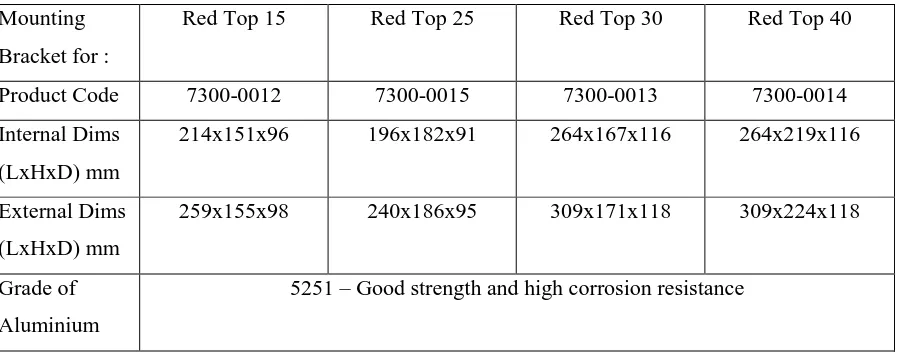
Table 2.1 Size of Mounting Bracket
The use of battery mount is to protect your battery from damage caused by excessive shock and vibration. Nowadays, there are many companies that compete to make a new design of the battery mount that is lighter and strong. The Varley Red Top is the best product development in battery mount design. The new Varley Red Top battery bracket combines strong and lightweight aluminum with polyethylene foam padding. Unlike some other battery brackets on the market, the Varley Red Top bracket
Mounting
Bracket for :
Red Top 15 Red Top 25 Red Top 30 Red Top 40
Product Code 7300-0012 7300-0015 7300-0013 7300-0014
Internal Dims
(LxHxD) mm
214x151x96 196x182x91 264x167x116 264x219x116
External Dims (LxHxD) mm
259x155x98 240x186x95 309x171x118 309x224x118
Grade of Aluminium
12 incorporates 10mm closed cell polyethylene foam padding to protect the battery from both excessive shock and vibration emanating from the engine, gearbox and track/road surface.
Slotted fixing points allow for easier fitting in tight and awkward places, permitting the simple loosening of some fastenings when removing or replacing the battery and or mounting bracket. Designed to be fitted in restricted spaces with fixing holes or slots to suit M6 fastening to the sides and base. Available in four different sizes, to suit the popular Varley Red Top 15, Varley Red Top 25, Varley Red Top 30 and Varley Red Top 40 batteries, the brackets offer a weight efficient, robust solution to securing and protecting a battery for racing (www.varleyredtop.com).
13
2.5 Selection of Metal
The behavior and design of high strength steel box and I-section columns at elevated temperatures have been investigated. In this study, the high strength steel with nominal yield strength of 690 MPa was considered. Equations predicting the material properties and stress–strain curve model for high strength steel and mild steel at elevated temperatures have been proposed. A finite element model including geometrical and material nonlinearities has been developed and verified against the experimental results of high strength steel columns at normal room temperature and mild steel columns at elevated temperatures. In the finite element model, the material properties and stress–strain curves at elevated temperatures were obtained from the proposed equations in this study.
A parametric study on high strength steel box and I-section columns at elevated temperatures has been performed using the developed finite element model. The high strength steel column lengths ranged from stub columns to slender columns of 3450 mm, while the temperatures ranged from 22 to 900 _C. Furthermore, the direct strength method was also used to predict the high strength steel column strengths at elevated temperatures. Generally, it is shown that the direct strength method using the reduced material properties conservatively predicted the column strengths of high strength steel box and I-sections for stub and slender columns at elevated temperatures. The main objective of this paper is to study the behavior and design of high strength steel columns at elevated temperatures using finite element analysis.
14 steel columns over a range of column lengths for various temperatures. The nonlinear finite element model was verified against experimental results of columns at normal room and elevated temperatures J. Chen, (2008).
2.5.1 Mild Steel
Mild steel is one of the most versatile and resilient materials, and it forms the backbone of wide varieties of heavy machines as well as for various industries due to low cost and good mechanical strength. Various grades of mild steels have found wide spread usage in making ships, submarines, dry docks, floating docks; slip ways and offshore structures, where highly corrosive marine environment is experienced. Components made out of steel have to undergo wide varieties of manufacturing operations including machining before they are utilized in structural as well as non-structural applications. Machining operations involve removal of metal from a work-piece with the help of a tool made of material harder than the work work-piece. Turning operation is one of the simplest and most widely used machining processes. Nian et al. (1999) reported in their paper that proper selection of cutting parameters in turning operation is of high importance for generation of good surface finish Nian, C.Y., Yang 1999. Optimization of turning operations with multiple performance characteristic. J. Mater. 95.