THEMATIC STRUCTURE IN SELECTED ADVERTISEMENTS IN PEOPLE MAGAZINE
A THESIS
BY
IVO NOVITA S S REG. NO. 100705039
DEPARTMENT OF ENGLISH
THEMATIC STRUCTURE IN SELECTED ADVERTISEMENT IN PEOPLE MAGAZINE
A THESIS
BY
IVO NOVITA S S REG. NO. 100705039
SUPERVISOR CO-SUPERVISOR
Dr. Eddy Setia, M. Ed. TESP
NIP. 19570412 198403 1 001 NIP. 19570803 198404 1004
Drs. Chairul Husni, M. Ed. TESOL
Submitted to Faculty of Cultural Studies University of Sumatera Utara Medan in partial fulfillment of the requirements for the degree of Sarjana Sastra from Department of English.
DEPARTMENT OF ENGLISH
Approved by the Department of English, Faculty of Cultural Studies University of Sumatera Utara (USU) Medan as thesis for The Sarjana Sastra Examination.
Head, Secretary,
Dr. H. Muhizar Muchtar, MS
NIP. 19541117 198003 1 002 NIP. 19750209 200812 1 002
Accepted by the Board of Examiners in partial fulfillment of requirements for the degree of Sarjana Sastra from the English Department, Faculty of Cultural Studies University of Sumatera Utara.
The examination is held in the Faculty of Cultural Studies University of Sumatera Utara on Friday July 18th, 2014
The Dean of Faculty of Cultural Studies University of Sumatera Utara
NIP.19511013 197603 1 001 Dr. H. Syahron Lubis, MA
Board of Examiners
Dr. H. Muhizar Muchtar, MS ………..
Rahmadsyah Rangkuti, M. A. Ph. D ………..
Dr. Eddy Setia, M. Ed. TESP ………..
Prof. Hj. T. Silvana Sinar, M.A. Ph. D ………..
AUTHOR’S DECLARATION
I, IVO NOVITA S S DECLARE THAT I AM THE SOLE AUTHOR OF THIS THESIS EXCEPT WHERE REFERENCE IS MADE IN THE TEXT OF THIS THESIS. THIS THESIS CONTAINS NO MATERIAL PUBLISHED ELSEWHERE OR EXTRACTED IN WHOLE OR IN PART FROM A THESIS BY WHICH I HAVE QUALIFIED FOR OR AWARDED ANOTHER DEGREE. NO OTHER PERSON’S WORK HAS BEEN USED WITHOUT DUE ACKNOWLEDGEMENTS IN THE MAIN TEXT OF THIS THESIS. THIS THESIS HAS NOT BEEN SUBMITTED FOR THE AWARD OF ANOTHER DEGREE IN ANY TERTIARY EDUCATION.
Signed :
COPYRIGHT DECLARATION
NAME : IVO NOVITA S S
TITLE OF THESIS : THEME AND RHEME IN SELECTED
ADVERTISEMENTS IN PEOPLE MAGAZINE
QUALIFICATION : S-1/SARJANA SASTRA
DEPARTMENT : ENGLISH
I AM WILLING THAT MY THESIS SHOULD BE AVALIABLE FOR REPRODUCTION AT THE DISCRETION OF THE LIBRARIAN OF DEPARTMENT OF ENGLISH, FACULTY OF CULTURAL STUDIES, UNIVERSITY OF SUMATERA UTARA ON THE UNDERSTANDING THAT USERS ARE MADE AWARE OF THEIR OBLIGATION UNDER THE LAW OF THE REPUBLIC OF INDONESIA.
Signed :
ACKNOWLEDGMENTS
In the name of the Holy Father, and The Son, and The Holy Spirit, Amen. My
gratitude for God for the blessing He gives me in writing this thesis. It is not my
power that I could finish my study in this department, but His. Jesus, You are my
everything…
First, I would like to thank the Dean of Faculty of Cultural Studies Dr. Drs.
Syahron Lubis, MA, the head of Department of English Dr. Drs. Muhizar Muchtar ,
M.S, the secretary, Dr. Rahmadsyah Rangkuti, M.A. Ph. D, and all the lecturer that have given guidance in studying in this faculty. I also would like to thank my
supervisors, Dr. Eddy Setia, M. Ed. TESP and Drs. Chairul Husni, M. Ed. TESOL
for the support, guidance and advices in writing my thesis. May God bless you. And
also I thank Bang Mistam for all the help you gave me during my study.
My special thank is for my beloved parents Mr. D. Silalahi and Mrs. A.
Napitupulu. Thank you Pak, Mak, for your endless love, supports and care. May God
bless you. And also for my two brothers Chandra Frans Daniel Silalahi and Pranata
Yosua Silalahi, I love you. Hope you two grow well and much blessed.
I also thank new my family in Medan Apartemen ’26 K’ Iren, Lenny, K’
Maris, K Sab, K Yosi, K Ela, K Way, Dona and Via. For my family and friends in
Sant’ Egidio Community Medan whose name I cannot write one by one. Sorry guys,
but I love you all. My special thanks for my girls in Asrama Putri USU, Pesta Nita,
Rani, Mian, Detta, Step, Sastri, K’ Dina, K’ Lin, K’ Nyerli, K’ Iren, K’ Del, K’
My grateful thanks is for by ‘best friend’ during my study in this faculty, Mr.
Marbun, thank you for being with me up till now, giving me support and courage.
Keep humble and spirit, Bo. And for my allies Ayu Imelda my pal, Devi, Stephanie,
Novi, and Inun, thanks for our stories, guys.
Finally I would like to thank everybody who had helped me during my study
and during the writing of this thesis. I pray you may God bless you, and me.
Medan, July 2014 The writer,
Ivo Novita Sari Silalahi Reg. No 100705039
ABSTRAK
Skripsi berjudul “Theme and Rheme in Selected Advertisement in People Magazine” merupakan suatu analisis tentang fungsi textual, khususnya tentang Tema yang terdapat pada beberapa iklan yang dipilih dari Majalah PEOPLE. Tujuan penulisan skripsi ini adalah untuk menentukan Tema – Rema pada iklan dan menetukan jenis Tema yang digunakan, serta menunjukkan bagaimana teks iklan tersebut dibangun. Teori yang digunakan adalah teori Halliday yang membagi tema menjadi 4 jenis, yaitu: Tema Topikal, Tema Interpersonal, Tema Tekstual, dan Tema Majemuk (Multiple). Untuk mengetahui pengembangan Tema, digunakan Teori Enggins yang membagi pengembangan tema menjadi 3 jenis, yaitu: Pengembangan Tema Berulang (Reiteration Pattern), Pengembangan Tema Zig-zag, dan Pengembangan Tema Rema Majemuk (Multiple Rheme Pattern). Penelitian ini menggunakan metode deskriptif kualitatif. Data diperoleh dengan pemilihan sample secara acak. Dari 12 iklan yang dipilih, terkumpul sebanyak 102 klausa. Setelah data dianalisis, ditemukan bahwa Tema Topikal digunakan sebanyak 95 klausa, Tema Interpersonal sebanyak 5 klausa, Tema Tekstual sebanyak 26 klausa, dan Tema Majemuk sebanyak 28 klausa. Juga ditemukan bahwa seluruh iklan yang dianalisis dibangun dengan menggunakan Pengembangan Tema Pengulangan. Dari hasil temuan tersebut maka disimpulkan bahwa pada teks iklan di majalah People yang diteliti Tema Topikal digunakan secara dominan dan seluruh teks dibangun dengan menggunakan Pengembangan Tema Pengulangan.
ABSTRACT
The thesis entitled “Theme and Rheme in Selected Advertisement in People Magazine” is an analysis of Textual Function, especially the Thematic Structure found in several selected advertisements in PEOPLE Magazine. The objective of this study is to determine the Theme and Rheme in the advertisements, to determine the types of Themes used, and to find out how the Themes Development in the advertisements in People Magazine. In this thesis used Halliday’s theory which defines 4 types of Themes. They are: Topical Theme, Interpersonal Theme, Textual Theme and Multiple Theme. To analyze the Theme development, it is used Enggins’ theory which defines the Theme Development into 3 types: Reiteration Pattern, Zigzag Pattern, and Multiple Rheme Pattern. This thesis applies descriptive qualitative method. The data source is obtained by randomly selecting the advertisements. From the 12 advertisements selected, there are found 102 clauses. After the analysis, it is found that there are 95 Topical Theme, 5 Interpersonal Theme, 26 Textual Theme, and 28 Multiple Theme. It is also found that all of the advertisement texts analyzed are built by using the Reiteration Pattern. From these findings it is concluded that in the advertisement in People Magazine, the Topical Theme is used dominantly and all of the text which has been analyzed is built by using the Reiteration Pattern.
TABLE OF CONTENTS
AUTHOR’S DECLARATION ... v
COPYRIGHT DECLARATION ... vi
ACKNOWLEDGEMENTS ... vii
ABSTRAK ... ix
ABSTRACT ... x
TABLE OF CONTENTS ... xi
CHAPTER I. INTRODUCTION 1.1 Background of the Study ... 1
1.2 Problem of the Study ... 4
1.3 Objectives of the Study ... 4
1.4 Scope of the Study ... 4
1.5 Significance of the Study... 5
CHAPTER II. REVIEW OF LITERATURE 2.1 Textual Function ... 6
2.2 Thematic Structure ... 7
2.2.1 Theme ... 7
2.2.2 Rheme ... 9
2.3 The Types of Theme ... 10
2.3.1 Ideational Theme ... 10
2.3.2 Interpersonal Theme ... 14
2.3.4 Multiple Theme ... 17
2.4 Method Of Development ... 18
2.4.1 Theme Reiteration ... 19
2.4.2 Theme Zigzag ... 19
2.4.3 Multiple Rheme Pattern ... 20
2.5. Relevant Studies ... 21
CHAPTER III. RESEARCH METHODOLOGY 3.1. Research Method ... 23
3.2. Data and Data Source ... 23
3.3. Data Collecting Method ... 24
3.4. Data Analyzing Method ... 24
CHAPTER IV. ANALYSIS AND FINDINGS 4.1 Introduction ... 28
4.2 Data Analysis ... 28
4.2.1 Topical Theme ... 29
4.2.2 Interpersonal Theme ... 35
4.2.3 Textual Theme ... 37
4.2.4 Multiple Theme ... 41
4.3 Finding of Types of Theme ... 44
4.4 Method of Development ... 46
CHAPTER V. CONCLUSIONS AND SUGGESTIONS
5.1. Conclusions ... 64
5.2. Suggestions ... 65
REFERENCE ... xiii
ABSTRAK
Skripsi berjudul “Theme and Rheme in Selected Advertisement in People Magazine” merupakan suatu analisis tentang fungsi textual, khususnya tentang Tema yang terdapat pada beberapa iklan yang dipilih dari Majalah PEOPLE. Tujuan penulisan skripsi ini adalah untuk menentukan Tema – Rema pada iklan dan menetukan jenis Tema yang digunakan, serta menunjukkan bagaimana teks iklan tersebut dibangun. Teori yang digunakan adalah teori Halliday yang membagi tema menjadi 4 jenis, yaitu: Tema Topikal, Tema Interpersonal, Tema Tekstual, dan Tema Majemuk (Multiple). Untuk mengetahui pengembangan Tema, digunakan Teori Enggins yang membagi pengembangan tema menjadi 3 jenis, yaitu: Pengembangan Tema Berulang (Reiteration Pattern), Pengembangan Tema Zig-zag, dan Pengembangan Tema Rema Majemuk (Multiple Rheme Pattern). Penelitian ini menggunakan metode deskriptif kualitatif. Data diperoleh dengan pemilihan sample secara acak. Dari 12 iklan yang dipilih, terkumpul sebanyak 102 klausa. Setelah data dianalisis, ditemukan bahwa Tema Topikal digunakan sebanyak 95 klausa, Tema Interpersonal sebanyak 5 klausa, Tema Tekstual sebanyak 26 klausa, dan Tema Majemuk sebanyak 28 klausa. Juga ditemukan bahwa seluruh iklan yang dianalisis dibangun dengan menggunakan Pengembangan Tema Pengulangan. Dari hasil temuan tersebut maka disimpulkan bahwa pada teks iklan di majalah People yang diteliti Tema Topikal digunakan secara dominan dan seluruh teks dibangun dengan menggunakan Pengembangan Tema Pengulangan.
ABSTRACT
The thesis entitled “Theme and Rheme in Selected Advertisement in People Magazine” is an analysis of Textual Function, especially the Thematic Structure found in several selected advertisements in PEOPLE Magazine. The objective of this study is to determine the Theme and Rheme in the advertisements, to determine the types of Themes used, and to find out how the Themes Development in the advertisements in People Magazine. In this thesis used Halliday’s theory which defines 4 types of Themes. They are: Topical Theme, Interpersonal Theme, Textual Theme and Multiple Theme. To analyze the Theme development, it is used Enggins’ theory which defines the Theme Development into 3 types: Reiteration Pattern, Zigzag Pattern, and Multiple Rheme Pattern. This thesis applies descriptive qualitative method. The data source is obtained by randomly selecting the advertisements. From the 12 advertisements selected, there are found 102 clauses. After the analysis, it is found that there are 95 Topical Theme, 5 Interpersonal Theme, 26 Textual Theme, and 28 Multiple Theme. It is also found that all of the advertisement texts analyzed are built by using the Reiteration Pattern. From these findings it is concluded that in the advertisement in People Magazine, the Topical Theme is used dominantly and all of the text which has been analyzed is built by using the Reiteration Pattern.
CHAPTER I
INTRODUCTION
1.1 Background of the Study
Language is used to share idea. It is including persuading people. The
meaning of ‘to persuade’ is to make someone agree to do something by giving
him/her good reasons for doing it, such as: using cosmetics products, buying vehicles
or making infestations. To persuade is one of the main purposes of advertisements.
Advertisement as a promotion tool has an important role in the effort to make
marketing of products to be successful. It is used to convey certain information about
products, services, or ideas to the target markets. A good advertisement can attract
the target markets to be aware of the product, and then to encourage them to buy it.
As a result, it has a beneficial effect to increase the sale of products. J. Thomas
Russell and W Roland Lane, in Kazmi (2004) have defined advertising in the
following words: “Advertising is a message paid for by an identified sponsor and
delivered though some medium of mass communication. Advertising is persuasive
communication.” Therefore, we may conclude that advertisement has some elements:
(1) messages, (2) sponsor, (3) mass media, (4) persuade or influence.
Advertising can be done in two ways. It can be electronic advertisements (by
using electronic media such as TV, radio, or computer), and display advertisement
(such as newspaper, posters, catalogues, magazines, etc.) As a promotion tool, in
of words but also pictures and illustrations. So, there are usually limited words used
in the display advertisement.
When the advertiser tries to convey the information, she/he always thinks
how to manage the words in a sentence so the information will be understood by the
consumers. Sentences in advertisements are structured in such away to attract the
readers. Thus, the advertiser must consider how she/ he structured the information:
what is put, where and why.
The information is the message of the advertisement. The difference of the
information arrangement makes the difference of the message. It can be exemplified
as below:
(1.a) Gerber Generation is the favorite food in America.
(1.b) The favorite food in America is Gerber Generation.
These two sentences seem to be alike except the structure. In the example
(1.a) the advertisement talks about the name of a product. It is ‘Gerber Generation’,
not the other products. In the example (1.b), it talks about ‘The favorite food in
America’. It is not about the favorite drink neither is the favorite food in Africa.
In Discourse Analysis, the structure of information is discussed in Thematic
Structure. It is Theme- and Rheme system which is introduced by M.A.K Halliday.
The thematic structure views that the function of language is as message. At this
point, clauses are considered as messages. The language is used to built a message to
other messages; a clause to other clauses. A message can be related to preceding or
following discourse or to the content. This function is realized by Theme-Rheme
Gerot and Wignel (1994:103) state that in English the Theme can be
identified as that or those elements which come first in the clause. Theme represents
‘This is what I’m talking about’ and Rheme is ‘This is what I am saying about it’.
The interaction of the Theme and Rheme governs how information in a text develops.
The boundary between Theme and Rheme is simple: Theme is the beginning of the
clause conveying what is the clause about. So, we can find the topic of the
information in a Theme. Rheme is the rest of the clause. The information is typically
contained in the Rheme. Theme can be divided in to three categories: Ideational
Themes, Textual Themes, and Interpersonal Themes. In this thesis, the writer wants
to analyze the Theme used in the advertisements based on these distributions.
The analysis of Theme-Rheme system which is a term of clause as
message constructing a text is needed to see the distribution of information of the
products in every clause. Moreover, we can reveal what kinds of item or concept are
explored as the points of view on the texts of advertisements.
The writer plans to analyze the advertisements taken from People Magazine.
People Magazine is a weekly American magazine of celebrity and human-interest
stories, published by Time Inc. People Magazine contains many advertisements,
which most of them are life style advertisements such as women cosmetics, health
products, foods, pet’s food, accessories, diet food, and fashion items.
The writer is interested in analyzing advertisements from People Magazine
because it is one of the most famous magazines in the word. ‘People’ has the largest
audience of any American magazine with a readership of 46.6 million adults. The
appreciation by being named "Magazine of the Year" by
2005 for advertising.
1.2 Problem of the Study
In this analysis, there are some questions to be answered. These questions
are the problems that need solution, they are:
1. What types of Themes are found in the advertisements in People
Magazine?
2. How is Themes Development in the advertisements in People Magazine?
1.3Objectives of the Study
In relation of the problem, the objectives of this analysis are:
1. To find out the types of Themes in advertisements in the People
Magazine.
2. To find out how Themes Development in the advertisements in People
Magazine is.
1.4 Scope of the Study
In research, it is important to limit the analysis on specific data that has been
chosen. This research will be done on the text of advertisements in People Magazine.
The analysis only concerns with the Textual Function which sees clauses as
messages. In other words, we only focus to the Theme and Rheme used in these
topical Themes, Textual Themes, Interpersonal Themes, and Multiple Themes. In
addition, this thesis also concern to the types of Method of Theme Development
which explained by Suzanne Enggins.
1.5 Significance of the Study
The writer hopes this study is able to give the information about Theme and
Rheme to the readers. This thesis is also expected to explain how the advertisements
deliver their messages concerning with its information arrangement. For the readers,
this analysis is expected to encourage people to be more critical in reading
CHAPTER II
REVIEW OF LITERATURE
2.1 Textual Function of Language
The textual function of language is an interpretation of language in its
function as a message, which is a text forming function of language. It means that the
textual represents the speaker’s text forming potential and it makes language relevant.
The textual meaning is concerned with how intra clausal elements are organized to
make meanings in this the textual function indicates the way the text is organized or
structured.
The textual meaning of language (clause) in its function as a message is
realized by the Theme System of language. The Theme system of the clause
comprises two major elements, they are Theme and Rheme.
Considering that clauses are messages, Gerot (1994) states that a message
comes to somewhere and leads to somewhere. It means that there is a departure point
of message as well as the arrival point. The departure point of the message is called
Theme and the arrival point is called Rheme. Theme provides the settings for the
remainder of the sentence. Rheme is the remainder of the message in a clause in
which Theme is developed, that is to say, Rheme typically contains unfamiliar or
new information. New information is knowledge that a writer assumes the reader
does not know, but needs to have in order to follow the progression of the argument.
Thus, display advertisements can be analyzed by using Halliday concept to see that a
2.2 Thematic Structure
In using discourse the main purpose and target of to communicate is to
transmit the messages. The message exists in clause. In order to interpret and to get
the message, we may analyze the structure of the clause which gives the clause its
character as a message. This structure is called thematic structure.
2.2.1 Theme
Theme structures express the organization of the message: how the clause
relates to the surrounding discourse, and to the context of situation in which it is
being produced. These three sets of options together determine the structural shape of
the clause.
According to Halliday (2004:64), The Theme is the element which serves as
the point of departure of the message; it is that which locates and orients the clause
within its context. It means that Theme come first in the clause. It connects the
message with the context. In other words we might say that Theme introduces the
context of the clause.
Halliday (2004: 66) says that generally Theme of a clause is the first group or
phrase that has some function in experiential structure of the clause. It can be
participant, circumstance or process. Theme is usually as the subject, but it may also
be as a verb, a complement and an adverbial. Theme depends on first element of the
clause. So, Theme is always in the code of the clause and it is followed by a Rheme.
For examples:
(2.a) Henry Ford built his first car in the backyard.
Henry Ford built his first car in the backyard.
Theme Rheme
(2.b) In the backyard Henry Ford built his first car. In the backyard, Henry Ford built his first car.
Theme Rheme
(2.c) His first car was built by Henry Ford in the backyard His first car was built by Henry Ford in the backyard.
Theme Rheme
In the first sentence, Henry Ford is Theme as a subject which is a person, in the second sentence, In the backyard is Theme as spatial expression which talks about place and the third sentence His first car is Theme as nonperson subject.
Theme in a simple sentence may be simple or multiple. A simple Theme is
coded by one element of the clause that is a process, participant or circumstance. The
multiple Theme is comprised of topical, interpersonal and textual one. The guiding
principle of the thematic structure is that the Theme always contains one, and only
one, the topical Theme. (Halliday, 2004:79)
In relation to this study, the writer will describe the form of Themes and
Rheme in advertisements in getting more information from the magazine, especially
2.2.2 Rheme
Theme and Rheme are always together in connected text. The definition of
the Rheme is that it is part of the clause in which the Theme developed. Since we
typically depart from the familiar to head towards the unfamiliar, the Rheme
typically contains unfamiliar or new information.
In other statement, Rheme is simply the rest of the sentence, the part which is
not Theme. Rheme is the comment of the clause. Rheme is what the speaker says
about the Theme. In other words Rheme is the rest of the message of the clause after
the Theme. It means that Rheme is where the clause moves after the point of
departure.
To understand the identification criteria for the Rheme is simple. Thus, once
we have identified the Theme in a clause, we have also identifies the Rheme. For
examples:
(3.a) Jack and Jill went up the hill Jack and Jill went up the hill
Theme Rheme
(3.b) Up the hillJack and Jill went Up the hill Jack and Jill went
Theme Rheme
2.3 The Types of Theme
2.3.1 Ideational Theme
Ideational Theme is also called topical Theme. It is coded by the first element
of the transitivity system. It can be a participant, process, or circumstance. When the
topical Theme places at the first part in a clause, it means that the Theme is simple
Theme. But if the Theme is doing not place at the first element of a clause, it means
that the clause combine with the other kinds of Theme and it’s mean that this kind of
Theme is the complex Theme.
According to Halliday (1994: 53) Ideational Theme is signaled by element
beside the interpersonal and textual member of Theme. Logically, in complex Theme,
the topical Theme is also possible marked or unmarked Theme. In conclude, topical
Theme is the first part of a clause when it is a simple Theme and it can be not at the
first part of a clause when it is a complex or as a member of the complex Theme.
Ideational or topical Theme can be divided into two kinds; they are marked
Theme and unmarked Theme. Marked Theme is a Theme when the first part of the
transitivity system is not a subject, that’s why the Theme needed to be marked. So
the marked Theme is the Theme in a clause which the function n a clause is a not
subject, it can be as verb, Adverb, etc. For example given by Enggins (2004: 319) :
(4) In the city Diana donated blood. In the city Diana donated blood
Topical
Unmarked Theme is a Theme n a clause which the function n a clause is as
the subject .that’s why it doesn’t have to be marked. It is the unmarked one. For this
point, Halliday (1994:43) said: “We shall refer to the mapping of Theme on to
subject as the marked Theme of a declarative clause. A Theme that is something
other than subject, in a declarative clause, we shall refer to as a marked Theme.” the
example is given by Enggins below:
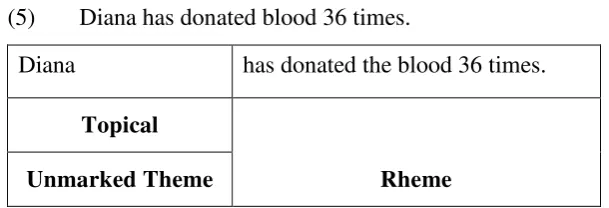
(5) Diana has donated blood 36 times.
Diana has donated the blood 36 times.
Topical
Rheme Unmarked Theme
The difference between marked and unmarked Theme is exemplified as below:
Topical Theme Unmarked Topical Theme Marked
1 you+ can’t store protein protein + you can’t store
2 but you+ can’t store protein but protein + you can’t store
3 however you + can’t store protein however protein + you can’t store
Table 2.1 Table of differences Marked and Unmarked Theme
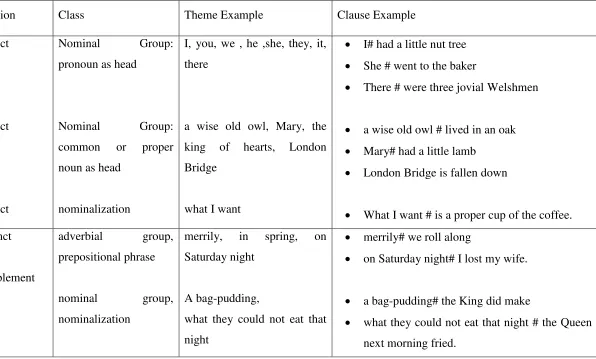
Halliday determines the unmarked Theme and marked Theme in declarative
Function Class Theme Example Clause Example king of hearts, London Bridge
what I want
• I# had a little nut tree • She # went to the baker
• There # were three jovial Welshmen
• a wise old owl # lived in an oak • Mary# had a little lamb
• London Bridge is fallen down
• What I want # is a proper cup of the coffee.
merrily, in spring, on Saturday night
A bag-pudding,
what they could not eat that night
• merrily# we roll along
• on Saturday night# I lost my wife.
• a bag-pudding# the King did make
• what they could not eat that night # the Queen next morning fried.
Table 2.1 Theme in declarative clause by Halliday (1985: 46)
The main principle in identifying the Theme of the clause is that a clause
must contain one, and only one topical Theme. Once we have identified the topical
Theme in the clause, we can consign all the remaining clause constituents to the
Theme role. (Enggins, 2004: 302)
For example:
(6) In Greece they give you nothing. In Greece they give you nothing.
Topical
Rheme Marked Theme
The first constituent is a circumstance of location, therefore it is a topical
Theme. The rest of the clause is Rheme.
(7) However, cries are discomforting.
However, cries are discomforting.
Topical Theme
Rheme Theme
In this clause, the first constituent is a textual Theme, it is ‘however’. It is
followed by the subject of the carrier ‘cries’ as the Topical Theme. All the
2.3.2 Interpersonal Theme
Interpersonal Theme is used when the speaker or writer wants to projects his
or her angle on the value of what the clause is saying. It covers one or more of the
elements of finite, Wh-element, vocative and modal adjunct. Finite in interpersonal
function is realized by an auxiliary. In a clause indicates that a respond is expected
from the addressee. Finite as Theme in a clause make the type of the sentence in a
question or imperative form and sometimes in inversion form. If it is as simple
Theme, but it is as a part of complex Theme, it is not must or inference the sentence
or clause mood. For example (Gerot, 1994:111):
(8) Did we decide to wait?
Did we decide to wait?
Interpersonal Theme Rheme
A WH-element covers all of WH-question word as Theme in a clause
whether it is as simple or complex Theme, such as: what, when, where, why, whom,
which, whose, and also how. The WH-question makes the mood of the clause always
in question form for the simple Theme but if it is complex Theme is isn’t always in
question form, for example:
(9) What time we will go tomorrow?
What time will we go tomorrow?
Vocative indicates persons or the names of the person to whom the
information is asked. Vocative Theme always separated by commas because in this
chance the name of the person indicates as the person to whom the question is asked.
Vocative always in terms of person’s name, for example: (Gerot, 1994:110)
(10) Mary, we decided to wait until next week?
Mary, We decide to wait until next week?
Interpersonal Theme Rheme
Modal Adjunct in interpersonal Theme typically is coded by certain adverb in
a clause. Adjunct commonly functions as Theme. Adjunct as Theme in a clause
provide or indicates the speaker’s comment, and assessment or attitude towards the
message, for example (Gerot, 1994:110):
(11) Perhaps, we can wait until next week.
Perhaps, we can wait until next week.
Interpersonal Theme Rheme
2.3.3 Textual Theme
Textual Theme makes explicit the way the clause related to the surrounding
discourse. It covers four element of Theme, they are: (1) conjunction, (2) relative, (3)
conjunctives, (4) continuatives. It is different from interpersonal Theme, textual
Theme concern to the cohesive part of a clause or text, in interpersonal Theme it is
coordination relation. So for the conjunction, it is only the coordinate conjunction
such as: and, but, so, whether, when, while, etc.
For example (Enggins, 1994:306):
(12) And he proposes marriage.
And he proposes marriage.
Textual Theme Topical Themes
Rheme Theme
Relatives also relate a dependent clause to another clause, relatives relate to
the clause by using the relative pronouns such as: which, what, who, when, where,
etc in sentence which the Theme is the relative element, the sentence must consist of
one independent clause and one subordinate clause. What we call as complex
sentence.
For example:
(13) The house which we are going to buy had been sold.
The house which we are going to buy had been sold.
Topical Textual Theme
Rheme Theme
Conjunctives indicate by a transitional signal which provides a cohesive like
to the discourse. By a conjunctive and the text, the condition of the text can be
cohesive. The conjunctives such as: consequently, furthermore, in addition, in
For example (Gerot, 1994:106):
(14) Well, on the other hand, we could wait.
Well, on the other hand, we could wait
Textual Theme Textual Theme Topical Theme
Rheme Theme
Continuatives also make the condition of a text cohesive. Continuatives
indicate a relationship to the previous discourse. By continuatives, we can know
what they continue idea from the continue idea from the previous chapter or
discourse. Continuatives such as: right, well, oh, thus, etc.
For example, in Gerot (1994: 106):
(15) Right, what we needed to do today is revise for our test. Right, what we need to day is revise for our best.
Textual Theme Topical Theme
Rheme Theme
2.3.4 Multiple Themes
The Theme and Rheme is the basic form of the organization of the clause of
the message. There is always an ideational/ topical element in the Theme. When the
topical Theme is preceded the textual and interpersonal Theme, it is called as
multiple Theme.
For Example given by Gerot and Wignel (1994:108)
But, Mary, surely we can wait until next week Textual Interpersonal Interpersonal Topical
Rheme Theme
From the example above we can see the Theme and Rheme inside the sentence
where the Theme “well, kids, tomorrow we and the left clause “will go to the zoo is
the Rheme.
But, Mary, surely we
Theme Rheme
can wait until next week.
Then, based on textual function we can see that there is three kinds Theme in
that sentence, they are textual Theme, interpersonal Theme, and textual Theme.
Textual Theme : but
Interpersonal Theme : Mary, surely
Topical Theme : we
2.4 Method of Development
According to Enggins (2004:324) method of development of Theme is very
significant contribution because it deals with how Thematic elements succeed each
other. It means that considering how the development of theme is important to make
the information connected cohesively. The Theme selection is connected with how
the information is developed in the text. Fries in Martin (1997:434) says that the
combination of Themes in the text is known as the Thematic development.
Three main patterns of Thematic development can be observed as below:
2.4.1 Theme Re-Iteration
Theme Re-Iteration is a basic way to keep a text focused. The Theme is
repeated to build the next information. This type of Thematic pattern, where the same
element occurs regularly as Theme. It can be demonstrated as below:
Theme1 Rheme1
Theme1 Rheme2
Theme1 Rheme3
Diagram 2.2 Re-Iteration Pattern
This pattern is exemplified is this text:
1. Mr. Black
2.
is our new neighbor.
He
3.
lives next to our apartment.
He
4.
seems like to sing.
He
5.
sings every time.
He
2.4.2 Theme Zig-zag
, somehow, bother us with his singing.
In this pattern, an element which is introduced in the Rheme in the clause 1
in the previous Rheme. The Zig-zag Pattern achieves cohesion in the text by building
on newly introduced information. This pattern can be diagrammed in Figured 2.3
Clause 1 Theme Rheme
Clause 2 Theme Rheme
Clause 3 Theme Rheme
Diagram 2.2 Re-Iteration Pattern
The text below is an example of Zig-zag Pattern
1. For Christin Poirier, psychology is central to her occupation as a
2.
social worker
As a social worker, Poirier works at a community mental health center
3.
where she helps children and adolescents
4.
who
(Source Introduction to Psychology: a module, not published) are experiencing emotional or behavioral difficulties or both.
2.4.3 The Multiple-Rheme Pattern
In this pattern, the Theme of one clause introduces a number of different
pieces of information, each of which is then picked up and made Theme in
elaborating on each of main thematic points. In the other words, the multiple Rheme
consist of the Zig-zag Pattern and Re-iteration Pattern to elaborate the information in
the text. The multiple-Rheme pattern of thematic development can be
diagrammatically figured as below:
Clause 1 Theme Rheme
Clause 2 Theme pRheme
Clause 3 Theme Rheme
Clause 4 Theme Rheme
For example:
Text 1.
The three main reasons babies cry are hunger, cold, and illness
Hunger can be determined by considering when the baby was last fed. .
Babies feel cold more actually than we do and the smaller the baby, the more warmly
it should be wrapped up.
Finally, sickness of pain may also be signaled by crying.
(Source: Enggins, 2004:325)
Text 2.
There are many things people remember about sixties.
Some people remember it for mini-skirts, the Beatles, hippies, and the flower
children.
It
(Richards’ Intercahnge I, 1991:7)
was a time when young people owned the world and thought that anything was
CHAPTER III
RESEARCH METHODOLOGY
3.1 Research Method
This thesis applies descriptive qualitative method, namely by identifying and
analyzing the Theme in advertisements in People Magazine. Hamidi (2004) explains
in his book that qualitative method is a procedure which results a descriptive data.
Moleong (2004:3) says that qualitative research is the research that the data collected
consist of words, pictures, and not number, and the background of descriptive
research is interpretative paradigm, and does not on result but in the prioritizes the
process of research. In this thesis, this method will be applied by giving the
distribution of Theme and Rheme found in the advertisements in People Magazine.
3.2 Data and Data Source
The data is the every clause found 12 selected advertisements in People
Magazine. There are found 102 clauses to be analyzed. The source of the data is the
advertisements in People Magazine published in July 8th 2013. The advertisements
selected are : Olay Regenerist, Olay Regenerist Eyelash Duo, Clinique, Aveeno
Active Natural, Banana boat Protect & Hydrate, Miracle whip, Gerber Graduates
Snacks, A.1. Steak Sauce, Dreyer’s Outshine Fruit Bars, Ore Ida Tater Tots; Bio
3.3 Data Collecting Method
The method that is used in collecting the data is documentation method since
the data source is written source. Nawawi (1991:133) states that documentation
method is a technique of collecting data by categorizing and classifying the written
document that has relation with the problem discussed, whether from document or
books, newspaper, magazine, etc.
3.3 Data Analyzing Method
In writing this thesis the writer uses descriptive qualitative method. Miles and
Huberman (1992:20) explain that there are four main components in descriptive
qualitative research. Those components can be portrayed as bellows.
Picture 3.1 Components of Data Analysis by Miles and Huberman
The steps of analyzing the data are explained as follows:
1. Data Collection.
this magazine. The advertisements is reduced so12 advertisements are
selected. The advertisements are selected based from the clause contained in
the advertisements. The advertisement must has at least 4 clauses to be
analyzed.
2. Data Reduction
Next, the sentences found in data source are divided into clauses. The data
used are every single major clause found in selected advertisement.
3. Data Display
In this step, the data will be analyzed in two ways to answer the previous
problems in chapter I.
a. First, the every clause is classified and analyzed by applying Halliday’s
theory. It is displayed in a table to make the analysis clear. The
explanations of the table are described under the table. Here are some
examples found in the People Magazine:
1. Ideational Themes
The Gerber Generation has a firm grasp on nutrition.
The Gerber Generation has a firm grasp on nutrition. Topical
RHEME THEME
This clause consists of Topical Theme. The clause above begins with
the Topical Theme which is realized by the “The Gerber Generation”. It is an
unmarked Theme because it is the name of the product and takes role as the
subject of the clause. It is followed by “has a firm grasp on nutrition” which
2. Interpersonal Themes
Would you recognize ovarian cancer?
Interpersonal Topical
RHEME THEME
The clause above consists of Interpersonal Theme, and Topical
Theme. The clause begins with the Interpersonal Theme which is the word
‘would”. In this clause, ‘would’ is the finite in interrogative clause. It is
followed by the topical Theme pronoun ‘you’. The Rheme is ‘recognize
ovarian cancer?’ which is the rest of the clause.
b. After that, the pattern of Theme Development is determined by applying
Enggins’ theory to find whether the text use Reiteration Pattern, Zig-zag
Pattern or Multiple Pattern.
Below is an example of the analysis:
The Gerber Generation has a firm grasp on nutrition.
Gerber Graduates Snacks -made with the goodness of whole grains. The
nutrition and feeding experts at Gerber. Gerber have created delicious
snacks that aren’t just nutritious but designed specifically to help your
little one develop those essential feeding skills.
Clause 1 T1 (The Gerber Generation)
Clause 2 T2 (
R1 (has.… nutrition.)
Gerber Graduates Snacks)
Clause 3 T3 (
R2 (-made with … grains)
The nutrition … Gerber)
In this advertisement, the Themes are developed by using Reiteration
pattern. The first Theme “The Gerber Generation” is reiterated as the element
of Theme in the Clause 2 “Gerber Graduates Snacks”. The Theme on the
Clause 3 “The nutrition and feeding experts at Gerber” is also built from the
preceding Theme.
R3 (have ... feeding skills).
4. Conclusion
Finally, the conclusions answering the problems of this thesis are derived
according to the previous analysis. The suggestions also offered for the
CHAPTER IV
ANALYSIS AND FINDINGS
4.1Introduction
In this chapter will be described the analysis of the data to answer the
problems occurring in the Chapter I. They are to find out the types of Theme in
advertisements in the People Magazine and to find out how their Theme
Development. In 4.2 is explained the distribution of Theme and Rheme of the
selected data. The analysis will be displayed according to the first Theme occurring,
whether it’s Topical, Interpersonal, or Textual. In 4.3 the findings of types of Themes
will be portrayed.
In the next part, 4.4, will be described the Theme Development of each
advertisements. It is discussed how each clause supports each other. After that, in 4.5
is discussed the finding of Theme development.
4.2Data Analysis
The source of the data is the advertisements in People Magazine published in
July 8th 2013. The data is the every clause found 12 selected advertisements in
People Magazine. There are 102 clauses to be analyzed. There are found 95 Topical
Themes, 5 Interpersonal Themes, 26 Interpersonal Themes, and 28 Multiple Themes.
The analysis of each Themes is discussed below:
4.2.1Ideational (Topical) Theme
Ideational Theme is also called Topical Theme. It is coded by the first
element of the transitivity system. It can be a participant, process, or circumstance.
Ideational or Topical Theme can be divided into two kinds; they are marked Theme
and unmarked Theme. The main principle in identifying the Theme of the clause is
that a clause must contain one, and only one Topical Theme. Once the Topical
Theme in the clause have been identified, all the remaining clause constituents can
be consigned to the Rheme role. Below are the data and the analysis of Topical
Themes found in advertisements in People Magazine:
1. See brighter, firmer eyes in just one week. (Olay)
See brighter, firmer eyes’ in just one week. Topical
RHEME THEME
The clause above consists of Topical Theme for the imperative clause. The
word ’see’ is as the Topical Theme. It is called marked Theme because the Theme
does not take role as the subject of the clause. The Rheme is “brighter, firmer eyes in
just one week” which is the new items in the clause.
2. Gently, dap the cream around your eyes to soften the appearance of lines and smooth the look of the lids. (Olay)
Gently dap the cream around your eyes to soften the appearance of lines and smooth the look of the lids
Topical
This clause consists of Topical Theme. The clause above begins with the
Topical Theme which is realized by the “Gently”. It is a marked Theme as it is an
adverb and not the subject of the clause. It is followed by “the cream around your
eyes to soften the appearance of lines and smooth the look of the lids” that is the
Rheme.
3. It all starts with Olay Regenerist Eye and Lash Duo (Olay Regenerist Eye and Lash Duo)
it all starts with Olay Regenerist Eye and Lash Duo Topical
RHEME THEME
This clause consists of Topical Theme. The clause above begins with the
Topical Theme which is realized by the “it all”. It is an unmarked Theme as it is
pronoun and the subject of the clause. The rest of the clause, “starts with Olay
Regenerist Eye and Lash Duo” is the Rheme.
4. Finish the look with a dab of cream blush and glossy lip. (Olay Regenerist Eye and Lash Duo)
Finish the look with a dab of cream blush and glossy lip. Topical
RHEME THEME
The clause above consists of Topical Theme for the imperative clause. The
word ‘finish’ is as the Topical Theme. It is called marked Theme because the Theme
does not take role as the subject of the clause. The Rheme is “the look with a dab of
5. Some people find nails enamels irritating- not just on their hand, but all around their eyes. (Clinique)
Some people
find nails enamels irritating- not just on their hand, but all around their eyes.
Topical
RHEME THEME
This clause consists of Topical Theme. The clause above begins with the
Topical Theme which is realized by the “some people”. It is an unmarked Theme as
it is noun and the subject of the clause. It is followed by “find nails enamels
irritating- not just on their hand, but all around their eyes” which is the Rheme.
6. For a long time this mouth was slammed to Miracle Whip (Miracle Whip)
For a long time this mouth was slammed to Miracle Whip Topical
RHEME THEME
This clause consists of Topical Theme. The clause above begins with the
Topical Theme which is realized by the “for a long time”. It is a marked Theme
because it is adjunct circumstantial giving information of time. It is followed by
“this mouth was slammed to Miracle Whip” which is the Rheme.
7. Exclusive Active Naturals Total Formula is proven to improve: tone, texture, blotchiness, dullness, brown spots. (Aveeno)
Exclusive Active Naturals Total Formula is proven to improve: tone, texture, blotchiness, dullness, brown spots. Topical
This clause consists of Topical Theme. The clause above begins with the
Topical Theme which is realized by the “Exclusive Active Naturals Total Formula”.
It is an unmarked Theme because it is nominal group and takes role as the subject of
the clause. It is followed by “is proven to improve: tone, texture, blotchiness,
dullness, brown spots” which is the Rheme.
8. The Gerber Generation has a firm grasp on nutrition. (The Gerber Generation) The Gerber Generation has a firm grasp on nutrition.
Topical
RHEME THEME
This clause consists of Topical Theme. The clause above begins with the
Topical Theme which is realized by the “The Gerber Generation”. It is an unmarked
Theme because it is the name of the product and takes role as the subject of the
clause. It is followed by “has a firm grasp on nutrition” which is the Rheme.
9. You’re one spectacular person. (AIsaos)
You are one spectacular person.
Topical
RHEME THEME
This clause consists of Topical Theme. The clause above begins with the
Topical Theme which is realized by the “You”. It is an unmarked Theme as it is
pronoun and the subject of the clause. The rest of the clause, “are one spectacular
10.Try Biotrue. (Biotrue.)
Try Biotrue.
Topical
RHEME THEME
The clause above consists of Topical Theme for the imperative clause. The
word ’try’ is as the Topical Theme. It is marked Theme because the Theme does not
take role as the subject of the clause. The Rheme is “Biotrue.” which is the new
items in the clause.
11.The Dreyer’s Fruits Bar you know and love are now called Outshine bars. (Outshine)
The Dreyer’s Fruits Bar you know and love
are now called Outshine bars.
Topical
RHEME THEME
This clause consists of Topical Theme. The clause above begins with the
Topical Theme which is realized by the “The Dreyer’s Fruits Bar you know and
love”. It is an unmarked Theme because it is a nominalization and takes role as the
subject of the clause. It is followed by “are now called Outshine bars” which is the
12.Kell, Ripa and QVC Program Host Lisa Robertson know that ovarian cancer often disguises itself as other illness. (Ovarian)
Kell, Ripa and QVC Program Host Lisa
Robertson
know that ovarian cancer often disguises itself as other illness.
Topical RHEME
THEME
This clause consists of Topical Theme. The clause above begins with the
Topical Theme which is realized by the “Kell, Ripa and QVC Program Host Lisa
Robertson”. It is an unmarked Theme because it is takes role as the subject of the
clause. It is followed by “know that ovarian cancer often disguises itself as other
illness” which is the Rheme.
13.Banana Boat Protect and Hydrate provides all-day moisture with broad spectrum UVA/UVB protection and aloe vera. (Banana Boat Protect and Hydrate)
Banana Boat Protect and Hydrate
provides all-day moisture with broad spectrum UVA/UVB protection and aloe vera. Topical
RHEME THEME
This clause consists of Topical Theme. The clause above begins with the
Topical Theme which is the name of the product “Banana Boat Protect and
Hydrate”. It is an unmarked Theme because it is takes role as the subject of the
clause. It is followed by “provides all-day moisture with broad spectrum UVA/UVB
14.The kids from the Justice for Potatoes League want you to know The kids from the Justice for Potatoes
League
want you to know
Topical
RHEME THEME
This clause consists of Topical Theme. The clause above begins with the
Topical Theme which is the name of the product “The kids from the Justice for
Potatoes League”. It is an unmarked Theme because it is takes role as the subject of
the clause. It is followed by “want you to know.” which is the Rheme.
4.2.2 Interpersonal Theme
Interpersonal Theme is used when the speaker or writer wants to projects his or
her angle on the value of what the clause is saying. It covers one or more of the
elements of finite, Wh-element, vocative and modal adjunct. Below are the
Interpersonal Theme found in the advertisements in People Magazine:
1. Just see what this amazing duel eye treatment can do. (Olay)
Just see what this amazing duel eye treatment can do. Interpersonal Topical
RHEME THEME
The clause above consists of Interpersonal Theme for the imperative clause.
The word ’Just’ is the interpersonal Theme . Just’ is a mood adjunct. It is followed
by the Topical Theme ‘see’. The Rheme is “brighter, firmer eyes in just one week”
2. Just because they didn’t carry your beloved sauce. (AI Sauce)
Just because they didn’t carry your beloved sauce. Interpersonal Textual Topical
RHEME THEME
The clause above consists of Interpersonal Theme, Textual Theme and
Topical Theme. The word ’Just’ is the interpersonal Theme which occurs in the
beginning of the clause. Just’ is a mood adjunct. It is followed by the textual Theme
“because” and Topical Theme ‘they’. The Rheme is “didn’t carry your beloved
sauce” which is the new items in the clause.
3. Are your contacts calling it quits before your eyes do? (Biotrue)
Are your contacts calling it quits before your eyes do? Interpersonal Topical
RHEME THEME
The clause above consists of Interpersonal Theme, and Topical Theme. The
clause begins with the interpersonal Theme which is the word ‘are’. In this clause,
‘are’ is the finite in interrogative clause. It is followed by the Topical Theme ‘your
contacts’. The Rheme is “calling it quits before your eyes do??” which is the rest of
the clause.
4. Would you recognize ovarian cancer? (Ovarian)
Would You recognize ovarian cancer?
Interpersonal Topical
RHEME THEME
The clause above consists of Interpersonal Theme, and Topical Theme. The
clause, ‘would’ is the finite in interrogative clause. It is followed by the Topical
Theme pronoun ‘you’. The Rheme is “recognize ovarian cancer?” which is the rest
of the clause.
5. In fact it helps to even tone and texture for more radiant looking skin. (Aveeno)
In fact it
helps to even tone and texture for more radiant looking skin.
Interpersonal Topical
RHEME THEME
The clause above consists of Interpersonal Theme, Textual Theme and
Topical Theme. The word ’In fact’ is the interpersonal Theme which occurs in the
beginning of the clause. It is modal adjunct showing admissive . It is followed by the
Topical Theme which is the pronoun ‘it’. The Rheme is “helps to even tone and
texture for more radiant looking skin.” which is the new items in the clause.
4.2.3Textual Theme
Textual Theme makes explicit the way the clause related to the surrounding
discourse. It covers four element of Theme, they are: (1) conjunction, (2) relative, (3)
conjunctives adjunct, (4) continuatives. Below are the Textual Theme found in the
advertisements of People Magazine:
1. Now you’re ready to create a dramatic eye – (Olay Regenerist)
Now You are ready to create a dramatic eye –
Textual Topical
The clause above consists of Textual Theme, and Topical Theme. The clause
begins with the textual Theme which is the word “now”. In this clause, ‘now’ is the
continuative word linking up the previous clause. It is followed by the Topical
Theme pronoun ‘you’. The Rheme is “are ready to create a dramatic eye –” which is
the rest of the clause.
2. Then addtwo coats of mascara
then add two coats of mascara
Textual Topical
RHEME THEME
The clause above consists of Textual Theme, and Topical Theme. The clause
begins with the textual Theme which is the word “then”. In this clause, ‘then’ is the
conjunction word linking up the previous clause. It is followed by the Topical Theme
which is realized in imperative word ‘add’. The Rheme is “two coats of mascara”
which is the rest of the clause.
3. Yes now you can wear nail enamel.
Yes now you can wear nail enamel.
Textual Textual Topical
RHEME THEME
The clause above consists of two Textual Themes, and a Topical Theme. The
clause begins with the textual Theme which is the word “yes”. In this clause, ‘yes’ is
the continuative word signaling the moving from the previous topic. It is followed by
the second textual Theme which is the word “now”. ‘Now’ is the conjunctive
adjunct. The Topical Theme is the pronoun ‘you’. The Rheme is “can wear nail
4. So we created a new different nail enamel for sensitive skin.
So we created a new different nail enamel for sensitive skin Textual Topical
RHEME THEME
The clause above consists of Textual Theme, and Topical Theme. The clause
begins with the textual Theme which is the word “so”. In this clause, ‘so’ is the
continuative word signaling the moving from the previous topic. It is followed by the
Topical Theme pronoun ‘we’. The Rheme is “created a new different nail enamel for
sensitive skin” which is the rest of the clause.
5. Until finally it smeared on wheat
Until Finally it smeared on wheat
Textual Interpersonal Topical
RHEME THEME
The clause above consists of Textual Themes, Interpersonal Themes and
Topical Theme. The clause begins with the textual Theme which is the word “until”.
‘Until’ is the conjunction word linking up the previous topic. It is followed by the
second Interpersonal Theme which is the word “finally”. The Topical Theme is the
pronoun ‘it’. The Rheme is “smeared on wheat” which is the rest of the clause.
6. So, what’s your hold up.
So, what’s your hold up.
Textual Topical
The clause above consists of Textual Theme, and Topical Theme. The clause
begins with the textual Theme which is the word “so”. In this clause, ‘so’ is the
continuative word signaling the moving from the previous topic. It is followed by the
Topical Theme ‘what’s’. The Rheme is “your hold up.” which is the rest of the
clause.
7. but designed specifically to help your little one develop those essential feeding skills.
but designed specifically
to help your little one develop those essential feeding skills.
Textual Topical
RHEME THEME
The clause above consists of Textual Theme and Topical Theme. The clause
begins with the textual Theme which is the word “but”. ‘But’ is the conjunction
coordinator word linking up the previous clause. The Topical Theme is the verb
“designed specifically”. As the process in transitivity, it is unmarked theme. It is
followed by the Rheme is “to help your little one develop those essential feeding
skills.” which is the rest of the clause.
8. Because, you could be increased risk for plaque buildup in your arteries over time.
Because, You
could be increased risk for plaque buildup in your arteries over time. Textual Topical
The clause above consists of Textual Theme, and Topical Theme. The clause
begins with the textual Theme which is the word “because”. In this clause, ‘because’
is the conjunctive word linking up the previous topic. It is followed by the Topical
Theme pronoun ‘you’. The Rheme is “could be increased risk for plaque buildup in
your arteries over time” which is the rest of the clause.
9. When diet and exercise alone aren’t enough,
When diet and exercise alone aren’t enough,
Textual Topical
RHEME THEME
The clause above consists of Textual Theme, and Topical Theme. The clause
begins with the textual Theme which is the word “when”. In this clause, ‘when’ is
the relative word. It is followed by the Topical Theme ‘diet and exercise alone’. The
Rheme is “aren’t enough,” which is the rest of the clause.
10.Now with Outshine bars you can experience 24 deliciously refreshing ways to make every day a light brighter.
Now, with Outshine bars
you can experience 24 deliciously refreshing ways to make every day a light brighter.
Textual Topical
RHEME THEME
The clause above consists of Textual Theme, and Topical Theme. The clause
begins with the textual Theme which is the word “now”. In this clause, ‘now’ is the
continuative word linking up the previous clause. It is followed by the Topical
Theme ‘with Outshine bars’. The Rheme is “you can experience 24 deliciously
4.2.4Multiple Theme
There is always an ideational/ topical element in the Theme. When the topical
Theme is preceded the textual and interpersonal Theme, it is called as multiple
Theme. Below are some of multiple Theme found in advertisements in People
Magazine:
1. Just because they didn’t carry your beloved sauce. (AI Sauce)
just because they didn’t carry your beloved sauce. Interpersonal Textual Topical
RHEME THEME
The clause above consists of Interpersonal Theme, Textual Theme and
Topical Theme. The word ’Just’ is the interpersonal Theme which occurs in the
beginning of the clause. Just’ is a mood adjunct. It is followed by the textual Theme
“because” as the conjunction from the preceding topic. After that, it is followed by
Topical Theme pronoun ‘they’. The Rheme is “didn’t carry your beloved sauce”
which is the new items in the clause.
2. Until finally it smeared on wheat
Until Finally it smeared on wheat
Textual Interpersonal Topical
RHEME THEME
The clause above consists of Textual Theme, Interpersonal Theme and
Topical Theme. The clause begins with the textual Theme which is the word “until”.
‘Until’ is the conjunction word linking up the previous topic. It is followed by the
Theme is the pronoun ‘it’. The Rheme is “smeared on wheat” which is the rest of the
clause.
3. In fact, it helps to even tone and texture for more radiant looking skin. (Aveeno)
In fact it
helps to even tone and texture for more radiant looking skin.
Interpersonal Topical
RHEME THEME
The clause above consists of Interpersonal and Topical Theme. The word “In
fact ” is the Interpersonal Theme occurring in the beginning of the clause. It is the
modal adjunct. The following Topical Theme is the pronoun “it”. Rheme is “helps to
even tone and texture for more radiant looking skin” which is the rest of the clause.
4. Are your contacts calling it quits before your eyes do?
Are your contacts calling it quits before your eyes do? Interpersonal Topical
RHEME THEME
The clause above consists of Interpersonal and Topical Theme. The word
“Are ” is the Interpersonal Theme occurring in the beginning of the clause. It is the
finite. The following Topical Theme is the noun phrase “your contact”. Rheme is
“calling it quits before your eyes do?” which is the rest of the clause.
5. So we created a new different nail enamel for sensitive skin.
The clause above consists of Textual Theme, and Topical Theme. The clause
begins with the textual Theme which is the word “so”. In this clause, ‘so’ is the
continuative word signaling the moving from the previous topic. It is followed by the
Topical Theme pronoun ‘we’. The Rheme is “created a new different nail enamel for
sensitive skin” which is the rest of the clause.
4.3 Findings
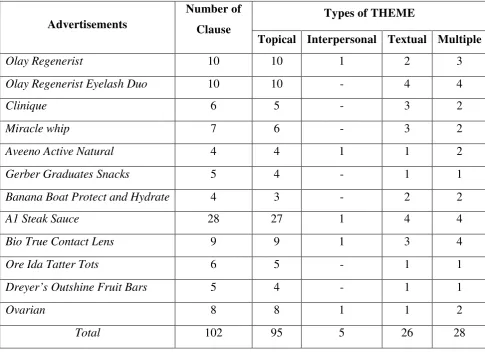
According to the preceding analysis, the result is summarized in the table below:
Table. 4.2 Table of Theme and Their Occurrence in Each Advertisement Text
Table 4.2 shows that the Olay Regenerist text consists of 10 clauses, there
are 10 Topical Theme, 1 Interpersonal Theme, 2 Textual Theme, and 3 Advertisements
Number of Clause
Types of THEME
Topical Interpersonal Textual Multiple
Olay Regenerist 10 10 1 2 3
Olay Regenerist Eyelash Duo 10 10 - 4 4
Clinique 6 5 - 3 2
Miracle whip 7 6 - 3 2
Aveeno Active Natural 4 4 1 1 2
Gerber Graduates Snacks 5 4 - 1 1
Banana Boat Protect and Hydrate 4 3 - 2 2
A1 Steak Sauce 28 27 1 4 4
Bio True Contact Lens 9 9 1 3 4
Ore Ida Tatter Tots 6 5 - 1 1
Dreyer’s Outshine Fruit Bars 5 4 - 1 1
Ovarian 8 8 1 1 2
Multiple Theme. Olay Regenerist Eyelash Duo text consists of 10 clauses, there are
10 Topical Theme, no Interpersonal Theme, 4 Textual Theme, and 3 Multiple
Theme. Clinique text consists of 6 clauses, there are 5 Topical Theme, no
Interpersonal Theme, 4 Textual Theme, and 4 Multiple Theme. Miracle whip text
consists of 7 clauses, there are 6 Topical Theme, no Interpersonal Theme, 3
Textual Theme, and 2 Multiple Theme. Aveeno Active Natural text consists of 4
clauses, there are 4 Topical Theme, 1 Interpersonal Theme, 1 Textual Theme, and
2 Multiple Theme. Gerber Graduates Snacks text consists of 5 clauses, there are 4
Topical Theme, no Interpersonal Theme, 2 Textual Theme, and 2 Multiple Theme.
Banana Boat Protect and Hydrate text consists of 4 clauses, there are 3 Topical
Theme, no Interpersonal Theme, 2 Textual Theme, and 2 Multiple Theme. A1 Steak
Sauce text consists of 28 clauses, there are 27 Topical Theme, 1 Interpersonal
Theme, 4 Textual Theme, and 4 Multiple Theme. Bio True Contact Lens text
consists of 9 clauses, there are Topical Theme, no Interpersonal Theme, 4 Textual
Theme, and 3 Multiple Theme. Ore Ida Tatter Tots text consists of 6 clauses, there
are 5 Topical Theme, no Interpersonal Theme, 1 Textual Theme, and 1 Multiple
Theme. Dreyer’s Outshine Fruit Bars text consists of 8 clauses, there are 8 Topical
Theme, no Interpersonal Theme, 1 Textual Theme, and 1 Multiple Theme. Ovarian
text consists of 8 clauses, there are 8 Topical Theme, 1 Interpersonal Theme, 1
Textual Theme, and 2 Multiple Theme
According to the table 4.2 above it can seen that entirely from the 102 clauses
the Topical Theme occurs dominantly as many as 92 clauses, while the Interpersonal
Themes occurs only 5 times. The Textual Themes are found as many as 26 clauses