TECHNICAL UNIVERSITY MALAYSIA, MELAKA
APPLICATION OF COLORS SENSOR IN AN
AUTOMATED SYSTEM
Thesis submitted in accordance with the requirement of the Technical
University Malaysia Melaka for Degree of Bachelor of Manufacturing
Engineering (Robotic and Automation)
By
Norfazlinda Binti Daud
UTeM Library (Pind.1/2005)
JUDUL : APPLICATION OF COLOR SENSOR IN AN AUTOMATED SYSTEM
SESI PENGAJIAN : 2006/2007
Saya NORFAZLINDA BINTI DAUD (HURUF BESAR)
mengaku membenarkan tesis (PSM/Sarjana/Doktor Falsafah) ini disimpan di Perpustakaan Universiti Teknikal Malaysia Melaka (UteM) dengan syarat-syarat kegunaan seperti berikut:
1. Tesis adalah hak milik Universiti Teknikal Malaysia Melaka.
2. Perpustakaan Universiti Teknikal Malaysia Melaka dibenarkan membuat salinan untuk tujuan pengajian sahaja.
3. Perpustakaan dibenarkan membuat salinan tesis ini sebagai bahan pertukaran antara institusi pengajian tinggi. termaktub di dalam AKTA RASMI 1972)
* Tesis dimaksudkan sebagai tesis bagi Ijazah Doktor Falsafah dan Sarjana penyelidikan, atau disertasi bagi pengajian secara kerja kursus dan penyelidikan, atau Laporan Projek Sarjana Muda (PSM).
** Jika tesis ini SULIT atau TERHAD, sila lampirkan surat daripada pihak berkuasa/organisasi berkenaan dengan menyatakan sekali sebab dan tempoh tesis ini perlu dikelaskan sebagai SULIT atau TERHAD
UNIVERSITI TEKNIKAL MALAYSIA MELAKA
BORANG PENGESAHAN STATUS TESIS*
APPROVAL
This thesis submitted to the senate of UTeM and has been accepted as fulfillment of the requirement for the degree of Bachelor of Engineering Manufacturing (Robotic
and Automation). The members of the supervisory committee are as follows:
……….. (MR SHARIMAN BIN ABDULLAH)
Main supervisor
DECLARATION
I hereby, declare this project entitled “Application of Color Sensor in an Automated System” is the result of my own research except as cited in the reference.
Signature : ………
ABSTRACT
ABSTRAK
ACKNOWLEDGEMENTS
Appreciations are expressed to those who have given generous contributions within the period of this thesis development to fulfill the requirement of the Degree of Bachelor of Engineering (Honours) Manufacturing (Robotic and Automation) program.
Here I would like to express my deepest appreciation to my supervisor, Mr. Shariman B. Abdullah, also acts as chief of Department Robotic and Automation of Faculty of Manufacturing Engineering in Technical University Malaysia, Melaka. His constant guidance and support during my thesis writing is invaluable to me. His continuous direction and opinion regarding the flow of the project has a mass contribution to achieve the objective of the project. Furthermore, the guide and help of him on how to make this thesis a more effective reference are followed with my sincere gratitude.
Finally, I would like to thank to all lectures, technicians especially En. Muhammad Asari B. Abdul Rahim that given assistance and guidance for fabricating the conveyor. All my friends especially Zakaria who help me a lot in the programming. I also want to thank to who had involved directly or indirectly in my thesis. In addition, I would like to thank the college for providing all the equipments as well as materials needed to fabricate my project.
Thank you.
TABLE OF CONTENTS
1.1 Introduction to the project 1-2
1.2 Problem Statement 2-3
1.3 Objectives, Aims and Scopes of the Research 3
1.3.1 Objectives 3
2.1 Color Identification 7
2.1.1 Color Theory 8-9
2.1.2 Color and Light 10-11
2.2 Color Sensor 11-12
2.3 Sorting 12
2.3.1 Sorting Information or Data 12-13
2.3.2 Physical Sorting Processes 13
2.3.4 Color Sensor Applications 20-21
2.4 Color Sensor 21
2.4.1 TCS230 Sensor 21-23
2.5 BASIC Stamp 23
2.5.1 Introduction to the BASIC Stamp 23-24
2.5.2 PBASIC Language 24
2.5.3 Hardware:Board of Education (Rev. B) 24-25 2.5.4 The Communication of Board of Education
(BOE) with TCS230 Color Sensor
25-30
3 METHODOLOGY 31
3.1 Flowchart 31
3.2 Details 32-33
3.3 Selection of Materials 33
3.3.1 Rubber belt 33
3.4.3.1 Detail of TCS 230 Color Sensor 39-45
3.4.4 Microcontroller 46-47
3.4.5 BASIC Stamp 48
3.4.5.1 Basic Information Using BASIC Stamp Editor
48-51
3.4.5.2 Getting Started TCS230 RGB Color Sensor to a BASIC Stamp
Microcontroller
51-52
3.5 Calculation of parameters needed. 52
3.5.1 Relationship among torque, power and rotational speed
53
3.5.3 Calculation of motor selection 55-57
3.6 Preparation of detail drawing 57
3.7 Programming 57
4 RESULT 58
4.1 Mechanical Design 58
4.2 Sketching of conveyor basic features 58-59 4.2.1 The Difference Structure between basic and actual
conveyor design
60-61
4.2.2 Bill of material 62
4.2.3 Final Fabrication of Conveyor. 63-64
4.3 Control system 64
4.3.1 Information of Programming 64-66
4.3.2 Programming to Identify RGB color 67-71
4.3.3 Application of Color Sensor 72-75
4.3.4 Forward and stop operation 76-78
5 DISCUSSION 79-82
6 CONCLUSION AND RECOMENDATION 83-84
LIST OF FIGURES
2.1 HSL diagram with Hue circle 8
2.2 Coordinates of hue, saturation and intensity of color in space 9
2.3 Model of color interpretation 9
2.4 Electromagnet radiation 10
2.5 Visual classification setup in an industrial setting 14
2.6 Automated sorting system 15
2.7 The overall structure of the ASSIST system 16 2.8 The semiautomatic cell for the sorting of wasted packaging
developed at Fraunhofer IPA
17
2.9 Block diagram of items on a conveyor belt being sorted by the apparatus
19
2.10 Simplified block diagram of color sorting system 19
2.11 Measuring color 22
2.12 TCS230 color Evaluation Module Connected to Basic Stamp 23 2.13 Board of Education shown with BS2-IC properly inserted 25
2.14 The TCS230 Color Sensor Module set 26
2.15 Sensor module color response 29
3.1 TCS230 Sensor Module Schematic 39
3.2 Package D 8-Lead SOIC 40
3.3 Function block diagram 41
3.4 Pin Configuration 43
3.5 Logic Symbol 43
3.6 DBV Package 45
3.7 NSPW500BS White LED 45
3.8 Basic Stamp 2p24 46
3.9 BASIC Stamp Windows Editor shown with 6 separate source code files open
49
3.11 Example Status Bar 50
3.12 Port status 50
3.13 Download Status 51
3.14 Basic belt drive geometry 53
4.1 Sketching of conveyor basic features 58
4.2 Isometric view for improvement conveyor structure 59 4.3 Right view for actual improvement conveyor 63
4.4 Top view for improvement conveyor. 63
4.5 Left view for improvement conveyor 63
4.6 Conveyor stand 64
4.7 Motor 64
4.8 Board of education 64
4.9 TCS 230 color 64
4.10 The sensor read the red color 67
4.11 The result from debug terminal for red color 68
4.12 The sensor read the blue color 69
4.13 The result from debug terminal for blue color 69
4.14 The sensor read the green color 70
4.15 The result from debug terminal for green color 70 4.16 The result from debug terminal for nothing 71
4.17 H-Bridge Relays Driven 72
4.18 Forward and stop operation 76
4.19 Reverse and stop operation 76
4.20 forward and stop circuit 77
5.1 The distance between 2 white LEDs with the sample product 80 5.2 Measuring the perfect focus for white LEDs at the sample
product
81
5.3 Covering the sensor from outside light 81
LIST OF TABLES
NUM TITLE PAGE
1.1 Gantt chart for PSM 1 5
1.2 Gantt chart for PSM 2 6
2.1 Color vs. Wavelength Range 11
2.2 Specification of TCS230 22
2.3 Setting of control lines oscillator 27
2.4 The BASIC Stamp port assignments 28
2.5 The decoding logic 28
3.1 Mechanical properties of aluminum 34
3.2 Advantages of aluminum 34
3.3 Advantages and disadvantages of DC motor 35
3.4 Power window motor specification 36
3.5 Relay specification 37-38
3.6 Relays advantages and disadvantages 38
3.7 Description of TCS230 Programmable Color (U2) 41
3.8 Scaling frequency 41
3.9 Photodiode selection 42
3.10 Pining 44
3.11 Function table 44
3.12 Terminal functions of TPS76301 44
3.13 BASIC Stamp 2p Pin Descriptions. 47
4.1 Basic Conveyor Specifications 60-61
4.2 Bill of Material 62
LIST OF ABBREVIATIONS, SYMBOLS, SPECIALIZED
NOMENCLATURE
AC - Alternating Current
ASSIST - Automatic System for Surface Inspection and Sorting of Tiles
BOE - Board of Education
B/W - Black and White
CCD - Charge Coupled Device
CMOS - Complementary Metal Oxide Semiconductor
CTRL - Control
DC - Direct Current
EEPROM - Electrically Programmable read-Only Memory HIS - Hue, Saturation and Intensity
TCS230EVM - TCS230 Evaluation Module
TV - Television
UV - Ultraviolet
3D - 3 Dimensional
CHAPTER 1
INTRODUCTION
1.1 Introduction To The Project
Industries today are approaching to use color sensor to fulfil their needs for a higher production and precise quality. Historically, components used for color sensing were considered expensive and required precision support circuitry, limiting their application mostly to specialized instrumentation. However, new technologies of color sensors with higher levels of integration are becoming available, allowing for more cost-effective solutions. As the cost of color sensing comes down, the number of applications using color sensing is increasing. Color sensors play a significant role in end equipment such as color-monitor calibration, color printers and plotters, paints, textiles, cosmetics manufacture and medical applications such as blood diagnostics, urine analysis, and dental matching. The complexity of a color sensor system is based largely on the number of wavelength bands, or signal channels, it uses to determine color. Systems can range from a relatively simple three-channel colorimeter to a multiband spectrometer.
Certain matters shall be looked upon to complete this project. Information concerning color sensor, their function, application and Basic Stamp programming should be search through many ways such as internet, journals and books. Information on how to program TCS230 Color Sensor must be learning in order to program this application into reality.
The programming should be successful and information of this color sensor can be useful to further understand their application. As a result of this, organization can use this application for student, to use in their research, or studies especially those majoring in Automation and Robotics.
1.2 Problem Statement
Machines can perform highly repetitive tasks better than humans. Worker fatigue on assembly lines can result in reduced performance, and cause challenges in maintaining product quality, an employee who has been performing a repetitive inspection task may eventually fail to recognize a defective product. But automating many of the tasks in the industries may helps to improve the productivity and product quality. In other hand, the use of sensor technology will give the opportunity to the industry to employ more automated processes.
In the past, traditional color sensor output only a ‘match/no match’ condition to the machine controller. Most color sensed unlike other color sensors that can be programmed to match only one to eight color. For example, some company try to use single sensor type for sorting colors. It is desirable to be able to apply only one single sensor type to identification and separation of all plastic resin types and colors. The primary consideration is to apply the proper sensor, or sensors, to the specific application in order to obtain the best available separation efficiency, with the highest reliability, and at the least cost.
recently has many types of color sensor. Most sensors are color blind although colors play an increasingly important role in today's manufacturing and processing procedures. Many sensors can distinguish between contrasts, light and dark and matte and gloss. But when the detection of a specific color becomes the primary requirement, the sensors find their limitations.
Thus, to relate with industry area, basic design of conveyor system will be construct, then the conveyor system will be fabricate. The main important thing is to define how the color sensor can read the color by using basic stamp program. In describing this project to readers, description of the factors that could affect the performing of this programming and the conveyor system are discussed.
1.3 Objectives, Aims and Scopes of the Project
Objectives
With the use of TCS230 Color Sensor, Basic Stamp programmer and BS2P microcontroller, this project explores the possibility of creating a programming that can sort RGB colors. In this project, the main objective is to create program that can identify red, green and blue colors and fabricate a mechanical system for identify RGB color by using a conveyor. The other objective also includes the understanding of the application of color sensor in an automated system by related literatures review.
1. Learning the basic stamp programming and its application also how it
functions.
2. Learning information concerning the TCS230 color sensor module.
3. Create the program that can identify RGB color by using basic stamp.
1.3.2 Aims
The aims of this project are to ensure that basic stamp has capabilities in programming. Certain matter shall be given priority:
i). Understanding a new knowledge of programming, which can easily be
developed as it has be.
ii). Create the program that will show the TCS230 color sensor able to
detect RGB colors.
1.3.3 Scope of the Project
The scopes of this project are:
1. Design a system that can identify RGB color from an object
2. Fabricate the system using:
a. Parallax Board of Education (BOE) Module
b. TCS230 Color sensor
c. DC motor
d. Relay
e. Microcontroller
f. Conveyor structure
3. Create a program that can use to identify RGB color.
CHAPTER 2
LITERATURE REVIEW
2.0 Introduction
Most sensors are electrical or electronic, although other types exist. A sensor is a type of transducer. Sensors are either direct indicating (e.g. a mercury thermometer or electrical meter) or are paired with an indicator (perhaps indirectly through an analog to digital converter, a computer and a display) so that the value sensed becomes human readable. In addition to other applications, sensors are heavily used in medicine, industry and robotics.
A common requirement in the field of color sensing is that of color identification, or sorting of objects by color. Typically this type of application is simpler than a general-purpose color measurement application. A common task in color sensing is to identify an unknown color as falling into one of these general categories.
2.1 Color Identification
2.1.1 Color Theory
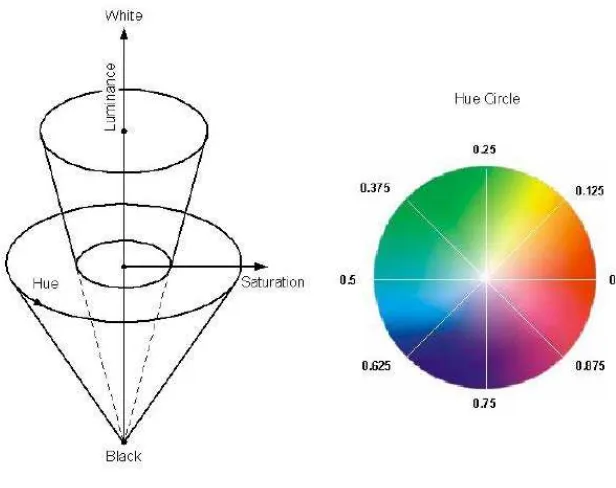
Berlien (2004) was said that there has three values can be thought of as coordinates of a point in three-dimensional space, giving rise to the concept of color space. Hue, saturation, luminance (HSL) is one such color coordinate system, or color space. A more precise method of describing color is by hue, saturation, and lightness. Hue is the attribute of a color according to its similarity with one of the colors red, yellow, green, or blue, or a combination of adjacent pairs of these colors considered in a closed ring, as shown in this figure 2.1
Figure 2.1: HSL diagram with Hue circle (Berlien 2004)
Color theory can also be defined by Soloman (1998). Color science defines color in a space, with coordinates of hue, saturation and intensity (HSI). Hue is related to the reflected wavelength of a color when a white light is shined on it. Intensity (lightness) measures the degree of whiteness or gray scale of a given color. Saturation is a
measure of the vividness of a given hue. The term chromaticity primarily includes
Figure 2.2: Coordinates of hue, saturation and intensity of color in space (Soloman 1998)
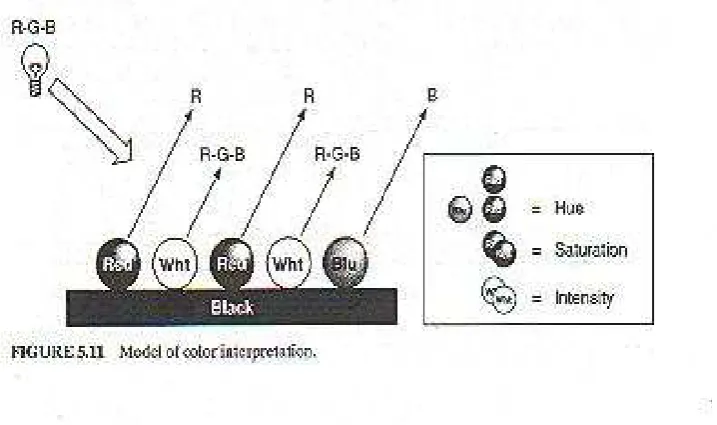
From figure 2.3, a color is depicted at a molecular level. Color is created when light interacts with pigment molecules. Color is generated by the way pigment molecules return (bend) incoming light.