L I V E . 2 0 5
W a t e r c o n s u m p t i o n o n
c a t t l e s h i p s
Final Report to MLA and Livecorp by:
Tony Brightling
Alwani Pty Ltd
Ph: (03) 9347 3099 Fax: (03) 9347 3137
Email: [email protected]
Meat & Livestock Australia Ltd
Locked Bag 991
North Sydney NSW 2059
Tel: 02 9463 9333
Fax: 02 9463 9393
December 2001
ISBN: 1 74036 112 1
MLA makes no representation as to the accuracy of any informa ion or advict e
con ained in this documen and excludes all liability, whether in con ract, ot t t t rt
(including negligence or breach of statutor duty) or otherwise a a result oy s f
relian e by any person on such information o advice. © Meat and Livestocc r k
Australia (2000)
Executive summary
A survey was undertaken to obtain more objective data about water use with commercial shipments of cattle exported from Australia. Data was obtained for 87 shipments of cattle exported on 17 ships.
Minimum water requirements should be set as a percentage of bodyweight per day, as this applies regardless of the average weight of each class of cattle on board.
The minimum water requirement in the Australian Livestock Export Standards of 12% bodyweight per day was not sufficient for 7 / 87 shipments in the survey.
Water consumption on ships with troughs was 20% greater than for ships with drinker bowls.
If minimum water requirements were set at 11% bodyweight / day for cattle supplied from drinker bowls and 13% bodyweight / day for cattle supplied from troughs, there would have been more than sufficient water for all but one of the shipments in this survey. The one shipment that consumed more than 13% bodyweight / day was a short-haul voyage from northern Australia, where rehydration after loading on the ship may have been a factor. This shipment had sufficient water when the requirement for an extra 25% water for contingencies was taken into account.
There was no statistical difference in water consumption between shipments loaded in ports north of the 26th parallel and those loaded south of the 26th parallel. Nor did the proportion of
Bos taurus cattle in the shipment affect average water consumption as a percentage of
bodyweight.
Recommendation
1. Minimum water requirements in the Australian Livestock Export Standards are set at:
• 11% bodyweight / day for cattle supplied with water from drinker bowls; and
• 13% bodyweight / day for cattle supplied with water from troughs;
Background
When this survey was commissioned, AMSA Marine Orders 43 and the Australian Livestock
Export Standards (ALES) had substantially different minimum water requirements for cattle
ships.
• Marine Orders 43 (Issue 4) required that, unless otherwise determined by a government
veterinary officer, cattle are supplied with 45 litres of water per head per day.
• ALES stated that allowance must be made for at least twelve percent of liveweight per
head per day. This could be reduced to ten percent if water consumption on each of the previous three voyages averaged less than ten percent.
This survey was undertaken to obtain more objective data about water use with commercial shipments of cattle exported from Australia. It follows an earlier preliminary analysis of water consumption for ships used by two exporters, which showed that cattle water consumption was affected by both ship design and cattle factors.
Marine Orders 43 have recently been updated, with Issue 5 coming into force from 1 January
2002. In Marine Orders 43 (Issue 5), ships are required to provide water in accordance with
ALES requirements – so there is now harmony between the two standards. However, there is
still a need to ensure that the common standards reflect the practical requirements of the trade.
Objective
To determine from data for commercial shipments, shipboard water requirements for cattle:
• by liveweight;
• by type of water supply system (troughs vs drinker bowls);
• by type of cattle (Bos indicus vs Bos taurus);
• by load port (north vs south); and
• by length of voyage.
Method
A postal survey was sent to exporters who were recorded on the LiveCorp database as having exported cattle by sea during 2000/01. Telephone contact was made to clarify or follow up survey responses.
The survey was restricted to shipments with more than 1,000 cattle on voyages of six days or more. Ships carrying 2,000 or more sheep and/or goats were also excluded. For ships carrying less than 2,000 sheep and/or goats, it was assumed that the sheep and goats consumed 5 litres of water / head / day, with stock water consumption adjusted accordingly.
Unfortunately useable responses from the postal survey were received for only 36 shipments. Reasons for the small data set included non-response by exporters and deletion of shipments where water consumption data was incomplete or uncertain – for example ships where stock water and domestic water are drawn from the same supply. However, the data set was expanded by inclusion of an additional 51 shipments from an earlier study.
It has been assumed that there was sufficient water available on each of the shipments in the survey. The data was analysed using multiple regression analysis.
Overview of survey voyages
• There were seventeen ships in the survey.
• Voyages varied in length from 6 - 24 days, with 27 short-haul voyages of less than ten days and 60 long-haul voyages of ten days or more.
• There were 51 voyages to South-east Asia or Japan, 35 to the Middle East and one to Mexico.
• The number of cattle carried varied from 867 to 5,029 with an average of 1,874 cattle per shipment.
• There were 48 shipments loaded in ports north of the 26th parallel and 39 loaded in ports south of the 26th parallel.
Survey findings
Water supply system
Average water consumption on ships with water supplied by drinker bowls was 8.3% bodyweight / day (SD ± 0.87), compared with 10.0% bodyweight / day (SD ± 1.85) for ships where water was supplied in troughs. The difference was highly significant statistically (P<.001).
Water consumption from troughs was 20% greater than from drinker bowls.
This finding is consistent with expectations, as there is less evaporation and spillage from drinker bowls and less wastage of water during cleaning. Water consumption is also lower in the first couple of days after cattle are introduced to drinker bowls, whilst the cattle learn how to drink from a bowl.
The method of water supply confounded other analyses, as ships with drinker bowls were associated more with long-haul voyages from southern ports to Middle East destinations, whilst ships with troughs were associated more with short-haul voyages from northern ports to Asian destinations. To eliminate this confounding effect, subsequent analyses (load port, proportion of
Bos taurus cattle, length of voyage etc) were done twice, with pre-selection for type of water
supply.
Water consumption per head
Figure 1. Water Consumption per head per day
The average water consumption for the 87 shipments was 34.1 litres / head / day. For eight of the 87 shipments, water consumption was greater than the 45 litres / head / day previously required under Marine Orders 43 (Issue 4). The average weight of the cattle in these eight shipments was 405 kg and all were provided with water in troughs.
45 litres / head / day is not sufficient for heavy cattle (> 400kg) watered from
troughs.
None of the 31 shipments where the average weight of the cattle was 350 kg or less consumed more than 40 litres / head / day. The average water consumption for these shipments of lighter cattle was 24.7 litres / head / day for cattle watered from drinker bowls and 31.8 litres / head / day for cattle watered from troughs.
45 litres / head / day is much more than required by cattle weighing 350 kg or less.
There was a linear relationship between bodyweight and water consumption. Each 10 kg increase in bodyweight was associated with an increase in daily water consumption of about 710 ml.
Water consumption as a percentage of bodyweight
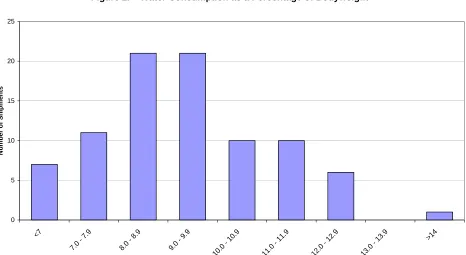
Figure 2. Water Consumption as a Percentage of Bodyweight
Water consumption as a percentage of bodyweight was largely independent of bodyweight per se. (There was a small negative correlation, with regression coefficients of - 0.0037 for cattle watered from troughs and - 0.0004 for cattle watered from drinker bowls).
Minimum water requirements should be set as a percentage of bodyweight / day rather than litres / head / day, as this can be applied regardless of the average weight of each class of cattle on board.
Minimum water requirements should be set as a percentage of bodyweight per day.
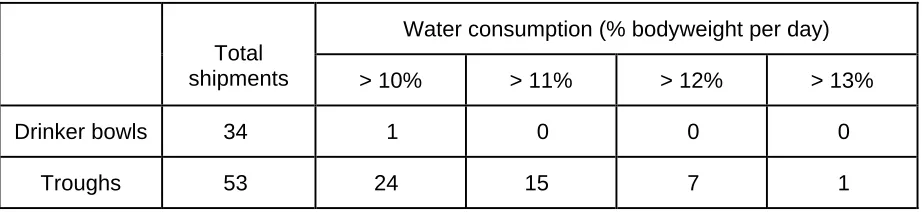
There were seven shipments where water consumption exceeded the 12% bodyweight / head / day minimum requirement currently stipulated in ALES. These seven voyages were on three different vessels, and all involved watering from troughs.
The ALES requirement of 12% bodyweight per day is not sufficient for some
shipments.
The minimum water requirements in Marine Orders 43 and ALES should be set to ensure there is sufficient water for the vast majority of voyages, taking into account the water supply
arrangements on the ship. This can be done statistically, using average water consumption plus the number of standard deviations needed to meet acceptable risk. However, because the data set is reasonably small, standard deviations from this survey are likely to be much larger than the real value for all shipments. Maximum water consumption in the survey is possibly a better guide.
Table 1. Shipments with water consumption above a specified limit
Water consumption (% bodyweight per day) Total
shipments > 10% > 11% > 12% > 13%
Drinker bowls 34 1 0 0 0
Troughs 53 24 15 7 1
If the minimum water requirement were set at 11% bodyweight / day for cattle supplied with water from drinker bowls and 13% bodyweight / day for cattle supplied with water from troughs, there would have been more than sufficient water for all but one of the shipments in this survey. This was a voyage of only seven days from a port in northern Australia. Rehydration after loading on the ship may account for the high water consumption. The consequences of running out of water are dire. However, the one shipment that consumed more than 13% bodyweight / day would have had sufficient water when the requirement for an extra three days supply or 25%, whichever is less, for contingencies is taken into account.
Type of cattle (Bos indicus vs Bos taurus)
The proportion of Bos taurus cattle in each shipment was estimated to the nearest 25% (0%, 25%, 50%, 75% or 100%), and analysed as a continuous variable. There was no statistical association between the proportion of Bos taurus cattle in a shipment and daily water consumption as a percentage of bodyweight.
Load port (north vs south)
There was no statistical difference in water consumption between shipments loaded in ports north of the 26th parallel and those loaded south of the 26th parallel.
Length of voyage
There was no statistical association between the length of voyage and average daily water consumption as a percentage of bodyweight. However, the survey was restricted to voyages of six days or more.
Cattle subjected to a trucking curfew and/or transported long distances to the ship may be dehydrated at loading and consume additional water during the first 24 hours on board.
Cattle not accustomed to shipboard fodder may not eat a full ration for the first 3-4 days, and with reduced feed intake there is also reduced water intake. Cattle not used to drinker bowls may also have reduced water intake until they become accustomed to drinking from the bowl.