Mali, Yustinus Calvin Gai. 2014. Coherence Problems in Academic Essay Writing.Yogyakarta: The Graduate Program in English Language Studies: Sanata Dharma University.
Writing has become an essential part in English language learning. Dealing with its essential part, people start to concern with the issue on writing as well as its challenges specifically in the context of academic writing. In that case, coherence, as a logical arrangement of ideas that can help readers understand meaning and value of a written work and as the most essential element in an academic writing, is regarded as the answer toward the challenges. In a local context, I could observe how coherence in students’ writing becomes an essential issue to consider, specifically in the teaching and learning process at ELESP of Sanata Dharma University. It strongly implies that ELESP students should be able to consider the coherence issue that they have learnt in the study program. It aims to make them, regarded as future English teachers’ candidate, be able to produce a good written work, to guide as well as to educate other people or their future students to do so. Therefore, finding out the coherence problems would significantly help the students minimize the problems and eventually help the students achieve those goals.
This qualitative research attempted to answer a research question. It was what coherence problems do the students’ analytical exposition essays contain? In order to answer the research question, I employed a document analysis as my research method. The documents to analyze were the analytical exposition essays written by students in class D of Academic Essay Writing class at ELESP in the 2013/2014 academic year.
From the data analysis, I revealed three major coherence problems in the essays written by the students. The first problem was unclear idea relationships, which revealed the difficulties in recognizing the relationships of ideas in eighteen essays that I analyzed. The second problem was irrelevant topic sentences to support the thesis statement stated in the students’ essays. The last problem was irrelevant supporting evidence. Dealing with this problem, I found the jumping ideas among the supporting evidence written to support a topic sentence in a paragraph.
Mali, Yustinus Calvin Gai. 2014. Coherence Problems in Academic Essay Writing.Yogyakarta: Kajian Bahasa Inggris, Program Pasca Sarjana: Universitas Sanata Dharma.
Menulis telah menjadi salah satu bagian penting dalam pembelajaran Bahasa Inggris. Berkaitan dengan hal tersebut, orang-orang mulai memberi perhatian terhadap pokok persoalan tentang menulis dan tantangannya khususnya dalam konteks menulis akademik. Dalam hal ini, pertalian-ide, sebagai susunan logis suatu ide yang dapat membantu para pembaca memahami makna dan nilai suatu tulisan dan juga sebagai elemen terpenting dalam suatu tulisan akademik, dianggap sebagai suatu jawaban terhadap tantangan yang ada. Pada suatu konteks lokal, saya dapat mengamati bagaimana pertalian-ide dalam tulisan siswa menjadi pokok persoalan penting untuk diperhatikan, khususnya dalam proses belajar mengajar di Program Studi Pendidikan Bahasa Inggris Universitas Sanata Dharma. Secara meyakinkan, hal tersebut menyiratkan bahwa para siswa di Program Studi tersebut harus mampu untuk memperhatikan isu pertalian-ide yang telah mereka pelajari. Hal ini bertujuan untuk membuat para siswa, sebagai calon Guru Bahasa Inggris, mampu untuk menghasilkan suatu tulisan yang baik, menuntun dan mengedukasi orang lain atau anak didik mereka di masa mendatang untuk juga dapat menghasilkan suatu karya tulis yang baik tersebut. Oleh karena itu, menemukan permasalahan-permasalahan pada pertalian-ide akan secara menguntungkan membantu para murid untuk meminimalisir permasalahan tersebut dan pada akhirnya membantu para murid untuk dapat mencapai tujuan-tujuan tersebut.
Penelitian kualitatif ini mencoba untuk menjawab suatu pertanyaan yaitu apakah permasalahan-permasalahan pertalian-ide yang terdapat di esei exposisi analitis para siswa? Untuk menjawab pertanyaan dalam penelitian ini, saya menggunakan suatu metodologi analisis dokumen dalam penelitian ini. Dokumen yang dianalisis ialah esei exposisi analitis yang ditulis oleh para mahasiswa di kelas Academic Essay Writing D pada Program Studi Pendidikan Bahasa Inggris di Universitas Sanata Dharma tahun pelajaran 2013/2014.
COHERENCE PROBLEMS IN ACADEMIC ESSAY WRITING
A THESIS
Presented as a Partial Fulfillment of the Requirements to Obtain the Magister Humaniora (M.Hum) Degree
in English Language Studies
by
Yustinus Calvin Gai Mali Student Number: 12 6332 045
THE GRADUATE PROGRAM IN ENGLISH LANGUAGE STUDIES SANATA DHARMA UNIVERSITY
i
COHERENCE PROBLEMS IN ACADEMIC ESSAY WRITING
A THESIS
Presented as a Partial Fulfillment of the Requirements to Obtain the Magister Humaniora (M.Hum) Degree
in English Language Studies
by
Yustinus Calvin Gai Mali Student Number: 12 6332 045
THE GRADUATE PROGRAM IN ENGLISH LANGUAGE STUDIES SANATA DHARMA UNIVERSITY
ii
A THESIS
COHERENCE PROBLEMS IN ACADEMIC ESSAY WRITING
by
Yustinus Calvin Gai Mali Student Number : 12 6332 045
Approved by
F.X.Mukarto, Ph.D. _________________________
iii
A THESIS
COHERENCE PROBLEMS IN ACADEMIC ESSAY WRITING
Presented by
Yustinus Calvin Gai Mali Student Number : 12 6332 045
Defended before the Thesis Committee and Declared Acceptable
THESIS COMMITTEE
Chairperson : Dr. B.B. Dwijatmoko, M.A. _______________
Secretary : F.X. Mukarto, Ph.D. _______________
Members : 1. Dr. Fr. B. Alip, M.Pd., M.A. _______________
2. Dr. J. Bismoko _______________
Yogyakarta, 7 February 2014 The Graduate Program Director Sanata Dharma University
iv
Temukan tujuan hidupmu
Capailah itu
dan
JANGAN PERNAH BERHENTI
Sebelum kamu mencapainya...
This thesis is dedicated for my family members;
“PAPA” YAKOBUS YOHANES MALI
“
MAMA
”
LUSIA KRISTIANI
“KAKAK” PETER CHRYSOLOGUS LANDO MALI
v
STATEMENT OF ORIGINALITY
This is to certify that all ideas, phrases, sentences, unless otherwise stated, are the
ideas, phrases, and sentences of the thesis writer. The writer understands the full
consequences including degree cancellation if he took somebody else’s ideas,
phrases, or sentences without proper references.
Yogyakarta, 27 January 2014
vi
LEMBAR PERNYATAAN PERSETUJUAN
PUBLIKASI KARYA ILMIAH UNTUK KEPENTINGAN AKADEMIS
Yang bertanda tangan di bawah ini, saya mahasiswa Universitas Sanata Dharma:
Nama : Yustinus Calvin Gai Mali
Nomor Mahasiswa : 12 6332 045
Demi pengembangan ilmu pengetahuan, saya memberikan kepada Perpustakaan
Universitas Sanata Dharma karya ilmiah saya yang berjudul:
COHERENCE PROBLEMS IN ACADEMIC ESSAY WRITING
beserta perangkat yang diperlukan. Dengan demikian saya memberikan kepada
Perpustakaan Universitas Sanata Dharma hak untuk menyimpan, mengalihkan
dalam bentuk media lain, mengelolanya dalam bentuk pangkalan data,
mendistribusikan secara terbatas, dan mempublikasikannya di Internet atau media
lain untuk kepentingan akademis tanpa perlu meminta ijin dari saya maupun
memberikan royalti kepada saya selama tetap mencantumkan nama saya sebagai
penulis.
Demikian pernyataan ini yang saya buat dengan sebenarnya. Dibuat di Yogyakarta
Pada tanggal : 27 Januari 2014 Yang menyatakan
vii
ACKNOWLEDGEMENTS
I would like to express my deepest gratitude for my Savior, Jesus Christ.
He has given His grace and love, so I could finish this thesis. I thank you Lord!
Then, I would like to express my million thanks to people who have helped me a
lot during the accomplishment process of this thesis.
Firstly, I would like to express my sincere gratitude to my thesis advisor,
F.X. Mukarto, Ph.D. I thank him for his time, guidance, and advice given to me
during the writing process of this thesis. Besides, he encouraged me to finish this
thesis soon and told me not to much worry about this long process. Without his
help, I would have never been able to finish this thesis.
Secondly, I would like to thank lecturers in the Graduate Program of
English Language Studies, Sanata Dharma University. I thank Dr. B.B.
Dwijatmoko, M.A, Dr. J. Bismoko, Dr. Fr. B. Alip, M.Pd., M.A., Fransiscus
Widya Kiswara, S.Pd., M.Hum., Prof. Dr. C. Bakdi Soemanto, Dr. Patrisius
Mutiara Andalas, SJ. In fact, I have learnt a lot from everything they have shared
and discussed during my study in this Graduate Program.
Thirdly, I am greatly indebted to C. Tutyandari, S.Pd., M.Pd, the
Chairperson of English Language Education Study Program, Sanata Dharma
University. I thank her for giving me the permission to conduct this research in
the Study Program. My gratitude also goes to the lecturer of class D of Academic
Essay Writing, Fidelis Chosa Kastuhandani, S.Pd., M.Hum. He gave the
permission to access the data I needed and helped me a lot during the data
viii
Fourthly, I am also greatly indebted to Drs. Concilianus Laos Mbato, M.A.
and Dr. Patrisius Mutiara Andalas, SJ for their willingness to fill in the inter-rater
form of this research. Their participation and constructive suggestions for this
research helped me a lot in finishing the data analysis process.
Fifthly, I would like to send my deep appreciation for Mbak Lely. She
helped a lot to process the permission letters that I used to conduct this research. I
also thank Mas Mul for his assistance and sincere warmth.
Sixthly, my deepest gratitude and love go to my beloved family members.
I thank Papa Yakobus Yohanes Mali and Mama Lusia Kristiani, for their magnificent love, never-ending support, and motivation. I also thank them
because they always ask me to finish my study as soon as possible and boost my
motivation when I sometimes want to discontinue this study. Without them, I
could not achieve this dream. I also thank my beloved brother, Peter Chrysologus
Lando Mali, S.E. I thank him so much for his advice and financial support for my
study. Then, my sincere appreciation goes to my aunt, Jessica Christiana
Pattinasarany, M.A.,for her sharing and some references that really supported my
thesis. Profound gratitude is also addressed to Om Florentinus Ari Mursodo. I thank him very much for his precious help and valuable advice.
Seventhly, my prayers go to my grandfathers (r.i.p), Gabriel Gai and Liem
Siok An (Santoso), as well as to my grandmothers (r.i.p), Martina Ngura and
Liem Kiok Nio (Wiasih). Even though we are now apart, I do believe that all of
you there always support me without your prayers. This thesis is to show my
ix
Eighthly, my special thanks go to all my beloved friends in KBI: Ms.
Ririn, Deny, Mbak Delfin, Mas Karman, Mbak Dinar, Botie, Leonie, Pak Yoseph,
Pak Yulianus, Mbak Sofie, Mbak Yustin, Mbak Ades, Mas Wawan, Mbak Lesly,
Mbak Pepy, Mbak Putri, Mbak Paulina, Mbak Indry, Mbak Mayang, Indes, Mbak
Rina. I thank them for the nice togetherness that we have. I do hope our friendship
will last forever.
Finally, I would like to express my gratitude to all people and friends
whose names I could not mention here. I thank them very much for their support
and prayers. Without them all, I could have never reached this dream. Once again,
I personally thank them all!
xi
3. Irrelevant Supporting Evidence ... 113
CHAPTER V CONCLUSION ... 127
A.Conclusion... 127
B.Suggestions... 129
1. For Students in the Academic Essay Writing Class ... 130
2. For Lecturers Teaching Academic Essay Writing ... 131
3. For Future Researchers ... 132
BIBLIOGRAPHY ... 134
APPENDICES ... 139
Appendix A. The Letter of References from ELS ... 140
Appendix B. An Initial Permission Letter Sent to the Lecturer ... 141
Appendix C. The Lecturer’s Instructions ... 142
Appendix D. The Inter-Rater Form ... 147
Appendix E. An Initial Permission Letter Sent to the Observers ... 163
Appendix F. The Letter of References from ELS to the Observers ... 165
Appendix G. The Observers’ Personal Data and Feedback ... 167
Appendix H. Samples of the Students’ Essays ... 172
xii
LIST OF TABLES
Table 2.1 Jointly Constructed of an Analytical Exposition Text ... 48
Table 2.2 Jointly Constructed of a Hortatory Exposition Text ... 50
Table 3.1 The Abbreviation System in Data Analysis ... 80
Table 3.2 The Criteria in Analyzing Coherence Problems in the Essays ... 81
Table 4.1 The Distribution of Unclear Idea Relationships in the Essays ... 87
Table 4.2 The Distribution of Irrelevant Topic Sentences in the Essays ... 89
xiii
LIST OF FIGURES
Figure 2.1 The Exemplification Relationship in a Written Work ... 19
Figure 2.2 The Contrast Relationship in a Written Work ... 20
Figure 2.3 The Comparison Relationship in a Written Work ... 21
Figure 2.4 The Comparison and Contrast Relationship in a Written Work ... 22
Figure 2.5 The Enumeration Relationship in a Written Work ... 23
Figure 2.6 The Chronology Relationship in a Written Work... 24
Figure 2.7 The Causality Relationship in a Written Work... 25
Figure 2.8 The Process Relationship in a Written Work ... 26
Figure 2.9 A Scheme in a Five-Paragraph Essay ... 28
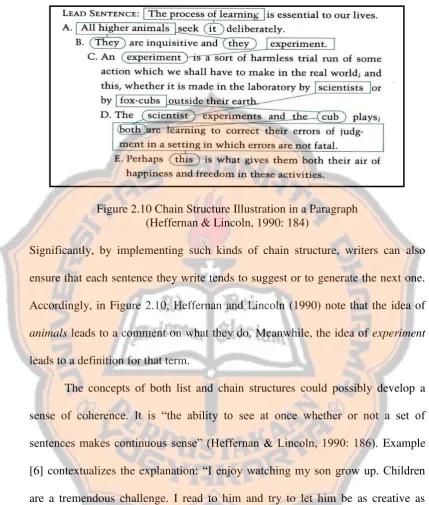
Figure 2.10 Chain Structure Illustration in a Paragraph ... 33
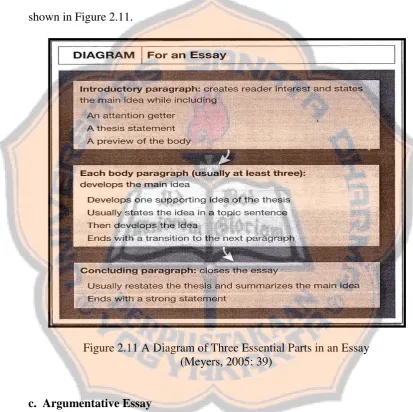
Figure 2.11 A Diagram of Three Essential Parts in an Essay ... 44
Figure 2.12 A Suggested Format to Plan an Analytical Exposition Text ... 47
Figure 2.13 A Suggested Format to Plan a Persuasive Exposition Text ... 49
Figure 2.14 The Relationships among Coherence, Essay, and Argumentative Essay... 57
Figure 2.15 Research Construct Map ... 61
Figure 3.1 Steps in Sampling ... 69
Figure 3.2 The Forwarded Files from the Lecturer ... 74
Figure 3.3 The Analytical Exposition Outline Converted in the Software ... 78
Figure 3.4 The Text Deconstruction Sample Done in the Software ... 79
Figure 3.5 The Triangulation Process ... 83
Figure 4.1 Three Major Coherence Problems Revealed in the Students’ Essays... ... 91
Figure 4.2 The Text-Deconstruction Sample of the Ninth Essay ... 96
xiv
LIST OF ABBREVIATIONS
NNS : Non-native speakers
NS : Native speakers
ESL : English as a second language
EFL : English as a foreign language
ELESP : English Language Education Study Program of Sanata Dharma University Yogyakarta
ELS : The Graduate Program in English Language Studies
of Sanata Dharma University Yogyakarta
xv
ABSTRACT
Mali, Yustinus Calvin Gai. 2014. Coherence Problems in Academic Essay Writing.Yogyakarta: The Graduate Program in English Language Studies: Sanata Dharma University.
Writing has become an essential part in English language learning. Dealing with its essential part, people start to concern with the issue on writing as well as its challenges specifically in the context of academic writing. In that case, coherence, as a logical arrangement of ideas that can help readers understand meaning and value of a written work and as the most essential element in an academic writing, is regarded as the answer toward the challenges. In a local context, I could observe how coherence in students’ writing becomes an essential issue to consider, specifically in the teaching and learning process at ELESP of Sanata Dharma University. It strongly implies that ELESP students should be able to consider the coherence issue that they have learnt in the study program. It aims to make them, regarded as future English teachers’ candidate, be able to produce a good written work, to guide as well as to educate other people or their future students to do so. Therefore, finding out the coherence problems would significantly help the students minimize the problems and eventually help the students achieve those goals.
This qualitative research attempted to answer a research question. It was what coherence problems do the students’ analytical exposition essays contain? In order to answer the research question, I employed a document analysis as my research method. The documents to analyze were the analytical exposition essays written by students in class D of Academic Essay Writing class at ELESP in the 2013/2014 academic year.
From the data analysis, I revealed three major coherence problems in the essays written by the students. The first problem was unclear idea relationships, which revealed the difficulties in recognizing the relationships of ideas in eighteen essays that I analyzed. The second problem was irrelevant topic sentences to support the thesis statement stated in the students’ essays. The last problem was irrelevant supporting evidence. Dealing with this problem, I found the jumping ideas among the supporting evidence written to support a topic sentence in a paragraph.
xvi
ABSTRAK
Mali, Yustinus Calvin Gai. 2014. Coherence Problems in Academic Essay Writing.Yogyakarta: Kajian Bahasa Inggris, Program Pasca Sarjana: Universitas Sanata Dharma.
Menulis telah menjadi salah satu bagian penting dalam pembelajaran Bahasa Inggris. Berkaitan dengan hal tersebut, orang-orang mulai memberi perhatian terhadap pokok persoalan tentang menulis dan tantangannya khususnya dalam konteks menulis akademik. Dalam hal ini, pertalian-ide, sebagai susunan logis suatu ide yang dapat membantu para pembaca memahami makna dan nilai suatu tulisan dan juga sebagai elemen terpenting dalam suatu tulisan akademik, dianggap sebagai suatu jawaban terhadap tantangan yang ada. Pada suatu konteks lokal, saya dapat mengamati bagaimana pertalian-ide dalam tulisan siswa menjadi pokok persoalan penting untuk diperhatikan, khususnya dalam proses belajar mengajar di Program Studi Pendidikan Bahasa Inggris Universitas Sanata Dharma. Secara meyakinkan, hal tersebut menyiratkan bahwa para siswa di Program Studi tersebut harus mampu untuk memperhatikan isu pertalian-ide yang telah mereka pelajari. Hal ini bertujuan untuk membuat para siswa, sebagai calon Guru Bahasa Inggris, mampu untuk menghasilkan suatu tulisan yang baik, menuntun dan mengedukasi orang lain atau anak didik mereka di masa mendatang untuk juga dapat menghasilkan suatu karya tulis yang baik tersebut. Oleh karena itu, menemukan permasalahan-permasalahan pada pertalian-ide akan secara menguntungkan membantu para murid untuk meminimalisir permasalahan tersebut dan pada akhirnya membantu para murid untuk dapat mencapai tujuan-tujuan tersebut.
Penelitian kualitatif ini mencoba untuk menjawab suatu pertanyaan yaitu apakah permasalahan-permasalahan pertalian-ide yang terdapat di esei exposisi analitis para siswa? Untuk menjawab pertanyaan dalam penelitian ini, saya menggunakan suatu metodologi analisis dokumen dalam penelitian ini. Dokumen yang dianalisis ialah esei exposisi analitis yang ditulis oleh para mahasiswa di kelas Academic Essay Writing D pada Program Studi Pendidikan Bahasa Inggris di Universitas Sanata Dharma tahun pelajaran 2013/2014.
xvii
1
CHAPTER I INTRODUCTION
This introductory chapter presents the background of the research, the
problem identification, and the problem limitation. Afterwards, it states the
problem formulation and the goals of the research. Finally, it explains the benefits
of conducting the current research.
A.Background
Writing has become an essential part in English language learning (White,
1986; Hughey, Wormuth, Hartfiel, & Jacobs, 1983). White (1986) believes that
writing becomes a way of learning that can improve our academic performance. In that case, “we can actually achieve deeper insight into any subject by writing out
our thoughts” (White, 1986: 18). Then, for English as a second language (ESL)
students, “writing is also an efficient tool to facilitate and to reinforce other
language skills” (Hughey, et al, 1983: 6). For instance, students need to read, to
observe, and to talk to other people in order to collect information for their writing
on a particular topic. They also need to think about suitable words and grammar
forms for their writing. In a speaking class, it is also observed that students
sometimes need to write down a script for their speaking performance and
memorize it in order to help them speak more fluently and confidently. In a
article that the students have read in order to check their understanding towards
the reading text.
Some other experts are also concerned with the issue on writing
specifically in relation to academic writing (Coffin, Curry, Goodman, Hewings,
M. Lillis, & Swann, 2003; Jones, 2011; Bailey, 2011; Johns, 1997 as cited in
Hinkel, 2004). Coffin et al (2003) assert that students’ academic writing is at the
center of teaching and learning in higher education because students are mostly
assessed by what they write. Academic writing in English is also equally essential
for both native-speaker (NS) and for non-native speaker (NNS), students who
hope to be successful in English-medium higher education since assessment is, in
most disciplines, mainly by writing (Jones, 2011). Similarly, Bailey (2011)
informs that written assignments are mostly used to assess students in most
academic courses. Undeniably, Johns (1997) as cited in Hinkel (2004) found that
after obtaining ESL training for a number of years, many NNS graduate and
undergraduate students write academic papers and essays that are said to be vague
and confusing. It is because the students find it difficult to recognize as well as to
apply properly the convention and features of academic writing.
Even though some factors possibly cause the challenges (Johns, 1997 as
cited in Hinkel, 2004) especially when the students write their academic writing,
coherence in a written work could become a possible answer toward the
challenges. It is because coherence is regarded as the most essential element in
can help reader understand meaning and value of written work, as it is believed by
Murray and Hughes (2008: 45):
Coherence is perhaps the single most important element in any kind of writing. However, it is particularly crucial in academic writing, where success of failure may well depend upon on how clearly you have managed to communicate your ideas and line of arguments to your readers. No matter how insightful or original those ideas may be if you are not able to present them in a clear and logical way, their meaning and value is lost. Considering coherence as an essential concept in academic writing, a
number of researchers conducted further studies on coherence in students’ written
work, specifically on coherence problems in the written work. Jones (2007), in his
small-scale classroom-based research, investigated the nature of non-coherence in
three different argumentative essays regarded as homework tasks and written by
NS and NNS university students. In analyzing the essays, he firstly restated the
definition of coherence used in his research. Secondly, he showed three students’
essays, as the evidence of his analysis. Thirdly, he started to provide his
descriptive analysis toward some coherence problems he found in the essays.
His investigation on the essays, whose topic was about the extent that
globalization has in threatening the traditions and values of some countries,
concluded that the students did not find any difficulties with their grammar. The
students also did not have any difficulties in dealing with their sentence structure.
Nevertheless, they had some problems in fashioning “a coherent argument where
sentences and ideas relate to one another without any missing links of meaning”
(Jones, 2007: 145).
In that case, the incoherent argument problems were because of some
paragraph. The other factor was unclear link in theme between paragraphs. For
instance, he observed two paragraphs written by a student. In the first paragraph,
the student wrote the effect of globalization on a particular traditional society in
Africa. On the contrary, the student wrote about threat to Australian society of the
new technology in the subsequent paragraph.
In 2011, taking an Australian university as the context of his research,
Jones conducted another research to analyze an essay written by the first-year
NNS coming from South America using a similar writing topic to his previous
research. In analyzing the coherence in the student’s written work, he believes that “criteria for analysis of the text derive from the definition of the genre essayitself
and of coherence, as set out earlier” (Jones, 2011: 5). Accordingly, his analysis
focuses the extent to which the writing shows logical order, in which its ideas
should hang together. Then, similar to his previous research in 2007, Jones (2011)
provided the descriptive analysis toward the student’s essay.
The findings of the research conducted in 2011 supported the findings of
his previous research in 2007. Jones (2011) revealed that the students faced
difficulties in constructing a coherent argument. As an example, he found that in a
paragraph in the essay written to explore the extent that globalization has in
threatening the traditions and values of some countries, there were four sentences
that were not connected to one another (Jones, 2011: 12):
cultural and traditional heritage of various countries around the world. The extent of the threats of globalization is not only for African societies but also to countries like Australia.
According to Jones (2011), the disconnection occurred between the second and
the third sentences. He also observed that the last sentence of the paragraph even
tried to introduce a new subtopic or a different idea from the previous sentences.
Another research focuses on the organizational problems that Egyptian
student teachers of English encounter when they write an English essay (Ahmed,
2010). The research particularly would try to reveal the problems that Egyptian
student teachers of English have in the cohesion and coherence of their essays. In
his research, Ahmed (2010) used a questionnaire, a semi-structured interview as
research instruments to collect the data as well as an interpretive approach to help
him reveal the problems. The findings of his research, in relation to coherence,
revealed that Egyptian student teachers of English experienced some coherence
problems in their English writing. The problems covered the difficulty in writing
the introduction, the thesis statement, the topic sentence, and the conclusion.
In her paper, Brostoff (1981: 278) suggests an idea that incoherence in writing can occur because “separate or unrelated ideas appear to be juxtaposed,
which means that they are next to, but not connected to each other.” Therefore,
readers find it difficult to follow sequences of sentences and paragraphs in a
written work. In addition, Brostoff (1981) believes that students could encounter
some failure that eventually resulted in incoherent writing. More specifically, the
together a series of relationships in a consistent way, specifically to form a
well-structured sequence or hierarchy of relationships” (Brostoff, 1981: 279).
In a local context, writing as an essential part in English language learning
is actualized in teaching and learning process in English Language Education
Study Program of Sanata Dharma University Yogyakarta, henceforth called
ELESP. It is because English writing becomes one of four skills learnt by ELESP
students. The students will learn the skill in writing courses offered by the study
program. More specifically, they will learn the skill in five initial and compulsory
writing courses held in semester one up to semester five. Those courses are Basic
Writing in semester one, Paragraph Writing in semester two, Critical Reading and
Writing 1 in semester three, Critical Reading and Writing 2 in semester four, and
Academic Essay Writing in semester five (Dosen-dosen Program Studi
Pendidikan Bahasa Inggris Universitas Sanata Dharma, 2011). These courses
become prerequisites to the students to continue their writing courses held in
upper semesters. The writing courses are their thesis proposal and eventually
undergraduate thesis courses.
In addition, based on the learning overview that each writing class has, the
study program is clearly concerned with the coherence issue in students’ writing.
It is observed that starting from semester two, based on the learning overview of
Paragraph Writing class, the students have already started to discuss the concept
of topic sentences, supporting sentences, concluding sentences, and essentially the
concept of unity and coherence in a paragraph. In other words, the learning
been emphasized. Therefore, coherence certainly becomes an essential part in the students’ written work.
ELESP also aims to prepare its students to become both English language
users in professional fields and future English teachers. Therefore, besides
mastering English reading, speaking, and listening skills, ELESP students surely
should be able to write various English written works that cover essential writing
concepts they have learnt. It aims to make them be able to produce a good written
work, to guide as well as to educate other people or their future students to do so.
In that case, writing a coherent written work, considered as a fundamental concept
in academic writing (Murray & Hughes, 2008) will therefore become an essential
concept to consider by the students.
The elaboration and all aspects stated in the previous paragraphs certainly
indicate that coherence in writing indeed becomes an essential issue to investigate
further. Therefore, this research specifically aimed to investigate coherence
problems in academic essays written by students in an Academic Essay Writing
class. Eventually, the findings of the research were expected to provide both
scientific contributions to the development of theories in English education as
well as practical contributions to the students, the lecturer in the Academic Essay
Writing class and me, as a student in the graduate level and as an English teacher.
B.Problem Identification
Hyland (2002) points out that in many schools, students are asked to write
only have little awareness of a reader. In that case, he asserts that grammatical
accuracy and clear exposition become the main criteria of good writing. In dealing
with academic writing, the grammatical accuracy as well clear exposition
(Hyland, 2002), however, will not become the only one-aspect that students need
to consider. As it is stated previously, the concept of coherence becomes an
essential aspect that students need to consider when they produce their academic
writing (Murray & Hughes, 2008).
Reflecting the importance of coherence in a written work, to the roles that
the students have both as an ELESP student and as a future English teacher, the
fact that students still encountered some coherence problems in their written work
as revealed by the previous related studies, this research asserts that coherence
becomes an important issue to investigate further. Specifically, this research
addressed the same fundamental ideas as what the previous related research did. It
was to investigate the coherence problems in students’ written work.
Nevertheless, unlike the previous research, this research focused its analysis on
argumentative essays, which were in the form of analytical exposition, written by
twenty students in an Academic Essay Writing class using a qualitative method,
specifically a document analysis.
C.Limitation of the Research
The limitation of the research covered four main aspects. The first aspect
dealt with approaches in researching writing. In relation to the approaches to
namely texts, writers, and readers. The first approach aims to focus its analysis to
the products of writing. It specifically aims to see writing as a textual product, a
coherent arrangement of elements structured based on a system of rules and either
to examine the formal surface structure or the discourse structure of particular
texts. The second approach focuses its analysis on a writer rather than on the texts.
It addresses the general issue of what good writers do when they are challenged
with a composing task as well as the methods that will help them obtain the skills.
The third approach discusses the role that readers play in writing and elaborates
how writers engage with an audience in creating a text. Considering the
approaches (Hyland, 2002), this research would only focus its analysis on
particular texts, as stated by the first approach. More specifically, it would analyze
the argumentative essays written by the students and subsequently investigate the
coherence problems in the essays based on the related theories of coherence that I
wrote in Chapter II.
The second aspect was related to the selection of the research setting. The
limitation was due to such considerations as flexibility to conduct the research and
accessibility to obtain the data to analyze. In that case, this research was
conducted at ELESP. Then, one Academic Essay Writing class held in semester
five in the academic year 2013/ 2014 was chosen. The fact that I was an alumnus
of ELESP facilitated me to obtain a permission to conduct this research as well as
to access the needed data effortlessly.
Meanwhile, the third aspect was related to types of essays to analyze.
semester five at ELESP are required to write three different types of academic
essays. They are argumentative, comparison and contrast, and eventually problem
and solution. In that case, I admitted that my position as a novice researcher as
well as the time limitation to conduct the research would not enable me to analyze
those three types of essays. Therefore, this research would only analyze the
argumentative essay written by students in the Academic Essay Writing class. The
essays were specifically in the form of analytical exposition. Besides, the essays would be the final version of the students’ writing. In other words, the essays to
analyze were those that have passed a drafting and revision process and have been
submitted to the lecturer in the writing class.
The last aspect was concerned with numbers of academic essays to
analyze. In this research, only twenty argumentative essays were analyzed. The
ground for the limitation was that the selected twenty essays were considered able
to provide rich data dealing with the coherence problems in the students’ essays.
D.Problem Formulation
This research aimed to analyze the students’ essays, specifically in the
form of analytical exposition. It also aimed to investigate the coherence problems
in the essays. Therefore, the question addressed in this research was: what
E.Research Goal
This research intended to investigate the coherence problems in the students’ essays. As the result of its investigation, this research would be able to
reveal the coherence problems in the essays. Specifically, the research would
provide descriptive analysis toward the coherence problems. The analysis would cover the real examples of the problems taken from the students’ essays and
explanations dealing with why they could happen and why they were related to
coherence. The explanations were also supported by the related theories of
coherence. The analysis would also discuss the relations of the problems revealed
by the current research to those revealed by previous related studies.
F. Research Benefits
The research, investigating the coherence problems in the students’ essays,
was expected to provide both scientific contributions to the development of
theories in English education as well as practical contributions to the students in
the Academic Essay Writing class and me, as a student in the graduate level and
as an English teacher. Scientifically, because the current research revealed
coherence problems in students’ academic essays, the findings of the research
would contribute to the development of theories dealing with the coherence
problems especially in the context of academic essay writing. In that case, English
teachers were expected to be more aware of challenges, specifically toward
essays. The teachers were also expected to be able to take a role in helping their
students minimize the problems and produce a coherent academic essay.
In practice, the findings of the research were expected to be beneficial to
students in the Academic Essay Writing class. The findings would show as well as
explain the coherence problems found in their essays. This would possibly reveal
the pattern of the coherence problems encountered by the students. Therefore, the
students were expected to see the problems in their essays, to recognize the
pattern of the problems, to realize the occurrence of the problems, to learn from
them, and eventually to minimize them when they write their future academic
essays. When this research could help the students do all of those things, this
research would significantly make an effort to help students make any positive
improvement in their writing, which is said to be “a means for self-actualization”
(Hughey et al, 1983: 35). Moreover, writing also enables us “to continually grow
and develop because we can willfully project goals for ourselves and can more
clearly define our expectations” (Hughey et al, 1983: 35). Therefore, by helping
the students make the improvement in their writing, this research would also help
the students achieve their self-actualization and human progress.
Additionally, the findings of the research were expected to enhance the
students’ understanding on the concept of coherence in academic essay writing
and its related problems. It was because this research would possibly become one
of many suggested models whose theories, findings, and discussion can be
adopted and regarded as a guide by the students when they write their academic
language users in professional fields and future English teachers, were therefore
expected to be able to learn how to write a coherent academic essay, to teach and
finally to guide their future students to do so.
This research was also expected to provide practical contributions for the
lecturer at the writing class. In that case, this research would provide information
about coherence problems in his students’ written work. Accordingly, the lecturer
could possibly regard this research as a significant and constructive suggestion in
developing the existing teaching materials, learning activities, and possibly the
existing writing assessment criteria in his writing class.
Finally, this research, in practice, was expected to benefit me, as a student
in the graduate level who will possibly write a number of academic written works
in which coherence becomes one of essential and emphasized requirements. It is
because this research has helped me, as the student, relearn and understand deeply
the concept of coherence in a context of academic writing. As a result, I could
keep being aware of the coherence concept in my written work, so I could make
an effort to keep producing a coherent academic writing. Then, the findings of the
research have provided me, as an English teacher, the information on what I
should do in order to produce a coherent written work. This research also enables
me to explain, to transfer the information to my students, as well as to guide them
14
CHAPTER II LITERATURE REVIEW
This chapter discusses two main parts, namely theoretical review and
theoretical framework. The theoretical review will present theories of coherence,
academic writing, and eventually essay. Subsequently, all constructs and concepts
synthesized from the discussed theories will be presented in the theoretical
framework.
A.Theoretical Review
The discussion of the theoretical review will support the accomplishment
of the research. Accordingly, the theoretical review covers three fundamental
sections. They are coherence, academic writing, and essay. The first section,
coherence, discusses definition of coherence, idea relationships, coherent
structure, coherence analysis, ways in developing coherence, and importance of
coherence. The second section, academic writing, discusses writing, academic
writing, and academic writing class at ELESP. The last section, essay, clarifies the
definition of essay, components of essay, and argumentative essay.
1. Coherence
This part reviews some related theories of coherence. More specifically, it
coherence analysis, and ways in developing coherence. This part also clarifies
importance of coherence.
a. Definition of Coherence
The term coherence can be defined into some similar ideas. Initially, the
word coherence has the same meaning as sticking together in a logical way
(McCrimmon, 1984; White, 1986). Then, Jones (2007: 134) believes that “writing
is coherent if the ideas flow smoothly from one sentence to the next sentence and
the parts of the text logically relate to one another.” Similarly, Oshima and Hogue
(2006: 21) believe that:
For coherence in writing, the sentences must hold together, that is, the movement from one sentence to the next must be logical and smooth. There must be no sudden jumps. Each sentence should flow smoothly into the next one.
Harmer (2007: 276) also believes that “a coherent writing makes sense because
you can follow the sequence of ideas.”
Considering the definitions of coherence (McCrimmon, 1984; White,
1986; Jones, 2007; Oshima & Hogue, 2006; Harmer, 2007), this research states
that coherence is a logical arrangement of ideas within a written work in which
every stated idea is connected one another. The logical arrangement and
connection of ideas would help readers understand as well as follow the ideas
stated in a written work easily.
The term coherence in a written work is also related to a paragraph level.
A paragraph is coherent when the sentences are woven together in such away that our readers can move easily from one sentence to the next and read the paragraph as an integrated whole, rather than a series of separate sentences.
Identically, Smalley and Ruetten (1986) also mention that a paragraph is coherent
when it contains sentences that have logical arrangement and flow smoothly. A
coherent paragraph will make readers see a continuous line of thought flowing
from a particular sentence to its subsequent sentence (Heffernan & Lincoln,
1990). Reviewing the coherent theories in a paragraph level, this research
underlines that a coherent paragraph consists of integrated sentences whose
relation among one sentence to other sentences should give a continuous line of
thought, have a logical arrangement, and not be seen as a series of separate
sentences.
Based on the ideas about a coherent paragraph, the concept of coherence in
a paragraph is closely related to the unity in a paragraph (Bram, 1995; Oshima &
Hogue, 2006). Bram (1995) believes that writers can unify their paragraphs by
writing mutually supported sentences in their paragraph. In this point, he asserts
that in achieving the unity, writers should write a good and clear topic sentence,
so they can control the flowing of information written in a paragraph and avoid
writing irrelevant some information into the paragraph they write. Example [1]
would illustrate the explanation (Bram, 1995: 20):
The paragraph shown in example [1] does not try to explain what the paragraph
should explain. Obviously, example [1] consists of a series of separate sentences.
In that case, Bram (1995: 20) believes that “if the topic sentence states that Melisa
has five choices, the paragraph has to inform the readers about the five choices.”
The example would clearly reflect that the logical arrangement and connection of
ideas becomes the key of achieving coherence in a paragraph.
In terms of unity in a paragraph, Oshima and Hogue (2006) propose a
similar idea to that proposed by Bram (1995). They believe that in achieving
unity, writers should also discuss only one main idea from the beginning to the
end in their paragraph (Oshima & Hogue, 2006). If the writers write about the
advantages of owning a car in their paragraph, they should also discuss the
advantages of it. If they write about the disadvantages of owning a car in their
paragraph, they will break the unity in the paragraph. In addition, writers should
ensure that “every supporting sentence must directly explain or prove the main
idea” (Oshima & Hogue, 2006: 18). Example [2] can illustrate the explanation on
the topic sentence (Oshima & Hogue, 2006: 19):
In a paragraph about the high cost of prescription drugs in the United States, you could mention buying drugs from pharmacies outside the United States as an alternative, but if you write several sentences about buying drugs outside the United States, you are getting off the topic, and your paragraph will not have unity.
Finally, the close relation among coherence and unity in a paragraph with
the coherence in a written work would firmly show that a coherent written work
should consist of united paragraphs as the components of the written work.
should always stand together to write a coherent written work. It is confirmed by
the ideas that “coherence is the overall unity of a text” (Spencer & Fitzgerald,
1993: 212) and is the sense of unity and flow that exists between the ideas
expressed in a piece of writing” (Murray & Hughes, 2008: 197).
b. Idea Relationships
This section clarifies idea relationships within a written work. In that case,
Arnaudet and Barret (1984: 28) believe that we need to:
recognize the way in which pieces of information, which are the text’s supporting ideas are related. Major supporting ideas usually represent one or more major thought relationships.
In a sense, the idea relationship is closely related to the idea of a logical order as
stated by Oshima and Hogue in 2006. They believe that arranging sentences in
some kind of logical orders becomes one way to achieve coherence in a written
work.
The major idea relationships could be divided into eight types of
relationships. They are exemplification, contrast, comparison, enumeration,
chronology, causality, process, and eventually spatial order (Arnaudet & Barret,
1984: 28-66). The subsequent paragraphs would discuss each type of those
relationships.
The first idea relationship is exemplification. In a written work,
exemplification deals with providing examples in order to represent particular
realizations concerning more broad ideas (Arnaudet & Barret, 1984). Examples
general ideas” (Arnaudet & Barret, 1984: 28). In that case, writers provide
examples in their written work in order to clarify their abstract ideas, so that
readers can understand their ideas clearly.
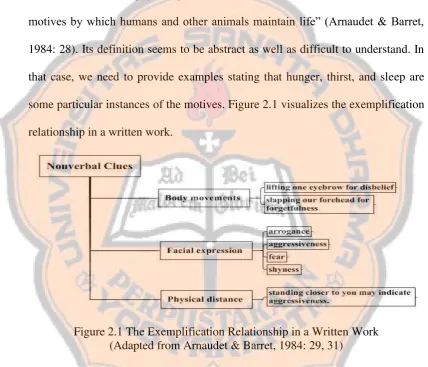
For instance, human motivation can be divided into three common types.
One of them is called physiological motives, which is defined as “basic unlearned
motives by which humans and other animals maintain life” (Arnaudet & Barret,
1984: 28). Its definition seems to be abstract as well as difficult to understand. In
that case, we need to provide examples stating that hunger, thirst, and sleep are
some particular instances of the motives. Figure 2.1 visualizes the exemplification
relationship in a written work.
Figure 2.1 The Exemplification Relationship in a Written Work (Adapted from Arnaudet & Barret, 1984: 29, 31)
Based on Figure 2.1, readers will possibly understand the general ideas of body
movements, facial expression, and physical distance more clearly and easily. It is
done by considering the specific and real examples, which become a fundamental
key of exemplification relationship, given to each general idea.
In addition, Figure 2.1 could possibly help readers recognize the pattern of
general idea, which is non verbal clues. Then, they provide some examples to
come to less general ideas, which are body movements, facial expressions, and
physical distance, of non-verbal clues. Finally, they provide other examples to
come to such more specific ideas as arrogance, fear, lifting one eyebrow for
disbelief. Another important thing is that the use of some verbs, which are
illustrated and exemplified, and some transitions, which are for example and for
instance can help writers establish this exemplification relationship in their
written work (Arnaudet & Barret, 1984).
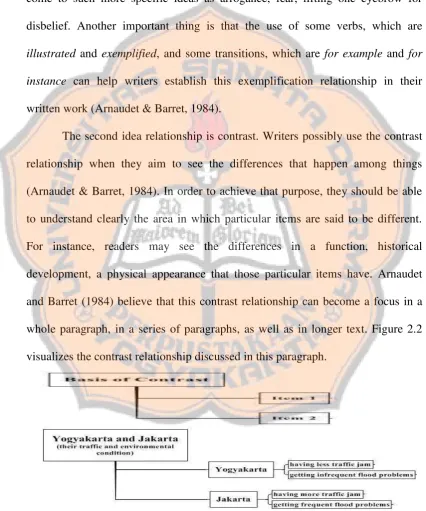
The second idea relationship is contrast. Writers possibly use the contrast
relationship when they aim to see the differences that happen among things
(Arnaudet & Barret, 1984). In order to achieve that purpose, they should be able
to understand clearly the area in which particular items are said to be different.
For instance, readers may see the differences in a function, historical
development, a physical appearance that those particular items have. Arnaudet
and Barret (1984) believe that this contrast relationship can become a focus in a
whole paragraph, in a series of paragraphs, as well as in longer text. Figure 2.2
visualizes the contrast relationship discussed in this paragraph.
Writers can also use some prepositions, which are in contrast to, as opposed to,
unlike, verbs, which are contrasts with, differs from, conjunctions, which are but,
however, on the other hand, in order to help them establish the contrast
relationship in their written work (Arnaudet & Barret, 1984).
The third idea relationship is comparison. In a comparison relationship,
writers need to state the similarities either between or among things. Then, similar
to contrast, this type of relationship can possibly be given a focus by writers in
their written text. Figure 2.3 illustrates the comparison relationship clarified in
this paragraph.
Figure 2.3 The Comparison Relationship in a Written Work (Adapted from Arnaudet & Barret, 1984: 37)
Writers can also use some adjectives, which are similar and both, conjunctive
adverbs, which are similarly, likewise, in the same way, in order to help them
develop the comparison relationship in their essay (Arnaudet & Barret, 1984).
they write their written text depending on the purpose they aim to achieve. Figure
2.4 illustrates the combination between contrast and comparison relationships.
Figure 2.4 The Comparison and Contrast Relationship in a Written Work (Adapted from Arnaudet & Barret, 1984: 38)
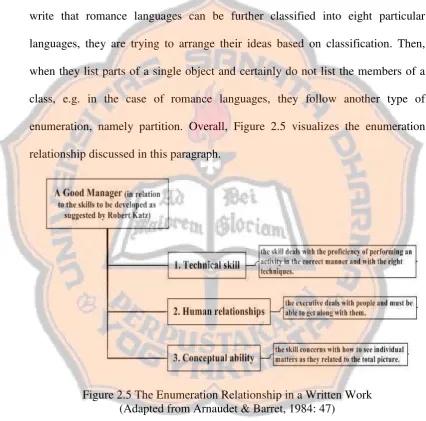
The fourth idea relationship is enumeration. Writers can relate ideas in
their written work by enumerating them. In that case, writers can take particular
items that have same general ideas and subsequently arrange them one after the
other (Arnaudet & Barret, 1984). This enumeration process can be divided into
some specific types.
They are informal enumeration, classification, and partition. When writers
some related items” (Arnaudet & Barret, 1984: 46). For instance, they may write;
“a third skill involves conceptual ability...”(Arnaudet & Barret, 1984: 47). When
writers apply the classification, they aim to divide a common category into its
total amount of natural parts. For instance, when writers of linguistics textbook
write that romance languages can be further classified into eight particular
languages, they are trying to arrange their ideas based on classification. Then,
when they list parts of a single object and certainly do not list the members of a
class, e.g. in the case of romance languages, they follow another type of
enumeration, namely partition. Overall, Figure 2.5 visualizes the enumeration
relationship discussed in this paragraph.
Figure 2.5 The Enumeration Relationship in a Written Work (Adapted from Arnaudet & Barret, 1984: 47)
The use of there is and there are, some nouns, which are several types, three
kinds, verbs, which are classified, divided, conjunctive adverbs, which are finally,
in addition, would help writers develop the enumeration relationship in their
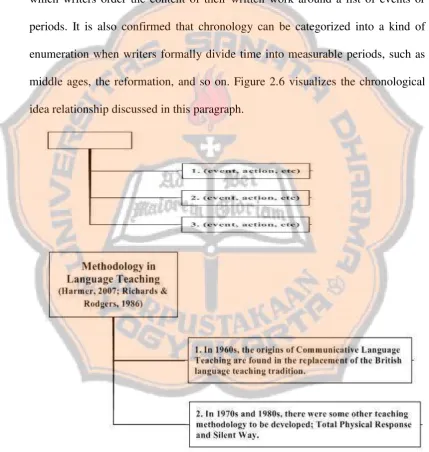
The fifth idea relationship is chronology. Writers will apply chronology or
chronological order relationship in their written work when they write a list
consisting of events arranged based on a time sequence (Arnaudet & Barret,
1984). In addition, chronology could possibly become a kind of enumeration in
which writers order the content of their written work around a list of events or
periods. It is also confirmed that chronology can be categorized into a kind of
enumeration when writers formally divide time into measurable periods, such as
middle ages, the reformation, and so on. Figure 2.6 visualizes the chronological
idea relationship discussed in this paragraph.
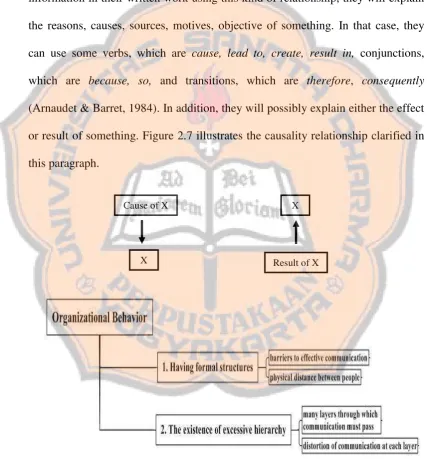
The sixth idea relationship is causality. This relationship aims to create a
time relationship between two actions or events. Essentially, it proposes an idea
that one action either will, should, or may lead to the other through the way of
causing it (Arnaudet & Barret, 1984). When writers try to organize the
information in their written work using this kind of relationship, they will explain
the reasons, causes, sources, motives, objective of something. In that case, they
can use some verbs, which are cause, lead to, create, result in, conjunctions,
which are because, so, and transitions, which are therefore, consequently
(Arnaudet & Barret, 1984).In addition, they will possibly explain either the effect
or result of something. Figure 2.7 illustrates the causality relationship clarified in
this paragraph.
Figure 2.7 The Causality Relationship in a Written Work (Adapted from Arnaudet & Barret, 1984: 57-58)
Cause of X
Result of X X
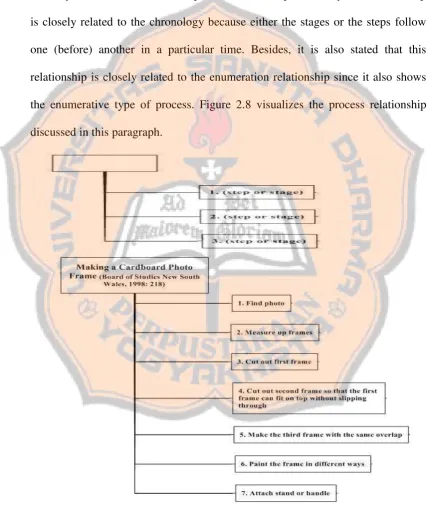
The seventh idea relationship is process. In a written work, writers
possibly list numbers of stages or steps in order to perform some action (Arnaudet
& Barret, 1984). In that case, the relationships among the different stages or steps
listed by the writers could form a process relationship. Generally, this relationship
is closely related to the chronology because either the stages or the steps follow
one (before) another in a particular time. Besides, it is also stated that this
relationship is closely related to the enumeration relationship since it also shows
the enumerative type of process. Figure 2.8 visualizes the process relationship
discussed in this paragraph.
The last idea relationship is spatial order. This relationship requires writers
to organize information in their written work based on a physical location or
spatial sequence (Arnaudet & Barret, 1984). In that case, writers organize the
information from one place to another, from one part of particular things to
another part. In addition, they try to describe the relation among those places or
parts within a space. This kind of relationship commonly occurs when the writers
aim to provide a physical description of something.
Based on the theories on idea relationships discussed in this section, three
essential points could be considered in order to recognize a particular idea
relationship in a written work. First, a particular idea relationship in a written
work can be easily recognized by observing the written cohesive devices. Second,
we can recognize the pattern of ideas based on the definition that each relationship
has. For instance, considering the pattern of exemplification relationship, we
could recognize that writers start from a general idea in their written work. Then,
they provide some examples to come to a less general idea. Eventually, they
provide other examples to come to a specific idea. Third, ideas written in all
elements in a written work should be related to the topic of the written work. For
instance, when the topic is about Flores Island in Indonesia, all parts in the written
work should also discuss about the island and not talk about another island in
c. Coherent Structure
According to White (1986), a coherent structure becomes one of four
pillars of good writing. Therefore, whenever writers start to write, they should
have some kinds of organizational schemes. White (1986) introduces a scheme
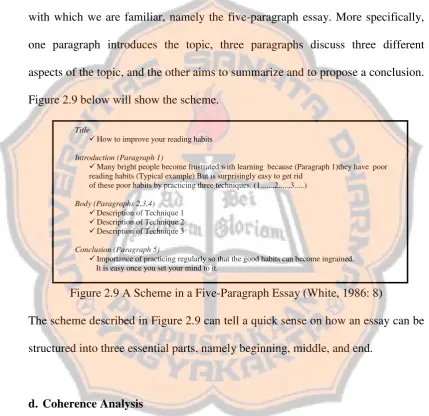
with which we are familiar, namely the five-paragraph essay. More specifically,
one paragraph introduces the topic, three paragraphs discuss three different
aspects of the topic, and the other aims to summarize and to propose a conclusion.
Figure 2.9 below will show the scheme.
Figure 2.9 A Scheme in a Five-Paragraph Essay (White, 1986: 8)
The scheme described in Figure 2.9 can tell a quick sense on how an essay can be
structured into three essential parts, namely beginning, middle, and end.
d. Coherence Analysis
This part reviews some previous related studies in order to find out ways
in analyzing coherence in a written work. Jones (2007) investigated the nature of
non-coherence in three different argumentative essays written by NS and NNS
university students. His analysis on the students’ essays covered three main
Title
How to improve your reading habits
Introduction (Paragraph 1)
Many bright people become frustrated with learning because (Paragraph 1)they have poor reading habits (Typical example) But is surprisingly easy to get rid
of these poor habits by practicing three techniques. (1...,2...,3...)
Body (Paragraphs 2,3,4) Description of Technique 1 Description of Technique 2 Description of Technique 3
Conclusion (Paragraph 5)
activities. First, he started his analysis by restating the definition of coherence
used in his research. Second, he showed three students’ essays, as the evidence of
his analysis. Third, he provided his descriptive analysis toward the coherence
problems he found in the essays. Below is the example of his descriptive analysis
(Jones, 2007: 138):
Text 5 illustrates loss of coherence within and between paragraphs. There is no clear link in theme between the first and second paragraphs: the first is about the menacing effect of globalization on traditional society, African in particular; the second on the threat to Australian society of the new technology. However, the writer does form a bridge between the two paragraphs with the last sentence of the first paragraph (which would be better placed at the start of the next).
Jones (2011), similar to his previous research, did quite similar activities
in analyzing a student’s essay. In his analysis, he provided a descriptive analysis
towards the student’s essay (Jones, 2011: 6):
But her skill fails her in Paragraph 4, where the four sentences are not explicitly connected to one another. The disconnection is especially abrupt between the second and third sentences, the latter introducing a new
subtopic. These separate sentences may be “chunks” that Maria has
imported from her reading and does not know how to integrate.
Jones (2011: 5) believes that “criteria for analysis of the text derive from the
definition of the genre essay itself and of coherence, as set out earlier.”
Accordingly, his analysis focuses the extent to which the writing shows a logical
order, in which its ideas should hang together. This can clearly imply that in this
research, the related theories of coherence can be used in order to develop the
criteria in analyzing coherence problems in the students’ essays. Further, the
e. Ways in Developing Coherence
Harmer (2004); Bram (1995); Heffernan & Lincoln (1990) suggest ways in
developing coherence. Initially, Harmer (2004: 25) states that:
Coherence is frequently achieved by the way in which a writer sequences information, and this brings us back to the issue of genre and text construction. It is precisely because different genres provoke different writing that coherence is achieved. When writers stray outside text construction norms, coherence is one of the qualities that is most at risk.
This indicates that understanding completely the construction of written text based
on a particular genre is considered as a way that writers can use to enhance the
coherence in their written work. In relation to the analytical exposition essay, as
the focus of this research, the students should understand completely the text
construction in an analytical exposition essay.
It is also essential for writers use transitions in order to achieve coherence
in their paragraphs. By using appropriate transitions, their ideas will flow
smoothly one after the other (Bram, 1995). In relation to transitions, Ellison
(2010:112-119) writes types of transitions that may serve different purposes.
The transitions are phrases for comparisons, transition phrases for contrast,
transitions phrases to show a process, phrases to introduce examples, transitions
phrases for presenting evidence, and eventually phrases for conclusions. Some
examples of transitions phrases for comparisons are similarly, identically, for
example, in other words, we also see, in addition to. Some examples of transition
phrases for contrast are by contrast, however, nevertheless, one hand...on the
other hand. Some examples of transitions phrases to show a process are first,
introduce examples are for example, for instance, specifically, particularly. Some
examples of transition phrases for presenting evidence are consequently,
especially, another important point is..., therefore. Eventually, in summary
(summarize the findings), this analysis reveals that, to summarize, we come to the
conclusion that become some examples of phrases for conclusions.
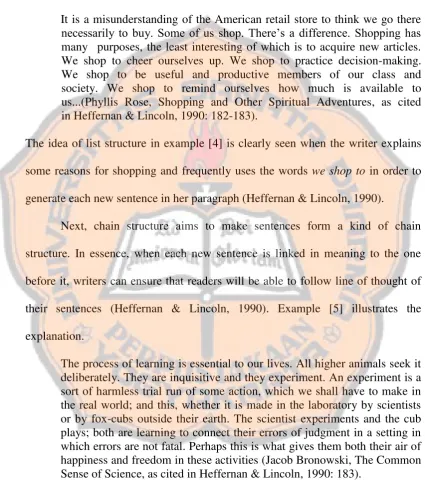
In a paragraph level, Heffernan & Lincoln (1990) believe that writers can
also strengthen coherence of their paragraphs by learning some ways of
developing it, namely list structure, chain structure, and strengthening weak
connections. According to Heffernan & Lincoln (1990: 182), list structure is:
a sequence of sentences that uses the same basic pattern to develop a general point with specific examples. Then, in list structure, each new sentence becomes an item on list.
The explanation can be visualized in example [3]:
They were a diverse group. There were priests who had brooded over the problem of a world in eternity and made the startling discovery that a holy mission summoned them away. There were noblemen in the great courts who stared out beyond the formal lines of the garden and saw the vision of the new empires to be won. There were young men without places who depended on daring and their swords and were willing to soldier for their
fortunes...” (Oscar Handlin, Race and Nationality in American Life, as
cited in Heffernan & Lincoln, 1990: 182).
In example [3], we may see that the first sentence states the main point of
the paragraph and the following examples develop the point by using a series of
examples. In addition, it is also pointed out that the repetition of there were...who,
as shown in example [3], significantly makes all examples parallel in a form