ABSTRACT
Kurniawati, Diana. 2015. The Influences of Student-Teacher Consultation on
Students’ Writing Proficiency in Academic Essay Writing Course. Yogyakarta. English Language Education Study Program, Sanata Dharma University.
This study aimed to find out the influences of student-teacher consultation on students’ writing proficiency in an Academic Essay Writing course at English Language Education Study Program of Sanata Dharma University. Since writing is one of the English skills which need to be developed in English department, the researcher considers that it is an important issue. The English Language Education Study Program designs an Academic Essay Writing course in order to facilitate the students to learn about the methods of citation, the conventions of style and organization, critical thinking and to develop their writing proficiency in writing an academic essay.
There are two research problems formulated in this study. The first problem is “What is the students’ perception on student-teacher consultation in
Academic Essay Writing course?” The second problem is “What are the influences of student-teacher consultation on students’ writing proficiency?”
In order to answer the problems, the researcher conducts survey research in which questionnaire and interview are used as the instruments. The results of the questionnaire are analyzed by calculating a percentage on the scale of agreements. Then, the interview results are used to support the data from the questionnaire.
The result of this study showed that the students had positive perception on the implementation of student-teacher consultation. There were more than 75% of the students who agreed that the consultation gave positive influences. The students were involved in the consultation when they were writing an essay. They believed that the consultation helped them to solve their writing problems and overcame their writing difficulties. Then, student-teacher consultation facilitated the students to improve their writing proficiency. There were more than 90% of the students who improved their writing proficiency. After having a consultation, the students improved the ability to develop the content of writing, to be more aware of the grammar and punctuation, to organize the ideas, and to choose appropriate words. It was concluded that the students’ writing proficiency were improved by the implementation of student-teacher consultation in Academic Essay Writing course.
ABSTRAK
Kurniawati, Diana. 2015. The Influences of Student-Teacher Consultation on
Students’ Writing Proficiency in Academic Essay Writing Course. Yogyakarta: Program Studi Pendidikan Bahasa Inggis, Universitas Sanata Dharma.
Penelitian ini bertujuan untuk mengetahui pengaruh student-teacher consultation terhadap kemampuan menulis mahasiswa di kelas Academic Essay Writing pada Program Studi Pendidikan Bahasa Inggris, Universitas Sanata Dharma. Oleh karena menulis adalah salah satu kemampuan Bahasa Inggris yang perlu dikembangkan di Institusi Bahasa Inggris, peneliti menganggap hal ini merupakan hal yang penting untuk diteliti. Program Studi Pendidikan Bahasa Inggris telah merancang pembelajaran Academic Essay Writing untuk memfasilitasi mahasiswa untuk belajar mengenai metode pengutipan, pengaturan gaya bahasa dan pengorganisasian, berpikir kritis, dan mengembangkan kemampuan menulis esai ilmiah.
Terdapat dua rumusan masalah pada penelitian ini. Pertama, “Bagaimana persepsi mahasiswa terhadap student-teacher consultation di kelas Academic Essay Writing?”. Kedua, “Apa pengaruh student-teacher consultation terhadap
kemampuan siswa dalam menulis?”.
Untuk menjawab pertanyaan tersebut, peneliti menggunakan survey sebagai metode dan kuesioner dan wawancara sebagai instrumen. Hasil dari data kuesioner dianalisa dengan menghitung persentase skala kecocokan. Kemudian, hasil wawancara digunakan untuk mendukung hasil data kuesioner.
Hasil dari penelitian ini menunjukkan bahwa mahasiswa memiliki persepsi positif terhadap penerapan student-teacher consultation. Lebih dari 75% dari mahasiswa setuju bahwa konsultasi memberi dampak positif. Mahasiswa terlibat dalam konsultasi saat mereka sedang mengerjakan esai. Mahasiswa meyakini bahwa konsultasi membantu mereka memecahkan masalah mereka dalam menulis dan mengatasi kesulitan menulis. Kemudian, student-teacher consultation memfasilitasi mahasiswa mengembangkan kemampuan menulis. Lebih dari 90% dari mahasiswa mengalami peningkatan pada kemampuan menulis mereka. Setelah makukan konsultasi, mahasiswa mampu mengembangkan kemampuan mereka dalam mengembangkan isi tulisan, ketelitian akan penggunaan tata bahasa dan tanda baca, pengorganisasian ide-ide, dan pemilihan kata-kata yang tepat. Dapat disimpulkan bahwa kemampuan mahasiswa dalam menulis dapat dikembangkan dengan menerapkan student-teacher consultation di kelas Academic Essay Writing.
THE INFLUENCES OF STUDENT-TEACHER
CONSULTATION ON S
TUDENTS’ WRITING PROFICIENCY
IN ACADEMIC ESSAY WRITING COURSE
A SARJANA PENDIDIKAN THESIS Presented as Partial Fulfillment of Requirements
to Obtain the Sarjana Pendidikan Degree in English Language Education
By
Diana Kurniawati Student Number: 111214002
ENGLISH LANGUAGE EDUCATION STUDY PROGRAM DEPARTMENT OF LANGUAGE AND ARTS EDUCATION FACULTY OF TEACHERS TRAINING AND EDUCATION
SANATA DHARMA UNIVERSITY YOGYAKARTA
i
THE INFLUENCES OF STUDENT-TEACHER
CONSULTATION ON S
TUDENTS’ WRITING PROFICIENCY
IN ACADEMIC ESSAY WRITING COURSE
A SARJANA PENDIDIKAN THESIS
Presented as Partial Fullfilment of Requirements to Obtain the Sarjana Pendidikan Degree
in English Language Education
By
Diana Kurniawati Student Number: 111214002
ENGLISH LANGUAGE EDUCATION STUDY PROGRAM DEPARTMENT OF LANGUAGE AND ARTS EDUCATION FACULTY OF TEACHERS TRAINING AND EDUCATION
SANATA DHARMA UNIVERSITY YOGYAKARTA
iv
This thesis is dedicated to
Jesus Christ for His everlasting Love and
Faithfulness in my life
This thesis is also dedicated to
Ibu Riwi Handayani as her birthday gift
v
STATEMENT OF WORK’S ORIGINALITY
I honestly declared that this thesis, which I have written, does not contain the work or parts of the work of other people, except those cited in the quotations and the references, as a scientific paper should.
Yogyakarta, 10 August 2015 The writer
vi
LEMBAR PERNYATAAN PERSETUJUAN
PUBLIKASI KARYA ILMIAH UNTUK KEPENTINGAN AKADEMIS
Yang bertanda tangan di bawah ini, saya mahasiswa Universitas Sanata Dharma:
Nama : Diana Kurniawati NIM : 111214002
Demi pengembangan ilmu pengetahuan saya memberikan kepada Perpustakaan Universitas Sanata Dharma, karya ilmiah saya yang berjudul:
THE INFLUENCES OF STUDENT
–
TEACHER
CONSULTATION ON
STUDENTS’ WRITING PROFICIENCY
IN ACADEMIC ESSAY WRITING COURSE
beserta perangkat yang diperlukan (bila ada). Dengan demikian saya memberikan kepada Perpustakaan Universitas Sanata Dharma hak untuk menyimpan, mengalihkan dalam bentuk media lain, mengelolanya dalam bentuk pangkalan data, mendistribusikan secara terbatas, dan mempublikasikannya di Internet atau media lain untuk kepentingan akademis tanpa perlu meminta ijin dari saya maupun memberikan royalti kepada saya selama tetap mencantumkan nama saya sebagai penulis.
Demikian pernyataan ini saya buat dengan sebenarnya.
Dibuat di Yogyakarta
Pada tanggal:10 Agustus 2015 Yang menyatakan
vii ABSTRACT
Kurniawati, Diana. 2015. The Influences of Student-Teacher Consultation on Students’ Writing Proficiency in Academic Essay Writing Course. Yogyakarta. English Language Education Study Program, Sanata Dharma University.
This study aimed to find out the influences of student-teacher consultation on students’ writing proficiency in an Academic Essay Writing course at English Language Education Study Program of Sanata Dharma University. Since writing is one of the English skills which need to be developed in English department, the researcher considers that it is an important issue. The English Language Education Study Program designs an Academic Essay Writing course in order to facilitate the students to learn about the methods of citation, the conventions of style and organization, critical thinking and to develop their writing proficiency in writing an academic essay.
There are two research problems formulated in this study. The first problem is “What is the students’ perception on student-teacher consultation in Academic Essay Writing course?” The second problem is “What are the influences of student-teacher consultation on students’ writing proficiency?”
In order to answer the problems, the researcher conducts survey research in which questionnaire and interview are used as the instruments. The results of the questionnaire are analyzed by calculating a percentage on the scale of agreements. Then, the interview results are used to support the data from the questionnaire.
The result of this study showed that the students had positive perception on the implementation of student-teacher consultation. There were more than 75% of the students who agreed that the consultation gave positive influences. The students were involved in the consultation when they were writing an essay. They believed that the consultation helped them to solve their writing problems and overcame their writing difficulties. Then, student-teacher consultation facilitated the students to improve their writing proficiency. There were more than 90% of the students who improved their writing proficiency. After having a consultation, the students improved the ability to develop the content of writing, to be more aware of the grammar and punctuation, to organize the ideas, and to choose appropriate words. It was concluded that the students’ writing proficiency were improved by the implementation of student-teacher consultation in Academic Essay Writing course.
viii ABSTRAK
Kurniawati, Diana. 2015. The Influences of Student-Teacher Consultation on Students’ Writing Proficiency in Academic Essay Writing Course. Yogyakarta: Program Studi Pendidikan Bahasa Inggis, Universitas Sanata Dharma.
Penelitian ini bertujuan untuk mengetahui pengaruh student-teacher consultation terhadap kemampuan menulis mahasiswa di kelas Academic Essay Writing pada Program Studi Pendidikan Bahasa Inggris, Universitas Sanata Dharma. Oleh karena menulis adalah salah satu kemampuan Bahasa Inggris yang perlu dikembangkan di Institusi Bahasa Inggris, peneliti menganggap hal ini merupakan hal yang penting untuk diteliti. Program Studi Pendidikan Bahasa Inggris telah merancang pembelajaran Academic Essay Writing untuk memfasilitasi mahasiswa untuk belajar mengenai metode pengutipan, pengaturan gaya bahasa dan pengorganisasian, berpikir kritis, dan mengembangkan kemampuan menulis esai ilmiah.
Terdapat dua rumusan masalah pada penelitian ini. Pertama, “Bagaimana persepsi mahasiswa terhadap student-teacher consultation di kelas Academic Essay Writing?”. Kedua, “Apa pengaruh student-teacher consultation terhadap kemampuan siswa dalam menulis?”.
Untuk menjawab pertanyaan tersebut, peneliti menggunakan survey sebagai metode dan kuesioner dan wawancara sebagai instrumen. Hasil dari data kuesioner dianalisa dengan menghitung persentase skala kecocokan. Kemudian, hasil wawancara digunakan untuk mendukung hasil data kuesioner.
Hasil dari penelitian ini menunjukkan bahwa mahasiswa memiliki persepsi positif terhadap penerapan student-teacher consultation. Lebih dari 75% dari mahasiswa setuju bahwa konsultasi memberi dampak positif. Mahasiswa terlibat dalam konsultasi saat mereka sedang mengerjakan esai. Mahasiswa meyakini bahwa konsultasi membantu mereka memecahkan masalah mereka dalam menulis dan mengatasi kesulitan menulis. Kemudian, student-teacher consultation memfasilitasi mahasiswa mengembangkan kemampuan menulis. Lebih dari 90% dari mahasiswa mengalami peningkatan pada kemampuan menulis mereka. Setelah makukan konsultasi, mahasiswa mampu mengembangkan kemampuan mereka dalam mengembangkan isi tulisan, ketelitian akan penggunaan tata bahasa dan tanda baca, pengorganisasian ide-ide, dan pemilihan kata-kata yang tepat. Dapat disimpulkan bahwa kemampuan mahasiswa dalam menulis dapat dikembangkan dengan menerapkan student-teacher consultation di kelas Academic Essay Writing.
ix
ACKNOWLEDGEMENTS
First of all, I would like to address my gratitude to my beloved Jesus Christ for His everlasting love, guidance, and blessing in my life, especially when I had to struggle for my thesis. Secondly, my gratitude goes to myself as a person who has struggled for every situation and the whole part of my body which has supported me very well during my life.
I would like to express my deepest gratitude to my best advisor, Yuseva Ariyani Iswandari S.Pd., M.Ed., for her love, guidance, patience, beneficial suggestions, and support so that I can finish my thesis. I also thank Christina Lhaksmita Anandari S.Pd., Ed.M., for her help, support and love during my study. I am thankful to Fidelis Chosa Kastuhandani, S.Pd., M.Hum., for allowing me to conduct my research in his class. Besides, I thank all the lecturers in the English Language Education Study Program who always help me in my learning process. I am also thankful to the Secretariat Staff for their best services.
x
I am also extremely grateful to have such wonderful friends: Nike, Cicik Sari, Angel Bolly, Puput, Suster Nicoline, Intan, and Mas Damar, for having shared happiness and many priceless experiences together during my study in Sanata Dharma University. Furthermore, my superb gratitude goes to Star De Acyuta family: Cila, Kakak Tina, Cicik Yoyo, Irene and Yosua for being the best partners, the awesome friends, and the second family who support me during my study and my process of finishing my thesis. I also thank TSD family for introducing me to so many meaningful experiences which train me to be a better person. I would also like to thank all of my friends in the English Language Education Study Program, in PPL, and KKN. I am very lucky and very happy to meet them.
Finally, my deepest gratitude goes to everybody who could not be mentioned one by one, who has helped me, directly and indirectly, in every part of my process, especially in writing this thesis.
xi
TABLE OF CONTENTS
TITLE PAGE ... i
APPROVAL PAGES ... ii
DEDICATION PAGE ... iv
STATEMENT OF WORK’S ORIGINALITY ... v
PERNYATAAN PERSETUJUAN PUBLIKASI ... vi
ABSTRACT ... vii
CHAPTER I. INTRODUCTION ... 1
A. Research Background ... 1
CHAPTER II. REVIEW OF RELATED LITERATURE ... 10
A. Theoretical Description ... 10
1. Writing Proficiency ... 11
a. The Nature of Writing ... 11
b. Principle of Teaching Writing ... 12
c. The Criteria of Writing Proficiency ... 14
d. The Roles of the Teacher and the Student ... 15
2. Essay Writing ... 16
a. The Nature of Essay ... 16
b. Types of Essay ... 16
c. Academic Essay ... 17
3. Student -Teacher Consultation ... 17
a. The Nature of Consultation ... 18
b. Types of Consultation ... 19
c. The Aims of Consultation ... 20
d. The Benefits of Consultation ... 21
4. Perception ... 22
a. The Nature of Perception ... 22
b. The Factors of Perception ... 23
xii
CHAPTER III. METHODOLOGY ... 26
A. Research Method ... 26
B. Research Participants ... 27
C. Research Setting ... 27
D. Instrument and Data Gathering Technique ... 28
1. Questionnaire ... 28
2. Interview ... 29
E. Data Analysis Technique ... 29
1. Questionnaire Data ... 29
2. Interview Data ... 30
F. Research Procedures ... 31
CHAPTER IV. RESEARCH FINDINGS AND DISCUSSION ... 33
A. Findings ... 33
1. Students’ Perception on The Implementation of Student-Teacher Consultation ... 34
a) Students’ Attitude towards Writing in Academic Essay Writing ... 34
b) Student -Teacher Consultation in AEW Course ... 36
c) Students’ Perception on Student -Teacher Consultation ... 38
d) Students’ Attitude towards Student -Teacher Consultation ... 43
2. The Influences of Student-Teacher Consultation ... 44
a) The Influences of Student-Teacher Consultation on Writing Proficiency ... 44
B. Discussion ... 47
1. Students’ Perception on Student -Teacher Consultation ... 48
2. The Influences of Student -Teacher Consultation on Students’ Writing Proficiency ... 52
CHAPTER V. CONCLUSIONS AND SUGGESTIONS ... 65
A. Conclusions ... 65
B. Suggestions ... 66
REFERENCES ... 69
xiii
LIST OF APPENDICES
Page
Appendix 1. Questionnaire ... 72
Appendix 2. Data Close-Ended Questionnaire ... 76
Appendix 3. Questionnaire Blue Print ... 79
Appendix 4. Results of Close Ended Questions ... 81
Appendix 5. Response of Open Ended Questions ... 84
Appendix 6. Lecturer Interview ... 90
Appendix 7. Students Interview ... 92
Appendix 8. AEW Course Outline ... 97
xiv
LIST OF TABLES
Page
Table 2.1 The Criteria of Writing Proficiency ...24
Table 3.1 Example 1 of Table of Questionnaire ...30
Table 4.1 Student-Teacher Consultation ...36
Table 4.2 Students’ Perception on Student-Teacher Consultation...39
xv
LIST OF FIGURES
Page
Figure 4.1 Students’ Difficulties in Writing ...35
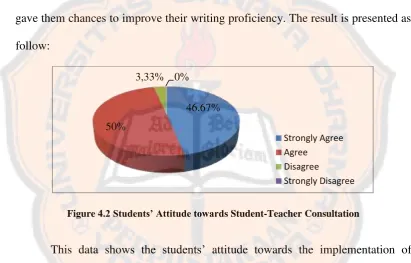
Figure 4.2 Students’ Attitude toward Student-Teacher Consultation ...43
Figure 4.3 Example 1 of Student’s Draft of Essay ...54
Figure 4.4 Example 2 of Student’s Final Draft of Essay ...55
Figure 4.5 Example 3 of Student’s Outline of Essay ...57
Figure 4.6 Example 4 of Student’s Essay of Discussion ...58
Figure 4.7 Example 5 of Student’s Draft Essay of Introduction ...59
Figure 4.8 Example 6 of Student’s Final Essay of Introduction ...60
Figure 4.9 Example 7 of Student’s Draft Essay of Introduction ...62
1 CHAPTER I INTRODUCTION
This chapter consists of seven sections. In the first section, the researcher presents the research background that explains the knowledge background of the study. The second section is the research questions, presents two research questions to be answered. The third section which is the problem limitation, presents the limitation of the study to make the problems becomes more focused. The fourth section is the research objectives, explain the purpose of the study. The fifth section is the research benefits, which present the benefits of the study for some parts in the ELESP (English Language Education Study Program). The last part is definition of terms which presents the definition of each term that is used to help the readers have the clear understanding of the study.
A. Research Background
organization. As stated by Bell and Burnaby, 1984; Bialystok, 1978; Brown and Yule, 1983; Nunan, 1989 and White, 1981 as cited in McNamara (2010), “writing in second language is far more challenging than to listen to, speak or read a foreign language”.
It indicates that writing process challenges the students in the learning English. The writing process in English language learning for EFL needs a cognitive skill which focuses on the ability to compose the ideas and to write a grammatical correct sentence. Furthermore, it also needs a students’ social connection, which means the students need to share ideas to the readers and to present the relevant of the topic to the readers. Kress (1989, as cited in Tribble, 1996) states that the command of writing gives access to certain cognitive, conceptual, social, and political areas. Thus, writing is a process in language learning which is useful for students’ critical thinking and discovering skill. In the writing process, the EFL students also need opinions, suggestions or information not only from books or any other sources but also from the teacher or friends by doing discussion in order to get feedback. Having discussion and feedback in writing process in ELESP is usually done by consultation. The ELESP students experience a consultation since they learn Critical Reading and Writing. It shows that the students are familiar with the consultation process.
AEW is the course in ELESP which is an intermediate course after Critical Reading and Writing course 2 (CRW 2). This course is designed to enable the students to improve the method of citation, convention of style and organization. Based on AEW course outline, before writing an essay, the students learned about the research paper convention, the part of research paper, quotation. They started to make an outline for their first draft. From the first draft, the students have chances to consult the essay before the final submission. In this course, content and grammar are important since an appropriate grammar will create an appropriate meaning for the readers. Thus, the readers get the complete information and the ideas from the writers.
The students who take AEW in semester five write an essay based on three different fields; Education, Literature, and Linguistics. The students conduct a research through a questionnaire, interview, and library study. The students are given time to finish each essay for about three weeks. During the writing process for each project, the students have opportunities to get feedback from the lecturer or from the other friends. They can get feedback for the topic, the outline, and the first draft. In this case, feedback helps the students to solve their writing problems such as the organization of the sentences and ideas, the development ideas of writing, or the grammatical mistakes. One of the activities done by the students for getting feedback from the lecturer is consultation.
lecturer holds a consultation outside the class if it is needed. It depends on the students’ need. The lecturer can monitor the students’ writing progress and help them in composing ideas for their essay. Besides, the students get chances to improve writing proficiency by learning to develop the ideas, improving their ability to organize an essay and being aware of their writing mistakes such as diction, grammar and punctuation.
From the process in AEW course, the researcher finds that a consultation is the part of the teaching and learning activities. This consultation process involves the teacher and the student. The teacher is responsible for helping the students to produce a good essay. Therefore, the consultation process should facilitate the students to share their opinions, to ask questions and to get feedback from lecturer in order to improve the students’ proficiency to write an academic essay well. Those are the
reasons why the researcher would like to conduct research which deals with the students’ perception on the implementation of student-teacher consultation and the
influences of student-teacher consultation on the students’ writing proficiency. Besides, all of the students in AEW course have already experienced a consultation as one of the activities in Critical Reading and Writing 2 (CRW 2).
Consultation is about gathering information or opinion, attitude, and priorities to inform decision making (Policy on Communication and Consultation, 2012). In the process of learning writing, it involves the lecturer and the students to discuss the students’ writing progress and to communicate personally. In teaching writing, the
the students by giving feedback or suggestion on the essay. Tribble (1996) also supports that the teachers’ role in teaching writing is to help the students to get information and to develop the ideas of writing.
This study investigates the students’ perception on consultation in Academic Essay Writing course and the influences of consultation on the students’ writing proficiency. This research is expected to give information about the influences or the effects of consultation on the teaching and learning activities in writing course especially Academic Essay Writing course. It is also expected to help the lecturer who teaches writing to develop the teaching and learning activities in writing course so that the lecturer can help the students to improve their writing proficiency through a consultation.
B. Research Problems
There are two research problems which are formulated in this study, namely: 1. What is the students’ perception on the implementation of student-teacher
consultation in Academic Essay Writing course?
C. Research Objectives
This study purposes to find out the answers related to the research problems, namely:
1. To identify the students’ perception on the implementation of student-teacher consultation in AEW course.
2. To discover the influences of student-teacher consultation in students’ writing proficiency in AEW course.
D. Problem Limitation
This study is limited to the students’ English writing proficiency in AEW course and the implementation of student-teacher consultation which is experienced by the students in Academic Essay Writing class of ELESP, Sanata Dharma University. This research focuses on the students’ perception on the implementation of student-teacher consultation and the influences of student-teacher consultation on the students’ writing proficiency. The survey focuses on the respondents who are from AEW class F in the academic year 2012/2013.
E. Research Benefits
The researcher expects that this research which is about the influences of student-teacher consultation to give benefits for the English writing lecturers, the students, and The ELESP Sanata Dharma University.
1. The English Writing Lecturers
For the lecturers, the identification of students’ perception on the implementation of consultation helps them to understand the students’ opinions and needs in the learning process in the writing course. By doing the discussion, the lecturers can encourage the students to improve their writing proficiency and to motivate them to have a better result in writing. Thus, the lecturers are able to organize and to improve the learning process better and to enhance the students’ writing proficiency.
2. The Students of English Language Education Study Program
For the students of ELESP, this study helps them to recognize their strengths and weaknesses in writing process and to recognize the influences of consultation on the students’ writing progress. In addition, it helps them to be aware of the
importance of consultation for their writing process and result. Thus, the students are able to improve their writing skill by doing consultation for their writing process. 3. The ELESP Sanata Dharma University
student-teacher consultation has positive influences, it can be implemented not only in writing course but also in the other courses. Thus, the students do not only improve their writing proficiency but also improve their speaking, reading and listening proficiency.
F. Definition of Terms
In order to give clear explanation and to avoid misunderstanding from the readers, the researcher provides the definition of terms used in this study. It helps the readers to understand the content and the theories in this study.
1. Student-Teacher Consultation
Student-teacher consultation is the way that feedback is delivered through the dialogue between the student and the teacher and it can be used to develop both of the students’ essay and the students’ writing proficiency (Williams, 2002 as cited in
Hyland, 2006). From this research, student-teacher consultation refers to the activity of consultation which is done by the student and the lecturer in the classroom or outside the classroom in order to help the students to improve their writing proficiency. The lecturer is considered as an expert in the learning process to help the students to solve the problems in their writing process.
2. Students’ Writing Proficiency
proficiency refers to the ability to express the ideas through written text with minimum errors and has an informative content. Moreover, Zimmermar and Rodrigues (1992) state that a good writing should be appropriate to the audience and purpose for specific writing situation. From the writing process, the writing product indicates the writers’ proficiency. The process of writing focuses on the improvement of the students’ writing proficiency by doing consultation. Then, the product is the result of students’ essay.
3. The Academic Essay Writing Course
10 CHAPTER II
REVIEW OF RELATED LITERATURE
In this chapter, the researcher provides review of related literature which has two main components. First, theoretical description reviews the basis of the theory for the whole research. Second, theoretical framework reviews some theories to cover this study in order to explain the study obviously.
A. Theoretical Description
This study presents the influences of student-teacher consultation in Academic Essay Writing course (AEW). In this part, the researcher reviews the theories of writing which include the nature of the writing proficiency, the principle of teaching writing, the criteria of writing proficiency and the roles of the teacher and the student. Then, the researcher describes the academic essay writing which consists of the nature of essay and two types of essays: academic essay and non-academic essay. Since the first research question deals with the students’ perception on the implementation of student-teacher consultation, the
1. Writing Proficiency
In this section, the researcher reviews the theories which are related to the writing proficiency. There are four theories: the nature of writing, the principle of teaching writing, the criteria of writing proficiency, and the roles of the teacher and the student.
a. The Nature of Writing
Generally, writing is one of the English basic skills. Writing is both process and product in the English learning activities (Sokolik as cited in Nunan, 2003). The process of writing can be seen from the activity that is experienced by the students while they are working on the writing project. The process is often cyclical and sometimes takes long time. Then, the product of writing can be a letter, an essay, a story, or a research report that are readable. In addition, as stated by Hyland (2003), writing is seen as a product constructed from the writer’s ability of lexical and grammatical. In this case, writing is seen as the writer’s ability to construct meaning by producing well-formed sentences. Writing is considered as a reinforcing language patterns through the sentence formation ability and testing writer to develop the ability to manipulate lexis and grammar.
of field. Therefore, the writer is treated to express their idea written that should be appropriate to the audience and the purpose.
In the process of learning writing, the writers can learn not only to construct sentences in English but also to present the information and the ideas which are appropriate to the audience and the purpose. Furthermore, it helps the writers to improve their ability to understand the topic and the purpose of their writing so that the students can produce a good writing to be read by the readers. b. Principle of Teaching Writing
In teaching writing, the teacher needs to consider some principles while planning a course in order to deliver a meaningful learning to the students. As stated by Sokolik as cited in Nunan (2003), there are four principles of teaching writing.
The first principle is understanding students’ reason for writing. It is important for the teacher in learning process to understand the students’ topic of writing. It helps the teacher to give information or explanation about what kind of writing that the students will write, what the students’ topic and how the topic will be developed. Therefore, the teacher needs to interact with the students and to get involved in the students’ writing process.
writing process. By practicing writing more, the students are trained to think critically, to construct the correct English sentences, and to express the ideas.
The third principle is making helpful and meaningful feedback. The students need feedback for their writing clearly. This feedback can be written or oral. For the written feedback, it should be short and use understandable vocabulary or symbol used or a simple message. By giving feedback or comments, the students can see their mistakes on their writing project. It will help them to be more aware of their weaknesses.
Since this study focuses on consultation, oral feedback becomes the focus because the lecturer gives feedback or comments orally through the consultation. As stated by Akbarzadeh (2014) in a journal titled The effect of oral feedback on the accuracy and complexity of EFL learners’ writing performance, oral feedback
refers to interactive feedback, which has meaning as an interaction between the teacher and the students who have equal status to share their needs and make an effort to understand each other. This direct interaction gives opportunities for the students to negotiate, to ask questions more, and to develop the students and the teacher communication. Therefore, it will help the students to understand their writing problems and to learn from the mistakes.
writing requirements. The writing rubric should include the grammar, organization, content or other features of writing that are important to be included and the scores in each aspect should be provided. For each aspect, the teacher should provide requirements which should be achieved by the students.
c. The Criteria of Writing Proficiency
The criteria of writing proficiency include so many elements of writing that should be noticed and should be adjusted to the students’ grade. These help the students to be aware of the writing requirements to write an essay. The criteria of writing proficiency are stated by some experts such as Hyland, Brown and Zimmermar and Rodrigues to asses and determine the students’ writing proficiency.
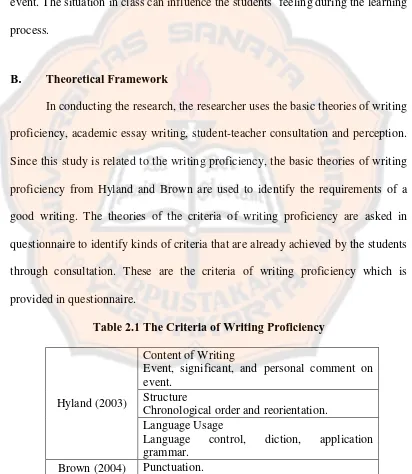
Hyland (2003) states three major areas in determining students’ writing proficiency. First is the content of writing which deals with the stated event, document event, significant and personal comment on event. The content shows the information presented by the writer and the appropriateness to the reader. Second is the structure of the text. It deals with the orientation, background, chronological order and reorientation. It demands the writer to be able to organize the ideas in order to present understandable information in content. The third is the language usage which deals with the language control, diction, the application grammar and writing style. It shows the ability of the writer to construct the grammatically correct sentences.
logical, developmental ideas, grammar, punctuation, spelling and style. In addition, Zimmermar and Rodrigues (1992) also state some criteria of a good writing that should be appropriate for the purpose, audience, content, style, effective organization, sentence structure, word choice and information within it. By explaining the criteria of writing proficiency to the students in evaluation and they are expected to avoid to make mistakes in writing. These criteria help the students to be more aware of a good writing.
d. The Roles of the Teacher and the Student
This study focuses on the influence of consultation in writing class. The researcher provides the roles of the teacher and the student. It shows the teacher’s role in writing process and the student’s role in consultation. Hyland (2003) states that teacher’s role is to guide the students through the writing process in order to
help them to develop strategies of generating, drafting and refine the ideas. The teacher has responsibilities to help the students to generate the ideas of content and structure, to encourage brainstorming, to give responses and to transform information in order to develop the students’ writing proficiency.
discussion and in responding the feedback in order to improve their writing proficiency through the consultation.
2. Essay Writing
Since this study finds out the influences of consultation in Academic Essay Writing course, the researcher defines the nature of the academic essay and the types of essay.
a. The Nature of Essay
Essay is a short literary prose composition, presenting writer’s thought that is usually analytic, speculative or interpretative (Tiedt, 1989). In addition, the other explanation about essay comes from Indrisano and Squire (2000) who state that an essay creates the opportunity for the students to develop the reasoned explanations as they discover, analyse, and synthesize the ideas through the process of writing. Therefore, in the essay writing process, the student needs to analyze or to interpret the data or the information and to express or to respond the ideas in the written form.
b. Types of Essay
In order to clarify the nature of the essay, this part reviews the types of the essay. There are two types of essay: academic and non-academic.
1) Academic
found in AEW are language teaching, literature, and linguistics. The academic essay shows an analytical review of particular topic.
2) Non-academic
As stated by Crème and Lea as cited in Dickinson (2004), a non-academic essay is more personal. The information comes from the writer’s personal feeling and opinion rather than the fact. It is usually based on the personal experience or interpretation. The theme is also about the life experience or activities in the daily life.
c. Academic Essay Writing
As stated by Muhyidin (1988), an academic essay is a formal composition. The researcher provides the purposes of the academic essay in order to give additional explanation of academic essay. There are four purposes of the academic essay writing. Those purposes are stated by Bailey (2011) namely to report on a piece of research, to answer the research questions, to discuss a subject of common interest and to synthesize the research.
3. Student-Teacher Consultation
Since this study focuses on the consultation which is implemented in AEW course, the researcher reviews some theories which are related to the student-teacher consultation. The researcher reviews the theories of the nature of consultation, the types of consultation, the aims of consultation and the benefits of consultation.
a. The Nature of Consultation
Student-teacher conference is also called student-teacher consultation. Student-teacher consultation is the way that feedback is delivered through the dialogue between the student and the teacher and it can be used to develop both of the text and the students’ writing proficiency (Williams, 2002 as cited in Hyland, 2006). Consultation gives chance for the teacher to help the student to clarify the meaning, solve the writing problem and minimize mistakes in the writing.
The student should have a plan about what they want to discuss with their teacher and what they want to get from the consultation (Tiedt, 1989). The students’ plan can be a schedule or a target that should be achieved by the
students. It helps the students to improve their writing project sustainably and the teacher can predict the students’ target, then, help the students to achieve the target.
to develop his/her autonomy learning and allows him/her to ask questions which related to the writing project so that he/she can construct a revision plan.
In conducting the student-teacher consultation, there are seven procedures that are stated by White and Arndt (1991) as cited in Hyland (2003). There are seven procedures for conducting the consultation.
1) The teacher needs to concern with the situation where the student will not feel threatened by finding something to praise. It helps student to feel relaxed and enjoy the consultation.
2) The teacher and the student need to build the interaction to establish a collaborative relationship.
3) The consultation involves the students in the analysis process and gives the opportunity to communicate and make the revision decision for the writing project.
4) The teacher needs to serve the global problems before the students working on the sentence and word level problem.
5) The teacher gives the response to the essay as working in progress or under construction.
6) The teacher asks the students to draw the conclusion or to sum up the changes they need to make for the revision.
b. Types of Consultation
In order to clarify the definition of consultation in the writing process in AEW, the researcher provides the types of consultation which are implemented in writing class. There are three types of consultation.
1) Teacher-Class
Teacher-class consultation refers to the forum discussion which is stated by Zelko (1957) that the lectures or doing the conference in front of the larger group. The primary purpose of this conference is educational and instructive. The lecturer gives the information or shares the knowledge and gives the instruction to help the students to improve their writing.
2) Teacher-Group
Teacher-group consultation refers to group conference. In this type, the teacher meets more than two students. Each student has opportunity to explain their writing topic then they get the responses or the comments from the lecturer (Three Types of Conference, 1930).
3) Teacher-Student
c. The Aims of Consultation
The implementation of consultation in teaching writing has some purposes for the students’ learning process. As stated by Harrison (2004) and Brown, et al., (1996), there are four purposes of consultation.
1) Consultation helps the students to acquire the knowledge and proficiency needed to solve the writing problems. (Brown, 1996).
2) Consultation helps the lecturer to implement what they have learned to assist the students (Brown, 1996).
3) Consultation is directed towards the problem identifications and exploration to get the detail information about the solution (Harrison, 1996).
4) Consultation helps the students to determine the action as a result of the discussion from the problems (Harrison, 2004).
Those purposes indicate the goals of consultation that give the advantages to students to solve their problem in writing for the academic purpose. It gives the opportunity to the students to learn more from the lecturer and get new experience by implementing the lecturer’s suggestions.
d. The Benefits of Consultation
1) The teacher stimulates independent learning for the student and gives chance to take the responsibility for her/his own writing project.
2) The teacher provides the interaction with an experience as a reader and a writer.
3) The teacher can give the instruction directly to the student then he/she has time to talk to the teacher about their writing project.
4) The instruction is directly tied to specific piece of writing which calls for specific strategies.
4. Perception
Since the researcher studies on the students’ perception on student-teacher consultation, the theories of perception is essentially considered to be mentioned. The theories are about the nature of perception and the factors of perception. a. The Nature of Perception
As stated by Robbins (2001), perception is a process of individuals who organize and interpret their sensory impression in order to give a meaning to their environment. The environment gives a stimulus to someone’s mind. The process of perceiving a stimulus will result perception that enables someone to understand what is faced in their environment. It means that people’s perception will influence their behaviour or act on the situation or reality.
come from the teacher and the writing project. The teacher gives feedback as the stimuli for student’s writing and the student has his/her own writing product that
should be improved as the stimulus for them to do consultation. b. The Factors of Perception
Perception is influenced by the stimuli that come from the environment. There are three factors that influence individual’s perception stated by Robbins (2001) in his book Organizational Behavior.
1) The Perceiver
Perception is influenced by the personal characteristic of the individual perceiver. The characteristics that affect perception are attitudes, motives, interest, experience and expectation. Attitude means how someone gives responses to the reality based on their perception. Motive refers to the students’ needs to the reality. Interest refers to situation which is faced by someone will differentiate perception itself. Then, experience influences someone perception because an event that has never been experienced are more noticeable than an event that has ever been experienced. The last is expectation. Someone tends to perceive that their expectations sometimes will not be the same as the reality.
2) Target
3) Situation
The situation around the environment also influences the perception. The context of the situation in which the objects or event can be seen is important. The situation refers to the time, location or work setting, and social setting of the event. The situation in class can influence the students’ feeling during the learning process.
B. Theoretical Framework
In conducting the research, the researcher uses the basic theories of writing proficiency, academic essay writing, student-teacher consultation and perception. Since this study is related to the writing proficiency, the basic theories of writing proficiency from Hyland and Brown are used to identify the requirements of a good writing. The theories of the criteria of writing proficiency are asked in questionnaire to identify kinds of criteria that are already achieved by the students through consultation. These are the criteria of writing proficiency which is provided in questionnaire.
Table 2.1 The Criteria of Writing Proficiency
Hyland (2003)
Content of Writing
Event, significant, and personal comment on event.
Structure
Chronological order and reorientation. Language Usage
Language control, diction, application grammar.
Meanwhile, the theories of the teacher’s role and the principles of teaching writing are used to analyze and support the finding in chapter four. The theories of the academic essay are used to clarify kind of writing that is written by the students in AEW. It will support the finding and give more information about the academic essay. In addition, the theories of essay writing are presented in order to give clearer information about the academic essay writing. It is used to support the results of the data.
The theories of student-teacher consultation are used as the main theories which are used in questionnaire and interview. Since the focus of this study is the influence and the perception on the student-teacher consultation, the theory of student-teacher consultation, the benefits and the aims of the consultation are used to analyze and support the finding in order to find out students’ interpretation and
attitude towards consultation in the academic essay writing. These theories explain that student-teacher consultation helps students to learn directly from the teacher as an expert. It will help the students to improve their writing proficiency especially in writing an essay.
26 CHAPTER III METHODOLOGY
In this chapter, the researcher provides the method used in conducting the research. The detailed explanation of the methodology is presented into six sections: research method, research participant, research setting, instrument and data gathering technique, data analysis technique, and research procedures.
A. Research Method
Considering that this research presents the students’ perception on student-teacher consultation and what the influences of the student-student-teacher consultation, this research belongs to qualitative research. As stated by Ary and Jacobs (2010), “qualitative research deals with interpret human action, institutions, events,
costumes and the like” (p. 421). In addition, Johnson and Christensen (2012) stated that qualitative research tends to rely on non-numerical data and the type of research is exploration or discovery. Thus, the results of this study will be described. The product of qualitative research is usually a narrative report that full of description to show the data result.
interview was used to complete the data result or the information that was needed and in order to find the validity of the data from the questionnaire.
B. Research Participants
The target of the population was all the students from semester five who took Academic Essay Writing course, class F, in the English Language Education Study Program of Sanata Dharma University. This research focused on the Academic Essay Writing (AEW) students as the target of the population because they were taught to write an academic essay and they learned to do research. They were expected to write essays in particular focuses of the study such as literature, linguistics, and language teaching.
Each student of AEW course had chances to determine his/her own focus of the study to be written. This essay is going to train the students to write a thesis for the next semester. In order to guide the students in their writing process, the lecturer gave chances for them to have the consultation. Thus, this research selected all the students who deal with the consultation to help them to finish their writing project. The researcher engaged all the students in AEW class. There were thirty students who participated to answer questionnaire and five students who participated the interview section. In order to get a supporting data, the researcher also interviewed the lecturer.
C. Research Setting
of Teachers Training and Education. It was conducted in semester 5 because AEW course was held in this semester. This research dealt with survey research in the classroom and library.
D. Instrument and Data Gathering Technique
This section deals with the research instrument and technique which are used in this study to collect the data. The instrument which was used in this research, namely, questionnaire and interview which enable the researcher to gather the data. The questionnaire was used to obtain the data from the appropriate and qualified respondents. Then, the interview was used to ensure and to recheck respondents’ answer in the questionnaire.
1. Questionnaire
number in each column provided in the close-ended part. For each statement, they were asked to choose the frequency of occurrence of a certain statement which expresses the possibility perception on consultation in writing course.
2. Interview
This research provided open-ended questions for the interview as the data gathering method. The interview was done orally and informally. It took place in Sanata Dharma University. Therefore, the respondents could answer the questions comfortably and the interviewer got further information to complete and to recheck the result from the questionnaires. The questions that were asked in the interview were more or less the same with the open-ended question in the questionnaire. There were five questions for interviewing the students and three questions for interviewing the lecturer.
E. Data Analysis Technique
Since this study belongs to a descriptive study, the researcher distinguished the students’ perception and the influences of student-teacher consultation by using the questionnaire and the interview given.
1. Questionnaire Data
In order to answer the research questions, the data analysis techniques below were expected to be able to gather information. In order to find the students’ perception on student-teacher consultation in academic essay writing
calculated the questionnaire data into percentage. The formula of percentage calculation was as follow:
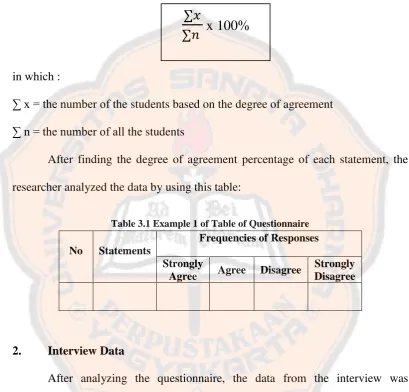
in which :
∑ x = the number of the students based on the degree of agreement ∑ n = the number of all the students
After finding the degree of agreement percentage of each statement, the researcher analyzed the data by using this table:
Table 3.1 Example 1 of Table of Questionnaire
No Statements
Frequencies of Responses
Strongly
Agree Agree Disagree
Strongly Disagree
2. Interview Data
After analyzing the questionnaire, the data from the interview was analyzed by writing the conversation between the researcher and the respondents, summarizing and concluding the answers. The researcher provided five questions as the main questions for the interview and chose five students to be interviewed. The researcher wrote the transcription of the interviews to present clearer conversation. Therefore, the students’ perception on student-teacher consultation in academic essay writing course and the influences of student-teacher
consultation on students’ writing proficiency can be explained clearly. In addition, the researcher provided three questions which were asked to the lecturer in order to get further information related to the implementation of consultation in AEW.
F. Research Procedures
In this study, there were three steps in conducting this research. The steps were (1) distributing the questionnaire, (2) interviewing the lecturer and the students of Academic Essay Writing course, (3) analyzing and interpreting the data results.
1. Distributing the Questionnaire
The questionnaires were distributed to the students after the midterm test on 13 November 2014. The researcher distributed the questionnaires to all AEW students in class F who did the consultation. To avoid the inefficient in learning process, the researcher distributed the questionnaires after the class finish. Since this study is about perception and the influences of the consultation, the researcher did not gave chance for students to bring home the questionnaire so that the students answered the questionnaire directly in the class to avoid uncompleted questionnaires back. After getting all the questionnaires back, the researcher started to analyze it.
2. Interviewing the Lecturer and the Students of Academic Essay Writing Course
Academic Essay Writing course. The process of determining the respondents was based on the result of questionnaires. During the interview, the researcher asked five questions for each student and used audio recorder to save the complete information from the interview. The interviews were held on 10 and 12 December 2014. Then, the researcher interviewed the lecturer on 5 June 2015.
3. Analyzing and Interpreting the Data Results
33 CHAPTER IV
RESEARCH FINDINGS AND DISCUSSION
In this chapter, the researcher presents the finding and data analysis which have been gathered by employing two research instruments: questionnaire and interview. From the data analysis, the researcher presents the findings which answer the two research questions stated in Chapter 1.
The first part is the findings. In this section, the researcher presents the findings from the questionnaires and the interviews which have been gathered. The numerical data on the questionnaire was converted into statements and the interview data are related to the questionnaire as the supporting data. There are two sub tittles: 1) The students’ Perception on The Implementation of Student -Teacher Consultation 2) The Influences of Student--Teacher Consultation. The last section is the discussion. This part overviews the general result of the students’ perception on student-teacher consultation and the influences of student-teacher consultation on the students’ writing proficiency.
A. Findings
questionnaire, the researcher provided twenty close-ended statements with the degree of frequency: strongly disagree (1), disagree (2), agree (3) and strongly agree (4), and five open-ended questions. Besides, the researcher also provided five questions for the interview section to the students and three questions for the interview section to the lecturer. Therefore, the findings were divided into two parts: 1) students’ perception on the implementation of student-teacher
consultation and 2) the influences of student-teacher consultation.
1. Students’ Perception on the Implementation of Student-Teacher Consultation
This section presents the findings which were related to the students’ perception on the implementation of student-teacher consultation. There are four sub-discussions: students’ attitude towards writing in Academic Essay Writing, student-teacher consultation in AEW course, the students’ perception on student -teacher consultation and students’ attitude towards student-teacher consultation.
This finding is used to answer the first research question.
a) Students’ Attitude towards Writing in Academic Essay Writing
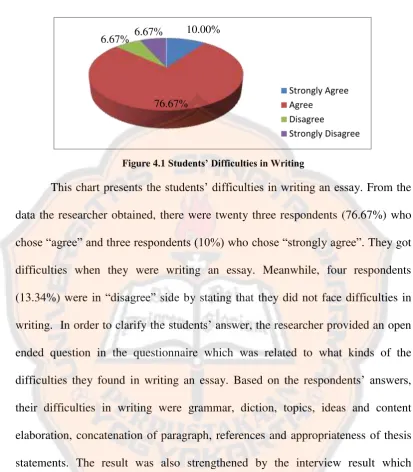
Figure 4.1 Students’ Difficulties in Writing
This chart presents the students’ difficulties in writing an essay. From the data the researcher obtained, there were twenty three respondents (76.67%) who chose “agree” and three respondents (10%) who chose “strongly agree”. They got
difficulties when they were writing an essay. Meanwhile, four respondents (13.34%) were in “disagree” side by stating that they did not face difficulties in writing. In order to clarify the students’ answer, the researcher provided an open ended question in the questionnaire which was related to what kinds of the difficulties they found in writing an essay. Based on the respondents’ answers, their difficulties in writing were grammar, diction, topics, ideas and content elaboration, concatenation of paragraph, references and appropriateness of thesis statements. The result was also strengthened by the interview result which explained that participants faced difficulties in writing such as how the students found the appropriate topic, how they chose the appropriate diction and the grammar usage, how they found the suitable references in order to support the data, and how they organized the ideas so that the readers got the information. Hyland (2003) states that second language writers mostly find difficulty to express themselves in writing in English because they have different linguistics
10.00%
76.67% 6.67% 6.67%
Strongly Agree Agree
Disagree
knowledge, vocabulary, and the ability to handle the grammar of the language. It can be concluded that L2 students got difficulties to write sentences and develop the ideas in English correctly. Therefore, L2 students’ writing contained more errors in grammar, diction and conveying ideas so that it made the students struggle to express the meaning in English.
b) Student-Teacher Consultation in AEW Course
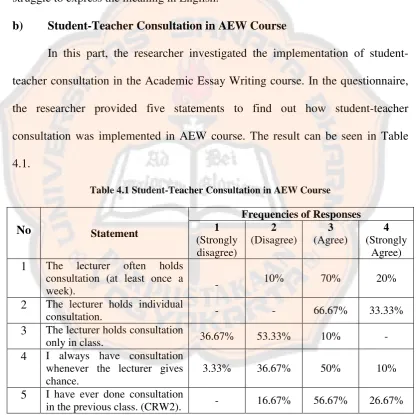
In this part, the researcher investigated the implementation of student-teacher consultation in the Academic Essay Writing course. In the questionnaire, the researcher provided five statements to find out how student-teacher consultation was implemented in AEW course. The result can be seen in Table 4.1.
Table 4.1 Student-Teacher Consultation in AEW Course
No Statement
3 The lecturer holds consultation
only in class. 36.67% 53.33% 10% -
4 I always have consultation whenever the lecturer gives chance.
3.33% 36.67% 50% 10%
5 I have ever done consultation
in the previous class. (CRW2). - 16.67% 56.67% 26.67%
students (20%) who chose “strongly agree” and three students (10%) who chose “disagree”. The first statement showed that 90% of the students agreed that the
lecturer gave enough opportunity to consult their essay at least once a week when they had a class. In addition, in the next statement, the researcher identified how lecturer held the consultation in the class. The result showed that 100% of the students agreed that the lecturer facilitated an individual consultation for the students. Based on the result of the lecturer’s interview, the lecturer implemented individual consultation because the essay writing in AEW course was an individual task and every student had his/her own topic so that the lecturer could focus on helping one student. It was also supported by Tiedt (1989) that one of the benefits of student – teacher consultation is the discussion can focus on the specific piece of writing. Therefore, the student got relevant information and clearer feedback from the lecturer in order to revise their writing.
The next statement is related to whether the lecturer held the consultation only in the classroom. The researcher identified that there were twenty seven students (90%) disagreed. Therefore, the researcher concluded that the lecturer did not only hold the consultation in the classroom but also outside the classroom. The students could have the consultation in the lecturer’s room and sent a message or e-mail to the lecturer. It means that the lecturer gave enough time for the students to consult and to ask questions related to their essay.
result showed that fifteen students (50%) chose “agree”, three students (10%) chose “strongly agree”, eleven students (36.67%) chose “disagree” and one
student (3.33%) chose “strongly disagree”. It showed that most of the students did the consultation whenever the lecturer gave a chance since 60% of the students agreed that they consulted their writing whenever the lecturer gave them a chance. The researcher concludes that the students needed the lecturer’s opinion or suggestions in writing process.
The next statement presents the students’ experience in the consultation in the previous writing course, namely, Critical Reading and Writing 2 (CRW 2). The researcher identified seventeen students (56.67%) chose “agree”, eight students (26.67%) chose “strongly agree”, and five students (16.67%) chose “disagree”. Since more than 80% of the students have ever done the consultation
in the previous class, the researcher concludes that the consultation was not a new learning activity that was interesting for the students. As stated by Robbins (2001), someone’s perception is influenced by his/her experience in the past and past experience will nullify an object’s interest. From the data result, the researcher concluded that the lecturer held the consultation whenever the students needed. Therefore, the lecturer could facilitate the students to ask questions, to discuss and to get the lecturer’s opinion in order to improve the essay.
c) Students’ Perception on Student-Teacher Consultation
Table 4.2 Students’ Perception on Student-Teacher Consultation
individual consultation. 3.33% 10% 60% 26.67%
2 I need to consult when I do my
essay. - 10% 53.33% 36.67%
3 I usually consult more than one
time in a week. 6.67% 70% 20% 3.33%
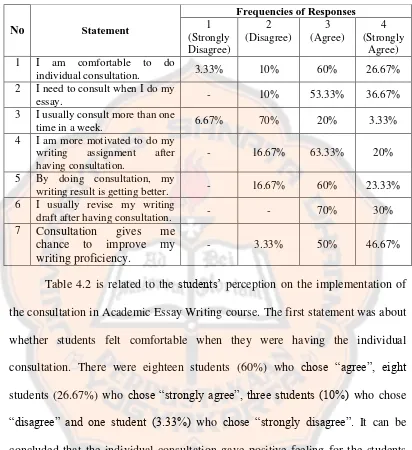
4 I am more motivated to do my writing assignment after having consultation. the consultation in Academic Essay Writing course. The first statement was about whether students felt comfortable when they were having the individual consultation. There were eighteen students (60%) who chose “agree”, eight students (26.67%) who chose “strongly agree”, three students (10%) who chose “disagree” and one student (3.33%) who chose “strongly disagree”. It can be
The second statement from Table 4.2 is related to whether the students needed to consult their essay. The result showed that sixteen students (53.33%) chose “agree”, eleven students (36.67%) chose “strongly agree”, three students
(10%) chose “disagree” and no one (0%)chose “strongly agree”. It shows that the
consultation was a learning activity which was needed to facilitate the students. As stated by Schiff in a journal titled Responding to Writing: Peer Critiques, Teacher-Student Conferences, and Essay Evaluation, the student needs his/her lecturer’s intervention to decrease the student’s anxiety and to improve the student’
writing.
The next statement is about how often the students did the consultation with their lecturer. The researcher asked whether the students did the consultation once in a week. The result showed that six students (20%) chose “agree”, one student (3.33%) chose “strongly agree”, twenty one students (70%) chose
“disagree” and two students (6.7%) chose “strongly disagree”. In order to support