Content List JBASR March 2013 Part II
I Ketut Suamba, M.Muslich Mustadjab, Djoko Koestiono, Wayan Windia
The Advantage of Agrobusiness for Farmers on the Subak System of Bali
J. Basic Appl. Sci. Res.2013 3(3): 237-245 Ogboko Benson
Selenium in Saliva and Hair of School Going Children in Ceres District of the Western Cape South Africa
J. Basic Appl. Sci. Res.2013 3(3): 246-254. Y. Mahmoudi, N. Karimian, M. Abdollahi
Adomian Decomposition Method with Hermitepolynomials for Solving Ordinary Differential Equations
J. Basic Appl. Sci. Res.2013 3(3): 255-258.
Mohammad Taheri, Zahra Lashini, Marziyeh Hadiyan
Strategic Planning and Participatory Culture
J. Basic Appl. Sci. Res.2013 3(3): 259-262.
Ebrahim Fataei, Seyyed Amir Seyyedsharifi, Seiied Taghi Seiiedsafaviyan, Sahar Nasrollahzadeh
Water Quality Assessment Based on WQI and CWQI Indexes in Balikhlou River, Iran
J. Basic Appl. Sci. Res.2013 3(3): 263-269.
Ali Nagi Agdasi, Yousef Alipour Baghbannezhad, Monireh Mafi, Behnam Talebi
Information Literacy Relationship with the Librarians' Performance in Tabriz
J. Basic Appl. Sci. Res.2013 3(3): 270-275. Parvaneh Adelzadeh, Nafiseh Khodadaded
Study on the Social Capital (Trust) in Beihagi History
J. Basic Appl. Sci. Res.2013 3(3): 276-280. Shovitri, M., Zulaika, E. and Kuswytasari, N.
DNA Fingerprinting AmongBacillusIsolated From the Mercury Polluted Kalimas River Surabaya
J. Basic Appl. Sci. Res.2013 3(3): 281-284.
Hassan Mehrmanesh, Javad Khamisabadi, Behnaz Baghaie, Farzane Nazemi, Mehdi Zaeimi Sakhvidi
Introducing a Model in Order to Logistics Balance with the Aim of Improving for Total Expected Cost (Case Study: Tondar 90 Assembly Shop ...
J. Basic Appl. Sci. Res.2013 3(3): 285-292.
Azita Amirfakhraei, Nooshin Taghinejad, Elham Sadeghifar
Relationship between Risky Driving Behavior and Sensation – Seeking and Sex among Students of Islamic Azad University –Bandar Abbas, Iran,...
J. Basic Appl. Sci. Res.2013 3(3): 293-301. Puntani Pongsumpun, Sireepatch Sangsawang
Local Stability Analysis for Age Structural Model of Chikungunya Disease
J. Basic Appl. Sci. Res.2013 3(3): 302-312. Kamal Ghalandari, Jafar Ghahremanpour
The Effect of Market Variables and Herding Effect on Investment Decision as Factor Influencing Investment Performance in Iran
J. Basic Appl. Sci. Res.2013 3(3): 313-318.
Fariba Nourbakhsh, Alireza Rostami, Ali Arshadi1, Ahmad Sarlak, Mojtaba Almasi
Comparative Study of Artificial Neural Networks ANN and ARIMA Method in Predicting the Overall Index of Tehran Stock Exchange
Maziar Izadbakhsh, Alireza Rezvani, Bahar Ghahremanpour, Mohammad Danesh Pajouh, Armin Alimardany, Ali Ebrahimi, Mehdi Salami Lemraski, et al.
Modeling of a City with Fixed Speed Breaker at Streets as Electrical Generators and its Legal Aspects
J. Basic Appl. Sci. Res.2013 3(3): 325-333. Bedier B. EL-Naggar, Ismail A. Kholeif
Viscous Damping of Surface Waves
J. Basic Appl. Sci. Res.2013 3(3): 334-336.
Farzad Fadaei, Mehdi Shahbazian, Massoud Aghajani, Hooshang Jazayeri-Rad
A Novel Hybrid Fuzzy PID Controller Based on Cooperative Co-evolutionary Genetic Algorithm
J. Basic Appl. Sci. Res.2013 3(3): 337-344. Suhaimi Mhd Sarif, Yusof Ismail, Abdullah Sarwar
Creating Wealth through Social Entrepreneurship: A Case Study from Malaysia
J. Basic Appl. Sci. Res.2013 3(3): 345-353.
Rezvan Hejazi, Mahboobeh Mesripour, Zinat Ansari
Environmental Accounting and Sustainable Development- with Specific Attention to the Air
J. Basic Appl. Sci. Res.2013 3(3): 354-363.
Mohammad Taheri, Mohammad Reza Jabber Ansari, Raziyeh Ganji
The Relationship between Cultural Barriers, Open Mindedness and Organizational Innovation
J. Basic Appl. Sci. Res.2013 3(3): 364-367.
I Nyoman Dita P.Putra, Nadjadji Anwar, Christiono Utomo, Sony Sunaryo
Evaluation of Land Indication Value with Principal Component Analysis Method Based on Transaction and Market Data
J. Basic Appl. Sci. Res.2013 3(3): 368-374. D. Maamoun, H. Osman, S.H. Nassar, M. Khairy
A New Approach in Printing Wool and Wool/Polyester Fabrics with Disperse Dye Nanoparticles
J. Basic Appl. Sci. Res.2013 3(3): 375-380.
Mohammad Hadi Asgari, Mohammad Taleghani, Fatemeh Gilanpour
Investigation of Relationship between Personality Traits and Conflict Management Styles in Guilan Province Schools Managers
J. Basic Appl. Sci. Res.2013 3(3): 381-386.
Maheno Sri Widodo, Marsoedi, Trinil Susilawati, Agung Permana WM
Maturity Level and Somatic Index of Gonado at Dwarf Snake-head (Channa gachua) during January to December 2009
J. Basic Appl. Sci. Res.2013 3(3): 387-393.
Mansour Fakhri, Nariman BaraziJomoor, Mahmoud R. Keymanesh
Evaluation of Permeability Rate on Porous Asphalt Mixtures and Hot Mix Asphalt
J. Basic Appl. Sci. Res.2013 3(3): 394-399. Nawfal JEBBOR and Seddik BRI
2D Study of Inclusion Shape Effect on the Effective Permittivity of Random Inhomogeneous Media
J. Basic Appl. Sci. Res.2013 3(3): 400-404. Nasser Ghasemi Rozveh
The Comparative Survey of Pessimism in Abul Ala Al-Maarri and Hakim Omar Khayyam Poems
J. Basic Appl. Sci. Res.2013 3(3): 405-413.
The Effect of Relationship Marketing Tactics on Customer Loyalty Given the Mediating Role of Quality Relationship (Case Study: Shahab Gas...
J. Basic Appl. Sci. Res.2013 3(3): 414-419. Fransz Semuel Siahaya, Joni Hermana
Environmental Impact Assessment of Land Use Due to the Change of Water Resources Potentialin Urban Watershed: A Review
J. Basic Appl. Sci. Res.2013 3(3): 420-425.
Manouchehr Ansari, Amir Norouznezhad Darzi Naghibi
Identifying and Ranking Knowledge Management Factors Using Fuzzy TOPSIS: A Case in Security and Exchange Organization
J. Basic Appl. Sci. Res.2013 3(3): 426-433.
M.A. Smail Khalafazadeh Asetmal, M.A. Babak Golabizadeh, M.A. Seyyed Yaser Gheibi
Customer Satisfaction and Employee Creativity Case Study (National Bank Headquarters City of Marand)
J. Basic Appl. Sci. Res.2013 3(3): 434-441. I. S. Amiri, D. Gifany, J. Ali
Ultra-short Multi Soliton Generation for Application in Long Distance Communication
J. Basic Appl. Sci. Res.2013 3(3): 442-451. Nabavizadeh, Ebrahim, ShafiAbadi, Abdullah
Observation of Psychological Characteristics and Quality of Life in Chronic Dialysis Patients
J. Basic Appl. Sci. Res.2013 3(3): 452-458. Valiolla Davari
Operation Method of Wave's Diffusion Problem Solving in Elastic Environment under the Influence of Cylindrical Overlap
J. Basic Appl. Sci. Res.2013 3(3): 459-469. Behrooz Sepehri, Shahaboddin Omidian
Numerical Model of the Human Head under Side Impact
J. Basic Appl. Sci. Res.2013 3(3): 470-474.
Seyed Hesam Hesampanah, Mohammad Zabihmanesh, Sadegh Hamehkhani, Homayoun Khosravi
The Investigation Impact Ethical Perspective of Financial Management on Financial Reports
Editorial Board
Editor - in – Chief
!"#$%&'(#)"#*(+,+%(-,
!"#$%"#%&"'()*'+!%,-"'"./0 1(2%3"!4%56-7(!8-9/0.$/$ :;<+-'=9(>9!"+?@"*!6+'8A.<+-'$)"<
Editorial Board Members
!"#$+!0121 3+,421&5-(+!561
!"#(88"!0% !"#(88-"6+'% :6.-6((!% "#% B6?"6(8-+6% C")-(9/% "#% C+6-9+!/% +6?% :67-!"6<(69+'% :6.-6((!80
7,51,&8-+"
!"#/9(+,#:+';8;<14=;
D(E+!9<(69%"#%,*8-6(88%F?<-6-89!+9-"60%G+)(99(E(%56-7(!8-9/0 >.?:@A$
!"#B(+!+=+CD18#>8&2&!-8
D(E+!9<(69%"#% 8/)H"'"./0% +69(-"6%56-7(!8-9/%"#%C")-+'%+6?% "'-9-)+'%C)-(6)(80%F9H(680E!&&F&$
!"#31(5#G+<-C#H-,#/D5;==+(
F88")-+9(% !"#(88"!0%D(E+!9<(69%"#%&+9H(<+9-)80%I+)*'9/%"#%C)-(6)(%+6?%J()H6"'"./0%56-7(!8-9-%&+'+/8-+0
3+=+98-+"
!"#$"#?+I-F(+,5!+,
F88-89+69% !"#(88"!0%D(E+!9<(69%"#% H/8-)80%C+9H/+K+<+%56-7(!8-9/07,5-+ "
!"#318%+J+#@8=+C-D(E+!9<(69%"#%&+9H(<+9-)80%I+)*'9/%"#%C)-(6)(80%56-7(!8-9/%"#%L*-'+60%M+8H907!+," !"#@<<+%#31=1;2#:&,+09
:)"6"<-)%D(E+!9<(690 I+)*'9/%"#%N"<<(!)(0%O+#!%:';CH(-4H%56-7(!8-9/0@49'%$
!"#7D%-8+C#+D5#&=#4(+,9#(+CC+5
F88")-+9(% !"#(88"!%"#%L(6(9-)80%I+)*'9/%"#%C)-(6)(0%G('2+6%56-7(!8-9/0@49'%" !#3+C15&#:(+,#K+;8(+5
D(E+!9<(69%"#%&+9H(<+9-)80%I+)*'9/%"#%C)-(6)(0%56-7(!8-9/%"#%&+*!-9-*803+;!-%-;8" 3-!<+#L+8+,;<<+C+,
D(E+!9<(69% "#% F.!"6"</0% I+)*'9/% "#% F.!-)*'9*!(0% CH(!;(;,+6.'+% F.!-)*'9*!+'% 56-7(!8-9/0DH+4+0
H+,4=+5&8($
!"#L+=+#/(C&5#L+J&<#:+,5-=
J. Basic. Appl. Sci. Res., 3(3)237-245, 2013
*Corresponding Author:I Ketut Suamba, Doctoral Program of Agricultural Economy Program, Faculty of Agriculture, University of Brawijaya, Malang of Indonesia. Email: [email protected]
The Advantage of Agrobusiness for Farmers on the Subak System of Bali
1,*
I Ketut Suamba, 2M.Muslich Mustadjab, 2Djoko Koestiono, and 3Wayan Windia
1
Doctoral Program of Agricultural Economy Department, Faculty of Agriculture, University of Brawijaya, Malang, East Java of Indonesia
1Faculty of Agriculture, University of Udayana, Denpasar, Bali of Indonesia
2
Faculty of Agriculture, University of Brawijaya, Malang, East Java of Indonesia 3
Faculty of Agriculture, University of Udayana, Denpasar, Bali of Indonesia
ABSTRACT
The sustainability of subak system in Bali is made effort through the transformation of subak activity. Up to now, subak activity is limited on socio-cultural activity and nowadays there is needed additional economic activity like agrobusiness. It means that socio-cultural unit will also be strengtherned by economic unit. Therefore, it is nacessary to study how the economic activity on subak will be able to give benefit to the members of farmer. The benefit is analyzed using the efficiency of relative economy and the difference on farm income level of irrigated paddy which is carried out by farmer. This study was conducted in Guama Subak, Tabanan Regency of Bali which has carried out agrobusiness in the form of farmer-cooperation and as the comparison was Pacung Subak where was located in the same irrigation system. Efficiency of relative economy was analyzed using the profit function of Cobb-Douglas. Result showed that agrobusiness in the form of farmer-cooperation was very useful for farmer interest. Farmer-farmer-cooperation is very helpful farmers because it gives ease in the availibility of input, production process, and in marketing of agrocultural product. In addition, the farm becomes more efficient and the level of income is higher. Therefore it is very relevant to develop the economic activity like agrobusiness in the form of farmer-cooperation on the subak system of Bali.
KEYWORDS: subak, farmer-coorporation, profit function, farm income.
INTRODUCTION
In carrying out their farm, the farmers of irrigated rice area often experiences the difficulty of capital for land preparation and input supply like seeding, manure, and medicines. If there are desease attack, the farmers often have no money to buy some medicines and it causes failure and harmless of harvest. This condition is more seriously by decreasing of price when the harvest time. Because of the price is trifled by middlemen with the bargained position is stronger than the farmers. Some efforts have been carried out by the government to fulfill this problem. One of them is to transform the traditional organization of farmers in Bali (subak) by adding the organization function of agrobusiness activity in the form of farmer cooperation. The activity of economic effort in subak organization is hoped to be able to fulfill the difficulty of farmer members. In addition, it will strengthen the subak organization because there is fund resource for carrying out socio-cultural activity in subak. Subak is defined as traditional rule of society which has the characteristic of socio-agraris-religious and the union of farmers who manage water in irrigated rice area. Subak is often mentioned as irrigation system organization which has otonomy right to manage itself widely and intends to guarantee the fair and averaged allocation of irrigation water, to increase the irrigated rice yield and the prosperity of members [1][2].
Okoruwa et.al [3] has conducted his research in North Nigeria. He wanted to know the relative efficiency of paddy farm between wide and narrow area of farm by using profit function approach of SUR method (Seemingly Unrelated Regression method). Result indicated that the significant difference of economic efficiency was suggested to use the first class variety and increasing in using manure. The other research of Muslich [4] was to differentiate the authority status of area between owner farmer, working farmer, and hirer farmer on dry land of two lime area vilages in South Malang, East Java. The conclusion was in allocating input of employer, seeding, and chemical manure, the owner farmer had the same relative economic efficiency with working farmer, but it was smaller than hirer farmer. The next research was carried out by Asmara R [5] which analysed the level difference of income and relative efficiency between paddy farm that used and unused pumping well irrigation in Mojowarno village, Mojowarno District, Jombang Regency, East Java. The result indicated that income level of irrigated paddy farm which used pumping well irrigation was higher that unused pumping well irrigation. The usage of pumping well irrigation gave more profit than usual irrigation. In addition, paddy farm by using pumping well irrigation had more relative technical efficiency, more relative price efficiency, and more relative economic efficiency than usual irrigation.
Nowadays, the trend of subak remaining is more decreasing. It is caused by some factors as follow: 1) the very low interest of youth generation for working in agrocultural sector; 2) decreasing on quantity and quality of
Suamba et al., 2013
irrigation water; 3) the more narrowing of irrigated rice area (subak) because changed function of area: irrigated number area of Bali in 2005 was 87,850 ha and it was decreasing in 2009 became to 82,664 ha [6]. It means that there was occured the area changed function of 5,206 ha during 5 years (the average was more than 1,000 ha/ year); and 4) the modern line and technology change is high enough in some aspects of society life. If the problem is not immediately fulfilled, the possibility of Bali is not only to be going to miss one of the cultural unique but it will also give wide impact to the island environment [7][8]. In fact, up to now government used the subak as media of innovation distribution in agroculture. Subak has active function to filter the innovation which includes the innovation in economic that is suitable with the condition of agrobusiness nature. Innovation in economic includes the activity of agrobusiness in the form of farmer cooperation on subak. This activity causes the agroculture sector (primair) will enter in the service activity (tertiar). By entering the socio-economic activity in subak, it is hoped that farmers prosperity (subak member) will be better and subak organization will be stronger. There can be occured because subak is not only traditionally binded by socio-cultural binding but it will be stronger binded by economic binding.
Based on the description as above, it is nacessary to be carried out the related research to economic activity of subak. This research intended to know how far the economic activity of subak was able to give profit to the farmer member. Detailly, the aims of this research were as follow: 1) to analyze the efficiency of relative economy on farm of irrigated paddy in subak which has farmer cooperation due to the subak without farmer cooperation, and 2) to analyze the difference between profit level on irrigated paddy farm of the subak with and without farmer cooperation.
MATERIALS AND METHODS
Efficiency in production is as comparison size between output and input. Concept of efficiency was introduced by Michael Farrell. He defined that efficiency was as the ability of production organization for producing certain product on the minimum cost level [9]. If there is assumed that company maximizes the profit and market structure is as perfect competitive market, so economic efficiency will be reached at the condition which the marginal product value is the same as the variable input value. According to Nicholson [10], economic efficiency was used to explain situation of the sources that is optimally allocated. Economic efficiency includes two components such as technical efficiency and price or allocative efficiency. Technical efficiency measures how much the product can be reached by a certain input set. The production capacity explains the condition of technical knowledge and fixed capital that is controlled by the farmer or producer. An effort is said technically to be more efficient if by using the same input will produce higher product. Technical efficiency is also mentioned as long term efficiency, but allocative efficiency is related with the success of farmer in reaching maximum profit, this kind of efficiency is mentioned as short term efficiency. Efficiency is generally as measurement tool for evaluating the selection on the combination of input and output.
According to Soekartawi [11], there are 3 functions by measuring efficiency as follow: 1) it is as the standard to obtain relative efficiency, to make easy the comparison between one to another economic unit; 2) if there is the variety on efficiency level of some available economic units, so it can be carried out a research for answering what factors that determine the difference of efficiency level; 3) the information about efficiency has policy implication because manager can determine the company policy accurately. In the production economy, economic efficiency can be reached if it fulfills two criteria as follow [12]:
• Nacessary condition is as a condition with the same number of products may not be produced by using a less number of input and a more number of product may not be produced by using the same input.
• Sufficiency condition is a condition which is nacessary to determine the position of economic efficinecy in the rational area because by knowing only the production function, the position of economic efficiency in the rational area can be determined. To determine the position of economic efficiency, it is needed a tool that is as selection indicator such as input and price.
A farmer is said technically more efficient compared with the other one if the farmer can produce higher physically by using the same production factor. The price efficiency can be reached by a farmer if he is able to maximize profit (he is able to make the same on the product marginal value of each variable production factor with the price). Economic efficiency occurs if the efficiency of price and technic are occured. The difference of efficiency among farm group can be caused by the difference in the level of technical and price efficiency or both of them [13][14]. Capacity of economic efficiency indicates the ratio between actual and maximum profit. According to Kusumawardani [15], to study economic efficiency of a farm can be carried out by the approach of profit function. It is the same as presented by Soekartawi [16]. He expressed that profit function of Cobb-Douglas is used to measure the efficiency level which is recently more interested because some reasons as follow:
• There is assumed that farmer has the characteristic to maximize profit in long term period as well as in long term one
• The estimation is relatively easy.
J. Basic. Appl. Sci. Res., 3(3)237-245, 2013
• Manipulation of analysis is easily carried out such as to make the dimension of elasticity becomes constant or not, and
• There can measure the efficiency level in the different level
Profit function can be formulated with Output Price Cobb Douglas Profit Function (UOP-CDPF) by assuming that producer more maximizes the profit than satisfaction. UOP-CDPF ia as the funcion which involves production factor price and production that is expressed as certain price such as production price.
Farmer cooperation on the subak system in Bali
The rule of local government in Bali Province No. 02/PD/DPRD/1972 presented that subak was a traditional rule society which had the characteristic of socio-agraris-religious and it was as the farmer organization which manage irrigation water in rice irrigated area. Where as in government rule No. 23 in the year of 1982 about irrigation, subak was defined as traditional rule society with the characteristic of socio-agraris-religious which was historically grown and developed as an organization water management in the level of farm. In addition, subak was an organization of society which especially managed the irrigation system that is used in planting rice in Bali of Indonesia.
In the beginning, subak system only managed irrigation water for member interest. Economic activity in subak system was begun with the process of water buy and sell which occured in the 9th century [17]. In the development that was begun in about 1970, unsure and economic activity was more appeared on the subak system in Bali that intended to increase member prosperity such as to carry out credit-saving activity, to buid farmer cooperation, and to get credit in bank for the network development of subak irrigation.
Trend of subak activity to economy is sees as a rational development in supporting farmer prosperity due to the activity can guarantee the harmony and being joint together. Of course it is right if during this time subak is said as traditional irrigation organization which has the characteristic of socio-agraris-religious. Whereas it does not closed the possibility that in the future, subak is also needed to develop itself becominng to economic oriented organization which it is not only carry out the base function as irrigation water manager but it has to be carried out without sacrificing the characteristic of socio-agraris-religious. The form of business-organization which is suitable with the economic-social condition in Indonesia is farmer cooperation because the business is mainly for fulfilling the need of member farmer. The business system is as agrobusiness which includes 4 sub-systems as follow: 1) sub-system of production; 2) sub-system of agro-industry; 3) sub-system of marketting; and 4) sub-system of supporting organization. On the sub-system of production, farm or agrocultural company produces the agrocultural product such as food material. The activity actors on this sub-system are the producers which include farmers or agrocultural business-men.
Sub-system of manufacture or agro-industry is differentiated into two items such as upstream and downstream agro-industry. Upstream agro-industry is as industry that produces input for supporting production sub-system. The examples of upstream agro-industry include the factory that produces manure, the industry that produces some kinds of medicine for destroying disease and infection such as pestiside, fungiside, and herbyside, the seeding industry, the tractor factories, and the other mechanical utilization for supporting the production process. Downstream agro-industry is as industry that produces output or by product of production sub-system into half or full goods. For examples tuber into tapioca or cassava snack, manufacture industry of sawit coconut from fresh fruit into Crude Palm Oil or margarine, seed coffee manufacture into coffee pollen, fresh milk into marganine, ice cream, etc.
Sub-system of marketting is as the process of goods flow from producer to consument which in this process sometimes there is a series of activity beginning from the collecting of farm products, manufacture, deposit, sortation, and distribution. Part of the farm product is directly distributed to consument in or out of country. The other part formerly experiences the manufacture process and then to be distributed to consuments. Sub-system of supporting organization is as support of the other system so that the agrobusiness system fluently goes on or agro-business actors can fluently do their activities. This sub-system includes: 1) supporting organization of infrastructure such as building, road, bridge, transportation, etc.; 2) supporting organization as the other organization like bank, cooperation, research organization, espionage organization, market, and government rules.
Methods
This research was conducted in Guama Subak, Tabanan Regency of Bali which has carried out agrobusiness in the form of farmer cooperation. As the comparison was Pacung Subak which was located close to Guama Subak. The condition of geography, water source, activity of socio-cultural in the context of subak activity was very homogenous with Guama Subak, but the comparated subak has not had farmer cooperation. Sample size in each of subak was determined by using the formula as follow [18}:
N Z2 σ2
n = --- (1)
N d2 + Z2 σ2
Suamba et al., 2013
Note:
n = sampel size
N = total number of population in each of subak
Z = Normal distribution value of 1.96 in the 95% level of significant
σ2 = population varian about the number area of subak belonged to subak member d2= maximum error which is assumed can be accepted of 0.1 (10%)
Data was collected due to survey method by using the list of questions which has been prepared before. Analysis of data was due to the aim such as to know the relative economic efficiency and the comparison on the profit level of irrigated paddy farm. Analysis of relative efficiency was intended to compare the efficiency level between two groups of farmers. The two groups of farmer were differentiated based on there was agrobusiness or not of the subak. Model was used by entering dummy variable in the profit function by using SUR (Seemingly Unrelated Regression) Model with the restriction of α* = α*", which illustrated the production function model in the condition of efficient input usage. The profit function of Cobb-Douglas in irrigated paddy farm was as follow:
m n
π *=A* Π ci αi *Π Z j β j * (1)
i=1 j=1
In the form of natural logaritmis, the above formula can be written as follow: In π *=InA* Σα i * Inci * Σβ j * InZj (2)
Inπ* = InA* + α1* In c1 + α2* In c2 + α3* In c3 + α4* In c4 + α5* In c5 + α6* In c6 + β1* In Z1
+β2* Inz2 +e0 (3)
Note :
π* = long term period of profit which has been normalized by rice price A* = interception
c1* = price of seed which has been normalized by rice price c2* = price of Urea manure which has been normalized by rice price c3* = price of TSP manure which has been normalized by rice price c4* = price of organic manure which has been normalized by rice price c5* = price of pesticide which has been normalized by rice price c6* = salary of employer which has been normalized by rice price Z1 = fixed input of utility
Z2 = fixed input of other cost
α* = estimated parameter input variable, i = 1, ...6 βj* = estimated fixedparameter input, j = 1, 2
e0 = standard eror
The demand function of variable input (factor share) as the contribution of variable input to the profit can be formulated from the profit function of Cobb-Douglas as follow [19][14]:
-ci Xi / πa = αi*’’ + ei; i = 1,2,3,4,5,6 (4)
Xi = -αi*’’ πa / ci* (5)
Note :
ci* = price of variable input which is normalized by rice price πa = profit of UOP in short time period
αi*’’ = demand parameter of input vartabel (share factor) Xl = number of seed input value in rupiah
The equation of (5) is transformed in the form of natural logarithmis as follow:
In Xi = In (-αi*’’) + In πa – In ci* (6)
In Xi = In (-αi*’’) + In A* + Σαi* In ci* + Σβj* In Zj - In ci* (7) In Xi = In (-αi’’) + In A* + Σαi* + Σβj* In Zj (8) By entering dummy variable (D) to the equation of (3) and (8), it can be obtained as follow:
Inπ* = InA* + D + α1* In c1 + α2* In c2 + α3* In c3 + α4* In c4 + α5* In c5 + α6* In c6 + β1* In Z1
+β2* Inz2 +e0 (9)
In Xi = In (-αi’’) + D + In A* + Σαi* + Σβj* In Zj (10)
J. Basic. Appl. Sci. Res., 3(3)237-245, 2013
Note:
D = 1 for subak with agrobusiness D = 0 for subak without agrobusiness
As the consideration in solving the profit function of UOP (Unit Output Price) by using simultanoeus method is to reach the stochastic spesification which analysis model has αi* that appears in the whole equation. If the case uses OLS, so there will occur inefficiency and it is been fearfull the appearance of correlation among the error of each equation. Therefore, estimation of UOP profit function will be solved by using Zellner's Method of Seemingly Unrelated Regression Model with the restiction of α* = α*" which is as simultaneous equation by using 7 equations which are simultaneous analysed. The profit function equation of share factor function on farm in study location included one profit function and 6 share factor functions as follow:
Inπ*= InA*+D + αl*Inc1*+α2*Inc2*+α3*Inc3*+α4*Inc4*+α5*Inc5*+ α6*Inc6*+ β1*Inzl + (β2*In z2 + eo (11)
In X1 = In (- αl*") + D + α2* Inc2* + α3* Inc3* + α4* Inc4 * + α5*Inc5*+ α6*Inc6*+ β1* In zl +β2* In z2 +
eo (12)
In X2 = In (- α2*") + D + α1* Inc1* + α3* Inc3* + α4* Inc4 * + α5*Inc5*+ α6*Inc6*+ β1* In zl +β2* In z2 +
eo (13)
In X3 = In (- α3*") + D + α1* Inc1* + α2* Inc2* + α4* Inc4 * + α5*Inc5*+ α6*Inc6*+ β1* In zl +β2* In z2 +
eo (14)
In X4 = In (- α4*") + D + α1* Inc1* + α2* Inc2* + α3* Inc3 * + α5*Inc5*+ α6*Inc6*+ β1* In zl +β2* In z2 +
eo (15)
In X5 = In (- α5*") + D + α1* Inc1* + α2* Inc2* + α3* Inc3 * + α4*Inc4*+ α6*Inc6*+ β1* In zl +β2* In z2 +
eo (16)
In X6 = In (- α6*") + D + α1* Inc1* + α2* Inc2* + α3* Inc3 * + α4*Inc4*+ α5*Inc5*+ β1* In zl +β2* In z2 +
eo (17)
Restrict In c1* = In (αI *") Restrict In c2* = In (α2 *") Restrict In c3* = In (α3*") Restrict In c4* = In (α4*") Restrict In c5* = In (α5*") Restrict In c6* = In (α6*")
The statistical hypothesis test is if dummy variable value (D) > 0 (positive), it means that the farm of farmer group in Guama Subak was more efficient than Pacung Subak. On the contrary, if dummy variable (D) < 0 (negative), so the farm of farmer group in Pacung Subak was more efficient in Guama Subak.
Income of farm in farmer level was analyzed by using the formula as follow:
π = TR – TC (18)
Note:
π = income level TR = Total Revenue.
TC = Total Cost which includes TFC (Total Fixed Cost) and TVC (Total Variable Cost).
Total Fixed Cost is as fixed cost which is payed in paddy farm. Fixed cost included land-rent, land-tax, cost of ritual activity, and cost of utility depressiation. Total Variable Cost included cost of buying seed, manure, pesticide, and salary of employer. Then, farm income of farmer in subak was compared with non agrobusiness one by using t-Test. The hypothesis was as follow:
H0 : µua = µtua Ha : µua > µtua Note:
µua = the average of farm sample in subak with agrobusiness
µtua = the average of farm sample in subak without agrobusiness Criteria of test:
If tcalc < t(α/2),(n-k), so the decision was to accept H0
Tcalc ≥ t(α/2),(n-k), so the decision was to reject H0
If H0 was rejected, the level of paddy farm income in subak with agribusiness higher than without agrobusiness one. If H0 was accepted, so the decision was on the contrary.
Suamba et al., 2013
RESULTS AND DISCUSSION
Analysis of Relative Economic Efficiency
Recapitulation of parameter estimation on the profit function with dummy variable (D) of the model was presented as in Table 1.
Table 1 Estimation of profit function on paddy farm for analysing relative economic analysis
Variable Parameter Coefficient of regresssien Probability
Interception A -18.8958**) 0.0002
D (Dummy of agrobusiness) Ω 0.105366*) 0.0426
Coefficient of determination 0.39596
Fcalculation 13.69**) 0.0001
Note:
*) = significant on the level of 95% (α = 0.05)
**) = significant on the level of 99% (α = 0.01)
Based on the parameter estimation coefficient of dummy (D) in the Table 1, model which illustrated profit function in the condition of optimal input usage with reaching maximum profit, parameter estimation coefficient of dummy (D) was positive and significant with the probability of 0.04. It indicated that farm on farmer group in Guama Subak (subak with agribusiness) economically was more efficient than in Pacung Subak which was as non agrobusiness subak or the input usage in Guama Subak was more optimal than in Pacung Subak. The value of Fcalc that was very significant in the level significant of 90% indicated that all of independent input variables which were enter to the model together, influenced dependent variable (profit). Whereas determination coefficient of 0.39596 indicated that total varian of dependent variable (profit) was able to be described only by 39.5% of independent variable and the rest one was caused by the other variable which was not entered in the model. Therefore, it was nacessary to present the qualitative descriptive explanation because there was the difference of efficiency or optimization of input usage which was indicated by dummy variable (D).
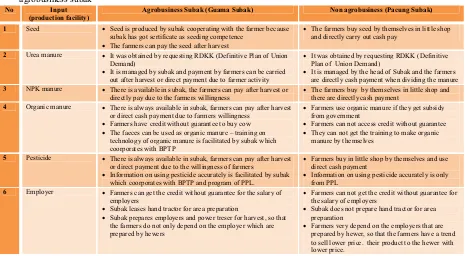
The farmer in Guama Subak (subak with agribusiness) have obtained some ease in getting input (production facility). The farmer in Pacung Subak (subak without agribusiness) experienced on the contrary as described in Table 2 as below.
Table 2 The facility or ease to get input on paddy farm in agrobusiness subak to be compared with non agrobusiness subak
No Input
(production facility)
Agrobusiness Subak (Guama Subak) Non agrobusiness (Pacung Subak)
1 Seed • Seed is produced by subak cooperating with the farmer because
subak has got sertificate as seeding competence
• The farmers can pay the seed after harvest
• The farmers buy seed by themselves in little shop
and directly carry out cash pay
2 Urea manure • It was obtained by requesting RDKK (Definitive Plan of Union
Demand)
• It is managed by subak and payment by farmers can be carried
out after harvest or direct payment due to farmer activity
• It was obtained by requesting RDKK (Definitive
Plan of Union Demand)
• It is managed by the head of Subak and the farmers
are directly cash payment when dividing the manure
3 NPK manure • There is available in subak, the farmers can pay after harvest or
directly pay due to the farmers willingness
• The farmers buy by themselves in little shop and
there are directly cash payment
4 Organic manure • There is always available in subak, farmers can pay after harvest
or direct cash payment due to farmers willingness
• Farmers have credit without guarantee to buy cow
• The faeces can be used as organic manure – training on
technology of organic manure is facilitated by subak which coorporates with BPTP
• Farmers use organic manure if they get subsidy
from government
• Farmers can not access credit without guarantee
• They can not get the training to make organic
manure by themselves
5 Pesticide • There is always available in subak, farmers can pay after harvest
or direct payment due to the willingness of farmers
• Information on using pesticide accurately is facilitated by subak
which coorporates with BPTP and program of PPL.
• Farmers buy in little shop by themselves and use
direct cash payment
• Information on using pesticide accurately is only
from PPL
6 Employer • Farmers can get the credit without guarantee for the salary of
employers
• Subak leases hand tractor for area preparation
• Subak prepares employers and power treser for harvest, so that
the farmers do not only depend on the employer which are prepared by hewers
• Farmers can not get the credit without guarantee for
the salary of employers
• Subak does not prepare hand tractor for area
preparation
• Farmers very depend on the employers that are
prepared by hewer, so that the farmers have a trend to sell lower price. their product to the hewer with lower price.
J. Basic. Appl. Sci. Res., 3(3)237-245, 2013
The ease that was obtained by agrobusiness farmers caused the usage of production facility was more optimal compared to non agrobusiness subak. In fact, the trust that was given by subak to the member farmers was not wrong used by subak members. Credit return and the payment of production facility after harvest were very obeyed by subak members because there was social sanksi which was feared by subak members.
The difference of farm income
The difference of paddy farm income was analysed between farmers on subak with cooperation and without cooperation such as between the farmers in Guama Subak and Pacung Subak. The average of paddy farm production was 6,870 kg/ha in subak with cooperation (Guama Subak) with the price of Rp. 3,667.20/kg, total acceptence was Rp. 25,204,309.00 per-hectar and 5,984 kg/ha with the price of Rp. 3,402.05/kg, total acceptance was Rp. 20,369,126.00 in paddy farm without cooperation (Pacung Subak). The income of paddy farm for subak with and without cooperation was presented as in Table 3 below.
Table 3 The income average per-ha of Guama Subak (subak with cooperation) and Pacung Subak (Subak without cooperation) in 2011
No Description Subak with farmer cooperation (Rp) Subak without farmer cooperation (Rp)
1 Acceptance 25,204,309.00 20,369,126.00
2 Production cost 8,020,798.00 5,811,159.00
3 Income 17,183,511.00 14,557,968.00
Table 3 presented that though the production cost of paddy farm on subak with cooperation was higher than the subak without cooperation, the income was also higher. It indicated that the addition of paddy farm acceptance was higher than the addition of production cost.
The next analysis was carried out to use t-Test (average difference test) for knowing that the difference of accepted income was statistically significant difference or not. This analysis result was presented as in Table 4 below.
Table 4 Result of t-Test on paddy farm of Guama Subak (subak with cooperation) and Pacung Subak (subak without cooperation) in 2011
No Variable Average of result Std Error Tcalc Prob.
SDK SNK Difference
1 Production (kg) 6,869.90 5,984.22 885.68 7.96 6.41 0.000
2 Production price (Rp/kw) 366,720 340,205 26,515 16,070 18.54 0.000
3 Acceptance (Rp) 25,204,309 20,369,126 4,835,183 3,504,627 12.54 0.000
4 Total cost (Rp) 8,020,798 5,811,158 2,209,640 1,619,560 12.30 0.000 without cooperation. The different income was Rp. 2,625,543.00. The difference was statistically very significant with the probability of 0.000. It indicated that paddy farm on subak with cooperation was more profitable compared with subak without cooperation. The same kind of study with different treatment has been carried out by Asmara [20] in Mojowarno Village, Mojowarno District, Jombang Regency of East Java Province. It indicated the same result: the income level of paddy farm with pumping well irrigation was higher than usualirrigation, so that the usage of pumping well irrigation favoured than usualirrigation.
In addition, the production level that was accepted by farmers were also very significant different. It indicated that production level that was accepted by farmers very determine the income differece of paddy farm in the farmer level. Therefore, the availibility of farmer cooperation was very important and meaningfull for farmers. On the sub-system of input availibility, paddy farm on the subak with cooperation could use more optimal input for increasing the production than on the subak without cooperation. The more optimal of input usage on the subak with cooperation because farmer cooperation prepare the available input any time due to the farmers demand. The payment could be carried out after harvest, so that the capital for input availibility did not become again as the constraint for farmers in increasing the farm productivity.
Table 4 also indicated the significant price difference which was accepted by the farmers on subak with and without cooperation with the probability of 0.000. Farm on the subak with cooperation, paddy which was produced by farmers was bought by farmer cooperation. It intended to withdraw from price playing by hewer. Though the paddy production which was produced by farmers could be bought by farmer cooperation, but the farmer cooperation did not band. It meaned that if the farmers obtained the sold price higher than outside of farmer cooperation, the farmers were allowed to sell to the outside of farmers cooperation. The hewers would be competitive with the cooperation to be able to buy rice from farmers. This condition very favoured the farmers
Suamba et al., 2013
and would strengthern the bargain position of farmer. The policy like this was very hoped by farmers because it was due to the farmer interest. Then, it was hoped that there can be carried out by the other subaks in Bali. In fact, there was 46.40% of farmers have sold their paddy to hewers, 52.80% of farmers have sold to the farmer cooperation with hewing system, and 0.8% of harvest was managed by farmer and then sold them to farmer cooperation. It meaned that the farmers have a trend to sell by hewing system to cooperation as well as to the outside of cooperation. Though the percentage of farmers that sold to cooperation were more than to hewer in outside of cooperation, but the difference was not too big. It indicated that there was competition between cooperation and hewer sin outside of cooperation. This condition was hoped by the farmers, so that the farmers could get higher price. Based on the study result in the field, the farmers were very rational to select the alternative for selling their paddy production. It meaned that the farmers would select the alternative which gave the biggest profit due to the economical analysis. This condition could be occured because the policy of farmer cooperation was very flexible which was allowed the farmers to sel their product to cooperation with hewing system, to sell in the form of unhulled rice, and to sell to the outside with hewing system. Therefore, the availibility of farmer cooperation was very important and meaningfull for the farmers in determining the decision of selling their producted unhulled paddy.
CONCLUSION
Based on the study result as above, it was concluded as follow: 1) paddy farm on the farmers in Guama Subak (subak with agrobusiness) was economically more efficient or had more optimal input usage than in Pacung Subak (subak without agrobusiness); 2) paddy farm income in Guama Subak (subak with agrobusiness in the form of farmer cooperation) was higher or more favoured than in Pacung Subak (subak without agrobusiness in the form of cooperation).
REFERENCES
1. Windia, W, K. Suamba, M. Sarjana. 2007. Pengembangan Subak Lodtunduh sebagai Kawasan
Pertanian Berbasis Agrobisnis dan Agrowisata. Kerjasama Jurusan Sosial Ekonomi Pertanian,
Fakultas Pertanian Universitas Udayana dengan Bada Penelitian dan Pengembangan Pemda Kabupaten Gianyar, Bali.
2. Pendit, N.S. 2001. Membangun Bali (Menggugat Pembangunan di Bali untuk Orang Jakarta melalui
Jalur Pariwisata). Denpasar. Pustaka Bali.
3. Okoruwa, V.O, A.O Akindeinde, K.K Salimonu (2009). Relative Economic Efficiency of Farms in Rice Production a Profit Function Approach in North Central Nigeria. Journal: Tropical and
Subtropical Agroecosystems, 10 (2009): 279 – 286. Nigeria.
4. Muslich Mustadjab. 1994. Alokasi Sumberdaya Pertanian dan Usaha Konservasi Tanah pada Usahatani Lahan Kering dengan Status Penguasaan Laha yang Berbeda (Kasus di Dua Desa Daerah Kapur Malang Selatan, Jawa Timur). Disertasi. Program Pascasarjana, Universitas Padjadjaran, Bandung
5. Asmara, R. 2000. Analisis Efisiensi Usahatani Padi pada Lahan Sawah dengan Sistem Pengairan Sumur Pompa (Studi Kasus di Desa Mojowarno, Kecamatan Mojowarno, Kabupaten Jombang). Tesis. Program Pascasarjana, Universitas Brawijaya, Malang.
6. Biro Pusat Statistika. 2010. Bali Dalam Angka. BPS Propinsi Bali. Denpasar.
7. Surata, 2003. Budaya Padi dalam Subak sebagai Model Pendidikan Lingkungan. Dalam Kasryno, F, E. Pasandaran, dan AM Fagi (Ed). Subak dan Kerta Masa; Kearifan Lokal Mendukung Pertanian
Berkelanjutan. Jakarta. Yayasan Padi Indonesia.
8. Lansing, J.S., J.N. Kremer, V. Gerhart, P. Arthawiguna, S.P.K. Surata, Surata, Suprapto, I.B. Suryawan, I.G. Arsana, V.L. Scarborough, J. Schoenfelder, K. Mika. 2001. Analysis Volcanic
Fertilization of Balinese Rice Paddies. Ecological Economic, 38:383-900.
9. Kusumawardhani, 2002, Efisiensi Ekonomi Usahatani Kubis (Di Kecamatan Bumaji, Kabupaten Malang), Agro Ekonomi Vol. 9 No. 1 Juni 2002. Jurusan Sosial Ekonomi Pertanian Fakultas Pertanian UGM.
10. Nicholson, Water, 1995, Teori Makro Ekonomi : Prinsip Dasar dan Perluasan, Edisi Kelima. Terjemahan : Danel Wijaya, Bina Rupa Aksara, Jakarta.
J. Basic. Appl. Sci. Res., 3(3)237-245, 2013
11. Soekartawi, Nicholson, Water, 1995, Teori Makro Ekonomi : Prinsip Dasar dan Perluasan, Edisi Kelima. Terjemahan : Danel Wijaya, Bina Rupa Aksara, Jakarta.
12. Doll, J.P and Frank Orazen. 1978. Production Economics Theory with Application. Grind Inc. Ohio.
13. Yotopoulos, Pan A and Lawrence J. Lau. 1973. A Test for Relative Economic Efficiency. Published by American Economic Association. USA.
14. Soekartawi, 1990. Teori Ekonomi Produksi dengan Pokok Bahasan Analisis Fungsi Cobb-Douglas.
Rajawali Press, Jakarta.
15. Kusumawardhani, 2002, Efisiensi Ekonomi Usahatani Kubis (Di Kecamatan Bumaji, Kabupaten Malang), Agro Ekonomi Vol. 9 No. 1 Juni 2002. Jurusan Sosial Ekonomi Pertanian Fakultas Pertanian UGM.
16. Soekartawi, 2002. Teori Ekonomi Produksi dengan pokok bahasan analisis fungsi Cobb-Douglas,
Cetakan ke 3, Rajawali Pers, Jakarta.
17. Wardha, 1989. Subak dari Segi Perkumpulan, Analisis Hasil Penelitian Arkeologi, Fakultas Sastra Universitas Udayana, Bali.
18. Parrel, C.P; G.C Caldito; P.L Ferrer; G.G De Guzman; C.S Sinsioco; and R.H Tan. 1973. Sampling
Design and Procedures. The Agricultural Development Council, Quezon City.
19. Yotopoulos, Pan A and Lawrence J. Lau. 1973. A Test for Relative Economic Efficiency. Published by American Economic Association. USA.
20. Asmara, R, 2000. Analisis Efisiensi Usahatani Padi pada Lahan Sawah dengan Sistem Pengairan Sumur Pompa (Studi Kasus di Desa Mojowarno, Kecamatan Mojowarno, Kabupaten Jombang). Tesis. Program Pascasarjana, Universitas Brawijaya, Malang.