A Semiotic Analysis of Fashion Domination through Signs
in Music Videos
A Research Paper
Submitted to the English Education Department of the Faculty of Languages and Arts Education of the Indonesian University of Education as a Partial Fulfillment
of the Requirements for Sarjana Sastra Degree
By:
ERIKA KHAIRUNNISA
0808519
ENGLISH EDUCATION DEPARTMENT
FACULTY OF LANGUAGE AND ARTS EDUCATION
INDONESIAN UNIVERSITY OF EDUCATION
A Semiotic Analysis of Fashion
Domination through Signs in Music
Videos
Oleh Erika Khairunnisa
Sebuah skripsi yang diajukan untuk memenuhi salah satu syarat memperoleh gelar Sarjana pada Fakultas Pendidikan Bahasa dan Seni
© Erika Khairunnisa 2013 Universitas Pendidikan Indonesia
Desember 2013
Hak Cipta dilindungi undang-undang.
PAGE OF APPROVAL
A Semiotic Analysis of Fashion Domination through Signs in Music Videos
A Research Paper
By
Erika Khairunnisa
0808519
Approved by
First Supervisor
Dr. DidiSukyadi, M. A.
NIP. 196706091994031003
Second Supervisor
RuswanDallyono, S. Sos., M. Pd.
NIP. 197008032005011002
Head of Department of English Education
Faculty of Languages and Arts Education
Indonesian University of Education
Prof. Dr. DidiSuherdi, M. Ed.
ABSTRACT
ABSTRAK
TABLE OF CONTENTS
Statement of Authorization……… i
Preface………..…….…………... ii
Acknowledgement………..……… iii
Abstract………..………... iv
Table of Contents……….……….. v
List of Tables………..………viii
List of Figures……….. ix
Chapter I: Introduction………... 1
1.1 Background……… 1
1.2 Research Questions……… 4
1.3 Research Purposes……….. 4
1.4 Scope of the Study………. 4
1.5 Significance of the Study……… 4
1.6 Research Method……… 5
1.7 Organization of the Paper………... 5
1.8 Clarification of the Terms……….. 6
Chapter II: Literature Review……….. 7
2.1 Semiotics……… 7
2.1.1 Signs………. 7
2.1.2 Denotation and Connotation……… 8
2.1.3 Myth………. 9
2.2 Fashion……….. 10
2.2.1 Fashion and Identity……… 13
2.2.2 Fashion and Culture………. 13
2.2.3 Fashion and Ideology……….. 14
2.2.4 Fashion and Social Status……… 15
2.2.5 Civility and Exhibitionism………... 15
2.3 Visual Elements of Music Videos….……… 17
2.4 Previous Studies……… 18
Chapter III: Research Methodology………..24
3.1 Research Method……….. 24
3.2 Data Collection………. 25
3.3 Research Procedure………27
3.4 Research Analysis Example……….. 27
Chapter IV: Findings and Discussion………. 30
4.1 Fashion Domination in the Korean Music Video……… 30
4.1.1 Denotative, Connotative, and Mythical Meanings Analysis of the Selected Scenes……… 31
4.1.2 Binary Opposition of the First and the Second Fashion Style.. 38
4.2 Fashion Domination in the American Music Video………. 41
4.2.1 Denotative, Connotative, Mythical Meanings Analysis of the Selected Scenes……… 43
4.2.2 Binary Opposition of the Protagonist’s and the Antagonist’s Fashion Style……… 49
4.3 Fashion Domination in the Chinese Music Video………... 53
4.3.1 Denotative, Connotative, Mythical Meanings Analysis of the Selected Scenes……… 54
4.3.2 Binary Opposition of the First and the Second Fashion Style.. 57
4.4 Discussion……….. 59
4.4.1 Denotative and Connotative Meanings of the Signs in the Korean Music Video………. 59
4.4.2 Denotative and Connotative Meanings of the Signs in the American Music Video………. 61
4.4.3 Denotative and Connotative Meanings of the Signs in the Chinese Music Video……… 63
4.4.4 The Myths………. 64
Chapter V: Conclusions and Suggestions……….. 68
5.2 Suggestions……… 69
LIST OF TABLES
Table 2.1 ……….. 16
Table 2.2 ……….. 16
Table 2.3 ……….. 17
Table 3.1 ……….. 28
Table 4.1 ……….. 32
Table 4.2 ……….. 38
Table 4.3 ……….. 39
Table 4.4 ……….. 43
Table 4.5 ……….. 50
Table 4.6 ……….. 51
Table 4.7 ……….. 54
Table 4.8 ……….. 58
LIST OF FIGURES
Figure 2.1 ……… 9
Figure 2.2………. 11
Figure 2.3………. 11
1
CHAPTER I
INTRODUCTION
This chapter introduces briefly the basic information about this research. Reasons of conducting the research, problems and purposes of the study, methods of analysis, and other details will be elaborated.
1.1 Background
The music video is one of the most favored forms of entertainment in the world today. The fast growth of people‟s interest in music videos has started since the website YouTube was launched in 2005. YouTube is a website where people can share their videos. Through YouTube, music videos from around the world can be shared globally. Worldwide people can view music videos easily by opening the website. There are also other similar websites that enable them to upload videos, even though not as popular as YouTube, such as Dailymotion, Metacafe, and Vimeo. The ease of Internet browsing and advanced technology these days make those websites, especially YouTube, effortlessly accessible.
It is already stated before that people can view music videos from around the world easily. Consequently, it is not impossible that massive things can happen or change people‟s lives through the Internet because many people are involved. It is already known that Justin Bieber, a global superstar, was discovered by his manager through YouTube where Bieber‟s videos were uploaded. Another example is the internationally known “Gangnam Style” that has spread worldwide after it was posted on the Internet. Now, it seems that almost everyone in the world knows “Gangnam Style”. In Indonesia, Sinta and Jojo were well-known in a short time because their video “Keong
2
lives. Perhaps it is merely an entertainment, but certainly it is not insignificant.
A music video can show various kinds of issues from around the world. As a kind of entertainment which is abundant and easily accessed, it is unavoidably a part of people‟s daily lives. Music videos can carry issues and ideologies in society which can be constructed consciously or unconsciously. In the previous research by Mezey and Niles (2005), it is shown that film and television have major roles in creating public assumptions on law. Knowledge about law for many common people is obtained mostly from those two forms of entertainment: television and film. Therefore, the ideologies of film and television may affect how people think of law. These depictions that film and television make about law can influence society to some extent. As another form of entertainment, music videos also have the same ability as film and television in portraying image and delivering ideologies.
There is another previous study by Click and Kramer (2007) which analyzes images of women and men in two mainstream popular songs by content analysis. Mainstream popular songs are the songs that are liked by the majority of people. Content analysis is a type of analysis which consists of description and interpretation (Hancock, 2000). It shows ideologies in the two songs portray men and women differently. The images of women and men in the lyrics and music videos of the two mainstream popular songs depict different identities and characteristics of two gender roles. It demonstrates that lyrics and music videos of songs can depict identities in society. Therefore, in this present research, the depictions of identities in music videos were analyzed by using a semiotic analysis.
3
form of communication. Therefore, in this present research, fashion was examined as an indicator of identities in society.
It is already established that fashion is closely related to capitalism, where the system of society is based on profit. In a thesis by Karacan (2007), it is elaborated how fashion in capitalism makes women objects of consumer culture. Women are oppressed by a patriarchal system that demands them to pursue the beauty myth that has been standardized. In this case, fashion is already a system of oppression against women. It shows that fashion has a profound effect on social lives.
Related to the previous studies, this present research attempts to analyze domination in fashion against another fashion which identifies certain identities that belong to particular members of a community. Therefore, in this research, three music videos taken for analysis were selected because these videos depict a comparison between two different fashion styles where one is oppressed, while the other one dominates. These three music videos are
Taylor Swift‟s “You Belong with Me” (Western), Super Junior M‟s “Super Girl” (Chinese), and Ailee‟s “I Will Show You” (Korean). The preference of clothing as shown in the music videos seems natural and agreeable by society. However, there is nothing that is truly natural because every culture and society has its own ideology. This is what Barthes called as a myth: a complicated system of communication to serve the dominant ideologies and to make culture seems natural (in Sukyadi, 2011).
4
Ideologies in music videos are hidden because they are mystified and they need demystification to be deciphered. One way to demystify them is by analyzing the meaning based on Barthes‟ orders of signification. A myth is described as the third order of signification (not by Barthes himself) (Chandler, 2002), where the first and the second are denotation and connotation. Denotation is the first order of signification which consists of signifier and signified, while connotation is the second order of signification where its signifier is the sign (signifier and signified) of the denotation. Barthes argues that denotation and connotation unite together to create ideology (.ibid). Thus, the denotation and connotation can lead the analysis to the quest of myth.
1.2 Research Questions
In line with the purpose, the study attempts to address the problems below: 1. What are the denotative and connotative meanings of signs in selected
scenes of the music videos that show a fashion domination issue?
2. What are the mythical meanings of signs in selected scenes of the music videos that show a fashion domination issue?
1.3 Research Purposes
Relevant to the background of the study above, the research aims to:
1. To analyze the denotative and connotative meanings of signs in selected scenes of the music videos that show a fashion domination issue.
2. To decipher the mythical meanings of signs in selected scenes of the music videos that show a fashion domination issue.
1.4 Scope of the Study
The research focuses on Barthes‟ orders of signification theory to reveal ideologies in music videos that contain fashion domination issues. The music videos taken for analysis were selected regarding the issues and particular scenes were chosen to be analyzed. The scenes that focus on the issues were chosen as the data of analysis.
1.5 Significance of the Study
5
1.5.1 Theoretical
The research may contribute to increase the knowledge of signification in music videos. Videos may contain issues that cover meaning beyond what is seen. Therefore, this research hopefully can enhance semiotics literature, especially about meaning in music videos.
1.5.2 Practical
Hopefully, this research can contribute to trigger future research about meaning in music videos. Not only videos, but also other forms of signs, such as photograph and logo may be elaborated in future research. 1.5.3 Professional
The research might reveal how various signs can construct meaning or ideologies in a video. Therefore, perhaps people who work in this field can take the benefits and be more thoughtful in making videos.
1.6 Research Method
This research uses qualitative and descriptive approaches because it deals with description and explanation of the signs in the music videos. It also uses a semiotic analysis by analyzing the images of the selected scenes in the music videos. The meaning and interpretation of the scenes can be acquired
by using Barthes‟ orders of signification as a semiotic tool. The tool consists of three levels of analysis: denotative, connotative, and mythical meanings. 1.7 Organization of the Paper
The paper‟s structure consists of introduction, literature review, methodology, findings and discussion, and conclusion and suggestion. The details of each chapter will be presented below.
1.7.1 Chapter I: Introduction
Introduction contains background, purpose of the study, research questions, scope of the study, significance of the study, research method, organization of the paper, and clarification of key terms. 1.7.2 Chapter II: Literature Review
6
The third is the previous research that influences or connects with the analysis. The last is the research contribution to fill the gap in the study. 1.7.3 Chapter III: Methodology
This chapter elaborates the research design, data collection, data analyzing methods, and the details.
1.7.4 Chapter IV: Findings and Discussion
The results of the research will be explored and discussed thoroughly in this chapter.
1.7.5 Chapter V: Conclusions and Suggestions
This is the conclusion of the paper which includes the restatement of research problems and the results and also the suggestion for future research.
1.8 Clarification of the Terms
There are several main terms in the research which are presented below. 1. Fashion is a word that originally comes from Latin factio which means
“make, do”. At the present time, fashion means “way, manner”, “particular shape or style”, and “prevailing or current manner” (Ayto, 1990: 220).
2. Signs are everything that represents the other thing (Chandler, 2002: 2). 3. Semiotics is “the study of signs” (Chandler, 2002: 1).
4. Denotation is the “literal” or “obvious” meaning (Chandler, 2002: 140). It is the first order of signification.
5. Connotation is the meaning that is influenced by “the socio-cultural and
„personal‟ associations” (Chandler, 2002: 140). It is the second order of signification.
6. Myth is the naturalization of the dominant ideology (Chandler, 2002). It is the third order of signification.
24
CHAPTER III
RESEARCH METHODOLOGY
This chapter discusses the methodology used in the research. It consists of research method, data collection, research procedure, and research analysis example.
3.1 Research Method
The study used qualitative and descriptive approaches to describe and interpret the data to investigate the domination issue through the code of fashion. A qualitative approach is suitable for this research because it “…aims to help us
to understand the world…concerned with the social aspects of our world…”
(Hancock, 2002: 2). It deals with social issues and the elucidation of how the issues occur in society.
Moreover, the qualitative approach also “describes social phenomena as
they occur naturally” (ibid.). Therefore, the qualitative approach is also descriptive, in the way the phenomena are described to be analyzed. The description is natural which means there is no deliberate change in the phenomena because qualitative research attempts to analyze the phenomena as the way it is.
The research used semiotic analysis as the method of the analysis.
Barthes’ orders of signification were employed to reveal the meaning of the codes of fashion implied in the images. There are denotative, connotative, and mythical meaning analysis. Firstly, the selected scenes of the music videos were described, as the denotative meaning analysis, and interpreted, as the connotative meaning analysis. Afterward, binary opposition was made as further analysis to decipher myths.
25
meanings: denotation and connotation. Denotation is descriptive; it is a mere description of the data. On the other hand, connotation is interpretative; it deals with the cultural or associated meanings of the data. As already illustrated before, these two stages of meanings and the mythical meaning are the semiotic tools used to analyze the data.
3.2 Data Collection
The data investigated in this research were the selected scenes from three
music videos: Ailee’s “I Will Show You”, Taylor Swift’s “You Belong with Me”, and Super Junior M’s “Super Girl”. These scenes were selected based on the relation of the domination issue through fashion. Therefore, not all of the scenes were presented in order to keep the research focused on the particular issue.
These three music videos were not randomly selected. The selection was made based on the similarity between these videos. The similarity is that all of the videos show that the same person can portray two different types of fashion or identities. This same person with different fashion or identities receives different treatment from the surroundings merely based on her or his fashion change. Therefore, these videos show the power of fashion as a code that can change others’ behavior toward the wearer.
The first video is Ailee’s “I Will Show You”. Ailee is a South Korean singer. The video was uploaded in YouTube on October 15, 2012 by LOENENT. The song is in Korean. Therefore, English translation of the song was obtained in order to help to understand and analyze the video.
26
The second music video is “You Belong with Me” by Taylor Swift. The video is acquired from the official channel TaylorSwiftVEVO. It was uploaded on 16th June, 2009 in YouTube and produced by Big Machine Records. The length of the video is 3 minutes 49 seconds.
The story of the music video involves Taylor Swift who plays two roles at the same time: as the protagonist and the antagonist. As the protagonist, she wears eyeglasses, nerd fashion style, and has curly blond hair. As the antagonist, she wears fancy clothes, has black straight hair, and drives a luxurious car. The protagonist character falls in love with a boy who is the
antagonist’s boyfriend. One day, they break up and the protagonist sees that
the antagonist does not treat the boy well. In the end, the protagonist wears fancy clothes and goes to the party to meet the boy. In the party, she shows her love to the boy and vice versa and finally they can be together.
The third music video is “Super Girl” by Super Junior M. Super Junior M is a subgroup of Super Junior, a Korean boy band. Super Junior M is intended to reach the Chinese market so that the song is in Mandarin. The video was uploaded by SM Entertainment on September 14, 2009. In order to understand the lyrics, English translation of the song is used to help analyze the video.
27
3.3 Research Procedure
The procedure of the research has several steps as follows:
a. Planning an inquiry on music videos. Music videos which have similarities were investigated. The result showed that there are three music videos which have the same issue: fashion domination. These three music videos also have a similar plot so that these videos were selected to be investigated.
b. Collecting the data. The selected music videos were downloaded from YouTube. Selected scenes from the videos were screen-capped and analyzed. The selected scenes were captured based on the relation with the issue. The scenes which are not related to the issue were not captured. Not only the data, but literature sources were also obtained as the basis of conducting the research.
c. Observing and deciphering the signs in music videos. The signs that relate to fashion domination in the videos were decoded and interpreted based
on the Barthes’ theory of orders of signification. The decoding was conducted in three steps of analysis: denotative meaning, connotative meaning, and mythical meaning. After the connotative meanings of the codes were acquired, binary opposition analysis was employed in order to discover the mythical meanings implied in the music videos.
d. Making inference and proposing suggestions. The result of the analysis was concluded and suggestions for future research were proposed.
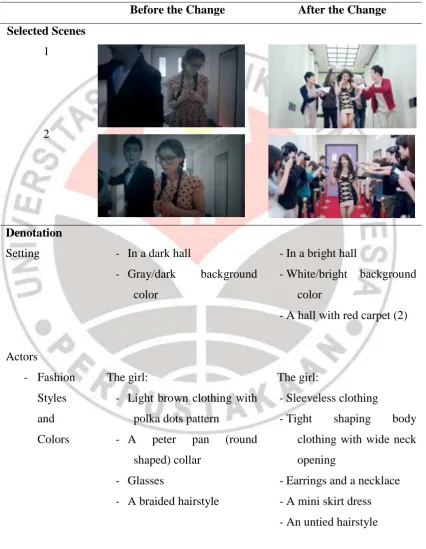
3.4 Research Analysis Example
28
Table 3.1
Denotative, connotative, and mythical meanings of the selected scenes in
Ailee’s music video “I Will Show You”
Before the Change After the Change
29
- Actions
The man beside the girl:
- A black suit with a white shirt inside
- The girl is walking with head down.
- Flat expression
- The man beside her frowns at her (2).
The men around her:
-Blue, gray, and red cardigans and a gray sweater
-Waving to the crowd (2) -Happy face (2)
68
CHAPTER V
CONCLUSIONS AND SUGGESTIONS
This chapter will conclude the research by reviewing the overall study. The conclusion will focus on the results of the study as the answers of the research questions. Suggestions for future research will also be presented in this chapter. 5.1 Conclusions
The research aims to investigate denotative, connotative, and mythical meanings of the selected scenes in three music videos: Ailee’s “I Will Show You”, Taylor Swift’s “You Belong with Me”, and Super Junior M’s “Super Girl”. The denotative meaning analysis shows that the three music videos tell a story about a person who changes his or her appearance to be a better person. The connotative meaning analysis discovers that the second fashion style is better than the first fashion style or the original style. The connotative meaning is obtained by interpreting the signs inside and outside the fashion. The signs outside the fashion associate its values so that the values are attached to the fashion.
In the end, the values of the first and the second fashion style are compared in binary opposition analysis. By comparing the values as binary opposition, it can be seen that the second fashion style dominates the first fashion style. The values of the second fashion style are considered as positive while the values of the first fashion style are regarded as negative. Therefore, the second fashion style is better than the first one. This conviction is made as if it is natural. The association is seen as reality and the truth. However, this is actually a myth that naturalizes ideology into reality.
69
dominancy will be maintained. Therefore, the idea that the second fashion style is better than the first fashion style is a myth and it is not the reality. 5.2 Suggestions
For future research, it is suggested to focus more on the details of the fashion. The connotative meaning of various fashion styles can be explored so that the more thorough analysis of fashion will be acquired. An analysis of specific fashion style will also enrich the knowledge on fashion style as the means of communication and identity.
Bibliography
Almeida, D. 2009. Where have all the children gone? A visual semiotic account of advertisements for fashion dolls. Visual Communication, [e-journal] 8 (4), 481-501. Available through: Sage Publication < http://vcj .sagepub.com /content/8/4/481> [Accessed 8 April 2013].
Angell, H. M. 2005. What Music Videos Teach At-risk Adolescent Girls: Making a Case for Media Literacy Curriculum. [online] Available at: <etd.fcla.edu /UF/UFE0009942/angell_h.pdf> [Accessed 7 December 2012].
Auty, S. & Elliot, R. 1998. Social Identity and the Meaning of Fashion Brands. E - European Advances in Consumer Research, [online] 3, 1-10, eds. Basil G. Englis and Anna Olofsson, Provo, UT : Association for Consumer Research. Available at: <http://www.acrwebsite.org/search/view-confer-ence-proceedings.aspx?Id=11145> [Accessed 19 June 2013].
Ayto, J. 1990. Dictionary of Word Origins. New York: Arcade.
Barnard, M. 2011. Fashion sebagai Komunikasi. Yogyakarta: Jalasutra. Barthes, R. 1977. Image Music Text. London: Fontana Press.
Barthes, R. 1991. Mythologies. New York: The Noonday Press.
Berger, A. A. 2010. The Objects of Affection: Semiotics and Consumer Culture. New York: Palgrave Macmillan.
Brauer, L. & Shields, V. R. 1999. Princess Diana‟s celebrity in freeze-frame: Reading the constructed image of Diana through photographs. European Journal of Cultural Studies, [e-journal] 2 (1), 5-25. Available through: Sage Publication < http://ecs.sagepub.com/content/2/1/5> [Accessed 8 April 2013].
Campsall, S. 2005. Analysing Moving Image Texts: ‘Film Language’ [pdf] Available at: <www.englishbiz.co.uk/downloads/filmanalysis.pdf> [Accessed 24 November 2012].
Chandler, D. 2002. Semiotics the Basics. London: Routledge.
University of Missouri Columbia website <http://communication .missouri.edu> [Accessed 5 December 2012].
Diaz-Meneses, G. 2010. The Ethics of Consumer Involvement with Fashion: A Freedom under Social Pressure. Textile Research Journal, [e-journal] 80 (4), 354-364. Available through: Sage Publication < http://trj. sagepub.com/ content/80/4/354> [Acessed 8 April 2013].
Djonov, E. & Van Leeuwen, T. 2011. The semiotics of texture: from tactile to visual. Visual Communication, [e-journal] 10 (4), 541-564. Available through: Sage Publication < http://vcj.sagepub.com/content/10/4/541> [Accessed 8 April 2013].
Douglas, H. 2012. History of the Peter Pan Collar. The Courier online. Retrieved August 14, 2013 from http://thecourieronline.co.uk/history-of-the-peter-pan-collar-2/
Dyer, R. 1993. Entertainment and Utopia. The Cultural Studies Reader, Second Edition. Ed. Simon During. London: Routledge.
Hancock, B. 2002. An Introduction to Qualitative Research [pdf] Available at: <http://faculty.cbu.ca/pmacintyre/course_pages/MBA603/MBA603_file s/IntroQualitativeResearch.pdf> [Accessed 12 February 2013].
Hanna, F. J., Talley, W. B., & Guindon, M. H. 2000. The Power of Perception: toward a Model of Cultural Oppression and Liberation. Journal of Counseling & Development, [online] 78, 430-441. Available at: <www.dhss.delaware.gov/ dsamh/files/perception1192.pdf>[Accessed7
Dcember2012].
Hawkins, S. 2002. Settling the Pop Score: Pop Texts and Identity Politics. Burlington, VT: Ashgate.
Heaven, V. 2009. Fashion’s Victims: Considering the Dualistic Oppression of the Makers and Consumers of Apparel. [online] Available through Columbia College website: <http://www.colum.edu> [Accessed 7 December 2012].
Karacan, E. 2007. Women under the Hegemony of Body Politics: Fashion and Beauty. [online] Available through: Middle East Technical University website <https://etd.lib.metu.edu.tr/upload/12608861/index.pdf> [Accessed 7 De-cember 2012].
1 (3), 3-17. Available at: <http://evols.library.manoa.hawaii.edu/handle/ 10524/1691> [Accessed 2 February 2013].
Koller, V. 2008. „Not just a colour‟: pink as a gender and sexuality marker in visual communication. Visual Communication, [e-journal] 7 (4), 395-423. Available through: Sage Publication < http://vcj.sagepub.com/ content/7/4/395> [Accessed 8 April 2013]. Georgetown University. Available through: Georgetown University website <http://cct.georgetown.edu/research/thesisdatabase/Ahava Leibtag.pdf> [Accessed 5 December 2012].
Lull, J. 1992. Popular Music and Communication: An Introduction. In J. Lull (Ed.), Popular Music and Communication (2nd ed., pp.1-32). Newbury Park, CA: Sage.
Mannino, B. 2013. Hairstyles that make you look younger. Glo. Retrieved August 15, 2013 from http://glo.msn.com/beauty/hairstyles-that-make-you-look-younger-5847
Margolies, E. 2003. Were those boots made just for walking? Shoes as performing objects in everyday life and in the theatre. Visual Communication, [e-journal] 2 (2), 169-188. Available through: Sage Publication < http://vcj. sagepub.com/content/2/2/169> [Accessed 8 April 2013].
McKenna, L. 2006. Audience Interpretations of the Representations of Women in Music Videos by Women Artists. Graduate School Theses and Dissertatios, [online] Available at: <http://scholarcommons.usf.edu/etd> [Accessed 5 December 2012].
McMahon, M. 2013. What Is a Peter Pan Collar?. wiseGEEK. Retrieved August 14, 2013 from http://www.wisegeek.com/what-is-a-peter-pan-collar.htm McMurtrie, R. J. 2010. Bobbing for power: an exploration into the modality of
hair. Visual Communication, [e-journal] 9 (4), 399-424. Available through: Sage Publication < http://vcj.sagepub.com/content/9/4/399> [Accessed 8 April 2013].
Mezey, N. & Niles, M. C. 2005. Screening the Law: Ideology and Law in American Popular Culture. Columbia Journal of Law and the Arts, [e-journal] 28, 91-185. Available through: Georgetown Law Library website <http://scholarship.law.georgetown.edu> [Accessed 5 December 2012].
Molloy, J. T. 1976. Dress for Success. New York: Warner Books.
Morgado, Marcia A. 2007. The Semiotics of Extraordinary Dress: A Structural Analysis and Interpretation of Hip-Hop Style. Clothing and Textiles Research Journal, [e-journal] 25 (2), 131-155. Available through: Sage Publication <http://ctr.sagepub.com/content/25/2/131> [Accessed 8 April 2013].
Murphy, C. 2013. Dealing With Depression. Clive Murphy: Self Empowerment Centre. Retrieved August 15, 2013 from http://www.clivemurphy .com/pages.php?pageid=6
Oxford Advanced Learner’s Dictionary of Current English (Low-priced ed.). 1974. Oxford: Oxord University Press.
Pearson, S. (n. d.). Over Seventy Years of Fashion History – How Fashions Have Changed Since the 1920s. The People History. Retrieved August 11, 2013, from http://www.thepeoplehistory.com/fashions.html.
Schiermer, B. 2010. Fashion Victims: On the Individualizing and De
-individualizingPowersofFashion.Fashion Theory,[e-journal]14(1),
83-104. Available through: EBSCO Host Connection <http:// connection.ebscohost.com/c/articles/48443652/fashion-victims-individu-alizing-de-individualizing-powers-fashion> [Accessed 7 December 2012].
Sukyadi, D. 2011. Teori dan Analisis Semiotika. Bandung: Rizqi Press.
Stone, T. L., Adams, S., & Morioka, N. 2006. Color design workbook: a real-world guide to using color in graphic design. Massachusetts: Rockport Publishers.