WOMEN EDUCATION AND RURAL ECONOMIC
DEVELOPMENT OF THE BODO COMMUNITY OF ASSAM;
A Case Study In Barpeta and Baksa District of Assam
Ritul Talukdar
Assistant Professor in Economics B.H. College, Howly, Assam E-mail: [email protected]
Abstract: In this paper, a case study has been done on the present women
educational status of the Bodo community of Assam along with the problems associated with it and the role of women in upliftment of the rural economy of Assam. An attempt has been made to study in details the present women educational status of the Bodo community of Assam, problem associated with it, the role of the Bodo women in economic activities and the way to uplift the rural economy of Assam through active participation of women by educationally empowering the women section of the community.
The study is based on primary data. Data is be collected by random sampling method.
Key words: Bodo community, Women, Education, Occupation, Income,
Poverty.
1. Introduction
Women are nearly the half of the total population size of a society. That is why, their participation in economic development activities is very important. In this respect, the Bodo women can take a decisive role to up life the economic status of the community. Generally the women section of the Bodo community are very active in household as wel as in economic activities. They are born weaver, skilled in agricultural and allied activities but the modes of operation of economic activities are primitive in nature. The causes behind it are low rate of literary of the women section in the community, low rate of capital formation of the community etc. That is why, women section of the community generate low rate of income in their economic activities.
In the context of the economic development of the rural sector of the Bodo community of Assam, it is very urgent to study the problem of women education in the community and their role in uplifting the rural economy.
2. Objectives of the Study
Though Bodo women can take a decisive role to uplift the economic status of the community still their poor educational status is standing as a hindrance on this way. Hence, my paper has made an attempt to analysis the women education status in the Bodo community of Assam and their role in uplifting the economic status of the rural sector of the community.
The major objectives of the study can be stated as below:
2.1. To study the educational status of the women in the Bodo community of Assam and problems of women education in the community.
2.2. To study the role of women in economic activities of the Bodo community of Assam and impact of it on education.
3. Material and Methodology
The study is based on primary data. To collect primary data from sampling unit, a sample survey has been made and for this purpose a suitable questionnaire was a view to collect information from the sample village.
Bajali development block, Kareguri and Hatapara village is under Gobordana development block.
Out of total household of the representative 5 villages we have selected 10 household from each village and total numbers of sample household were 168 female out of 343 total no of family members. We have purposively selected these 5 villages and 50 household because of their representative character for the economy of Bodo community.
4. Analysis of Field Data
Sampling is the process by relatively small numbers of objects or events are selected and analyzed in order to find out something about the entire population from which it is selected. Sampling procedure provides generalization on the basis of a relatively small portion of the population.
In our sample survey data have been collected from 50 representative household to find out the present economic scenario of the women of Boro community of Assam, yet some other information have also been collected from the sample household. In my study, data are arranged in tabular forms to facilitate comparison and show the involved relations.
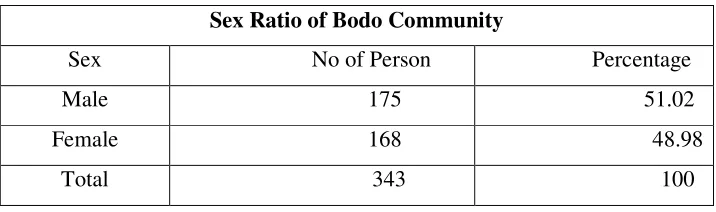
4.1 Sex ration of the villagers of Bodo Community: In our simple survey the sex
ration of the household have been taken in to account as it can effect on the socio economic condition of the female section of the society. In a society nearly half of the total population is female and as such they can take a decisive role not only in family but also economic development of the society as a whole.
Table No. 1.1
Sex Ratio of Bodo Community
Sex No of Person Percentage
Male 175 51.02
Female 168 48.98
Total 343 100
4.2 Educational Status of the Women of Bodo Community
It is observed that a co-relation exist between education and economic and social development of a society. Generally educated women are skilled labour and they are able to avail all sorts of facilities including financial assistance given by government through bank, DRDA, Panchayat etc. as compared to the illiterate people. So far as the level of education of sample women is concerned, it is seen that only 10.7% are illiterate and remaining others belong to different educational status as shown in the table no. 1.2.
Table No. 1.2
Educational Status of Bodo Community
EducationalQuality No. of Household Percentage %
Illiterate 18 10.7%
Below HSLC 74 44.04%
HSLC 52 30.95%
HSSLC 19 11.30%
Graduation and above 5 2.97%
Total 168 100%
4.3 Change of Occupational Pattern of Women of Bodo Community
Economic development creates various types of employment opportunities in an economy. In under developed countries majority of the population are still remain in agriculture and allied sector.
Table No. 1.3
Occupational Transformation of women in Bodo community
Sl. No. Name of the Village Present Occupation Past Occupation
1 Agriculture 52% 76%
2 Business 14% 8%
3 Service 22% 10%
4 Other 12% 6%
Table number 1.3 shows that at present time 52% out of total is engaged under agriculture sector, 14% are in business and 22% are in service sector and 12% people are belongs to different type of unskilled manual labour, wage labour .
But if we compare the present structure of occupation with the occupation of past generation then it will be clear that 76% Bodo women were engaged in agriculture, 8% in business and 10% service and only 6% people were belongs to other types of occupation in past.
4.4 Sources of Income
Increase of income enhances the rate of savings, investment, production and consumption behavior of the society at a multiplier process. But in the rural area of India generation of income is vary slow as maximum people are engaged in agricultural activities where productivity is very low. An attempt has been made to know about the various sources of income of the Bodo women of Assam as shown in Table No. 1.4. The Table No. 1.4 indicates various types of income sources of the women in Bodo community of Assam which are as like agriculture, weaving, poultry, piggery business, service, traditional industries and wage labour. Among these activities traditional industries like handicraft, weaving, preparation of traditional wine, piggery and poultry are the most prestigious culture of the Bodo community which is prevailing mostly in the rural area. Such types of activities are generating a respectable amount of income for the Bodo family but the rate of income generation in such activities is not satisfactory as compare to modern farming activates.
Karaiguri 53.1
9% 1.6 2.5 10.31 24 7.2 1.2 100 Total 55.08
%
1.3
2.5 10.09 22 7.41 1.26 100
Table No. 1.4 shows that 55.08% income is generated from agriculture, 1.36% from poultry, 2.5% from piggery, 10.09% from business, 22% from service, 7.41% from traditional industries and 1.26% from wage labour. If we add the income percentage of poultry, piggery, traditional industries, it will be 11.26% from these three types of activities which are directly guided by the traditional culture of the Bodo Community.
5. Major Findings
5.1 Occupational structure of women in the Bodo community of Assam reflects that till now major part of the total women engaged in agriculture sector and generating a respectable amount of income for their livelihood. But among the young generation a tendency of transformation agriculture to service and business sector is appeared which is an indicators of the movement of the society towards development.
Women engaged in service are not satisfactory but there is tremendous improvement which is appeared from the comparative analysis of occupational structure of present generation with past generation. Like service sector an identical picture is also appeared in case of business sector. A substantial amount of educated young Bodo women are attracted towards different types of business activities, small scale and cottage industries based on locally available natural resources, shopkeeper etc.
5.2 The female literacy level among the Bodo community have game up but they could
not able to maintain the equal pace of progress with the women of non-tribal groups. More particularly the Bodo women in remote area are maintaining the same mode of living major changes over the years. That is why in this places the tribal women are far from taking formal education but education is the most important factor of economic development of the community.
a. Poor transforportation and communication facilities in the rural area. b. Drop out of girl students due to economic backwarden, neglegency of
guardians towards the education of girls.
c. No of Bodomedium schools up to high school level is not sufficiently available in the close distance of their village.
d. Lack of strong motivation towards higher education of girls due to some problems like economic backwardness, neglegency of parents, language problems early marriage of girls etc.
5.4 Maximum Bodo women are working in different types of agriculture and allied
activities. Their modes of operation are pemetive that is why income generation from such activities is not satisfactory. The women who are not highly educated they are generally involving in these type of activities.
5.5 Highly educated women are working Govt. and private sector jobs, They have also
their own business like fashion design, Beauty parlour, Sewing and cutting, tailoring etc. Income earn from such activities are impressively higher than traditional premetive economic activities.
6. Policy Measures
For creating the goal an empowered women for rural development, the following strategically need to be implemented by the Govt. in partnership with NGO and Community—
6.1 Creating community demand for girls education not only elementary level but also all the level of education.
6.2 Gender and poverty sensation programme should be developed to create an environment where by all will work together to remove all the disparities - physical, social and economic.
6.3 The Technical and Vocational education should be made available for girls. 6.4 No. of Bodo medium school need to extent up to all village of the community.
6.5 The adult education programme in rural area is essential.
6.6 Efforts should made to solve the drop out problem of girls education in rural area
activities like fashion designing, tailoring, food processing beautician, need to increase. For which following means should be adopt:-
a. Training facilities should be there in rural area through which the women of the community will get better chance to be specialized in this field.
b. Knowledge and information on Global changing business environment like marketing in formation, the change of test, habit, preference of the consumer should be provided regularly through government and Non-government efforts like NGO, SHGs, Mahila Sangathan.
7. Conclusion:
To conclude, it is note worthy that the Bodo community specially the rural sector will develop properly when the women empowerment will be realized in its appropriate sense. For this great think, the mindset of the people should deeply concentrate that man and women can not be differentiated in the reconstructed with the new dimension.
References
1. Brahma, K.: Aspects of Social custos of the Bodos, Girin Print Service 91-A, Baithakhana Road, Calcutta-700009.
2. Souvenir; Bodo Sahitya Sabha, 23rd Annual Conference, 1982, P.34. 3. Choudhuri, S.S.: A Mittal Publication.