Welcome to the 13th International Educational Technology Conference IETC-2013.
"The International Educational Technology Conference (IETC)" series is an international educational activity for
academics, teachers and educators. This conference is now a well-known educational technology event and the
number of paper submissions and attendees increase every year. It promotes the development and
dissemination of theoretical knowledge, conceptual research, and professional knowledge through conference
activities, the conference proceeding book, and the Turkish Online Journal of Educational Technology (TOJET).
Its focus is to create and disseminate knowledge about the use of instructional technology for learning and
teaching in education. This year, IETC-2013 received almost 400 applications. The conference academic
advisory board accepted 235 applications.
The first of "The International Educational Technology Symposium (IETS)" and the second of "The International
Educational Technology Symposium (IETS)" were held at Sakarya University in Turkey in 2001 and 2002. The
third one was at Eastern Mediterranean University in the Turkish Republic of Northern Cyprus in 2003, and the
fourth one at Sakarya University in Turkey in 2004. The fifth International Educational Technology Conference
(IETC) was organized at Sakarya University in Turkey in 2005.The Sixth International Educational Technology
conference was held in Turkish Republic of Northern Cyprus. In 2007, the seventh conference was organized at
Near East University in the Turkish Republic of Northern Cyprus. After then The 8th International Educational
Technology Conference was held at Anadolu University in Turkey in 2008. The 9th International Educational
Technology Conference was organized at Hacettepe University in Turkey in 2009. IETC-2010 was organized at
Bogazici University in 2010 in Turkey. IETC-2011 was conference organized at Istanbul University in 2011 in
Turkey. IETC-2012 conference was organized at National Central University in Taiwan in 2012.
The International Educational Technology Conference aims to diffuse the knowledge and researches among
academicians and lead to development in educational technology and instructional technologies.
Without the authors and participants, IETC-2013 would, of course, have been impossible. We would like to
sincerely thank all of you for coming, presenting, and joining in the academic activities. We would also like to
thank all of those who contributed to the reviewing process of the “IETC
-
2013” conference papers, which will
be also published in TOJET. And finally, we would like to thank Sakarya University
–
University of Malaya
organizing team and The Turkish Online Journal of Educational Technology (TOJET) for successfully organizing
and hosting “IETC
-
2013” in Kuala Lumpur, Malaysia. Last thank is going to Prof. Dr. Saedah Siraj for her warm
hosting and for her great effort. She always tried to do her best.
We have lots of participants from 30 different countries. Should you have any enquiries regarding IETC
conference, please do not hesitate to contact with us for any additional information you may require.
Finally, we would like to wish you all a pleasant stay in Kuala Lumpur - Malaysia and safe return back home. We
hope that IETC-2013 will be a meeting you will pleasantly remember.
We hope to meet you again in IETC 2014 which will be held in Chicago, United States between 03-05 September
2014.
Thank you....
Prof. Dr. Muzaffer ELMAS
President
Sakarya University
Prof. Dr. Aytekin İŞMAN
General Coordinator & Founder of IETC
Editor in Chief of TOJET
Prof. Dr. Arif ALTUN
Coordinator of IETC 2013
Hacettepe University
Prof. Dr. Ghauth JASMON, Vice Chancellor, University of Malaya
Prof. Dr. Muzaffer ELMAS, Rector, Sakarya University
General Coordinator
Prof. Dr. Aytekin ISMAN-Sakarya University
IETC 2013 Coordinators
Prof. Dr. Saedah SIRAJ - University of Malaya
Prof. Dr. Arif ALTUN - Hacettepe University
IETC 2013 Associate Coordinators
Dr. Norlidah ALIAS - University of Malaya
Dr. Mübin KIYICI
- Sakarya University
Dr. Eric Zhi Feng LIU - National Central University
Dr. Fahriye ALTINAY AKSAL -
Eastern Mediterranean University, TRNCÂ
Dr. Zehra ALTINAY GAZI -
Eastern Mediterranean University, TRNCÂ
Dr. Zaharah HUSSIN University of Malaya
Dr. Chin Hai LENG - University of Malaya
Dr. Dorothy DEWITT - University of Malaya
Conference Secretary
Inst. Onur ISBULAN -Sakarya University
Inst. Ali KIRKSEKIZ - Sakarya University
Inst. Aydin KIPER - Sakarya University
Inst. Selcuk Sirri TERCAN - Sakarya University
Dr. İsmail İPEK
Bilkent University, Turkey Dr. Issham ISMAIL
University of Sains Malaysia, Malaysia Dr. Jarkko SUHONEN
University of Eastern Finland, Finland Dr. Jialin YI
Indiana University at Bloomington, USA
Dr. Li YING
China Central Radio and TV University, P.R. China
Dr. Mehmet CAN
Çukurova University, Turkey Dr. Norlidah ALIAS
University of Malaya, Malaysia Dr. Serhat Bahadır KERT
Victoria University of Wellington, NEW ZEALAND
Aubrey Neil LEVERIDGE
National Central University, Taiwan Bor-Chen KUO
National Taichung University, Taiwan Fahme DABAJ
EMU, Turkey I-Hen Tsai ,
Mahmut TÜNCEL
General Directorate of Educational Technology, Turkey
Megan HASTIE
Brisbane Schhol of distance Education Australia, Australia
Melissa Huı-Mei Fan
International Islamic University, Pakistan
Murat YALÇIN
Directorate of Educational Technology, Turkey Sheng-Yi WU
National Central University, Taiwan Ünal AKGÜZ
Directorate of Educational Technology, Turkey Yi Chun LIN
Executive Board Member - The Council of Higher Education, TURKEY
Prof. Dr. Muzaffer ELMAS,
President of Sakarya University, TURKEY
Quality processes in Sakarya Universiy
Prof. Dr. J. Michael SPECTOR,
Universiy of Georgia, USA
Educational Technology Trends and Research Issues
Prof. Dr. Cengiz Hakan AYDIN
Anadolu University, Turkey
Trends and Issues in Open and Distance Learning
Prof. Dr. Ibrahim Ahmad BAJUNID
A Case Study of Secondary Pre-service Teachers' Technological Pedagogical and Content Knowledge
Mastery Level ______________________________________________________________________ 15
Hasniza NORDIN
a, Niki DAVIS
b, Tengku Faekah TENGKU ARIFFIN
cA Case Study on the Effects of an L2Writing Instructional Model for Blended Learning in Higher
Education _________________________________________________________________________ 23
Lee So
a, Chung Hyun Lee
aA content analysis in the studies of YouTube in selected journals ______________________________ 33
Norlidah Alias, Siti Hajar Abd Razak, Ghada elHadad, Nurul Rabihah Mat Noh, Kokila Kunjambu,
Parimaladevi Muniandy
A Content Analysis of Italian NSSI Web-Sites ______________________________________________ 41
Nicola Luigi Bragazzi
1,, Debora Parigi
2, Franca Pezzoni
2, Giovanni Del Puente
2A content analysis of wikis in selected journals from 2007 to 2012_____________________________ 48
Norlidah Alias, Dorothy DeWitt, Saedah Siraj, Sharifah Nor Atifah Syed Kamaruddin, Mohd Khairul
Azman Md Daud
A Literary Aspect in Micro Teaching Subject in French Education Department Yogyakarta State University
_________________________________________________________________________________ 57
Indraningsih
A Mobile Game-based Insect Learning System for improving the learning achievements ___________ 61
Chung-Ho Su
a, Ching-Hsue Cheng
bA new dimension to teaching mathematics using iPads _____________________________________ 70
Diana Audi
a, Rim Gouia-Zarrad
aA Proposed Model of Photovoltaic Module in Matlab/Simulink
TMfor Distance Education ___________ 73
Zekiye ERDEM
a, M.Bilgehan ERDEM
bA STUDY OF NETWORK LEARNING RESOURCE CENTER FOR ELEMENTARY SCHOOLS OF BANGKOK
METROPOLITAN ____________________________________________________________________ 80
Ruaysup Deshchaisri
a*, Saroach Sopeerak
bA Study on student and teacher views on technology use ____________________________________ 84
Buket Akkoyunlu
a, Semra Erkan
bA Survey on Teachers’ Awareness and Attitudes on Computer-Corpus Data: An Assisted
Technology-based EFL Vocabulary Selection and Instruction Source _____________________________________ 91
Fatima Zohra Belkhir
Ad-
ŚŽĐĂŒůĂƌŝĕŝŶĂƌĂƔƚŦƌŵĂǀĞĞŒŝƚŝŵĂŵĂĕůŦLJĞŶŝďŝƌďĞŶnjĞƚŝŵĂƌĂĐŦ
__________________________ 100
Sinan Tuncel
a,, Hüseyin Ekiz
bAdjective identification in television advertisements_______________________________________ 107
Alternative energy biogas from chocolate rind ___________________________________________ 114
Sri Redjeki, Nurul Widji Triana, Iriani, Isni Utami
An Adaptation of Circuit Analysis Course to Distance Education With Content Development _______ 118
Fatih Çelik
a͕ďĚƵůůĂŚ&ĞƌŝŬŽŒůƵ
a, Ayhan Kiraz
a, Zafer Albayrak
a, Hüseyin Ekiz
bAn Overview Of The Technologies Used For Anatomy Education In Terms Of Medical History ______ 125
Engin KURT
a, S.Eray YURDAKUL
b, Adnan ATAÇ
cAn Overview to Ethical Problems in Telemedicine Technology _______________________________ 131
Adnan ATAÇ
a, Engin KURT
b, S.Eray YURDAKUL
cAnalysing the success of level determination exam according to the school type and lesson type that is
represented by questions in the exam __________________________________________________ 136
ďĚƵůůĂŚshbK)>h
a͕ĂŚĂbE
a,, Emine UÇAR
b, Murat UÇAR
bAnalysis of Research in Programming Teaching Tools: An Initial Review ________________________ 141
Syahanim Mohd Salleh
a,, Zarina Shukur
a, Hairulliza Mohamad Judi
bAnalysis of tajweed errors in quranic recitation ___________________________________________ 149
Surul Shahbudin Bin Hassan, Dr. Muhammad Azhar Bin Zailaini
Are English language teachers in Saudi Arabia ready to integrate technology? __________________ 158
Nadeem Saqlain, Fawaz Al-Qarni, Needal Ghadi
Are Laptops Distracting Educational Tools in Classrooms ___________________________________ 164
Falah Awwad
a,, Ahmad Ayesh
a, and Sarah Awwad
bAttitudes towards the use of ICT Training Curriculum for Thai Elderly People ___________________ 170
Snit SITTI
a,, Srikul NUNTACHOMPOO
bAugmented reality in the higher education: Students' science concept learning and academic
achievement in astronomy ___________________________________________________________ 174
Jung-Chuan Yen
a, Chih-Hsiao Tsai
b, Min Wu
aAugmented Reality-based Support System for Teaching Hand-drawn Mechanical Drawing ________ 182
Hirosuke HORII, Yohei MIYAJIMA
Automatic Detection of Learning Styles in Learning Management Systems By Using Literature-Based
Method __________________________________________________________________________ 190
Norazlina Ahmad
a, Zaidatun Tasir
b, Jamri Kasim
cand Harun Sahat
aBlended learning in foreign language teaching ___________________________________________ 197
Marta Gluchmanova
ůŽŐ<ƵůůĂŶŦŵŦŶŦŶůĞƔƚŝƌĞůƺƔƺŶĐĞLJĞ͕<ĂůŦĐŦůŦŒĂ
sĞŬĂĚĞŵŝŬĂƔĂƌŦLJĂƚŬŝƐŝ
___________________ 201
ƐůŦŚĂŶhZz/>D
a,Arnold R. Lorenzo
a, Blessie U. Lorenzo
aƺƚƺŶůĞƔŝŬŬĞŶƚƐĞůŐĞůŝƔŵĞƐƚƌĂƚĞũŝƐŝǀĞĞLJůĞŵƉůĂŶŦĕĞƌĕĞǀĞƐŝŶĚĞLJĂƔĂŵŬĂůŝƚĞƐŝŶŝŶĂƌƚŦƌŦůŵĂƐŦŶĚĂLJĞƌĞů
yönetimlerin rolü __________________________________________________________________ 216
WƌŽĨ͘ƌ͘,Ăůŝů7ďƌĂŚŝŵLJĚŦŶůŦ͕ƌƔ͘'Ƃƌ͘^ĂůŝŚŝĨƚĕŝ͕EĞƐƌŝŶbĞŶƚƺƌŬ͕ƌƔ͘'Ƃƌ͘>ĞLJůĂŝĨƚĕŝ
Career Adaptability and Intention to Leave among ICT Professionals: An Exploratory Study ________ 230
Safiah Omar
a,, Fauziah Noordin
bComparison of the Use of Social Network in Education between North and South Cyprus _________ 239
&ĞnjŝůĞ/ƔŦŬ
Computer aided education ___________________________________________________________ 248
Can Cemal Cingi
Computer animation in teaching surgical procedures ______________________________________ 257
Can Cemal Cingi
Computer Based Courseware in Learning Mathematics: Potentials and Constrains _______________ 264
Ong Boon Han
1, Noor Dayana Binti Abd Halim
2, Rio Surmani Binti Shariffuddin
3, Zaleha Binti Abdullah
4,Constructing a comic to communicate scientific information about sustainable development and natural
resources in mexico ________________________________________________________________ 270
AQUILES NEGRETE
Continuing with the promise of “scratch” in the applied linguistics classroom ___________________ 278
Clarisa Garcia Quan, Ph.D.
Cyber security: rule of use internet safely? ______________________________________________ 287
Maskun
a, Alma Manuputty
b, S.M.Noor
c, Juajir Sumardi
dDesign and development of a Sustainable Tourism Indicator based on human activities analysis in Inle
Lake, Myanmar ____________________________________________________________________ 292
Ismael Abedin Ingelmo
Design and development of Webquest for Physics Module by employing Isman Instructional Design
Model ___________________________________________________________________________ 302
Norlidah Alias, Dorothy DeWitt, Saedah Siraj
Developing sustainable relations with internal and external stakeholders in universities: vision and
mission views _____________________________________________________________________ 310
Dr. Ömür Hakan KUZU
a,͕WƌŽĨ͘ƌ͘,ĂŬŬŦ'P<>
b͕WƌŽĨ͘ƌ͘,ĂƐĂŶ<ƺƌƔĂƚ'm>b
cDevelopment of an integrated learning environment with knowledge management for cultivating
student critical thinking skills _________________________________________________________ 318
Yen-Ting Lin
a, Min Jou
aDevelopment of ICT Competency Standard Using the Delphi Technique _______________________ 327
Development of Instructional Model Based on Connectivism Learning Theory to Enhance
Problem-solving Skill in ICT for Daily Life of Higher Education Students ________________________________ 342
Snit SITTI
a,, Saroch SOPEERAK
b, Narong SOMPONG
cDevelopment of Malaysia Skills Certificate E-Portfolio: A Conceptual Framework ________________ 350
Mohd Bekri, R.
a,
Ruhizan, M.Y.
b, Norazah, M.N.
c, Faizal Amin Nur, Y.
dTajul Ashikin, H.
eDigital Citizenship __________________________________________________________________ 357
Aytekin ISMAN
a,, Ozlem CANAN GUNGOREN
bDo undergraduates use their personal computers to support learning? ________________________ 363
KwongNui Sim & Russell Butson
E-Learning Environment for Hearing Impaired Students ____________________________________ 371
Hisyamuddin Hashim
a, Zaidatun Tasir
a,, Siti Khadijah Mohamad
aEducational Implication of Reflection Activities Using SNS in Cooperative Learning _______________ 376
Sang-Yon Kim, Mi-Ryang Kim
Effect of English Short Sentences Memorization on the Speaking Skill and the E-learning of English _ 383
Ikuo Kitagaki
Effective Factors for Accomplishment in Training Teacher Profession Experience of Faculty of Education
Students Rajabhat Maha-Sarakham University Thailand ____________________________________ 386
Tiwarat PRASERTSUNG
)7d7D7>'7^zZd7)7E7E7E>ED^7
___________________________________________ 389
Ebru ALBAYRAK
Electronic Portfolio Increases Both Validating Skills and Employability _________________________ 395
Mustafa Jwaifell
Employing Microsoft Live@edu Cloud Platform to Assist in Teaching Chinese Reading for Junior High
School Students ___________________________________________________________________ 402
Shi-Jer LOU
a, Chia-Liang CHO
a, Chih-Cheng TSAI
b, Ru-Chu SHIH
a,Enhancement of the 21
stCentury Skills for Thai Higher Education by Integration of ICT in Classroom 407
Nutteerat Pheeraphan
Expectation towards Cooperative Education Management of Rajamangala University of Technology Isan
Thailand __________________________________________________________________________ 416
Thanasarn SERMSUK
Exploring attitudes and achievement of web-based homework in developmental algebra _________ 420
Kwan Eu Leong
a,, Nathan Alexander
bExploring E-Decision Making Competence through Online Self Determination Platform ___________ 427
Factor Influencing the Critical Thinking of Teacher Students Studying at the Faculty of Education in
Suratthani Rajabhat University ________________________________________________________ 435
Chawakit Thongnuypram
Factors Affecting the Behaviors of Yasothon Community Leaders in Receiving Information and News. 440
Kanokon Ruenruethai
a,, Saroach Sopeerak
bFactors Influencing the Development in English Pronunciation Skills Training in Primary Students of
Schools in the Primary Education Services Area Office in Bangkok. ____________________________ 445
Premrudee SRIUDOMKIJ
a,, Advisor: Assoc. Prof. Dr. Saroch Sopirak
bFactors Influencing the Success of Rajamangala University of ________________________________ 448
Technology Thanyaburi’s Ubiquitous Learning ____________________________________________ 448
Suchitra Yodsaneha
a,, Saroach Sopeerak
bFactors Influencing the Success of Web-based Training for Teachers of The Secondary Educational
Service Area Office 30. ______________________________________________________________ 451
Issaree Sirisorn , Saroach Sopeerak
abFactors related the Utilization of Instructional Media and Innovation of Nursing Instructors at
Boromarajonani College of Nursing, Suphanburi, Thailand __________________________________ 456
Akom Phosuwan, RN,MS
a,, Saroch Sopeerak, PhD
b, Supaporn Voraroon, MS
aFormation of Multilingual Educational System in Kazakhstan: Kazakh-Turkish High Schools ________ 461
Davronzhon GAIPOV
a,, Yusuf YAYLACI
b͕<ƵƌƚĂLJ/)
cSelim GUVERCIN
dGender and cultural differences in attitudes toward Schooling usage and Personal usage of Computers:
A study of Malaysia and Jordan _______________________________________________________ 469
Nabeel Abedalaziz
a,, Chin Hai Leng
b& Saedah Siraj
cGender Equality in Online Learning: The Case of UP Open University __________________________ 478
Percia V. Secreto
Global Citizenship in Technology Age from the Perspective of Social Sciences ___________________ 486
Birol Bulut
,ªZafer Çakmak
b, Cihan Kara
cHow to say “hello” in indonesian language (Teaching Indonesian Address Term) ________________ 492
Roswita LumbanTobing
Impact of Video on Learning in Students with Autism in Malaysia: Future Prospects ______________ 500
Kathleen Saiman
a, Sushila Sinnatamby
b, Laily Mastura Mustafa
c, Norlidah Alias
d, Saedah Siraj
eImplementation Review of Professional Education of Teachers (PPG) as the Implementation of Quality
Management Function ______________________________________________________________ 507
Isti Hidayah
Mohd Salleh Abu
,a, Zaid Zainal Abidin
b, Baharuddin Aris
cImproving Turkish language training materials: Grapheme-to-phoneme conversion for adding phonemic
transcription into dictionary entries and course books _____________________________________ 521
PnjŐƺŶ<KbEZ
a͕ĂŒĚĂƐĂŶ7ZEd
b͕PnjůĞŵ<db
bIncorporating Mind-maps in Cell Biology Lectures - A Reflection on the Advantages and Potential
Drawback ________________________________________________________________________ 532
Influence of E-Portfolio Supported Education Process to Academic Success of the Students ________ 538
M. Fatih BARIS
a, Nilgün TOSUN
bInformation technologies in the postindustrial society _____________________________________ 544
tŝĞƐųĂǁ,ųĂĚŬŝĞǁŝĐnj͕WŝŽƚƌ'ĂǁųŽǁŝĐnj
Innovation Models of Indonesian Learning in Multicultural Society ___________________________ 548
Ida Zulaeha
Instructional relationships within a web-based learning environment: Students’ perceptions in a
Malaysian classroom ________________________________________________________________ 556
Mai Neo
a, Ken T.K. Neo
b, Thian-Li Lim
cHeidi Yeen-Ju Tan
d& Wai-Jing Kwok
eIntegrating Project Based Learning Environment into the Design and Development of Mobile Apps for
Learning 2D-Animation ______________________________________________________________ 565
Nurul Farhana Jumaat
a,
Zaidatun Tasir
aInteracting with Screenagers in Classrooms ______________________________________________ 573
Seo Young Yoon
a, June Lee
a, Chung Hyun Lee
aInternet memes as an information dissemination tool for libraries: the Ateneo de Manila University
experience ________________________________________________________________________ 580
Karryl Kim A Sagun
aInvestigation of Problematic Internet Usage of University Students With Psychosocial Levels at Different
Levels____________________________________________________________________________ 588
DĞŚŵĞƚZK)>h
a, Mustafa PAMUK
b, Kübra PAMUK
cInvestigation of Vocational High-school Students’ Computer Anxiety __________________________ 594
Murat TUNCER
a͕zƵŶƵƐK)E
b͕ZĂŵĂnjĂŶdEb
cKhatam Al-Quran in Islamic Education Curriculum in Malaysia _______________________________ 599
Surul Shahbudin Bin Hassan, Dr. Muhammad Azhar Bin Zailaini
Learning Management in Enhancing Potential of Thai Community ICT Learning Center Project for ICT
Development and Utilization _________________________________________________________ 606
Narong Sompong
a,Nattaphon Rampai
bCherdpong Kheerajitt
cLearning Outcomes and Student Perceptions In Using Of Blended Learning In History ____________ 615
Learning Style in A Personalized Collaborative Learning Framework ___________________________ 622
Nuzulla Mamat, Norazah Yusof
Learning Styles of Teacher Education Students: Basis in Improving the Teaching - Learning Process _ 629
Arnold R. Lorenzo
a, Blessie U. Lorenzo
a>'KD/E^dKZD^hLJŐƵůĂŵĂůĂƌŦŶŦŶŒŝƚƐĞůĕŦĚĂŶƚŬŝůĞƌŝŶŝŶ7ŶĐĞůĞŶŵĞƐŝŶĞ7ůŝƔŬŝŶŝƌ7ĕĞƌŝŬŶĂůŝnjŝ
ĂůŦƔŵĂƐŦ
_________________________________________________________________________ 639
ĂƌŦƔh<hZb/
aLoneliness and mobile phone _________________________________________________________ 647
Çetin TAN
a, Mustafa PAMUK
b͕LJƔĞŶƵƌPEZ
cMaking the Teacher Relevant and Effective in a Technology-Led Teaching and Learning Environment 653
Safdar Ali Shah
Malaysian Teachers’ Perception of Applying Technology in the Classroom _____________________ 660
Samira Nikian, Faizah Mohamad Nor and Marzila A. Aziz
Management of Academic Information System (AIS) at Higher Education in The City Of Bandung ___ 666
Etin Indrayani
Marketing Education Online: A Case study of New Zealand Higher Education Institutions _________ 674
Rubaiyet Hasan Khan
aMaternal weight gain and correlation with birth weight infants ______________________________ 686
S. Lumbanraja
a, D. Lutan
a, I. Usman
a,Media, moral education and professional ethics of journalists in Slovakia ______________________ 694
Vasil Gluchman
DĞƐůĞŬzƺŬƐĞŬŽŬƵůƵPŒƌĞŶĐŝůĞƌŝŶŝŶsŝƐƵĂůĂƐŝĐWƌŽŐƌĂŵůĂŵĂĞƌƐŝŶĞzƂŶĞůŝŬPnjƺnjĞŶůĞŵĞ
^ƚƌĂƚĞũŝůĞƌŝŶŝŶ<ĂƌƔŦůĂƔƚŦƌŦůŵĂƐŦ
________________________________________________________ 701
ƐůŦŚĂŶhZz/>D
aMobile Augmented Reality: the potential for education ____________________________________ 708
Danakorn Nincarean
a, Mohamad Bilal Ali
a, Noor Dayana Abdul Halim
a, Mohd Hishamuddin Abdul
Rahman
aMobile Learning: A Good Practice _____________________________________________________ 715
Dawood Salim Al Hamdani
Nature exquisiteness based digital photography arts project for creativity enhancement among low
achievers students. (PROSFD
ak) _______________________________________________________ 724
Siti Nuur Adha Mohd Sanif, Zaharah Hussin, Fatiha Senom, Saedah Siraj & Abu Talib Putih
Need For Mobile Learning: Technologies and Opportunities _________________________________ 733
Nursing Professionals’ Evaluation in Integrating The Computers in English for Nursing Purposes (ENP)
Instruction and Learning _____________________________________________________________ 741
Weichieh Wayne Yu
a, Chunfu Charlie Lin
b, Jenny Wang
bPŒƌĞŶŵĞEĞƐŶĞůĞƌŝmnjĞƌŝŶĞŝƌ7ŶĐĞůĞŵĞ
_______________________________________________ 750
7ƐŵĂŝůdKEh>K)>h
aKŬƵůĚĂŦƔůĂŶŵŦƔůŦŬPůĕĞŒŝ'ĞůŝƔƚŝƌŵĞĂůŦƔŵĂƐŦ
___________________________________________ 757
ĂLJƌĂŵd7E
a͕njŵŝdmZ<E
bOnline Social Networking-based Health Education: Effects on Students’ Awareness and Practice of
Laboratory Safety __________________________________________________________________ 765
Joshua Rovie Lee Daclan
Open Wonderland: A Potential 3-D MUVE for Teaching and Learning _________________________ 774
Mohd Hishamuddin Abdul Rahman
a, Noraffandy Yahaya
a, Noor Dayana Abdul Halim
a, Danakorn
Nincarean Eh Phon
aParticipatory Development Communication for Natural Resources Management in Ratchaburi Province,
Thailand __________________________________________________________________________ 780
Cherdpong Kheerajit
a, Alexander G. Flor
bPersonalized learning and learning style among upper secondary school students _______________ 786
Noor Azida Sahabudin
aMohamad Bilal Ali
b,WůĂƐƚŝŬƐĂŶĂƚůĂƌƂŒƌĞƚŝŵŝŶĚĞŝŶƚĞƌŶĞƚǀĞďŝůŐŝƐĂLJĂƌĚĞƐƚĞŬůŝĞůĞŬƚƌŽŶŝŬĞŬŝƉŵĂŶůĂƌŦŶƂŒƌĞŶŵĞ
ĚƺnjĞLJůĞƌŝŶĚĞŬŝĚĞŒŝƔŝŵŝ
_____________________________________________________________ 792
PŒƌƚ͘'Ƃƌ͘&ƵĂƚz/<͕ƌƔ͘'Ƃƌ͘EĂĐŝ7
Plus Minus of ICT Usage in Higher Education Students _____________________________________ 798
Yudi Perbawaningsih
Potential of Twitter in Post-reading Activities Among Community College Students in Malaysia _____ 805
Ida Soraya Hamidon, Norlidah Alias, Saedah Siraj,
K. Kokila, Mariani Mohammed, T. Vanita
Thanabalan
aPotential of Video Games in Learning Bahasa Melayu Vocabulary Among International University
Students in Malaysia: A Meta Analysis of Selected Journals _________________________________ 814
Fuziah Rosman, Norlidah Alias, Saedah Siraj, Husaina Banu Kenayathulla,
Abd. Razak Zakaria, Ghazali Darusalam
Pre - Implementation Study of Blended Learning in an Engineering Undergraduate Programme: Taylor’s
University Lakeside Campus __________________________________________________________ 823
S.Sivakumar
a, S.Namasivayam
a, M.T.Al-Atabi
aand S.Ramesh
bQuantitative Measurement of Students PO Attainments for Taylor’s University Engineering Programmes
________________________________________________________________________________ 839
Reynato Gamboa
a, Satesh Namasivayam
b, Mushtak Al-Atabi
cand Ramesh Singh
dResearch and trends in the studies of WebQuest from 2005 to 2012: A content analysis of publications
in selected journals _________________________________________________________________ 849
Norlidah Alias, SaedahSiraj, Mohd Nazri Abdul Rahman, Alijah Ujang,
Research Trends and Issues in the Studies of Twitter: A Content Analysis of Publications in Selected
Journals (2007 – 2012) ______________________________________________________________ 859
Norlidah Alias, Muhammad Sayuti Sabdan, Khatimah Abdul Aziz, Mariani Mohammed, Ida Soraya
Hamidon, Nazean Jomhari
Review of Digital School Construction and Development in China ____________________________ 866
Dong Yan
a,, Wu Lan
bSchool Improvement Efforts and Challenges: A Case Study of A Principal Utilizing Information
Communication Technology __________________________________________________________ 875
Nur Ain Wong Abdullah
a, Dorothy DeWitt
b, Norlidah Alias
bSchool management by values according to teachers’ opinions ______________________________ 884
ƐƐŽĐŝĂƚĞWƌŽĨĞƐƐŽƌƌ͘7͘ĂŬŦƌZ/
Self-Directed Learning in asynchronous courses: Strategies for Effective Design and Development __ 889
Thuraya Khalifa AL Ghafri
Shared Mental Model Among Graphic Designers, Multimedia Designers and Subject Matter Experts in
Designing Multimedia-based Instructional Media _________________________________________ 898
Rafiza Abdul Razak
Smart principals and smart schools ____________________________________________________ 904
Mohammed Sani Ibrahim
a, Ahmad Zabidi Abdul Razak
a, Husaina Banu Kenayathulla
aSocial Media as a Non-formal Learning Platform __________________________________________ 914
Brian Lee
Student Centered Learning in Statistics: Analysis of Systematic Review ________________________ 919
Hairulliza Mohamad Judi
a,, Noraidah Sahari
aStudents’ attitudes towards computer-assisted language learning ____________________________ 927
Mojgan Afshari, Simin Ghavifekr, Saedah Siraj & Duan Jing
Students’ Feedback of e-AV Biology Website and the Learning Impact towards Biology ___________ 934
Siti Hadiati Nugraini
a, Koo Ah Choo
b, Hew Soon Hin
c,Teoh Sian Hoon
dSuccess of Marketing Information System Model for SMEs of Punjab: Validation of Survey Based Results
and Case Study Analysis _____________________________________________________________ 942
Teacher Opinions About Computer Usage and Education in Preschool Education ________________ 950
&ŝŐĞŶ'm>b
a, Ömür Hakan KUZU
b, Tuba POLAT
cTeachers’ self-efficacy beliefs and their English language proficiency: A study of nonnative EFL teachers
in selected language centers _________________________________________________________ 958
Farimah Ghasemboland
a, Fatimah Binti Hashim
bTeaching Across Cultures: Considerations for International Language Teachers in Kazakhstan ______ 967
Yusuf YAYLACI
a, Aibarsha ISLAM
bTeaching of Simulation an Adjustable Speed Drive of Induction Motor Using MATLAB/Simulink in
Advanced Electrical Machine Laboratory ________________________________________________ 977
Ali Saghafinia
a,b,, Hew W. Ping
a, M. Nasir Uddin
c, Atefeh Amindoust
dTeaching Programming in the Higher Education not for Engineering Students ___________________ 987
Gabor KISS
Techi-Teaching: Productivity Analysis of Using Technological Devices in Teaching Business Subjects _ 993
Dr. Gualberto A. Magdaraog Jr.
Technology Applications Used by First year Undergraduates in a Malaysian Public University _____ 1001
Dorothy DeWitt, Zahra Naimie, Saedah Siraj
Technology transfer training in the Czech Republic _______________________________________ 1009
– pilot of European certification ______________________________________________________ 1009
/ǀĂŶǀŽƎĄŬ
a͕<ĂƚĞƎŝŶĂŝŚĂƎŽǀĄ
bThe Analysis of the Effects of Olfactive Stimulus in Learning in Context of Educational Technology _ 1016
ƵƌŚĂŶŬƉŦŶĂƌ͕&ĂLJƐĂůPnjĚĂƔ͕ŝůĂůzŦůĚŦƌŦŵ͕sĞůŝĂƚĚŦ
dThe Application of Information Technology among Trainee Counselors _______________________ 1023
Hamidah Sulaiman, Megat Ahmad Kamaluddin Megat Daud, PhD
The Assessments of Media for Sufficiency Economy Project Public Relations in Krabyai Sub-District,
Ratchaburi Province, Thailand _______________________________________________________ 1028
Cherdpong Kheerajit
a, Chatchai Keosonthi
aThe challenges in the usage of e-journal amongst lecturers at a public university _______________ 1032
Mohd Yahya MOHAMED ARIFFIN
a, Arzmi ABU BAKAR
bThe Design of Quality Documentation System at Higher Education Using ISO 9000 Model ________ 1038
Ika Sartika
The development and evaluation of a Kinect sensor assisted learning system on the spatial visualization
skills ____________________________________________________________________________ 1045
The Development and Testing of Multimedia-assisted Mastery Learning Courseware with regard to the
Learning of Cellular Respiration ______________________________________________________ 1053
Fazzlijan Mohamed Adnan Khan
a, Mona Masood
aThe Development Model of Knowledge Management via Social Media to Enhance Graduated Student’s
Self-Directed Learning Skill __________________________________________________________ 1059
EĂƚƚĂƉŚŽŶZDW/
The Development of a U-Learning Instructional Model Using Project Based Learning Approach to
Enhance Students’ creating-innovation skills ____________________________________________ 1063
Mahachart INTHACHOT
a,Saroch SOPEERAK
b, Nattaphon RAPAI
cThe Development of Working Design through Characterized Technology Pedagogy and Content
Knowledge in the Elementary Schools’ Instructional ______________________________________ 1067
Aisyah.A.R
The Education of Analytical Chemists in Polish Universities ________________________________ 1075
DĂƌĞŬ//h<͕:ĂĐĞŬED/_E/<
The effect of different interaction levels on instructional design learners _____________________ 1086
Magdy Aqel
The Effect of Game-Based Learning on Students’ Learning Performance in Science Learning – A Case of
"Conveyance Go" _________________________________________________________________ 1094
Eric Zhi Feng Liu
a,b, Po-Kuang Chen
aThe ehea qualification level in the context of changing values in higher education: A conceptual
framework _______________________________________________________________________ 1101
Dr. Ömür Hakan KUZU
a͕WƌŽĨ͘ƌ͘,ĂƐĂŶ<ƺƌƔĂƚ'm>b
bThe Entrepreneurs’ Expectations and Satisfaction Level in Today’s Accounting Education: A Survey of
Aksaray Organized Industrial Zone ____________________________________________________ 1107
Haluk Duman
a͕7ďƌĂŚŝŵƉĂŬ
b͕D͘zŦůŵĂnj7ĕĞƌůŝ
a͕DĞŚŵĞƚzƺĐĞŶƵƌƔĞŶ
cThe Evaluation of University Students’ Views on Internet Resources _________________________ 1115
Hasan Aydemir
a͕ůŝ7ŚƐĂŶĞŶnjĞƌ
b, Osman Karahan
c͕ŐĞŵĞŶŬŵĞŶĕĞ
dThe follow up of the trainee from the training via internet by the Extension and Training Office of
Kasetsart University during 2009 - 2012. _______________________________________________ 1123
Churairat Intara-O-Sot
a, Saroach Sopeerak
bThe Impact of Digital Mind Maps on Science Achievement among Sixth Grade Students in Saudi Arabia
_______________________________________________________________________________ 1125
Ibrahim. M. A. Jbeili
The Impact of PowerPoint on Undergraduates’ Technical Communication Achievement _________ 1133
Yee Chiew Ling @ Vivian
a, Low Loi Ming
b, Chong Seng Tong
a, Ng Yu Jin
aIbrahim Guran YUMUSAK
1, Mahmut BILEN
2, Hamza ATES
3The Integration of Authentic Learning Principles and Facebook in Service Learning______________ 1146
Halawati Abdul Jalil Safuan
a, Roy Soh
bThe potential of Youtube for teaching and learning in the performing arts ____________________ 1154
Dorothy DeWitt, Norlidah Alias, Saedah Siraj, Mohd Yusaini Yaakub, Juhara Ayob & Rosman Ishak
The Problem of Using Educational Technology in the Faculty of Technology ___________________ 1162
Cengiz Öner
a,Osman Karahan
b͕ĂŚĂĚŦƌ<ƂŬƐĂůĂŶ
c͕^ĂůŝŚŬLJŦůĚŦnj
dThe Quality Of Service Of The Distance Education ________________________________________ 1167
Tolga DURSUN
a͕<ĂĚĞƌK^<zb
a, Cansu GÖKMEN
aThe Relationship Among Tertiary Level EFL Students’ Personality, Online Learning Motivation And Online
Learning Satisfaction _______________________________________________________________ 1185
Hsiu-Feng SHIH
a, Shu-Hui Eileen CHEN
b, Shu-Chu CHEN
c, Shyh-Chyi WEY
d aDepartment of Applied
Foreign Languages, National Yunlin University of Science and Technology, Yunlin, Taiwan, R.O.C.
The Role of Educators in Introduce Technology In Early Childhood Through Science Activities _____ 1193
Sri Sumarni, Dr. M.Pd.
The State of Technology and the Arts - Interactive Multimedia in Enhancing Culturally Responsive
Pedagogy ________________________________________________________________________ 1201
Siti Zuraida Maaruf, Saedah Siraj (PhD.)
The Underlying Reasons of Students’ Success or Failure in Accounting Lessons, A Suggested Model: The
Case of KMU - ASU ________________________________________________________________ 1210
Rabia Özpeynirci
a͕DĞŚŵĞƚzƺĐĞŶƵƌƔĞŶ
b, Haluk Duman
c͕7ďƌĂŚŝŵƉĂŬ
dThe Use of Current Mobile Learning Applications in EFL ___________________________________ 1219
Rodríguez-Arancón, Pilar
a, Arús, Jorge
band Calle, Cristina
cThe Use of ICT Among Administrative Staff in an Open University: The University of the Philippines Open
University Experience ______________________________________________________________ 1226
Emely M Amoloza
The use of social media technologies among Malaysian youth ______________________________ 1233
Farrah Dina YUSOP
a, Melati SUMARI
bThe web as a channel to connect the current and traditional cultural consumptions _____________ 1238
Mariangela Giusti
Time perception in children with developmental dyscalculia _______________________________ 1246
Monica Pellerone
Truants’ and Teachers’ Behaviors in the Classroom _______________________________________ 1253
Turnover intentions: The influence of perceived organizational support and organizational commitment
_______________________________________________________________________________ 1262
Talat Islam
a, Saif ur Rehman Khan
b, Ungku NorulKamar Ungku Ahmad
cdǁŝƚƚĞƌ^ŽƐLJĂůŒ^ŝƚĞƐŝŶŝŶŒŝƚŝŵ
-
PŒƌĞƚŝŵ^ƺƌĞĐŝŶĚĞ<ƵůůĂŶŦůŵĂƐŦŶŦŶƚŬŝůĞƌŝ
__________________ 1267
ĂƌŦƔh<hZb/
aUnderstanding the two sides of online counseling and their ethical and legal ramifications _______ 1273
Poh Li,Lau, Rafidah Aga Mohd Jaladin, Haslee Sharil Abdullah,
Usability and User Satisfaction of Hardware-Software Interfacing Visualization Kit for Novice Learning
Programming ____________________________________________________________________ 1281
Ahmad Zamzuri MOHAMAD ALI, Siti Rosminah MD DERUS
Usage Of Facebook: The Future Impact Of Curriculum Implementation On Students In Malaysia ___ 1288
Nurulrabihah Mat Noh, Siti Hajar Abd Razak, Norlidah Alias, Saedah Siraj, Mohd Ridhuan Mohd Jamil
& Zaharah Hussin
Use of Information Communications Technology (ICT) in Malaysian science teaching; A microanalysis of
TIMSS 2011 ______________________________________________________________________ 1297
Ling Pick Yieng & Rohaida Mohd. Saat
Use of Nonverbal Communication in the Classroom as a Way of Enhancing Classroom Teaching: A Case
Study of Solusi High School, Zimbabwe. ________________________________________________ 1304
Mrs Stella Muchemwa
Using mobile phone texting to support the capacity of school leaders in Ghana to practise Leadership for
Learning ________________________________________________________________________ 1311
Sue Swaffield
a, Stephen Jull
aand Alfred Ampah-Mensah
bVocational School Students’ Attitudes Towards Internet ___________________________________ 1318
Murat TUNCER
a͕zƵŶƵƐK)E
b͕ZĂŵĂnjĂŶdEb
ctĞďdĂďĂŶůŦŒŝƚŝŵ&ĂƌŬŦŶĚĂůŦŒŦŶŦŶƌĂƔƚŦƌŦůŵĂƐŦ͗ŐĞmŶŝǀĞƌƐŝƚĞƐŝPƌŶĞŒŝ
_____________________ 1323
ƐƐŝƐƚ͘WƌŽĨƌ͘7ůŬŶƵƌzK)h<Z^>E
Web-based Instruction Model under Constructionism for Critical Thinking Development _________ 1333
Nutthakritta SIRISOPON
a, Saroch SOPEERAK
bWhat does PowerPoint mean to you? A Phenomenological Study ___________________________ 1342
Limia Ali Mohamed Abdelrahman
a, Mohammad Attaran
b, Chin, Hai-Leng
cWhat Drives a Successful Web-Based Language Learning Environment? An Empirical Investigation of the
Critical Factors Influencing College Students’ Learning Satisfaction __________________________ 1350
Yi-Cheng Chen
a, Ron Chuen Yeh
b, Shi-Jer Lou
c, Yi-Chien Lin
bAli Öztürk
Young Malaysian Children’s Silence in a Multicultural Classroom ____________________________ 1364
Hamidah Yamat
1, Rosalind Fisher
2,Sarah Rich
2Using Eye Tracking Method and Video Record In Usability Test of Educational Softwares and Gender
Effects __________________________________________________________________________ 1370
7ƐŵĂŝůdŽŶďƵůŽŒůƵ
aUsing 5E or 7E Teaching Model as an Instructional Design Model ____________________________ 1376
LJƚĞŬŝŶ7bDE
a͕bŝƌŝŶ<mm<
b͕7ƐŵĂŝůb,7E
bLeadership styles in synchronous and asynchronous virtual learning environments _____________ 1382
Stefano Ruggieri
a,b, Stefano Boca
a, Maria Garro
ahƐĂŐĞŽĨdŚŝŶͲůŝĞŶƚͬ^ĞƌǀĞƌƌĐŚŝƚĞĐƚƵƌĞŝŶŽŵƉƵƚĞƌŝĚĞĚĚƵĐĂƚŝŽŶͺͺͺͺͺͺͺͺͺ
_____________ 13
ϵϬ
ĂŐŚĂŶŝŵĞŶ͕zƵƐƵĨ<ĂǀƵƌƵĐƵ͕,ĂůŝƚLJĚŝŶ
13th International Educational Technology Conference
A Case Study of Secondary Pre-service Teachers' Technological
Pedagogical and Content Knowledge Mastery Level
Hasniza NORDIN
a1, Niki DAVIS
b, Tengku Faekah TENGKU ARIFFIN
caUniversiti Utara Malaysia, 06010, Sintok, Malaysia bUniversity of Canterbury, 8041, Christchurch, New Zealand
cUniversiti Utara Malaysia, 06010, Sintok, Malaysia
Abstract
In recent years, researchers reported that effective ICT integration requires teachers to acquire knowledge of technology, content, pedagogy and the intersection of these, known as TPACK (Mishra & Koehler, 2006; Archambault, & Crippen, 2009). This study specifically sought to answer: 1) What are pre-service teachers’ perceptions of their TPACK mastery level before and after field experience; and, 2) Is there a significant difference of TPACK after field experience in schools? The TPACK survey instrument was adapted from Schmidt et al. (2009) and Archambault and Crippen (2009) and administered before and after their field experience to 107 pre-service teachers in a research intensive university programme in New Zealand. In addition, three student teachers were interviewed before and after field experience. These pre-service teachers scored highest in Content Knowledge (CK) and lowest in Technology Knowledge (TK) domains within TPACK at both before and after field experience. Paired-sample t-tests showed significant increases in most TPACK domains, namely, TK, PK, PCK, TCK and TPACK. Interviews and observations of three students clarified complex changes in knowledge of TPACK that linked to their experience in schools. The study continues to support the need for field experience while also adding caution to the interpretation of TPACK survey evidence given the strength of the student teachers’ perceived knowledge before field experience. Further research is underway with a comparative survey in a programme that prepares teachers for secondary schools in Malaysia.
Keywords: pre-service teachers, TPACK, ICT Integration
INTRODUCTION
The integration of information and communications technologies (ICT) in teaching and learning remain as key issue in most educational institutions (Jones, Harlow & Cowie, 2003; Choy, Wong & Gao, 2008). A study of ICT implementation across all schools in New Zealand showed that ICT is implemented across all school types with differences in implementation between the primary, middle and secondary school systems (Jones, Harlow & Cowie, 2003). Bolstad’s (2011) more recent synthesis of the future focus in the New Zealand curriculum indicates the increasing challenges of integrating ICT.
Therefore the preparation of teachers for New Zealand schools and in many countries worldwide includes preparation to enhance learning and teaching with ICT (Davis, 2010). However, it is important to note that many student teachers have inaccurate perceptions of their competence to teach before they gain experience in schools and such beliefs must be challenged throughout their programme; field experience is a particularly relevant strategy (Howey & Zimpher 1996; Knowles & Cole, 1996). Most if not all pre-service teacher education programmes include field experience in schools to provide a hands-on opportunity for pre-service teachers to put what they have learned into classroom instructions (Darling-Hammond & Baratz-Snowden, 2007; Smith & Lev-Ari, 2005). Field experiences provide “the first formalized opportunity for pre-service teachers to verify, challenge, and modify their preconceptions” (Knowles & Cole, 1996, p. 654). Within such field experience student teachers in the 21st century are also likely to gain experience with ICT in classrooms that enhance their understanding of the complex
interaction of digital technologies with content and pedagogical knowledge (Compton & Davis 2010). For this reason pre-service teachers’ confidence to teach may drop in the process of becoming more competent. In other words, measures of pre-service teachers’ perception of their competence to teach may drop as a result of all or part of their programme, particularly as they experience of the complexity of education during a field experience (Compton, Davis & Mackey 2009).
Effective ICT integration requires teachers to acquire knowledge of technology, content, pedagogy and the intersection of those (Neiss, 2005; Mishra & Koehler, 2006; Archambault, & Crippen, 2009). Therefore Technological Pedagogical and Content Knowledge (TPACK) model provides a useful theoretical framework for this study. The TPACK model was developed by Mishra and Koehler (2006), derived from Shulman’s Pedagogical Content Knowledge (PCK) model. According to Shulman (1986) pedagogical content knowledge (PCK) is a “specific category of knowledge which goes beyond knowledge of subject matter per se to the dimension of subject matter knowledge for teaching”. As for TPACK model, Technology Knowledge (TK) covers pre-service teachers’ knowledge of technology tools to be used in teaching (Koehler et al., 2007). Pedagogy Knowledge (PK) is defined as knowledge in applying strategies to deliver the instruction which includes teaching approaches for assessing individual’s learning needs, performance and strategies to present the content (Koehler et al., 2007). Content Knowledge (CK) is a subject matter knowledge in which teachers specialize. The intersection between three domains of knowledge produces Pedagogical Content Knowledge (PCK), Technological Pedagogical Knowledge (TPK) and Technological Content Knowledge (TCK). The PCK domain refers to knowledge of integrating effective teaching strategies with the content knowledge (Mishra & Koehler, 2006). TPK involves pre-service teachers’ understanding of using technology with suitable teaching strategies. The heart of the suggested model is Technological Pedagogical and Content Knowledge (TPACK), which is described as knowing how to integrate technology within the subject matter in pedagogically sound ways (Mishra & Koehler, 2006). The TPACK model lays out the core knowledge; TK, CK and PK, and their intersections; PCK, TCK, TPK and TPACK to enhance teaching with technology (Mishra & Koehler, 2006). Pre-service teachers’ perceptions of TPACK may be used to ensure effective integration of ICT in classroom instructions (Mishra, & Koehler, 2006; Schmidt, Baran, Thompson, Mishra, Koehler & Shin, 2010; Lux, Bangert, & Whittier, 2011). Studies have been conducted to measure teachers’ TPACK development (Koehler & Mishra, 2005; Graham, Burgoyne, Cantrell, Smith, St. Clair, & Harris, 2009; Jimoyiannis, 2010), in-service teachers’ TPACK (Archambault, & Crippen, 2009; Lee & Tsai, 2010; Jang & Tsai, 2012) and pre-service teachers’ TPACK (Schmidt, et al., 2010; Lux, Bangert, & Whittier, 2011; Yurdakul, Odabasi, Kilicer, Coklar, Birinci, & Kurt, 2012). However, the majority of the TPACK survey studies were administered with teachers in the USA (e.g. Schmidt, et al., 2010; Lux, Bangert, & Whittier, 2011) and very few studies have been conducted outside the country (e.g. Jimoyiannis, 2010; Yurdakul et. al., 2012) and now in New Zealand. Therefore, there is a need for measuring pre-service teachers’ level of TPACK in New Zealand to effectively integrate ICT in teaching. A reliable measure of TPACK could benefit the field by enabling a better understanding of the ICT in pre-service teacher education. This is very relevant with the planned increased access to ICT introduced above.
PURPOSES
The study reported in this paper is part of an ongoing research project examining pre-service teachers’ use of ICT during field experience and their development of Technological Pedagogical and Content Knowledge (TPACK) mastery before and after completing the field experience in New Zealand and in Malaysia. In this paper, we limit our findings to one programme in New Zealand and seek to answer: 1) What are pre-service teachers’ perceptions of their TPACK mastery level; and, 2) Is there any significant difference in pre-service teachers’ perceptions of their TPACK mastery level before and after field experience.
METHODOLOGY
Research Design
starting field experience and after completing field experience and also observed during the field experience by the consists of 36 items that measure pre-service teachers’ perceptions of TPACK with a five-point Likert-type scale: (1) strongly disagree; (2) disagree; (3) neutral; (4) agree and (5) strongly agree. A pilot study was conducted with pre-service teachers (N = 33) in New Zealand to test the reliability of the TPACK instrument.
Participants
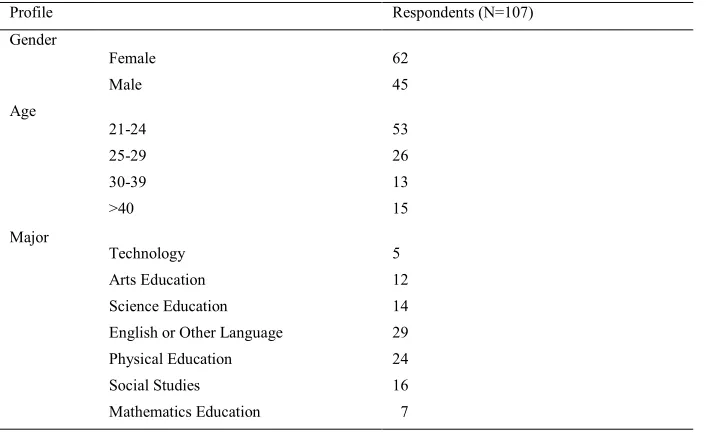
The participants in the New Zealand study were enrolled in a Graduate Diploma in Teaching and Learning (Secondary) from a research intensive New Zealand university. A total of 107 respondents participated both in the pre-survey and post-survey. As summarised in Table 1 the sample comprised 62 females and 45 males. In terms of age 53 were between 21-24 years, 26 were between 25-29 years, 13 were between 30-39 years, and 15 were above 40 years. As for the major subject taken by the pre-service teachers in the teacher education program, the majority of the respondents took English or another language as their major (n=29); 16 pre-service teachers majored in Social Studies, while pre-service teachers majored in Science Education (n=14), Physical Education (n=24), Arts Education (n=12), Mathematics Education (n=7), or Technology Education (n=5). The Technology Education group included the two pre-service teachers with ICT major who volunteered for closer study.
Table 1. Profile of respondents based on gender, age and major
Profile Respondents (N=107)
examined by the principal researcher. The themes emerged were then reviewed and discrepancies were discussed and resolved. All data are reported anonymously where possible and the three pre-service teachers were given fictitious names of Vanessa, Paige and Melinda. Both data sets were analyzed and merged during data interpretation for data triangulation to provide more information (Creswell & Clark, 2011).
FINDINGS score was for technological knowledge (M = 3.61, SD = .68). However, the mean scores for all TPACK domains indicated an overall positive response to the scales. In other words, generally, pre-service teachers agreed that their level of TPACK before and after were above average. Although the mean score for technology knowledge was the lowest mean score among the seven domains of perceptions of TPACK, it was observed that pre-service teachers perceived that they had the necessary technology knowledge, sufficient enough for them to be able to apply TK during field experience.
Table 2. Reliability, mean scores, standard deviations, t-value and effect size of TPACK domains (n = 107)
Note: *. t-value is significant at p < .05; Cohen’s d values were presented for TPACK domains with the significant difference
There was a small improvement between pre and post mean scores on all seven TPACK constructs (Table 2). In order to measure the significant differences between the two times of data collection, a paired-samples t-test was conducted to evaluate the differences in the mean of the pre-service teachers’ TPACK mastery level before and after field experience with a total of 107 respondents. There was a statistically significant increase in the mean scores between the pre- and post-survey for TK, t(106) = 2.25, p < .05, d = 0.25; PK, t(106) = 4.97, p < .05, d = 0.55; PCK, t(106) = 2.46, p < .05, d = 0.34; TCK, t(106) = 2.61, p < .05, d = 0.32 and TPACK, t(106) = 5.16, p < .05, d = 0.63. Cohen (1988) defines effect sizes as small, d = .2, medium, d = .5, and large, d = .8. Therefore, the findings reported that the Cohen’s d for TK, PCK and TCK indicated a small effect size and a medium effect size for PK and TPACK.
Reliability Pre-survey Post-survey t Effect Size (Cohen’s d)
participation as a volunteer in an ICT project led by New Zealand Association for Computing, Digital and Information Technology Teachers. During the period of field experience, Vanessa was assigned to three associate teachers: 1 Economic and 2 ICT. Vanessa rated agree in all TPACK domains. However, after field experience, whilst TK, PK, PCK, TPK and TPACK remained at the same level, she rated a negative change in her CK and a positive change of her TCK. The negative change of her CK in the survey was supported in the third interview session after field experience. “[M]y economics part was quite old, and when I was teaching my year 13 economics…I was learning two or three steps ahead of the students and it was coming back… but because I don’t use economics every day its quite rusty” Thus Vanessa needed to revise the work before continuing her teaching. Furthermore, “my economics associate [teacher]… was never around”. In contrast, her ICT subject, “all of the content is not a problem for me at all, but in saying that there is still so much more - especially in my area that needs to be maintained and upgraded and so on”. Vanessa stated that this knowledge developed throughout her field experience. She noted that her understanding of TPACK concepts was “getting there” and that her “…PK is improving all the time”; she further added that “we can’t chop one of them out as we need them all”, (Vanessa, 3rd interview, 2011).
Melinda was majoring in ICT and taking a minor in Mathematics and she was guided by three associate teachers: two Mathematics and one ICT. Melinda rated ‘agree’ for all TPACK domains before and after field experience. She further described that there was not much teaching involved during her field experience as the students had a group discussion on the project they were working on. Thus, “ICT use was not really there” which suggested her TK remaining at the same level as rated in the pre-survey. However, in the third interview session after field experience, Melinda agreed that she had improved more of her CK when they discussed the students’ projects and during their revision period. She added that she was not able to enhance her content knowledge during her studies perhaps because the “student teachers have already done a degree (in most cases) on the subject they taught, thus they knew a lot about the content of that subject and they may just pick up new bits and pieces during field experience” (Melinda, 3rd interview, 2012). Additionally, she stated that there was a significant increase in PCK as she was able to solve students’ misunderstanding of the concepts taught previously.
In contrast, Paige, who was majoring in Social Studies with a minor in Geography, rated ‘agree’ in all TPACK domains before field experience and remained ‘agree’ in all domains except for TCK and TPK which were rated as ‘strongly agree’ in the post-survey. The reason for this was clarified when she said that “We won’t be an effective teacher if we were lacking in one of those areas”. Furthermore, those three domains of knowledge were important and “I don’t think there is one more important than the other”, (Paige, 3rd interview, 2011). Paige continued that “I guess you could teach without technology if you had the other two, but the lessons would be probably more boring”. She further commented that “[A]ll the feedback from students that I've received says that using technology in class makes it much more interesting”. Paige noted that “if you have learnt what they [TPACK] are, then, you can develop it during teaching practice”. Though Paige found that most of the time during her field experience she was unfamiliar with the topic, she tried to find out what was taught in school in the different year levels in that subject and to make sure that she learnt the topic before she got to teach the class. She was then able to teach the topic. She stated in relation to TK that “I have been exposed to ICT tools, and then I need to just have some time actually working on them and learning them practically”.
DISCUSSION
The mean level of each TPACK domain was similar to that of previous studies (Koh, Chai and Tsai, 2010; Schmidt, et al. 2009). Contrary to the findings of Graham, et al., (2009), but consistent with those of Archambault and Crippen (2009), participants in New Zealand showed lower levels of TK before and after field experience than other domains of knowledge. Although the mean score for technology knowledge was the lowest mean score among the seven domains of perceptions of TPACK mastery level, results still indicated that the pre-service teachers in New Zealand perceived that they do have a certain level of technology knowledge. For example, they can keep up with the important new technologies and they can learn to use new software easily, -- technology knowledge they thought would be adequate enough to enable them to use ICT during their field experience. In spite of this, participants in New Zealand showed significant differences in their TK mastery level which indicates that they have developed their TK mastery level after completing field experience.
integrating technology into their lesson plans, however, when it comes to the actual implementation, they faced issues, such as a lack of time and difficulties in reserving technology for their class. While pre-service teachers perceived that their CK were good in comparison with other domains, they showed no significant improvement of CK after field experience. In support of this finding, the contexts of the students interviewed provided evidence of the lack of opportunity to develop content knowledge while in the field. For example, Melinda noted that “student teachers have already done a degree (in most cases) on the subject they taught, thus they knew a lot about the content of that subject and they may just pick up new bits and pieces during field experience” (Melinda, 3rd interview, 2012). Having rated their initial CK the highest among all domains, it became less likely that the trainees would show significant development of their CK during their field experience, as compared to the significant pre- and post- field experience differences observed in most of the other domains of TPACK. The significant increase in technology-related domains; TK, TCK and TPACK within New Zealand context provide support for the recommendation of Archambault and Crippen (2009) to integrate technology throughout content courses including field experiences where the use of technology can be contextualized.
Understanding of TPACK components was not an easy task, nor developing the knowledge bases among pre-service teachers. It requires a comprehensive understanding of the core knowledge and interaction of the knowledge within the teaching context (Mishra & Koehler, 2006; Niess, 2005). Although pre-service teachers were confident about the complementary knowledge bases before field experience, their use of ICT during field experience was limited. However, the requirement to complete two teaching practices during this teacher education program is likely to have contributed to the significant improvement in many of the TPACK domains, namely, TK, PK, PCK, TCK and TPACK.
CONCLUSION
In conclusion, pre-service teachers in New Zealand rated their CK as the highest and TK as the lowest mean score in both surveys, indicating little change in their knowledge. However, as noted in the introduction, pre-service teachers often have inaccurate preconceptions of their knowledge and skill of teaching and this can explain the puzzling findings on the TPACK survey of New Zealand pre-service teachers. There was medium effect size in PK and TPACK and small effect size in TK, PCK and TCK. The interviews and observations of three students enhanced our view of changes in the pre-service teachers’ perceptions of TPACK mastery level. Although the TPACK provides a model to guide effective integration of ICT into teaching, the implementation of these intersecting knowledge bases is a complex process that includes challenging students’ preconceptions. Therefore, the survey findings and the three students interviewed suggest further research of TPACK development during field experience to build up students’ knowledge of the three components and their interactions. Further research is underway with a comparative sample of pre-service students in a Malaysian teacher education programme.
Acknowledgements
We would like to thank the participants involved in this study; also the Ministry of Higher Education, Malaysia, for funding the doctoral research and the University of Canterbury, College of Education for supporting the first author to attend the conference.
References
Archambault, L. and Crippen, K. (2009): Examining TPACK among K-12 online distance educators in the United States. Contemporary Issues in Technology and Teacher Education 9(1), 71–88.
Bolstad, R. (2011). Taking a “future focus” in education—what does it mean? An NZCER working paper from the Future-Focused Issues in Education (FFI) project. Wellington: New Zealand Council for Educational Research.
Cohen, J. (1988): Statistical Power Analysis for the Behavioral Sciences (2nd ed.). Mahwah, NJ,Lawrence Erlbaum Associates.
Creswell, J. W., & Plano Clark, V. L. (2011). Designing and conducting mixed methods research (2nd ed.). Thousand Oaks, CA: Sage.