The journal homepage www.jpacr.ub.ac.id ISSN : 2302 ‐ 4690
13
Practical Preparation of (4
R
,5
R
,
E
)-methyl 5-(
tert
-butyldimethyl-silyloxy)-4-hydroxyhepta-2,6-dienoate
Yudhi Dwi Kurniawan,1,2* Duen-Ren Hou2, and Rurini Retnowati1
1
Laboratory of Organic Chemistry, Department of Chemistry, Brawijaya University Jl. Veteran No. 1 Malang, Indonesia 65145
2
Department of Chemistry, National Central University, 300 Jhong-Da Road, Jhong-Li, Taoyuan, Taiwan
*
Corresponding email : [email protected]
Received as a reviewed paper 24 September 2013; Accepted 19 October 2013; Published online 28 October 2013 for edition January-April 2014
ABSTRACT
This study is aimed to improve the preparation of uselful synthetic block (4R,5R,E)-methyl
5-(tert-butyldimethylsilyloxy)-4-hydroxyhepta-2,6-dienoate (1). This intermediate was
used in the synthesis of (+)-Cladospolide D. The strategy developed by Voigtritter et al. was adopted to exploit the acceleration effect of copper (I) iodide. This compound was
prepared from D-mannitol-derived dienediol (2) coupled with methyl acrylate through
olefin cross-metathesis reaction in various conditions. It was found that performing the reaction in the presence of 3 mol% of CuI in refluxing diethyl ether gave the product up to 75% of yield with lower catalyst loading, i.e.: 2 mol%.
Key word: acrylate, olefin cross-metathesis, Grubbs’ catalyst, copper iodide
INTRODUCTION
The journal homepage www.jpacr.ub.ac.id ISSN : 2302 ‐ 4690
14
Scheme 1 Preparation of protected carbonyl derivatives of (4R,5R,E)-4,5-dihydroxyhepta-2,6-dienes
EXPERIMENT
Chemicals and instrumentations
Chemicals used were analytical grade; D-mannitol (Acros), acetyl bromide (Lancaster), acetic anhydride (Echo), 1,4-dioxane (Tedia), pyridine (Showa), zinc dust (Panreac), glacial acetic acid (Scharlan), sodium hydroxide (Showa), methanol (Acros), hydrochloric acid (Fisher Scientific), ethyl acetate (Echo), sodium sulfate (Showa), diethyl ether (Echo), tert-butyldimetylsilyl chloride (TBSCl) (China), imidazole (Acros), dichloromethane (Echo), hexane (Echo), copper iodide (Fluka), methyl acrylate (Fluka), Grubbs’ catalyst second generation (Aldrich). The instrumentations used were NMR spectrometer 300 MHz (Bruker) and microwave instrument (Monowave 300).
Preparation of (3R,4R)-hexa-1,5-diene-3,4-diol (2)
To a suspension of 20.00 g (0.11 mol) of D-mannitol in 1,4-dioxane (157 mL) was added with AcBr (20 mL, 0.27 mol) and then allowed to room temperature for 2 days. Removal of the solvent gave a syrup which was treated 24 hours with an excess of Ac2O (47
The journal homepage www.jpacr.ub.ac.id ISSN : 2302 ‐ 4690
15
1N hydrochloric acid (25 mL) and deionized water (50 mL). The two layers were separated and the water layer was extracted with ethyl acetate (3 x 30 mL). The combined organic layer was dried over Na2SO4 and concentrated. The obtained orange syrup was then added with
NaOH (6.59 g, 0.16 mol), glacial acetic acid (28 mL, 0.49 mol), zinc dust (32.31 g, 0.49 mol) and water (220 mL) and allowed to reflux (100oC) for 3 h. Extraction of this mixture (3 x 50 mL of ethyl acetate) and concentration gave a syrup which was treated 3 hours with NaOH (6.59 g, 0.16 mol) in methanol (110 mL) at 80oC. The mixture was concentrated, neutralized (pH 6-8 by 1N HCl(aq)), diluted with H2O (35 mL) and extracted by diethyl ether (3 x 50 mL).
After concentration, the crude product was vacuum distilled at 110oC (oil bath temperature) to give 2 (4.96 g, 43.46 mmol, 40%) as a colorless oil. 1H NMR (300 MHz, CDCl3, 25oC) : δ
= 5.92-5.80 (m, 2H), 5.42-5.37 (d, Jtrans= 17.22 Hz, 2H), 5.30-5.26 (d, Jcis=10.56 Hz, 2H),
4.05-4.03 (d, J = 4.77 Hz, 2H), 2.45 (s, 2H) ppm. 13C NMR (75 MHz, CDCl3, 25oC): δ = 136.57, 117.42, 75.65 ppm.
Preparation of (3R,4R)-4-(tert-butyldimethylsilyloxy)hexa-1,5-dien-3-ol (3)
tert-Butyldimethylsilyl chloride (TBSCl, 1.3205 g, 8.8 mmol) was added to a solution of dienediol 2 (1.0000 g, 8.8 mmol), imidazole (894.7 mg, 13.14 mmol), and dry dichloromethane (50 mL) in a sealable tube at 0oC. The solution was allowed to room temperature for 16 h, quenched with water (30 mL), and diluted with ether (60 mL). The aqueous layer was further extracted with ether (20 mL x 3), and the combined organic layer was washed with HCl(aq) (0.1 N, 50 mL), satd NaCl(aq) (50 mL), dried over Na2SO4, filtered,
and concentrated. The crude product was purified by column chromatography (SiO2,
EtOAc/hexanes, 1:10; Rf 0.36) to give 3 (1.4719 g, 6.44 mmol, 74%) as a colorless oil. 1H NMR (300 MHz, CDCl3, 25oC): δ = 5.87-5.74 (m, 2H), 5.33-5.15 (m, 4H), 3.97-3.90 (m,
2H), 2.56-2.55 (d, J = 4.56 Hz, 1H), 0.89 (s, 9H), 0.10-0.08 (d, J = 8.4 Hz, 6H) ppm. 13C NMR (75 MHz, CDCl3, 25oC): δ = 137.76, 136.91, 117.06, 116.47, 75.68, 25.82, 18.18,
-4.15, -4.87 ppm.
Preparation of (3R,4R)-4-(tert-butyldimethylsilyloxy)hexa-1,5-dien-3-ol (1) Without copper (I) iodide
Grubbs’ catalyst second generation 4 (18.6 mg, 0.02 mmol) was added to the solution of diene 3 (100.0 mg, 0.44 mmol), 2,6-di-tert-butyl-4-methylphenol (BHT, 48.2 mg, 0.22 mmol), and methyl acrylate (376.9 mg, 4.4 mmol) in toluene (1 mL). After being heated at reflux for 6 h, the reaction mixture was concentrated and the crude product was purified by column chromatography (SiO2, EtOAc/hexanes, 1:5; Rf 0.40) to give 1 (24.9 mg, 0.09 mmol,
20%) as a light yellow oil. 1H NMR (300 MHz, CDCl3, 25oC): δ = 6.94-6.87 (dd, J = 15.6,
4.2 Hz, 1H), 6.14-6.09 (dd, J = 15.6, 1.6 Hz, 1H), 5.86-5.74 (ddd, J = 17.4, 6.9, 6.6 Hz, 1H), 5.30-5.21 (m, 2H), 4.14-4.09 (m, 1H), 4.02-3.98 (m, 1H), 3.72 (s, 3H), 2.60-2.58 (d, J = 5.1 Hz, 1H), 0.88 (s, 9H), 0.05-0.03 (d, J = 5.1 Hz, 6 Hz) ppm. 13C NMR (75 MHz, CDCl3,
25oC): δ = 166.74, 146.57, 137.13, 121.54, 117.99, 76.89, 51.57, 25.75, 18.14, -4.22, -4.94 ppm.
Preparation of (3R,4R)-4-(tert-butyldimethylsilyloxy)hexa-1,5-dien-3-ol (1) With copper (I) iodide
The journal homepage www.jpacr.ub.ac.id ISSN : 2302 ‐ 4690
16
methyl acrylate (188.5 mg, 2.2 mmol) and Grubbs’ catalyst second generation 4 (7.4 mg, 0.009 mmol). The rubber septum was then replaced with a reflux condenser. The solution was heated at reflux for 4.3 h. After cooling to room temperature, the reaction mixture was concentrated in vacuo and the residue was purified by column chromatography (SiO2,
EtOAc/hexanes, 1:5; Rf 0.40) to give 1 (93.9 mg, 0.09 mmol, 75%) as a light yellow oil.
RESULT AND DISCUSSION
The starting material in our research, dienediol 2, was prepared in four steps from commercially available D-mannitol [10-12], where the purification by column chromatography was not required for the first three steps. According to a literature procedure, dibromide 9 was easily prepared from D-mannitol by regioselective bromination with acetyl bromide, followed by acetylation of the remaining hydroxyl groups [10,11]. Coumpound 9 underwent reductive elimination of bromide and acetate with zinc to give diacetate 10, as described by Burke et al. [12],. Deacetylation of 10 was achieved by methanolysis in the presence of NaOH. Thus, 2 was prepared from D-mannitol in four steps with multi-gram quantities and a 40% overall yield (Scheme 2).
OH
Scheme 2 Preparation of dienediol 2
Before attempting the cross-couple reaction with methyl acrylate to afford compound 1, dienediol 2 was first subjected to the hydroxyl group protection reaction (Scheme 3). The protection on one of the two hydroxyl groups of 2 has some beneficial effects to the subsequent cross metathesis reaction. Previous studies showed that the substituent at the allylic position influences the reactivity of metathesis significantly. An alkyl substitution at the allylic position retards the metathesis reaction of the alkene with metal carbenes. In contrast, a hydroxyl group at the allylic position accelerates this reaction. This effect of the hydroxyl group may arise through pre-association of the diene with the catalyst. Hydrogen bonding between the hydroxyl group and one of the chloride ligands may also favour the reaction between the alkene and the carbene centre [13]. To facilitate the metathesis reaction at one side of the olefin 2 only, bulky tert-butyldimethylsilyl chloride was used as the protecting agent. Mono-protected dienediol 3 was achieved in 74% yield.
The journal homepage www.jpacr.ub.ac.id ISSN : 2302 ‐ 4690
17
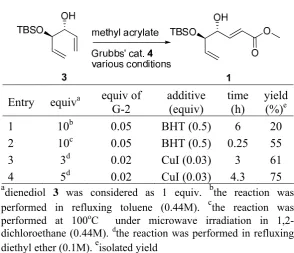
Starting from mono-protected dienediol 3, a set of cross-metathesis reaction with methyl acrylate was performed in different conditions, i.e. by applying microwave irradiation and strategy developed by Voigtritter et al. [9]. The conventional procedure [3] was also included for comparison. The experimental results are summarized in Table 1. Performing this reaction under the conventional condition (0.5 equiv. of BHT as the additive) afforded the product in 20% yield (entry 1), and the yield increased to 55% when microwave irradiation was applied to raise the reaction temperature to 100 oC (entry 2). In the addition of copper (I) iodide, the yield increased to 61%. Further increase in the yield, i.e. 75%, was observed at longer reaction time and more methyl acrylate (entry 4). Under this condition, the reaction was performed in refluxing diethyl ether, lower amount of methyl acrylate and catalyst, compared to the conventional procedures.
Table 1. Cross-metathesis reaction of 3
Entry equiva equiv of G-2
additive (equiv)
time (h)
yield (%)e
1 10b 0.05 BHT (0.5) 6 20
2 10c 0.05 BHT (0.5) 0.25 55
3 3d 0.02 CuI (0.03) 3 61
4 5d 0.02 CuI (0.03) 4.3 75
a
dienediol 3 was considered as 1 equiv. bthe reaction was performed in refluxing toluene (0.44M). cthe reaction was performed at 100oC under microwave irradiation in 1,2-dichloroethane (0.44M). dthe reaction was performed in refluxing diethyl ether (0.1M). eisolated yield
To understand the effect of copper (I) iodide, it is necessary to consider the mechanism of metathesis reaction in detail. Grubbs proposed a three-step sequence for metathesis (Scheme 4): first, the olefin coordination to the metal center to form the species B, then the dissociation of one of the ligands (L2) to form C, and the formation of the
The journal homepage www.jpacr.ub.ac.id ISSN : 2302 ‐ 4690
18
Scheme 4 Three-steps sequence for metathesis proposed by Grubbs
CONCLUSION
In conclusion, we report here an improved, practical route to prepare (4R,5R,E)-methyl 5-(tert-butyldi(4R,5R,E)-methylsilyloxy)-4-hydroxyhepta-2,6-dienoate (1). The merits of this synthesis include inexpensive co-catalyst and avoid the use of chlorinated solvents, which provides a more efficient access to these useful compounds.
ACKNOWLEDGMENT
We thank to Ministry of National Education, Indonesia, for the financial support. We also specially thank to National Central University, Taiwan, for the supporting facility.
REFERENCES
[1] Cossy, J., BouzBouz, S., and Hoveyda, A.H., J. Organometal. Chem., 2001, 624, 327– 332
[2] Chou, C.Y. and Hou, D.R., J. Org. Chem., 2006, 71, 9887-9890 [3] Lu, K.J., Chen, C.H., and Hou, D.R., Tetrahedron, 2009, 65, 225–231
[4] Liu, S.W., Hsu, H.C., Chang, C.H., Tsai, H.H.G., and Hou, D.R., Eur. J. Org. Chem., 2010, 4771–4773
[5] Forman, G.S. and Tooze, R.B., J. Organometal. Chem., 2005, 690, 5863–5866 [6] Gebauer, J., Arseniyadis, S., and Cossy, J., Eur. J. Org. Chem., 2008, 2701–2704 [7] Coquerel, Y. and Rodriguez, J., Eur. J. Org. Chem., 2008, 1125–1132
[8] Boddaert, T., Coquerel, Y., and Rodriguez, J., C. R. Chimie, 2009, 12, 872-875 [9] Voigtritter, K., Ghorai, S., and Lipshutz, H., J. Org. Chem., 2011, 76, 4697-4702
[10] Crombez-Robert, C., Benazza, M., Fréchou, C., Demailly, G., Carbohydr. Res., 1997, 303, 359–365
[11] Schimdt, B. and Nave S., Adv. Synth. Catal., 2007, 349, 215–230 [12] Burke, S.D. and Sametz, G.M., Org. Lett., 1999, 1, 71–74