P-ISSN: 2087-1228 E-ISSN: 2476-9053 Binus Business Review, 7(3), November 2016, 307-314
DOI: 10.21512/bbr.v7i3.1815
EDUCATIONAL TOURISM BASED ON
TRI HITA KARANA
IN MENGESTA IN BALI
Ni Nyoman Parwati
1; Trianasari
21Mathematics Education Department, Faculty of Mathematics and Natural Sciences, Universitas Pendidikan Ganesha 2Hospitality Department, Faculty of Economy and Business, Universitas Pendidikan Ganesha
Jl. Udayana, No. 11 Singaraja, Indonesia, 81116 1[email protected]; 2[email protected]
Received: 20th October 2016/ Revised: 24th January 2017/ Accepted: 27th January 2017
How to Cite: Parwati, N. N., & Trianasari. (2016). Educational Tourism Based on Tri Hita Karana in Mengesta in Bali. Binus Business Review, 7(3), 307-314. http://dx.doi.org/10.21512/bbr.v7i3.1815
ABSTRACT
The purposes of this research were to validate the potential of superior natural resources and human resources in the tourism development of education based on Tri Hita Karana (THK) in Mengesta in Bali, to establish the centers of educational tourism, to form groups of community that supported the educational tourism based on THK, and to design media promotion. The method designed to achieve the targets were analysis, design, evaluation, and revision. Data were collected through observation, questionnaires, and interviews and analyzed using SWOT analysis and descriptive analysis. The results of this research show that there are seven learning resources that have been successfully validated, namely: dance and percussion forum, natural agricultural laboratory, Bali traditional house, agriculture training center, tracking, natural panorama and hot water bathing place, and culinary tour. The understanding and commitment of the people about educational tourism based on THK fall into good categories. Moreover, the media promotion has been successfully designed, which are in the form of art forum brochure, village tourism brochure, and a draft of guide book to educational tourism based on THK.
Keywords: tourism development, educational tourism, Tri Hita Karana
INTRODUCTION
The purposes of this research are to validate the potential of superior natural resources and human resources in the tourism development of education based on Tri Hita Karana (THK) in Mengesta Village in Bali, to establish the centers of educational tourism, to form groups of community that supports the educational tourism based on THK, and to design media promotion. Recently, the global business environment has become very competitive (Guest, 2007). Such phenomenon seems inevitable considering that business is a dynamic world (Sharma & Tarwal, 2005). One of the competitive advantages of a business may lay on the concern it has toward the issue of environment and society (Golja &
Nižić 2010). For example, the competitiveness of a
business may lead to improved quality of life of its stakeholders. It seems true for businesses that are
highly involved in the community (Cagıl & Nazmi,
2016). To improve the quality of life, it is essential to explore the potentials possessed by a community or area that would be developed into business sectors that can be used as a local advantage (Al-Hosam, Ahmed, Ahmad, & Joarder, 2016). An example of a business that is based on the community is tourism.
The tourism sector is the major revenue source for Bali after agriculture (Disparda, 2014). The efforts to develop this sector are continuously done from time to time starting from urban areas to country sides. However, along with the rapid development of Bali tourism, it cannot be denied that social problems start to surface. One of them is the increasing of shrunk agricultural land that has an implication in the decrease in the community income, especially the peasant community. The land conversion that occurs in Bali cannot be stopped due to the rapid development of the tourism sector. Moreover, Bali natural condition, which was formerly natural and became a tourist
and beaches, now has become worse because of the construction of villas, hotels, restaurants, and houses (Bali Post, 2013). It seems undeniable that the growth of the tourism sector in Bali has led to unmanageable and destructive responses that bring environmental consequences (Trianasari & Yuniarta, 2016).
Another problem that recently started to arise in Bali is the fading of the local values or local genius values inherited from the ancestors (Parwati, 2009). This problem is also faced by people in the agricultural region like Subak in Mengesta, or Jatiluwih in Tabanan that are in World Cultural Heritage marked by the
official declaration of an inscription by Mrs. Wiendu
Nuryati, Deputy of Ministry of Education and Culture of Culture Affairs of the Republic of Indonesia. This
region has a beautiful natural panorama (rice field
terraces) with the area of 33.000 hectares.
Ninety-five percent of the total populations are peasants or
breeders. Although it has been declared as a world cultural heritage, the result of the management has not been able to improve the community life quality yet. The problems still exist and threaten the conservation of the environment in the agricultural region like Jatiluwih or Subak, especially in Mengesta. Most of the peasants have middle to lower economic status that many of them are below the poverty line. According to statistical data, there are 93.200 or 3,95% of the population fall into the latter category (BPS, 2012). This region is famous for its red rice. However, since people use inorganic fertilizer from time to time, their rice production has increasingly dropped because of the worsened land quality. The potential to develop this region into a tourist region or business region is
actually great since it has beautiful rice field terraces,
natural landscapes such as mountains, arts performing groups like dancing, percussion, Pesantian (Balinese traditional song performance), the community that stresses local Balinese values , and some big temples (Penyungsungan Jagat) located at the foot of Mount Batukaru.
Besides being situated in an interesting geographical location, Bali is more famous for its local culture. Balinese culture with its local genius values is the major interesting element that attracts domestic and foreign tourists. This will be continually maintained if some efforts are made to revitalize it. One of the efforts is maintaining the harmony between human and the environment. (Kerstin et al., 2016). One of the Balinese local genius values that are related to the conservation of the environment is Tri Hita Karana that has been inherited from one generation to the next generation in Balinese community. However, due to the limitation in knowledge and ability, the potentials of Balinese community especially in Mengesta village have not yet been developed optimally. One of the potentials is a tourist region. From the characteristics of the area and the community, the development of tourism is a community-based tourism and emphasi
zes on environmental conservation (Cagıl & Nazmi,
2016; Abubakar, Shneikat, & Oday, 2014).
Moreover, between tourism and culture or
religion, there is a mutual relationship of influence
and being complementary and even co-habitualness (Weidenfeld & Ron, 2006). Furthermore, MacDonald and Jolliffe (2003) said that culture which was often well preserved in rural areas was a valuable resource, and community-based partnerships such as cooperatives might be very effective. Therefore, the development of culture-based tourism is very feasible to be developed in Mengesta.
Tourism has three main pillars, namely the government, private organizations, and the community. The community constitutes one of the main pillars in developing tourism because no matter what the government policy is, and the support from the private organizations is, both of them are providers of facilities. However, without the support of the community or the role played by the people surrounding the tourist destination, the tourism will not be able to develop optimally (Siradj, 2009). On the other hand,
society should benefit from the existence of tourism firms or organizations (Arnaudov & Koseska, 2012)
that may include sponsorship for education, health, and recreational facilities (Mandimika, Tadarera, Nyikahadzoi, & Matamande, 2013). Unfortunately, to develop or promote public tourism awareness is not easy. According to Swarbrooke (2002), there has been some types of tourism development, which include the entirety with new objectives like developing an attraction site which is not used formerly as an attraction site and the creation of new activities or stages of an activity that moves from one site to
another in which it requires modifications in building
and structure. Based on this perspective, educational tourism is one of the types of tourism that is feasible to be developed in Mangesta. In addition, Ahmed et al. (2013) and Maister (2001) stated that there was a positive correlation between psychological empowerment of the community and the level of work satisfaction.
Educational tourism is a program that combines an element of a tourism activity with educational content. This program is suitable for those who want to travel to tourism objects to do learning activity. With this characteristic, this program seems suitable for schools which are developing and educating their students. In addition to learning in the classroom, the educational tourism program has been proven to be effective in improving students’ learning and
socialization (Whitefield et al., 2012). Travel activity in the educational tourism tour will have a broad impact on economic development in the region because the tourism centers involve the community in a direct way. The community participation can be done in two ways, which are participation in decision making,
and participation in the division of the benefits of the
tourism (Timothy & Boyd, 2003).
can be used in ensuring the community commitment to developing the tourism education business (Schein, 2010; Simbolon, 2016). THK means to maintain the harmonious and peaceful relationships that human has with God, other humans, and the environment to live a balanced life (Trianasari & Yuniarta, 2015; Trianasari, Dharma, & Yudiaatmaja, 2013). In developing tourism based on THK, some aspects are required to support it. The aspects are as following parahyangan aspect that consists of a space or a region for holy places for worship, pawongan aspect consisting of space or region of humans and the community , and palemahan aspect consisting of space or region for farming and conservative land such as ravines, steep river banks
or mountains rivers, river flood plains, mounts or hills
and forests (Dalem, 2007; Parwati, 2016).
Based on the above description, it is deemed to be important to develop the regional potential of Mengesta to become an educational tourism of agriculture and waste processing technology, and Balinese culture like dancing, and singing based on Tri Hita Karana concept through the educational tourism development which engages the public directly. It is expected that it can support the economy in this region. The objective of this research is to establish a map of superior natural resource and human resource potentials to develop educational tourism whose major element is the conservation of the Bali environment and Balinese local genius.
Some indicators that can be used to measure success in the management of THK-based educational tourism are as following: (1) The construction of learning sources for tourists that involve the community directly that has an impact on the acceleration of the economic development; (2) The improvement of the average economic status in the community; (3) The formation of a harmonious cooperation among the native, the local government, the tourism actors and the tourists; (4) The maintenance of the conservation of the environment that consists of preservation of nature, customs, and local genius of the community; (5) The evidence of satisfaction of tourists who have visited the site.
METHODS
This research is a developmental research with stages of development that consist of analysis, design evaluation, and revision (Plomp, 2010). This type
of research is chosen because it fits the aims of the
research. This research only results the analysis and
design stages that cover several things. First, the field
research that is mapping and validation of the existing natural resource and human resource potentials that are developed into learning resources. Second, it is the training to prepare human resources for the implementation of a THK-based educational tourism for the community. Third, it is focus group discussion on writing a guide book that involves representatives
of the community, adolescents, office of culture and
tourism, tourism actors, and academic people.
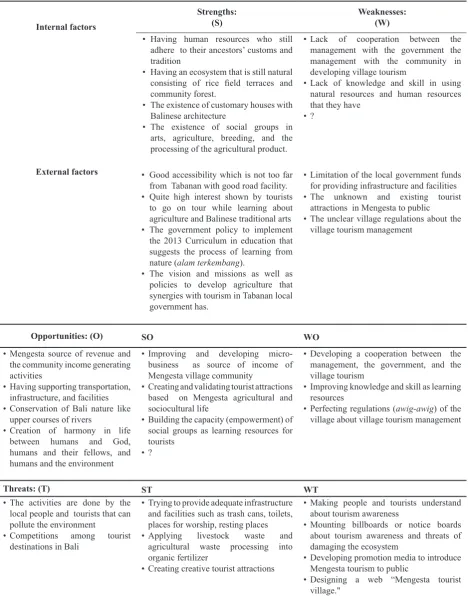
Then, the techniques of data analysis are SWOT analysis and descriptive analysis. SWOT analysis is done by identifying the internal and external factors of the region using observation, interview, and questionnaire. Both factors are presented in a matrix format. SWOT and strategies obtained are SO, ST, WO, and WT as seen in Table 1. that use strengths to address the threats
Moreover, the descriptive analysis is conducted by following the sequence of activities. There are data reduction, data display, data interpretation, and conclusion drawing (Miles & Huberman, 1992).
RESULTS AND DISCUSSIONS
The achievement of this research is the mapping of superior natural resources and human resources potentials to develop a THK-based educational tourism and activation of social groups as learning centers. Based on the results of the observation, in-depth interview and questionnaire made and done with the selected community members; the SWOT matrix can be seen in Table 2.
Based on the SWOT matrix in Table 2 the potentials that can be developed into tourist attractions and learning resources in developing educational tourism in Mengesta are many. One of them is the physical potential of the region. Mengesta has an area of 14.198 Hectares, located at the altitude of 159 - 1.087 M above the sea surface. 4.437 Hectares of the
total area is the rice field area, 384 Hectares of it is
plantation area, and the rest is used for other purposes such as residential area, roads, and river. Moreover, the average rainfall is 2.000 to 3.000 mm/year with 65,6 rainy days on average (BPS, 2012).
The existing rice fields are in the form of rice
Table 2 SWOT Matrix on the Potentials to Develop Educational Tourism in Mengesta
Internal factors
Strengths: (S)
Weaknesses: (W)
• Having human resources who still adhere to their ancestors’ customs and tradition
• Having an ecosystem that is still natural
consisting of rice field terraces and
community forest.
• The existence of customary houses with Balinese architecture
• The existence of social groups in arts, agriculture, breeding, and the processing of the agricultural product.
• Lack of cooperation between the management with the government the management with the community in developing village tourism
• Lack of knowledge and skill in using natural resources and human resources that they have
• ?
External factors • Good accessibility which is not too far
from Tabanan with good road facility.
• Quite high interest shown by tourists to go on tour while learning about agriculture and Balinese traditional arts
• The government policy to implement the 2013 Curriculum in education that suggests the process of learning from nature (alam terkembang).
• The vision and missions as well as policies to develop agriculture that synergies with tourism in Tabanan local government has.
• Limitation of the local government funds for providing infrastructure and facilities
• The unknown and existing tourist attractions in Mengesta to public
• The unclear village regulations about the village tourism management
Opportunities: (O) SO WO
• Mengesta source of revenue and the community income generating activities
• Having supporting transportation, infrastructure, and facilities
• Conservation of Bali nature like upper courses of rivers
• Creation of harmony in life between humans and God, humans and their fellows, and humans and the environment
• Improving and developing micro-business as source of income of Mengesta village community
• Creating and validating tourist attractions based on Mengesta agricultural and sociocultural life
• Building the capacity (empowerment) of social groups as learning resources for tourists
• ?
• Developing a cooperation between the management, the government, and the village tourism
• Improving knowledge and skill as learning resources
• Perfecting regulations (awig-awig) of the village about village tourism management
Threats: (T) ST WT
• The activities are done by the local people and tourists that can pollute the environment
• Competitions among tourist destinations in Bali
• Trying to provide adequate infrastructure and facilities such as trash cans, toilets, places for worship, resting places
• Applying livestock waste and agricultural waste processing into organic fertilizer
• Creating creative tourist attractions
• Making people and tourists understand about tourism awareness
• Mounting billboards or notice boards about tourism awareness and threats of damaging the ecosystem
• Developing promotion media to introduce Mengesta tourism to public
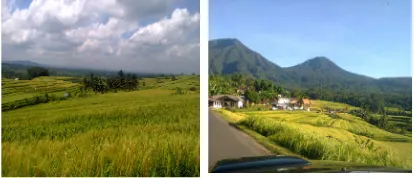
Figure 1 Rice Terraces with a Natural Mountain Range View on the North and Sea View on the South
In the food crop agricultural and horticultural subsector in Mengesta, most of the land is used to cultivate rice as the main crop. The rest is for corn, cassava, sweet potato, peanut, vegetables, banana,
and other horticultural crops. The process of rice field
preparation is done both in traditional and modern ways. In the traditional way, cows and buffaloes are used while in a modern way; a tractor is used. Agricultural land preparation is done by peasant groups (Sekehas).
In the plantation subsector, the land used for plantation is for growing coconuts, cacaos, cloves. While in the sub-sector of the plantation, the use of land is for growing coffee crops, Arbesia wood.
The plantation is specified for growing coconuts,
cacao, cloves, coffee, Arbesia wood, Jati Belanda (a kind of teak) wood, Kayu Jabon (a kind of wood), and mahogany. The plantation sector developed has an important role to develop the breeding sector. In addition to its function as the place to grow livestock, it functions as the source of feed for the livestock.
Moreover, the existing temples in Mengesta are the means to maintain the harmony between humans and God, humans and their fellow humans, and humans and nature. The manifestation of thankfulness for the blessings from God who has given them a good life is seen in the Yadnya ceremony held by the community every six months called Piodalan and Mesaba in Subak temples (agricultural temples). The Yadnya ceremony is done by the people together with a clear job description for each community member.
The Ngaturang Ayah (sacrificing something sincerely)
spirit is still alive and colors this activity. From here, it is clear that there is a harmonious relation among the community members. No matter how much hard work that they have to do, they do it with patience and cheerfully as if it is done to cure their tiredness. In holding the Dewa Yadnya, they need something from nature, such as fruits, leaves, and animals. In consequence, they treat the natural sources well so they can use them throughout the ages. The manifestation of this deed is seen in every yard where there is a plot for decorative crops besides using it to live in. This is one of the efforts to maintain a harmony between humans and nature.
Based on the characteristics of this region, most
of the land is used for crops, fishery, breeding, livestock
feed, and plantation. In the breeding sub-sector, the
livestock commodities raised by the community are cows, pigs, and chickens. The supporting feeds that are grown intensively to support the breeding are Rumput Gajah (wide - leaved grass) and field grass for cow feed, taro tuber, squash, papaya, and banana stem as pig feed, and , and Gamal (tree that exterminates elephant grass) and Lamtoro (Leucaena Glauca) as legumes. The others include agricultural wastes such as straws, corns, sweet potatoes, cassava leaves, coconut leaves, Dadap leaves (flowering trees of Erythrina Spp) and Waru leaves (a kind of trees).
Furthermore, the existing arts in the community in Mengesta developed since the former time to present are dance and percussion. The development cannot be separated from the tradition in the community. For instance when a Yadnya ceremony is held, it is a must to perform both arts. The other example is when there is a Piodalan ceremony (temple anniversary) at a temple or a birthday celebration at a house, percussion has to be played to accompany the ceremony activities. In addition, dance is performed to give an entertainment to the people who are tired at work. Moreover, as a community that has the dominant Hindu population, the tradition in the community in Mengesta is colored by religious (Hindu) activities. Starting from the design of the residential area, this still adheres to Asta Kosala Kosali rule. Some of the existing peasant groups are Utama Sari Group, Nyama Braya Sejahtera Group, and Female Peasants named Kuntum Sari Group. The activities of the groups include working together in livestock breeding management, planting arrangement, and processing of agricultural crop (red rice tea) and breeding. The groups empowered in this educational tourism operation are a female group. This is because women have a higher responsibility in preserving the environment, by the results of research
that finds women reported greater environmentally
responsible behavior than men (Ishmael, 2012). Moreover, there are some breeding businesses done by the breeder group, namely cow breeder group, pig breeder group, and purebred chicken breeder group. Most of the businesses are considerably well
managed, that includes having regulations in profit
sharing or income sharing.
Next, the artist groups that have been successfully made to be active again as learning resources are dance group and percussion group. As the center of training, an art forum is established under the name, Giri Utama Sari.
To prepare human resources, the training to prepare the human resources has been conducted in the form of tourism awareness training and village tourism management training. The data on understanding and commitment to the community concerning educational tourism based on Tri Hita Karana (THK) are collected through questionnaires and interviews. The result from questionnaires distributed to 40 respondents shows the score of 33 or good category.
In the guide book, it describes the background, intention, and aims as well as learning resources and tourism attractions that are available. This guidebook is designed based on a theoretical review and suggestions
from FGD between public figures, adolescents, staffs of Tabanan Regency Culture and Tourism Office,
academicians, and tourism players (private sectors). Next, the brochures that have been written are for the art forum, and the other one is how to conduct tourism and resources that the art forum has. The art forum brochure contains the information about the admission of new students and resources of the forum. While the tourism brochure contains types of attraction in Mengesta. The aspects that should be considered to develop community-based tourism are natural resources as the most valuable public assets, the role
and significance of the natural resource base in the
process, land use planning and zoning requirements which exist to regulate the use of natural resources (Garrod, Wilson, & Bruce, 2001; Sartini, 2004).
Based on the research results on the identification
of the potentials of the region to develop a Tri Hita Karana-based educational tourism, there are seven types of tours that are feasible to be developed as learning resources. There are dance and percussion forum, natural agricultural laboratory, Balinese traditional house, agricultural training center, tracking, panorama and hot spring bathing place, and culinary tour. Moreover, in developing THK-based tourism, one needs supporting aspects like Parahyangan, Pawongan and Palemahan aspects.
The THK concept is one of the guidances in life adhered by the Balinese community from one generation to the next generation. THK means to maintain a harmonious and peaceful life through the relationships human has with God, other humans, and environment. Furthermore, an implementation of
the THK concept in business operations is beneficial
regarding protecting the nature and environment and preserving the local wisdom as well as the traditional culture (Trianasari & Selly, 2015).
The balance among these three aspects contained in the concept of THK is developed with a system. The system can be maintaining the harmony between humans and God by preserving the sacredness of worshipping places and cleanliness. Every six months in each holy place, a Yadnya ceremony is held, which
means sincere sacrifice for the blessings of God that
human beings are safe and prosperous. In addition to that, to maintain the balance of humans and other humans is done by maintaining the gotong-royong (mutual help). Every customary and religious work is done by working together by dividing the task clearly and assigning a particular part of it to a certain community member. In practicing the agricultural and breeding system, the work is done in the group with a set of regulations that have been set and agreed by each group member. As an example, in pig breeding business, the work is done in the group under the chairman’s coordination. To ensure the continuation of this business, the capital is sought by preparing
feed, buying piglets, and providing medicines. Therefore, every member has to count and pay his or her operational cost at the time when the pigs are sold. It is the same in managing an art forum which is using a management that is agreed by the members. Furthermore, the maintenance of balance between humans and environment can be done by maintaining the preservation and cleanliness of the environment like by applying organic farming system. The fertilizer used is an organic fertilizer produced from livestock and agricultural wastes that are processed by using waste processing technology. By applying organic farming system, the environment in this area is free from livestock wastes. The other important thing is the produced livestock wastes can be used as an additional source of income such as raw material for fertilizer and biogas for the households.
CONCLUSIONS
This research is limited to the development of educational tourism in Mengesta in Bali. Based on the results of this research, it can be concluded that the strategies used to identify the potentials to develop educational tourism based on Tri Hita Karana (THK) in Mengesta consist of SO strategy, WO strategy, ST strategy, and WT strategy. SO strategy consists of (1) developing creative economic businesses in the form of red rice tea making and culinary tour with the menu produced in the local village; (2) creating agriculture-based educational tourism attractions like natural laboratory for rice cultivation; (3) learning cultural village by visiting or spending a night in the villagers’ houses with Balinese architectural design; (4) forming traditional Balinese dance and percussion forum in the place where tourists learn the Balinese traditional arts. Moreover, the WO strategy includes (1) fostering cooperation between the management
and Tabanan Tourism Office to develop the village
tourism; (2) giving the training to improve knowledge and skill of the groups that are related to the processing of agricultural products and agricultural like breeding wastes processing, and business management. Next, for the ST strategy, there are (1) trying to build places for wastes, and resting area; (2) making use of the existing facilities in the residential area to serve tourists as a place for eating lunch and taking a rest; (3) applying waste processing technology to produce organic fertilizer; (4) creating creative tourist attractions in the form of Barong Bangkung dance, tracking and cycling tours. Finally, the WT strategy consists of (1) giving an understanding about tourism awareness and threats to the ecosystem to the people and the tourists through installing billboards or noticeboards; (2) developing promotion media such as the brochure, educational tourism guide; (3) designing the web “Mengesta Tourism”.
conduct educational tourism based on THK. Next, there are seven learning resources that have been successfully validated, namely dance and percussion forum, natural agricultural laboratory, Bali traditional house, agriculture training center, tracking, natural panorama and hot water bathing place, and culinary tour. The understanding and commitment of the people about THK-based educational tourism are in good categories. Moreover, the media promotion has been successfully designed, which are in the form of art forum brochure, village tourism brochure, and a draft of guide book to THK-based educational tourism. Thus, it is suggested that in conducting the business of this educational tourism, every component of the community, local government, and private organizations can give an optimal support to its implementation. Then, this effort may become a source of revenue to support the economic growth of the community, especially in Mengesta.
REFERENCES
Abubakar, A. M., Shneikat, B. H. T., & Oday, A. (2014). Motivational factors for educational tourism: A case study in Northern Cyprus. Tourism Management Perspectives, 11, 58-62. https://doi.org/10.1016/j. tmp.2014.04.002
Ahmed, S., Raihan, M. Z., & Islam, N. (2013). Labor unrest in the ready-made garment industry of Bangladesh. International Journal of Business and Management, 8(15), 68-80.
Al-Hosam, A. A. M, Ahmed, S., Ahmad, F. B., & Joarder, M. H. R. (2016). Impact of transformational leadership on psychological empowerment and job satisfaction relationship: A case of Yemeni banking. Binus Business Review, 7(2), 109-116.
Arnaudov, K., & Koseska, E. (2012). Business ethics and social responsibility in tourist organizations in terms of changing environment. Procedia Social Behavioral Science, 44, 387-397.
Bali Post. (2013, March 9). Petani Jatiluwih pertanyakan kontribusi WBD. Bali Post
BPS. (2012). Laporan BPS (Badan Pusat Statistik) pemprov Bali tahun 2012.
Cagıl, H. O. & Nazmi, K. (2016). An exploratory research
of resident perceptions toward the tourism industry in Cappadocia: a Social Exchange Theory approach.
Asia Pacific Journal of Tourism Research, 21(12),
1-17.
Dalem, A. A. G. R. (2007). Filosofi Tri Hita Karana dan implementasinya dalam industri pariwisata. Denpasar: UPT Penerbit Universitas Udayana bekerja sama dengan Pusat Penelitian Lingkungan Hidup.
Disparda. (2014). Laporan bulanan dinas pariwisata pemprov Bali. Retrieved on February 28th, 2014 from http://www.disparda.baliprov.go.id
Garrod, B., Wilson, J. C. and Bruce, D. B. (2001). Planning for marine ecotourism in the EU Atlantic area: Good practice guidelines, project report. Bristol:
University of the West of England.
Golja, T, & Nižić, M. K. (2010). Corporate social
responsibility in tourism. Management, 10(2), 107-111.
Guest, D. (2007). HRM and the worker: Towards a new psychological contract. International Journal of Human Resource Management, 12(7), 1092-1106. Ishmael, M. (2012). Environmental education and
environmentally responsible behavior: The case of international tourists in Accra hotels. International Journal of Tourism Sciences, 12(3), 69-89.
Kerstin, K. Z., Angelica, S., Daniel, O., Veronica, T. G., & Anggie, W. (2016). Determinants of tourist satisfaction with national park guides and facilities in the Galápagos. International Journal of Tourism Sciences, 16(1-2), 60-82.
MacDonald, R., & Jolliffe, L. (2003). Cultural rural tourism: Evidence from Canada. Annals of Tourism Research, 30(2), 307-322. https://doi.org/10.1016/ S0160-7383(02)00061-0
Maister, D. H. (2001). Practice what you preach. New York: The Free Press.
Mandimika, E., Taderera, E., Nyikahadzoi, L., & Matamande, W. (2013). Corporate Social Responsibility in the tourism sector: The case of Zimbabwe. Journal of Academic and Business Ethics, 7, 1-11.
Miles, M. B., & Huberman, A. B. (1992). Analisis data kualitatif. Jakarta: UI Press.
Parwati, N. N. (2016). The existence of Balinese local wisdom for building positive students character. Paper presented at the ETWC. Inna Grand Sanur Bali: Universitas Negeri Jakarta.
Parwati, N. N. (2009). Model pembelajaran matematika berwawasan lingkungan. In Seminar Nasional Lingkungan Hidup. Malang: Kementerian Lingkungan Hidup in collaboration with Universitas Negeri Malang.
Plomp, T. (2010). Educational design research: An introduction. In T. Plomp, & N. Nieveen (Eds). An Introduction to Educational Design Research. Netherlands: Netzodruk, Enschede An.
Rangkuti, F. (2005). Analisis SWOT teknik membedah kasus bisnis reorientasi konsep perencanaan strategis untuk menghadapi abad 21. Jakarta: PT. Gramedia Pustaka Utama.
Sartini. (2004). Menggali kearifan lokal nusantara sebuah
kajian filsafati. Jurnal Filsafat, XXXVII(2), 111-120. Schein, E. H. (2010). The learning culture and the
learning leader. In G. R. Hickman (Ed.). Leading organizations: Perspectives for a new era (2nd ed.). Thousand Oaks, CA: Sage.
Sharma, A. K., & Talwar, B. (2005). Insights from practice. Corporate Social Responsibility: Modern vis-à-vis Vedic approach. Measuring Business Excellence, 9(1), 35-45.
Simbolon, F. P. (2016). The impact of relationship marketing strategy in Indonesia retail industries Binus Business Review, 7(2), 143-147.
Ditjen Pemerintahan Umum. Jakarta: Depdagri. Swarbrooke, J. (2002). Development and management of
visitor attractions (2th ed.). Canada: Elsevier Ltd. Timothy, D. J., & Boyd, S. W. (2003). Heritage tourism.
England: Pearson Education.
Trianasari, & Yuniarta, G. A. (2016). Linking the Tri Hita Karana concept and CSR activities: A case study on the environmental aspect at Alila Uluwatu Villa, Bali. In Tourism and Events International Seminar on 9-10 November 2016.
Trianasari, & Yuniarta, G. A. (2015). An exploratory research on the distributions of hotels CSR funds in Bali. Journal of Economics, Business, Management (JOEBM), 3(9), 894-897.
Trianasari, Dharma, A., & Yudiaatmaja, F. (2013). Konsep Tri Hita Karana dan kaitannya dengan etika bisnis: Sebuah kajian konseptual. In the 6th annual doctoral
colloquium and conference: “Ethically sustainable business practice and green economy”. Yogyakarta: Gajah Mada University.
Trianasari & Selly, Y. (2015). Tri Hita Karana and its Implementations in hotels: A comparative research in Buleleng. Proceeding at the International Social Science Conference. Lombok: Universitas Mataram. Weidenfeld, A., & Ron, A. S. (2006). Religious needs in the
tourism industry. Tourism and Hospitality Research, 6(2), 143–159. https://doi.org/10.1080/13032917.20 08.9687080
Whitfield, J., Diokko, L. D. A. N., Webber, D., & Zhang,