European Research Studies Journal Volume XX, Issue 4B 2017
pp. i-x
ERSJ, Vol. XX, Issue 4B, 2017
Guest Editor:
Agnieszka Brelik,
Professor of Economics, West Pomeranian University
of Technology of Szczecin, Szczecin,
Poland
Guest Co-Editor:
Simon Grima,
Professor of Accounting and Finance, Department of
Insurance, University of Malta,
Malta
Guest Editorial Board Members:
Jean-Pierre Allegret,
Professor of Economics, University of Paris X Ouest -
Nanterre La Défense,
France
Ramona Rupeika-Apoga,
Professor of Finance, Chair, Department of
Finance and Accounting, Faculty of Business, Management and Economics,
University of Latvia,
Latvia
Anca Bandoi,
Ass. Professor of Economics, University of Craiova,
Romania
Theologos-Homer Bonitsis,
Ass.
Professor of Finance, School of
Management, New Jersey Institute of Technology, Newark, NJ,
USA
Pavla Breckova,
Ph.D. Ing. Professor of Management, Head of Management
Department, Faculty of Economic Studies, University of Finance and
Administration,
Czech Republic
Slawomir I. Bukowski,
Professor of Economics, Deputy Rector, Kazimierz
Pulaski University of Technology and Humanities in Radom,
Poland
Andees Faíña,
Professor of Economic Analysis, European Chair Jean Monnet
in European Industrial Economics, Department of Economic Analysis,
University of Coruña,
Spain
Jesus-Andree Filipe,
Professor of Economics, Instituto Universitário de
Lisboa (ISCTE-IUL),
Portugal
Hardy Hanappi,
Professor of Political Economy, Ad Personam Jean Monnet
Chair for Political Economy of European Integration, IWM- Economics,
Technology University of Vienna,
Austria
Christis Hassapis,
Professor of Finance, Department of Economics,
University of Cyprus,
Cyprus
John Malindretos,
Editor TIJF, Professor of Finance, CC College of
Economics, Finance & Global Business, William Paterson University, New
Jersey,
USA
Vera Palea,
Ph.D. in Economics, Università Degli Studi di Torino,
Italy
Tulus Suryanto,
Akt., CA.,
The State of Raden Intan Lampung Islamic
University,
Indonesia
Statty Stattev,
Dr. Sc. Professor of Macroeconomics, Rector of the University
of National and World Economy,
Bulgaria
Ileanna Tache,
Professor of Economics, Vice Dean, Ad Personam European
Chair Jean Monnet, Faculty of Economic Sciences, Transylvania University
of Brasov,
Romania
Eleftherios I. Thalassinos,
Professor of International Economics, European
Chair Jean Monnet, Director Jean Monnet Centre of Excellence, Editor ERSJ,
IJEBA, IJMTEI, Chair ICABE, University of Piraeus,
Greece
Natalia G. Vovchenko
Professor Dr. of Economic Sciences, Vice Dean,
Rostov State University of Economics,
Russia
Guest Editor’s Note
Professor Agnieszka Brelik
It is my great honor and pleasure to act as the
Guest Editor for issue 4B 2017
of the
European Research Studies Journal on its 20
thanniversary.
It was
a challenge for me working with a team of distinquist colleagues from several
countries on the preparation of the issue.
All articles were selected based on specific criteria set by the
Guest Editorial
Board,
appointed for this issue of the journal in accordance with the Code of
Ethics and the Basic Requirements for Publication that have been adopted by
the Journal since its circulation in 1998.
As the
Guest Editor
of this volume I am very thankful to the members of the
Editorial Board consisting of
21 colleagues from 17 different countries.
I am
also thankful to the Guest
Co-Editor Professor Simon Grima from
University of Malta
and the
Editor-in-Chief of ERSJ Professor El
Thalassinos
for their effective cooperation in the preparation stage of this
volume. For the
successful completion
the Guest Editorial Board has followed
the double blind method in the evaluation process of each article according to
their professional and academic experience.
In this issue of ERSJ we have published several articles selected among others
after a peer evaluation by the Guest Editorial Board members. It is in the
intention of the Journal to take opportunities
disseminating scientific
research from colleagues from all over the world.
I strongly believe that
some of the publications are of high quality with innovative ideas that can be
adopted easily for the benefit of the economies they are referred to.
Professor Dr. Agnieszka Brelik
ERSJ Editor’s Note
ERSJ celebrates its 20
thanniversary in 2017
with the publication of
issues
dedicated to international conferences, special events, economic and business
themes and more.
Selected articles have been included
in this issue covering economic and
business disciplines after an extensive evaluation procedure set by the Guest
Editorial Board.
I would like to take this opportunity to express my sincere thanks to
all the
members of the Board
for their collaborative behavior, especially to the
Guest Editor Professor Agnieszka Brelik
for her cooperation in the
preparation of this issue.
Her intervention was always valuable and very
helpful.
It was a great honor for me to cooperate with all the authors,
to read all
the articles getting a very good understanding of the content, the conclusions
and the methodology used in each one of the articles where I had an interest.
Recommendations and conclusions
included in the published articles could
be of great importance in case they were adopted by the corresponding bodies.
After 20 years of publication experience
I would like to congratulate my
cooperatives from several countries for their valuable comments and their help
in the circulation of ERSJ.
ERSJ Volume XX, Issue 4B, 2017
Contents:
1. Toward the Best Model of Strategy Implementation in Indonesian Islamic Banking from the Lens of Strategic Clarity
Dodi Permana...3-15
2. Trafficking of Migrant Workers in Indonesia: A Legal Enforcement and Economic Perspective of Prevention and Protection Efforts
Herry Nuraeny………..16-26
3. ASEAN-China Free Trade Area: An Assessment of Tariff Elimination Effect on Welfare
Sugiharso Safuan………..27-37
4. Analysis of Factors Affecting Inflation and its Impact on Human Development Index and Poverty in Indonesia
Yolanda Yolanda...38-56
5. Creating a Learning Organization as an Increase in the Adaptability of a Company's Human Capital to the Volatility of the External Environment I.M. Aliev, V.I. Sigov...57-69
6. Relationship of Earnings Management and Earnings Quality before and after IFRS Implementation in Indonesia
Farichah Farichah...70-81
7. Blended Learning Russian as a Foreign Language: The Principles of Organization and Implementation Experience
A.N. Al-Kaisi, A.L. Arkhangelskaya, M.A. Bragina, B.A. Bulgarova, O.I.
Rudenko-Morgu……….82-98
8. The Impact of the Global Stock Market and the Foreign Exchange Market on Domestic Financial Market
W. Murti...99-111
9. Problems and Prospects of Higher Education System Development in Modern Society
10. A Study of Service Quality, Corporate Social Responsibility, Hospital Image, and Hospital Value Creation in Medan
A.N. Lubis, P. Lumbanraja, R.R. Lubis, B.K. Hasibuan ………125-133
11. Strategic Implementation of Environmentally Friendly Innovation of Small and Medium-Sized Enterprises in Indonesia
Muinah Fadhihah, Andriyansah………134-148
12. Socio-Political and Economic Aspects in Legal Context
Edy Lisdiyono, Sri Suatmiati...149-157
13. Role of MNCs in Changing Preferences for Food Consumption in Russia under Import Substitution
V.Yu. Chernova, V.S. Starostin, G.V. Butkovskaya, A.M. Zobov...158-166
14. Factors of Economic Behavior of Population in Regional Labor Market E.I. Beglova, S.I. Nasyrova, A.V. Yangirov………..………...167-182
15. The Effect of Human Resources Management Competency and the Role of Culture on Accrual Accounting Implementation Effectiveness and the Impact on Quality of Accounting Information
Nurul Hidayah, Wahyudin Zarkasyi………...………..183-199
16. Mobile Banking Adoption in Thailand: An Integration of Technology Acceptance Model and Mobile Service Quality
W. Puriwat, S. Tripopsakul……….200-210
17. Optimal Monetary and Macroprudential Policies Under Risk Taking Environment
R. Triandhari, S. Safuan, M. Syamsudin, H. Alamsyah...211-226
18. Adoption Model of E-Commerce from SMEs Perspective in Developing Country Evidence – Case Study for Indonesia
Agus David Ramdansyah, H.E.R. Taufik………...………..227- 243
19. Banks’ Risk Taking Behavior and the Optimization Monetary Policy
R. Triandhari, S. Safuan, M. Syamsudin, H. Alamsyah…..………...244-259
20. The Study of the Logistics Development Effectiveness in the Eurasian Economic Union Countries and Measures to Improve it
21. Conception of Managing of Fuzzy-Institutional Meso-Level Organizational Separations in a Context of Product Projects Internationalization
O.N. Dmitriev, S.V. Novikov………...…………277-289
22. The Importance of Structural Criminal Responsibility System in Juvenile Criminal Law in Indonesia
Krismiyarsi………...……….290-304
23. Audit Committee Characteristics and Integrated Reporting: Empirical Study of Companies Listed on the Johannesburg Stock Exchange
A. Chariri, I. Januarti………...……...305-318
24. Improving Mechanisms to Manage Foreign Trade Activity of Regional Industrial Complexes in the Context of International Limitations
V.V. Bezpalov………...……….319-333
25.Bank Factoring: Russian and International Practice
G.A. Bunich, E.I. Abdyukova, A.A. Sysoeva, V.S. Akopov……… 334-349
26. The Construction of the Digital Organizational, Social and Economic Production Mechanism in the Agro-industry
D.D. Burkaltseva, O.V. Boychenko, O. S. Sivash, N.M. Mazur, S.A. Zotova, A.V. Novikov………..………...350-365
27. Realization of Investment Processes in the Agricultural Sector of the Digital Economy
D.D. Burkaltseva, O.S. Sivash, O.V. Boychenko, L.V. Savchenko, T.N. Bugaeva, S.A. Zotova...366-379
28. Crowd-Technology in the Selection of Personnel
O.L. Chulanova, G.H. Kucherenko, D.V. Chulanov, A.V. Kirillov, A.V. Melnichuk…...380-397
29. Formation of Stakeholders’ Client Capital of Trade Institutions
S.S. Galazova, V.V. Manuylenko, B.T. Morgoev, N.V. Lipchiu, M.A. Biganova... ...398-411
30. Operational Management of Enterprise Structures in the Sphere of Education and Science: Problems and Methods for their Solution
31. Organizations of the Sphere of Education and Science Methods of Competitiveness Improvement
A.A. Galushkin………...………...421-431
32. ASEAN Economic Community Impact on MSMSs: A Regional Case Study L. Kustina, Junedi...432-438
33. Theory and Practice of Managing Public Procurement Based on Key Professional Competencies
I.P. Gladilina……….439-452
34.Project Lending in Banking Risk Management
Yu.Yu. Rusanov, N.N. Natocheeva, T.V. Belyanchikova, G.S. Bektenova……...453-471
35. Current Trends in the Development of Russia’s E-Commerce Sector
J.V. Gnezdova, V.I. Barilenko, N.N. Semenov, Y.V. Yakutin, S.V. Sharova……472-483
36. Development of Algorithms for Searching, Analyzing and Detecting Fraudulent Activities in the Financial Sphere
M.P. Khrestina, D.I. Dorofeev, P.A. Kachurina, T.R. Usubaliev, A.S. Dobrotvorskiy………...484-498
37. The Increase in Geopolitical Competition as a Challenge (threat) to Russia's National Security
V.V. Kovalev, V.V. Kasyanov, Yu.S. Bortsov, A.Yu. Goloborod’ko, T.D. Skudnova……….…..499-508
38. Investment Activity in Russia’s Regions
E.A. Krasil'nikova, E.A. Mayorova, A.F. Nikishin, T.V. Pankina……….509-521
39. Implementing the Concept of Sustainable Development in Russia: Developing the Childhood Infrastructure
O.V. Kuchmaeva,E.A. Maryganova, O.A. Mahova,T.P. Maksimova...522-535
40. Government Promoting Communication Tool in Innovation Development of Companies
S.A. Lipina, S.A. Lochan, D.V. Fedyunin, V.V. Bezpalov………...………536-547
41. Tax Amnesty and Tax Administration System: An Empirical Study in Indonesia
42. Performance Measurement Information, Job Rotation, Role Stress, and Performance: An Investigation οf Local Government
F.G. Dewi, A. Halim, S. Sugiri, E. Nahartyo...557-577
43.A Legal Perspective of the Law Enforcement of Land Dispute
F. Santiago...578-587
44. Optimizing SMEs’ Business Performance Through Human Capital Management
Agus Suroso, Ade Irma Anggraeni, Andriyansah………588-599
45. Fertility, Urbanization and Underemployment
M.T. Nurlina, K.M. Sobri, Yunisvita, Liliana, M. Farhan...600-608
46. Indonesian Market Economics Is Reviewed of the Constellation of Law Yuhelson...609-621
47. Professional Competence and Service Innovation in Higher Education Institutions in Central Java, Indonesia
Suparjo...622-636
48. Improvement of Employees’ Performance through Training Intervention in
Digital Era
I. Budiningsih, T. Dinaryo, Z. Ashari………637-654
49. Development of Knowledge Management Model in Establishing Innovation and Company Performance in UMKM/ SME in Indonesia
C.W. Utami, M. Ferdiansah...655-665
50. The “New National Problem” in Europe: Problems of Migration Policy at the End of the 20th Century
I.A. Gataullina, D.V. Shmelev, O.V. Kozlova, O.M. Gilmutdinova, I.B. Shagbanova, L.K. Nagmatullina...666-678
51. Emotional Intelligence and Behavior Styles of Russian Middle Managers in Business Communication
S. Gurieva, I. Kuznetsova, E. Yumkina, S. Manichev, E. Sidorenko……….679-693
52. Cultural Code in Controlling Stereotypes of Mass Consciousness
O.D. Shipunova, L.V. Mureyko, I.P. Berezovskaya, I.V. Kolomeyzev, V.A.
53. Main Determinants of Financial Reporting Quality in the Lebanese Banking Sector
R. Mahboub...706-726
54. The Effect of the Financial Crisis on Emerging Markets: A Comparative
Analysis of the Stock Market Situation Before and After
European Research Studies Journal Volume XX, Issue 4B, 2017
pp. 125-133
A Study of Service Quality, Corporate Social
Responsibility, Hospital Image, and Hospital Value Creation
in Medan
Arlina Nurbaity Lubis1*, Prihatin Lumbanraja1, Rodiah Rahmawaty Lubis2 Beby Kendida Hasibuan1
Abstract:
Globalization and emerging market created fierce global competition toward healthcare
services industry. Retaking public trust required an overhaul of local hospital’s value
creation. Value is the key concept to win the customer’s heart.
This paper examined the value-creation based on inpatients as co-creator concept. A second-order analysis was conducted to evaluate the ten aspect of service quality as we want to
evaluate each’s importance factor.
Medical personnel is considered as the most important aspect to deliver services in healthcare industry. Hospital value improved by delivering good services and building hospital image. CSR must improve hospital image to increase hospital value.
Keywords: Value-creation, hospital image, CSR, Service Quality.
1 Department of Economic and Business, Universitas Sumatera Utara, Medan 2 Department of Medical Study, Universitas Sumateara Utara, Medan
1. Introduction
A key concept to win customers’ heart is through creating the value for customers. It also has been viewed as key success factor in marketing approach (Kotler & Keller, 2012; Sheth & Uslay, 2007). According to Vargo and Lusch (2008), firm could not deliver the value itself, but offer the value to customers. Customers acted as “co-creator” while realizing the actual value. Thus, one’s value can only be created by including customers’ point of view. Edvardsson et al. (2005) proposed a perspective to view a firm’s services as value creation process. Since then, services perspective become one of the root in value creation. However, it had not been analyzed in a manner to evaluate the relation between services on a firm’s value. We previously
stated the existence of ‘creator’, which refer to the firm activities, and ‘co-creator’,
which refer to customer, as the core of create one’s value. Firm’s activities viewed as internal process that determine the proposition of value. Ronnback et al. (2009) claimed that these internal factors were the central source the destroyed value. Since the services was outsourced, the intended value was never experienced by the customer.
This study aimed to evaluate the role of both firm activities and customer in value creation process. The firm provide services and conduct corporate social responsibility (CSR) which aimed to improve the value to its customers. A corporate reputation acted as mediator in order to achieve the desired value. Globalization effect in addition to the newly emerged market of ASEAN Economic Community (AEC) pushed competition to a new level. In healthcare services industry, many people believe in services provided by a firm which perceived as the most valuable for them. In Indonesian’s case, many of its people believe in services provided by other countries than local services. As result, it will be more benefit to other country than Indonesia. Thus, improving local healthcare services value become an important matter. A firm delivered value to customers in order to attract them to product or services provided by the firm. However, the crucial factor of these activities lies on customers’ perspective toward the proposed value. Customer will seek for the most valuable one while deciding their product or services consumption. Value creation become more and more important to be analyzed. Local’s healthcare services should create a more valuable services to regain people’s trust for local services. Lubis et al. (2016)’s work on service dimension of healthcare services in Indonesia showed that customers perceived 10 aspects on service quality dimension. However, the previous study did not empirically analyze its impact on value creation. The current study aimed to evaluate the importance of each aspect of service quality in healthcare in addition to evaluating its impact on value creation.
Service quality approach originally proposed by Parasuraman et al. (1985) on five dimension, (1) tangibility, (2) empathy, (3) responsiveness, (4) reliability, and (5) assurance. The basic of service delivered to customers were based on these five dimension. However, Lubis (2016) expanded the model in accordance to inpatients’ perspective of hospital’s service quality in Indonesia. The previous study categorized service quality based on 10 aspects, namely (1) patient educational services, (2) staff-professionalism, (3) food aspect, (4) assurance, (5) responsiveness and convenience services, (6) empathy, (7) cleanliness, (8) well-educated staff, (9) people trust-gaining services, and (10) reliable services.
The current study used the ten-dimension of hospital services quality aspect as we conduct the research in Indonesia. The first part of this study aimed to evaluate the most important aspect that constructing service quality as whole. The second part of this study evaluated the effect of service quality on both corporate images and value. Many of previous study treated service quality and corporate images as unrelated variables. However, as we speak of customers, they experienced the service delivered to them. The experience may build their perception toward hospital which will feed public with information and shape its corporate image.
2.1 Corporate Social Responsibility Approach conduct the act of CSR. Previous works showed a strong relationship between CSR and corporate image (Gazzola, 2014; Susanto, 2012; Giannakopoulou et al., 2016; Hapsoro and Suryanto, 2017; Pena-Miguel et al., 2017). However, CSR may also affecting the organization to lose its publicimage (Ihlen et al., 2012). As people become more aware to ethical behavior, social responsibility factor become a bigger factor to be considered as strategic tools. Brandão et al. (2012) claimed that CSR in hospital governance helped to generate the desired value. In today’s competitive market, a good CSR practice will improve hospital value for a long term as it is practically improve its effectiveness and efficiency while delivering services. However, Gherghina & Vintia’s study (2016) showed that there is no effect of CSR on hospital value in form of stakeholder-related CSR but environment-related CSR. Srivastava et al. (2012) warned that CSR could damage corporate value if not managed well.
2.2 Healthcare Image Approach
entity. Corporate image may also be defined as the reflection of one’s organization from time to time over the eyes of stakeholders and expressed through their thought and words (Miles and Covin, 2000; Tsitsakis et al., 2014). Many scholars used the definition of embodiment of people’s experience on organization’s services (Fombrun, 1996), however there is no unambiguous definition yet. Based on previous work, the corporate images lies on people’s thought. Public’s thought of the corporate gave the signal of its capabilities and desired performance in future. It represent corporate attributes as whole and will affect people’s behavior toward the organization (Dolphin, 2004). Corporate images become important to create hospital’s value based on customer’s perspective.
2.3 Healthcare Value
Value, in general, is defined as assessment of trade-off between cost and benefit or cost-benefit function (Day, 1990; Zeithalm 1988). People tend to evaluate something to be more valuable as they gain more (mostly monetary gain) from other (Gronross and Helle, 2010). Value creation is considered as process to improve the customers’ well-being which related to create a better-off situation for the customers. The term of ‘customers’ made it clear that fulfill every customers’ value is hard to achieve. One person’s value to other is different. For example, one may viewed a luxury bed in hospital as value while other do not see its benefit. Previous works showed that value-creation related to customers’ experience toward the value proposed by organization.
3. Data and Methodology
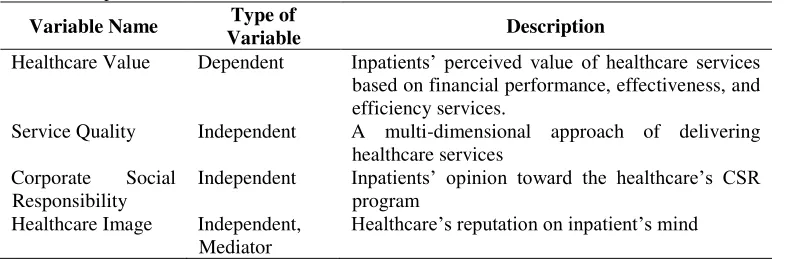
A number of 150 inpatients from three private hospital in Medan were participated in this study. The study used questionnaires to collect the inpatients’ thought related to service provided by the healthcare, hospital image, CSR program, and hospital value. The questionnaires were built based on operational variables (Table 1). The study was conducted from January to March 2017.
Table 1. Operational Variables
Variable Name Type of
Variable Description
Healthcare Value Dependent Inpatients’ perceived value of healthcare services
based on financial performance, effectiveness, and efficiency services.
Service Quality Independent A multi-dimensional approach of delivering
healthcare services
Corporate Social
Responsibility
Independent Inpatients’ opinion toward the healthcare’s CSR
program
Healthcare Image Independent,
Mediator
The data were analyzed using second-order construct analysis using SmartPLS. The study evaluated the 10-dimension of service quality to determine the service quality construct. Bootstrap analysis was used to test the significance of each path.
3.1 Model Specification
The study aimed for evaluate the construct of service quality and evaluate the factors to improve healthcare value. We proposed the path model based on our objectives (Appendix 1). We also formulated the model to improve healthcare value as follow:
(1) Where Value represent the healthcare overall perceived value, SERVQUAL represent the perceived service delivered by the healthcare, CSR represent the perceived CSR program, and IMAGE represent the healthcare reputation.
3.2 Validity and Reliability Model
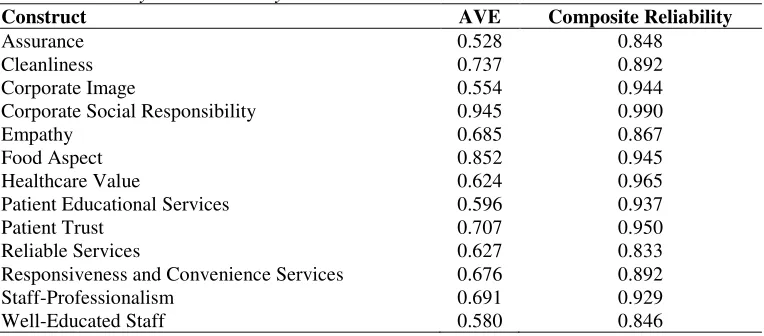
The structural model’s validity was evaluated through convergent and discriminant validity. The convergent validity model was based on each constructs’ average extracted variance (AVE) value which should be at least 0.5 (Table 2). The model’s discriminant validity was based on Fornel-Lacker Criterion (Hair et al. 2014). The model’s reliability was based on internal consistency reliability. The value of each
constructs’ composite reliability should be more than 0.7 (Table 2 and Appendix 2).
Table 2. Validity and Reliability Criteria
Construct AVE Composite Reliability
Assurance 0.528 0.848
Cleanliness 0.737 0.892
Corporate Image 0.554 0.944
Corporate Social Responsibility 0.945 0.990
Empathy 0.685 0.867
Food Aspect 0.852 0.945
Healthcare Value 0.624 0.965
Patient Educational Services 0.596 0.937
Patient Trust 0.707 0.950
Reliable Services 0.627 0.833
Responsiveness and Convenience Services 0.676 0.892
Staff-Professionalism 0.691 0.929
Well-Educated Staff 0.580 0.846
Table 2 showed that the proposed model and indicators had been fully passed the validity and reliability model and may be analyzed furthermore with the estimate analysis
3.3 Estimate Result
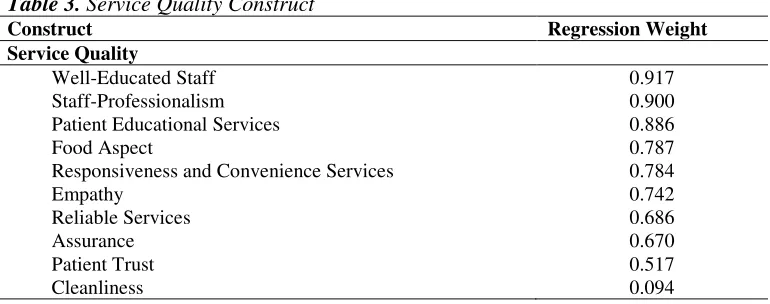
based on regression weight of each construct while explaining the service quality construct. Table 3 summarized the regression weight of service quality construct.
Table 3. Service Quality Construct
Construct Regression Weight
Responsiveness and Convenience Services 0.784
Empathy 0.742
Reliable Services 0.686
Assurance 0.670
Patient Trust 0.517
Cleanliness 0.094
Table 3 showed that the most important aspect of delivering services in healthcare industry is the staff or medical personnel. They play major role to improve service experienced by the inpatients. The medical personnel have to be well-educated and professional to their role. The other aspect was related to the food provided by hospitals. Many of current inpatients commented that the food was far from enjoyable. Based on our result, inpatients pay less attention toward hospital’s cleanliness. The second part of our study was to evaluate the value-creation based on co-creator, inpatients, point of view. The proposed model suggested hospital’s reputation as mediating variables, thus there should be direct, indirect, and total effect. Table 4 summarized the path coefficient of our proposed model.
Table 4. Direct, Indirect, and Total Effect Independent
Variable
Dependent
Variable Mediator Direct Effect Indirect Effect Total Effect
SERVQUAL
sensitive to CSR practice, the slightest act of CSR may improve corporate image. Both service quality and CSR provided 67.2% explanation of the corporate image’s variance (R-squared = 0.672). Our result showed that in order to improve hospital’s value, the hospital should pay more attention on creating reputation and delivering a good services to inpatients. CSR, however, can only indirectly improving the value through the hospital’s brand image. The most important aspect is delivering the
This paper gave a deep insight of healthcare services quality. Based on 10-aspect of services quality, most important aspect perceived by the inpatient was related to human resource. In order to deliver a better service quality, healthcare should improve their staff for both knowledge and how to care with their customers. Cleanliness did not serve as important factor for inpatients. The inpatients rather indifferent with their room’s cleanliness as long as they get a better services and happy with the staff. This paper examined the new paradigm delivering healthcare services quality, CSR program, and healthcare corporate image to create corporate value. PLS bootstrap indicated that improving healthcare corporate value could be reached by improving healthcare services and corporate images. CSR program did not directly affect corporate value. However, CSR did improve its corporate images which indirectly built the corporate value. Thus, corporate should be aware that CSR will do nothing unless public perceived it well while improving corporate image in public’s mind.
References:
Brandão, C.G. Rego, I.D. and Nunes, R. 2013. Social responsibility: A new paradigm of
hospital governance? Health Care Analysis, 21, 390–402.
Bromley, D.B, 2001. Relationships between personal and corporate reputations. European Journal of Marketing, 35, 316-334.
Day, G.S. 1990. Market-driven strategy: Processes for Creating Value. The Free Press, NY. Dolphin, R. 2004. Corporate reputation - a value creating strategy. Corporate Governance
4(3), 77-92.
Edvardsson, B.A., Gustafsson, and Roos, I. 2005. Service Portaits in Service Research: A Critical Review. International Journal of Service Industry Management, 16(1), 107-121.
Fombrun, C. 1996. Reputation: Realizing value from the corporate image. Harvard Business School Press, Boston.
Gherghina, Ş.G. Vintilă, V. 2016. Exploring the impact of corporate social responsibility policies on firm value: The case of listed companies in Romania. Economics and
Sociology, 9(1), 23–42.
Giannakopoulou, N.E., Stamatopoulos, V.T. and Thalassinos, I.E. 2016. Corporate
governance in shipping: An overview. Maritime Policy and Management, 43(1), 19-38.
Gronroos, C. and Helle, P. 2010. Adopting a service logic in manufacturing: Conceptual foundation and metrics for mutual value creation. Journal of Service Management, 21(5), 564-590.
Hair, J.F.Jr, Hult, G.T.M., Ringle, C.M. and Sarstedt, M. 2014. A Primer on Partial Least Squares Structural Equation Modeling (PLS-SEM). SAGE Publications, USA. Hapsoro, D., Suryanto, T. 2017. Consequences of Going Concern Opinion for Financial
Reports of Business Firms and Capital Markets with Auditor Reputation as a Moderation Variable: An Experimental Study. European Research Studies Journal, 20(3), 3-20.
Inleh, O., Bartlett L.J. and May, S. 2011. Corporate social responsibility and communication, in Ihlen, O., Bartlett, J.L. and May, S. (Eds). The Handbook of Communication and Corporate Social Responsibility. Chichester, Wiley-Blackwell.
Kotler, P. and Keller, L.K. 2012. Marketing Management. 14th Edition, Prentice Hall, NJ. Lubis, A.N., Lumbanraja, P., Lubis, R.R. and Hasibuan, K.B. 2016. Factor Analysis of
Healthcare Service Quality in Medan’s Governmen Hospital. Journal of Ponte,
72(10), 131-141.
Miles, M.P. and Covin, G.J. 2000. Environmental marketing: A source of reputational, competitive and financial advantage. Journal of Business Ethics, 23(3), 299-311. Parasuraman, A., Zheitmal, A.V. and Berry, L.L. 1985. SERVQUAL: A Conceptual Model
of Service Quality and its Implications for Future Research. Journal of Marketing, 49(1), 41-50.
Peña-Miguel, N., Corral-Lage, J., De La Peña Esteban, I.J. 2017. A First Approach to a
Public Financial Information System for Social Benefits. European Research Studies Journal, 20(2), 109-127.
Ringle, C.M., Wende, S. and Becker, M.J. 2015. SmartPLS 3, Boenningstedt: SmartPLS. Roonback, A.L. Witell, M. and Enquist, B. 2009. Quality Management Systems and Value
Creation. International Journal of Quality and Service Sciences, 1(3), 241-254.
Schermerhorn, J.J.R. 2016. Management, 6th Asia–Pacific Edition, Wiley, Melbourne.
Sheth, J.N. and Uslay, C. 2007. Implications of the Revised Definition of Marketing: From Exchange to Value Creation. Journal of Public Policy & Marketing, 26(2), 302-307. Srivastava, A.G. Negi, V. Mishra, and Pandey, S. 2012. Corporate social responsibility: A
case study of TATA group. Journal of Business and Management, 3(5), 17–27.
Susanto, A. 2012. The role of corporate social responsibility in enhancing corporate
reputation. Social Responsibility Review, 3, 26–33.
Tsitsakis, G., Batzios, Ch., Florou, G., Karasavvoglou, A., Polychronidou, P. 2014.
Healthcare Resources Consumed by Foreign Patients in the Public Hospitals of East Macedonia and Thrace. International Journal of Economics and Business Administration, 2(2), 119-140.
Vargo, S.L. and Lusch, F.R. 2008. Service Dominant Logic: Continuing the Evolution. Journal of the Academy of Marketing Science, 36(1), 1-10.
Appendix 1. Research’s path model