The Indonesian Journal of Southeast Asian Studies
Volume 1, Number 1, July 2017IKAT: The Indonesian Journal of Southeast Asian Studies is an academic journal about Southeast Asia. Founded in 2017 at the Center for Southeast Asian Social Studies Universitas Gadjah Mada, Yogyakarta, the journal aims to provide new, rigorous and comprehensive knowledge and understanding of the region. It has three special focuses: economic welfare, socio-cultural and political transformations, and developments in information and communication technology in Southeast Asia. We welcome critical and scholarly works in the humanities and social sciences to encourage more perspectives so that a broader horizon of important Southeast Asian issues can be discussed academically.
Editorial Team
Editor-in-ChiefAgus Suwignyo Universitas Gadjah Mada, Indonesia
Editorial Board
Bambang Purwanto Universitas Gadjah Mada, Indonesia
Tri Widodo Universitas Gadjah Mada, Indonesia
Hermin Indah Wahyuni Universitas Gadjah Mada, Indonesia Muhadi Sugiono Universitas Gadjah Mada, Indonesia
Al Makin Sunan Kalijaga State Islamic University, Indonesia
International Advisory Board
Thomas Pepinsky Cornell University, USA Okamoto Maasaki Kyoto University, Japan
David Robie Auckland Technology of University, New Zealand Juergen Rulland University of Freiburg, Germany
Judith Schlehe University of Freiburg, Germany
Thomas Hanitzsch Ludwig-Maximilians-Universität München, Germany Ariel Heryanto Monash University, Australia
Sunny Yoon Hanyang University, South Korea
Sung Kyum Cho Chungnam National University, South Korea
Managing Editor
Vissia Ita Yulianto Universitas Gadjah Mada, Indonesia Theresia Octastefani Universitas Gadjah Mada, Indonesia Andi Awaluddin Fitrah Universitas Gadjah Mada, Indonesia
Editorial Office
Center for Southeast Asian Social Studies Jl. Teknika Utara, Gedung PAU Sayap Timur. Lantai 1
Sleman - D.I. Yogyakarta - Indonesia Telp./ Fax : +62274-589658 [email protected] | [email protected]
v Undeniably a region in change, interest in Southeast Asia is growing. With this
growth comes an increase in academic works written about the region, adding to an
already impressive canon. With this background in mind, the Centre of Southeast Asian
Social Studies (CESASS) at the Universitas Gadjah Mada, Yogyakarta, Indonesia is
proud to publish IKAT: The Indonesian Journal of Southeast Asian Studies. This journal welcomes and facilitates exchange in academics and disseminates knowledge
produced through this growing interest in Southeast Asia.
The name IKAT was adopted to reflect a shared practice found in Southeast
Asia. It is derived from the word Tenun Ikat, meaning woven fabric, which is a common textile in the region. In addition, IKAT is an Indonesian word, which means to
bind, bundle, tie, or bunch. It is our hope that the publication of the IKAT Journal will
serve as a platform for those interested in Southeast Asia, binding together those with
a common geographical interest. As a means to unite the region, IKAT is open to
contributions from all disciplines. This interdisciplinarity enables us to examine and
reflect upon Southeast Asia from a plethora of perspectives, each focusing on diverse
issues.
Six articles are published in this inaugural volume. The first article takes into
consideration the uneven development in each of the ASEAN (Association of Southeast
Asian Nations) member countries. The author, Shofwan Al-Banna Choiruzza from the
Universitas Indonesia, seeks to show the challenges of ASEAN integration, which is
caught up in the contestation between globalization and localization. He characterises
ASEAN in terms of compartmentalised regionalism, arguing that while the economic
technocracy in ASEAN member countries is generally supportive of free trade, the
wider ASEAN community is moving along two separate, region-oriented trajectories,
namely economic and political security regionalism.
The second article, written by Irawan Jati from the Islamic University of
Indonesia, focuses on the specific response of ASEAN member countries and the
Organisation of Islamic Cooperation (OIC) to the Rohingnya situation in Myanmar.
Despite ASEAN’s hopeful and well-meaning attempts to tactically resolve the crisis
through peaceful means, his study acknowledges that ASEAN’s role was limited to
vi the third article focuses on radicalism in the Philippines and Thailand, as it relates to
these countries’ Muslim minority populations. Here, Bayu Mitra A. Kusuma from Sunan
Kalijaga State Islamic University, underlies the role of local government policies in
igniting the rise of radicalism in their respective country. In the case of the Philippines,
his research findings show that this regional rise of radicalism is a direct consequence
of governmental revisions to the referendum policy relating to special autonomies in a
predominantly Muslim area. In contrast, he found that radicalism in Thailand was
triggered by enacting governmental policies of cultural assimilation aimed at the Thai
Muslim minority.
Kosuke Mizuno from Kyoto University’s Centre for Southeast Asian Studies
(CSEAS) focuses his analysis on the post-Lehman shock strategies of East Asian and
Southeast Asian countries. He contends, that the basis for conflict among ASEAN
member countries is the inequality created by conventional development strategies,
which resulted in differing levels of economic growth.
The next article addresses how ASEAN responds to regional dynamics and the
resulting problems in Southeast Asia. The authors, Dian Christianti and Hermin Indah
Wahyuni from the Universitas Gadjah Mada, discuss the ASEAN Secretariat’s Adaptive
System Approach in dealing with the Dynamics of Interaction between and among
states in the region. Using Niklas Luhmann’s Theory of Autopoietic Social Systems, they
delve into the organisation of ASEAN, and through their analysis conclude that the
ASEAN community needs to be further strengthened by adopting an Adaptive
Communication Strategy.
The final article, by Jan Grawon from the University of Freiburg, Germany,
discusses the role of education as it relates to regional integration processes in
Southeast Asia. In the past, many scholars have attempted to synthesize interrelated
issues in these regions. Through the lens of Neofunctional and Norm Diffusion
Approaches, his findings show that ASEAN members’ major interest concerning
ASEAN-EUcooperation in educationlies in enhancing economic performances through
strengthening the education sector rather than just emphasizing the education sector
itself.
This collection of six articles written by specialists from different disciplinary
vii journal, along with all future editions, may contribute new knowledges and rigorous
studies about this ever-changing region to the interdisciplinary realm of Southeast
Asia Studies.
Yogyakarta, July 7, 2017
ix
IKAT
The Indonesian Journal of Southeast Asian Studies
Volume 1, Number 1, July 2017
Contents
Editorial Foreword v
ASEAN in the Age of Anti-Globalization: Compartmentalized Regionalism(s) and Three Trajectories
1
Shofwan Al Banna Choiruzzad
Comparative Study of the Roles of ASEAN and the Organization of Islamic Cooperation in Responding to the Rohingya Crisis
17
Irawan Jati
Islam, Asymmetric Policy, and Social Conflicts: The State’s Role as a Root of Radicalism in the Philippines and Thailand
33
Bayu Mitra A. Kusuma
The East Asian Economy Post-rebalancing: Domestic Demand-led Growth, Social Security, and Inequality
47
Kosuke Mizuno
Adaptive Organizational Communication of ASEAN from an Autopoietic Systems Perspective
69
Dian Christianti, Hermin Indah Wahyuni
ISSN 2580-6580
1
ASEAN in the Age of Anti-Globalization: Compartmentalized
Regionalism(s) and Three Trajectories
Shofwan Al Banna Choiruzzad1
Abstract
This essay attempts to examine the prospect of ASEAN integration in the age of anti-globalization by understanding ASEAN as a compartmentalized regionalism. It argues that discussions on the prospect of ASEAN are actually discussions on the trajectories of two separate regional projects: economic regionalism and political security regionalism. It must be noted that we often have difficulties separating the two because their evolution has so far been marked by centripetal movement towards liberal tradition in the two regional projects. However, since we are entering the age of anti-globalization, this is changing. To make an educated guess on the future of ASEAN regionalism(s), I argue that we should focus our attention to three main indicators: (1) Structural: will the international system be cooperative or competitive multipolar system? (2) National elite orientation: will the liberal elites and technocracy in ASEAN countries remain liberal, or will nationalist elites take charge?; and (3) Public sentiment: how big is the positive or negative sentiment towards economic liberalization?
Keywords: Regionalism, ASEAN, Compartmentalized Regionalism
1 Lecturer at the Department of International Relations, Faculty of Social and Political Sciences, Universitas
2
Introduction: The Age of Anti-Globalization and ASEAN
"Fifteen years ago, I wrote a little book, entitled 'Globalization and its Discontents', describing growing opposition in the developing world to globalizing reforms… Now, globalization's opponents in the emerging markets and developing countries have been joined by tens of millions in the advanced countries" (Stiglitz, 2016).
Donald Trump's victory in the United States presidential election is just one
symptom of the turbulent age that we are now facing. Today, the world is marked by
the emergence of Daesh (ISIS); the rise of right-wing leaders such as Geert Wilders, Le
Pen, and Donald Trump; growing tension in the Asia Pacific region; and the stagnation
of the European integration project. European regionalism, seen as irreversible for
decades, now faces a serious challenge. Talks about European disintegration have
begun to appear in the discussions of policymakers and academics (Schmitter &
Lefkofridi, 2016; Legrain, 2016). However, their pessimism has not affected ASEAN
leaders. On the organization's 49th anniversary, ASEAN leaders seem continuously
optimistic about the future of the ASEAN integration project. The ASEAN Community
Vision 2025, adopted by ASEAN leaders in Kuala Lumpur last year, declared that
ASEAN leaders are resolved to "consolidate our community, building upon and
deepening the integration process."
Is such optimism justified? This essay attempts to look at the prospect of ASEAN
integration in the age of anti-globalization by understanding ASEAN as a
compartmentalized regionalism: "political project to reorganize a particular regional
space along defined economic and political lines, which actually consists of multiple
and separated/compartmentalized kinds of arrangements of the regional space(s) but
identified as a single project."2 In simple words, compartmentalized regionalism is
"multiple regionalisms in one particular regional space under one name". (Choiruzzad,
2016). It argues that discussions on the prospect of ASEAN are actually discussions on
the trajectories of two separate regional projects: economic regionalism and political
security regionalism. It must be noted that we often have difficulty separating the two
because their evolution has so far been marked by centripetal movement towards
2 The definition is built upon Anthony Payne and Andrew Gamble's definition of regionalism. It will be
3 liberal tradition in the two regional projects. However, as we are entering an age of
anti-globalization, this is changing. To make an educated guess on the future of ASEAN
regionalism(s), I argue that we should focus our attention on three main indicators: (1)
Structural: will the international system be cooperative or competitive multipolar
system? (2) National elite orientation: will the liberal elites and technocracy in ASEAN
countries remain liberal, or will nationalist elites take charge?; and (3) Public
sentiment: how big is the positive or negative sentiment towards economic
liberalization?
Literature Studies: Regionalism and Globalization3
Conceptual Definition
Before further discussion, it is important to clarify what this paper means by
regionalism and how it is related to other commonly used concepts such as
'regionalization' and 'regional cooperation.' However, it must be acknowledged that
these concepts may be understood differently by different scholars. This clarification
of the concepts thus serves more as an attempt to explain the position of this paper
rather than an intellectual exercise to determine which definition is correct/incorrect
or to elaborate the details of the conceptual debates (for conceptual debates, see
Hettne, 2005), both of which are beyond the scope of this paper. This paper
understands regionalism as the "political project to reorganize a particular regional
space along defined economic and political lines". This definition is based on Anthony
Payne and Andrew Gamble's definition of regionalism as a "state-led or states-led
project designed to reorganize a particular regional space along defined economic and
political lines" (Payne & Gamble, 1996, p. 2) but acknowledges that states are not the
only actors involved as drivers in such a process.
Some scholars use the concept of regionalism interchangeably with
regionalization (Baldwin, 2007), while some others differentiate the two. Those who
distinguish between the two concepts differ in explaining why the two concepts are
different. Some scholars distinguish the concept by understanding 'regionalism' as a
top down process (mainly driven by political authority, i.e. state) and 'regionalization'
3 Parts of sections 2 and 3 are developed from my presentation at AUN-KASEAS International
4
as a more bottom up process (sprang from the need for transnational relations due to
economic interdependency). Others see the relationship between 'regionalism' and
'regionalization' as similar to that between 'nationalism' and 'nation building'
(Camroux in Dieter, 2007). This paper sees that the two as distinct concepts, with
regionalism referring to "a political project to reorganize a particular regional space" and regionalization referring to a "process of forming regions that can emerge both by being planned (i.e.: a political project) or by spontaneous development" (developed
from Hettne, 2005, p. 546). With these definitions, both concepts are distinct, but may
be used interchangeably in some particular contexts. All regionalisms are
regionalization, but not all regionalization can be understood as regionalism (because
not all regionalization processes are planned consciously as political projects).
Regional cooperation, on the other hand, is a wider and more general concept
that can be understood as referring to any kind of joint efforts by states to solve a
specific problem. In Ernst Haas' classical definition, regional cooperation is "a vague
term covering any interstate activity with less than universal participation designed to
meet commonly experienced need" (Haas, 1970, p. 610). With the above mentioned
conceptual understanding, this paper deliberately uses the term 'regionalism', as
ASEAN is clearly a political project.
Regionalism and Globalization
Studies in regionalism began in the 1950s, responding to development in
post-World War II Europe. These early studies on regionalism, first intended to understand
and prescribe a strategy for European regional integration but later spread to study
other regional projects elsewhere, is often considered 'Old Regionalism'.
Old regionalism approaches are often also considered 'political programs', since
they also serve as prescriptions for regional integration. Federalism, an early approach
to study regionalism that was very influential among the pioneers of European
integration, advocated for the retreat of the nation-state and the formation of a new
form of political structure that integrated existing nation-states. The impetus for this
argument was the European experience of devastating world wars and the drive to
ensure peace in the region. This argument was later criticized by functionalism, often
associated with David Mitrany, which argued that function is more important than
5 organization) must be established based on 'function', i.e. cooperation and activities
around functional needs such as trade, production, welfare, and transportation
(Hettne, 2005, p. 546).
Later, functionalists were criticized by neo-functionalists such as Ernst Haas,
who disputed functionalists' neglect of politics and argued that those 'functions' are
not merely technical but also political (Hettne, 2005, p. 546). Integration, they argued,
is not driven by 'functional automaticity', but by process and the existence of
purposeful actors. According to neo-functionalists, increasing levels of
interdependence would initiate a process that would lead to political integration. One
important mechanism related to this argument is 'spillover', which is "the way in which
the creation and deepening of integration in one economic sector would create
pressures for further economic integration within and beyond that sector and greater
authoritative capacity at the European level" (Hettne, 2005, p. 546).4 Based on this
idea, Bela Balassa developed the influential concept that regional integration should
occur in five stages: free trade area will lead to customs union, customs union will lead
to common market, common market will lead to economic and monetary union, and
finally economic and monetary union will lead to political union (Balassa, 1961;
Balassa in Eatwell et al., 1987, pp. 43–47). It must be noted that, despite being
published in 1960s and thus potentially labeled 'Old Regionalism', Balassa's concept
remains influential in shaping our understanding (and the strategy of policymakers)
even today (Dieter, 2000, pp. 7–8).
Despite the internal debates within 'Old Regionalism', its approaches generally
consider regionalism to be a linear and relatively mono-dimensional process. Linear
means that the process follows a particular trajectory. This does not mean that it
necessarily runs in the single direction of progress, since the process can stagnate or
even regress. It means that the stages (explicitly mentioned as in Balassa's concept or
implicitly assumed) are connected as a series of milestones. Mono-dimensional refers
to the tendency to see regionalism as something that happens in one or at least a
'unified' dimension (e.g. security or economy).
4 The use of 'European' here is understandable because Old Regionalism mostly focuses on Europe,
6
This first wave of regionalism studies was halted with the so-called
'Eurosclerosis' and the stagnation of attempts for regional integration elsewhere in in
the 1970s. A new wave of regionalism studies that started in the 1980s was related to
the phenomenon of globalization. This new wave of studies is often identified as 'New
Regionalism.' However, some scholars have advocated for transcending this division
of old and new regionalisms (Hettne, 2005; Hettne & Soderbaum in Cooper et al.,
2008).
'New Regionalism' approaches differ from their 'Old' counterpart by
acknowledging the diversity of regionalisms. According to Andrew Hurrel, five
distinguishing factors differentiate 'New Regionalism' from 'Old Regionalism': (1) New
Regionalism in very diverse, being comprised of a range of models/structures/
processes of region-building rather than a single norm; (2) New Regionalism can
involve partnerships between developed and developing countries; (3) New
Regionalism varies in the level of institutionalization, in contrast to Old Regionalism's
very formal understanding of region building; (4) New Regionalism is
multi-dimensional and blurs the distinction between the economic and the political; and (5)
New Regionalism reflects, shapes, and requires the development of a regional sense of
identity (Hurrel, 1995). According to Hettne and Soderbaum, 'New Regionalism'
considered new aspects related to the phenomenon of globalization. They also argue
that New Regionalism focused on concepts of 'regionalism' and 'regionalization' (in
contrast to the concepts of 'regional integration' and 'regional cooperation' preferred
by earlier studies of regionalism), because those concepts are considered more
appropriate for capturing the multidimensional features of contemporary regionalism
(Hettne & Soderbaum in Cooper et al., 2008).
It is also important to note that this distinction of old and new regionalisms does
not only apply in a theoretical sense, but also in an empirical sense, as the terms do not
only refer to approaches of studying regionalism but also to the regionalism projects
themselves. Some regional organizations are considered 'old regionalism' (mostly
those established during the Cold War, especially in the 1950s–1970s) and others,
especially those effectively established after the 1980s, are considered 'new
regionalism.' According to Hettne, 'old regionalism' was a "Cold War phenomenon" and
had specific objectives (some security-motivated while others more economically
7 multidimensional societal process" (Hettne, 2005, p. 549). In this sense, it is interesting
to note that ASEAN was established in 1967, with a strong Cold War context, but new
elements of the regional project were established in 1990s. This situation has often
created confusion for observers, because ASEAN could be considered both 'old' and
'new' regionalism.
If we look at political and security issues, ASEAN meets the description of old
regionalism due to its Cold War origins and the continuing importance of the member
states. However, this cannot capture the development of many features of ASEAN
regionalism after the 1990s, which transcend a single specific dimension. Some would
argue that ASEAN is closer to 'new regionalism' because it is considered
'comprehensive and multidimensional' (referring to the existence of three equal pillars
of ASEAN Community). However, 'comprehensive and multidimensional' assumes
integrality of dimensions, indicated by the existence of unified patterns/rules of
arrangement, similar proponents, and a single particular logic on which the regional
project operates. This might not be sufficient to explain the frequent disconnection
between the economic, security, and socio-cultural 'pillars' of ASEAN and the focal
point agencies of each pillar in each country.
Compartmentalized Regionalism
"Today, power in the world is distributed in a pattern that resembles a complex three-dimensional game" (Nye, 2011).
The limitations of 'Old' and 'New' regionalisms in capturing the abovementioned
complexity of ASEAN regionalism demand a more creative approach. To fill this
demand, this paper aims to explore the idea of 'compartmentalized regionalism'. This
concept argues that ASEAN is a 'political project' composed of at least two different
'political projects' with distinct arrangements, proponents, and logics that are separate
but identified politically as a single integrated project.
Joseph Nye's analogy of multidimensional chessboards is relevant in the case of
ASEAN regionalism. Furthermore, I believe that actors are not only playing on multiple
chessboards simultaneously, but playing different board games with different rules on
8
creates authority in economics, politics, security, agriculture, environment, as well as
some other sectors, in an integrated process based on a coherent arrangement and
operating on a particular logic. In the context of the European Union, this logic is
"liberal prescription for the conduct of international politics" (Walt, 2015). ASEAN is not only multi-dimensional, because some of the dimensions have arrangements,
proponents, and logics that are distinguishable from each other. The dimensions in
European regionalism may be chessboards, but the dimensions in ASEAN regionalisms
are different board games.
In this paper, I would like to propose that ASEAN regionalism is driven by
separated regional projects. ASEAN is a 'political project' composed of at least two
different 'political projects'. One is in the political security dimension (in recent
developments, manifested in the ASEAN Community in the ASEAN Political Security
Community pillar) and the other one is in the economic dimension (manifested in the
ASEAN Economic Community pillar). The two have distinguishable arrangements,
proponents, and logics that are separate but identified politically as a single integrated
project. Thus, I would like to propose the use of the term 'compartmentalized
regionalism'.
One symptom of this 'compartmentalized regionalism' is the partial and limited
leadership in ASEAN. For example, Emmers observed that Indonesia's leadership has
so far been limited to the political and security spheres and left other sectors to others
(Emmers, 2014). If we use the framework of compartmentalized regionalism, this is
not merely a problem of partial, sectorial, incomplete, or limited leadership in a
particular state in ASEAN. It is related to the fact that economic and political security
are not merely 'sectors' of ASEAN regionalism, but two distinct regionalisms despite
being identified under the single flag of ASEAN. Below, this paper elaborates the
distinct arrangement, proponents, and logics that can be used to distinguish between
the two regionalism projects under the name of ASEAN regionalism.
Distinct Arrangements
One visible distinction between the two 'compartments' is that they have
different arrangements in organizing the regional space. In the political security
compartment, sovereignty and non-interference remain sacred and act as the basic
9 sovereignty, equality, territorial integrity, and national identity of all ASEAN Member
States" is included in the Charter as the first principle of ASEAN. This is apparently not
enough, as another principle to guarantee Member States' sovereignty appears in point
(k) "Abstention from participation in any policy or activity, including the use of its
territory, pursued by any ASEAN Member State or non-ASEAN State or any non-State
actor, which threatens the sovereignty, territorial integrity or political and economic
stability of ASEAN Member States". The principle of non-interference is mentioned in
point (e) "non-interference in the internal affairs of ASEAN Member States" and (f)
"respect for the right of every Member State to lead its national existence free from
external interference, subversion and coercion".
It is interesting to note that, while the ASEAN Political and Security Community
Blueprint emphasizes the importance of the principles contained in the ASEAN Charter
("The APSC Blueprint is guided by the ASEAN Charter and the principles and purposes
contained therein"), the ASEAN Economic Community Blueprint directly mentions that
"the Leaders agreed to hasten the establishment of the ASEAN Economic Community
by 2015 and to transform ASEAN into a region with free movement of goods, services,
investment, skilled labour, and freer flow of capital". The AEC Blueprint does not refer
specifically to the principles in the ASEAN Charter, but mentions that "ASEAN shall act
in accordance to the principles of an open, outward-looking, inclusive, and
market-driven economy consistent with multilateral rules as well as adherence to rules-based
systems for effective compliance and implementation of economic commitments". This
is, of course, in line with Article 2 Paragraph 2 point (n) of the ASEAN Charter, but with
additional words (rather than being solely market driven as in the Charter, additional
characteristics are explicitly added: open, outward-looking, and inclusive). Of course,
one can argue that this is only a trivial matter of document structure. However, this
shows that the two compartments actually have different principles in organizing
regional space.
In the 'political security compartment,' sovereignty and non-interference are
generally considered as non-negotiable. Thus, ASEAN observers are pessimistic about
the possibility of functioning human rights institutions under ASEAN or about the
prospect of ASEAN's democratization agenda (Kvanvig, 2008; Dosch, 2008, pp.
527-545). However, in the economic compartment, it seems that sovereignty can, and even
10
Blueprint emphasizes that ASEAN Member Countries shall adhere to "rules-based
systems for effective compliance and implementation of economic commitments". To
comply and implement economic commitment, one must compromise at least part of
its sovereignty.
As already mentioned, one symptom of 'compartmentalized regionalism' is the
partial and limited leadership in ASEAN. This is also an indicator that the
'compartments' are driven by different champions with different motivations. The
political security regionalism/compartment was formed and initiated by ASEAN
Member States during the Cold War. It is in this context that the principle of
non-interference was outlined as the ASEAN principle, as mentioned in the Bangkok
Declaration. From the 1960s to the 1980s, ASEAN successfully managed to prevent
large conflict and provide regional stability. This is an important achievement if we
compare ASEAN with other regions that were devastated by conflicts spurred by the
interference of competing blocs. Thus, states played a very important role in the
shaping of regional cooperation in security. This has continued after the end of the Cold
War and the rise of China that set new geopolitical complexity in the region. However,
states continue to act similarly, with their own national interests acting as their guiding
lights. In this compartment, countries with large size and huge strategic interests such
as Indonesia act as sectorial leaders. It must be noted that, despite the existence of the
non-interference principle, external powers such as US, Japan, and China are also
competing for influence in shaping the regional security architecture.
The economic regionalism/compartment was initiated by different proponents.
Some scholars argue that ASEAN regionalism (in the context of this paper, the
'economic regionalism' part) has been largely driven by the private sector, especially
by the activities of the Japanese Multinational Corporations (MNCs) and overseas
Chinese businesses, while states have only played secondary and reactive roles
(Stubbs, 1995, pp. 785–797). This has changed since the Asian Crisis of 1997/1998,
which spurred the emergence of a more active role of states in shaping the regional
project (Bowles, 2002, pp. 244–270). In this compartment, Singapore plays a
significant role, and external economic powers such as Japan and China act as
important proponents. For example, Japan helped establish and sustain ERIA
(Economic Research Institute for ASEAN and East Asia), a think tank that is very
11 Domestically, the separation between the two compartments is also visible.
Different focal points (especially Ministry of Foreign Affairs and Ministry of Defense vs.
Ministry of Trade) often have different ideas of ASEAN and how it should interact with
external powers. However, these differences are not becoming a problem because they
have their own 'compartments' that are institutionalized through ASEAN mechanisms.
Distinct Logics
Lastly, the two compartments are different because they operate based on
different logics. The difference in the regional arrangement and its proponents are
strongly correlated to the difference in the ideological perspective that serves as the
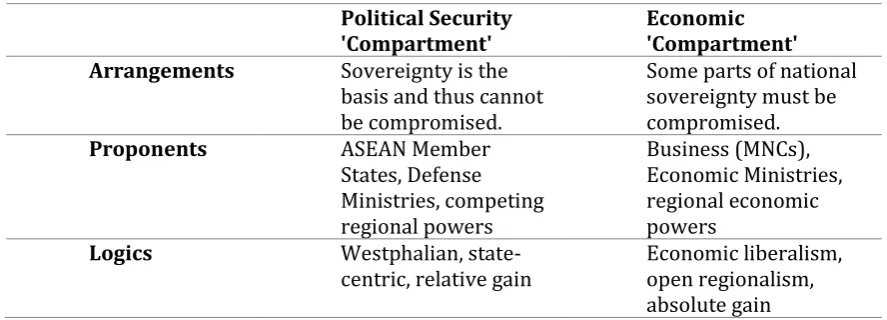
basis of the regional project. The political security compartment operates on a
Westphalian logic that stresses the importance of the state and territoriality, while the
economic compartment relies on the insights of the technocrats that believe in
economic liberalism. The former is concerned with relative gain, while the latter is
concerned mostly with absolute gain.
To sum up, the differences that separate the two compartments can be outlined
as follows:
Table 1. The Different Features of Political Security and Economic Compartments of ASEAN Regionalism
Based on the understanding of ASEAN as compartmentalized regionalism,
discussion of the prospect of ASEAN is actually on the trajectories of two separate
12
Nevertheless, it must be noted that we often have difficulty separating the two because
their evolution has so far been marked by centripetal movement towards liberalization
in the two regional projects.
In the economic compartment, the move toward a more liberal tendency is
evident in itself, since economic liberalism is the driving idea of the economic
regionalism project. As such, every progress in regional economic integration is in
itself a move toward liberalism. In the political compartment, despite the stubborn
persistence of Westphalian notions of sovereignty and non-interference, ASEAN is
constantly moving towards a more liberal arrangement (Kurniawan, 2015, pp. 4–6).
In the beginning, ASEAN member states preserved security in the region by
declaring their commitment towards principles of national sovereignty and
non-interference to end regional inter-state violent political conflicts. This means that
ASEAN countries were following realist tradition, as they recognized the anarchic
nature of the international system. Later, this situation gradually changed with the
introduction of regional codes of conduct such as Zone of Peace, Freedom, and
Neutrality (ZOFPAN); the Treaty of Amity and Cooperation (TAC); and the Southeast
Asia Nuclear-Weapon-Free Zone (SANWFZ). The move toward a more liberal
arrangement became faster with the end of the Cold War and was marked by the
establishment of the ASEAN Regional Forum (ARF) in 1994, which was intended to
engage major powers in East Asia and beyond in a cooperative security mechanism.
The establishment of ARF, with its assumption that it should be able to evolve as a
"community of law security system" in the long run (Navari in Williams, 2008, p. 42;
Kurniawan, 2015), indicates a further step towards liberal ideas of maintaining
security. The latest milestone in the shift towards liberalism is the establishment of the
ASEAN Political Security community (APSC) as one of the pillars of the ASEAN
Community. Under the APSC, ASEAN leaders envision a secure Southeast Asia with
three key characteristics: (1) a rules-based community of shared values and norms;
(2) a cohesive, peaceful, stable, and resilient region with shared responsibility for
comprehensive security; and (3) a dynamic and outward-looking region in an
increasingly integrated and interdependent world (APSC Blueprint Report 2009).
What explains this constant shift towards a more liberal orientation and the
creation of a pathway for unifying the two regional projects? The first is structural, i.e.
13 from a bipolar to unipolar international system with liberalism as the triumphant
ideology. The second factor is elite orientation. After their independence in the mid-
20th century, most countries in South East Asia in the 1980s began to have their own
groups of technocrats and elites with a liberal orientation. This is related to the growth
of post-independence generations; education orientation, mostly toward Western
universities; and the elimination of leftist groups, seen by many South East Asian
regimes as domestic threats, at the height of the Cold War. The third is the public
sentiment that generally expect the world to become more integrated after the lengthy
tensions of the Cold War.
However, with the upcoming age of anti-globalization, changes are occurring to
these three factors. Based on this assessment, what are the possible trajectories of
ASEAN regionalism, i.e. the two regional projects? Will the centripetal move towards a
liberal tradition (and thus integrate the compartments into a more European
Union-like multidimensional arrangement) continue (Scenario 1)? Or will reversals happen?
If reversals occur, will there be a return to two separated regional arrangements
(realist regional political and security order and continuing liberalization of regional
economic arrangement, Scenario 2)? Or, will the conflation of the economic and
political compartments, driven by competitive Great Power politics, leads to the
collapse of ASEAN (Scenario 3)?
To make an educated guess on the future of ASEAN regionalism(s), I argue that
we should focus our attention to three main indicators: (1) Structural: will the
international system be cooperative or competitive multipolar system? (2) National
elite orientation: Will the liberal elites and technocracy in ASEAN countries remain
liberal, or will nationalist elites take charge?; and (3) Public sentiment: How big is the
positive or negative sentiment towards economic liberalization? The three possible
scenarios are outlined in the table below.
14
For now, it is too early to judge the fate of ASEAN. Things are changing, certainly.
On the structural dimension, most observers agree that the region, and even the world,
is shifting towards a multipolar structure. Nevertheless, it is difficult to define the
dynamics of great power rivalry in the region between China, Japan, and the United
States as cooperative or competitive in clear-cut manner.
Competition does characterize the relationship between China and Japan, as seen
in the competition of the Asia Plus Three (APT) that limits is membership to ASEAN+3
countries and the East Asia Summit (EAS) which includes Australia, New Zealand,
India, the United States, and Russia. Competition is also evident in the establishment
of China-led Asia Infrastructure Investment Bank vis a vis existing institutions led by Japan (Asia Development Bank) and the United States (the World Bank) and the
introduction of the One Belt One Road (OBOR) initiative vis a vis Japan's Partnership for Quality Infrastructure introduced by Prime Minister Abe in May 2015. However,
Japan and China do cooperate in many ASEAN-based frameworks, including in the
development of the Greater Mekong Sub-region.
On the aspects of national elite orientation and public sentiment, the rise of
anti-globalization sentiment, as illustrated by the rise of Trump and his policies, will pose
challenges against the generally liberal elite and technocracy of the current ASEAN
governments. Nationalist sentiments do appear more expressively in ASEAN member
countries' politics, such as during Indonesia's presidential campaign (despite the fact
that, after the election, economic policies have generally remained in the liberal
precepts) and Malaysian political bickering. So far, the economic technocracy of ASEAN
countries remains generally supportive of free trade. However, changes often happen
15 For now, the most probable scenario is the status quo: that the ASEAN economic
regionalism and ASEAN's political security regionalism will remain separated, despite
being under the single banner of the ASEAN Community. In the economic realm,
economic integration will continue, albeit slowly. In the political security realm, the
gradual shift toward liberal precepts will be reversed. Nevertheless, predictions are
predictions, and no single academic work can guarantee the accuracy of its predictions.
We will have to wait for the future to unravel itself.
References
ASEAN Secretariat. (2009). ASEAN Economic Community Blueprint. Jakarta: ASEAN Secretariat.
__________. (2009). ASEAN Political Security Community Blueprint. Jakarta: ASEAN Secretariat.
__________. (2009). ASEAN Socio-Cultural Community Blueprint. Jakarta: ASEAN Secretariat.
Balassa, B. (1961). The Theory of Economic Integration. Illinois: Richard Irwin.
Baldwin, R. (2007). Managing the Noodle Bowl: The Fragility of East Asian
Regionalism. CEPR Discussion Paper Series, 5561, 2007.
Bowles, P. (2002). Asia's Post-Crisis Regionalism: Bringing the State Back In, Keeping
the United States Out. Review of International Political Economy, 9(2), 244–270. Choiruzzad, S. A. (2016, August 26–27). Centrality or Centralities? Understanding
ASEAN as Compartmentalized Regionalism. Paper presented at AUN-KASEAS International Conference, Seoul.
Cooper, A. F., Hughes, C. W., & De Lombaerde, P. (Eds.). (2008). Regionalisation and Global Governance: The Taming of Globalisation? New York: Routledge.
Dieter, H. (2000). Monetary Regionalism: Regional Integration without Financial
Crises. CSGR Working Paper, 52/00, May 2000.
Dieter, H. (Ed.). (2007).The Evolution of Regionalism in Asia. New York: Routledge. Dosch, J. (2008). ASEAN's Reluctant Liberal Turn and the Thorny Road to Democracy
Promotion. The Pacific Review, 21(4), 527–545.
16
Emmers, R. (2014). Indonesia's Role in ASEAN: A Case of Incomplete and Sectorial
Leadership. The Pacific Review, 27(4).
Haas, E. B. (1970). The Study of Regional Integration: Reflections on the Joy and
Anguish of Pretheorizing. International Organization, 24(4).
Hettne, B. (2005). Beyond the 'New' Regionalism. New Political Economy, 10(4), 543– 570.
Hurrel, A. (1995). Explaining the Resurgence of Regionalism in World Politics, Review of International Studies, 21, 331–358.
Kurniawan, Y. (2015). Liberalizing ASEAN Security Architecture. ASEAN Insights. March 2015.
Kvanvig, G. (2008). ASEAN, Sovereignty and Human Rights. Retrieved from
http://www.jus.uio.no/smr/english/about/programmes/vietnam/docs/asean-sovereignty-and-human-rights---gisle-kvanvig.pdf.
Legrain, P. (2016). Three Paths to European Disintegration. Retrieved from
https://www.project-syndicate.org/commentary/brexit-european-union-disintegration-by-philippe-legrain-2016-08?barrier=accessreg
Nye Jr., J. S. (2011). The Future of Power. New York: Public Affairs.
Payne, A., & Gamble, A. (Eds.). (1996). Regionalism and World Order. New York: McMillan.
Schmitter, P. C., & Lefkofridi Z. (2016). Neofunctionalism as a Theory of Disintegration.
Chinese Political Science Review, 1(1).
Stiglitz, J. E. (2016). Globalization and Its New Discontents. Retrieved from
https://www.project-syndicate.org/commentary/globalization-new-discontents-by-joseph-e--stiglitz-2016-08?barrier=true
Stubbs, R. (1995). Asia-Pacific Regionalization and the Global Economy: A Third Form
of Capitalism. Asian Survey, 35(9), 785–797.
Walt, S. M. (2015). Back to the Future: World Politics Edition. Foreign Policy, July. Retrieved from
http://foreignpolicy.com/2015/07/08/back-to-the-future-world-politics-edition-russia-isis-europe-china/
ISSN 2580-6580
17
ComparativeStudy of the Roles of ASEAN and the Organization of Islamic Cooperation in Responding to the Rohingya Crisis
Irawan Jati1
Abstract
Since 2012, Southeast Asia has witnessed the human rights tragedy of the Rohingya people of Myanmar. Hundreds of thousands of Rohingya have been displaced from their homes and traveled to refugee facilities in Myanmar and Bangladesh, while others have been stranded on the Andaman Sea. The Rohingya crisis is perhaps the most horrific human rights tragedy after the crisis in Vietnam in the 1970s. As the crisis has developed, international communities, including ASEAN and the Organization of Islamic Cooperation (OIC), have responded to the crisis. As the main regional organization, ASEAN has been hoped to elucidate the crisis tactically through peaceful means. OIC, meanwhile, has been expected to join humanitarian action using a diplomatic approach to other international humanitarian bodies, including the UNHCR. However, it is obvious that ASEAN's response to the crisis has been limited to diplomatic oration and failed to prevent a wider crisis. For OIC, its humanitarian solidarity has lacked access to the target community. Therefore, this paper would like to attempt a comparative analysis to describe the central inquiry; how have ASEAN and OIC responded to the Rohingya crisis? This analysis involves studying ASEAN and OIC publications and related references. The initial argument of this paper is that both organizations have given reasonable responses to the crisis, but have been unable to halt its advance.
Keywords: ASEAN, Human Rights, OIC, Refugee, Rohingya
1 Lecturer and Head of the International Relations Program, Faculty of Psychology and Socio-Cultural
Sciences, Islamic University of Indonesia, Yogyakarta. The paper was presented at the 1st International
18
Introduction
Since 1991, the plight of the Rohingya has gained global attention through
articles in the media. These people have been identified as unfortunate people facing
pressure from their own government, that of Myanmar. Early in the 1960s, the
Rohingya had made a sea journey to neighboring countries to save their lives and to
find better places to live. Unfortunately, the crisis has escalated severely since 2012.
Some 120,000 Rohingya have taken the journey over Andaman Sea. This is a real-life
tragedy in ASEAN's back yard. However, ASEAN's response to the crisis has been far
from sufficient, particularly compared to those of the Organization of Islamic
Cooperation (OIC). OIC's international efforts have included establishing fact-finding
missions and providing humanitarian assistance to Rohingya. Unfortunately,
international efforts to reduce the suffering of the Rohingya people have mostly been
limited to rhetoric and had a limited impact (Southwick, 2015).
The Rohingya are 'forced' to take a long and dangerous journey. They cross
jungles and sail the Andaman Sea to reach neighboring states. The push factor for this
irregular migration is the threat of persecution, either by the Buddhist majority or by
the government of Myanmar. The pull factor is the potential to find a more conducive
environment and better job opportunities in other countries, such as Malaysia and
Thailand. However, only a few of these people are able to arrive at their desired
destinations. Most are stranded, or even drown, at sea. Early in 2015, some two
thousand Rohingya were stranded on the Andaman Sea near the Indonesian border.
Larger groups were sailing towards Malaysia and Thailand. Initially, the Indonesian,
Malaysian, and Thai governments denied these people entrance into their territory.
However, after pressure from national and international communities, they agreed to
welcome Rohingya refugees. This decision was made during a three party meeting in
Malaysia.
The three party, involving Indonesia, Malaysia, and Thailand, resulted in a
temporary solution: the Rohingya could be settled for a period of one year. During the
crisis, some ASEAN partners did not show much support. China and India looked
else-where, while Australia faced allegations of paying people smugglers to send the
Rohingya back to Indonesian waters. Meanwhile, the Myanmar government has yet to
change its political and legal stance, which undermines the Rohingya as a people. At
19 with the Rohingya but still keeps them in camps (Graham, 2015). For the Myanmar
government, even the word Rohingya is taboo; they term the group "Bengalis" and
solely consider them stateless Bengalis (Hukil & Shaunik, 2013).
The Rohingya crisis is a real test of ASEAN's commitment to protect its people,
as declared in its Charter and declaration of human rights. Unfortunately, ASEAN has
made little effort to address the crisis. At the diplomatic level, ASEAN lacks the
confidence to address the Rohingya crisis, instead relying on diplomatic rhetoric.
Another international organization has shown greater concern for this case: the
Organization of Islamic Cooperation (OIC), whose concerns are related to the fact that
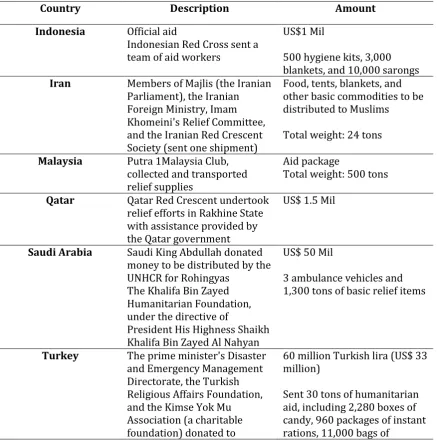
the Rohingya are Muslim. OIC's response to the crisis has included delivering
humanitarian assistance, using a diplomatic approach with international
organizations such as the United Nations (UN), and establishing a fact-finding group
to collect factual information on the root of the crisis. This article, therefore, tries to
discuss the question of how ASEAN and OIC have responded to the Rohingya crisis.
Literature Review
Numerous articles discuss the Rohingya case, particularly ASEAN's involvement,
from different perspectives. Many of these articles critique ASEAN as the primary
regional organization in Southeast Asia. The critiques mostly focus on ASEAN's
non-intervention principle, which is depicted as the main source of the organization's
weakness in solving humanitarian crises in the region (Arendshorst, 2009; Goh, 2002;
Jones, 2009; Othman & Othman, 2010; Singh, 2014). The non-intervention principle
has become both a strength and weakness of ASEAN in advancing its cooperation. On
the other hand, ASEAN's policy on Myanmar is usually depicted as one of 'constructive
engagement' (Vinh, 2014). This policy implies that ASEAN takes a positive attitude
towards non-democratic countries such as Myanmar. The accession of Myanmar,
Vietnam, and Cambodia is the result of this constructive engagement policy.
An effort to compare ASEAN's response to refugee crises with that of other
organizations has been made by Alistair Cook, who compares ASEAN's stance towards
refugee issues with that of the European Union. Based on his study, he concludes that
both ASEAN and EU approaches have no "significant impact" to changing regime
20
approach, the European Union tends to use a 'carrot and stick' or sanction approach
in dealing with Myanmar (Balossi-restelli, 2015; Jom & Sidhu, 2015).
The OIC, meanwhile, has used a 'humanitarian' approach towards Myanmar. The
organization's transforming role in humanitarian assistance has been well researched
in the Humanitarian Policy Group's Working Paper (Svoboda, Zyck, Osman, & Hashi,
2015). Unfortunately, OIC's capability to solve conflict is still lacking. The recent case
in Yemen is one example of OIC's 'failure' in settling the problem (Qadir & Rehman,
2015). However, research on OIC's policies or politics remains rare. Therefore, this
research finds its significance in contributing to research on OIC politics.
Research Method
This study is based on qualitative analysis of both ASEAN and OIC's responses to
the Rohingya crisis. The study applies a comparative politics method. The focus of this
study is the diplomatic responses to the crisis and practical humanitarian assistance
of ASEAN and OIC. This research also uses a literature study for research. The general
procedures of this research consist of three main phases: (1) Pre-Research: Most of
the activities during this phase are related to the preparation process, including
research planning and administrative works; (2) Data Collection: Since the research
employs a literature study, all data collected in this research is categorized as
secondary data. In collecting data, the researcher utilized digital data, particularly
electronic journals, online articles, and selected news resources; and (3) Data
Analysis: To obtain research results, the collected data must be analyzed, first by
scanning/reading the literature to reveal patterns and tendencies in the
organizations' behavior then by labeling each pattern with some codes. This coded
data was then interpreted based on explicit statements or arguments.
Findings and Discussion The Rohingya Plight
The previous military junta of Myanmar intended to 'Burmanize' the entire
country (Lay, 2009). Its Burmanizing politics were practiced soon after it first took the
leadership in Myanmar after the 1962 military coup. As reported by Fortify Rights, the
totalitarian political practices of the military junta have included the stripping the
21 marriage restrictions, and restrictions on movements; and conducting invasive
monitoring (Matthew & Taylor, 2014). Since the political transition to a military junta,
Myanmar has been considered the 'world's greatest violator of human rights'
(Deppermann, 2013). Who are the Rohingya? What is their history?
The term Rohingya, also pronounced Rooinga, 'refer(s) to Sunni Muslims living
in the former Arakan State, designated the Rakhine State in 1989' (Robinson &
Rahman, 2012). Rakahine is an area of Myanmar that borders Bangladesh. Before the
Burmese army took over this area, it was the site of a Buddhist kingdom that enjoyed
bilateral relations with the Mughal Empire in India. This kingdom recognized the
Mughals as their patrons and used Muslim titles (ICG, 2014). Rohingya can be
understood as meaning 'Tiger from the old village'; it also means 'the tiger who is sick
of life goes to the strange forest' (Saw, 1993).
During the British colonial era, many of the people of Bengal migrated to Rakhine
area. This migration was supported by the British, as they needed a workforce for rice
production (ICG, 2014). The term Rohingya began to surface at the beginning of the
1950's; before, they were called Bengalis, Muslims, or Mohammedans by the British
(Nemoto, 1991). Several stories exist regarding the meaning of the word Rohingya.
For Saw (1993), the Rohingya are illegal migrants who came to Arakan State from
Bangladesh. Saw claims that they have no legitimate historical knowledge of their
Rohingya name (Saw, 1993). However, this does not mean that they do not deserve
Burmese citizenship. A counter argument is made by Tha (2007), who argues that the
Rohingya are descendants of Arabs who come to Arakan more than 1000 years ago.
He suggests that their name is closely related to that of Arakan, which is derived from
the Arabic word Ar Rukun, meaning the land of peace (Tha, 2007).
ASEAN's Role
As the core regional organization, ASEAN should take a leading role in resolving
the Rohingya crisis. ASEAN and its members have a moral obligation to take necessary
measures, which should be greater than humanitarian assistance. ASEAN should
concretize its 'ASEAN community' identity by working together to address the crisis.
Nevertheless, ASEAN has shown reluctance in its response and focused on formal
22
ASEAN Member Meetings
As its general response to any case, ASEAN—particularly member states such as
Indonesia, Malaysia, Thailand, and Myanmar—conduct diplomatic efforts to formulate
a solution. Institutionally, ASEAN has not hosted any official meetings to deliberate the
Rohingya crisis. Only in 2012, during a meeting of the heads of state in ASEAN, was the
question of Rohingya issues raised to high-level representatives from Myanmar and
Bangladesh (Lipes, 2012). Personally, former ASEAN Secretary General Surin Pitsuan
expressed interest in the issue. However, this came without further action to prevent
atrocities. Similarly, in 2015, ASEAN behaved in the same manner: ignoring the
catastrophic plight of the Rohingya. The failure of ASEAN to take immediate action has
been called 'the greatest embarrassment ASEAN has ever faced' (Hunt, 2015).
During the height of the Rohingya crisis (2012–2015), only two noteworthy
meetings were held by ASEAN member states. The first was the three party meeting
between Indonesia, Malaysia, and Thailand, which was held in Putra Jaya. This
meeting was conducted in the face of international pressure that these countries
welcome the Rohingya into their territory, rather than allow them to remain stranded
at sea. During the meeting, Indonesia, Malaysia and Thailand agreed to accept the
Rohingya within their territory for a duration of one year. During this period, these
countries called international society to participate in providing a conclusive ending
to the Rohingya crisis. It appears that ASEAN, or more precisely some of its members,
would like to turn the crisis into one of international liability. Unfortunately, the
meeting failed to reprimand the principal actor behind the crisis: the Myanmar
government itself.
Myanmar's reluctance to address the Rohingya crisis reflects its political stance,
which can be describe as discriminatory policies. Myanmar has sent the clear message
that it will not accept the use of the term 'Rohingya' during any bilateral or multilateral
discussions. Myanmar, as discussed earlier, insists on the term 'Bengali' and treats
refugees as irregular migrants. To date, Myanmar's political stance has been respected
by ASEAN and its member. Although the crisis began in 2012, no ASEAN meetings have
addressed the Rohingya crisis as a specific issue, and no ASEAN members dare
challenge Myanmar. Any attempt to discuss the Rohingya crisis with Myanmar must
not mention Rohingya in the agenda of the meeting. Such a strategy was used by
23 This meeting, the Special Meeting on Irregular Migration in the Indian Ocean,
was the second meeting held by individual members of ASEAN to address the
Rohingya crisis. It was an attempt to put the issue on the table for discussion among
multiple parties. This meeting showed improvement, in that it reflected a more
coordinated effort among concerned parties in Southeast Asia, its neighbors, and
international organizations. More importantly, the meeting was able to include
Myanmar. The Bangkok special meeting was attended by 25 high-level
representatives from Afghanistan, Australia, Bangladesh, Cambodia, India, Indonesia,
Iran, Laos, Malaysia, Myanmar, New Zealand, Pakistan, Papua New Guinea, the
Philippines, Sri Lanka, Vietnam, and Thailand. Three international organizations
under the United Nations (the United Nations High Commissioner for Refugees
[UNHCR], the United Nations Office on Drugs and Crime [UNODC], the International
Organization for Migration [IOM]) and the United Nations Resident Coordinator for
Thailand also attended as participants. Meanwhile, representatives of Japan,
Switzerland, and the United States of America attended as observers. A number of
ambassadors and chargé d'affaires based in Bangkok also observed the meeting (MFA,
2015). The special meeting reached 17 prospective conclusions, including the
continuous commitment of the 'five most affected countries' to provide humanitarian
assistance for the irregular migrants and to solve the root causes of the problems. The
meeting also welcomed the United States and Australia's pledged humanitarian
assistance to Rakhine State and Cox's Bazar. Most importantly, the parties in the
special meeting agreed to forward the issue to the ASEAN Ministerial Meeting on
Transnational Crimes; the Bali People Smuggling, Trafficking in Person, and Related
Transnational Crimes (Bali Process); and other relevant regional frameworks (MFA,
2015).
Emergency Meeting
The Emergency ASEAN Ministerial Meeting on Transnational Crimes Concerning
Irregular Movement of Persons in Southeast Asia (EAMMTC) was a more focused
ASEAN meeting concerning the Rohingya crisis. Held on 2 July 2015 in Kuala Lumpur,
Malaysia, the meeting discussed three main agendas, namely; preparing a scenario for
the irregular movement of persons in Southeast Asia (by land and by sea), its
24
smuggling, and preparing a plan of action/way forward to resolve these issue (ASEAN
Secretariat, 2015). In the chairman's statement of the EAMMTC, people smuggling was
described as one aspect of transnational crime. In this respect, ASEAN categorized the
irregular movement of persons as a non-traditional security issue under the auspices
of the ASEAN Ministerial Meeting on Transnational Crimes (AMMTC) (Reliefweb. Int,
2015).
The application of the term 'irregular movement of persons' is clearly an effort
to shift human rights issues to regional security issues. ASEAN likely prefers to treat
irregular migrant issues under AMMTC because is it simply more negotiable than
human rights. However, categorizing the Rohingya crisis as an irregular migrant issue
will only redirect the case and blur the lines between it and people smuggling and
human trafficking issues.
ASEAN Foreign Ministerial Meeting (AMM)
From 1 to 6 August 2015, the foreign ministers of ASEAN countries met in Kuala
Lumpur to hold an annual ASEAN Ministerial Meeting. In its joint communiqué, the
leaders of ASEAN welcomed the international humanitarian and relief efforts to deal
with the irregular movement of people (Reliefweb. Int, 2015). As in the statement of
the chairman of EMMTC, AMM's joint communiqué adopted the broad term 'irregular
movement of persons'. AMM welcomed the outcomes of the EMMTC and
Thailand-initiated meeting on the irregular movement of persons in Southeast Asia. However,
the joint communiqué does not address Myanmar as the country of origin for this
crisis, and as such effective responsibility in resolving it cannot be ensured.
ASEAN Intergovernmental Commission on Human Rights
In 2009, ASEAN finally agreed to establish a regional human rights commission
to promote and protect human rights and fundamental freedoms. The ASEAN
Intergovernmental Commission on Human Rights (AICHR) is the realization of ASEAN
leaders' commitment to coordinate, actively participate, and contribute to the
application, promotion, and protection of human rights, as indicated in the first
purpose of AICHR under its Terms of Reference (ToR) document. The document
25 independently observe, evaluate, and investigate human rights practices in each
ASEAN member states.
Regarding this concern, the International Commission of Jurists (ICI) issued a
memorandum on problematic provisions in the document. This includes the narrow
interpretation of non-interference principle, the critique on ASEAN Human Rights
Declaration, the detachment of human rights in civil society and non-governmental
organizations in dialogue and consultation forums, the ineffectiveness of AICHR's
mandate and functions, inefficient consultative functions with other internationally
recognized human rights institutions, indistinctive qualifications and selection
processes for representatives, lack of guarantee of tenure for representatives, and lack
of secretarial and administrative supports for the AICHR (ICJ, 2014). The ICJ
memorandum was followed by recommendations for revising the TOR. The ICJ
criticism on AICHR TOR, especially the narrow interpretation of the non-interference
principle, and the ineffectiveness of its mandate and functions is shown accurate in
AICHR's response to the plight of the Rohingya.
Despite its novel mission of promoting and protecting the human rights of the
ASEAN people, AICHR has lost its primary role in promoting and protecting the
Rohingya people. It has been criticized by many observers as insensitive and as failing
to protect its people (Gecker & Ng, 2015; Nolan, 2015; Bowen, 2015). During the
Rohingya crisis, AICHR has failed to make a solid move in the form of policy and action.
It has lacked the initiatives to force ASEAN into taking the lead on resolving the
Rohingya crisis. Not only until the ASEAN Special Meeting of the AICHR in Bandar Seri
Begawan on 13-15 June 2015, did the AICHR country representative of Indonesia,
Rafendi Djamin, propose that AICHR 'discuss and address the humanitarian and
human rights plight – migration flow and seafaring refugees' (AICHR Indonesia, 2015).
The proposal was bundled in the AICHR annual report to AMM, which held a meeting
on August.
OIC's Role
The atrocity in Southeast Asia has caught the attention of the Organization of
Islamic Cooperation (OIC). A day after President Thein Sein announced a state of
emergency in Myanmar, the Secretary General of the OIC released his concerns and