The Indonesian Journal of Southeast Asian Studies
Volume 1, Number 2, January 2018IKAT: The Indonesian Journal of Southeast Asian Studies is an academic journal about Southeast Asia. Founded in 2017 at the Center for Southeast Asian Social Studies Universitas Gadjah Mada, Yogyakarta, the journal aims to provide new, rigorous and comprehensive knowledge and understanding of the region. It has three special focuses: economic welfare, socio-cultural and political transformations, and developments in information and communication technology in Southeast Asia. We welcome critical and scholarly works in the humanities and social sciences to encourage more perspectives so that a broader horizon of important Southeast Asian issues can be discussed Hermin Indah Wahyuni Universitas Gadjah Mada, Indonesia Muhadi Sugiono Universitas Gadjah Mada, Indonesia
Al Makin Sunan Kalijaga State Islamic University, Indonesia
International Advisory Board
Thomas Pepinsky Cornell University, USA Okamoto Maasaki Kyoto University, Japan
David Robie Auckland Technology of University, New Zealand Juergen Rulland University of Freiburg, Germany
Judith Schlehe University of Freiburg, Germany
Thomas Hanitzsch Ludwig-Maximilians-Universität München, Germany Ariel Heryanto Monash University, Australia
Sunny Yoon Hanyang University, South Korea
Sung Kyum Cho Chungnam National University, South Korea
Managing Editor
Vissia Ita Yulianto Universitas Gadjah Mada, Indonesia Theresia Octastefani Universitas Gadjah Mada, Indonesia Andi Awaluddin Fitrah Universitas Gadjah Mada, Indonesia
Editorial Office
Center for Southeast Asian Social Studies Jl. Teknika Utara, Gedung PAU Sayap Timur. Lantai 1
Sleman - D.I. Yogyakarta - Indonesia Telp./ Fax : +62274-589658 [email protected] | [email protected]
ix
IKAT
The Indonesian Journal of Southeast Asian Studies
Volume 1, Number 2, January 2018
Contents
Editorial Foreword v
David Robie
Production Shifts and Upgrading in ASEAN Automotive Production Network: Case on Toyota-led Region Value Chains
115
Riza Noer Arfani and Awan Setya Dewanta
Traffic Woes, Metro Manila and Collaborative Problem-Solving: A Case
Study of Computer-mediated, Collaboratively Built Information
Infrastructure in The Field of Transportation in the Philippines
145
Joshua Ramon Enslin
Frenemy in Media: Maritime Sovereignty and Propaganda on South China Sea
165
Lupita Wijaya
The Implementation of Gender Mainstreaming in ASEAN 185
Atiqah Nur Alami
Bilingual Khmer/English Literature: Contestation Practice and Strategies in the Cambodian Literary Field
209
Fransiskus Tri Wahyu Setiawan
Can Art Make a Difference? Visual and Performative Arts on the subject of Indonesian Mass Killings of 1965 - 66
227
ISSN 2580-6580, E-ISSN 2597-9817
185
The Implementation of Gender Mainstreaming in ASEAN
Athiqah Nur Alami1
Abstract
Studies on gender mainstreaming in Southeast Asia, with its diverse socio-political background of its member states, are still under-explored. This paper examines the implementation of gender mainstreaming in the Association of Southeast Asian Nations (ASEAN). Meanwhile, the region has shown its considerable economic growth and rapid development of human rights issue in the last decades. The study finds that ASEAN has shown its initiatives across different stages of gender mainstreaming. By the adoption of gender mainstreaming concept, ASEAN has made institutionalization of gender issues and also has produced and implemented extensive gender mainstreaming policies. However, there are constraints on each stage, which mostly are about conforming gender equality agenda to organizational mandates as well as lacks of supporting systems such as data, human resources, and funding. Even though this paper agrees on the long-term nature of gender mainstreaming strategy, the implementation of the strategy in ASEAN should be effectively improved and consistently maintained to fulfill the goals of ASEAN Community
Keywords: Gender Mainstreaming, ASEAN, Gender Equality, ASEAN Community, Southeast Asia
1 The author is a researcher at the Centre for Politics, The Indonesian Institute of Sciences. She is
currently finishing her doctoral project at the National University of Singapore. Corresponding e-mail:
186
Introduction
"The spirit of promoting gender equality should be an integrated part of ASEAN's
policies and programmes towards the ASEAN Community. The goal of gender
equality should be central to all three pillars of economy, political-security, and
socio-cultural of ASEAN" (H.E. Le Luong Minh, Secretary-General of ASEAN).2
During the last decade, the concept of gender mainstreaming has been
developed and practiced in different countries and institutions in various contexts,
which impacts its acceptance, implementation, and policy outcomes. This situation is
inevitable, according to Hafner-Burton and Pollack (2000), because gender
mainstreaming is a demanding strategy. It requires policymakers to adopt a different
perspective, to learn new skills, and to change procedures in existing institutions. In
institutional context, the implementation of gender mainstreaming can be seen in the
establishment of a special unit to deal with gender issues, special programs to
improve the condition of women, training to build capacity and gender sensitivity,
and the development of analytical tools for gender mainstreaming through planning,
monitoring, evaluation, and budgeting.
The practice of gender mainstreaming in institutions occurs in three stages: the
adoption of gender equality or gender mainstreaming in organizational processes,
the adoption of gender mainstreaming in institutional policies or programs, and the
implementation of gender mainstreaming policies. Even though each stage has its
own constraints, it can reflect gender mainstreaming practices. The tensions in these
practices include the instrumentalization of gender issues, bureaucratic resistance,
lack of capable and competent human resources, and the absence of
monitoring-evaluation mechanism.
In this paper, I examine the implementation of gender mainstreaming in the
Association of Southeast Asian Nations (ASEAN) in these three stages. It questions
where among these stages ASEAN's gender mainstreaming practices are. This study
is important for several reasons. First, studies on the implementation of gender
mainstreaming in Southeast Asia, and especially in ASEAN, remain limited,
confirming Blackburn's claim that not many political scientists are interested in
2 This statement was part of the opening remarks of the Secretary-General of ASEAN at the Gender
187 exploring the gender dimensions of social and political issues in Southeast Asia
(Blackburn, 2009, p. 65). In fact, in recent years, Southeast Asia, including ASEAN,
has shown considerable economic growth and development of human rights issues
once relegated to the private sphere. The establishment of the ASEAN Community is
also another interesting development issue that can be analyzed from gender
perspectives. As indicated by the ASEAN Secretary-General's statement quoted
above, the ASEAN Community, with its three pillars, should adopt gender issues as a
concern due to its fundamental relevance to reaching the goals of the ASEAN
Community.
Secondly, most studies on the practice of gender mainstreaming in institutions
use the experiences of the European Union (EU), United Nations (UN) agencies such
as UNDP and ILO, and international development institutions such as the World
Bank and the Asian Development Bank (ADB), as case studies. This is somewhat
understandable, since the EU, according to Hafner-Burton and Pollack (2009), is the
international leader in the adoption of gender mainstreaming. UN agencies are also
mentioned in the Beijing Platform for Action (BPfA) as stakeholders with the
responsibility of implementing gender mainstreaming policies. Moreover, since the
emergence of gender mainstreaming as a concept is closely linked to the issue of
gender inequality in development, this policy also targets international development
institutions.
As a consequence of these considerations, the implementation of gender
mainstreaming in an Asian context, particularly Southeast Asia with all of its
complexity, has not been widely explored. However, there have recently been some
studies on gender issues in ASEAN, especially related to the Women, Peace, and
Security agenda. For that purpose, the paper aims to examine the institutional
practice of gender mainstreaming in ASEAN that includes two parts. First, it reviews
the literature on the stages of gender mainstreaming practices in institutions.
Second, the paper explores the implementation of gender mainstreaming in ASEAN,
which serves to illustrate the implementation and constraints of gender
188
Gender Mainstreaming in Institutions: Conceptual Framework
The BPfA (1995), as the output of the Fourth World Conference on Women, is
the first document to emphasize explicitly the need for gender mainstreaming
policies. It urges governments and other actors, including international
organizations, to adopt gender mainstreaming policies as part of their strategic
objectives and actions in twelve critical areas of concern. The document asserts that
"Governments and other actors should promote an active and visible policy of
mainstreaming a gender perspective into all policies and programs, so that, before
decisions are taken, an analysis is made of the effects on women and men
respectively." According to Moser and Moser (2005), the practice of gender
mainstreaming, can be seen in three stages: adopting the terminology of gender
equality and gender mainstreaming; putting gender mainstreaming policy into place,
and implementing gender mainstreaming. These three stages are discussed in the
following sections.
Adopting Gender Equality and Gender Mainstreaming Concept
The concept of gender mainstreaming has been considered a gender equality
policy. The United Nations Economic and Social Council (UN ECOSOC) defines gender
mainstreaming as:
The process of assessing the implication for women and men of any planned action, including legislation, policies or programs, in any area and at all levels. It is a strategy for making the concerns and experiences of women as well as men an integral part of the design, implementation, monitoring and evaluation of policies and programs in all political, economic and societal spheres so that women and men benefit equally, and inequality is not perpetuated.
However, arguably there is still no agreed definition of gender mainstreaming
that impacts its varied implementation, and as such thus many scholars consider it a
contested concept. In spite of that, this concept has been adopted in many
institutions. The adoption of gender mainstreaming, in Prugl and Lustgarden's view,
is part of an infusion of gender considerations into the organization process (Prugl &
Lutsgarten, 2006, p. 56).
One effort for adopting gender mainstreaming is through the establishment of
special units or divisions in institutions that handle women's and gender issues. It
189 that gender mainstreaming is about the institutionalization of gender issues in
development (Mukhopadhyay, 2014, p. 356). In the case of the World Bank, for
example, as shown in Prugl and Lustgarden's study (2006), concern for women's
issues was realized in the creation of an advisor on Women in Development (WID) in
1980. In 1990, the unit was replaced with a Gender Analysis and Policy Thematic
Group. Likewise, EU support for gender issues was shown in 1995 with the
formation of the Commissioners' Group on Equal Opportunities and the
Commissioner for Employment and Social Affairs. A year later, the EU formed the
Inter-Service Group on Gender Equality, which was put under the Commissioner's
Group and the Unit for Equality between Women and Men, which replaced the Equal
Opportunities Unit within the Directorate-General Employment and Social Affairs
(Mazey, 2002, p. 233).
It appears that the policies of the World Bank and EU cannot be separated from
development issues. First, international organizations were urged to adopt a Women
in Development (WID) approach, which was replaced by the Gender and
Development (GAD) approach in the 1990s. Policies, thus, were not actually based on
analysis of gender inequality issue in society. In addition, the establishment of new
units was unable to fully challenge existing policies, because this did not change or
revise the existing organizational policies. However, acknowledging the long-term
nature of gender mainstreaming, this paper agrees with Mahapatro (2014), who calls
gender mainstreaming a "complex" and "sustainable continuous" process seeking to
achieve gender mainstreaming in gender-blind policies.
Because gender mainstreaming is a process, other ways for adopting it are
apparent in organizational processes such as capacity building. This aims to build
awareness of gender issues in institutions, for example, by organizing gender
training. This is necessary as there is a lack of knowledge and skill competencies on
gender issues among policymakers and staff that potentially challenge the
implementation of gender mainstreaming in institutions. Not everyone has
knowledge regarding or sensitivity to gender issues. Gender training is expected by
staff with have a commitment to gender issues (Moser & Moser, 2005, p. 16), but
they insist that training should be conducted not only at the junior level but also at
the senior management level with consideration of gender focal points. Moreover, to
190
organizations have chosen to employ what Mazey (2002) calls "flying gender
experts", persons considered to have practical knowledge and experience with the
issue.
Mainstreaming Gender in Policies
Once an institution has recognized the concept of gender mainstreaming and
adopted it internally by establishing special units and through its capacity building,
the next stage is creating gender mainstreaming policies. This is a stage where
institutions mainstream policies or programs using a gender perspective. In other
words, it is about integrating the concerns of women and men into organizations'
policies or programs. According to Moser and Moser (2005), six key components can
reflect gender mainstreaming in policies: gender mainstreaming; gender analysis;
responsibility sharing between staff and gender experts; gender training; supporting
women's empowerment and decision-making; knowledge resources; and monitoring
and evaluation. They also developed indicators to assess each component of gender
mainstreaming policies. For example, gender analysis includes the availability of
sex-disaggregated data and gender budgeting; gender training involves producing
manuals or toolkits; and the knowledge resources component may include
publication of reports, joint networking, and production of online databases.
The practice of gender mainstreaming also can be seen in policies implying
what Jahan calls an "integrationist approach" or "agenda-setting approach". The
integrationist approach is a kind of add-on approach that incorporates gender or
women agendas in policies, and it tends not to challenge the existing framework
(1995, p. 13). Although this approach may be too focused on the bureaucratic
process, Lombardo (2005) argues that it is powerful in its emphasis on the role of
gender experts in policy formulation and its potential to create effective integration
once gender mainstreaming is accepted by decision makers. Therefore, in the context
of the EU, Lombardo (2005) argues that the integrationist approach has succeeded in
formally introducing gender mainstreaming in EU policies, but did not bring effective
implementation at the policy-making level.
Meanwhile, the agenda-setting approach entails a paradigm shift in existing
policy and generates entirely new concepts of gender mainstreaming. It is also
191 to Lombardo (2005), it implies a transformation and reorientation of existing policy
paradigms by changing decision-making structures and processes, prioritizing
gender objectives among competing issues, and reorienting the mainstream political
agenda by rethinking and rearticulating policy ends and means from a gender
perspective. He also affirms the recognition of women's voices via consultation
processes is one of the strengths of this approach (Lombardo, 2005, p. 415).
However, in the mainstreaming of gender policies, there is a potential problem
of instrumentalism, where gender mainstreaming – as a gender equality policy – is
developed as a means of development, rather than as an end (Moser & Moser, 2005,
p. 14). Gender mainstreaming policy is formulated in a particular organization’s
context with its specific pressures, mandate, and ideology; as such, an organization’s
gender policy and mandate must 'fit' (Razavi, 1997). Proponents of instrumentalism
argue that the situation is unavoidable because there is an existing organizational
context and paradigm, and that is where the logic of gender mainstreaming should
play. Moreover, in real politics, compromises and strategic alliances are a reality that
must be faced.
Meanwhile, opponents of instrumentalism claim that it is risky to depoliticize
the transformative nature of the feminist agenda. This will potentially create
problems when there is conflict between gender policy and other issues (Moser &
Moser, 2005, p. 15). As stated by Allwood (2014, p. 16), for example, when policy
issues intersect with gender, gender disappears. It is because, in the case of the EU,
the highly sectoral policy-making structures make it difficult to gender mainstream
cross-cutting issues such as climate change. As a result, to negotiate with this
technocratic policy style, according to Mazey (2002), the EU has largely adopted the
'dominant' Nordic, top-down, expert-bureaucratic model of gender mainstreaming.
In addition, gender advocates strategically have to frame gender mainstreaming to
make it fit within the dominant frame to avoid potential resistance (Hafner-Burton &
Pollack, 2009, pp. 452-453). Instrumentalism also may lead to a co-optation by other
agendas. According to True and Parisi (2013), the intersection of gender
mainstreaming approaches that focus on the World Bank's processes and neo-liberal
agenda, for example, makes gender agenda co-opted by an economic growth agenda.
Among the above two forms of gender mainstreaming policies, feminists
192
mainstreaming policies (Walby, 2005, p. 324). However, in practice, gender
mainstreaming policies are still likely to adapt an integrationist model. The trend can
be seen in the findings of a number of studies, which show that most international
organizations prefer to integrate women and gender issues within specific policies,
rather than challenging the organizations’ main goals (Razavi and Miller 2005; Rees,
2005). Lambardo's study on the EU's Convention II constitution-making process
shows that gender mainstreaming was integrated, but did not change the orientation
of the constitution-making process (Lombardo, 2005, p. 427). Despite the character
of the constitution-making process in democratic Europe, the convention still
maintained patriarchal elements often seen in various contexts.
The same trend is also visible in gender mainstreaming in gender and security
issues. In theory, UNSCR 1325 is intended to involve various actors to facilitate an
agenda-setting model, but Barrow (2009) claims that empirical data show that
women's involvement in peace and security processes still follow the integrationist
model, which ultimately stops at "redressing gender-blind peace and security
processes" (Barrow, 2009, p. 66). The above findings confirm Razavi and Miller's
(1995) study on the UNDP, World Bank, and ILO, which concludes that, in general,
international organizations adopt an integrationist approach in gender
mainstreaming by integrating women and gender issues into specific policies rather
than thinking about organizations’ fundamental goals from a gender perspective
(Razavi & Miller, 1995, p. 66). Based on these experiences, it appears that the
integrationist model does not question existing policy paradigms or is considered
less substantial. However, the adoption of the integrationist model requires more
effort too. Gender advocates in institutions must think strategically about how to
keep the gender agenda and fit it into their organization's culture.
Implementing Gender Mainstreaming
The last stage of gender mainstreaming strategy is implementation, where the
challenges are apparent in most of their practices in institutions. Moser and Moser
(2005) explain that gender mainstreaming implementation can be seen in two
aspects: institutional and operational implementation. At the institutional level,
193 culture and procedures. It is usually in the form of shared responsibilities among
organizational staff and capacity building programs.
Meanwhile, the operational level is about addressing operational outcomes and
impact on gender mainstreaming. One way to handle the operational gender
mainstreaming implementation is by cooperating and collaborating with civil society
in gender mainstreaming policy. This works well on the issue of Women, Peace, and
Security. The establishment of a regional action plan for implementing UNSCR 1325
by the Pacific Islands Forum, for example, is a shining example of cooperation
individual women's organizations, assisted by regional UN agencies (UN
Development Program Pacific and UN Women Pacific) and bilateral aid agencies
(such as the Australian Agency for International Development). George (2016, p.
376) refers to them as the key drivers of this policy framework.
However, implementing gender mainstreaming has met several types of
resistance, mostly at the institutional level. Bureaucratic resistance is one constraint
on implementing gender mainstreaming in an institution. Rao and Kelleher's study
(2005) finds a deep-seated and entrenched resistance to gender transformation in
the development of many organizations. A review of gender mainstreaming in nine
international development agencies by Aasen (2006) also finds that widespread
resistance existed towards gender equality programs in the 1990s. Additionally, a
study by True and Parisi (2013) reveals the emergence of resistance in the
implementation of gender mainstreaming in institutions, not only because it is too
confusing or too threatening, but also because of policy-makers' lack of
understanding of gender perspective's substantial significance to policy issues.
According to Moser and Moser (2005), male resistance and non-committed decision
makers do not support gender issues that should be their responsibilities, and as a
result specialized gender focal points are marginalized in mainstream activities. This
condition confirms True and Parisi's finding that bureaucratic processes exclude
women's movements (True & Parisi, 2013, p. 47).
Moreover, in implementing gender mainstreaming policy, institutions share
responsibilities among staff and gain support from gender specialists. However,
according to Moser and Moser (2005), the success of implementing gender
mainstreaming depends not only on the commitment and skills of key individuals
194
How can an organizational culture that is male-biased in its behavior, recruitment,
and working conditions, and that discriminates against female staff and clients,
support gender mainstreaming policy? As a result, staff become desperate because
gender mainstreaming is not achieved in their organizations (Moser & Moser, 2005,
p. 16). In other words, according to Parpart (2014), hostile institutional culture and
skeptical leadership undermine the implementation of many gender mainstreaming
programs in major development institutions.
Another important issue in the implementation stage is the absence of
monitoring and evaluation, both at the institutional and at the national level. This
mechanism is indeed significant to assess the success or failure of gender
mainstreaming policies. Since gender is deployed in various ways by different
international organizations according to their institutional mandates (True and
Parisi, 2013, p. 44), it may produce diverse results. The mechanism is also valuable
as part of accountability in gender mainstreaming policies with specific targets,
funding, and coordination with various partner institutions.
Assessing the impact of gender mainstreaming practice is important in the
implementation stage. However, gender mainstreaming in implementation has not
yet considered being transformative in changing existing policy to be
gender-sensitive and achieve gender equality. Although Hafner-Burton and Pollack (2009)
argue that gender mainstreaming is about inserting gender-equality perspective into
all levels of 'mainstream' public policy, its implementation still faces numerous
challenges. One challenge is the potential loss of feminist political objectives in the
institutional mainstreaming process (Milward et al., 2015, p. 75). Therefore,
ensuring the accomplishment of gender equality goals in implementing gender
mainstreaming policies requires greater effort and commitment from all
stakeholders.
Implementing Gender Mainstreaming in ASEAN
As part of the international community, ASEAN is also responsible for
participating and supporting the global gender agenda to eliminate gender
inequalities through gender mainstreaming policies. Although ASEAN, established in
1967, has been considered the world's oldest regional organization, it has shown a
195 the annual average economic growth of ASEAN member countries has reached 5.1%,
higher than the average growth of the global economy (Jha & Saxena, 2016, p. 9). In
addition, the World Economic Forum (2014) noted that ASEAN member countries
have experienced 30.7% global progress in reducing the gender gap compared to
2013 (31.1%).
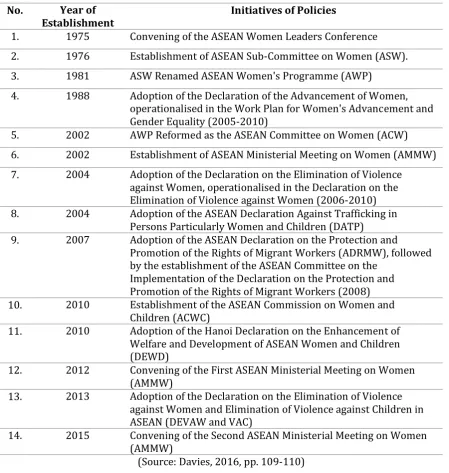
Table 1. ASEAN's Initiative on Women and Gender Issues
No. Year of
Establishment
Initiatives of Policies
1. 1975 Convening of the ASEAN Women Leaders Conference 2. 1976 Establishment of ASEAN Sub-Committee on Women (ASW). 3. 1981 ASW Renamed ASEAN Women's Programme (AWP)
4. 1988 Adoption of the Declaration of the Advancement of Women, operationalised in the Work Plan for Women's Advancement and Gender Equality (2005-2010)
5. 2002 AWP Reformed as the ASEAN Committee on Women (ACW) 6. 2002 Establishment of ASEAN Ministerial Meeting on Women (AMMW) 7. 2004 Adoption of the Declaration on the Elimination of Violence
against Women, operationalised in the Declaration on the Elimination of Violence against Women (2006-2010) 8. 2004 Adoption of the ASEAN Declaration Against Trafficking in
Persons Particularly Women and Children (DATP) 9. 2007 Adoption of the ASEAN Declaration on the Protection and
Promotion of the Rights of Migrant Workers (ADRMW), followed by the establishment of the ASEAN Committee on the
Implementation of the Declaration on the Protection and Promotion of the Rights of Migrant Workers (2008) 10. 2010 Establishment of the ASEAN Commission on Women and
Children (ACWC)
11. 2010 Adoption of the Hanoi Declaration on the Enhancement of Welfare and Development of ASEAN Women and Children (DEWD)
12. 2012 Convening of the First ASEAN Ministerial Meeting on Women (AMMW)
13. 2013 Adoption of the Declaration on the Elimination of Violence against Women and Elimination of Violence against Children in ASEAN (DEVAW and VAC)
14. 2015 Convening of the Second ASEAN Ministerial Meeting on Women (AMMW)
(Source: Davies, 2016, pp. 109-110)
Meanwhile, in the institutional context, ASEAN has taken a new direction in
realizing its vision as a caring and sharing community under the ASEAN Community
196
Community, and ASEAN Socio-Cultural Community. ASEAN also frequently brings
together non-governmental organizations and civil society organizations to
participate actively in various consultation processes regarding a number of issues,
including gender issues. In addition, the principles of human rights have been
introduced and embodied in three human rights bodies, namely the ASEAN
Intergovernmental Commission on Human Rights (AICHR), the ASEAN Commission
on the Promotion and Protection of Women and Children's Rights (ACWC), and the
ASEAN Declaration on the Protection and Promotion of the Rights of Migrant
Workers (ACMW). As assessed by Mohamad (2002), the proliferation of these human
rights and democracy discourses in the region have been modest progress since the
Asian financial crisis of 1997.
There are positive developments in ASEAN's initiatives regarding gender and
women's issues, as seen in Table 1, from ASEAN's early involvement in women issues
through the convening of the ASEAN Women Leaders Conference in 1975, to the
latest ASEAN Ministerial Meeting on Women. These various initiatives show that
ASEAN has adopted gender issues in policy by addressing several problems in the
region, such as violence against women and children as well migrant workers.
However, the question is at what stage ASEAN's gender mainstreaming has been
implemented. The answer to this question will be reflected in the general practice of
gender mainstreaming in ASEAN.
Adoption of Gender Mainstreaming in ASEAN's Organizational Processes
Gender mainstreaming, here, is understood as focusing on infusing gender
considerations into organizational processes. In the context of ASEAN, the first step
in the process is the conceptual adoption of gender equality in the institution.
Although ASEAN does not provide a specific definition of gender equality, referring
to the Asia-Pacific Human Development Report in the ACW Work Plan (2011–2015),
it agrees that gender equality is about equipping women and men with equal access
and capacity so they have freedom to choose opportunities and improve their lives.
Because all people are inherently valuable, gender issues need to be taken into
account in policies, plan, and programs.
Moreover, ASEAN outlines several conceptual elements that have become the
197 meaning to intensify protection of women against all forms of violence but also
promote women's rights and gender analysis in other areas; "strengthening gender
perspectives and analysis", decidedly moving beyond the "add women and stir"
approach and the "ghettoization of women", and pursuing the complementation and
integration of gender analysis and goals with other work programs and committed
actions; expanding the reach of gender mainstreaming by moving decidedly beyond
the "traditional women's issues" and "women's comfort zones" and applying a more
vigorous gender lens to a variety of political, economic and social issues (ASEAN
Secretariat 2012, pp. 13–14). It shows that ASEAN actually has a firm understanding
of the importance of applying gender perspectives and adopting gender
mainstreaming in its policies.
This commitment is evident from the establishment of special units working on
gender issues within ASEAN. At least three bodies have been established for gender
mainstreaming, namely, the ASEAN Committee on Women (ASW), a sectoral body;
the ASEAN Commission on Women and Children (ACWC), an ASEAN human rights
instrument that specifically focuses on women and children; and the ASEAN
Ministerial Meeting on Women (AMMW) which is located under the Social-Cultural
Community pillar.
Besides establishing organizational special units, the internalization of gender
perspectives among internal actors is significantly needed. In an attempt to improve
the capacity building of its staff as part of its organizational processes, ASEAN affirms
its commitment. For instance, the ASEAN Secretariat held a Gender Mainstreaming
Training session in 2013 intended to enhance knowledge on gender mainstreaming
elements, approaches, and strategies to assist staff in gaining practical skills for
measuring organizational capacity to address gender issues and mainstream gender
perspectives in their respective lines of work. Over eighty ASEAN secretariat staff
members joined the training. H.E. Alicia R. Bala, Deputy Secretary-General for the
ASEAN Socio-Cultural Community (ASCC), highlighted that "The role of the ASEAN
Secretariat is critical in making gender mainstreaming as a standard practice in
ASEAN's policies and programs across the three pillars" (ASEAN Secretariat News,
2013). She then argued that, before we are able to effectively stimulate gender
mainstreaming strategy in ASEAN, we first need to understand clearly the concept of
198
However, the adoption of gender mainstreaming in institutionalization poses
several challenges. The specific bodies that handle women's issues have limitations
in the nature of their mandates or positions. The weakness in the institutionalization
of gender issues in ASEAN has emerged since the convening of the ASEAN Women
Leaders Conference, which was perceived to be elitist because it only involved
women leaders that were non-political and did not threaten the status quo (Davies,
2013, p. 52). Also, even though its members were senior officials, ACW's position
outside of ASEAN's organizational structure meant it was considered not part of
ASEAN. This sectoral body also had many responsibilities, such as promoting the
implementation of effective programs and cooperation on women issues, preparing
regional reports, and collaborating with other internal and external actors in ASEAN.
In the recent work plan, ACWC has also been given the responsibility to influence all
pillars and thereby produce a visible, credible, and strong input for governments.
Could these huge responsibilities possibly be handled by one "outsider" unit?
ACWC's status as an intergovernmental body is also criticized for its independence
since its members are government representatives.
Moreover, AMMW's position under the ASEAN social-cultural community pillar
(instead of the other two pillars) is questioned. Proponents argue that locating
women's issues in a particular body will draw more focus on policies and make it
easier to monitor. In contrast, questions emerge as to whether it indicates that
women's (and gender) issues seem to only be discussed from a socio-cultural
perspective rather than a political security or economic perspective. The position of
women's issues under the socio-cultural community pillar means only that a gender
perspective has not been effectively mainstreamed in all pillars. This has been
identified as one problem in the October 2015 progress report on women's rights
and gender equality in ASEAN (Dios, 2016). This shows that gender issues still
experience challenges as related to political security issues, including in the
recognition of the role of women in conflict resolution and peacebuilding. From an
economic perspective, the problem lies in the lack of recognition of women's
contributions to economic growth and development, particularly in the informal
sector (Jha & Saxena, 2016). The contribution of women in political-security and
199 Also, putting women's concerns under the ACWC implies that women's issues
must be a separate commission, rather than being integrated into the AICHR. It
suggests that their issues are different in status than other human rights concerns
(Davies et al., 2014, p. 420). It seems that ASEAN's reluctance to incorporate
women's issues into the political security pillar is indicated by its slow progress in
following up the Women, Peace and Security agenda (particularly relative to its
response to development issues). In fact, Davies et al., (2014) argue that most ASEAN
member states are vulnerable to conflict and experiences in these countries show
the magnitude of the role of women in conflict situations, especially in conflict
resolution. During the conflict and peace settlement process in Aceh, Indonesia, for
example, some Acehnese women played roles as combatants, arms smugglers,
mediators, and peace lobbyists. Likewise, women's presence in the conflict in Kachin,
Myanmar, was apparent since they participated as soldiers or military-trained
members of the civilian administration of the Kachin Independence Organization
(International IDEA 2015, p. 62). Therefore, a gender and security agenda is arguably
relevant for ASEAN member states. The above situation is considered ironic, since
gender equality has become the accepted norm in ASEAN countries and
institutionalized through the ratification of CEDAW and CRC, both of which are the
only UN treaties to be ratified by all ten ASEAN member states. This contrasts with
ASEAN leaders' commitment that gender issues should be a central part of the third
pillar of ASEAN community.
ASEAN's Gender Mainstreaming Policies
The second stage of gender mainstreaming is at the policy level. In general,
ASEAN has produced several work plans to operationalize and guide the
implementation of the mandates of the ACW, the ACWC, and the AMMW on issues of
women and gender. Since one of its mandates is to monitor and evaluate the
implementation of a women and gender agenda, the ACW sets up policies for
monitoring and evaluating the effectiveness of undertaken projects or activities. It
includes mid-term reviews, final reviews, and reports of work plan implementation.
As part of its gender training, the ACWC has policies to develop guidelines to
take a non-violent approach to women's issues and avoid gender stereotyping in
200
institutional capacity of the ACWC, it holds fundraising activities. Moreover, to gain
knowledge resources, it has established the ACWC Network of Social Service
Agencies (NOSSA) to promote consultation and dialogue with stakeholders at the
national and regional level, as well as a public campaign to stop violence against
women. To apply a gender perspective in policies, strategies, and programs for
migrant workers, there is also high-level consultation on gender perspectives in
policies, strategies, and programs for migrant workers, including experts and
relevant policy makers.
The practice of gender mainstreaming in ASEAN shows that the organization
has adopted an integrationist approach, rather than agenda-setting. The existence of
women-only units or policies in ASEAN, for example, shows that its organizational
logic has not switched from the long-abandoned WID approach. The GAD logic that
focuses on gender relations between men and women in public policies does not
seem to underlie ASEAN's gender mainstreaming policies.
In addition, ASEAN's integrationist policies in gender mainstreaming are not
intended to challenge or change existing organizational paradigms. The main
foundations of ASEAN policy – the 1967 ASEAN Declaration, the 1976 Treaty of
Amity and Cooperation (TAC) in Southeast Asia, and the ASEAN Charter – are almost
untouchable in attempts to apply gender perspectives in the existing rules of the
game. These documents still adopt gender-neutral or gender-blind language that is
male-centered (Prasertri et al., 2014, p. 17). This means that ASEAN's fundamental
principles of sovereignty, use of force, peaceful settlement of disputes,
non-interference, and consensus in decision-making processes that lie at the heart of
"ASEAN ways" makes it impossible to criticize member states' policies that violate
the human rights of women and children.
As such, ASEAN contributing to addressing the four main gender issues in the
region – economic participation of women, migration and discriminatory laws,
political participation, and violence against women (Al-Ghozaly, 2012) – remains a
distant hope.
Implementing Gender Mainstreaming in ASEAN
ASEAN has produced many policies related to gender issues. No less important
201 operational level. Operationally, there has been significant progress in addressing
the issue of violence against women through concerted efforts at regional and
national level. ASEAN member states have produced National Action Plans (NAP) to
support the implementation of laws and policies addressing violence against women
and children. In 2009, the Philippines launched a NAP for the 2010–2016 period for
implementing UNSCR 1325 and 1820 in response to various forms of violence
against women during conflicts. The Indonesian government also launched its first
NAP in 7 March 2014, titled National Action Plans for the Protection and
Empowerment of Women and Children during Social Conflict (2014–2019) (RAN
P3A-KS), through Presidential Decree No. 18 of 2014. ACWC also developed the
Gender Sensitive Guidelines for Handling Women Victims of Trafficking in Person,
convened the Regional Workshop on Promoting the Right to a Nationality for
Women and Children in the Implementation of CEDAW and CRC in ASEAN, and
conducted a public campaign to stop violence against women. In this, they have also
cooperated and collaborated with civil society.
However, there are still some challenges to its implementation. The ASEAN
Regional Action Plan of Action on the Elimination of Violence against Women report
(2015) notes that the progress of addressing violence against women has been
uneven. For example, marital rape and other forms of sexual violence have not been
covered fully in the legislations of all ASEAN member states. Cambodia's Law on the
Prevention of Violence and the Protection of Victims in 2005, for instance, does not
cover marital rape. The 1994 Domestic Violence Act in Malaysia is the same.
Meanwhile, Thailand's Protection of Domestic Violence Victims Act B.E. 2550 (2007)
includes marital rape, as is the case of Vietnam's Law on Prevention of and Control
over Domestic Violence (2007). This issue still requires that data gaps on the extent
and impact of violence against women be given attention, as well as support for
human resources and funding law enforcement/delivery of support services.
According to the 2011–2015 ACW Work Plan (2012), the availability of
sex-disaggregated data has been another obstacle in the implementation of gender policy
in ASEAN. Sex-disaggregated data is crucial for evidence-informed policy-making,
monitoring, and reporting of gender equality commitments. There are differences on
what data ASEAN member states measure, and traditional indicators of the gender
202
but also at the ASEAN level. Data on the implementation of policies on women's
rights and gender equality has not been regularly collected and presented, and as a
result ASEAN depends more on the reliable data provided by other international
organizations such as the World Bank, ADB, and UNESCAP. Another constraint of
gender mainstreaming in ASEAN, as noted by ACW in its 2011–2015 Work Plan, is
the persistent resistance to and inadequacies in understanding how gender power
relations and rooted attitudes and perceptions of women and men operate to
subordinate and discriminate against women.
In the case of ASEAN's adoption of CEDAW, studies by Li-ann, Linton, and
Davies (as quoted by Davies, 2016, p. 111) find that there is still a considerable gap
between the commitments made by member states and the achievement of rights
within their domestic political contexts. ASEAN's member states still put
reservations on CEDAW in different issues. Singapore, for example, made
article-specific reservations (Article 2 on Policy Measures; Article 9(2) on Nationality;
Article 11 on Employment; and Article 16 on Marriage and Family Life), as did
Malaysia with Article 5(a) on Role Stereotyping and Prejudice and Article 7(b) on
Political and Public Life and Brunei Darussalam with Article 9(2) on Nationality. The
ACWC, whose mandate is to encourage member states to complete the ratification of
relevant international human rights instruments on women and children, including
CEDAW, has been unable to pressure them. In response, Linton (2008) argues that
reservations toward human rights treaties are not about ASEAN values or Asian
values, but about particular circumstances in member states' and their societies,
such as the prevailing attitudes about women and the role of culture and religion.
These situations confirm some constraints of gender mainstreaming
implementation that have been identified in most international organizations,
particularly the lack of resources (i.e. reliable data, capable human resources, and
sustained funding). Hence, ASEAN has not seen much progress in implementing the
policies that have been generated.
Conclusion
To summarize, ASEAN has shown considerable progress in initiatives related to
women and gender issues. In its adoption of conceptual approaches to gender
203 the concepts instead of borrowing definitions from other institutions. However,
ASEAN has progressed in institutionalizing gender issues by setting up special
bodies to handle these issues. It has also begun building internal capacity to deal
with gender issues.
Moreover, at the policy level the achievement of gender mainstreaming is
evident. ASEAN has produced Work Plans to operationalize and guide its
establishment and mandating of ACW, ACWC and AMMW. It also has extensive
policies related to establishing gender training, optimizing knowledge resources, and
gaining cooperation and collaboration with civil societies.
As in many institutions, challenges are mostly in the implementation of gender
mainstreaming policies. Compared to the operational level, implementation at the
institutional level has not gained much attention. It means that policies for
improving organizational culture and procedures have not settled. In some cases, for
example in CEDAW, the implementation of ASEAN's policy reflects more an
obligation rather than a commitment. According to Benschop and Verloo (2006), the
question is whether such obligation is enough to ensure that the gender analysis of
policy is done well, or whether commitment is the key success. They argue that
commitment may go hand in hand with obligation. Although Eveline and Bacchi
(2009) agree, they argue that "commitment may follow from obligation" and suggest
that commitments towards gender analysis in institutions will only be sustained if
these institutions can see gender's relevance to their work.
Drawing from this argument, it must be considered whether ASEAN is the right
and relevant forum for gender mainstreaming policies and for the achievement of
gender equality objectives. If it is, how should ASEAN recognize the adoption of
women and gender issues as more than merely fulfilling obligations, but also a
commitment to achieving a caring and sharing ASEAN community. Also, despite
progress in implementing gender mainstreaming policies, several fundamental
constraints related to the availability of reliable data as well as human and funding
resources should still be addressed by ASEAN.
The practice of gender mainstreaming in ASEAN, therefore, should mean more
than adding women to existing policies and programs. Ideally, it should also change
204
Without gender-sensitive and people-oriented policy frameworks and practices, a
caring and sharing ASEAN Community is impossible to achieve.
References
Aasen, B. (2006). Lessons from Evaluations of Women and Gender Equality in
Development Cooperation. Oslo: Norwegian Institute for Urban and Regional
Research.
African Development Bank (ADB). (2012). Mainstreaming Gender Equality:
Operations Evaluation Department. Tunisia: African Development Bank.
Al-Ghozaly, M. N. (2012, 4 December) Whither Women's Rights in ASEAN? The
Jakarta Post.
Allwood, G. (2014). Gender Mainstreaming and EU Climate Change Policy, in The
Persistent Invisibility of Gender in EU Policy, ed. Elaine Weiner and Heather
MacRae, European Integration Online Papers (EioP), Special Issue 1, 18, 6,
http://eiop.or.at/eiop/texte/2014-006a.htm, 1-26.
ASEAN Secretariat News. (2013, 23 February). ASEAN SG: Gender Equality should be
Central in Achieving ASEAN Community. Retrieved from
http://asean.org/asean-sg-gender-equality-should-be-central-in-achieving-asean-community/(8 August 2016).
ASEAN Secretariat. (2015). ASEAN Regional Action Plan of Action on the Elimination
of Violence against Women (ASEAN RPA on EVAW). Jakarta: ASEAN Secretariat.
_________. (2013). ASEAN Commission on the Promotion and Protection of the Rights of
Women and Children: Work Plan 2012-2016 and Terms of Reference. Jakarta:
ASEAN Secretariat.
__________. (2012). ASEAN Committee on Women (ACW) Work Plan (2011-2015).
Jakarta: ASEAN Secretariat.
Barrow, A. (2009). [It's] like a rubber band: Assessing UNSCR 1325 as a Gender
Mainstreaming Process. International Journal of Law in Context, 5, 1, 51-68.
Beijing Declaration and Platform for Action, 15 September 1995.
Benschop, Y., & M. Verloo. (2006) Sisyphus' Sisters: Can Gender Mainstreaming
Escape the Genderedness of Organizations? Journal of Gender Studies, 15, 1,
2006, 19-33.
205 Southeast Asian Politics, in Gender Trends in Southeast Asia: Women Now,
Women in the Future, ed. Theresa W. Devasahayam. Singapore: ISEAS.
Council of Europe. (1998). Gender Mainstreaming: Conceptual Framework,
Methodology and Presentation of Good Practices: Final Report of Activities of the
Group of Specialists on Mainstreaming. Strasbourg: Council of Europe.
Davies, M. (2016). Women and Development, Not Gender and Politics: Explaining
ASEAN's Failure to Engage with the Women, Peace and Security Agenda.
Contemporary Southeast Asia 38, 1, 106–127.
________, et al. (2014). States of Compliance? Global Human Rights Treaties and the
ASEAN Member States. Journal of Human Rights, 13, 4, 414–433.
_________. (2013). The ASEAN Synthesis: Human Rights, Non-Intervention, and the
ASEAN Human Rights Declaration. Georgetown Journal of International Affairs,
14, 2, 51–58.
Davies, S.E., K. Nackers., & S. Teitt. (2014). Women, Peace, and Security as an ASEAN
Priority. Australian Journal of International Affairs, 68, 3, 333–355.
De Dios, A.J. (2016). ASEAN Initiatives to Promote Gender Equality, 2016, Retrieved
from
http://www.ched.gov.ph/wp-content/uploads/2016/01/6.1_ASEANInitiatives-AJDEDIOS.pdf (19 October
2016).
Eveline, J., & C. Bacchi. (2009). Obeying Organizational 'Rules of Relevance': Gender
Analysis of Policy. Journal of Management and Organization, 15, 5, 556–581.
George, N. (2016). Institutionalising Women, Peace and Security in the Pacific
Islands: Gendering the 'Architecture of Entitlements'? International Political
Science Review, 37, 3, 375-389.
Hafner-Burton, E. and M.A. Pollack. (2009). Mainstreaming Gender in the European
Union: Getting the Incentives Right. Comparative European Politics, 7, 114–138.
International Institute for Democracy and Electoral Assistance (International IDEA).
(2015). Women in Conflict and Peace. Sweden: International Institute for
Democracy and Electoral Assistance.
Jha, S., & A. Saxena. (2016). Projected Gender Impact of the ASEAN Economic
Community. Jakarta: The ASEAN Secretariat.
Linton, S. (2008). ASEAN States, Their Reservations to Human Rights Treaties and
206
Quarterly, 30, 436–493.
Lombardo, E. (2005). Integrating or Setting the Agenda? Gender Mainstreaming in
the European Constitution-Making Process. Social Politics: International Studies
in Gender, State, and Society, 12, 3, 412–432.
Mahapatro, M. (2014). Mainstreaming Gender: Shift from Advocacy to Policy. Vision,
18, 4, 309–315.
Mazey, S. (2002). Gender Mainstreaming Strategies in the EU: Delivering on an
Agenda. Feminist Legal Studies, 10, 2002, 227–240.
Milward, K., et al. (2015). Gender Mainstreaming Critiques: Signposts or Dead Ends?
IDS Bulletin, 46, 4, 75–81.
Mohamad, M. (2002). Towards a Human Rights Regime in Southeast Asia: Charting
the Course of State Commitment. Contemporary Southeast Asia, 24, 2, 230–251.
Moser, C., & A. Moser. (2005). Gender Mainstreaming since Beijing: A Review of
Success and Limitations in International Institutions, Gender & Development,
13, 2, 11–22.
Mukhopadhyay, M. (2014). Mainstreaming Gender or Reconstituting the
Mainstream? Gender Knowledge in Development. Journal of International
Development, 26, 356–367.
Parpart, J.L. (2014). Exploring the Transformative Potential of Gender
Mainstreaming in International Development Institutions. Journal of
International Development, 26, 382–395.
Prasertri, D., et al. (2014). An ASEAN Handbook for Women's Rights Activist. Chiang
Mai: Southeast Asia Women's Caucus on Women.
Prugl, E., & A. Lustgarten. (2006). Mainstreaming Gender in International
Organizations, in Women and Gender Equity in Development Theory and
Practice: Institutions, Resources, and Mobilization, ed. Jane S. Jaquette and Gale
Summerfield. Durham, NC, and London: Duke University Press.
Rao, A., & D. Kelleher. (2005). Is There Life After Gender Mainstreaming? Gender &
Development, 13, 2, 57–69.
Razavi, S. (1997). Fitting Gender into Development Institutions, World Development,
25, 7, 1111–1125.
Razavi, S., & C. Miller. (1995). Gender Mainstreaming: A Study of Efforts by the UNDP,
207
Occasional Paper 4.
Statement of Secretary-General of ASEAN at the Gender Mainstreaming Training in
Jakarta on 13 February 2013.
True, J., & L. Parisi. (2013). Gender Mainstreaming Strategies in International
Governance, in Feminist Strategies in International Governance, ed. Gulay
Caglar, Elisabeth Prugl, and Susanne Zwingel. London: Routledge.
United Nations. (1997). Report of the Economic and Social Council for 1997, A/52/3,
18 September 1997.
Walby, S. (2005). Gender Mainstreaming: Productive Tensions in Theory and Practice.
Oxford University Press.
World Economic Forum. (2014). The Global Gender Gap Report 2014. Geneva: World