ii
Tim Prosiding
Editor
Purnami Widyaningsih, Respatiwulan, Sri Kuntari, Nughthoh Arfawi Kurdhi, dan Bowo Winarno Tim Teknis
Ika Susanti, Lilik Prasetyo Pratama, Hamdani Citra Pradana, Caesar Adhek Karisma, Aditya Wendha Wijaya, Ibnu Paxibrata,Yeva Fadhila Ashari, dan Sufia Nurjanah
Layout & Cover
iii
Tim Reviewer
Drs. H. Tri Atmojo Kusmayadi, M.Sc., Ph.D. Dr. Sri Subanti, M.Si.
Dr. Dewi Retno Sari Saputro, MKom. Drs. Muslich, M.Si.
Dra. Mania Roswitha, M.Si.
Dra. Purnami Widyaningsih, M.App.Sc. Drs. Pangadi, M.Si.
Drs. Sutrima, M.Si. Drs. Sugiyanto, M.Si. Dra Etik Zukhronah, M.Si. Dra Respatiwulan, M.Si. Dra. Sri Sulistijowati H., M.Si. Irwan Susanto, DEA
Winita Wulandari, M.Si. Sri Kuntari, M.Si.
Titin Sri Martini, M.Kom. Ira Kurniawati, M.Pd.
iv
Steering Committee
Prof. Ir. Ari Handono Ramelan, M.Sc., (Hons) Ph.D. Dr. Hartono
Dr. Suhartono, M.Sc. Dr. Mardiyana, M.Si.
Dr. Dewi Retno Sari Saputro, MKom. Dr. Sutanto, DEA
v
Sambutan Ketua Panitia
Assalamu’alaikum Wr.Wb.Seminar Nasional Matematika FMIPA UNS telah dilaksanakan pada tanggal 6 Oktober 2012. Seminar tersebut ditindaklanjuti dengan menerbitkan prosiding sebagai bukti otentik telah berlangsungnya komunikasi dan sharing gagasan ilmiah dari berbagai kalangan yang sifatnya nasional. Prosiding ini diharapkan dapat membantu dan bermanfaat bagi semua insan pendidikan khususnya yang berkiprah dalam pengembangan profesi. Tema ”Matematika dan Pendidikan Matematika Berbasis Riset” sangat tepat dipilih untuk memberikan sumbangan dalam peningkatan kompetensi pada pengembangan profesi sebagai peneliti, dosen, dan guru serta profesi lainnya.
Ketua Panitia menyampaikan penghargaan kepada seluruh pembicara utama, pemakalah, peserta, dan panitia Seminar Nasional Matematika 2012 yang telah mendukung penyelenggaraan kegiatan ini. Kegiatan seminar ini sangat penting diadakan selain untuk pengembangan pribadi dan institusi sekaligus juga untuk menjalin komunikasi ilmiah antar peneliti, dosen, guru, dan praktisi pendidikan dalam rangka memperbaiki pendidikan khususnya serta kemajuan bangsa pada umumnya.
Bagi Jurusan Matematika kegiatan ini merupakan karya nyata untuk meningkatkan kualitas institusi, penelitian, dan pembelajaran serta mewujudkan jaring-jaring komunikasi ilmiah yang menunjang perkembangan Jurusan Matematika khususnya serta FMIPA dan UNS pada umumnya.
Secara khusus Ketua Panitia menyampaikan terima kasih kepada Prof Dr. Rer. nat. Widodo, MS selaku Kepala Pusat Pengembangan Pemberdayaan Pendidik dan Tenaga Kependidikan Kementerian Pendidikan dan Kebudayaan, Dr. Ir. Sasmito Hadiwibowo, M.Sc. selaku Direktur Statistik Harga BPS Pusat, dan Dr. Ir. RM. Agus Sediadi Tamtanus, M.Si. selaku asisten deputi data dan informasi iptek yang telah berkenan menularkan ilmunya dengan menjadi pembicara utama pada Seminar Nasional ini. Ucapan terima kasih juga saya sampaikan kepada semua pihak yang telah mendukung demi suksesnya seminar ini.
Akhirnya saya berharap semoga dengan terbitnya prosiding ini dapat bermanfaat dalam rangka membangun insan profesional berkarakter kuat dan cerdas. Amin.
vi DAFTAR ISI
Halaman
Halaman Judul ………..……….. i
Tim Prosiding ………..…………. ii
Tim Reviewer ………..………… iii
Steering Committee ………..…… iv
Sambutan Ketua Panitia ………... v
Daftar Isi ………..………. vi
MAKALAH UTAMA Memilih dan Melakukan Penelitian Matematika/Statistika yang Melibatkan Mahasiswa Widodo ………..………. 1
BIDANG ANALISIS dan ALJABAR 1 Algoritma Eigenmode Tergeneralisasi untuk MatriksTereduksi Reguler di dalam Aljabar Max-Plus Agus Zuliyanto, Siswanto, dan Muslich ………. 7
2 Aljabar Max-Plus yang Simetri Risdayanti, Sri Mardiyati……… 15
3 Fungsi yang Terdefensial Quasi di dalam Ruang Bernorma Quasi Dwi Nur Yunianti ………..………. 23
4 Generalisasi Barisan Selisih dari Klas p-Mean Value Bounded Variation Sequences Moch. Aruman Imron, Ch. Rini Indrati, dan Widodo ………... 29
5 Kekontinuan Operator Superposisi pada Ruang Holder Yundari ……….. 36
6 Konstruksi 2-Norma dengan Dual Kothe-nya Sadjidon dan Sunarsini ……… 43
7 Membangun Suatu Relasi Fuzzy pada Semigrup Bentuk Bilinear Karyati, Sri Wahyuni, Budi Surodjo, Setiadji ……… 48
8 Nilai Eigen Matriks Atas Aljabar Maks Plus Tersimetris Gregoria Ariyanti, Ari Suparwanto, dan Budi Surodjo ………... 53
9 Pertidaksamaan Hadamard Suzyanna………….………….………….………….………….………. 61
10 Sekitar Submodul Prima dan Submodul Maksimal atas Gelanggang Komutatif Sri Efrinita Irwan, Hanni Garminia, dan Pudji Astuti ………….………….. 69
vii
BIDANG KOMPUTER dan MATEMATIKA TERAPAN
1
Algoritma Fuzzy Backpropagation pada Pengklasifikasian Menggunakan Fuzzy Mean Square Error
Apriliana Yuliawati, Titin Sri Martini, Sri Subanti ……….. 73
2 Analisis Model Epidemi SEIRS dengan Waktu Tundaan dan Laju Insidensi Jenuh
Rubono Setiawan ………... 79
3 Aplikasi Persamaan Panas pada Sterilisasi Minuman Kemasan
Eminugroho R., Fitriana Yuli S., Dwi Lestari ……….... 84
4 Digraf Eksentrik dari Graf Flower Tri Atmojo Kusmayadi, Nugroho Ari Sudibyo, Sri Kuntari, Rindang
Putuardi ………. 98
5 Interpretasi Numerik Model Endemik SIR dengan Imigrasi, Vaksinasi dan Sanitasi
Anita Kesuma Arum, Sutanto, dan Purnami Widyaningsih ……….. 105
6 Interpretasi Numerik Model Susceptible Infected Recovered (SIR) dengan Vaksinasi dan Sanitasi
Siti Mushonifah, Purnami Widyaningsih, dan Tri Atmojo Kusmayadi ……. 110
7 Kekuatan Tak Reguler Sisi Total pada Graf Web dan 2-Copynya
Diari Indriati, Widodo, Indah E. Wijayanti, dan Kiki A. Sugeng ………….. 114
8 Metode Utility Additive untuk Mengevaluasi Peringkat Subjektif dalam Pengambilan Keputusan Multikriteria
Yuli Astuti, Tri Atmojo Kusmayadi, dan Titin Sri Martini ………. 122
9 Pemberian Nomor Vertex pada Jaringan Graf n-Barbell
Bangkit Joko Widodo dan Tri Atmojo Kusmayadi ……… 129
10
Pendekatan Probabilitas pada Masalah Program Linear Multi-Objektif dengan Parameter Random Fuzzy
Indarsih, Widodo, dan Ch. Rini Indrati ……… 133
11 Penerapan Algoritma C4.5 pada Program Klasifikasi Mahasiswa Dropout
Anik Andriani ……… 139
12
Pengaruh Indeks Global Terhadap Fluktuasi Indeks Harga Saham Gabungan (IHSG) Menggunakan Hukum Pendinginan Newton
Arief Wahyu Wicaksono, Purnami Widyaningsih, dan Sutanto …………... 148
13
Simulasi Model Susceptible Infected Recovered (SIR) dengan Imigrasi dan Sanitasi Beserta Intepretasinya
viii
14
Simulasi Seleksi Mahasiswa Baru Jalur Undangan dengan Menggunakan Metode Simple Additive Weighting
Rubiyatun, Bowo Winarno, dan Sri Sulistijowati ……… 162
15
Skema Central Upwind Semidiskrit untuk Persamaan Hiperbolik Dimensi-Satu
Noor Hidayat, Suhariningsih, Agus Suryanto ………. 168
16
Titik Kesetimbangan Model Endemik Susceptible Infected Susceptible (SIS) Beserta Kestabilannya
Adi Tri Ratmanto, Purnami Widyaningsih, dan Respatiwulan ……… 176
BIDANG STATISTIK
1 Analisa Perhitungan Cadangan Premi Modifikasi
Fia Fridayanti Adam, Kahfi Irawan ……….. 181 2 Analisis Faktor-Faktor yang Mempengaruhi Berat Badan Bayi Saat Lahir di Kota Surakarta Menggunakan Metode Pohon Regresi
Nina Haryati, Winita Sulandari, Muslich ……….. 189 3 Analisis Regresi Cox Proportional Hazards pada Ketahanan Hidup Pasien Diabetus Mellitus
Ninuk Rahayu, Adi Setiawan, Tundjung Mahatma ……… 196 4 Analisis Ruang Runtun Waktu pada Data Kemiskinan
Kartini, Irwan Susanto dan Pangadi ………. 207 5
Analisis Tingkat Kemiskinan Menggunakan Pendekatan Stochastic Dominance
Anggita Linggar Pratami, Irwan Susanto, dan Tri Atmojo Kusmayadi …… 215 6 Estimasi Parameter Distribusi COM-Poisson dengan Metode Bayesian
Tia Arum Sari, Sri Sulistijowati H., Purnami Widyaningsih ………. 222 7 Estimasi Parameter Model DTMC SIR Menggunakan Metode Maksimum Likelihood
Rizki Wahyu Pramono, Respatiwulan, dan Sri Kuntari ……… 229 8 Estimasi Parameter Model INAR(1) Menggunakan Metode Bayes
Nurmalitasari, Winita Sulandari, dan Supriyadi Wibowo ………. 238
9 Estimasi Parameter Model Regresi Com-Poisson untuk Data Tersensor Kanan Menggunakan Metode Maksimum Likelihood
Dian Anggraeni, Sri Sulistijowati H, dan Nughthoh Arfawi Kurdhi ………. 245
10
Estimasi Parameter Model Seemingly Unrelated Regression (SUR) dengan Residu Berpola Autoregressive Orde Satu (AR(1)) dengan Metode Park
ix
11
Estimator Smoothing Spline dalam Model Regresi Nonparametrik Multivariabel
Rita Diana, I Nyoman Budiantara, Purhadi dan Satwiko Darmesto ……… 258
12
Forecasting Index of Jakarta Stock Exchange Using Radial Basis Function Network-Self Organizing Map
Suryanto Wibowo, Winita Sulandari, and Mania Roswitha ……….. 265
13
Implikasi Uji Peringkat Baru Terhadap Uji Cramer-Von Mises, Uji Kolmogorov-Smirnov dan Uji Wilcoxon
Sugiyanto dan Etik Zukhronah ……….. 271
14
Kriteria Penduga Tak Bias Linear Terbaik (Best Linear Unbiased Estimator) pada Metode Ordinary Kriging
Dewi Retno Sari Saputro ………... 278
15
Model Nilai Tukar Dolar Kanada terhadap Rupiah menggunakan Markov Switching GARCH
Yunita Ekasari, Sugiyanto, dan Pangadi ………... 283
16
Model Nilai Tukar Dolar Singapura Terhadap Rupiah Menggunakan Markov Switching ARCH
Intan Wijayakusuma, Sugiyanto dan Santosa Budiwiyono ……… 289
17
Optimalisasi Portofolio Saham pada Indeks LQ-45 dengan Pendekatan Bayes melalui Model Black-Litterman
Fauzia Widyandari, Sri Subanti, dan Sutrima ………... 296
18
Peluang Kebangkrutan Perusahaan Asuransi dimana Waktu Antar Kedatangan Klaim Menyebar Eksponensial
Ali Shodiqin, Achmad Buchori, Najmah Istikaanah ……….. 302
19
Pemilihan Portofolio Optimal dengan Menggunakan Bayesian Information Criterion (BIC)
Eko Utoro, Sri Subanti dan Santoso Budi Wiyono ……… 310
20
Pemodelan Nilai Tukar Dollar Terhadap Rupiah Menggunakan Neural Network Ensembles (NNE)
Nariswari Setya Dewi, Winita Sulandari dan Supriyadi Wibowo …………. 317
21 Pendekatan Probabilistik pada Filogeni
Tigor Nauli ………….………….………….………….………. 323
22
Penerapan Circular Statistics untuk Pengujian Sampel Tunggal Sebaran Von Mises Menggunakan Simulasi Data
Pepi Novianti ………. 332
23
Penerapan K-Mean Cluster dalam Penentuan Center RBFN pada Pemodelan Indeks Harga Saham Gabungan
x
24
Pengelompokan Tingkat Partisipasi Pendidikan di Kabupaten Boyolali dengan Fuzzy Subtractive Clustering
Yenny Yuliantini, Etik Zukhronah, Siswanto ………. 344
25
Penggunaan Model Black-Scholes untuk Menentukan Harga Opsi Beli Tipe Eropa
Neva Satyahadewi dan Herman ……… 351
26 Pengukuran Value at Risk dengan Metode Variance Covariance
Ibnuhardi Faizaini Ihsan, Respatiwulan, Pangadi ……… 361
27
Peramalan Harga Saham Sharp dengan Menggunakan Model ARIMA-GARCH dan Model Generalisasi Proses Wiener
Retno Budiarti ………..……….. 367
28
Persamaan Simultan untuk Kebijakan Finansial dengan Metode Three Stage Least Square
Titik Purwanti, Sri Subanti, Supriyadi Wibowo ………. 376
29
Regresi Robust dengan Generalized S-Estimation (Estimasi-GS) pada Penjualan Tenaga Listrik di Jawa Tengah Tahun 2010
Yurista Wulansari, Yuliana Susanti, dan Mania Roswitha ……… 382
30
Regresi Semiparametrik untuk Data Longitudinal dengan Pendekatan Spline Truncated
Idhia Sriliana ………..………... 389
31
Simulasi Peramalan Data Indeks Harga Saham Gabungan (IHSG) dengan Fuzzy Time Series Using Percentage Change
Endah Puspitasari, Lilik Linawati, Hanna Arini Parhusip ………... 394
32
Uji Koefisien Korelasi Spearman dan Kendall Menggunakan Metode Bootstrap (Studi Kasus: Beberapa Kurs Mata Uang Asing Terhadap Rupiah)
Rangga Pradeka, Adi Setiawan, Lilik Linawati ……… 403
33 Uji Nonparametrik Perlakuan Tetap pada Rancangan Persegi Latin
Sigit Nugroho ………. 414 BIDANG PENDIDIKAN
1
Analisis Proses Pembelajaran Matematika pada Anak Berkebutuhan Khusus (ABK) Learning Disabilities di Kelas Inklusi
Ayu Veranita, Budiyono, dan Suyono ……… 420
2
Efektivitas Metode Diskusi dengan Alat Bantu Peraga pada Mata Ajar Matematika Bangun dan Ruang di Kelas V Sekolah Dasar
xi
3
Efektivitas Pembelajaran Berbasis Masalah dengan Pendekatan Kontekstual pada Siswa Kelas VII SMP Negeri di Kota Madiun untuk Pokok Bahasan Himpunan
Vigih Hery Kristanto ……….. 434
4
Eksperimen Model Pembelajaran Kooperatif Tipe Student Teams Achievement Division (STAD) dengan Metode Problem Solving pada Materi Sistem Persamaan Linear Dua Variabel Ditinjau dari Sikap Peserta Didik terhadap Matematika Kelas VIII SMP Negeri di Kabupaten Tegal
Wikan Budi Utami ………. 444
5
Investigating of The Mathematical Concept In Order To Preparing The Learning Process Toward Improving The Quality of Mathematics Novice Teachers
Edy Bambang Irawan ……… 448
6
Ketrampilan Berpikir Kreatif Matematis dalam Pembelajaran Berbasis Masalah (PBM) pada Siswa SMP
Fransiskus Gatot Iman Santoso ………. 453
7
Membangun Kreativitas Guru dalam Pembelajaran Matematika melalui Lesson Study
Sardulo Gembong ……….. 460
8
Pemanfaatan Sumber Belajar Internet Berbasis Edutaintment dalam Pembelajaran Matematika Siswa Sekolah Dasar
Kuswari Hernawati ……… 466
9
Pembelajaran Matematika Berbasis Kreatif Mata Kuliah Teori Bilangan dengan Model Reog Ditinjau dari Strategi Kognitif (Studi Eksperimen pada Mahasiswa Pendidikan Matematika Semester II STKIP PGRI Pacitan)
Urip Tisngati ………….………….………….………….………. 474
10
Penanaman Norma-Norma Sosial Melalui Interaksi Siswa Dalam Pembelajaran Matematika dengan Pendekatan PMRI di Sekolah Dasar
Rini Setianingsih ……… 483
11
Pengenalan Pembelajaran yang Aktif, Kreatif, Efektif dan Menyenangkan (PAKEM) dalam Meningkatkan Pemahaman Konsep Matematika di SMPN 4 Kubutambahan Buleleng
Made Susilawati ………..……….. 491
12
Perangkat Pembelajaran dengan Model Pembelajaran Matematika Berbasis Pengajuan dan Pemecahan Masalah untuk Meningkatkan Kemampuan Berpikir Kreatif Siswa Sekolah Dasar Kelas IV SDN Jati Sidoarjo
xii
13
Profil Kemampuan Pemecahan Masalah Mahasiswa yang Mempunyai Gaya Kognitif Field Independen (FI) pada Mata Kuliah Kalkulus
Muhtarom ………..………. 513
14
Proses Berpikir Siswa Kelas IX Sekolah Menengah Pertama yang Berkemampuan Matematika Sedang dalam Memecahkan Masalah Matematika
265
FORECASTING INDEX OF JAKARTA STOCK EXCHANGE USING
RADIAL BASIS FUNCTION NETWORK-SELF ORGANIZING MAP
Suryanto Wibowo, Winita Sulandari, and Mania Roswitha Mathematic Department, Faculty of Mathematics and Natural Science,
Sebelas Maret University
ABSTRACT. In recent years, Radial Basis Function Network (RBFN) has been proposed as a promising alternative approach to nonlinear time series modeling and forecasting. Index of Jakarta Stock Exchange (JKSE) can be considered as a nonlinear time series, thus RBFN is appropriate to model it. The problem is how to construct RBFN model, because RBFN performance is influenced by the number and the value of parameters. In the conventional RBFN, the number of inputs is equal to the number of centers as a parameters of RBFN. The architecture of RBFN will be ineffective if the number of inputs are large. Self Organizing Map is the proposed algorithm to reduce parameters by clustering the centers. Then, modified of RBFN is called by RBFN-SOM. Based on the value of Akaike Information Criterion, it can be concluded that the architecture of optimal RBFN is 1-9-1.
Keywords: Radial Basis Function Network, Self Organizing Map, Index of
Jakarta Stock Exchange
1. INTRODUCTION
The stock market is a market that is associated with the purchase and sale of companies already listed on the stock exchange. The Jakarta Stock Exchange is a stock trades center in Indonesia. Index of Jakarta Stock Exchange is a stock market index that is used by the Indonesia Stock Exchange as an indicator of stock price movements. In taking the decision, an Investor requires an analysis to predict the value of the index in the next period.
In recent years, Radial Basis Function Network (RBFN) has been proposed as a promising alternative approach to nonlinear time series modeling and forecasting. Index of Jakarta Stock Exchange (JKSE) can be considered as a nonlinear time series, thus RBFN is appropriate to model it. RBFN is one of Artificial Neural Network (ANN) used the radial basis as the activation function. The number of inputs are equal to the number of centers Haykin [2]. When the number of centers are large, the architecture will be complex and the number of parameters will be inefficient. Hence, it can be solved by reducing the number of centers by clustering method. According to Lin and Chen [4], The Self Organzing Map (SOM) algorithm was introduced by Kohonen [3] at 1990 to solve clustering problem. In this paper, it is proposed as clustering method to find the centers of RBFN. Futhermore, the proposed ANN algorithm is called by RBFN-SOM.
In this study, RBFN-SOM algorithm was constructed into a programming language Matlab, with the number input and centers is 10 neurons. The program included the process of selecting the best architecture model based on Akaike Information Criterion (AIC) according to Phancaletal et al [5]. The best architecture RBFN-SOM is used to predict the stock price index for one next period. With updating the data, the program
Seminar Nasional Matematika 2012 266 Prosiding
can predict every single period ahead of stock data, which can help investors in making decisions.
2. MAIN RESULTS
2.1. Radial Basis Function Network - Self Organizing Map. In this study, the number
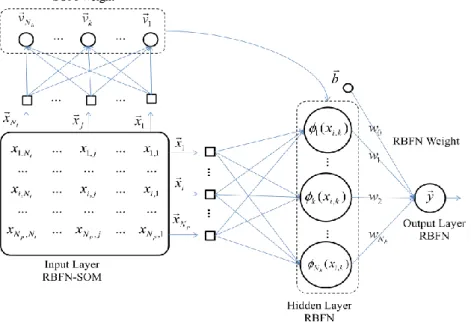
of RBFN inputs and SOM clusters were confined in 10 neurons. Based on these limits, the architecture of RBFN-SOM can be arranged as shown in Figure 1. According to the network architecture in Figure 1, RBFN-SOM algorithm for forecasting can be divided into 4 stages.
Figure 1. Architecture of RBFN-SOM
These stages are (1) initialization of input data, (2) classification of SOM, (3) construction of RBFN-SOM models, (4) reconstruction the best RBFN-SOM models. Each stage of the RBFN-SOM algorithm can be described as follows.
1. Initialization of input data
RBFN-SOM input data based on its function is divided into three types of data, i.e. training, testing, and verification data.
2. Classification of SOM
This stage consists of 4 sub stages described as follows. a. Determining the SOM weight vector
SOM weight vectors for each cluster has the same dimensions with the SOM input vector . The initial value for the weights can be determined randomly on the range of input data. Based on experiments, the classification results would be more appropriate if the initial weights are random around the center of the input data. b. Determining the winning neuron
Winning neuron, ( ⃗ ), is the weight vector k, { ⃗ }, which has the closest euclidean distance to the j-th input vector, { ⃗}. Suppose the SOM input vector is taken on the first training data, ( ⃗ ), then the euclidean distance, ( ⃗ ), to each weight vector, { ⃗ }, is
Seminar Nasional Matematika 2012 267 Prosiding
Forecasting Index of Jakarta Stock Exchange Using Radial Basis Function Network-Self Organizing Map
‖ ⃗ ⃗ ‖ √∑( )
SOM weight vectors, { ⃗ }, around the winning neuron, ( ⃗ ), changes according to the topological neighborhood based on Gaussian function
( ‖ ‖ ) where is spread of the topological neighborhood. c. Updating the weight
Update the weight on the first training data according to the Hebbian hypothesis by Kohonen [5], it can be formulated as
⃗ ( ⃗ ⃗ )
where is the learning rate or the rate of weight change. The process for updating the weight k-th vector, at time ( ) is formulated by
⃗ ( ) ⃗ ( ) ⃗ ( )
In the same way, the update process is repeated for until .Thus, the weight update process has reached one epoch.
d. Repeating updates weights
Process on the stages a and c is repeated until it reaches the maximum epoch. If the value of the maximum epoch has been reached, the final SOM weights are obtained. It will be the center of each cluster of RBFN.
3. Constructing RBFN-SOM models
This stage consists of 4 sub stages described as follows. a. Determining the input and target
Training data is divided into inputs and target data. The maximum number of input neurons are 10 neurons and the output neuron is 1 neuron.
b. Determining the center and spread
The value of the centers are determined by SOM final weights. Then, it is adjusted to the RBFN algorithm, we find
⃗ ⃗ [ ,1 ... , ... , ] h N i k i i v v v ,
The spread can be defined as
√ where is the maximum value of
euclidean distance from the centers with . c. Determining the value of the matrix in the hidden layer
Matrix in the hidden layer is determined by entering the data input into the Gaussian activation function which defined by
( ) ( ‖ ‖ ), with the number of neurons in the hidden layer are . By adding a bias vector, the matrix of the hidden layer turns into [ ⃗⃗ ].
d. Determining the optimum weight value
Optimum weight value can be determined using the least squares method, so ⃗⃗⃗ ( ) ⃗, where . For value , can be written as , while , can be written as ⃗⃗⃗ , where . By using weights and ⃗⃗⃗ , RBFN-SOM can be written by
Seminar Nasional Matematika 2012 268 Prosiding
Forecasting Index of Jakarta Stock Exchange Using Radial Basis Function Network-Self Organizing Map
∑ ( )
4. Reconstruction the best RBFN-SOM models
The RBFN algorithm refers to Haykin [2] Furthermore, the combination of RBFN and SOM algorithm (RBFN-SOM) constructed according to Lin and Chen [4]The selection of the best architecture of RBFN-SOM, is determined based on Akaike's Information Criteria (AIC) in according to research that conducted by Phancaletal et al. [5].
2.2. Matlab Programming of The RBFN-SOM. The program is based on the algorithm
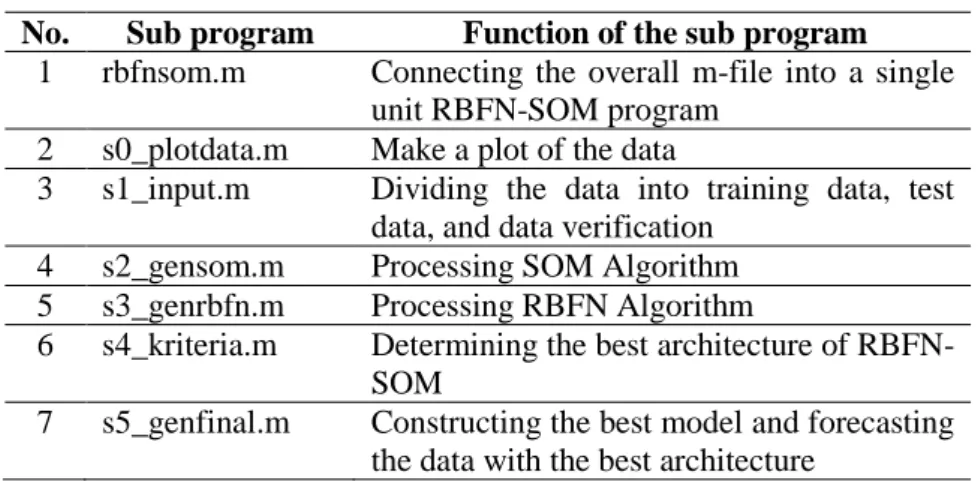
in the sub-section 2.1. The programming codes is written manually in the form of *.m file. List of RBFN-SOM sub program is shown in Table 1.
2.3. Forecasting JKSE Using RBFN-SOM. Index of JKSE’s data used in this study is
daily data on the period April 12, 2011 until April 24, 2012. It was taken from finance.yahoo.com. In the Figure 2, it is shown that index of JKSE has a fluctuative pattern. It has been proven by RESET on Warsito and Ispriyanti [6], with the RESET test value of 2,7688 is greater then F value of 0,3928, so we can say that index of JKSE is nonlinear time series.
Table 1. Sub program RBFN-SOM and its function
No. Sub program Function of the sub program
1 rbfnsom.m Connecting the overall m-file into a single unit RBFN-SOM program
2 s0_plotdata.m Make a plot of the data
3 s1_input.m Dividing the data into training data, test data, and data verification
4 s2_gensom.m Processing SOM Algorithm 5 s3_genrbfn.m Processing RBFN Algorithm
6 s4_kriteria.m Determining the best architecture of RBFN-SOM
7 s5_genfinal.m Constructing the best model and forecasting the data with the best architecture
Index of JKSE data is used as the training data to construct RBFN-SOM models, and the testing data to calculate the value of AIC for each available architectures. From all possible existing architectures, minimum AIC values is reached for the architecture with
1 input neuron and 10 centers neuron. Furthermore, SOM and RBFN optimum weights are calculated according to the best architecture using a combination of training and
Seminar Nasional Matematika 2012 269 Prosiding
Forecasting Index of Jakarta Stock Exchange Using Radial Basis Function Network-Self Organizing Map
Figure 2. Time series plot of JKSE
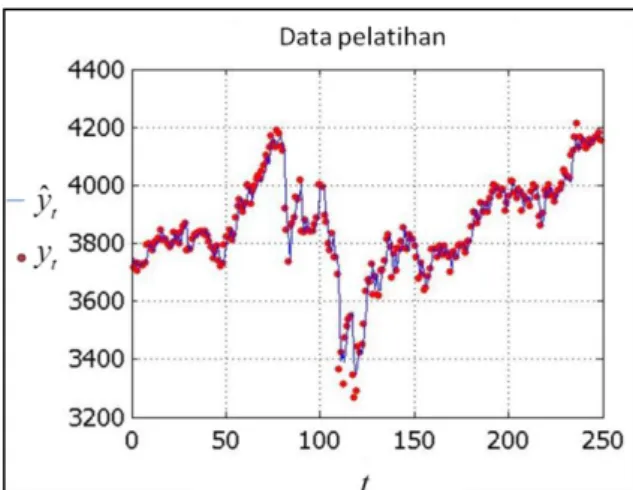
RBFN-SOM program results 2 outputs, they are plots of fitting model (see Figure 3), the optimum SOM weights and the RBFN optimum weights (see table 2).
Figure 3. RBFN-SOM program outputs of the combined data Table 2. Optimum SOM weights and the RBFN optimum weights
k v1,k w bias -2871,55 1 3443,878 k =1 -87694,8 2 3822,004 k =2 -802621 3 4144,605 k =3 24447,17 4 3320,668 k =4 24733,81 5 3674,911 k =5 -334488 6 3904,726 k =6 430493,2 7 3759,344 k =7 764395,2 8 3990,984 k =8 -144842 9 3529,966 k =9 145414,2
Seminar Nasional Matematika 2012 270 Prosiding
Forecasting Index of Jakarta Stock Exchange Using Radial Basis Function Network-Self Organizing Map
The best model of RBFN-SOM is applied to the verification data to predict the data in one next period. Forecasting value of JKSE Index at the next period is 4160,81, which is almost the same as the real data 4169,99.
3. CONCLUSION
From the results of the discussion, it can be concluded that the architecture of optimal RBFN is 1-9-1 based on the value of Akaike Information Criterion. In this research, it showed that forecast value of nonlinear time series of JKSE Index using RBFN-SON is almost the same as the real one.
REFERENCES
[1] Jakarta Stock Exchange, http://finance.yahoo.com/q/hp?s=^JKSE+Historical+Prices, downloaded at 24 April 2012.
[2] Haykin, S. (1999). Neural Network A Comprehensive Foundation Second Edition. Printice-Hall Inc, New Jersey, USA.
[3] Kohonen, T. (1990). The Self Organizing-Map. Proceedings of the Institute of Electrical and Electronics Engineers, vol. 78, pp: 1464 – 1480. (Finland, 9 September 1990).
[4] Lin, G. F. dan Chen L. H. (2005). Time Series Forecasting by Combining The Radial Basis Function Network and Self-Organizing Map. Hydrol Process, vol. 19, pp: 1925-1937.
[5] Phancal, G., A. Ganatra, dan Kosta Y. P., (2010). Searching Most Efficient Neural Network Architecture Using Akaike’s Information Criterion (AIC). International Journal of Computer Applications, vol. 1, pp: 41 – 44.
[6] Warsito, B. dan Ispriyanti D. (2004). Uji Linearitas Data Time Series dengan Reset Test. Jurnal Matematika dan Komputer, vol. 7, pp: 36 – 44.