The Law, Corporate
Finance, and Management
This is the book The Law, Corporate Finance, and Management (v. 1.0).
This book is licensed under a Creative Commons by-nc-sa 3.0 (http://creativecommons.org/licenses/by-nc-sa/ 3.0/) license. See the license for more details, but that basically means you can share this book as long as you credit the author (but see below), don't make money from it, and do make it available to everyone else under the same terms.
This book was accessible as of December 29, 2012, and it was downloaded then by Andy Schmitz (http://lardbucket.org) in an effort to preserve the availability of this book.
Normally, the author and publisher would be credited here. However, the publisher has asked for the customary Creative Commons attribution to the original publisher, authors, title, and book URI to be removed. Additionally, per the publisher's request, their name has been removed in some passages. More information is available on this project's attribution page (http://2012books.lardbucket.org/attribution.html?utm_source=header).
About the Authors
... 1
Acknowledgments
... 5
Preface
... 6
Chapter 1: Introduction to Law and Legal Systems
... 8
What Is Law?... 9
Schools of Legal Thought ... 11
Basic Concepts and Categories of US Positive Law ... 17
Sources of Law and Their Priority... 23
Legal and Political Systems of the World ... 32
A Sample Case... 34
Summary and Exercises ... 40
Chapter 2: Corporate Social Responsibility and Business Ethics
... 44
What Is Ethics? ... 46
Major Ethical Perspectives... 52
An Ethical Decision Model... 63
Corporations and Corporate Governance... 66
Summary and Exercises ... 78
Chapter 3: Courts and the Legal Process
... 83
The Relationship between State and Federal Court Systems in the United States ...85
The Problem of Jurisdiction... 92
Motions and Discovery ... 111
The Pretrial and Trial Phase ... 114
Judgment, Appeal, and Execution ... 120
When Can Someone Bring a Lawsuit?... 124
Relations with Lawyers... 127
Alternative Means of Resolving Disputes ... 130
Chapter 4: Constitutional Law and US Commerce
... 141
Basic Aspects of the US Constitution ... 142
The Commerce Clause ... 147
Dormant Commerce Clause... 154
Preemption: The Supremacy Clause ... 159
Business and the Bill of Rights... 163
Cases ... 173
Summary and Exercises ... 195
Chapter 5: Administrative Law
... 200
Administrative Agencies: Their Structure and Powers ... 201
Controlling Administrative Agencies... 209
The Administrative Procedure Act ... 212
Administrative Burdens on Business Operations ... 215
The Scope of Judicial Review ... 219
Cases ... 224
Summary and Exercises ... 231
Chapter 6: Criminal Law
... 236
The Nature of Criminal Law... 237
Types of Crimes ... 240
The Nature of a Criminal Act ... 250
Responsibility ... 254
Procedure... 257
Constitutional Rights of the Accused... 260
Cases ... 264
Summary and Exercises ... 271
Chapter 7: Introduction to Tort Law
... 276
Purpose of Tort Laws ... 277
Intentional Torts ... 283
Negligence ... 292
Strict Liability... 300
Cases ... 304
Summary and Exercises ... 316
Chapter 8: Contracts
... 320
General Perspectives on Contracts ... 321
Contract Formation ... 332
Remedies ... 340
Cases ... 346
Duties between Agent and Principal... 371
Cases ... 384
Summary and Exercises ... 399
Chapter 10: Liability of Principal and Agent; Termination of Agency
... 404
Principal’s Contract Liability ... 405
Principal’s Tort and Criminal Liability ... 411
Agent’s Personal Liability for Torts and Contracts; Termination of Agency...419
Cases ... 425
Summary and Exercises ... 437
Chapter 11: Partnerships: General Characteristics and Formation
... 442
Introduction to Partnerships and Entity Theory ... 443
Partnership Formation... 449
Cases ... 458
Summary and Exercises ... 471
Chapter 12: Partnership Operation and Termination
... 476
Operation: Relations among Partners... 477
Operation: The Partnership and Third Parties ... 488
Dissolution and Winding Up ... 494
Cases ... 506
Summary and Exercises ... 522
Chapter 13: Hybrid Business Forms
... 529
Limited Partnerships ... 531
Limited Liability Companies ... 539
Other Forms... 546
Cases ... 551
Summary and Exercises ... 560
Chapter 14: Corporation: General Characteristics and Formation
... 566
Historical Background... 567
Partnerships versus Corporations... 571
The Corporate Veil: The Corporation as a Legal Entity ... 574
Classifications of Corporations... 579
Corporate Organization... 582
Effect of Organization... 589
Cases ... 591
Chapter 15: Legal Aspects of Corporate Finance
... 610
General Sources of Corporate Funds... 611
Bonds... 614
Types of Stock... 617
Initial Public Offerings and Consideration for Stock ... 623
Dividends ... 627
The Winds of Change ... 632
Cases ... 635
Summary and Exercises ... 642
Chapter 16: Corporate Powers and Management
... 647
Powers of a Corporation... 648
Rights of Shareholders ... 653
Duties and Powers of Directors and Officers... 660
Liability of Directors and Officers ... 664
Cases ... 676
Summary and Exercises ... 685
Chapter 17: Securities Regulation
... 691
The Nature of Securities Regulation ... 692
Liability under Securities Law ... 701
Cases ... 708
Summary and Exercises ... 716
Chapter 18: Corporate Expansion, State and Federal Regulation of Foreign
Corporations, and Corporate Dissolution
... 720
Corporate Expansion ... 721
Foreign Corporations... 728
Dissolution ... 732
Cases ... 735
Summary and Exercises ... 741
Chapter 19: Nature and Form of Commercial Paper
... 746
Introduction to Commercial Paper ... 747
Scope of Article 3 and Types of Commercial Paper and Parties ... 754
Requirements for Negotiability... 761
Cases ... 767
Indorsements... 788
Problems and Issues in Negotiation... 795
Cases ... 801
Summary and Exercises ... 817
Chapter 21: Holder in Due Course and Defenses
... 822
Holder in Due Course... 823
Defenses and Role in Consumer Transactions ... 831
Cases ... 838
Summary and Exercises ... 852
Chapter 22: Liability and Discharge
... 857
Liability Imposed by Signature: Agents, Authorized and Unauthorized ...858
Contract Liability of Parties ... 862
Warranty Liability of Parties ... 869
Discharge ... 874
Cases ... 879
Summary and Exercises ... 896
Chapter 23: Legal Aspects of Banking
... 902
Banks and Their Customers ... 903
Electronic Funds Transfers ... 914
Wholesale Transactions and Letters of Credit ... 920
Cases ... 927
Summary and Exercises ... 941
Chapter 24: Consumer Credit Transactions
... 946
Entering into a Credit Transaction ... 948
Consumer Protection Laws and Debt Collection Practices ... 957
Cases ... 963
Summary and Exercises ... 973
Chapter 25: Secured Transactions and Suretyship
... 978
Introduction to Secured Transactions... 979
Priorities ... 998
Rights of Creditor on Default and Disposition after Repossession ... 1006
Suretyship... 1011
Cases ... 1019
Chapter 26: Mortgages and Nonconsensual Liens
... 1036
Uses, History, and Creation of Mortgages ... 1037
Priority, Termination of the Mortgage, and Other Methods of Using Real Estate as Security...1044
Nonconsensual Lien ... 1052
Cases ... 1056
Summary and Exercises ... 1073
Chapter 27: Bankruptcy
... 1078
Introduction to Bankruptcy and Overview of the 2005 Bankruptcy Act ... 1079
Case Administration; Creditors’ Claims; Debtors’ Exemptions and Dischargeable Debts; Debtor’s Estate ... 1085
Chapter 7 Liquidation ... 1098
Chapter 11 and Chapter 13 Bankruptcies... 1104
Alternatives to Bankruptcy... 1110
Cases ... 1113
Don Mayer
Don Mayer teaches law, ethics, public policy, and sustainability at the Daniels College of Business, University of Denver, where he is professor in
residence. His research focuses on the role of business in creating a more just, sustainable, peaceful, and productive world. With James O’Toole, Professor Mayer has coedited and contributed content toGood Business: Exercising Effective and Ethical Leadership(Routledge, 2010). He is also coauthor ofInternational Business Law: Cases and Materials, which is in its fifth edition with Pearson Publishing Company. He recently served as the first Arsht Visiting Ethics Scholar at the University of Miami.
After earning a philosophy degree from Kenyon College and a law degree from Duke University Law School, Professor Mayer served as a Judge Advocate General’s (JAG) Corps officer in the United States Air Force during the Vietnam conflict and went into private practice in North Carolina. In 1985, he earned his LLM in international and comparative law at the Georgetown University Law Center. Later that year, he began his academic career at Western Carolina University and proceeded to become a full professor at Oakland University in Rochester, Michigan, where he taught for many years before moving to the University of Denver. He has taught as a visitor at California State Polytechnic University, the University of Michigan, the Manchester Business School Worldwide, and Antwerp Management School.
Daniel M. Warner
Daniel M. Warner is a magna cum laude graduate of the University of Washington, where—following military service—he also attended law school. In 1978, after several years of civil practice, he joined the faculty at the College of Business and Economics at Western Washington University, where he is now a professor of business legal studies in the Accounting Department. He has published extensively, exploring the intersection of popular culture and the law, and has received the College of Business Dean’s Research Award five times for “distinguished contributions in published research.” Professor Warner served on the Whatcom County Council for eight years (two years as its chair). He has
served on the Faculty Senate and on various university and college committees, including as chairman of the University Master Plan Committee. Professor Warner has also been active in state bar association committee work and in local politics, where he has served on numerous boards and commissions for over thirty years.
George J. Siedel
George J. Siedel’s research addresses legal issues that relate to international business law, negotiation, and dispute resolution. Recent publications focus on proactive law and the use of law to gain competitive advantage. His work in progress includes research on the impact of litigation on large corporations and the use of electronic communication as evidence in litigation.
Professor Siedel has been admitted to practice before the United States Supreme Court and in Michigan, Ohio, and Florida. Following graduation from law school, he
worked as an attorney in a professional corporation. He has also served on several boards of directors and as associate dean of the University of Michigan Business School.
The author of numerous books and articles, Professor Siedel has received several research awards, including the Faculty Recognition Award from the University of Michigan and the following awards from the Academy of Legal Studies in Business: the Hoeber Award, the Ralph Bunche Award, and the Maurer Award. The Center for
International Business Education and Research selected a case written by Professor Siedel for its annual International Case Writing Award. His research has been cited by appellate courts in the United States and abroad, including the High Court of Australia.
Professor Siedel has served as visiting professor of business law at Stanford
University, visiting professor of business administration at Harvard University, and Parsons fellow at the University of Sydney. He has been elected a visiting fellow at Cambridge University’s Wolfson College and a life fellow of the Michigan State Bar Foundation. As a Fulbright scholar, Professor Siedel held a distinguished chair in the humanities and social sciences.
Jethro K. Lieberman
Jethro K. Lieberman is professor of law and vice president for academic publishing at New York Law School, where he has taught for more than twenty-five years. He earned his BA in politics and economics from Yale University, his JD from Harvard Law School, and his PhD in political science from Columbia University. He began his teaching career at Fordham University School of Law. Before that, he was vice president at what is now the International Institute for Conflict Prevention and Resolution (CPR). For nearly ten years, he was legal affairs editor ofBusiness Weekmagazine. He practiced antitrust and trade regulation law at a large Washington law firm and was on active duty as a member of the
Navy’s Judge Advocate General’s (JAG) Corps during the Vietnam era. He is the author ofThe Litigious Society(Basic Books), the winner of the American Bar Association’s top literary prize, the Silver Gavel, and the author ofA Practical
Companion to the Constitution: How the Supreme Court Has Ruled on Issues from Abortion to Zoning(University of California Press), among many other books. He is a long-time letterpress printer and proprietor of The Press at James Pond, a private press, and owner of the historic Kelmscott-Goudy Press, an Albion handpress that was used to print the Kelmscott Press edition of Geoffrey Chaucer’sCanterbury Talesin the 1890s.
Alyssa Rose Martina (Contributing Author)
nation’s largest state judicial circuits. As a dedicated entrepreneur, she saw an opportunity to fill a void for parents and established a family magazine. Today, more than 263,000 readers rely onMetro Parentas their “parenting bible.” Alyssa’s company, Metro Parent Publishing Group, also produces several ancillary
publications:Metro Baby, a biannual pregnancy resource guide;Going Places, a biannual guide to family fun in Southeast Michigan;Party Book, an event planning resource guide; andSpecial Edition, a resource for parents regarding children with special needs. To offer support and resources to African American families, Alyssa saw an opportunity to establish a second publishing company catered to the African American market. In 1999, the company was launched and today,BLAC Magazine, which covers “Black Life, Arts and Culture,” reaches over sixty thousand readers in the Detroit region. This monthly lifestyle publication explores and celebrates the rich cultural fabric of African American life in southeast Michigan, under the guidance of African American community leaders and educators and a distinguished panel of advisors who form an advisory council.
Alyssa presents lectures and workshops to various business and community groups around the country on topics such as innovation, strategy, entrepreneurship, and next-level thinking. She also serves as a consultant on events marketing for several of her sister publications throughout the country. In April 2010, Alyssa received her MBA with highest distinction from the University of Michigan’s Ross School of Business. She has guest-lectured on entrepreneurial/legal issues at Ross and has also served as a teaching assistant. She has written a number of parenting articles and a children’s book, and she was a weekly columnist for theDetroit News. Alyssa has served as an editor and reviewer for several business law articles and
manuscripts. Alyssa teaches at Walsh School of Business as an adjunct professor. Her course is focused on legal issues in business for MBA students.
The authors would like to thank the following colleagues who have reviewed the text and provided comprehensive feedback and suggestions for improving the material:
• Jennifer Barger Johnson, University of Central Oklahoma • Dawn M. Bradanini, Lincoln College
• Larry Bumgardner, Pepperdine University
• Michael Edward Chaplin, California State University–Northridge • Nigel Cohen, University of Texas–Pan American
• Mark Edison, North Central College • Mark Gideon, University of Maryland
• Henry J. Hastings, Eastern Michigan University • Henry Lowenstein, Coastal Carolina University • Tanya Marcum, Bradley University
• Harry McCracken, California Lutheran University • Robert Miller, Dominican University
• Leon Moerson, George Washington University • Tonia Hat Murphy, University of Notre Dame
• Bart Pachino, California State University–Northridge • Kimber J. Palmer, Texas A&M University–International • Lawrence Price, Saint Mary’s University of Minnesota • Kurt Saunders, California State University–Northridge • Ron Washburn, Bryant University
Preface
Our goal is to provide students with a textbook that is up to date and
comprehensive in its coverage of legal and regulatory issues—and organized to permit instructors to tailor the materials to their particular approach. This book engages students by relating law to everyday events with which they are already familiar (or with which they are familiarizing themselves in other business courses) and by its clear, concise, and readable style. (An earlier business law text by authors Lieberman and Siedel was hailed “the best written text in a very crowded field.”)
This textbook provides context and essential concepts across the entire range of legal issues with which managers and business executives must grapple. The text provides the vocabulary and legal acumen necessary for businesspeople to talk in an educated way to their customers, employees, suppliers, government
officials—and to their own lawyers.
Traditional publishers often create confusion among customers in the text selection process by offering a huge array of publications. Once a text is selected, customers might still have to customize the text to meet their needs. For example, publishers usually offer books that include either case summaries or excerpted cases, but some instructors prefer to combine case summaries with a few excerpted cases so that students can experience reading original material. Likewise, the manner in which most conventional texts incorporate video is cumbersome because the videos are contained in a separate library, which makes access more complicating for instructors and students.
TheUnnamed Publishermodel eliminates the need for “families” of books (such as the ten Miller texts mentioned below) and greatly simplifies text selection.
Instructors have only to select between ourLegal Aspects of Corporate Management and Financevolumes of the text and then click on the features they want (as opposed to trying to compare the large number of texts and packages offered by other
publishers). In addition to the features inherent in any Flat World publication, this book offers these unique features:
• Cases are available in excerpted and summarized format, thus enabling instructors to easily “mix and match” excerpted cases with case
summaries.
various sections of the Uniform Commercial Code, which is available at
http://www.law.cornell.edu/ucc/ucc.table.html.
• Likewise, many sample legal forms are readily available online. For example, the chapter on employment law refers to the type of terms commonly found in a standard employment agreement, examples of which can be found at http://www.rocketlawyer.com/popular-legal-forms.rl?utm_source=103&campaign=
Alpha+Search&keyword=online%2520legal%2520forms&mtype=e&ad=1 2516463025&docCategoryId=none&gclid=
CI3Wgeiz7q8CFSoZQgodIjdn2g.
• Every chapter contains overviews that include the organization and coverage, a list of key terms, chapter summaries, and self-test questions in multiple-choice format (along with answers) that are followed by additional problems with answers available in the Instructors’ Manual.
Chapter 1
Introduction to Law and Legal Systems
L E A R N I N G O B J E C T I V E S
After reading this chapter, you should be able to do the following:
1. Distinguish different philosophies of law—schools of legal thought—and explain their relevance.
2. Identify the various aims that a functioning legal system can serve. 3. Explain how politics and law are related.
4. Identify the sources of law and which laws have priority over other laws. 5. Understand some basic differences between the US legal system and
other legal systems.
1.1 What Is Law?
Lawis a word that means different things at different times.Black’s Law Dictionary
says that law is “a body of rules of action or conduct prescribed by controlling authority, and having binding legal force. That which must be obeyed and followed by citizens subject to sanctions or legal consequence is a law.”Black’s Law Dictionary, 6th ed., s.v. “law.”
Functions of the Law
In a nation, the law can serve to (1) keep the peace, (2) maintain the status quo, (3) preserve individual rights, (4) protect minorities against majorities, (5) promote social justice, and (6) provide for orderly social change. Some legal systems serve these purposes better than others. Although a nation ruled by an authoritarian government may keep the peace and maintain the status quo, it may also oppress minorities or political opponents (e.g., Burma, Zimbabwe, or Iraq under Saddam Hussein). Under colonialism, European nations often imposed peace in countries whose borders were somewhat arbitrarily created by those same European nations. Over several centuries prior to the twentieth century, empires were built by Spain, Portugal, Britain, Holland, France, Germany, Belgium, and Italy. With regard to the functions of the law, the empire may have kept the peace—largely with force—but it changed the status quo and seldom promoted the native peoples’ rights or social justice within the colonized nation.
In nations that were former colonies of European nations, various ethnic and tribal factions have frequently made it difficult for a single, united government to rule effectively. In Rwanda, for example, power struggles between Hutus and Tutsis resulted in genocide of the Tutsi minority. (Genocide is the deliberate and systematic killing or displacement of one group of people by another group. In 1948, the international community formally condemned the crime of genocide.) In nations of the former Soviet Union, the withdrawal of a central power created power vacuums that were exploited by ethnic leaders. When Yugoslavia broke up, the different ethnic groups—Croats, Bosnians, and Serbians—fought bitterly for home turf rather than share power. In Iraq and Afghanistan, the effective blending of different groups of families, tribes, sects, and ethnic groups into a national governing body that shares power remains to be seen.
Law and Politics
diverse group of nongovernment organizations (NGOs) such as the American Petroleum Institute, the Sierra Club, and the National Rifle Association. In the fifty states, judges are often appointed by governors or elected by the people. The process of electing state judges has become more and more politicized in the past fifteen years, with growing campaign contributions from those who would seek to seat judges with similar political leanings.
In the federal system, judges are appointed by an elected official (the president) and confirmed by other elected officials (the Senate). If the president is from one party and the other party holds a majority of Senate seats, political conflicts may come up during the judges’ confirmation processes. Such a division has been fairly frequent over the past fifty years.
In mostnation-states1(as countries are called in international law), knowing who has power to make and enforce the laws is a matter of knowing who has political power; in many places, the people or groups that have military power can also command political power to make and enforce the laws. Revolutions are difficult and contentious, but each year there are revolts against existing political-legal authority; an aspiration for democratic rule, or greater “rights” for citizens, is a recurring theme in politics and law.
K E Y T A K E A W A Y
Law is the result of political action, and the political landscape is vastly different from nation to nation. Unstable or authoritarian governments often fail to serve the principal functions of law.
E X E R C I S E S
1. Consider Burma (named Myanmar by its military rulers). What political rights do you have that the average Burmese citizen does not?
2. What is a nongovernment organization, and what does it have to do with government? Do you contribute to (or are you active in) a
nongovernment organization? What kind of rights do they espouse, what kind of laws do they support, and what kind of laws do they oppose?
1. The basic entities that comprise the international legal system.Countries,states, andnationsare all roughly synonymous.Statecan also be used to designate the basic units of federally united states, such as in the United States of America, which is a nation-state.
1.2 Schools of Legal Thought
L E A R N I N G O B J E C T I V E S
1. Distinguish different philosophies of law—schools of legal thought—and explain their relevance.
2. Explain why natural law relates to the rights that the founders of the US political-legal system found important.
3. Describe legal positivism and explain how it differs from natural law. 4. Differentiate critical legal studies and ecofeminist legal perspectives
from both natural law and legal positivist perspectives.
There are different schools (or philosophies) concerning what law is all about. Philosophy of law is also calledjurisprudence2, and the two main schools arelegal positivism3andnatural law4. Although there are others (seeSection 1.2.3 "Other Schools of Legal Thought"), these two are the most influential in how people think about the law.
Legal Positivism: Law as Sovereign Command
As legal philosopher John Austin concisely put it, “Law is the command of a
sovereign.” Law is only law, in other words, if it comes from a recognized authority and can be enforced by that authority, orsovereign5—such as a king, a president,
or a dictator—who has power within a defined area or territory. Positivism is a philosophical movement that claims that science provides the only knowledge precise enough to be worthwhile. But what are we to make of the social phenomena of laws?
We could examine existingstatutes6—executive orders, regulations, or judicial decisions—in a fairly precise way to find out what the law says. For example, we could look at the posted speed limits on most US highways and conclude that the “correct” or “right” speed is no more than fifty-five miles per hour. Or we could look a little deeper and find out how the written law is usually applied. Doing so, we might conclude that sixty-one miles per hour is generally allowed by most state troopers, but that occasionally someone gets ticketed for doing fifty-seven miles per hour in a fifty-five miles per hour zone. Either approach is empirical, even if not rigorously scientific. The first approach, examining in a precise way what the rule itself says, is sometimes known as the “positivist” school of legal thought. The second approach—which relies on social context and the actual behavior of the 2. The philosophy of law. There
principal actors who enforce the law—is akin to the “legal realist” school of thought (seeSection 1.2.3 "Other Schools of Legal Thought").
Positivism has its limits and its critics. New Testament readers may recall that King Herod, fearing the birth of a Messiah, issued a decree that all male children below a certain age be killed. Because it was the command of a sovereign, the decree was carried out (or, in legal jargon, the decree was “executed”). Suppose a group seizes power in a particular place and commands that women cannot attend school and can only be treated medically by women, even if their condition is life-threatening and women doctors are few and far between. Suppose also that this command is carried out, just because it is the law and is enforced with a vengeance. People who live there will undoubtedly question the wisdom, justice, or goodness of such a law, but it is law nonetheless and is generally carried out. To avoid the law’s impact, a citizen would have to flee the country entirely. During the Taliban rule in
Afghanistan, from which this example is drawn, many did flee.
The positive-law school of legal thought would recognize the lawmaker’s command as legitimate; questions about the law’s morality or immorality would not be important. In contrast, the natural-law school of legal thought would refuse to recognize the legitimacy of laws that did not conform to natural, universal, or divine law. If a lawmaker issued a command that was in violation of natural law, a citizen would be morally justified in demonstrating civil disobedience. For example, in refusing to give up her seat to a white person, Rosa Parks believed that she was refusing to obey an unjust law.
Natural Law
The natural-law school of thought emphasizes that law should be based on a universal moral order. Natural law was “discovered” by humans through the use of reason and by choosing between that which is good and that which is evil. Here is the definition of natural law according to theCambridge Dictionary of Philosophy: “Natural law, also called the law of nature in moral and political philosophy, is an objective norm or set of objective norms governing human behavior, similar to the positive laws of a human ruler, but binding on all people alike and usually
understood as involving a superhuman legislator.”Cambridge Dictionary of Philosophy, s.v. “natural law.”
Both the US Constitution and the United Nations (UN) Charter have an affinity for the natural-law outlook, as it emphasizes certain objective norms and rights of individuals and nations. The US Declaration of Independence embodies a natural-law philosophy. The following short extract should provide some sense of the deep beliefs in natural law held by those who signed the document.
The Unanimous Declaration of the Thirteen United States
of America
July 4, 1776
When in the Course of human events, it becomes necessary for one people to dissolve the political bands which have connected them with another, and to assume among the powers of the earth, the separate and equal station to which the Laws of Nature and of Nature’s God entitle them, a decent respect to the opinions of mankind requires that they should declare the causes which impel them to the separation.
We hold these truths to be self-evident, that all men are created equal, that they are endowed by their Creator with certain unalienable Rights, that among these are Life, Liberty and the Pursuit of Happiness. That to secure these rights, Governments are instituted among Men, deriving their just powers from the consent of the governed.…
The natural-law school has been very influential in American legal thinking. The idea that certain rights, for example, are “unalienable” (as expressed in the Declaration of Independence and in the writings of John Locke) is consistent with this view of the law. Individuals may have “God-given” or “natural” rights that government cannot legitimately take away. Government only by consent of the governed is a natural outgrowth of this view.
Civil disobedience—in the tradition of Henry Thoreau, Mahatma Gandhi, or Martin Luther King Jr.—becomes a matter of morality over “unnatural” law. For example, in his “Letter from Birmingham Jail,” Martin Luther King Jr. claims that obeying an unjust law is not moral and that deliberately disobeying an unjust law is in fact a moral act that expresses “the highest respect for law”: “An individual who breaks a law that conscience tells him is unjust, and who willingly accepts the penalty of imprisonment in order to arouse the conscience of the community over its injustice, is in reality expressing the highest respect for law.…One who breaks an unjust law must do so openly, lovingly, and with a willingness to accept the penalty.”Martin Luther King Jr., “Letter from Birmingham Jail.”
effectively learn by just looking at what the written law says, or by examining how it has been applied. In response, natural-law thinkers would argue that if we care about justice, every law and every legal system must be held accountable to some higher standard, however hard that may be to define.
It is easier to know what the law “is” than what the law “should be.” Equal employment laws, for example, have specific statutes, rules, and decisions about racial discrimination. There are always difficult issues of interpretation and
decision, which is why courts will resolve differing views. But how can we know the more fundamental “ought” or “should” of human equality? For example, how do we
knowthat “all men are created equal” (from the Declaration of Independence)? Setting aside for the moment questions about the equality of women, or that of slaves, who were not counted as men with equal rights at the time of the
declaration—can the statement be empirically proven, or is it simply a matter of a priori knowledge? (A priorimeans “existing in the mind prior to and independent of experience.”) Or is the statement about equality a matter of faith or belief, not really provable either scientifically or rationally? The dialogue between natural-law theorists and more empirically oriented theories of “what law is” will raise similar questions. In this book, we will focus mostly on the law as it is, but not without also raising questions about what it could or should be.
Other Schools of Legal Thought
The historical school of law believes that societies should base their legal decisions today on the examples of the past. Precedent would be more important than moral arguments.
The legal realist school flourished in the 1920s and 1930s as a reaction to the historical school. Legal realists pointed out that because life and society are
constantly changing, certain laws and doctrines have to be altered or modernized in order to remain current. The social context of law was more important to legal realists than the formal application of precedent to current or future legal disputes. Rather than suppose that judges inevitably acted objectively in applying an existing rule to a set of facts, legal realists observed that judges had their own beliefs, operated in a social context, and would give legal decisions based on their beliefs and their own social context.
The legal realist view influenced the emergence of the critical legal studies (CLS) school of thought. The “Crits” believe that the social order (and the law) is dominated by those with power, wealth, and influence. Some Crits are clearly influenced by the economist Karl Marx and also by distributive justice theory (see
Chapter 2 "Corporate Social Responsibility and Business Ethics"). The CLS school
believes the wealthy have historically oppressed or exploited those with less wealth and have maintained social control through law. In so doing, the wealthy have perpetuated an unjust distribution of both rights and goods in society. Law is politics and is thus not neutral or value-free. The CLS movement would use the law to overturn the hierarchical structures of domination in the modern society.
Related to the CLS school, yet different, is the ecofeminist school of legal thought. This school emphasizes—and would modify—the long-standing domination of men over both women and the rest of the natural world. Ecofeminists would say that the same social mentality that leads to exploitation of women is at the root of man’s exploitation and degradation of the natural environment. They would say that male ownership of land has led to a “dominator culture,” in which man is not so much a steward of the existing environment or those “subordinate” to him but is charged with making all that he controls economically “productive.” Wives, children, land, and animals are valued as economic resources, and legal systems (until the
nineteenth century) largely conferred rights only to men with land. Ecofeminists would say that even with increasing civil and political rights for women (such as the right to vote) and with some nations’ recognizing the rights of children and animals and caring for the environment, the legacy of the past for most nations still
confirms the preeminence of “man” and his dominance of both nature and women.
K E Y T A K E A W A Y
E X E R C I S E S
1. Vandana Shiva draws a picture of a stream in a forest. She says that in our society the stream is seen as unproductive if it is simply there, fulfilling the need for water of women’s families and communities, until engineers come along and tinker with it, perhaps damming it and using it for generating hydropower. The same is true of a forest, unless it is replaced with a monoculture plantation of a commercial species. A forest may very well be productive—protecting groundwater; creating oxygen; providing fruit, fuel, and craft materials for nearby inhabitants; and creating a habitat for animals that are also a valuable resource. She criticizes the view that if there is no monetary amount that can
contribute to gross domestic product, neither the forest nor the river can be seen as a productive resource. Which school of legal thought does her criticism reflect?
2. Anatole France said, “The law, in its majesty, forbids rich and poor alike from sleeping under bridges.” Which school of legal thought is
represented by this quote?
3. Adolf Eichmann was a loyal member of the National Socialist Party in the Third Reich and worked hard under Hitler’s government during World War II to round up Jewish people for incarceration—and eventual extermination—at labor camps like Auschwitz and Buchenwald. After an Israeli “extraction team” took him from Argentina to Israel, he was put on trial for “crimes against humanity.” His defense was that he was “just following orders.” Explain why Eichmann was not an adherent of the natural-law school of legal thought.
1.3 Basic Concepts and Categories of US Positive Law
L E A R N I N G O B J E C T I V E S
1. In a general way, differentiate contract law from tort law.
2. Consider the role of law in supporting ethical norms in our society. 3. Understand the differing roles of state law and federal law in the US
legal system.
4. Know the difference between criminal cases and civil cases.
Most of what we discuss in this book is positive law—US positive law in particular. We will also consider the laws and legal systems of other nations. But first, it will be useful to cover some basic concepts and distinctions.
Law: The Moral Minimums in a Democratic Society
The law does not correct (or claim to correct) every wrong that occurs in society. At a minimum, it aims to curb the worst kind of wrongs, the kinds of wrongs that violate what might be called the “moral minimums” that a community demands of its members. These include not only violations of criminal law (seeChapter 6 "Criminal Law") but also torts (seeChapter 7 "Introduction to Tort Law") and broken promises (seeChapter 8 "Contracts"). Thus it may be wrong to refuse to return a phone call from a friend, but that wrong will not result in a viable lawsuit against you. But if a phone (or the Internet) is used to libel or slander someone, a tort has been committed, and the law may allow the defamed person to be compensated.
There is a strong association between what we generally think of as ethical
property may be limited by law; I can’t, without the public’s permission, operate an incinerator on my property and burn heavy metals, as toxic ash may be deposited throughout the neighborhood.
The Common Law: Property, Torts, and Contracts
Even before legislatures met to make rules for society, disputes happened and judges decided them. In England, judges began writing down the facts of a case and the reasons for their decision. They often resorted to deciding cases on the basis of prior written decisions. In relying on those prior decisions, the judge would reason that since a current case was pretty much like a prior case, it ought to be decided the same way. This is essentially reasoning by analogy. Thus the use ofprecedent7
in common-law cases came into being, and a doctrine ofstare decisis8(pronounced STAR-ay-de-SIGH-sus) became accepted in English courts.Stare decisismeans, in Latin, “let the decision stand.”
Most judicial decisions that don’t apply legislative acts (known as statutes) will involve one of three areas of law—property, contract, or tort. Property law deals with the rights and duties of those who can legally own land (real property), how that ownership can be legally confirmed and protected, how property can be bought and sold, what the rights of tenants (renters) are, and what the various kinds of “estates” in land are (e.g., fee simple, life estate, future interest, easements, or rights of way). Contract law deals with what kinds of promises courts should enforce. For example, should courts enforce a contract where one of the parties was intoxicated, underage, or insane? Should courts enforce a contract where one of the parties seemed to have an unfair advantage? What kind of contracts would have to be in writing to be enforced by courts? Tort law deals with the types of cases that involve some kind of harm and or injury between the plaintiff and the defendant when no contract exists. Thus if you are libeled or a competitor lies about your product, your remedy would be in tort, not contract.
The thirteen original colonies had been using English common law for many years, and they continued to do so after independence from England. Early cases from the first states are full of references to already-decided English cases. As years went by, many precedents were established by US state courts, so that today a judicial opinion that refers to a seventeenth- or eighteenth-century English common-law case is quite rare.
Courts in one state may look to common-law decisions from the courts of other states where the reasoning in a similar case is persuasive. This will happen in “cases of first impression,” a fact pattern or situation that the courts in one state have never seen before. But if the supreme court in a particular state has already ruled 7. A prior judicial decision that is
either binding or persuasive, and as such, provides a rule useful in making a decision in the case at hand.
8. Latin, for “let the decision stand.” By keeping within the rule of a prior judicial decision, a court follows “precedent” by letting the prior decision govern the result in the case at hand.
on a certain kind of case, lower courts in that state will always follow the rule set forth by their highest court.
State Courts and the Domain of State Law
In the early years of our nation, federal courts were not as active or important as state courts. States had jurisdiction (the power to make and enforce laws) over the most important aspects of business life. The power of state law has historically included governing the following kinds of issues and claims:
• Contracts, including sales, commercial paper, letters of credit, and secured transactions
• Torts
• Property, including real property, bailments of personal property (such as when you check your coat at a theater or leave your clothes with a dry cleaner), trademarks, copyrights, and the estates of decedents (dead people)
• Corporations • Partnerships
• Domestic matters, including marriage, divorce, custody, adoption, and visitation
• Securities law • Environmental law
• Agency law, governing the relationship between principals and their agents.
• Banking • Insurance
Over the past eighty years, however, federal law has become increasingly important in many of these areas, including banking, securities, and environmental law.
Civil versus Criminal Cases
to the plaintiffs or when Pennzoil won a $10.54 billion verdict against Texaco (see
Chapter 7 "Introduction to Tort Law").
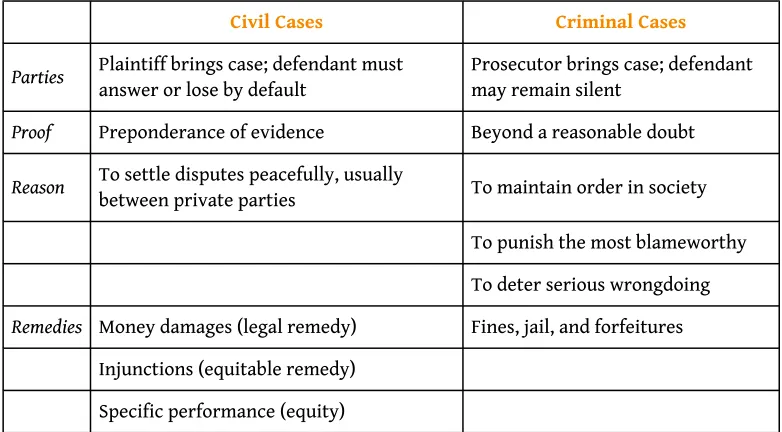
Some of the basic differences betweencivil law9andcriminal law10cases are illustrated inTable 1.1 "Differences between Civil and Criminal Cases".
Table 1.1 Differences between Civil and Criminal Cases
Civil Cases Criminal Cases
Parties Plaintiff brings case; defendant must answer or lose by default
Prosecutor brings case; defendant may remain silent
Proof Preponderance of evidence Beyond a reasonable doubt
Reason To settle disputes peacefully, usually
between private parties To maintain order in society To punish the most blameworthy To deter serious wrongdoing Remedies Money damages (legal remedy) Fines, jail, and forfeitures
Injunctions (equitable remedy) Specific performance (equity)
Regarding plaintiffs and prosecutors, you can often tell a civil case from a criminal case by looking at the caption of a case going to trial. If the government appears first in the caption of the case (e.g.,U.S. v. Lieberman, it is likely that the United States is prosecuting on behalf of the people. The same is true of cases prosecuted by state district attorneys (e.g.,State v. Seidel). But this is not a foolproof formula. Governments will also bring civil actions to collect debts from or settle disputes with individuals, corporations, or other governments. ThusU.S. v. Mayermight be a collection action for unpaid taxes, orU.S. v. Canadamight be a boundary dispute in the International Court of Justice. Governments can be sued, as well; people occasionally sue their state or federal government, but they can only get a trial if the government waives its sovereign immunity and allows such suits.Warner v. U.S., for example, could be a claim for a tax refund wrongfully withheld or for damage caused to the Warner residence by a sonic boom from a US Air Force jet flying overhead.
9. In contrast to criminal law, the law that governs noncriminal disputes, such as in lawsuits (as opposed to prosecutions) over contract disputes and tort claims. In contrast to common law, civil law is part of the continental European tradition dating back to Roman law.
10. That body of law in any nation-state that defines offenses against society as a whole, punishable by fines,
forfeitures, or imprisonment.
Substance versus Procedure
Many rules and regulations in law are substantive, and others are procedural. We are used to seeing laws as substantive; that is, there is some rule of conduct or behavior that is called for or some action that is proscribed (prohibited). The substantive rules tell us how to act with one another and with the government. For example, all of the following are substantive rules of law and provide a kind of command or direction to citizens:
• Drive not more than fifty-five miles per hour where that speed limit is posted.
• Do not conspire to fix prices with competitors in the US market. • Do not falsely represent the curative effects of your over-the-counter
herbal remedy.
• Do not drive your motor vehicle through an intersection while a red traffic signal faces the direction you are coming from.
• Do not discriminate against job applicants or employees on the basis of their race, sex, religion, or national origin.
• Do not discharge certain pollutants into the river without first getting a discharge permit.
In contrast, procedural laws are the rules of courts and administrative agencies. They tell us how to proceed if there is a substantive-law problem. For example, if you drive fifty-three miles per hour in a forty mile-per-hour zone on Main Street on a Saturday night and get a ticket, you have broken a substantive rule of law (the posted speed limit). Just how and what gets decided in court is a matter of procedural law. Is the police officer’s word final, or do you get your say before a judge? If so, who goes first, you or the officer? Do you have the right to be
represented by legal counsel? Does the hearing or trial have to take place within a certain time period? A week? A month? How long can the state take to bring its case? What kinds of evidence will be relevant? Radar? (Does it matter what kind of training the officer has had on the radar device? Whether the radar device had been tested adequately?) The officer’s personal observation? (What kind of training has he had, how is he qualified to judge the speed of a car, and other questions arise.) What if you unwisely bragged to a friend at a party recently that you went a
hundred miles an hour on Main Street five years ago at half past three on a Tuesday morning? (If the prosecutor knows of this and the “friend” is willing to testify, is it relevant to the charge of fifty-three in a forty-mile-per-hour zone?)
limit.) Federal laws must also be fair, because the Fifth Amendment to the US Constitution has the exact same due process language as the Fourteenth
Amendment. This suggests that some laws are more powerful or important than others, which is true. The next section looks at various types of positive law and their relative importance.
K E Y T A K E A W A Y
In most legal systems, like that in the United States, there is a fairly firm distinction between criminal law (for actions that are offenses against the entire society) and civil law (usually for disputes between individuals or corporations). Basic ethical norms for promise-keeping and not harming others are reflected in the civil law of contracts and torts. In the United States, both the states and the federal government have roles to play, and sometimes these roles will overlap, as in environmental standards set by both states and the federal government.
E X E R C I S E S
1. Jenna gets a ticket for careless driving after the police come to
investigate a car accident she had with you on Hanover Boulevard. Your car is badly damaged through no fault of your own. Is Jenna likely to face criminal charges, civil charges, or both?
2. Jenna’s ticket says that she has thirty days in which to respond to the charges against her. The thirty days conforms to a state law that sets this time limit. Is the thirty-day limit procedural law or substantive law?
1.4 Sources of Law and Their Priority
L E A R N I N G O B J E C T I V E S
1. Describe the different sources of law in the US legal system and the principal institutions that create those laws.
2. Explain in what way a statute is like a treaty, and vice versa. 3. Explain why the Constitution is “prior” and has priority over the
legislative acts of a majority, whether in the US Congress or in a state legislature.
4. Describe the origins of the common-law system and what common law means.
Sources of Law
In the United States today, there are numerous sources of law. The main ones are (1) constitutions—both state and federal, (2) statutes and agency regulations, and (3) judicial decisions. In addition, chief executives (the president and the various governors) can issue executive orders that have the effect of law.
In international legal systems, sources of law includetreaties11(agreements between states or countries) and what is known as customary international law (usually consisting of judicial decisions from national court systems where parties from two or more nations are in a dispute).
As you might expect, these laws sometimes conflict: a state law may conflict with a federal law, or a federal law might be contrary to an international obligation. One nation’s law may provide one substantive rule, while another nation’s law may provide a different, somewhat contrary rule to apply. Not all laws, in other words, are created equal. To understand which laws have priority, it is essential to understand the relationships between the various kinds of law.
Constitutions
Constitutions12are the foundation for a state or nation’s other laws, providing the country’s legislative, executive, and judicial framework. Among the nations of the world, the United States has the oldest constitution still in use. It is difficult to amend, which is why there have only been seventeen amendments following the 11. Formal agreements concluded
between nation-states.
first ten in 1789; two-thirds of the House and Senate must pass amendments, and three-fourths of the states must approve them.
The nation’s states also have constitutions. Along with providing for legislative, executive, and judicial functions, state constitutions prescribe various rights of citizens. These rights may be different from, and in addition to, rights granted by the US Constitution. Like statutes and judicial decisions, a constitution’s specific provisions can provide people with a “cause of action” on which to base a lawsuit (seeSection 1.4.3 "Causes of Action, Precedent, and "on “causes of action”). For example, California’s constitution provides that the citizens of that state have a right of privacy. This has been used to assert claims against businesses that invade an employee’s right of privacy. In the case of Virginia Rulon-Miller, her employer, International Business Machines (IBM), told her to stop dating a former colleague who went to work for a competitor. When she refused, IBM terminated her, and a jury fined the company for $300,000 in damages. As the California court noted, “While an employee sacrifices some privacy rights when he enters the workplace, the employee’s privacy expectations must be balanced against the employer’s interests.…[T]he point here is that privacy, like the other unalienable rights listed first in our Constitution…is unquestionably a fundamental interest of our
society.”Rulon-Miller v. International Business Machines Corp., 162 Cal. App.3d 241, 255 (1984).
Statutes and Treaties in Congress
In Washington, DC, the federal legislature is known as Congress and has both a House of Representatives and a Senate. The House is composed of representatives elected every two years from various districts in each state. These districts are established by Congress according to population as determined every ten years by the census, a process required by the Constitution. Each state has at least one district; the most populous state (California) has fifty-two districts. In the Senate, there are two senators from each state, regardless of the state’s population. Thus Delaware has two senators and California has two senators, even though California has far more people. Effectively, less than 20 percent of the nation’s population can send fifty senators to Washington.
Many consider this to be antidemocratic. The House of Representatives, on the other hand, is directly proportioned by population, though no state can have less than one representative.
Each Congressional legislative body has committees for various purposes. In these committees, proposed bills are discussed, hearings are sometimes held, and bills are either reported out (brought to the floor for a vote) or killed in committee. If a bill
is reported out, it may be passed by majority vote. Because of the procedural differences between the House and the Senate, bills that have the same language when proposed in both houses are apt to be different after approval by each body. A conference committee will then be held to try to match the two versions. If the two versions differ widely enough, reconciliation of the two differing versions into one acceptable to both chambers (House and Senate) is more difficult.
If the House and Senate can agree on identical language, the reconciled bill will be sent to the president for signature or veto. The Constitution prescribes that the president will have veto power over any legislation. But the two bodies can override a presidential veto with a two-thirds vote in each chamber.
In the case of treaties, the Constitution specifies that only the Senate must ratify them. When the Senate ratifies a treaty, it becomes part of federal law, with the same weight and effect as a statute passed by the entire Congress. The statutes of Congress are collected in codified form in the US Code. The code is available online athttp://uscode.house.gov.
Delegating Legislative Powers: Rules by Administrative Agencies
Congress has found it necessary and useful to create government agencies to administer various laws (seeChapter 5 "Administrative Law"). The Constitution does not expressly provide for administrative agencies, but the US Supreme Court has upheld the delegation of power to create federal agencies.
Examples of administrative agencies would include the Occupational Safety and Health Administration (OSHA), the Environmental Protection Agency (EPA), and the Federal Trade Commission (FTC).
It is important to note that Congress does not have unlimited authority to delegate its lawmaking powers to an agency. It must delegate its authority with some guidelines for the agency and cannot altogether avoid its constitutional responsibilities (seeChapter 5 "Administrative Law").
Agencies propose rules in the Federal Register, published each working day of the year. Rules that are formally adopted are published in theCode of Federal Regulations, or CFR, available online at
State Statutes and Agencies: Other Codified Law
Statutes are passed by legislatures and provide general rules for society. States have legislatures (sometimes called assemblies), which are usually made up of both a senate and a house of representatives. Like the federal government, state
legislatures will agree on the provisions of a bill, which is then sent to the governor (acting like the president for that state) for signature. Like the president, governors often have a veto power. The process of creating and amending, or changing, laws is filled with political negotiation and compromise.
On a more local level, counties and municipal corporations or townships may be authorized under a state’s constitution to create or adopt ordinances. Examples of ordinances include local building codes, zoning laws, and misdemeanors or
infractions such as skateboarding or jaywalking. Most of the more unusual laws that are in the news from time to time are local ordinances. For example, in Logan County, Colorado, it is illegal to kiss a sleeping woman; in Indianapolis, Indiana, and Eureka, Nebraska, it is a crime to kiss if you have a mustache. But reportedly, some states still have odd laws here and there. Kentucky law proclaims that every person in the state must take a bath at least once a year, and failure to do so is illegal.
Judicial Decisions: The Common Law
Common law13consists of decisions by courts (judicial decisions) that do not involve interpretation of statutes, regulations, treaties, or the Constitution. Courts make such interpretations, but many cases are decided where there is no statutory or other codified law or regulation to be interpreted. For example, a state court deciding what kinds of witnesses are required for a valid will in the absence of a rule (from a statute) is making common law.
United States law comes primarily from the tradition of English common law. By the time England’s American colonies revolted in 1776, English common-law traditions were well established in the colonial courts. English common law was a system that gave written judicial decisions the force of law throughout the country. Thus if an English court delivered an opinion as to what constituted the common-law crime of burglary, other courts would stick to that decision, so that a common body of law developed throughout the country. Common law is essentially
shorthand for the notion that a common body of law, based on past written decisions, is desirable and necessary.
In England and in the laws of the original thirteen states, common-law decisions defined crimes such as arson, burglary, homicide, and robbery. As time went on, US state legislatures either adopted or modified common-law definitions of most 13. Judicial decisions that do not
involve interpretation of statutes, regulations, treaties, or the Constitution.
crimes by putting them in the form of codes or statutes. This legislative ability—to modify or change common law into judicial law—points to an important
phenomenon: the priority of statutory law over common law. As we will see in the next section, constitutional law will have priority over statutory law.
Priority of Laws
The Constitution as Preemptive Force in US Law
The US Constitution takes precedence over all statutes and judicial decisions that are inconsistent. For example, if Michigan were to decide legislatively that students cannot speak ill of professors in state-sponsored universities, that law would be void, since it is inconsistent with the state’s obligation under the First Amendment to protect free speech. Or if the Michigan courts were to allow a professor to bring a lawsuit against a student who had said something about him that was derogatory but not defamatory, the state’s judicial system would not be acting according to the First Amendment. (As we will see inChapter 7 "Introduction to Tort Law", free speech has its limits; defamation was a cause of action at the time the First
Amendment was added to the Constitution, and it has been understood that the free speech rights in the First Amendment did not negate existing common law.)
Statutes and Cases
Statutes generally have priority, or take precedence, over case law (judicial decisions). Under common-law judicial decisions, employers could hire young children for difficult work, offer any wage they wanted, and not pay overtime work at a higher rate. But various statutes changed that. For example, the federal Fair Labor Standards Act (1938) forbid the use of oppressive child labor and established a minimum pay wage and overtime pay rules.
Treaties as Statutes: The “Last in Time” Rule
A treaty or convention is considered of equal standing to a statute. Thus when Congress ratified the North American Free Trade Agreement (NAFTA), any judicial decisions or previous statutes that were inconsistent—such as quotas or limitations on imports from Mexico that were opposite to NAFTA commitments—would no longer be valid. Similarly, US treaty obligations under the General Agreement on Tariffs and Trade (GATT) and obligations made later through the World Trade Organization (WTO) would override previous federal or state statutes.
for dolphins in the Eastern Tropical Pacific, and the United States began refusing to allow the importation of tuna that were caught using “dolphin-unfriendly”
methods (such as purse seining). This was challenged at a GATT dispute panel in Switzerland, and the United States lost. The discussion continued at the WTO under its dispute resolution process. In short, US environmental statutes can be ruled contrary to US treaty obligations.
Under most treaties, the United States can withdraw, or take back, any voluntary limitation on its sovereignty; participation in treaties is entirely elective. That is, the United States may “unbind” itself whenever it chooses. But for practical purposes, some limitations on sovereignty may be good for the nation. The
argument goes something like this: if free trade in general helps the United States, then it makes some sense to be part of a system that promotes free trade; and despite some temporary setbacks, the WTO decision process will (it is hoped) provide far more benefits than losses in the long run. This argument invokes utilitarian theory (that the best policy does the greatest good overall for society) and David Ricardo’s theory of comparative advantage.
Ultimately, whether the United States remains a supporter of free trade and continues to participate as a leader in the WTO will depend upon citizens electing leaders who support the process. Had Ross Perot been elected in 1992, for example, NAFTA would have been politically (and legally) dead during his term of office.
Causes of Action, Precedent, and
Stare Decisis
No matter how wrong someone’s actions may seem to you, the only wrongs you can right in a court are those that can be tied to one or morecauses of action14.
Positive law is full of cases, treaties, statutes, regulations, and constitutional provisions that can be made into a cause of action. If you have an agreement with Harold Hill that he will purchase seventy-six trombones from you and he fails to pay for them after you deliver, you will probably feel wronged, but a court will only act favorably on your complaint if you can show that his behavior gives you a cause of action based on some part of your state’s contract law. This case would give you a cause of action under the law of most states; unless Harold Hill had some legal excuse recognized by the applicable state’s contract law—such as his legal
incompetence, his being less than eighteen years of age, his being drunk at the time the agreement was made, or his claim that the instruments were trumpets rather than trombones or that they were delivered too late to be of use to him—you could expect to recover some compensation for his breaching of your agreement with him.
14. In a complaint, a legal basis on which a claim is predicated. The legal basis can be a Constitutional law, a statute, a regulation, or a prior judicial decision that creates a precedent to be followed.
An old saying in the law is that the law does not deal in trifles, or unimportant issues (in Latin,de minimis non curat lex). Not every wrong you may suffer in life will be a cause to bring a court action. If you are stood up for a Saturday night date and feel embarrassed or humiliated, you cannot recover anything in a court of law in the United States, as there is no cause of action (no basis in the positive law) that you can use in your complaint. If you are engaged to be married and your spouse-to-be bolts from the wedding ceremony, there are some states that do provide a legal basis on which to bring a lawsuit. “Breach of promise to marry” is recognized in several states, but most states have abolished this cause of action, either by judicial decision or by legislation. Whether a runaway bride or groom gives rise to a valid cause of action in the courts depends on whether the state courts still
recognize and enforce this now-disappearing cause of action.
Your cause of action is thus based on existing laws, including decided cases. How closely your case “fits” with a prior decided case raises the question of precedent.
As noted earlier in this chapter, the English common-law tradition placed great emphasis on precedent and what is calledstare decisis.A court considering one case would feel obliged to decide that case in a way similar to previously decided cases. Written decisions of the most important cases had been spread throughout England (the common “realm”), and judges hoped to establish a somewhat predictable, consistent group of decisions.
The English legislature (Parliament) was not in the practice of establishing detailed statutes on crimes, torts, contracts, or property. Thus definitions and rules were left primarily to the courts. By their nature, courts could only decide one case at a time, but in doing so they would articulate holdings, or general rules, that would apply to later cases.
Suppose that one court had to decide whether an employer could fire an employee for no reason at all. Suppose that there were no statutes that applied to the facts: there was no contract between the employer and the employee, but the employee had worked for the employer for many years, and now a younger person was
replacing him. The court, with no past guidelines, would have to decide whether the employee had stated a “cause of action” against the employer. If the court decided that the case was not legally actionable, it would dismiss the action. Future courts would then treat similar cases in a similar way. In the process, the court might make a holding that employers could fire employees for any reason or for no reason. This rule could be applied in the future should similar cases come up.
cover up the company's criminal or unethical act. Suppose that, as in earlier cases, there were no applicable statutes and no contract of employment. Courts relying on a holding or precedent that “employers may fire employees for any reason or no reason” might rule against an employee seeking compensation for being fired for telling the truth on the witness stand. Or it might make an exception to the general rule, such as, “Employers may generally discharge employees for any reason or for no reason without incurring legal liability; however, employers will incur legal liability for firing an employee who refuses to lie on behalf of the employer in a court proceeding.”
In each case (the general rule and its exception), the common-law tradition calls for the court to explain the reasons for its ruling. In the case of the general rule,
“freedom of choice” might be the major reason. In the case of the perjury
exception, the efficiency of the judicial system and the requirements of citizenship might be used as reasons. Because the court’s “reasons” will be persuasive to some and not to others, there is inevitably a degree of subjectivity to judicial opinions. That is, reasonable people will disagree as to the persuasiveness of the reasoning a court may offer for its decision.
Written judicial opinions are thus a good playing field for developing critical thinking skills by identifying the issue in a case and examining the reasons for the court’s previous decision(s), or holding. Whathasthe court actually decided, and why? Remember that a court, especially the US Supreme Court, is not only deciding one particular case but also setting down guidelines (in its holdings) for federal and state courts that encounter similar issues. Note that court cases often raise a variety of issues or questions to be resolved, and judges (and attorneys) will differ as to what the real issue in a case is. A holding is the court’s complete answer to an issue that is critical to deciding the case and thus gives guidance to the meaning of the case as a precedent for future cases.
Beyond the decision of the court, it is in looking at the court’sreasoningthat you are most likely to understand what facts have been most significant to the court and what theories (schools of legal thought) each trial or appellate judge believes in. Because judges do not always agree on first principles (i.e., they subscribe to different schools of legal thought), there are many divided opinions in appellate opinions and in each US Supreme Court term.