THE REPRESENTATION OF WOMEN IN SPORTS IN MEDIA: A CASE
STUDY OF KATY PERRY'S SWISH SWISH (2017) MUSIC VIDEO
UNDERGRADUATE THESIS
Submitted in Partial Fulfilment of the Requirements for the Sarjana Degree Of English Department, Faculty of Humanities, Universitas Airlangga
BY:
VENTI KATERINA 121411231110
ENGLISH DEPARTMENT FACULTY OF HUMANITIES UNIVERSITAS AIRLANGGA
This thesis is dedicated to:
ACKNOWLEDGEMENTS
First, I would like to sincerely thank God for the blessings, strength, and patience that have been given to me throughout my work that I could finally complete this thesis thoroughly. I would also like to mention the people who have continuously provided me endless encouragement, motivation, and knowledge. This thesis would not have been possible without them.
For my family, I am incredibly grateful for your company, affections, and moral support throughout my life. This thesis is sincerely dedicated to my mom, whom I owe the most sacrifice for everything she has given to me until this very present day. For my dad, thanks for the affection and support you have given to me which you have expressed in your own way. For my sister, thanks for bearing with my immaturity since the day I was born. I am deeply thankful for the never ending prayers and love from all of them.
Next, I would like to genuinely express my deepest gratitude to my thesis advisor as well as my academic advisor, Nurul Fitri Hapsari, M.A., for the professional and personal guidance, immense knowledge, enthusiasm, and valuable lessons during my college years. It has been a great opportunity to have her guidance, patience, and necessary advice for me to learn.
And finally, it would be impossible for me not to mention how grateful I am for the amazing memorable four years with my sleepless colleagues, Nadya, Riska, Gita, Manami Rz, Gadh, Livi, and Raissa. I wish them nothing but the very best of luck for the future endeavors. I am greatly thankful for the memories, compassion, laughter, and unconditional support they have given to me throughout my college days. I would also like to thank my dearest companions, Doy, Raras, and Roby/Hamish, for their contribution as my very own Team Hore. They deserve a special recognition for this despite not helping at all. I would also like to thank my sinful fellas, Uut, Cici, Bibah, Icha, Manda, and Team F4 (Agung and friends) for the colorful journey and the support. And last but not least, I want to specially thank Ibuk Kos, Hana, Febri for their companionship in my second home.
No words can express my gratitude to everyone whom I have gained support, prayers, and love from during the time I was working on this thesis.
Surabaya, 7 June 2018
“
You are braver than you believe, stronger than you seem,
and smarter than you think. But the most important thing
is, even if we’re apart… I wil
l always be with you.
”
TABLE OF CONTENT
1.2Statement of the Problem ... 8
1.3Purpose of the Study ... 8
1.4Significance of the Study ... 8
1.5Organization of the Thesis ... 9
1.6Definition of the Key Terms ... 10
CHAPTER II: LITERATURE REVIEW ... 12
2.1 Theoretical Framework ... 12
2.1.1 The Dynamic Change of Women’s Participation in Sports ... 12
2.1.2 Women in the Male-Dominated Sports... 14
2.1.3 Women and Sports in Media ... 16
2.2 Review of Related Studies ... 18
CHAPTER III: RESEARCH METHOD ... 22
3.1 Research Approach ... 22
3.2 Scope and Limitation ... 22
3.3 Data Source ... 23
3.4 Technique of Data Collection ... 23
3.5 Technique of Data Analysis ... 24
CHAPTER IV: FINDINGS AND DISCUSSION ... 26
4.1.2.1 Reality ... 43
4.1.2.2 Interpretation ... 61
4.1.2.3 Ideology ... 75
4.2 Interpretation of the Findings ... 81
CHAPTER V: CONCLUSION ... 88
REFERENCES ... 91
LIST OF FIGURES
Figure 1: The Female Coach Reading a Book before the Game Starts ... 26
Figure 1.1: The Female Coach’s Outfit ... 26
Figure 1.2: The Audience in the Female Coach’s Side ... 30
Figure 1.3: The Audience in the Male Coach’s Side ... 30
Figure 2: The Female Coach Asking for Help during Her Team’s Performance . 31 Figure 3: The Female Coach Holding Her Breasts ... 32
Figure 4: The Female Coach Kissing the Referee ... 33
Figure 5: Perry Falling from Basketball Pyramid ... 43
Figure 5.1: Perry’s Outfit ... 43
Figure 6: Jenna’s Profile View ... 44
Figure 6.1: Jenna’s Attire ... 44
Figure 7: Christine’s Profile View ... 45
Figure 7.1: Christine’s Attire ... 45
Figure 8: Perry’s Profile View ... 47
Figure 8.1: Perry’s Makeup... 47
Figure 8.2: Perry’s Polished Fingernails ... 47
Figure 9: Female Player from the Opponent’s team ... 51
Figure 10: The Two Teams at the Beginning of the Game ... 52
Figure 11: Perry Crying after Missing the Ball ... 54
Figure 12: Jenna Catching the Ball ... 55
Figure 13: Perry Being Collapsed on the Floor ... 55
Figure 14: Christine Kissing the Male Opponent ... 56
Figure 15: Perry’s Male Stunt after Scoring for Her Team ... 57
ABSTRAK
Selama bertahun-tahun, bidang olahraga umumnya diasosiasikan dengan laki-laki karena identik dengan kekuatan fisik dan agresivitas. Sebaliknya, perempuan di bidang olahraga masih cenderung dipandang lebih rendah dari laki-laki karena dianggap kurang profesioal, tidak kompeten, dan terlalu feminin meskipun mereka telah mencapai kemajuan pesat pada masa sekarang dibanding masa dulu. Di media, para olahragawati juga sering digambarkan dalam gambaran yang sensual dan feminin terutama dari sudut pandang laki-laki. Oleh karena itu, penelitian ini mencoba untuk menganalisis video klip Katy Perry ft. Nicki Minaj yang berjudul
Swish Swish (2017) yang menggambarkan perempuan dalam bidang olahraga basket dari sudut pandang perempuan. Objek penelitian akan dianalisis menggunakan pendekatan semiotik yaitu Television Culture oleh John Fiske dari level reality, representation, dan ideology. Buku berjudul Women, Sports, and Media: Challenging Gender Values (1994) oleh Pamela Creedon akan digunakan sebagai kerangka teoritis untuk menemukan bagaimana perempuan di bidang olahraga direpresentasikan dalam budaya populer. Hasil penelitian menunjukkan bahwa meskipun dibuat dari segi pandang perempuan, para pemeran perempuan dalam video klip tetap cenderung menggambarkan diri mereka dengan stereotip-stereotip tertentu yang berhubungan dengan citra feminin dan sensual melalui parodi yang berlebihan. Terlebih, penampilan Perry sebagai orang kulit putih, mata biru, rambut pirang, dan badan langsing, juga menunjukkan bahwa standar kecantikan konvensional masih lebih disukai dan menjadi prioritas di budaya populer karena penampilan menarik olahragawati dapat berpotensi meningkatkan minat penonton.
ABSTRACT
Over the centuries, sports have traditionally been identified with men as it requires physical strength and aggressiveness. Women, in contrast, despite their dramatic progress in sports in reality, are still typically considered to be less qualified than men as they tend to be deemed unprofessional, incompetent, and feminine. In media, sportswomen are also frequently depicted in sexualized and feminized images particularly from the perspective of males. This research, therefore, attempted to analyze a parodized basketball-themed music video titled Swish Swish
(2017) by Katy Perry ft. Nicki Minaj which portrays women and sports in a basketball championship from the perspective of females. By using Pamela
Creedon’s Women, Media, and Sports: Challenging Gender Values (1994) as the
theoretical framework, this research aimed to analyze how the sportswomen are being represented in the music video. The data collected included shots and lyrics from the music video on Katy Perry’s official YouTube channel. Semiotic’s Television Codes by John Fiske was used as the method to break down the music video starting from the Reality, Representation, and Ideological level. This research found that even though the music video was filmed from a female’s perspective, the women in the music video still are likely to embrace and reaffirm certain gendered stereotypes related to feminization and sexualization by performing parodized exaggerations of the stereotypes. The way Perry appears to be White, blonde, blue-eyed, and slim also shows that the conventional beauty standards are
still highly maintained in popular culture as female’s attractiveness can potentially
increase the audience’s interest.
CHAPTER I
INTRODUCTION
1.1Background of the Study
In this twenty-first century, society's attitude towards women tends to be less sexist as there have been various movements, changes, and actions taken place during the past few years including "movement to end sexism, sexist exploitation, and oppression" (Hooks 1984, 8). However, some critical feminists argued that gender discrimination remains still in the society, "the two sexes have never divided the world up equally; and still today, even though her condition is changing, woman is heavily handicapped" (Beauvoir 2015, 29). In the past, women were struggling to achieve gender equality after years of being socially, economically, psychologically, and politically oppressed. Today, however, the existing patriarchal view casting men as the superior, strong, decisive, and rational beings, and women as irrational, emotional, and inferior beings remains subtle (Tyson 2015).
players and their coaches (Creedon 1994). Decades ago, "sport was a core, patriarchal institution in a larger, contested gender order," but with the growth of girls' and women's athletic participation today, it is no longer a conservative male-centered field. "The mass movement of girls and women into sports has empowered women in ways that have challenged and destabilized the masculinist center of American sport" (Messner 2005, 137). In one of the most prestigious sports competitions, The Olympics, women first participated in 1900 in Paris where 22 women competed in tennis, sailing, croquet, equestrian, and golf (Wood 2010). This marked the modern Olympics where the number of women in sports arose, although there is still a disparity remains (Senne, Examination of Gender Equity and Female Participation in Sport 206).
In this modern society, women have contributed in actively participating in the sporting world either for recreational purpose or professional career, e.g. football, basketball, tennis, golf, etc. Globally, women have participated in various sports from the seemingly “feminine” to the “masculine” ones. Hajar Abulfazl, an
Afghan medical doctor working in Child Advocacy and Women’s Rights International based in Washington, has played for the Afghanistan women’s
national football team for almost a decade despite growing in a strongly patriarchal Afghan culture (Macur 2017). In the United States, after the National Basketball Association (NBA) was founded on 6 June 1946, the Women’s National Basketball
Association (WNBA) was formed on 24 April 1996 as the women’s counterpart to
Summer Olympics (Olympic.org 2018). In Indonesia, women have also participated under the Indonesian Basketball Association (PERBASI) which was founded in 1952. The Indonesian women's national basketball team has also played in the FIBA Asia Championship for Women and currently ranked in the 58th position for the women FIBA world rank (FIBA 2009). Compared to the past, women’s progress in sports has increased dramatically considering the
accomplishment they achieve. However, if women's sports are compared to men's, there are still gap and inequalities particularly for women participating in the male-dominated sports.
Chalabaev, et al (2013) stated that to say sports is dominated by men is not necessarily correct considering some types of certain sports are exclusively dominated by women, e.g. gymnastics, dance, and similar sports that require grace and aesthetics. The prominent hierarchy in sport is mainly due to the higher popularity of the male-dominated high profile sports, e.g. soccer, basketball. Therefore, the sportswomen participating in extreme sports dominated by men are more likely to face gender discrimination. Such gender discriminations in sports are partly due to the common stereotypes related to women’s characteristics where they
the factors supposedly playing a critical role in achieving the non-gender-biased images of women in sport.
Some studies analyzing women and gender discrimination in sport and media have been conducted to understand the issues. Hively and El-Alayli (2014), in her research titled “You Throw like a Girl:” The Effect of Stereotypes Threat on Women’s Athletic Performance and Gender Stereotype argued that such stereotype threats thrown at athletes may affect their performance, specifically women in sports who are found to perform worse after facing gendered stereotype threats. Another study titled Partisipasi Wanita Dalam Olahraga Prestasi (2009) (Women Participation in Sports) which concerns on the factors affecting women's participation also discussed the social and cultural norms that constrain girls and women's athletic participation. This kind of gender-based constraint in sports does occur in the media as well, a study titled Women Play Sport, But Not on TV: A Longitudinal Study of Televised News Media (2013) by Cheryl Cooky, Michael Messner, and Robin Hextrum suggested that sports media still likely to remain dominated by men. These related studies previously conducted are expected to help understand more about the issue. Those previously conducted studies, despite similarly analyzing the women in sports, do not analyze the women in sports in popular culture. Thus it points the significance of this current study.
In sports media, it is proven that sports are being significantly dominated by men. According to The International Sports Press Survey in 2011, “more than 90% of the articles were written by male journalists and more than 85% of the articles
strong tendency to focus on male sports participants. Since a large majority of the sports news was frequently written by men, the news is usually written from men’s
perspective. The sports news covering women, therefore, typically focus more on
women’s physical attractiveness than their athletic participation. Messner argued
that "still, women are underrepresented and rarely appear in commercials unless they are in the company of men" (Messner 2005, 144). Despite the increased number of women’s participation in sports, “women only receive 2% to 4% of all
sports coverage” (Kane, Progress and Inequality: Women’s Sports and the Gender
Gap 2017). Among the 2% to 4% media coverage, women are still less likely to be positively portrayed based on their capability and sports participation as they are frequently associated with certain stereotypes.
In popular culture, media also tend to link women who participate in physical sports to certain stereotypes. In BOLA, an Indonesian sports magazine, the cartoon representing women and sports are still likely to contain ideologies that
suggest women’s inferiority in sports (Ikhsan 2004). In the United States, many
music videos are also found to perpetuate gender discrimination by portraying certain patterns of gender stereotypes related to women who participate in sports.
One of the music videos portraying women in sports is Drake featuring
Future’s Used to This music video which was published in 2016. Even though the
buttocks. Katy Perry’s Swish Swish (2017), on the other hand, still manages to portray women’s athletic participation in the music video.
Another music video which discusses the similar issue is Best I Ever Had
by Drake which is released in 2009. The music video features sportswomen in uniforms but similar to Used to This (2016), Best I Ever Had (2009) only shows women in tight sports uniform stretching in slow motion during the whole video without playing in the game. In contrast, Katy Perry’s Swish Swish (2017) still puts the women into their athletic participation.
Another similar music video featuring women in sport is Give it 2 U by Robin Thicke which is released in 2013. The music video, despite featuring women in football uniforms in the middle of the football field, it only shows sportswomen dancing and shaking their hips and buttocks in a sexually-provocative way during the game. Similar to the previous music videos, Give it 2 U (2013) is still likely to portray women who participate in sport in a sexually-objectified frame, without putting them in their actual athletic participation.
Filmed from the perspective of male singers, the previous three music videos are found to bring certain gendered stereotypes related to women in sport by portraying the women in sexualized manner without putting them in their sports participation. Compared to the three music videos by male singers above, Katy
Perry’s Swish Swish has provided a different approach as it was filmed from
From the female singers’ perspective, the women are portrayed to actually take parts in playing basketball in the field with the female singer as the lead role. However, the stereotypes and the gendered images are found to be still explicitly displayed and even embraced. Thus this music video reflects the significant issue related to women’s role in describing themselves in sports from their own
perspective. This study aimed to reveal how Perry, as the female singer and the lead role in the music video, tends to portray the women in sexualized and feminized images.
Katy Perry’s Swish Swish (2017) portrays women's sports participation in
the middle of a chaotic male-dominated environment. The song was released on May 19, 2017, from Katy Perry's album Witness but the music video was officially released on August 24, 2017. The official 06.24-minute music video was posted on YouTube with over 294M views, 2M likes until October 28, 2017. Directed by Dave Meyers, the music video from Capitol Records label, the music has succeeded to achieve the first rank in US Dance Club Song. In the music industry, Katy Perry herself is considered as one of the ten most powerful musicians in the global scale according to the Forbes. She is also considered as one of the most influential people on the internet as she is the first person to pass 100M followers on Twitter. Thus, her produced music videos can be considered as influental in the pop music industries.
real life references with the attempt to ridicule some events in sports show how this music video can also be considered as a parody. The concept of a parody itself is “the comical imitation of a writer, artist, genre, or celebrity with great exaggeration” (M. D. Corrigan 2015). It explains why the music video contains exaggeration that does not necessarily reflect the real life situation in basketball.
The Swish Swish (2017)music video starts with Katy Perry as the basketball team captain for her Tiger team led by a female coach against the Sheep team whose team keeps winning the first round. The Tiger team consists of three men and three women, and the Sheep team with five men and a woman. In the middle of the game, Nicki Minaj appears in blonde hair and latex clothing while singing and dancing on the stage to send Katy Perry motivational support. After the break, the second round
is won by Perry’s team as her male stunt has scored multiple times for her team.
However, despite winning the basketball game in the end, more often the women portray themselves to be incompetent in the field, particularly in the scene where Perry uses a male stunt to score for her team.
Being filmed from a female’s perspective, the music video is found to
lacking aggressiveness and physical strength, that do not actually reflect real life sports.
1.2Statement of the Problem
How are the women in sports being represented in the music video?
1.3Purpose of the Study
To analyze how the sportswomen are being represented in the music video.
1.4Significance of the Study
The study aimed to give further knowledge about how women participating
in sports are being represented in media from a female’s point of view. With the
study being conducted, it is expected that more people in this global modern society will be aware of the ideologies represented in the digital media, particularly the music industry. With the society being more aware towards the issue, hopefully, we can position ourselves more in the egalitarian society with fewer gender discrimination and stereotypes especially in Indonesia whose society is still strictly patriarchal where such gendered stereotypes are commonly found within the local cultural values. Also, this study is expected to provide further references for future research related to feminism or related issues at the University of Airlangga.
1.5Organization of The Thesis
analysis including theoretical framework work, i.e. Women, Media, and Sport: Challenging Gender Values (1994) by Pamela Creedon and the reviews of the related studies. The third chapter, the method of the study, discusses the data and method used for the research particularly Semiotics' Television Codes by John Fiske. The fourth chapter, the discussion, consists of the analysis of the findings and the interpretations of the music video to reveal the portrayal of women in sports. It is divided into two parts, the analysis on the female couch and the female players to reveal how women who participate different positions of sports are being similarly represented. The fifth chapter, the conclusion explains the summary of the thesis including the findings, discussion, and results.
1.6Definition of Key Terms
Sports : Various forms of competitive physical activity
to improve skills and at the same time provide entertainment for spectators (Sports Accord 2010).
Sportswomen : Women who engage in sports professionally such as the athletes and the coaches who train and develop the athletes’ sports skill (Creedon 1994).
Representation : The process of producing meanings through the creation of symbolic form and content (Orgad 2012, 15)
Gender Stereotypes : Psychological representations of the
CHAPTER II
LITERATURE REVIEW
This chapter mainly discusses the literature related to the theories applied to the analysis and the related studies. The following two sub-chapters include the theoretical framework and the review of the related studies. The first sub-chapter, theoretical framework, covers the theory that was going to be applied to the analysis related to feminism particularly women, sport, and media. The main theoretical framework used for this study is based on a critical theory by Pamela Creedon's book titled Women, Media, and Sport: Challenging Gender Values
(1994). The second sub-chapter, review of related studies, covers studies discussing similar issues to signify the importance of the current study.
2.1Theoretical Framework
The theoretical framework is divided into three parts. The first part of the theoretical framework describes the background about women’s suppressed
participation in the past and the challenges sportswomen face today. The second part accounts for the specific discussion about women participating in the male-dominated sports, e.g. basketball. The third part significantly describes how the women participating in sports are being represented in media.
2.1.1 The Dynamic Change of Women's Participation in Sports
dominated by men. In the past, women's access to the sports world was strictly limited as sports were generally considered too masculine for women which led to certain types of sports being deemed inappropriate for women (Creedon 1994). Some critics believed that this sex segregation in sports is strongly caused by gender socialization where the boys are taught to act masculine and encouraged to participate in sports more than girls (Messner 2005). On the other hand, parents typically assumed that girls are supposed to possess the ideal feminine qualities. This kind of gender role expectations could lead to the typical gender stereotypes and sexist view where women are believed to be physically and naturally inferior from men, more often when applied in sports environment. As Creedon (1994) noted:
Sport reproduces the ideology of male supremacy because it acts as a constant and glorified reminder that males are biologically, and thus inherently superior to females. Ultimately, this physical, biological, "natural" supremacy of males in sport becomes translated into the "natural" supremacy of males in the larger social order. (31)
Consequently, girls were more excluded from sports in the past. Other than battling the social norms considering sports as simply inappropriate for women, they also experienced various gender discrimination when it came to the internal institutional practices. Messner (2005) stated that the institutional structure of sport has constrained women from contributing in sports institutions as men were given more opportunities in the head coaching and other significant positions in the institutions. This kind of gender division in the power and labor position in formal sports agencies could actually perpetuate further women oppression.
croquet, equestrian, golf, and other recreational sports (Wood 2010). Particularly in the late 1970s, Title IX had passed the Congress as a part of the Education Amendments in the US, which protects both sexes from gender discrimination and allow them to get equal opportunities. Since then, girls and women’s participation in sports arose in drastically great number followed by the increased salary of the female coaches (Messner 2005). Such development might vary in different countries depending on the social and cultural background of the country. Despite the dramatic success of Title IX, a number of women's positions in the sports institutions were ironically dropping specifically in the 2000s. Some critics argued that "when the status and pay of an occupation rises, men tend to be pulled into the occupation, and women are squeezed out" (Messner 2005, 71). This kind of discrimination on the basis of sex is further validated by the fact that women were almost never given the opportunity to coach male teams. The masculinization of the sporting world, therefore, continued to persist. Women in sports still constantly experience discrimination, marginalization, and sexual objectification.
2.1.2 Women in the Male-Dominated Sport
when competing in the male-dominated sports, e.g. basketball, football, baseball. This is partly caused by the common belief of men's inborn superiority where normative expectations hold that males are "active, aggressive, and spontaneous whereas [females are] weak, passive and responsive" (Creedon 1994, 29). For that reason, a sport is considered to be the core institution to maintain hegemonic masculinity. Woman in sports are more prominently identified with sports associated with femininity, gracefulness, and beauty such as figure skating, gymnastics, etc. Historically speaking, women did not participate in professional figure skating as it used to be exclusively for men. Not until in the 1930s did figure skating become associated with femininity followed by the significant numbers of female figure skating athletes (Adams 1960). Being associated with “feminine” sports, women in the “masculine” sports, on the other hand, have been challenging
gender stereotypes and discrimination.
Among the widely publicized sports involving women, basketball is one of the male-dominated sports where women in college basketball can play with nearly identical rules, techniques, and equipment. McCabe (2008) stated that the emergence of WNBA has put women into a male-dominated arena. The enactment of Title IX in 1972 has inarguably played a critical role in promoting progress in the growing rates of female athletic participation. Nevertheless, women and men basketball are still commonly distinguished as men basketball is considered more intense, professional, and athletically committed (Walker and Bopp 2010). Additionally, women have been constantly pushed and discriminated from the
the head coaches were female. In contrast to men’s basketball, women only reached 0.1% of the assistant coaches and 0% of the head coaching positions (DeHass 2009). The lack of opportunities given to female athletes to coach men’s teams resulted in them being excluded and devalued from the head-coaching positions. Furthermore, Creedon (1994) argued that “Men's basketball contests were framed as dramatic spectacles of historic import, while women's basketball contests were
given the feel of neighborhood pickup games” (37). This underrepresentation of
women’s sport is further evidenced by the almost non-existent media coverage for
women in “masculine sports”. Messner (2005) noted,
Images and discussion of women athletes are almost entirely absent in the sports programs that boys watch most. The baseball, basketball, wrestling, and football programs we watched were men’s contests so perhaps could not have been expected to cover or mention women athletes (133).
2.1.3 Women and Sports in Media
This part of the sub-chapter discusses the primary theoretical framework,
Women, Media, and Sport: Challenging Gender Values (1994) by Pamela Creedon, to be applied for the analysis focusing on women, sport, and media. Some authors argued that media play a significant role in constructing certain images and ideologies towards the masses. In sports media, specifically, Creedon (1994) suggested that men’s sports are more likely to gain media exposure particularly in
the popular televised sports such as soccer, basketball, baseball. She also stated that “women had been playing basketball for more than 100 years and women's
basketball games had been televised for at least 20 years” (276). Despite women's
Based on the traditionally constructed gender roles, there are two types of roles typically portrayed in the media: masculine and feminine roles. In sports media, particularly, Creedon suggested that female athleticism is generally portrayed as feminized, sexualized, and trivialized. Their media portrayals in a sports magazine, television, newspaper, and even sports announcers' comments mostly focused on the women's physical and sexual appearance instead of their actual athletic achievements (Creedon 1994). It is mentioned that these constructed stereotypes of male and female athletes were basically about power relations maintaining the hegemonic masculinity. Given that argument, sports media are expected to bring more positive, balanced, and non-gender-biased representations about athletes without undermining or disregarding the athletes on the basis of sex. However, Creedon argued that such social change is difficult to achieve since female athletes are still strongly associated with their "appropriate" role as a female, not as professional athletes. This severe underrepresentation of female athletes has resulted in the common perception where women are simply perceived as almost absent in the "masculine" sporting world.
Creedon (1994) also thoroughly explained the role of media in both accommodating and resisting the stereotyped portrayal of female athletes. Boutilier and SanGiovanni (1983), in their media coverage research, stated that "approximately 60% of all photographs depicting females portrayed them in passive, nonathletic roles" (Creedon 1994, 37). Creedon further mentioned the term
appeared on media frequently “combined positive and flattering portrayals with subtly negative suggestions that trivialized or undermined their sports performance”
(38). One example of ambivalence was used by basketball announcers when describing female basketball athletes where they were “described as powerful, skillful and courageous, while at the same time they were also characterized as
vulnerable, cute, dependent and anxious” (38). These contradictory messages
suggest that in spite of sportswomen's remarkable athletic accomplishments today, the media are still likely to emphasize on their sex appeal rather than their athletic performance. This feminized athleticism in women's sport is commonly found in popular culture particularly movies and music videos featuring women in sport. But instead of portraying them appropriately and accurately for their athletic participation, they were mostly portrayed in a stereotypical manner.
2.2Review of Related Studies
Studies concerning the related issues about gender stereotypes towards women’s athleticism have been conducted to explain the phenomena. A research
Most of the professional female athletes are found to experience verbal sexual harassment by the male audience during their performance. While Anwar and
Saryono’s research focused on sportswomen's images in real life society, my study
attempted to focus on the sportswomen's mediated images appeared in pop culture. Another study entitled Partisipasi Wanita Dalam Olahraga Prestasi (2009) (Women Participation in Sports) by Berlina was conducted to analyze the dynamic participation of women in the sport along with its socio-cultural factors. The author has given a further explanation by providing the history of women in sports which indicated the increasing participation of sportswomen. With qualitative approach including participating observation, interviews, and literature reviews, the results showed that gender socialization or the child-rearing practice by the parents highly
affect their daughter’s interest in athletic participation. Some social norms existing
in the common local culture are found to be quite strictly patriarchal since girls are less encouraged to participate in extreme sports such as soccer, rugby, and basketball compared to boys. In sports, certain type of sports such as dancing and gymnastics are deemed more suitable for girls. While Berlina’s research has helpfully given further understanding towards the social factors affecting female participation in sports, it does not comprehensively describe the media influence related to women and sport. In my research, therefore, it is expected that media as a part of the gender socialization structure including the images of women participating in extreme sports like basketball is discussed thoroughly.
Hively and Amani El-Alayli focused on the sports performance of women and men under stereotype threat. By using stereotype threat manipulation factorial design, female athletes are found to perform worse and unstable. Their study proves that these stereotype threats could actually affect athletes' performance (Hively dan El-Alayli 2014). Unlike my current study, which attempted to analyze how texts in
from women’s perspective, media still tend to portray sportswomen with certain
stereotypes, Hively’s study focused on how the stereotypes can affect women’s
confidence and performance.
Going specific, another study entitled Exploring Elite Female Athletes’
Interpretations of Sport Media Images: A Window into the Construction of Social
A further study titled Women Play Sport, But Not on TV: A Longitudinal Study of Televised News Media (2013) by Cheryl Cooky, Michael Messner, and Robin Hextrum suggested that most sport televised news in media are still by, for, and about men. Similar to the previous study, Cooky et al. stated that despite that the sportswomen number of participants has increased, it is still male athletes who tend to gain more exposure in televised news media than women. The authors examined six weeks of televised sports news and stated that “the amount of coverage of women’s sports and the quality of that coverage illustrates the ways in
which the news media build audiences for men’s sport while silencing and
marginalizing women’s sport” (Cooky, Messner and Hextrum 2013). Despite their
CHAPTER III
METHODS OF THE STUDY
3.1Research Approach
This study used qualitative research method to analyze the text. Qualitative research is a research that attempts to make sense of or interpret phenomena in terms of the meanings people bring to them. Qualitative research might include
“newspapers, movies, sitcoms, e-mail traffic, folktales, life histories. . . In fact, most
of the archaeologically recoverable information about human thought and human behavior is text, the good stuff of social science (Denzin and Lincoln 2000, 769). A text cannot be understood based on the number of statistical data. Therefore qualitative method was adopted for this research as it allowed the researcher to examine the cause-effect relationships in explaining certain social phenomena. A semiotic approach was also used since it concerns with how representation including the signs or codes generate meaning of the text (Curtis 2006). In particular, John Fiske’s Semiotics of Codes of Television was used from the level of reality, representation, and ideology. Semiotics, therefore, was suitable to be applied as the approach to thoroughly decode the meanings through the signs or the symbols in the text being analyzed.
3.2Scope and Limitation
character of the female coach and the female players involved in the music video to be analyzed by using John Fiske's Semiotic three-level analysis (reality, representation, ideology). The analysis of the female coach's figure would reveal how the music video portrays women in sports leadership, particularly women in the head coaching position. While the analysis of the female player in the middle of the male-dominated environment would reveal how women are being represented in the sports arena. These two focuses are expected to help in understanding how women in sports institutions and women participating in the sports field are still being associated with certain stereotypes.
3.3Data Source
The primary data in this study included a music video by American singer Katy Perry featuring rapper Nicki Minaj titled Swish Swish which was uploaded on her official YouTube channel KatyPerryVEVO on August 24, 2017. With the total duration of six minutes and twenty-four seconds, the music video had achieved 400,147,826 views, 3 million likes, and approximately 977 thousand dislikes until March 3, 2018. The music video was also downloaded on March 3, 2018. It was produced under the Capital Records label with the song initially released on May 19, 2017. Other data source were the secondary data including books, journal articles, and websites which were used to support the analysis.
3.4Technique of Data Collection
The data collected for this study included the selected shots and lyrics. 1. The first step was streaming the Swish Swish music video by Katy Perry
KatyPerryVEVO which could be accessed on https://www.youtube.com/watch?v=iGk5fR-t5AU.
2. The next step was capturing the required shots which reflect the issue. 3. The shots captured were categorized based on the focus of the study, i.e.
the female coach and the female players in the field.
3.5Technique of Data Analysis
The next step after collecting the data was breaking down and analyzing the shots by using the semiotic method Codes of Television by John Fiske to reveal the three stage levels:
1. Reality level as the social codes analyzed the appearance, dress, makeup, behavior, and speech expression of the characters particularly the sportswomen in during their athletic performance in the field as visualized in the music video. The appearance of the characters normally contains a set of social codes which implicitly or explicitly reveal more about their class, heroism, and other significant backgrounds (Fiske 1987). The dress such as the team uniform, the make-up, and the behavior of the characters would also be further analyzed since they could shape the characters’ representation. The reality level would
reveal how the women and men in the music video were being portrayed when performing sports.
subjects in the music video (Fiske 1987). The representation stage including the technical aspects would examine how the certain group of characters particularly the sportswomen in the music video were being represented from the camera work including the angle, the editing, the point of view, as well as the lyrics and the beat. The way the characters were being represented would lead to the encoding of the ideology. 3. The Ideology level would describe the ideology promoted in the video
based on the reality and representation analysis (Fiske 1987). The codes refer to the construction of certain ideological practice embedded in the text, e.g. feminism: women in sport. By understanding the ideological codes, it was expected that the viewers could be more critically aware of certain ideologies promoted.
After analyzing the ideology level based on the reality and representation level. It would be further elaborated by interpreting the findings related to how the women participating in sports are being represented based on the theory by Pamela Creedon in her book titled Women, Media, and Sport: Challenging Gender Values
CHAPTER IV
RESULTS & DISCUSSION
This following chapter would cover the main discussion about women and sports in media as represented in the object being analyzed, i.e. Katy Perry’s Swish Swish (2017) music video, by using Semiotics approach, Codes of Television by John Fiske. The analysis would be divided into two sub-chapters: female as coach and female as a player. The following analysis is expected to reveal how the music video, despite being filmed from a female singer’s perspective, still shows even
celebrates the stereotypes addressed to them that disregard their sports participation.
4.1 Findings
The findings would be divided into two sub-chapters: the female coach and the female player. The first sub-chapter, female as a coach, would analyze the shots selected portraying women as coach in the sporting field. The second sub-chapter, female as a player, would also analyze the selected shots involving the female players to examine how women portray themselves in sports. These sub-chapters would be similarly analyzed by using John Fiske's Codes of Television from the reality, representation, and ideology level which are then followed by the interpretation results.
4.1.1 Female as Coach
There would be four shots selected which involve the scene portraying the female coach, as in Figure 1, 2, 3, and 4.
4.1.1.1Reality Level
Fiske’s Codes of Television starts from the reality as the first level which
includes the social codes, or codes that constitute our reality on the screen including appearance, dress, makeup, environment, gestures, and behavior (Fiske 2002). This level of reality would examine three shots selected starting from the appearance, makeup, dress, action, expression, gesture, and environment.
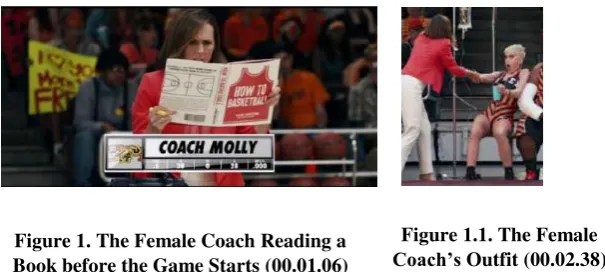
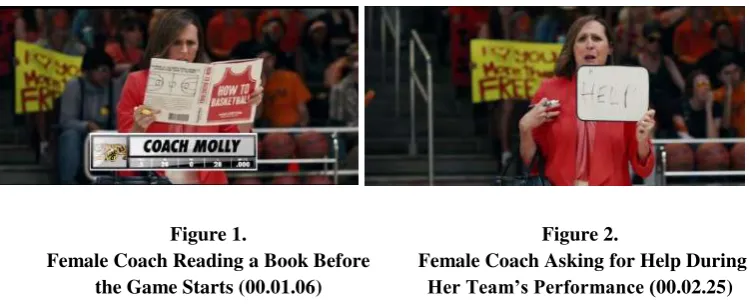
The first shot is shown in Figure 1, featuring basketball coach, Molly, which appears at 00.01.06. The shot was selected as it appears at the beginning of the match introducing the female coach from the Tigers team. From the appearance, the female coach is portrayed as a seemingly middle-aged woman with a thin body figure who is identified as a White American. A research by Stacy L. Smith showed that despite the highly multicultural society America has, most of the films were likely to feature Whites as the main characters (Chetty 2013). Fiske (1987) argued that a person’s race or ethnicity is sometimes associated with her heroism or
villainy. The use of a White person as one of the significant characters in this music
Figure 1. The Female Coach Reading a Book before the Game Starts (00.01.06)
Figure 1.1. The Female
video, therefore, suggests the idea that the media industries are still not more inclusive.
In Figure 1, the female coach is shown to be around her 50’s as seen from
the visible wrinkles on her face. She is seen with a little thick eye makeup. For the hair, the female coach is seen with her brown medium-length loose hair. In most sports, there are written rules where most female players are required to tie their hair back to avoid being distracted during the game (Hayes 2016). Although these rules do not similarly apply to the female coach, it is likely that the loosened hair can actually obstruct the female coach's view when observing her team's game performance. However, despite the fact that it might be distracting for the female coach, a recent study found that women in sport still attempt to give an image compatible with the socially constructed idea of femininity such as hairstyling and makeup (Loegel, et al. 2017). The well-styled loose hair and makeup done by the female coach shows that she still displays her femininity based on the use of cosmetics and the hair-do.
Other than physical appearance, she also puts much effort into her attire. Her attire includes formal clothing from a red blazer as the outer, a shirt as the inner, white pants, and crème mid heels as seen in Figure 1.1. Figure 1.1 is cropped to
focus on the female coach’s attire. Some female coaches dress well to appear more
pain and other foot problems associated with heels, many female coaches choose to wear heels to look more appealing as they represent their institutions in general. This is supported by Guéguen et al. (2016) where high heels as sexual characteristics could add the level of attractiveness of a woman. Creedon (1994)
stated that women’s media coverage were still likely to put emphasize on the
women’s physical attractiveness. Therefore, the female coach’s use of high heels
and costume plays an important role in enhancing her attractiveness as a part of her feminine role. It can be implied that the female coach might have attempted to appear more attractive to emphasize her sexual characteristics in the basketball court.
She is also seen wearing rings in both of her ring fingers, which suggests that she might have been married as the left ring finger is universally associated with wedding ring (Mooney 2017). The female coach's marital status indicates that there have been changes in this contemporary society where marriages no longer identify women to their domestic role or constrain them from pursuing a career. The woman being represented on screen has respectively reflected today's real-life setting which allows married women to pursue a professional career, "more women are breadwinners in today's American families that were in 1963" (Maatz and Hedgepeth 2013). Historically, the use of jewelry is also strongly associated with a
socially constructed feminine ideal boosting woman’s attractiveness (Russell
From her action, the female coach is seen reading a book titled "How to Basketball" while holding a black woman handbag and a yellow pen in her right hand. Such unnecessary personal belonging should ideally be put down temporarily so she can be fully focused to her team players instead, as noted by Orwig (2015) that minimizing multitasking is highly recommended to be able to fully focus. Consequently, her lack of focus might indicate her lack of professionalism. The title of the book itself is printed in considerably big size as a contemptuous remark referring to women’s lack of knowledge in sports as it also says “Literally, the most
basic guide to leading your team to victory” in the back cover. According to Oxford
Dictionary, the word "basic" refers to "forming an essential foundation or starting point." In other words, it refers to the starting or the beginning point of something. This suggests that the female coach is in the beginner or the basic level in basketball while a coach in general is supposed to have adequate knowledge about his or her expertise as he or she is holding responsibilities in leading and training the team. As stated by Ashe-Edmunds (2015), a basketball coach is responsible for managerial work, skill building, and coaching. Her action of reading the mentioned book indicates that the female coach is not well prepared for her position as a professional coach from the way she acts.
field of expertise, ironically. It shows that the female coach is highly unprepared, clueless, incompetent, and lacking in sports knowledge. Her incompetence, however, is being quite exaggerated to the point that it ridicules the female player’s
character. The exaggeration also occurs to the male coach in the opponent team where he is portrayed to have overly muscular body. The exaggeration of both coaches shows how in basketball, the female coach is shown to be extremely weak while the male coach is shown to be way too muscular, in which they do not reflect the real life basketball coaches.
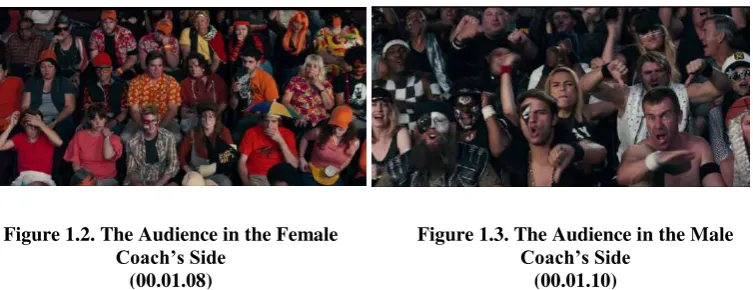
The next significant aspect is the environment represented on screen. In Figure 1, the setting is set in the basketball court during the match with the crowded audience behind the female coach as the background. The crowd is basically identified as the Tigers team's supporters as they are seen wearing identical orange-themed t-shirts. The atmosphere of the crowd in the environment when the screen is directed to the female coach is seen to be lacking in enthusiasm, particularly from the way the male audience in the right front seat seems to lean his head on his hand which hints the boredom gesture (Parvez 2015). The overall environment shown in the background when the camera is shot to the female coach is likely to suggest a lethargic situation as also shown in Figure 2. The supporters and audiences in the
Figure 1.2. The Audience in the Female Coach’s Side
(00.01.08)
Figure 1.3. The Audience in the Male Coach’s Side
female coach’s side and the male coach’s side are shown to be strikingly different. In Figure 1.2, the audience from the female coach’s side is seen to be passive, lacking in enthusiasm while the audience from the male coach’s side in Figure 1.3
is seen to be more aggressive and active. However, both of the team’s audience seats seem to be full, which might imply how basketball as one of the high profile sports is still populer among its audiences.
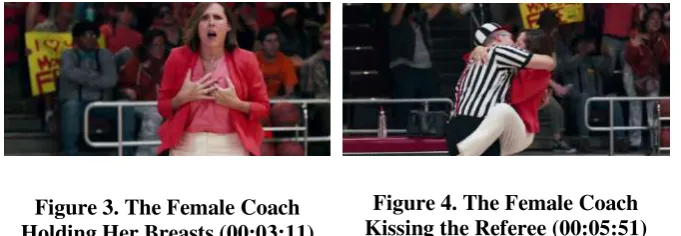
Figure 2. The Female Coach Asking for Help during Her Team’s Performance
(00.02.25)
While Figure 1 depicts female coach’s cluelessness, Figure 2 which appears
at 00.02.25 explicitly portrays the female coach’s helpless situation based on her
action, gesture, and facial expression. Her facial expression suggests a sign of frustration indicated by her inward slanting eyebrows with her head shaking (Macrae 2014). Researchers found that humans display this kind of facial expression as ‘subconscious calls’ for help by stimulating empathy from other
people (Evans 2014). Her distressed facial expression with her eyes directly looking at the camera indicates her desperate and helpless condition asking for help from others. The way she asks for help shows signs of unprofessionalism as she is not capable of handling her own situation as a coach.
at herself. The word help on the whiteboard that she wrote and showed to the camera is a signal that she needs help, which suggests that she is currently incapable of handling her situation. Fiske (1987) stated that certain actions of the character help to decode the way the character is being represented. The female coach's expression, action, and hand gesture represent distress, hopelessness, and surrender.
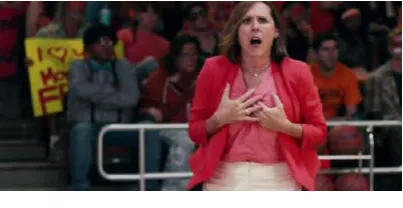
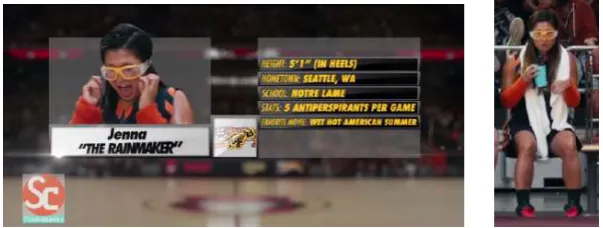
In Figure 3 and Figure 4, the female coach appears as strongly associated with sensual images from the gesture and the action. In Figure 3, the female coach is seen holding her breasts with shocked expression in 00:03:11. Her facial expression indicates a shock as she is seen with a large gaping mouth and forehead crunched up (Hope 2013). Her shocked facial expression is basically her reaction
towards her team’s failing performance. In this kind of frustrating situation, the
person would normally place her hands on his head (Bell 2012). In Figure 3, however, the female coach is seen placing her hands on her breasts. In this kind of overwhelming situation where her team’s performance is failing, she still poses in
a sexual way by grabbing her own breasts which might suggest a self-touching gesture. Some studies found that this kind of self-touching gesture typically indicates a woman’s flirting way to the opposite sex by emphasizing her intimate
body parts (Psychologia.co). The way the female coach still appears in sensual gesture shows that she might still conform the typical women’s sex role where some intimate body parts are being emphasized.
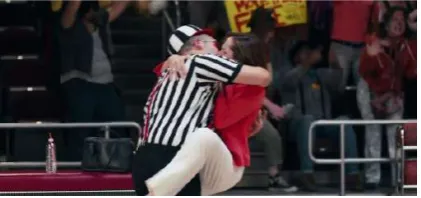
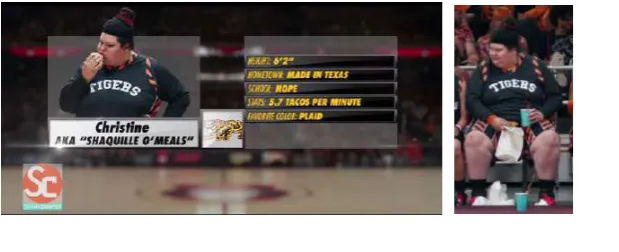
In Figure 4, the female coach is seen to kiss the referee as a celebration for her team’s win. For the body gesture, the female coach is seen hugging with her left
hand holding the referee’s face, her right hand hugging the referee, and her legs crossed on the referee’s body. This pose generally reflects an aggressive, intimate,
and passionate kiss marked by the person’s pressed body against the opposite sex
(Chudnofsky 2009). The kissing gesture of the female coach shows that she is the the one who would take innitiative when it comes to sensual kiss, as she is also the one initiating the kiss with the referee. It shows that the female coach herself has embraced the common images associating women with sensual depiction by initiating the sensual kiss.
4.1.1.2Representation
The second level in the Codes of Television by John Fiske is the representation level which includes the camera, lighting, and editing employed in the making process which transmits the conventional representational codes
shaping the representation of the subjects in the music video (Fiske 1987). The following discussion would analyze the representational codes in Figure 1, 2, 3, and 4 starting from the lyrics, the camera work, the lighting and the editing.
In Figure 1, 2, 3, and 4, the camera shot lingers on the female coach in the center of the frame from a medium angle which provides the viewers a close view on the subject and the advantages to feel more comfortable since the angle puts the viewers on an equal footing with the characters (Corrigan and White 2012). Thus, the use of medium angle shot in Figure 1, 2, and 3 can help the viewers to focus and perceive the subject’s situation better. It gives a closer look to the female coach
as the subject from the expression as well as the body gesture. Thus, the viewers can manage to observe the subject and her action on screen better. If other techniques of camera angles such as long shot, high, or low angle were used, the viewers would not be able to observe the title of the book, which is the key to the
subject’s representation in Figure 1. It also works similarly to Figure 3 where the
angle shows the female coach from the waist up to give emphasize to the female
Figure 1.
Female Coach Reading a Book Before the Game Starts (00.01.06)
Figure 2.
Female Coach Asking for Help During
coach’s activity from a closer look, i.e. the self-touching, producing the sexual images of women.
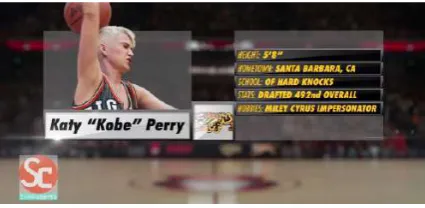
The next crucial aspect of the representational codes is the editing. In Figure 1, there is an additional digital editing appeared in the form of description text box. In cinematography, editing is one of the most important elements referring to the post-production process of arranging video shots by cutting or joining the shots, setting transitions, importing text or graphics, superimposing clips, and other basic editing techniques to create a sequential work (Thompson and Owen 2009). Figure 1 uses superimposing technique by laying graphics over the shot in forms of a text box to give statistical information about the female coach's career records. The statistics box shows that the coach has had 0.5 years of experience, played 28 matches with the total win of 0 and the total loss of 28. These failing statistics are further emphasized by the two male sports announcers commenting on the female coach's team, "this does not seem good, they haven’t had a good season." This
additional graphic added to the music video can serve to emphasize an inexperienced image of the female coach.
During the scene in Figure 3 at 00:03:11 when the female coach is seen touching her breasts, the lyrics say “Swish swish bish. . .Can’t touch this” while
Figure 3. The Female Coach Holding Her Breasts (00:03:11)
touching her breasts. The word swish basically refers to the sound of a basketball player when making a score. While the word bish is a slang word for bitch typically used to insult someone. So “swish swish bish” might symbolize the way the female
coach is making a statement to the person she insults that she ‘scores’ or
accomplishes more than that person.
While the line “can’t touch this” is a common idiom used to express “you
will never be as good as I am” (Definithing.com). The word this might refer to her
breasts as it is emphasized when she is touching her breasts, which implies that her breasts are possibly the accomplishment that makes her feel accomplished than the other person. In Figure 3, therefore, it suggests that the female coach somehow makes a statement that her best accomplishment is her sexual body parts, not her
coaching skill. Scientifically, women’s breasts are proven to be sexual organs as
the nipples light up the same area of the brain as the women’s genitals, while men’s
nipples do not (Barber 2013). It significantly suggests that the female coach is still likely to associate herself with her sexual body parts; thus embracing the common stereotypes that portray women and sensual images in media.
For the point of view, Figure 1, 2, 3, and 4 use an objective point of view. Corrigan and White (2012) defined a point of view as the cinematographic term referring to "the position from which a person, an event, or an object is seen (or filmed)" (105). If a subjective point of view is used to “re-create the perspective of
a character through camera placement,” an objective point of view aimed to give
observers who are not involved in the screen. This technique is normally used to properly introduce characters (Mascelli 2005). The use of the objective point of view in Figure 1 basically allows the female coach to be introduced to the viewers. The introduction of the female coach also helps the viewers to acknowledge the
female coach’s incompetent images.
While for the lighting, Figure 1, 2, 3, and 4 employ key lighting to illuminate the main subject in the frame, leaving the background less illuminated so the viewers can focus on the subject being represented (Corrigan and White 2012). This technique of lighting was used to put emphasis on the female coach as the main subject being portrayed on screen. It will help to draw deeper characterization of the female coach as the view is more focused on her and what event is happening on the screen.
4.1.1.3Ideology
woman in the coaching position is being represented from the perspective of a woman.
Based on the reality and representation analysis of Figure 1, the female coach is portrayed to be feminine, clueless, inexperienced, and unprepared for the match, which can be seen from her appearance, action, and the camera work. From the appearance and the costume, the way the female coach is portrayed with hints of makeup, loose-styled hair, heels, and jewelry implies that despite the fact that such appearance might distract her concentration and activity, she still displays her feminine ideal as a woman in order to appear attractive. These feminine qualities include the use of cosmetics, certain costume, high heels, and other feminine demeanor to enhance attractiveness level (Krane 2012). It is further confirmed by a recent research confirmed that a woman’s feminine appearance can affect
audience’s interest (Jones and Greer 2011). The display of the female coach’s
feminine qualities in Figure 1 represents the dominant ideology where the female coach herself has celebrated the existing stereotypical images considering women by her feminine role more than her occupational role.
graphic in forms of a description box showing the female coach’s game statistics explicitly suggests that she is also lacking in experience as the statistics show that she has never won a game and has lost to 28 games. This portrayal of the female coach in Figure 1 suggests that the female coach appears to be incompetent, inexperienced, and lacking in knowledge which subtly reinforce the view that male coaches are more capable and knowledgeable than female coaches.
The incompetent images of the female coach are portrayed in an exaggerated way that make her look downright incompetent compared to the male coach. Corrigan (2015) stated that a parody is occasionally made to critize social or
political issues. Thus, the exaggeration of the female coach’s incompetence and the
male coach’s extreme strength in the music video might intend to ridicule the
existing stereotypes in extreme sports like basketball casting female coaches to be inherently incompetent and the male coach to be extremely strong.
Also, the way the female coach is portrayed to be feminine and incompetent is partly due to the socially constructed idea where a woman is valued more from her appearance than her ability. When a professional tennis player Chris Evert was featured in Sports Illustrated−American sports media, Sports Illustrated chose to
focus on the woman’s appearance (Creedon 1994). Historically, this is closely
related the existing beauty standards promoted by the mass media making women to pay extra effort to their appearance in order to be accepted by the society (Wolf 2013). It is also stated that women in the public life are expected to look attractive in the workplace as a part of her self-representation. As a result, “urban professional
2013, 52). Thus, women working in the public life are mostly portrayed with “high -fashion clothing and costly beauty treatments” to be more socially accepted (Wolf 2013, 52). In Figure 1, the way the female coach is represented as a feminine woman who is fashion-conscious but also incompetent shows that even from women’s perspective, they still tend to associate themselves with feminine attribute, not their ability and coaching skill. In real life, however, female coaches are not necessarily about attractiveness and appearance. Tara VanDerveer, for example, is one of the successful female basketball coaches with skill and competence (Creedon 1994).
In Figure 2, the figure of the female coach is being similarly represented to Figure 1 based on the reality and representation analysis. But unlike Figure 1 which appears during the early minute before the game, Figure 2 appears in the middle of the game which highlights the coach's desperation and hopelessness watching her team's failing performance. From the action, the female coach is seen holding a “HELP” sign to the camera, which bears the message that she is not capable to
handle her conflicting situation which might probably be the consequence of her lack of experience and preparation as represented in Figure 1. It can also be seen from her hand gesture where her right-hand points at herself while her left-hand holds the "HELP" sign, and her head shaking which shows that she herself is asking for help.
angle to give a closer look at the female coach's helpless situation on screen. From the reality and representation aspects, Figure 2 symbolizes the female coach's hopelessness. It can be one specific example of how the women themselves accommodate the negative stereotypes of the female coach to be anxious and helpless when facing a difficult situation during a game.
Another dominant ideology found is the sensual portrayal as represented in Figure 3. In Figure 3, the female coach appears to be associated with sexual images as she is seen holding her breasts in the middle of her team’s failing performance with the lyrics saying “can’t touch this” with the word “this” emphasizing her
intimate body parts, her breasts. Based on the gesture and the lyrics as previously examined, Figure 3 displays the female coach’s sexual portrayal. This kind of sensual portrayal related to women and sports is commonly found in media where some of the sports announcers occasionally make sexual jokes about the female
athlete’s physical appearance (Creedon 1994). Thus, some mediated images of
women participating in sports are sometimes more focused more on the women’s
sexual characteristics than their actual sports skills. Even with this music video filmed and sung from the perspective of a woman singer, they still associate and embrace themselves in such sexual manner as reflected from Figure 3.
institution are the results of the traditional patriarchal view which sexually objectifies women. Thus in Figure 4, it shows that the female coach appears to be the one creating a sexualized image of herself by engaging in sensual encounter in the middle of the sports environment.
The undermining portrayal of women occupying the leadership roles in sports is found to be common as men are likely to be considered more qualified for the position which requires experience, skill, and self-reliance (Creedon 1994). These ideological values have emerged as a consequence of the traditional gender roles that believe men to be more physically and mentally superior to women, which is essential in sports (Creedon 1994). Therefore, the female coach appears in the music video is still likely to be associated with stereotypes viewing women to be feminine, incompetent, unprofessional, and sexualized.
4.1.2 Female as Player
After discussing the women representation in sports leadership above, this part of analysis would similarly examine the representation of women as sports players by using John Fiske's Codes of Television from reality, representation, and ideology level which would also be further collaborated in the interpretation. Four shots were selected to be analyzed as they contain strong symbolization of the women being depicted. The shots selected can be seen in Figure 5, 6, 7, 8, 9, 10, 11, 12, 13, 14, 15, and 16.
4.1.2.1Reality
Similar to the previous analysis, Fiske’s reality would cover the social codes