DESIGNING A SET OF INSTRUCTIONAL VOCABULARY
MATERIALS USING VIDEOS TO IMPROVE THE ENGLISH
MASTERY OF THE FIFTH GRADE STUDENTS
OF SD SUMBERADI 1 SLEMAN
A SARJANA PENDIDIKAN THESIS
Presented as Partial Fulfillment of the Requirements to Obtain the Sarjana Pendidikan Degree
in English Language Education
By
Agnes Shanti Satyarini Student Number: 071214037
ENGLISH LANGUAGE EDUCATION STUDY PROGRAM DEPARTMENT OF LANGUAGE AND ARTS EDUCATION FACULTY OF TEACHERS TRAINING AND EDUCATION
SANATA DHARMA UNIVERSITY YOGYAKARTA
i
DESIGNING A SET OF INSTRUCTIONAL VOCABULARY
MATERIALS USING VIDEOS TO IMPROVE THE ENGLISH
MASTERY OF THE FIFTH GRADE STUDENTS
OF SD SUMBERADI 1 SLEMAN
A SARJANA PENDIDIKAN THESIS
Presented as Partial Fulfillment of the Requirements to Obtain the Sarjana Pendidikan Degree
in English Language Education
By
Agnes Shanti Satyarini Student Number: 071214037
ENGLISH LANGUAGE EDUCATION STUDY PROGRAM DEPARTMENT OF LANGUAGE AND ARTS EDUCATION FACULTY OF TEACHERS TRAINING AND EDUCATION
SANATA DHARMA UNIVERSITY YOGYAKARTA
vii
ABSTRACT
Satyarini, Agnes Shanti. (2013). Designing a Set of Instructional Vocabulary Materials Using Videos to Improve the English Mastery of Fifth Grade Students of SD Sumberadi 1 Sleman. Yogyakarta: English Language Education Study Program Sanata Dharma University.
Learning English is considered difficult for elementary school students. They might find new vocabulary items, sentences, conversation, and other difficult terminologies while learning English. It also happens in SD Sumberadi 1 Sleman. The students have problems in memorizing the meaning of English words. Therefore, the researcher conducted a research on the development of a set of instructional vocabulary materials using video as the media to be implemented in SD Sumberadi 1 Sleman. Video was chosen because it carries great potential for educational use especially for young learners.
This research was aimed at solving these two research problems. They were (1) How is a set of instructional vocabulary materials using videos to improve the English mastery of fifth grade students of SD Sumberadi 1 Sleman designed? and (2) What does the design of instructional vocabulary materials using videos to improve the English mastery of fifth grade students of SD Sumberadi 1 Sleman look like?
In this research, the researcher employed five steps of Research and Development (R&D) as the research method. Those steps were (1) research and information collecting, (2) planning, (3) developing preliminary form of product, (4) preliminary evaluation and, (5) main product revision. Then, the researcher goals and topic, (3) establishing learning indicators, (4) listing the subject content, (5) selecting teaching learning activities, (6) designing the material, (7) evaluation, and (8) revision. To answer the second question, the researcher presented the instructional vocabulary materials which consisted of four units. Each unit consisted of four sub-sections, namely Let’s Start, Let’s Practice, Let’s Focus, and Let’s Review. The activities were aimed to improve the students’ mastery in English. The materials were designed using video and various activities based on Total Physical Response approach which is suitable to be applied to the fifth grade students of SD Sumberadi 1 Sleman.
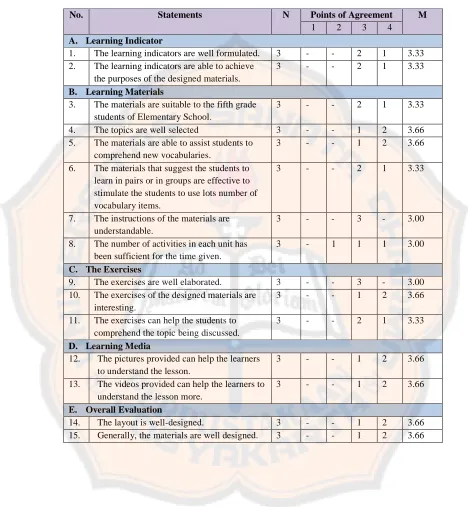
In order to evaluate the designed materials, the researcher distributed post-design questionnaire to one lecturer and two English teachers. The result showed that the mean was 3.66 on the scale of 4, which means the design was good and acceptable for the fifth grade students of SD Sumberadi 1 Sleman.
viii
ABSTRAK
Satyarini, Agnes Shanti. (2013). Designing a Set of Instructional Vocabulary Materials Using Videos to Improve the English Mastery of Fifth Grade Students of SD Sumberadi 1 Sleman. Yogyakarta: Program Studi Pendidikan Bahasa Inggris, Universitas Sanata Dharma.
Belajar bahasa Inggris dianggap sukar, terutama untuk siswa sekolah dasar. Mereka biasanya akan menemukan banyak kosakata baru, kalimat-kalimat, percakapan-percakapan dan istilah-istilah sulit ketika belajar bahasa Inggris. Hal yang sama juga terjadi di SD Sumberadi 1 Sleman. Siswa disana menemui banyak masalah ketika harus menghafalkan kosakata baru dalam bahasa Inggris. Oleh karena itu, peneliti mengadakan sebuah penelitian untuk mengembangkan satu set materi instruksional kosakata dengan menggunakan video sebagai media pembelajaran. Video dipilih sebagai media pembelajaran karena video memiliki banyak manfaat pendidikan yang luar biasa, terutama jika digunakan untuk mengajar siswa sekolah dasar.
Penelitian ini dilakukan untuk menjawab dua permasalahan penelitian, yaitu (1) bagaimana set materi pembelajaran instruksional kosakata dengan menggunakan video untuk mengembangkan kemampuan berbahasa Inggris dari siswa kelas lima SD Sumberadi 1 Sleman dirancang? (2) seperti apakah penyajian satu set materi pembelajaran instruksional kosakata dengan menggunakan video untuk mengembangkan kemampuan berbahasa Inggris dari siswa kelas lima SD Sumberadi 1 Sleman?
Dalam penelitian ini, peneliti menggunakan lima tahap Research and Development sebagai metode penelitian. Lima tahap tersebut yakni (1) research and information collecting, (2) planning, (3) developing preliminary form of product, (4) preliminary evaluation dan, (5) main product revision. Kemudian peneliti menggabungkan tahap tersebut dengan instructional design model adaptasi dari Kenp dan Yalden.
Untuk menjawab permasalahan yang pertama, peneliti menggunakan delapan langkah instructional design model yang telah diadaptasi dari milik Kemp dan Yalden. Langkah tersebut adalah (1) melakukan survey kebutuhan, (2) menspesifikasi tujuan instruksional dan topik, (3) menentukan indicator pembelajaran, (4) membuat daftar muatan subyek, (5) memilih aktifitas bekajar mengajar, (6) merancang materi, (7) evaluasi, dan (8) merevisi rancangan materi. Untuk menjawab permasalahan yang kedua, peneliti menyajikan materi pembelajaran kosakata bahasa inggris yang terdiri dari 4 unit. Setiap unit terdiri dari 4 sub-bab yang dinamakan Let’s Start, Let’s Practice, Let’s Focus, and
Let’s Review. segala aktifitas yang ada didalam materi pembelajaran ini bertujuan
untuk meningkatkan kemampuan bahasa inggris siswa. Materi dirancang dengan disertai video dan berbagai aktifitas berdasarkan pendekatan Total Physical Response yang cocok digunakan untuk siswa kelas 5 SD Sumberadi 1 Sleman.
ix
memiliki rata-rata nilai 3,00 dari skala 4. Hal itu menggambarkan bahwa materi pembelajaran yang dibuat baik dan tepat untuk siswa kelas lima di SD Sumberadi 1 Sleman.
x
ACKNOWLEDGEMENTS
First and foremost, I would like to express my greatest gratitude to Jesus
Christ the son of God who has given me His endless love and blessing so that I
can finish my thesis and my study.
My heartfelt thanks and honor also goes to my sponsor Made Frida
Yulia, S.Pd., M.Pd., for her guidance, attention, support, and motivation during
the accomplishment of my thesis. I really thank her for her patience, kindness, even laughter in every thesis consultation times.
I would like to give my gratitude to the head of English Education Study Program Ibu C Tutyandari, S. Pd., M. Pd. for her guidance during my study in Sanata Dharma University. My next gratitude is also for my examiners, Bapak
Dr. Pius Prihatin Nurwidasa, Ph. D. andBapak G. Punto Aji, S.Pd., M. Hum.,
for their suggestions, and guidance. I also would like to thank all English Education Study Program lecturers and staff for their guidance and patience during my study in English Education Study Program.
My gratitude also goes to the English teacher of SD Sumberadi 1 Sleman,
Ibu Rr. Siwi Kuswidayatiningsih S. Pd. who had helped me during the research.
xi
I am deeply grateful to my beloved parents Stevanus Murdiyanto and
Yohana Fransiska Sunarti who have supported me to get through the difficult
times through their prayer, guidance and a lot of affection. I would like to express my gratitude also to my beloved sisters Maria Dian Putriyanti and Lusia
Arumingtyas who have given me a lot of love, attention and supports.
Many thanks are addressed to all of my best friends Novi, Mericy,
Glorya, Sance, Widi, Mas Koben, Wendi, Gaby, Calvin, Rudi, Fendi, Atom,
Dion, Susi, Kania and those who I cannot mention one by one. I found precious
friendship with them, even a bond of brethren. My sincerest thanks go to Mr.
Antonius Jody, Frater Atma, Sr Margaret O’Donohue FCJ, Ms. Adesti
Komalasari, Mikael Dian Teguh, Teguh Prasetyo and Dwi Nugroho who have
lifted up my spirit and proofread my thesis.
I would like to give my deepest love and special thanks to my dearest one
Agustinus Adewanto Israharjo. I thank him for his never ending love, support,
protection and sacrifice. He gives me motivation to always do my best. My big thanks also go to Pak Budi, Bu Nuk, Eyang Manto, Kak Ika, kak Hans, and
mas Eko for their prayers and encouragement to finish my thesis. I thank them all
xii
TABLE OF CONTENTS
Page
TITLE PAGE……….. i
APPROVAL PAGES……… . ii
DEDICATION PAGE……… iv
STATEMENT OF WORK’S ORIGINALITY……… v
PERNYATAAN PERSETUJUAN PUBLIKASI……… vi
ABSTRACT………. vii
ABSTRAK………... viii
ACKNOWLEDGMENTS……….. x
TABLE OF CONTENTS……….. xii
LIST OF TABLES……… xvii
LIST OF FIGURES……….. xviii
LIST OF APPENDICES……….. xix
CHAPTER I. INTRODUCTION 1 A. Research Background………. 1
B. Research Problem……… 5
C. Problem Limitation………. 5
D. Research Objectives……… 6
E. Research Benefits………... 6
xiii
CHAPTER II. REVIEW OF RELATED LITERATURE 10
A. Theoretical Description………... 10
1. The Instructional Models……….. 10
a. Kemp’s Model……… 11
b. Yalden’s Model……….. 14
2. Young Learners………. 16
3. Elementary School Language Learning……… 17
a. The Characteristics of Elementary School Students……….. 18
b. Teaching Language to Elementary School Students……….. 19
4. Direct Instruction Model for Teaching……….. 21
a. The Introduction Phase………... 21
b. The Practice Phase……….. 21
c. The Review Phase……….. 22
5. Teaching Vocabulary………. 22
a. The Meaning………... 23
b. The Importance of Vocabulary……… 23
c. The Procedures in Teaching Vocabulary………… 23
6. Total Physical Response……..……….. 25
a. The Definition of Total Physical Response……….. 25
xiv
c. Types of Learning and Teaching Activities………. 27
d. The Roles of Learners in Total Physical Response.. 28
e. The Roles of Teachers in Total Physical Response.. 28
7. Video as Media to Teach English……… 29
B. Theoretical Framework………... 31
CHAPTER III. METHODOLOGY 36
A. Research Method………. 36
1. Research and Information Collecting……… 37
2. Planning……… 38
3. Developing Preliminary Form of Product……… 38
4. Preliminary Evaluation………. 39
5. Main Product Revision………. 39
B. Research Setting……….. 41
C. Research Participants……….. 41
D. Research Instruments and Data Gathering Techniques…… 42
1. Instruments and Data Gathering Techniques of Pre-design Research………. 42
a. Interview Guide……… 42
b. Observation Checklist……….. 43
xv
E. Data Analysis Technique……….. 45
1. Data Analysis of the Pre-Design Research………. 45
2. Data Analysis of the Post-Design Research…………... 45
F. Research Procedure……….. 47
CHAPTER IV. RESEARCH RESULTS AND DISCUSSION 50 A. The Elaboration of the Steps in Designing the Materials……… 50
1. Conducting Need Analysis……… 51
2. Determining Goals, Topics, and General Purposes…... 54
3. Establishing Learning Indicators……….. 55
4. Listing the Subject Content………... 55
5. Selecting Teaching Learning Activities……… 57
6. Designing the Materials………. 57
7. Materials Evaluation……….. 58
8. Revision………. 61
B. The Description of the Designed Materials………... 62
1. Let’s Start……….. 62
2. Let’s Practice………. 62
3. Let’s Focus……… 63
xvi
CHAPTER V. CONCLUSIONS AND RECOMMENDATIONS 67
A. Conclusions……….. 67
B. Recommendations………. 70
1. The Recommendations for English Teachers Particularly the English Teacher of SD Sumberadi 1 Sleman Yogyakarta ………... 70 2. The Recommendations for Future
Researchers……….. 70
REFERENCES……… 72
xvii
LIST OF TABLES
Table Page
3.1 The Participant’s Opinion on the Designed Materials (Blank)………… 46
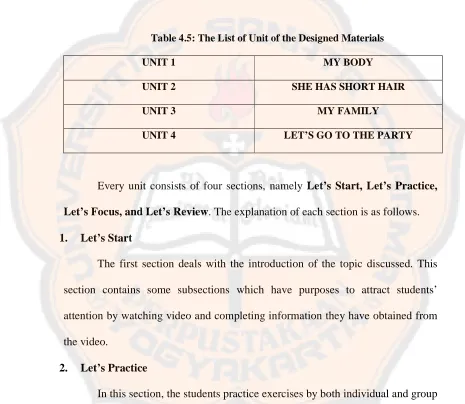
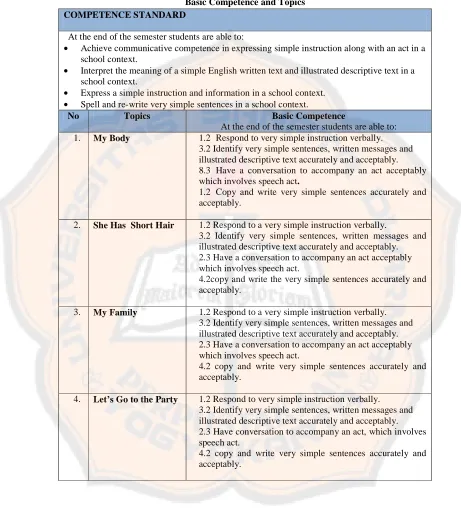
4.1 The Elaboration of Competence Standard, Basic Competence, and Topic………. 64
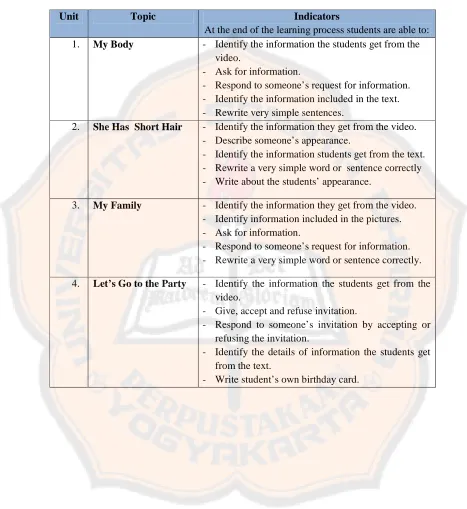
4.2 The Learning Indicators……….. 65
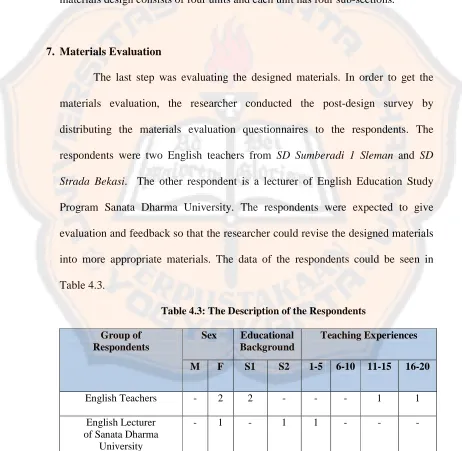
4.3 The Description of the Respondents……… 58
4.4 The Participants’ Opinions on the Designed Materials……… 66
xviii
LIST OF FIGURES
Figures Page
2.1 Kemp’s Instructional Design Model ………. 11 2.2 Yalden’s Language Program Design………. 16 2.3 Steps of the Researcher’s Instructional Design
xix
LIST OF APPENDICES
Appendix Page
APPENDIX A: The Letter of Permission……… 77
APPENDIX B: Observation Checklist ...……….. 79
APPENDIX C: The Data Based on Observation………... 82
APPENDIX D: The Interview Guide for the Teacher……… 85
APPENDIX E: The Evaluation Questionnaire……….. 87
APPENDIX F: The Model Unit of the Designed Materials………. 92
APPENDIX G: The Syllabus……… 95
APPENDIX H: The Lesson Plan……….. 104
1
CHAPTER 1
INTRODUCTION
This chapter covers six important parts of the thesis. The first part is the research background, which tells the researcher’s reasons to conduct the research. The second part is the research problem, which contains some questions related to aim of the research. The third part is the problem limitation, which limits the scope of the research. The fourth part is the research objectives, which tells the aims of the research. The fifth part is the research benefits, which reveals the advantages and the contributions of this research for education. The last part is definition of terms which explains some terms in the research.
A. Research Background
Language is one of the most important things in communication and it is used as a tool of communication among the nations all over the world. People use language to express their mind, wishes, and ideas. Language is not merely used for daily conversation. It is also used in education, research and science both spoken and written.
earlier level of education which is called Kurikulum Tingkat Satuan Pendidikan (KTSP).
Based on the 1994 curriculum, English is introduced as a local content subject for fourth to fifth grade of elementary school level but along with the development of the new curriculum, English now is taught in all grades of Elementary school level. According to Kurikulum Tingkat Satuan Pendidikan 2006 (KTSP, 2006) the aim of English teaching in Indonesia is to enable students
to have ability in developing communicative competence orally in a school context (p. 278). Learning English is considered difficult for elementary school students. They might find new vocabulary items, sentences, conversation, and other difficult terms. Moreover, students are taught four basic skills of English. Those skills are writing, reading, listening, and speaking that of course are not easy to be learnt. Philips (1993) noted that elementary school students are those from the first year of formal schooling (five or six years old) to eleven or twelve years age. Children in those ages have a very great capacity of learning but, they also have a low attention span. Due to this fact, it would be better for the teacher to consider about the way to introduce English using an appropriate teaching strategy.
Rivai (2001), media could enhance teaching and learning process, which then is expected to enhance the learning outcomes achieved (p.21).
Besides the use of media, students’ motivation to learn also determines the success of the learning process. Motivation arises because of the desire to do something either from the students themselves or the external factors. If students have high motivation to learn, the students will be ready to absorb and accept the materials presented by their teacher. Many students think that English is a difficult subject. As a result, they need a defining motivation to improve their academic achievement.
One way to improve students’ motivation and achievement in learning English is developing a set of instructional materials using media. One of the learning media that could be used to teach English is video. Boyle (1997) states that video provides a very powerful recourse for learning (p. 178). This statement is supported by Tomalin’s (1991) argument which says that, one of the aims of teaching English to young children is to instill in them the idea that language learning is a happy experience, and video creates an attractive enjoyable learning environment (p.48).
asked to do the Lembar Kerja Siswa (LKS) and another task which make the students to be passive subject. Moreover, the teacher also lacks materials so the teacher prefers to use LKS as the main tool in teaching English instead of using other media. Therefore, a set of instructional materials need to be developed to fulfill the students’ needs and cover all skills.
As mentioned before, the researcher attempts to design a set of vocabulary materials by using video. The researcher chose vocabulary as the model of English learning since vocabulary skill is still forgotten in a part of learning English. The English teacher of SD Sumberadi 1 Sleman focuses more on grammar and reading comprehension and ignores vocabulary in her teaching. This condition is supported by the students’ argument, which states that they have problems especially in memorizing the meaning of English words.
B. Research Problem
In relation to the topic of this research, there are two main problems to discuss in this research. They are as follows.
1. How is a set of instructional vocabulary materials using videos to improve the English mastery of fifth grade students of SD Sumberadi 1 Sleman designed? 2. What does the design of instructional vocabulary materials using videos to
improve the English mastery of fifth grade students of SD Sumberadi 1 Sleman look like?
C. Problem Limitation
D. Research Objectives
This research aims at:
1. Finding out how a set of instructional vocabulary materials using videos to improve the English mastery of fifth grade students of SD Sumberadi 1 Sleman is designed.
2. Presenting the designed set of instructional vocabulary materials using videos to improve the English mastery of fifth grade students of SD Sumberadi 1 Sleman.
E. Research Benefits
This research is expected to provide benefits and contributions to: 1. The English Teachers of SD Sumberadi 1 Sleman
The vocabulary materials can be used as a tool to help English teacher develop the English learning since there are various materials to be chosen based on students’ needs. In addition, the materials are equipped with video CD, which can be a tool to provide a model of English learning and can be used as supplementary materials in teaching English. In this research, supplementary means the materials that can be used to support the exiting materials.
2. The Students of SD Sumberadi 1 Sleman
The researcher hopes that the designed materials could help the students of SD Sumberadi 1 Sleman practice better English with various activities. Since the
learning English as well as be able to understand and memorize the words in English easily.
3. Future Researchers
It is expected that other researchers could develop this research considering that education continues to grow in accordance with the progress of science and technology.
F. Definitions of Terms
This part will explain about the definition of the terms to avoid misunderstanding. The definitions of terms are explained as follows.
1. Instructional Materials
Kemp (1977) notes, that instructional material is any resource including printed materials of many kinds, audiovisual media, and other items for group and individual use. The materials itself can help and motivate students to understand the subject given (p. 7). In this research, the term instructional material refers to the vocabulary exercises and activities from any kind of recourses.
2. Video
classroom (p. 11). Moreover, Kemp (1989) also states that video makes the learning process to become more effective than other instructional media especially for relating one idea to another, for building a continuity of thought, and for creating a dramatic impact (p. 48). In this research, videos are the main material of the design.
3. Vocabulary
According to Read (2000), vocabulary is an inventory of individual words with their associated meanings. Vocabulary knowledge involves knowing the meanings of words and developing naturally in adult life in response to new experiences, inventions, concepts, social trends and opportunities for learning to meet their communication needs (p. 16). In this research, the term vocabulary refers to a set of low-frequency vocabulary exercises and activities from any kinds of resources.
4. Total Physical Response (TPR)
5. Fifth Grade Students of Elementary School
10
CHAPTER II
REVIEW OF RELATED LITERATURE
This chapter is divided into two main parts, which are theoretical description and theoretical framework. The theoretical description consists of some supporting theories related to the research. Whereas, the theoretical framework includes the way the researcher connects the theories to the analysis of the topic.
A. Theoretical Description
This research aimed to give some basic foundation of literatures and to write sources which are related to the research. There are seven main areas presented in this part. They are instructional materials design models, young learners, elementary school language teaching, direct instruction model for teaching vocabulary, teaching vocabulary, total physical response, and video as the media.
1. Instructional Material Design Models
desired changes in students knowledge and skills for specific course content and a specific students population.
The researcher only employ Kemp’s and Yalden’s model of instructional models which are appropriate to be implemented in the design materials.
a. Kemp’s Model
In Kemp’s (1977) instructional design plan, consists of eight major plans which are considering goals, topics, general purposes, characteristics of the learners, specify the learning objectives, list the subject content, develop pre-assessments, select teaching/learning activities, support services, and evaluation (p. 9).
The eight steps of instructional design above are essential; therefore, the implementation of those eight elements should be very detailed and carefully done.
1)Defining Goals, Topic, and General Purposes
Kemp states that Instructional design plan starts with recognition of the broad goals of the school system or institution. Those broad goals may be derived from three sources. They are society, students, and subject areas. Kemp (1977) also mentions that statements of goals should be flexible. It means that the materials designers should pay attention to the changes of the learners’ needs and interest, as well as changes in society and institutions. After defining the goals, teachers have to select and list some major topics. The next step is selecting one or more purposes to represent a topic.
2)Identifying learners characteristics
In designing an instructional design, it is essential for the teacher to know about the learners’ characteristics, since some particular characteristics of the learners might influence the whole learning process.
3)Specifying learning objectives
student behavior. Kemp also discovers that objectives are beneficial because they form the framework for any instructional program which was built on a competency base and inform the students what will be required for them (p. 34). Objectives also help them to think in some specific terms, organize, and sequence the subject manner.
4) Listing Subject Content
Next stage of instructional design is listing the subject content. According to Kemp (1977), many teachers thought that subject content is the traditional starting point for teaching. Textbook, which is the primary instructional resource, often, determines objectives, content, and teaching sequence. Kemp (1977) states that, subject content is “the selection and organizing the specific knowledge, skills, and attitudinal factors of any topic” (p. 44).
5) Developing Pre-assessment
The writer must conduct pre-assessment in order to find out the learners background to know the students’ background knowledge and what materials that the teacher should develop more. The result of pre-assessment will affect the instructional planning. It may be necessary to eliminate, modify, or add objectives to the program.
6) Planning Teaching/learning Activities and Instructional Resource
individualized learning, and teacher-student interaction. After determining the teaching/learning patterns and activities, teachers have to select the supporting materials (instructional resources) which can motivate students and effectively explain and illustrate subject content (p. 57).
7) Considering Support Services
This is the last step of planning the instructional materials. This step is concerned with some support services, which are fund, personnel, facilities, equipments, and time for the schedule of planning the instructional materials. Careful consideration is definitely required during the appropriate planning step.
8) Conducting Evaluation
The evaluation is aimed to measure the result of the learning process relating to the objectives. Here, the media used in the evaluation is in the form of examination/test. Evaluation is considered essential because it can measure the success of the designed materials made and to gather the information about how far the learners have achieved the objectives.
b. Yalden’s Model
Yalden’s model of instructional design consists of eight steps which will be explained as follows.
1) Need survey
2) Description of purpose
The purpose of the language program should be decided when the needs survey has already been done. Identifying purpose is significant to find out the appropriate language content from the simplest to a wider scope.
3) Selection/development of syllabus type
The next step is selecting the syllabus which is appropriate to be implemented in the language program. The syllabus itself should be suited to the learners’ needs and characteristics. Yalden (1987) states that, there is no fixed syllabus of a particular subject. The modification of the syllabus can be done particularly under learning process (p.108).
4) Production of proto-syllabus
This step dealing with the production of the syllabus which consists of specific topics, variety of language and language use to be developed deals with the program. The researcher needs to obtain information from the needs analysis to determine how many components should be put in the syllabus.
5) Production of pedagogical syllabus
6) Development and implementation of classroom procedure
Here, the researcher requires using teaching techniques in the classroom. Mostly, the teacher‘s role is as a facilitator only. Therefore, the activities in the classroom should be based on the learners’ activity.
7) Evaluation
In this step, the researcher evaluates each step above and makes sufficient revision of the type and the content of the syllabus.
The figure of Yalden’s instructional design model can be seen as follows.
Figure 2.2 Yalden’s Language Program Development (1987: 88)
2. Young Learners
Philips (1933) states that, “young learners mean children from the first year of formal schooling to eleven or twenty years of age” (p. 3). In this age, children learn a foreign language depending on their developmental stage. Young learners will respond to a language when they are involved directly with the target language. In other words, they respond to language according to what it does or what they can do with it. Moreover, young learners are not making analytical links that older learners do. There are some factors which can increase young learners’ motivation. They are as follows:
1. The activities should be simple enough for the children to understand.
2. The task should be within their abilities: it needs to be achievable but at the same time sufficiently stimulating for young learners to feel satisfied with their work.
3. The activities should be orally based - indeed with very young children listening activities will take up a large proportion of class time.
4. Written activities should be used sparingly with younger children.
Those factors above are supported with the common sense that if an activity is enjoyable, it will be remembered for a long time; the language involved will stick and the children will have a sense of achievement which will develop their motivation in the learning process.
Byrnes (1966) notes that, the children development stage is related to the cognitive development. The word cognitive focused on mental processes such as thinking, learning, remembering and problem solving (p. 3). Meanwhile, the word development is used to imply that cognitive processes change with age or experience.
3. Elementary School Language Learning
a. The Characteristic of Elementary School Students
Hamackek (1985) notes that, “The years from six to twelve are remarkable ones. They are naturally critical to each other. They tend to absorb all that happens around them-for better or worse (p. 71). Cole (1956) includes the pupils in the intermediate grades are interested in learning all kinds of things and they want to know as many facts as possible about as many different things as possible. Their imaginations have also somewhat overrated. That is, their fantasy is strong (p.127-133). Hamackek (1985) also states that, the year from age six to twelve are increasingly more aware of and responsive to an ever-widening array of influences ranging all the way from their parents, to playmates, to television and comic books.
According to Byrnes (1996), “The children development stage is related to the cognitive development. The word cognitive focused on mental processes such as thinking, learning, remembering, and problem solving. Meanwhile, the word development is used to imply that cognitive processes change with age or experience (p. 3)”. The children cognitive development had three major changes which are proposed by Hamackek (1985) in Psychology in teaching, learning and growth (p. 82), they are as follows.
1. Intellectual Development
2. Vocabulary Development
Vocabulary development increases dramatically during middle years. Improved teaching methods and plus enlightened ideas about what young children are really able to learn have contributed to a steady increase in children’s vocabularies.
3. Actual Knowledge of Syntax Development
Actual knowledge of syntax continues to develop throughout elementary school, perhaps because children become more competent in using grammar to understand connections between words. By the time children are around eight, they are not easily fooled by word order or apparent meaning.
b. Teaching Language to Elementary School Students
One of the most common beliefs about age and language learning is that young children learn faster and more effectively than any other age group.
Harmer (1988) makes some recommendations about younger learners in general, which are children up to about ten and eleven (p. 83). They are as follows.
1) Teacher Needs to Provide a Rich Diet of Learning Experiences
2) Teacher Needs to Spend Time Understanding How their Students Think
and Operate
Teacher needs to be able to notice on their students’ current interests so that they can use them to motivate the children. In addition, they need good oral skills in English since speaking and listening are the skills which will be used by most of all students at this age. The teacher’s pronunciation should be accurate since the students would imitate it.
3) The Need for Highly Skilled and Dedicated Teaching
Elementary school age may be the most difficult (but rewarding) age to teach, but when the teacher teaches well, there is no reason why students should not defy some of the research results mentioned above and be highly successful learners.
4) The Importance of the Classroom Setting
Because children love discovering things and respond well to being asked to use their imagination, they may well be involved in puzzle-like activities, in making things, in drawing things, in games, in physical movement, or in songs. Regarding to those, a good primary classroom setting which mixes play and learning in an atmosphere of cheerful and supportive harmony is essential for the success of the learning.
4. Direct Instruction Model for Teaching Vocabulary
and feedback to help teacher acquire well-defined knowledge and skills needed for later learning. This section will discuss the three sequential phases in implementing lesson using the direct instruction model. They are explained as follows.
a. The Introduction Phase
According to Eggen (2012), the introduction phase attempts to attract the students’ attention, and informally assess their understanding to ensure that they have the prior knowledge needed to understand the skill.
b. The Practice Phase
According to Eggen (2012), the practice phase is divided into three parts. They are as follows.
1) Presentation
Presentation is attempting to help students develop as thorough an understanding skill as possible and have the students tried the skill while the teacher carefully monitor and provide support when they need it, together with feedback.
2) Guided Practice
3) Independent Practice
According to Gerstan (1999), independent practice serves two important functions. First, it allows students to develop automatically with the skill and the ability to transfer their understanding to new context. Second, if most of the students are practicing successfully, this frees the teacher to provide additional guided practice with the students who struggle to keep up with their classmates. c. The Review Phase
Norman (1986) notes that the review phase is aimed for checking the input and practice section, sharing information from the task, integrating the practiced skills and reviewing the language input, and skills practiced in memorization.
5. Teaching Vocabulary
Burton (1982) states that, “The vocabulary is the range of word that can support the students to learn other aspects of language” (p. 98). The students can manipulate the stock of their vocabulary to perform in the language, either to express their idea or to comprehend new information accurately. The teaching of vocabulary is considered important because it is the basic in teaching other aspects of language. Therefore, vocabulary should be taught before other aspects. This section discusses the meaning, the importance of vocabulary, and the procedures in teaching vocabulary.
a. Meaning
above means that vocabulary, as one of the language elements, is a useful means to facilitate and support the students in learning the skills of the language. Burton (1982) states that, “The larger of vocabulary, the better will be ones’ performance in all aspects of English language work.”
b. The Importance of Vocabulary
Based on the meaning of vocabulary, it can be said that vocabulary can support students to learn the English skills. According to Burton (1982), a large vocabulary helps the students to express their ideas, precisely and vividly (p. 88). Kellar (1987) notes that by having collections of words, the students will be able to comprehend the articles or text-books; they can also communicate and write fluently in any other languages.
Considering the importance of vocabulary role in students’ learning, the mastery of this element should be developed. If it is not done, the vocabulary mastery of the students will be very limited and they will find difficulties in learning a language.
c. The Procedures in Teaching Vocabulary
According to Lado (1964), in the past, vocabulary was taught mostly by translation either a list of words with their translation of the materials containing new words at the end (p. 120). However, the teaching process above does not really fit to be applied today since in the principle of teaching it is experiencing that is stressed.
1) Hearing the word
The teacher pronounces the word and lets the students hear it in isolation and in a sentence. The slow pronunciation would break the word into parts and building up to the whole word will help them to recognize the word.
2) Pronouncing the word
The students pronounce the word in order to help them remember the word longer and identify it more readily when they hear or see it. A few more repetitions of mispronunciation and the students will not make the mistake like habit.
3) Grasping the meaning
The next step is grasping the meaning. Many kinds of pictures have been successfully used to show the meaning to the class. Pictures can be used to illustrate the meaning of the words and help to recall them easily as the stimuli. It means that the students can recognize and identify the things more easily since they have seen them in the picture.
4) Illustrative sentence
It is done by putting the word in sentences in order to illustrate the range and variations of position.
5) Practicing from meaning to expression
6) Writing the word
This activity helps students to remember the spelling of the word that they have heard and pronounced.
6. Total Physical Response (TPR)
This research requires Total Physical Response as the approach. Some theories related to this approach are clarified as follows.
1. The Definition of Total Physical Response
2. The Three Hypothesis of Total Physical Response
According to Asher (2001), there are three hypotheses in Total Physical Response approach which Asher has elaborated. The descriptions are as follows (p. 90).
a. The Bio-Program
There are three processes as the central of first and second language learning.
1) Children develop listening competence before they developed the ability to speak. At the early stages of first language acquisition they can understand complex utterances that they cannot spontaneously produce or imitate.
2) Children’s ability in listening comprehension is acquired because children are required to respond physically to spoken language in the form of parental commands.
3) Once a foundation in listening comprehension has been established, speech evolves naturally and effortlessly out of it.
b. Brain Lateralization
c. Reduction of Stress
An important condition for successful language learning is the absence of stress. The key to stress-free learning is to tap into the natural bio-program for language development and thus to recapture the relaxed and pleasurable experiences that accompany first language learning.
3. Types of Learning and Teaching Activities
Asher (1977) indicates that imperative drills are the major classroom activity in Total Physical Response. They are typically used to elicit physical actions and activity on the part of learners. Asher (1977) states that “everyday conversations are highly abstract and disconnected; therefore to understand them requires a rather advanced internalization of the target language” (as cites in Richard & Rodgers, 2001, p. 93). Other class activities include role plays and slide presentations. Role play is centered in everyday situations, such as at the restaurant, supermarket, or gas station. The slide presentations are used to provide a visual center for teacher narration, which is followed by commands and for questions to students. Reading and writing activities may also be employed to further consolidate structures and vocabulary, and as follow-ups to oral imperative drills.
4. The Roles of Learners in Total Physical Response
and respond physically to commands given by the teacher. Learners are required to respond both individually and collectively. Learners have little influence over the content of learning since content is determined by the teacher, who must follow the imperative-based format for lessons (p. 93). Learners are also expected to recognize and respond to novel combination of previously taught items. Asher (1977) has described earlier about novel utterances:
Novel Utterances are recombination of constituents you have used directly in training. For instance, you directed students with ‘Walk to the table!’ and ‘Sit on the Chair!’ These are familiar to students since they have practiced responding to them. Now, will a students understand if you surprise the individual with an unfamiliar utterance that you created by recombining familiar elements (e.g. ‘Sit on the Table!’) (p. 31).
Learners are also required to produce novel combinations of their own. Learners monitor and evaluate their own progress. They are encouraged to speak when they feel ready to speak-that and when a sufficient basis in the language has been internalized.
5. The Roles of Teacher in Total Physical Response
rules of the target language. Thus, the teacher controls the language input that the learner receive and provides the raw materials for the “cognitive map” that the learner will construct in developing in learners at the learners’ own natural pace.
7. Video as a Media to Teach English
Soesianto and Indrajit (2004) note that, the usage of computer technology is very helpful for educators in the implementation of the learning process, it is mainly used as a means of drawing or illustration of the lesson that is being taught so that learners get a clear picture of the relationship between theory and fact. Program applications that are often used for this purpose are simulation game, multi media presentation, interactive case research, and so forth. Usage of technology has impacted directly and indirectly on how to provide education that leads to improved quality of human resources (p. 34).
1. The Benefit of Video for Classroom Materials
Fletcher noted that there are some benefits that a teacher could have by using videos as the classroom media (as cited by Semrau and Boyer, 1994, p. 28). They are as follows.
a. Video is Used Successfully to Teach
Overall, video was found to improve academic achievement when compared to less interactive, more conventional approaches to instruction. The students receive interactive video instruction expressed a greater interest in taking their course. Video opens the doors for learners by providing a new and exciting entry to knowledge.
Ann Haas Dyson (2000) found that younger students should be allowed to connect their academic experience with their practical lives through the use of media. Authors like Hurrell et al (2001), found benefits of using videos, or movies, in the classroom to help students in literacy development, writing or communication.
b. Using Video in the Classroom is Effective for Knowledge and Performance
Outcomes
experience through active learning, while helping students understand different perspectives. Moreover, Goodman (2003) researched the positive teaching and learning aspects of students using videos to produce documentaries as forms of art. Teachers, on the other hand, may use digital videos to “break up” lectures or as interactive media where students view material and are asked their input or to make decisions.
B. Theoretical Framework
In this part, the researcher is going to talk about the underlie theories which are important to determine the steps of designing the instructional materials. The researcher used Total Physical Response (TPR) as the approach since TPR using authentic materials in this case video as the learning tool. For that reason alone, the use of video is matched with this kind of approach. Thus, for the instructional design model, the researcher uses Yalden’s and Kemp’s model of instructional design to conduct this research.
From the explanation above, the steps which will be used by the researcher to make the materials design are as follows.
1. Conducting Need Analysis
The very beginning step in designing the material is gathering information of the students’ needs. At this step, the researcher collects information about the teacher’s and student’s problem they face in conventional English class, identify the source of the problem, and determine possible solutions for both the teacher and the students. The outputs of this step are students’ characteristics and the teacher and the students’ needs. The need analysis itself is conducted through interviews with the English teacher.
2. Determining Goals, Topics and General Purposes.
The second step is determining goals, topics, and general purposes. In this step, the theory of vocabulary skill and teaching vocabulary skill for fifth grade students of elementary school are used as the basis for determining goals, topics, and the general purposes. In this research, the goals, topics, and general purposes of the materials design are revealed in standard competence and basic competence in accordance with the KTSP curriculum as formulated in the syllabus for English subject of SD Sumberadi 1 Sleman Yogyakarta.
3. Establishing Learning Indicators
called objectives. This step shows the purpose to make the objectives on what students should achieve in every meeting.
4. Listing the Subject Content
This step is adopted from Kemp’s model. Kemp (1977) states that, “A student’s learning experience should include the subject contents (p. 43). The subject content, then, must involve both the objectives and the students’ needs. In this research, the materials consist of four parts which reflect the relation between objective and students’ needs.
5. Selecting teaching Learning Activities
In this step, the planning team should determine the most appropriate instructional methods and resources in order to accomplish each objective. We must determine the most efficient and effective methods and then select materials to provide learning experiences which will utilize the content associated with each objective. According to Kemp (1977), there are there teaching/ learning patterns; presentation to a group, individualized learning, and teacher-student interaction. They are basic methods of teaching and learning (p. 57).
6. Designing Materials
The materials involve students to be active as well as enthusiast in every topic. Thus, the materials are designed to help students to be more enthusiastic to follow the lesson based on the video.
7. Evaluation
The researcher adopts the eight steps of Kemp’s Model. It is to determine how successful the instructional design packages in facilitating effective participant learning by having a survey designed for criterion-related items and providing opportunities for feedback from the experts. Since the materials are not implemented, the evaluation is obtained by distributing questionnaires to two English teachers and one lecturer of English Education Study Program Sanata Dharma University.
8. Revision
Figure 2.3 Steps of the researcher’s Design Material Adapted from Kemp’s (1977) and Yalden’s (1987)
Conducting Need Analysis
Determining Goals, Topics, and General Puroposes
Establishing Learning Indicators
Listing the Subject Content
Designing the Materials
Evaluation
36
CHAPTER III
METHODOLOGY
In this research, the researcher needs to answer the two questions stated in the previous chapter dealing with a set of instructional vocabulary materials in form of videos for the fifth grade students of SD Sumberadi 1 Sleman. Based on the aims, this chapter will present the methodology of this research which includes: research method, research setting, research participants, instruments and data gathering technique, data analysis technique and research procedure.
A. Research Method
This research aimed to answer two questions. Firstly, the researcher conducted this research to find out how a set of instructional vocabulary materials in a form of videos for the fifth grade students of SD Sumberadi 1 Sleman is designed. Secondly, this research attempted to present the design of instructional vocabulary materials in a form of videos for the fifth grade students of SD Sumberadi 1 Sleman.
Education research and development (R&D) is a process used to develop and validate educational products. The steps of this process are usually referred to as the R & D cycle, which consists of studying research findings pertinent to the product to be developed, (p. 772)
In Research and Development research there is a cycle which consists of ten major steps. Those are: research and information collecting, classroom observation, planning, develop preliminary form of product, preliminary field testing, main product revision, main field testing, operational product revision, operational field testing, final product revision, and dissemination and implementation.
However, this research only applied five steps of Research and Development cycle because without implementing the designed materials in the class those five steps are considered enough to conduct this research. Those five steps based on Borg and Gall steps of development (1983) are:
1. Research and Information Collecting
2. Planning
In this research, a well prepared plan is needed to help the researcher avoid much wasted work during the phases of the Research and Development cycle. Borg and Gall (1983), state that the most important aspect in planning is stating the specific objectives to be achieved by the product (p. 799). Therefore, after collecting some important information, the researcher made some preparation of the materials, books and other devices needed before developing the product. The researcher also determined the objectives and the subject contents of the design materials. In this step, the researcher included the second and third steps of the researcher’s model. Those were stating the goal and general purposes, deciding topics that were suitable for the students’ needs and interest, and formulating learning objectives.
3. Developing Preliminary Form of Product
4. Preliminary Evaluation
In this step, the researcher distributed questionnaire to the two English teachers and one lecturer of the English Education Study Program Sanata Dharma University to obtain the feedback and evaluation of the developed materials which were beneficial to make a better design. According to Borg and Gall (1983), preliminary evaluation was conducted to obtain some information needed to make some improvements on the designed materials (p. 781). The aim of this step was to determine whether the designed materials were good and acceptable for the fifth grade students of SD Sumberadi 1 Sleman or not. Various aspects which needed to be evaluated were listed and organized systematically. Afterwards, the researcher developed the questions based on those items to ease the participants in answering the questions. Moreover, it eased the researcher to analyze the results.
5. Main Product Revision
In order to avoid misinterpretation and make more obvious explanation, the researcher made the research’s model that was matched with the steps of R & D cycle which could be seen in figure 3.1.
The Researcher’s Model R & D First Five Steps
Figure 3.1 The Elaboration of R & D Cycle and the Researcher’s Model Conducting Need Analysis
Evaluation
Determining Goals, Topics, and General Purposes
Listing the Subject Content
Selecting Teaching Learning Activities
Designing the Materials Establishing Learning Indicators
Preliminary Evaluation
Main Product Revision Developing Preliminary Form of
Product Planning
Research and Information Collecting
B. Research Setting
This research took place in SD Sumberadi 1 Sleman Yogyakarta. The
English class in SD Sumberadi 1 Sleman Yogyakarta is scheduled to be held on Wednesday at 11.15 AM until 12.30 AM. Therefore, it takes 45 minutes for each meeting in the class. The researcher’s got the opportunity to observe the teaching process on August 18th and on September 19th, 2012 the researcher interviewed the English teacher of SD Sumberadi 1 Sleman Yogyakarta. The interview and observations were held to obtain information about the students’ needs, interests, and problems so that the researcher could design the appropriate materials.
C. Research Participants
There were two groups of participants in this research. The explanations
on each group are described as follows.
1. Participants of Research and Information Collecting
The participant of the research and information collecting were the fifth grade students of SD Sumberadi 1 Sleman and the elementary English teacher of SD Sumberadi 1 Sleman. The interview was in the form of verbal questions to
2. Participants of Preliminary Evaluation
The participants of the preliminary evaluation were two elementary English teachers and one lecturer of the English Education Study Program Sanata Dharma University. The researcher distributed the questionnaire related to the materials designed in order to obtain the feedback as well as suggestion which could be used to evaluate, improve, and revise the materials.
D. Instruments and Data Gathering Techniques
The instruments and data gathering techniques of this research were divided into two parts. They were as follows.
1. Instruments and Data Gathering Techniques of the Pre-design Research
This research used interview and observation checklist as the research instrument to gather data about the students’ characteristics, needs and interest. The interview and observation will be conducted only in the beginning of the research to gather some important information.
a. Interview Guide
very tight structure in which the questions will probably be read from a carefully prepared interview schedule, similar to a questionnaire but used orally (p. 146). Unstructured interview has some kind of structure but not as tight as structured interviews. The atmosphere of this interview is more relax and informal. It would simply be a conversation (p. 146). Semi-structured interview has a structure and it is a prepared interview schedule, but most of the questions will probably be open questions (p.147).
In this research, the interview was conducted in needs analysis. An English teacher of SD Sumberadi 1 Sleman was interviewed to gain information about the students’ learning condition and teacher’s need toward the materials that uses videos as the media. The researcher used semi-structured interview in order to create a relax atmosphere so that the interviewees could give more detailed responses.
b. Observation Checklist
the class activity and made the thick mark at the observation checklist for each item which was observed. While doing the observation, the researcher also took notes of necessary information.
2. Instruments and Data Gathering Techniques of the Post-design Research
This research applied questionnaire as the instruments and data gathering techniques of the post-design research. Seliger and Shohamy (1989) state that, questionnaire was a printed list for the data collection, which contained questions or statements for the subject to response (p.172). The aim of using questionnaire as one of the instruments was because it could cover all the information related to the topic of this research. According to Coher et al (2000), there are two types of questionnaire questions; they are open-ended questions and closed ended questions.
The researcher employed both closed-ended and open-questions as the preliminary evaluation. According to Coher et al (2000), closed-ended questions form is a set of questions in which all possible answers are identified and the respondent is asked to choose one of the answers while open question form is a set of questions that allow the respondent to answer in any way they wish. Moreover, close form question is used for obtaining data on attitudes and opinions while open-ended questions is good for soliciting subjective data or when the range of responses is not tightly defined.
The questionnaire was employed to the two English teachers in SD Sumberadi 1 Sleman and one English lecturer of English Language Education
feedback for the researcher to do some revisions and improvements toward the designed materials.
E. Data Analysis Techniques
In this researcher, the researcher defines the data analysis techniques in two parts.
1. Data Analysis of the Pre-design Research
After gathering the information from the interview and observation, the researcher made the interpretation in the form of written paragraph. Having analyzed the data from the interview, the researcher then used the information to analyze the students’ needs. Based on the data gathered, the researcher determined which approaches and strategies were appropriate to the students’ needs.
2. Data Analysis of the Post-design Research
The data for the designed materials evaluation used the combination of closed-ended and open-ended form of questionnaires. In closed-ended form questions, the researcher described the questionnaire result after calculating the respondents’ answer as the questionnaire result. The questionnaire result was calculated to see the percentage to be described. The data were calculated with the following formula.
n x 100%
Notes :
N : the number of respondents that choose the certain topics/options ∑n : the total number of the respondents
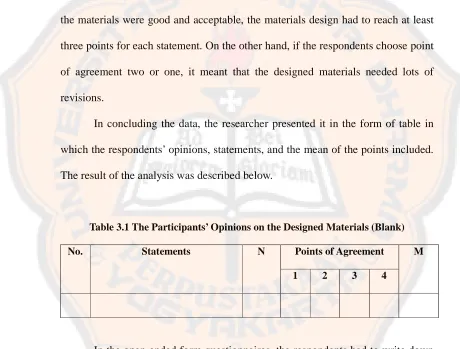
The percentage of the data results helped the researcher to describe and read the data to be analyzed. The researcher described the data and summed up the information gathered from the respondents in order to design the new product. If the materials were good and acceptable, the materials design had to reach at least three points for each statement. On the other hand, if the respondents choose point of agreement two or one, it meant that the designed materials needed lots of revisions.
In concluding the data, the researcher presented it in the form of table in which the respondents’ opinions, statements, and the mean of the points included. The result of the analysis was described below.
Table 3.1 The Participants’ Opinions on the Designed Materials (Blank)
No. Statements N Points of Agreement M
1 2 3 4
the form of written paragraphs. The researcher made improvement based on the respondents’ opinion, suggestion and also recommendations.
F. Research Procedure
This research covered the procedure in conducting the research. The explanations on the research procedures are described as follows.
1. Conducting Need Analysis
The very beginning step in designing the materials was to gather information of learners needs. At this step the researcher collected information about the teacher’s and students’ problem that they face in conventional English class, identify the source of the problem and determine possible solutions for both the teacher and the students. The outputs of this step were students’ characteristics, the teacher and the students’ needs. The need analysis itself was conducted through interview with the English teacher.
2. Determining Goals, Topics, General Purposes
3. Establishing Learning Indicators
After determining the general purpose, the researcher established the learning indicators to show detailed about what to teach and to accomplish in teaching learning. In other words, the indicators were also called objectives. This step showed the purpose to make the objectives on what students should achieve in every meeting.
4. Listing the Subject Content
This step was adopted from Kemp’s (1977) model. Students’ learning experience should include the subject content (p. 43). The subject content, then, must involve both the objectives and the students’ needs. In this research, the materials consisted of four parts which reflect the relation between objectives and students’ needs.
5. Selecting Teaching Learning Activities
In this step, the researcher selected the teaching technique and found the materials activities. This step also related to the selection of appropriate resources for the materials. The activities were designed based on the videos to enable students to participate actively.
6. Designing the Materials
7. Evaluation
The researcher adopted the eight steps of Kemp’s Model. It was to determine how successful the instructional design packages in facilitating effective participant learning by having a survey designed for criterion-related items and providing opportunities for feedback from the experts. Since the materials were not implemented, the evaluation was obtained by distributing questionnaire to the two English teachers and one lecturer of English Language Education Study Program Sanata Dharma University.
8. Revision
50
CHAPTER IV
RESEARCH RESULTS AND DISCUSSION
There are two main parts in this chapter. The first part explains the designing process of instructional vocabulary materials using video for the fifth grade students of SD Sumberadi 1 Sleman. The second part presents the presentation of the final version of the instructional vocabulary materials using videos for fifth grade students’ of SD Sumberadi 1 Sleman.
A.The Elaboration of the Steps in Designing the Materials