HERBARIUM BOGORlENSE
Head: ANWARI DILMY, Dip. For., Lecturer in Botany. Staff: W. SOEGENG REKSODIHARDJO, Ph.D., Botanist.
E. SOEPADMO, Ph.D., „
E. KUSWATA EAETAWINATA, B . S C , ASS. Botanist. MIEN A. RIPAI, M . S C , ASS. Mycologist. DJAJA DJENBOEL SOEJARTO, M . S C , ASS. Botanist. N. WlRAWAN, B.Sc, „
I. SOEJATMI, B.Sc, »
Honorary editors:
C. G. G. J. VAN STEENIS, D . S C , Flora Malesiana Foundation.
A. J. G. H. KOSTERMANS, D.Sc, Forest Research Institute.
K E I N W A R D T I A
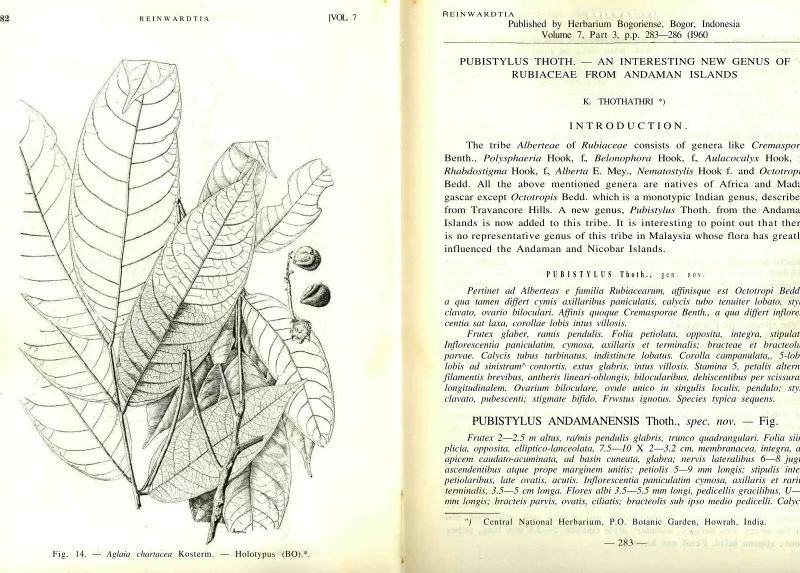
Published by Herbarium Bogoriense, Bogor, Indonesia Volume 7, Part 3, p.p. 221—282 (1966)
A MONOGRAPH OF AGLAIA, sect. LANSIUM Kosterm. (MELIACEAE)
A. J. G. H. KOSTERMANS *) SUMMARY
1. The history of the genus and the arguments for merging it with Aglaia,, are expounded.
2. The section Lansium of Aglaia is characterized by simple hairs and contains 15 species.
8. Aglaia kinabaluensis, A. intricatoreticulata, A. membrartacea and A. chartacea are new to science.
4. New combinations: Aglaia anamallayana, aquea, breviracemosa, dubia, koster-mansii, pedicellata, sepalina. New names: A. steenisii (base: L. pedicellatum
Kosterm.), A. pseudolansium (base: L.cinereum Hiern).
5. The genus Reinwardtiodendron Koorders is merged with Aglaia (sect Lansium) ; new name: A. reinwardtiana (base R. celebicum Kds.).
6. Excluded are: Lansium decandrum Roxb. and L. hum.ile Hassk., which are referred to Aphanamixis (A. decandra and A. humile, comb, nov.).
7. Aglaia jdnowskyi Harms is referred to Amoora as A. janowskyi (Harms) Kosterm., comb. nov.
8. The three well-known, commercial fruit trees: Duku, Langsat and Pisitan are considered to represent three distict species. They have been treated exhaustively. 9. Melia parasitica Osbeck is referred to Dysoxylum as D. parasiticum (Osb.)
Kosterm., comb, nov.; D. caulostachyum Miq. is a synonym.
10. Pull synonymy, descriptions, a key and an enumeration of Collector's numbers are presented.
11. Aglaia merrillii Elmer is reduced to A. dookkoo Griff.
INTRODUCTION AND ACKNOWLEDGEMENTS
In 1962 a MSS. on the Indonesian species of Lansium was presented by Mr. B. Prijanto as a thesis for his B. Sc. degree of the Agricultural Academy, Bogor. As Mr. Prijanto left for Edinburgh to continue his studies for a Ph. D. degree, I decided to improve and edit the MSS. How-ever, it became soon clear, that I had underestimated this task and the revision of Lansium, had to include a partial revision of the allied genera: A.mcora, Aphanamixis, Aglaia, and Chisocheton and some more superficial work in Dysoxylum.
') D. Sc, Professor of Botany, Bandung- Institute of Technology, of the Faculty of Mathematics and Physics, University of Indonesia, of the Agricultural Institute, Bogor; Assistant-Director Forest Research Institute, Bogor; Scientific Collaborator Herbarium Bogoriense.
221
222 R E I N W A R D T I A [TOL. 7
This took considerable time under the prevailing difficult conditions. I wish to extend my gratitude to the Director of the Kew Gardens, Sir George Taylor and to Mr. L. L. Forman (Kew Herbarium) for their valuable help in procuring data; to the Director of the British Museum of Natural History, Dept. of Botany and Mr. Robson for trying to locate Marsden's and Correa's specimens of Lansium domestieum, to the Director of the Botanical Dept., Naturhistoriska Riksmuseet, Stockholm, Dr. Tycho Nordlind, for providing me with a fragment of Melia parasitica Osbeck and to the Directors, Rijksherbarium, Leiden and Singapore for the loan of specimens.
Messrs Anwar and Damhuri prepared the drawings; they had to work under extremely difficult conditions with a salary hardly sufficient to stay alive.
The taxonomic and nomenclatural work was carried out under ab-normal conditions. No material (except that of Leiden and Singapore) could be borrowed (for safety reasons).
The personal has deserted the Herbariurii; they have to work else-where to seek out a living; most of the routine work of this large Institute had to be done by myself. As since several years the — formerly excellent — library hardly receives any more periodicals and other sources or re-ference, the bibliography of this paper is not as complete as that of my former monographs.
AGLAIA, sectio LANSIUM' Kosterm., sect. nov.
Lansium [Rumphius, Herb. Amboin. 1: 151, t. 54. 1741, p.p., excl. L. montanum et L. silvestre] Correa de Serra in Ann. Mus. Hist. nat. Paris 10: 157, t. 10, fig. 1. 1807 (fruetus) ; Jack in Trans. Linn. Soc. London 14(1) : 115, t. 4, f. 5. 1823; reprint, in Calcutta J. Nat. Hist. 4: 91. 1823; Blume, Bijdr. Fl. Ned. Ind., 4e Stuk: 164. 1825; Sprengel, Syst. Veg-. 3: 66. 1826 et Gen. 2: 542. 1831 (quoad nomen tantum) ; Hamilton in Mem. Werner. Nat, Hist. Soc. 5(2) : 355. 1826 (n.v.) ; de Jussieu in Mem. Mus. Hist. nat. Paris 19: 233. 1830; Bartling, Ordines nat. 356. 1830 (excl. Cipadessa Bl.) ; Spach, Hist. nat. Veg-. p'ban. 3: 190. 1834; Meissner, Gen. 48(35). 1837; Reichenbach, Handb. 313. 1837; Nomencl. 212, 1841; C. DC, Monogr. 1: 596. 1878; Endlieher, Gen. 14: 1049. 1840; Enchir. 551. 1841 (excl. Sphaerosaeme Wallieh):; Steudel Nom., ed. 2, 2: 8. 1841 (excl. Nemedra J<uss.) ; Walp. Rep. 1: 428, 1842; Hasskarl, Tweede Cat. PI. tuin Buitenzorg 220. 1844; Blanco, Fl. Filip., ed. 2: 288. 1845; ed. 3, 2: 61. 1878; Roemer, Fam. nat. 1: 82. 1846; Syn. Monogr., Hesper. 1: 98. 1846; Orbigny, Diet. iTist. nat. 7: 241. 1846 (Lanisium) ; Dietrich, Syn. 4: 788. 1847; Lindley, Veg. Kingd. 464. 1847; ed. 3: 464. 1853; Miquel, Fl. Ind. bat. 1(2): 544. 1858; Bentham & Hooker f., Gen. PL 1: 334. 1862; Peiffer, Nom. 2(1) : 24. 1874 (excl. Sphaerosaeme) ; Hiern in Hooker f., Fl. Brit. India 1: 557. 1875; Baillon, Hist. PI. 5: 501. 1873; Diet. Bot. 3 - 4 : 199. 1876; Durand, Index 61, no. 1183. 1888; Boerlage, Handl. Fl. Ned. Ind. 1:
1966] KoSTERMANS: Aglaia, sect. Lansium 223
192. 1890; King in J. As. Soc.-Beng-. 64(2): 80. 1895; Harms in Engler & Prantl, Nat. Pfl. fam. 3(4) : 396. 1896; ed. 2, 19 b. 1: 123. 1940 (et 1960) (excl. Sphaerosaeme) ; Koorders & Valeton, Bijdr. Kennis Booms. Java 3 in Meded. 'sLands Pl.tuin Buitenzorg 16: 178. 1896; Cooke, Fl. Bombay 1: 210. 1902; de Dalla Torre & Harms, Gen. siph. 261. 1903; Post & Kuntze, Lexikon 315. 1904; Brandis, Indian Trees 144. 1906; Backer, Fl. Batavia (in Meded. Dept. Landb. 4) 1: 278. 1907; Pellegrin in Notulao Syst. 1: 284^90. 1909; in Lecomte, Fl. g-en. Indoch. 1: 750. 1911; Merrill, Fl. Manila 275. 1912; Koorders, Excurs. Fl. Java 2: 443. 1912; Gamble, Fl. Madras 1: 182. 1915; Ridley, Fl. Malay Pen. 1: 410. 1922; Lemee, Diet, Genres 3: 943. 1931; Briquet in Boissieria 1: 1-126. 1936 (n.v.); Bailey, Stand. Cyclop. Hortio. 2: 1818. 1947; Adelbert in Backer, Fl. Java (emergency Ed.). Fam. 148: 20. 1949; How & Chen in Acta Phytotax. Sinica 4(1) : 27. 1955; Backer & Bakh. v.d. Brink, Fl. Java 2: 125. 1966. Plutea, Noronha in Verhand. Batav. Genootsch. 5, ed. 1, Art. 4: 3. 1790 (nomen); Hasskarl, Tweede Catal., I.e. 1844; Harms, ll.ee.
Lachanodendron Reinwardt ex Blume, Catal. Gewassen Pl.tuin Buitenzorg 70. 1823 (nomen); Steudel, Nom., ed. 2, 2: 1. 1841; Post & Kuntze, Lexikon 315. 1904 (Lachanodendrum).
SECTIO LANSIUM KOSTERM.
Pilis simplicibus, foliis imparipinnatis rarissime unif oliolatis, foliolis alternantibus, rarissime suboppositis prominule reticulatis, petiolis ple-rumque pulvinatis; inflorescentiis racemiformibus vel spicatis, rarissme pauce brachiatis vel anguste pamculaMs, floribus sub glob mis hermaphro-ditis, sepalibus 5 parvis, petalibus 5 inciirvatis concavis, tubo stamineo mbgloboso, antheribus 10 inclusis, rarissime margine impositus, cyelus I vel 2; nectarium deest, stylo patvo vel nullo-, stigmate magno vel in-conspicuo; fructus indehiscentibus, 5-locellatus, seminibus plerumqwe aril-lus includentibus, cotyledonis superpositis radiculis horlzontalis.
DISCUSSION
It is not necessary to repeat Pellegrin's (in Notulae Syst., I.e.) arguments for including Lansium, Aphanamixis and Amoora into Aglaia, as these arguments still stand. I shall limit myself to discuss the treat-ment of Harms in the second edition of Engler & Prantl.
224 R E I N W A R D T I A [VOL. 7 A comparison of the description of Aglaia and Trichilia makes it evident, that Aglaia could as well be fused with Trichilia.
I cannot predict which will be the future trend for an integrated classification of Melioideae-Trichilieae, whether the trend of combining (as is going on now: Heynea with Trichilia; Lansium, Reinivardtiodendron, Clemensia included in Aglaia) will prevail or whether heterogeneous genera like Trichilia and Aglaia will be split up into smaller entities.
It is clear that Harms prefers smaller entities, as he conserves genera, combined by other authors (Ruagea, Clemensia) and keeps the old genus Didymochiton separate from Dysoxylum. There is nothing against this and I have in the additional notes to the Lansium study kept Aphanamixis separate from Amoora (for the time being, pending a full revision) and I am inclined to agree with Harms that Didymochiton (provided that it be restricted to species with a pseudocalyx of bracts) may be upheld.
Harms' suggestion to raise the 3 subfamilies of Meliaoeae to family rank, however, is not acceptable; Cedreloideae and Swieteniodeae could as well be combined in one subfamily. Pollen morphology does not support Harms' suggestion (Erdtman).
On the other hand Harms leaves intact the huge and extremely heterogeneous genus Trichilia' (free sepals or a calyx tube; petals 3, 4 or 5; staminal tube or free stamens; anthers 5—10, attached to the rim of the tube; disc none or stipelike or even urceolate; ovary 2, 3 on 4-celled; style short or long; ovules usually 2 per cell, above or next to each other; capsule dehiscent; aril present or absent or partial; leaves imparipinnate or unifolioled; folioles entire or incised).
There are apparently only two constant characteristics: the anthers on the tube rim (but in Tr. volkensii they could as well be considered to be included) and the dehiscent, capsular fruit.
According to the key, Harms differentiates Lansium from Trichiliinae by the position of the anthers. In this way in Trichiliinae are included only section Hearnia of Aglaia and of section Lansium only Aglaia. steenisli. More confusing is the key in separating Lansium, Reinivardtiodendron and Aphanamixis and Amoora (Lansium: anthers twice as many as petals in one or two whorls, with or without appendix. Petals 4—5. Reinwardtioden-dron: anthers twice as many as petals, in 2 rows, with appendix; petals, 4—5. Aphanamixis and Amoora' (plus many other genera) : anthers twice as much as petals or the same number or slightly more, in one row. Petals 3—5).
In Lansium Harms includes Sphaerosacme (decandra), which is poly-gamous dioecious and belongs in Aphanamixis. Hence his description
1966] KOSTERMANS : Aglaia, sect. Lansium 225
differs from that of Lansium proper (Lansium has been treated in a similar way by Hiern, King, Ridley, etc.).
He subdivides Lansium, in three sections: Eulansium Harms with flowers on the bole (which is wrong) or on older branches; Neolansium Harms, which is a mixture of Aphanamixis (L. humile Hassk.) and true Lansium; Pseudolansium Harms is an Aphanamixis (L. decandrum).
He furthermore cites L. pedicellatum Hiern as being of uncertain status (it is an Aglaia) and L. javanicum Koorders & Valeton, which he says seems to be of uncertain position (it is Aglaia dookkoo Griff.).
He summerizes the differences between Reinivardtiodendron and Lansium as follows; simple leaves, connective appendix (in the key to Lansium, page 39 and 126, not in the description, Lansium is characterized by having connective appendices or these are lacking), fruitwall woody (it is not), aril lacking (cf. remark under Aglaia reimvardtiana Kosterm.). Actually only the characteristic of folioled leaves stands and one-foh'oled leaves are not uncommon in Aglaia.
Dysoxylum, Aglaia and Chisocheton could be easily accomodated in Trichilia as outlined above (Aglaia has indehiscent fruit, according to me, but Harms includes also species of Aglaia with dehiscent capsules).
The anthers, attached to the tube rim (in Trichilia) are comparable to those in section Hearnia of Aglaia.
In other genera Harms attaches enough importance to a tubelike calyx or free sepals (Urbanoguarea versus Guatea; Urbanoguarea seems to be mainly differentiated by the peculiar foliole shape, but in Trichilia species with entire and incised folioles are kept together!)
In Amoora. Harms incorporates species with 3, 4 and 5 petals, although King, Koorders & Valeton and others had restricted Amoora to species with 3 petals.
There are many more examples to show, that the delmitation of the genera has not been carried out consistently.
Apparently it is difficult to base genera on numerical characters (calyx lobes or sepals, petals, number of stamens, number of ovary cells) as these seem to vary considerably in closely related species and even in the same specimen (in Aglaia: sepals 4 or 5; petals 3, 4, 5; anthers 3, 5, 6, 10; ovary with 2, 3, 4 or 5 cells).
Other characteristics (discussed below) are not much better, unless the larger genera are split up.
in-226 R E I N W A R D T I A [VOL. 7 dehiscent; those mentioned by Koorders and Valeton are opened irregular-ly under artificial pressure in the herbarium; the same holds true for A. latifolia).
A genus like H>eimodendron Sillans (in Bull. Soc. bot. France 100: 263. 1953) is hardly warranted, as the fruit is unknown and it not even possible to ascribe this genus to one of the subfamilies.
Indumentum. For the Fijian species of Aglaia, A. C. Smith (in Contr. U.S. nat. Herb. 30: 477. 1957) presented a subdivision based on the presence of stellate hairs and two kind of scales *). He thought that this was a more practical subdivision than that based on the position of anthers ftnd furthermore he questioned the value of the latter characteristic, as it cuts across the one suggested. As mentioned before, I do not believe that one or the other is more "natural", but I also for practical reasons prefer a subdivision based on the indumentum. In Trichilia a similar sub-division exsists.
For the Javanese species of Lansium Koorders and Valeton pointed to the characteristic of simple hairs as opposed to stellate hairs or scales in Aglaia **). Whether these simple hairs are really simple has still to be proved, they might be forked hairs of which one arm is reduced. The ihairs on the fruit are extremely short and are perhaps of a different
character than those on the branchlets.
Lansium pedicellatum Hiern (renamed here Aglaia pedicellata) has to be removed from the section Lansium, because of the presence of scales, although in all other respects it fits in Lansium.
Leaves. Two kinds of leaves are found, compound and unifoliolate. Again this characteristic cuts across the primary subdivision of Aglaia. It would be possible to have the subdivision according' to this characteristic, but at least one species of Aglaia has from one to 3 leaflets in the same species.
The archaeic character of simple leaves is also debatable; the juvenile leaves of A. aquea, dookkoo are difficult to interprete as unifolioled leaves and resemble more the simple leaves of Vavaea (cf. under A. aquea). In Aglaia an appreciable number of species has unifolioled leaves (with stellate or lepidote indumentum), hence there is no reason to keep Rein-wardtiodendton (with unifolioled leaves) separate from Lansium, as it has simple hairs. Sometimes it is stressed, that the seeds of Reinwardtio-dendron are ex-arillate, but the specimen Kostermans 13776 cited by van
.'*)" Sectio Lepiaglaia, Pierre, indumentum lepidotum.; Sectio Stellato-pilosae sect, nov., indumentum, stellato-pilosum.
' '**) i Pierre (PI. for. sub. t. 333, 1895) wrongly states that Lansium has stellate hairs.
1966] KOSTERMANS : Aglow, sect. Lansium 227
Steenis has thinly arillate seeds; moreover I believe that the presence or absence of an aril (partial or complete) or an arilloid cannot be used as a generic characteristic (cf. Trichilia, Guarea, etc.).
In sectio Lansium the leaflets are alternate, except the apical ones in some species, which might be sub-opposite, in A. intricatoretievltiba they are opposite, in A. chartacea and A. membranacea they are alternate or siibopposite. The leaves are imparipinnate; there is either an apical leaflet Gr this may be reduced to a small stalk, the two kinds were observed on the same tree (A. dookkoo) ; in this sense the leaves resemble those of Sapindaceae. All species of section Lansium. have a prominulous reticu-lation on both surfaces of the folioles. In some species this reticureticu-lation is peculiar, consisting of secondary nerves, starting from the midrib and running parallel to the lateral nerves; in some cases they run out before reaching the margin, in other cases they form loops at the margin similar to those of the lateral nerves. This is most pronounced in A. dubia, where the reticulation resembles remotely that of Calophyllum or Ochnaceae. In other species the reticulation forms a dense lattice work, similar to that found in Aglaia matthewsii. Although the bulk of the species of Aglaia has rather smooth leaves, there are also species with a similar pronounced reticulation.
On the lower leafsurface sometimes domatia are found, consisting of shallow or deeper cavities with stiff hairs. These domatia are not present in all the leaves of the same specimen and are therefor not fit for specific segregation.
The foliole. base is usually slightly asymmetrical; strongly asymme-trical leaves as in Amoora and Aphanamixis are not found.
Most species of the section Lansium have pulvinate petiolules and petioles. This is also the case in some species of Aglaia.
The end bud remains dormant for a long time, once a year new flush developes.
•228 R E I N W A R D T I A [VOL. 7 The racemes and spikes or not proliferous, as contended by Griffith. The flowers are usually widely spaced (interupted) ; the flowers develop regularly from base to spex.
Flower. They have been described for a long time as hermaphrodite and polygamous-dioecious in Lansium, because L. decandrum was included in the genus; all other species of sectio Lansium are strictly hermaphrodite and so they are in Aglar.a proper (Lansium decandrum is here referred to Aphanamixis). The calyx (in all Aglaia) consists of 5 free sepals; they are slightly grown together at the base. The size of the sepals in the fruit represents a usefull specific characteristic. Usually the sepals are ciliate at the margin; they are as a rule broader than long and concave. The 5 petals (in Aglaia 3, 4 or 5) form the subglobose flower; they sometimes become explanate or reflexed; they are always complete-ly glabrous and rather fleshy. In one specimen the number of petals varies sometimes between 4 and 5.
The staminal tube is subglobose (also in Aglaia). The anthers are as a rule completely included (except A. steenisii) ; their number is in sectio Lansium, 10. In Aglaia there are either 10 or 5 stamens, rarely 3 (A. triandra). The inside of the tube shows ribs in the basal part; these represent the centre of the broad filaments; in fresh material the bound-aries of the filaments are discernable; they are separated by bands of other tissue (comparable with the lamellae found in other Meliaceae). A, de Jussieu's theory could be modified in this way, that the tube consists of the broad filaments grown together with alternating lamellae (cf. Harms in Engler & Prantl, I.e., ed. 2, 19 b. 1: 19. 1940). The apex of the anthers is acute and simulates in dried material an appendix. The shape of the anthers is constant in all of Aglaia.
A. steenisii of section Lansium., if following-the current subdivision, should fall in section (subgenus) Hearrda of Aglaia.
The style is lacking. Actually the top of the. ovary is more or less acuminate and bears often a large stigma, which in section Lansium is often conical or cylindrical in shape.
In Aglaia proper a similar stigma is found and here too the style is lacking (or very short).
The ovary is small, ovoid in shape, tapered towards the apex; it is densely pilose; the outside is (in dried material) ribbed (angled); the ovary has 5 cells each with one ovule, attached to the central axis.
There is no disc. This important characteristic holds also true for Aglaia proper.
1966] KOSTERMANS: Aglaia, sect. Lansium
The fruit represents a non-dehiscent capsule; the pericarp is leathery and not very thick in sectio Lansium; it is pilose outside, but the hairs are so tiny, that a high power lense is necessary to observe them. The inside of the skin is smooth,glossy, white and shows in between the septa an obscure rib, indicating the spot where in other genera (Aphanamixis, Dysoxylum, Guarea) dehiscence takes place.
There are always 5 compartments in sectio Lansium, but only 1—3 seeds develop; the remaining cavities are filled with the aril only. I suppose that in Aglaia with 2—5-celled fruit, the number has been actually 5; in those species with a thin aril, the compartments with abortive seeds dis-appear completely. Because of the leathery skin, which under pressure bursts open, pressed, dried fruit of Aglaia are sometimes mistaken for dehiscent fruit. There is never more than one seed per cell, which conforms with the situation in Aglaia proper.
In Lansium humile the fruit are dehiscent (cf. there) and for that reason and others this species has been removed to Aphanamixis.
The cotyledons are thick and transverse in section Lansium; in Aglaia there seem to be exceptions. The dividing plane between the cotyledons is slanting and hence in Aglaia intermediate stages between transverse and longitudinal cotyledons might be found.
An aril or arilloid is found in almost all (perhaps all) of Aglaia, in-cluding section Lansium,. The origin of the aril or arilloid is not clear, it might be the outer testa. Koorders described Reinwardtiodendron as having no aril, but the specimen Kostermans 13776, if belonging here, has a thin aril. In dried material a thin aril may become completely obliterated.
- KEY TO THE SPECIES
la. Leaves unifoliolate 1. A. reinwardtiana
b. Leaves imparipinnate 2 2a. Inflorescence a narrow panicle 15. A. ehartacea
b. Inflorescence a raceme or spike (sometimes slightly branched at the base) 3 3a. Leaves with scalariform secondary nerves IS. A. intricatoreticulata
b. Leaves with reticulate secondary nerves (or these partly simulating" primary
nerves, cf. A. dubia) .4
4a. Anthers exsert, inflexed, closing- the orifice of the tube . . . 2. A. steenisii
b. Anthers at the inside of the staminal tube 5 5a. Anthers in one whorl 6 b. Anthers in two whorls 9 6a. Racemes 0.5 - 4 cm long 3. A. breviraccmosum
) f
2—2.5 mm in diam.; anthers 1.5—2 mm. Fruit globose, densely pilose, orange yellow, skin tough, thin, with much latex 4. A. aquea
Lower leaf surface pilose on the main nerves, branchlets glabrescent. Flowers subsessMe, calyx lobes 1.5—2 mm in diam,., anthers 1—1.5 mm. Fruit ellipsoid, glabrescent, pale yelliow, skin thick, less tough:, with a little latex 6. A. domestica
Lower leaf surface and branchlets glabrous. Flowers shortly pedicelled; calyx lobss 0.3—0.8 mm in diam., anthers 0.3—0.5 mm. Fruit ellipsoid, pale yellow, glabrous, skin thick, less toug'h, without latex 8 Leaves membraneous, alternate and sub-opposite. Infructescences in the axils of
fallen leaves 14. A. membranacea
Leaves subcoriaceous, alternate. Infructescences on old branches . 5. A. dookkoo
Branchlets denseliy tawny tomentellous 10 Branchlets glabrous or only the utmost apex minutely pilose 11 Sepals (of the fruit) 4 mm in diam 12. A. sepalina
Sepals (of the fruit) 1 mm in diam 7. A. pseudolansium Lateral nerves strictly parallel, up to more than 15 pairs . . . 9. A dubia Lateral nerves 6—10 pairs 12 Lower leaf surface sparingly pilose, midrib pilose; upper surface smooth . .
. . . " 10. A . kostennansii
L o w e r l e a f s u r f a c e g l a b r o u s , u p p e r s u r f a c e p r o m i n u l o u s l y r e t i c u l a t e . . . . 1 3 S p i k e s g l a b r o u s . P e t a l s 4 — 5 m m . S t i g m a g l o b o s e , d e e p l y 5 - f u r r o w e d . . . .
. . , , , 8. A. kinabaluensis
Spikes minutely pulverulently puberulous to glabrous. Petals 3 mm., stigma
knoblike, subeylindrical 11. A. avatnallayana
AGLAIA, SECT. LANSIUM KOSTERM.
1. AGLAIA REINWARDTIANA Kosterm., nom, nov, — Fig. 1
Reinwardtiodendron celebioum Koorders (base), Flora N.O. Celebes in Meded. 's Lands Pl.tuin Buitenzorg 19: 389. 1898; Suppl. Fl. N.O. Celebes 1: 23—27, t. 8a, b. 1918; Harms in Engler & Prantl, Nat. Pfl. fam. Nachtr. 2: 37. 1900; id., ed. 2. 19 b 1: 125. 1940; Koorders-Schumacher, Syst. Verzeichn., Abt. 3(1): 63. 1914; Merrill, Enum. Philipp. fl. PI. 2: 369. 1923; Van Steenis in Nova Guinea 10: 210, f. 2. 1959. — Koorders 19712 (BO).
Reinwardtiodendron merrillii Perkins, Fragm. PI. Philipp. 74—76. 1904; Koorders, Suppl., I.e. 23; Merrill in Philipp. J. Sci. 1, Suppl. 72. 1906; Enum., I.e. 369; Elmer, Leaflets Philipp. Bot. 9: 3385. 1937. — Merrill 3149 (typus) ; Barnes 59 (para-typus).
Lansium monophyllum Merrill ex Perkins, I.e. 75. 1904 (nomen).
Tree, up to 25 m high, glabrous in all its parts, except the vegetation point, which is minutely adpressed pilose, diam. up to 30 cm, base slightly buttressed. Bark grey; living bark thin with a resinous odour. Branchlets to..oblonglanceolate, 10—20 x 3.5—6.5 cm; base cuneate, apex
long-acumi-1966] KOSTERMANS: Aglaia, sect. Lansium .'231
nate; both surfaces prominulously reticulate; upper surface glossy, midrib slender, in a groove, lateral nerves slender, prominulous; lower surface somewhat glossy, paler, midrib prominent, lateral nerves 7—9 pairs, slender, arcuate, axils with hol'low domatia in some leaves. Petiolules 2—3 mm long, apex somewhat swollen, petioles 1—2 cm long, slender, at base shortly pulvinate. '
Spikes axillary, erect, solitary or fascicled, 6—12 cm long with short petiolar part; rhachis slender, glabrous (with a few 100 µ . long hairs). Flowers sparse, sessile, subglobose, 3—4 mm long, without scent, yellowish, subtended by minute bracteoles. Sepals membraneous, rounded, glabrous, ca 1 mm. Petals pale yellow, oblong, obtuse, 3—4 mm long. Staminal tube pale green, shorter than the petals, margin with 5 very short, truncate teeth. Stamens 10 in 2 rows, included or slightly exsert. Anthers white, sessile, acuminate (in sicco) ; ovary small, ovoid, 5-angled, pubescent; style none, stigma 5-lobed, thick. Fruit densely, shortly pilose with hard exo-carp (4 mm in diam.), pearshaped or oblong or subglobose, up to 3 cm in diam., usually one-celled by abortion. Seeds with thin aril, testa mem-braneous, cotyledons above each other, plumule pubescent, radicle hori-zontal, short.
Distribution: Philippines, N. Celebes, N. Borneo, W. New Guinea, low and medium altitudes.
Vernac. names: Langsot, lasot (Celebes), Balibisan (Mbo.), Bianti (Tag.), Malakamanga (Tag.) (Philippines).
There are some discrepancies in Koorders' description: in the generic description it is stated that the ovary is ovoid, in the specific description it is oblong; in the former the inflorescences are racemose or paniculate, which is certainly wrong and in the latter spicate. In the key it is stated that the spikes are simple or slightly branched. If the specimen Koster-mans 13776 from Borneo belongs here, the seed has a thin aril; this specimen was cited by Van Steenis.
PHILIPPINES : Luzon, Prov. of Benguet, Twin Peaks, May, fr., Elmer 6332 (BO) ; Prov. of Bataan, Nov., fl., Elmer 6766 (BO); ibid., Aug. - Sept., fl., Alvarez F.B. 12926 (BO); ibid., Lamao R., Mt. Mariveles, fl., Borden F.B. 2060 (BO); ibid., Oct., fl., Barnes F. B. 59 (BO) ; Mindoro, Mt. Calavite, Apr., fl., Ramos B. Sci. 3,9381 (BO) ; N. CELEBES, Minahasa, Pingsan, Febr., fl., Koorders 19713 (BO, K, L) ; W. NEW GUINEA,
232 R E I N W A R D T I A [VOL. 7 1966] KOSTERMANS: Aglaia, sect. Lansium 233 2. AGLAIA STEENISII Kosterm., nom. nov, — Fig. 2 .
Lansium pedioellatum (non Hiern) Kostermans in Reinwardtia 7: 31, fig. 11. 1965. — Van Steenis 3U4 (BO).
Shrub or treelet 4—14 m; outer bark with peeling flakes, inner bark ochre white, 2 mm, resinous; wood light ochre; young branchlets densely, minutely, pale brown tomentellous; soon glabrous. Leaves glabrous (base of rhachis in young leaves somewhat pilose) ; rhachis (petiolar part of 4—10 cm included) up to 18 cm long, base shortly thickened. Folioles chartaceous to thinly coriaceous, 5—7, alternate, glabrous, obovate or sub-obovate-lanceolate (apical one) to subovate or elliptical (basal ones), up to 9 X 19 cm (apical one) to 2.5 X 6 cm (basal foliole), apex conspicuously, broadly acuminate, base cuneate; both surfaces prominulously reticulate; upper surface glossy, midrib slender, impressed, lower surface paler, duller, midrib prominent, lateral nerves 7—9 pairs, arcuate, prominent, secondary nerves prominulous. Petioles slender, 3—20 mm long, pulvinate at base, flat or slightly sulcate above.
Racemes on the bare branches behind the leaves, glabrous, slender, up to 17 cm long. Flowers sub-globose, 2—4 mm in diam. Pedicel fili-formous, 1—6 mm long, subtended by a minute, pilose bract. Sepals sub-orbicular, 1—2 mm in diam. (broader than long), margin ciliate, reflexed. Petals ovate-orbicular, 2—4 mm long. Anthers 10, in one row, slightly exsert, inflexed and closing the truncate, broad tube orifice; ovary ovoid, angular, pilose, stigma truncate, style cylindrical, thick, angular, 1 mm.
DISTRIBUTION: Sumatra, Borneo
The species is characterized by its glabrousness, the pedicelled flowers with reflexed sepals and the broad orifice of staminal tube. The leafsize is very variable, the Van Steenis specimen has the smallest folioles, the Meyer specimen the largest. The flowers of both are exactly alike. Also the pedicel length varies considerable, being 1 mm in the Steenis specimen and 6 mm in the Meyer one.
MALAY PENINSULA : Perak, Mt, Pondo, May, buds, King's Coll1. 7657 (SING) ; SUMATRA, North slope of Mt. Pakiwang, on lake Ranau, ca 600 m alt., Oct., fl., Van Steenis SiU (A, BO, K, L, U) ; Mt. Sago, Payakumbuh, alt. 100 m, A:ug\, fl., Meyer 5098 (L) ; Isl. Simaloeur, July, fl., Achmad 1272 (BO, K, L, P) et 1526 (BO, L) ; ibid., fr., 66. U07 (BO); June, fl., Achm.ad 1156 (BO, L); E. BORNEO, Mt. Sekrat near Sang-kulirang, June, fl., Kosterman$ 6223 (L).
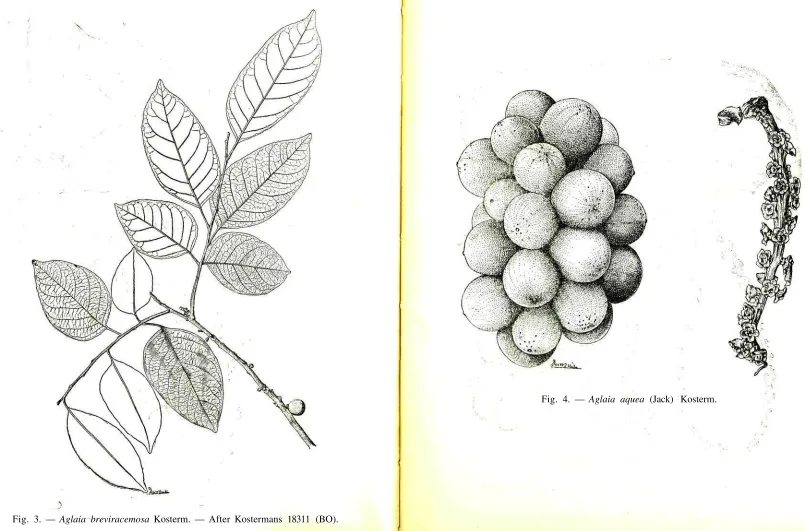
3. AGLAIA BREVIRACEMOSA (Kosterm.) Kostermans, comb. nov. — Fig. 3
Lansium breviracemosum Kostermans (basionym) in Bull. bot. Survey India 7: 128. 1965. — Kostermans 18311 (BO),
A small tree, up to 15 m high and 20 cm in diam. with small but-tresses. Bark smooth or cracked, pale brown, 0.5 mm, inside white; living bark 2—3 mm, green or lightbrown. Branchlets minutely adpressed pilose at apex, glabrescent, longitudinally striated with scattered, minute, elong-ate lenticels. Leaf buds densely, minutely sericeous. Leaves alternelong-ate, up to 27 cm long (the pilose, 4 cm long petiolar part included), spirally arranged, imparipinnate, base pulvinate. Folioles (5—) 7—10 (—11), usual-ly 9, chartaceous, glabrous, ovate-elliptical to elliptical, rareusual-ly obovate-ellip-tical or lanceolate-ellipobovate-ellip-tical, 5—14 x 3—6 cm, up to 7 x 15 cm, base acute or cuneate, apex bluntly acuminate; reticulation dense, prominulous on both surfaces; midrib slightly impressed on upper, prominent on the lower surface; lateral nerves (6—) 8—10 pairs, slender, prominulous, slightly arcuate. Petioles slender, up to 1.5—2 cm long with strongly pulvinate base.
Inflorescences axillary and on the bare branchlets, 5—40 mm long, pilose towards the base, racemiform, unbranched or with a few, up to 3 mm long, widely spaced ramifications at the base. Bracts concave, ovate, acute, minute. Flowers subsessile, subtended by a tiny bracteole. Sepals 5, with scattered tiny hairs, explanate, usually broader than long, acutish, 0.5—1 mm, margin minutely ciliate; outer petals orbicular, concave, glabrous, fleshy, white, 2—2.5 mm long, in one whorl, included in the 1—2 mm high, subglobose tube, mouth sub-entire, 1—1.5 mm in diam. Ovary cylindrical, sulcate, 3—5-celled, densely sericeous, topped by a flat, fleshy, stigma, which is constricted into a short thick pilose style, which merges into the ovary.
Fruit globose, greenish grey (fresh), minutely, densely pilose, 10— 15 mm in diam.; pericarp leathery, 0.5—0.7 mm thick; seeds usually 3 (one in each compartment), ellipsoid, 7—10 mm long, 4—6 mm in diam., aril none; testa coriaceous, thin; cotyledons superposed.
234: RE I N W A R D T I A [VOL, 7
In the original description by a printer's error, the description of the tree, inflorescence and flower has been misplaced on the same page under the heading: Soaphium longepetiolatum (Kosterm.) Kosterm., comb. nov. (basionym: Microcos longepetiolatum Kostermans in Reinwardtia 6: 301. 1963).
The flower pedicels are very short and thick and not lacking as I described them originally.
The inflorescences have occasionally a few, very short branches at their basal part.
W. SUMBAWA: Mt. Batulante, trail from Batudulang to Pukis, alt. 700-800 m, April, fl., fr., Kostermans 18811 (A, BO, CANB, K, L, LE, P) ; trail to Punik, alt. 700 m, Nov., fr., Kostermans 19195 (A, BO, C, CANB, K, L, US) ; trail to Pusu, alt. &00—1000 m, Oct., fr., Kostermans 19087 (A, BO', C, CANB, G, K, L, P, SING, US) ; trail to summit, alt. 700—880 m, April, fl., Kostermans 18269 (A, BO, CANB, K, L) et
Kostermans 18U3 (BO, G, K, L, LAE, LE, P, PNH, SING:, US) ; E. Sumbawa, Ro Mts., E. side, Wawo dunga, ster.; Elbert 3761 (L.).
4. AGLAIA AQUEA (Jack) Kosterm., comb, et stat. nov. — Fig. 4
Lansium domesicum, var. aqueum Jack (basionym) in Trans. Linn. Soc. London 14(1): 116. 1823; reimpr. in Calcutta J. nat. Hist. 4: 93. 1843; Roemer, Fam. Nat. Syn. Monogr., Hesperides 1: 99. 1846 (as a syn. of Lansium aqueum Roemer) ; King in J. As. Soc. Bengal 64(2) : 81. 1895 (as a syn. of Lansium domesticum Jack) ; Koorders & Valeton, Bijdr. Kennis Bomms. Java 3 in Meded. 's Lands Pl.tuin Buitenzorg 16: 180 et 183. 1896 (as a doubtfull syn. of L. domesticum Jack) ; Kostermans in Rein-wardtia 5(3): 351. 1960 — Lectotypus propos,: Kostermans s.n. (BO).
Lansium aqueum (Jack) Roemer, I.e. 99; Miquel, Fl. Ind. bat. 1(2): 545. 1859; Suppl. Sumatra 197. 1860; in Ann. Mus. Lugd. bot. 4: 34. 1868; Hiern in Hooker f., Fl. Brit. India 1: 558. 1875; C. DC, Monogr. Phan. 1: 598. 1878; King in J. As. Soc. Bengal 64(2) : 81. 1895 (as a syn. of L. domesticum Jack) ; Koorders & Valeton, I.e. 180 et 183 (as a syn. of L. domesticum, var. pubescens K. & V.) ; Koorders, Exk. Fl. Java 2: 443. 1912 (p.p., quoad ,,Kokosan") ; Harms in Engler & Prantl, Nat. Pfl. fam., ed. 2, 19 b 1: 124. 1950 (as a syn. of var. pubescens K. & V.) ; Kostermans, I.e.
Lansium, domesticum, var. kokossan Hasskarl, Tweede Cat. Pl.tuin Buitenzorg 220. 1844 (diag, latin, in adnot; quoad nomen tantum; material in Leiden, identified by Hasskarl as var. kokossan represents the real duku = Aglaia dookkoo Griff, and another sheet represents A. domestica, the pisitan or bidjitan.) ; Nut, I.e. 85; Teijsmann & Binnendijk, Cat. Pl.tuin 211. 1866 (kohkosan) ; Zippel ex Miquel, Ann. Mus. bot. Lugd. bat. 4: 34. 1868 (kokosan).
Lansium domesticum, var. pubescens Koorders & Valeton, I.e. 181 et 183. 1896; Hoohreutiner, PI. Bogor exsicc. 74. 1904; Backer, FL Batavia l(in Meded. Dept. Landb. Ned. Ind. 4): 279. 1907; Schoolf.. Java 215. 1911; Koorders - Schumacher, Syst, Ver-zeichn. 1(1), Fam. 140: 30. 1911; Koorders, Exk. Fl. Java 2: 443. 1912 (p.p.; quoad "Kokosan" = "Tjeloring"; ceter. exclud.) ; Ridley, Fl. Mai. Pen. 1: 411. 1922; Ochse & Bakh., Vruchten & Vruchtent. Ned. Ind. 62, t. 25. 1931; id., Fruit and Fruitcult. Ind.
1966] KOSTERMANS: Aglaia, sect. Lansium 235
62, t. 25. 1931 (excl. cit. "pisitan" = "pidjitan" = "peeseetan" = "peedjeetan") ; Adelbert in Backer, Fl. Java (emergency Ed.), Fam. 148: 20. 1949; Harms in Engler
& Prantl, I.e. 124. 1940; Ochse et al., Trop. & subtrop. Agr. 1: 644. 1961; Backer & Bakhuizen v. de Brink, Fl. Java 2: 125. 1966. — Koorders 5127 (BO).
Lansium domestieum (non Jack) Blume, Bijdr. Fl. Ned. Ind., 4« Stuk: 165. 1825 (quoad var. ,,Kokosan") ; de J'ussieu in Mem. Mus. Hist. nat. Paris 19: 233. 1830 (p.p.; quoad ,,Kokosan") ; (non Jack) Miquel, Suppl. Sumatra 54, 197, 509. 1860; (non Jack) Bisschop Grevelink, PL Nederl. Ind. 495. 1883 (excl. cit. "doekoe") ; (non Jack) de Clercq, Nieuw PI. Woordenb, Ned. Ind. 266, 1909 (p.p.; quoad ("Kokosan"); (non Jack) Koorders-Schumacher, Syst. Verzeichn. 3(1) : 26. 1910; (non Jack) Backer, Schoolfl. Java 2: 443. 1912 (p.p.; quoad "kokosan"); (non Jack) Van Gorkom, O. Ind. Cult. 3: 638. 1913 (p.p., quoad ("kokosan") ; (non Jack) Heyne, Nutt. PL Ned. Ind., ed. 2: 895. 1927 (p.p.; quoad "kokosan"); (non Jack) Ochse, Indische vruchten 120, fig. 60. 1927; Vruchten & Vr. t. Ned. Ind. 62. 1931 (p.p.; quoad "kokosan"; (non Jack) Burkill, Diet. econ. Prod. Mai. Pen. 2: 1314. 1935 (p.p., quoad langsat) ; (non Jack) Terra, Tuinbouw. 79. 1949 (p.p.; quoad "kokosan"); (non Jack) Corner, Ways. Trees Mai., ed. 2, 1: 463. 1952 (p.p.); (non Jack) Backer & Bakh. v.d. Brink, Fl. Java 2: 125. 1966.
Kokosan, Filet, Plantk. Woordenb. Nederl. Ind. 189. 1888.
Similar to Aglaia domestica, but: tree up to 25 m high and 25 cm in diam. Branchlets densely pubescent; the lower leaflets surface densely brown pubescent.
Folioles usually larger than those of A. domestica. Flowers sessile; calyx (fruiting) 8 mm in diam.; calyx lobes 2—2.5 mm in diam. Anthers 1.5—2 mm long. Fruit globose, sessile, more globose than that of A. dookkoo, up to 4 cm in diam., in a very compact cluster, skin with much sticky latex at maturity, rather thin; aril usually somewhat sourish; fruit-skin orange yellow, difficult to separate from the contents; separating septa thicker a*nd tougher than those of A. dookkoo. Even at maturity the fruit does not detach easily from the calyx.
Distribution: Malay Peninsula, Java, Sumatra, W. Borneo, wild and cultivated from 0 - 1050 m alt.
Vernac. names: Rangsadan, Langsep (Javanese); Kokkossan (Sunda-nese), Aer-Aer (Sumatra).
238 R E I N W ARDT I A [VOL. 7
5. AGLAIA DOOKKOO Griff. — Fig. 5 a, b.
Aglaia dookkoo Griffith, Notulae PI. Asiat. 4: 505. 1854; Hiern in Hooker f., PI. Brit. India 1: 558. 1875. — Griffith s.n., Malacca ad Malim (K).
Lansium domesticum, var. typica Backer, Fl. Batavia 1 (in Meded. Dept, Landb. Nederl. Ind. 4) : 279. 1914 (pro maxima parte) ; Ochse, Vruchten & Vruchtenteelt. Nederl. Ind. 62, t. 24. 1931; Fruit and Fruitcult. Netherl. Ind. 62, t. 24. 1931; Ochse et al., Trop. & subtrop Agr. 1: 644, f. 111. 1961.
Lansium javanicum (nee Roemer) Koorders in Moll & Janssonius, Mikrogr. Holzes 2: 176. 1911; Koorders-Scbumacher, Syst. Verzeichn. 1(1), Fam. 140: 31. 1911; Adelbert in Blumea 6: 319. 1947 (sub Lansium domestieum Correa) ; in Backer, Fl. Java (emergency Ed.), Fam. 148: 20. 1948; Harms in Engler & Prantl, Nat. Pfl. fam., ed. 2, 19 b 1: 125. 1940; Backer & Bakhuizen v.d. Brink, Fl. Java 2: 125. 1966.
— Koorders 23439 (BO).
Lansium domesticum, var., Hiern in Hooker f., Fl. Brit. India 1: 558. 1875. —•
Griffith s.n. (K).
Lansium domesticum, var. Duku Hasskarl, Tweede Catal. Pl.tuin Buitenzorg 220. 1844 (diagn. latin, in adnot.); Harms, I.e. 124 ("doekoe").
Lansium domesticum, var. Kokossan Hasskarl, I.e., quoad specim. in Herb. Lugd. bat.
Aglaia merrillii Elmer, Leaflets Philipp. Bot. 9: 3298. 1937. — Elmer 13285
(UC).
Lansium spec, Merrill in Univ. Calif. Publ. Bot. 15: 123. 1929; Harms, I.e. 125. — Elmer 21737, 21742 (UC).
Lansium domestieum (non Jack) Blume, Bijdr., Fl. Ned. Ind. 4e Stuk: 165. 1825 (quoad "duku" = duko) ; de Jussieu in Mem. Mus. Hist. nat. Paris 19: 233. 1830 (p.p.); (non Jack) Blanco, Fl. Filipp., ed 2: 228. 1845; ed. 3, 2: 62. 1878 (p.p.); (non Jack) Miquel, Fl. Ind. bat. 1(2): 545. 1859 (quoad var. "doekoe"); (non Jack) Hoola van Nooten, Fleurs, Fruits Java t, 16. 1863 (ed. 3) ; (non Jack) Teijsmann & Binneri-dijk, Catal. Pl.tuin Buitenzorg 211. 1866 (quoad var. "duku") ; (non Jack) C. DC, Monogr. Phan. 1: 598. 1878; (non Jack) ViMar, Nov. App. 43. 1880; (non Jack) Bis-schop Grevelink, PI. Nederl. Ind. 2: 459. 1883; Warburg in Engl. bot. Jahrb. 13: ,344. 1891 (sphalm. Auct. Jacq.) ; King in J. As. Soc. Bengal 64 (2) : 81. 1895 (Materials 569), excl. specim. Griffith; (non Jack) Koorders & Valeton in Meded. 's Lands Pl.tuin Buitenzorg 16: 180. 1896 (descriptio pro max. parte; exclus. "Bidjitan", "Langsat", "Kokosan"; excl. var. pubescens et Lansium aqueum "Jack") ; (non Jack) Ridley in Agr. Bull. Str. & Fed. Mai. St. 1: 429. 1902 (n.v.) ; Mai. Timmerhoutsoorten in Bull. kol. Mus. Haarlem 27: 37. 1903 (p.p.?); Fl. Malay Pen. 1: 411. 1923 (pro max. parte; inclus. f. "Duku"; exclus. var. pubescens et f. "Langsat") ; (non Jack) Bland in Agr. Bull. Str. & Mail. St. 1: 590. 1902; (non Jack) Gamble, Man. Ind. Timb., ed 2: 150. 1902; Fl. Madras 1: 182. 1915; (non Jack) Beccari, Nelle For. Borneo 598. 1902 ("Duku"); (non Jack) Merrill in Bull. 27, Dept. Inter. Phil., Bur. Gvt. Lab. 27: 31. 1905 (p.p.); Fl. Manila 275. 1912 (p.p.) ; Interpret. Rumph. Herb. Amb. 309. 1917 (p.p.) ; Enum. Born. PI. 320. 1921 (p.p.) ; Enum. Phil. fl. PI. 2: 368. 1923 (p.p.) ; in Univ. Calif. Publ. Bot. 15: 123. 1929 (p.p.); PI. Life Pacific World 94, 154, f. 204. 1946 (p.p.); (non Jack) Backer, Schoolfl. Java 215. 1911 (quoad f. "Doekoe" - "Doko") ; (non Jack) Koppel & Van Hall, Landb. Ind. Arch. IIA: 698. 1908; (non Jack) de Clercq, Nieuw PI. Woordenb. fled. Ind. 266. 1909 (quoad "Doekoe"); (non Jack)
1966] KOSTERMANS: Aglaia, sect. Lansium 239
Koorders, Exk. Fl. Java 2: 443. 1912 (quoad f. " Duku") ; (non Jack) Brandis, Ind. Trees 144. 1906 (p.p.) ; (non Jack) Popenoe, Man. Trees & Fr. 427, f. 54. 1920 (quoad "duku").; (non Jack) Mendiola in Philip. Agr. Bull. 11: 177—123. 1922; Man. PI. breeding Trop. 262—271, figs. 1926; (non Jack) Wester. Foodpl. Phil. (Phil. Bur. Agr., Bull. 39), ed. 3: 113. 1924 (p.p.) ; (non Jack) Den Berger in Meded. Proefsta. Thee Ned. Ind. 97: 73, t. 51. 19^6 (p.p.) ; (non Jack) Craib, Enum. PI. Siam. 1: 259. 1926; Heyne, Nut. PI. Ned. Ind., ed. 2: 895. 1927 (p.p.; quoad " Duku") ; (non Jack) Ochse, Indische vruchten 120, fig. 60. 1927; Burkill, Diet. econ. Prod. Mai. Pen. 2: 1314. 1935 (p.p.; quoad "Duku"); (non Jack)' Corner, Ways. Trees Mai. 1: 463. 1940 (quoad "Duku"); Bailey, Stand. Cycl. Hort. 2: 1818. 1947 (quoad "Duku"); (non Jack) Terra, Tuinb. Indon. 79. 1949; (non Jack) Quisumbing, Med. PI. Phil. (Bull. 16, Dept. Agr. Bur. Phil.) 480. 1915 (quoad lansones) ; (non Jack) Backer & Bakh. v.d. Brink, Fl. Java, I.e. (quoad "Duku").
? Lance Bontius, Hist. nat. et Med. Ind. or., Lib. 6: 109. cum tab. 1658. ? Lansones Blanco, Fl. Filip. 1: 326. 1837; Villars, Nov. App. 43. 1880.
' i ; " - i
Similar to A. domestica, but usually smaller tree. Branchlets glabrous. Leaves completely glabrous (only the very juvenile ones in the flush with a sparse, very short indumentum on the nerves) ; with very pronounced pulvinate, grey (in sicco) foliole bases.
Flowers shortly pedicelled. Calyx (fruiting) 3 mm in diam. Calyx lobes only 0.5—0.8 mm in diam. Anthers 0.3—0.5 mm long. Fruit ellipsoid with extremely short, sparse hairs (practically glabrous), thick-skinned, without latex; seeds small; aril sweet. Fruitskin easily separable from contents, separating septs very thin (in the centre practically obliterate). Fruit at maturity detaches easily from the calyx.
Distribution: Wild and cultivated in the Malay Penins., S. Siam; perhaps S. part of S. Viet-nam; Sumatra, Java, Borneo and the Philippines, from 0— 750 m alt.
Vernac. names: Lansones, Lanzon; Boboa (Bis.); Buahan (Mbo., Sul) ; Bulahan (Bis.) ; Buan (Mbo.) ; Bukan (Bis.) ; Kalibongan (Mbo.) ; Tubua (Bag.) (Philipp.) ; Duku, Dookkoo (Malay Pen., W. Java, Sumatra, Borneo).; Buaan (Borneo); Langsat (Mai. Pen.).
Griffith's description fits the species, known from Java as the "Duku". I have not seen the type specimen of Aglaia dookkoo.
240 R E I N W A R D T I A [VOL. 7
Koorders' Lansiwm javanicum, based on Koorders 23439 is in the Bogor Herbarium. The name appeared first in Moll & Janssonius, who gave a description of the timber, soon followed by a "description" of Koorders' wife (Koorders-Schumacher). Adelbert and subsequent authors wrongly included it in Aglaia domestica. although Koorders had already recognized it as being different.
Hiern explicitely described a variety of A. domestica (he added: var.
after the name) and based it on Griffith's type specimen of A. dookkoo.
Jack (in Trans. Linn. Soc. London 14: 115. 1823) in a footnote says, that he is not certain whether there is a specific difference between the Lanseh of Malacca and the Dookkoo.
Blume's description of 1825 is short and incomplete, he considered
A. aquea, dookkoo and domestica. to be conspecific as is evident from the cited vernacular names.
Hoola van Nooten gave a beautiful coloured plate of the "Duku", but in the text the essential characters are missing, but as the drawing was made in W. Java from the "Duku" we may assume that it represents
A. dookkoo.
King (I.e. 81) described mainly A. dookkoo. I have seen only the Specimen Wray. Mr. L. Forman (Kew) informed me, that the specimen Maingay 338 (K) has scattered hairs along the main nerves and calyx lobes. This specimen represents A. domestica. Gamble might have had a wood sample of the real "duku",
C. DC, I.e., cites a specimen without collectors name or number from Java and Maingay 338. This might be A. dookkoo, but also a mixture with .4. domestica. The anthers are said to be 1 mm long, which points to A. domestica.
Koorders & Valeton copied their description from King's, because, as they said: "we had not sufficient material of this cultivated species". This is a remarkable statement as the tree is and was grown in and around Bogor, where these botanists worked; apparently they were real herbarium-botanists, who did not want to study the living plant, even it was only five minutes away.
Backer in his Schoolflora did not mention the variety typica which he had created before and enumerated now 4 varieties under A. domestica
(cf. under A. domestica). Naves' drawing in Blanco, Fl. Filip., ed. 3: t. 117. 1880', might represent A. dookkoo. I have not been able to inspect suf-ficient material of the lansones of the Philippines, but I assume that it represents mostly A. dookkoo.
1966] KOSTERMANS : Aglaia, sect. Lansium 241
De Jong described the cultivation of the duku in E. Java. Although A. dookkoo is restricted to the always humid regions, it is possible to cultivate it in E. Java (where there is a dry spell from July to October) under heavy shade and with a dense undergrowth, on permanently moist soil.
He describes also the peculiar way of selling. The buyer agrees first with the owner, whether the latter will sell to him; if agreed the buyer looks after the growing fruit, covering them up with the fibrous tissue of the sugar palm (Arenga saccharif era) and cleaning the trees. When the fruit are ripe, the bargaining starts about the price. If they do not agree, the buyer looses the money, that the has put in the maintenance of the growing fruit. A similar method is used in the Philippines.
The tree may be marcotted, but this is difficult and hence not done. It is grown from seed (the 3 species grow true from seed, cf. Terra, I.e.). Even the growing from seed is difficult. They are sown in situ. This is clone also in the Philippines (Mendiola).
The trees are usually smaller than those of A. domestica and the c r o w n s a r e l e s s d e n s e . T h e t r e e s o f t e n h a v e a r a t h e r " u n h e a l t h y " a p p e a r -a n c e .
I had no opportunity to study most of the specimens from the Philippines enumerated by Merrill. They might represent a mixture of A. domestica and A. dookkoo. Both species occur wild in the Philippines.
The plates of Mendiola represent probably this species.
De Clercq (Nieuw Plantk. Woordenb. Ned. Ind. 266. 1909) gives some ethnological particulars, which I repeat here.
242 R E I N W A R D T I A [VOL. 7
Use
The wood is used for handles of axes and lances and for other pu-poses where a tough, but flexible timber is needed.
A decoction of bark, mixed with that of Pterocarpus indicus is used against dysentery because of it astringent properties.
The very bitter seeds, which are green outside are an anthel-mintic.
A velvety yellowish brown colour, especially of women is called ,,kulit langsep" (Aglaia dookkoo skin), a colour which is esteemed very high in Malaysia.
Ochse and others mention that the plant breeds true to seed, which is denied by Mendiola. Aglaia domestica is exactly intermediate between A. dookkoo and A. aquea and might represent a hybrid. As it takes up to 15 years before the trees bear fruit the saying that the trees breed true te seed cannot be trusted unless a full scale experiment has been carried out. I
According to Mendiola there should be two varieties of the Lanzons in the Philippines, a sweet and a sour one. The sweet one may be A. dookkoo (which is pictured), the sour one might be the wild form or A. domestica. Mendiola recognizes two kinds of shapes, the round and the elongate, the elongate being the sweeter. An infection of a mildew at the base of the fruit around the stem causes blackness, which is considered a sure sign of the sweetness of the fruit. This infection is not always present in the sweet duku of Indonesia.
There are fully seeded'fruit., but also fruit which have only one full-grown seed, two, three, four or five. There are also completely seedless fruit, but there are no trees known, which bear year after year only seed-less fruit. The seedseed-less compartments of the fruit are filled with an aril and within the aril the brownish papery seedcoat. There are also half developed seeds, which do not germinate.
Mendiola gives in tabular form 6 distinct types of trees distinguished by fruit characteristics. The size of the fruit is very variable on the same tree and is correlated (Mendiola) with the presence or absence of seeds. If the fruit are asymmetric in form there are one more viable seeds pre-sents. Completely seedless fruit are much smaller than the seedbearing ones. Complete symmetry means either complete seedlessness or complete seediness.
1966] KOSTERMANS: Aglaia, sect. Lansiwm
Diseases and ennemies
243
Parasitism of Loranthacvue causes the trees to die. A weevil attacks the bark and causes gradually death of the branches and ultimately of the whole tree. An effective control for this insect is cleaning with a common broom, as is practised in the Philippines.
The branchlets are attacked by Coccideae, to the effect of the bark becoming rough and pustular.
Propagation
( • • ! !
Hard wood cuttings propagate well, the rooting may be hastened by treating the cuttings with an 1.5 to 2 % solution of potassium permanga-nate for 12 to 24 hours before they are placed in the sand.
Marcotting — although rarely used — is possible and requires about 134 days. It is said that plants produced by Chinese layering or air-layering, bear earlier than those grown from seed; th latter becoming productive after 12 to 15 years.
Cleft or side grafting has been successfull in the Philippines. Trials of budding were usually failures. An attempt to graft on Sandoricum koetjape had no success (after Mendiola).
The differences between A. domestica, A. dookkoo and A. aquea are small but constant.
MALAY PENINSULA: Penang, Penang Hill, ster., Holt turn 37354 (SING); Waterfall, ster., Curtis 2767 (SING) ; Perak, Ulu Bera, alt. 200 m, Aug., fr., King's Coll. 10808
244 R E I N W A R D T I A [VOL. 7
near Goping, May, buds, Kunstler 7657 (L) ; Pahang, Berserak, ster., Burkill & Haniff 17616 ( S I N G ) ; Temerloh, Sg. Nering, March, fl., Henderson 10730 (SING; Raub Pa-hang, Nov., fr., Kalonff 20463 (SING) ; Ulu Gombak For. Res., alt. 300 m, May fr,, Koehummen Kep. F.N. 9,9015 (L) ; Sg. Mengala For. Res., Plot 102, alt. 30 m, Jan., buds, Wyatt-Smith, Kep. F.N. 70184 (L) ; Selangor, Ginting Bidai, May, fr., Ridley 7390 a (SING; Johore, Johore R., fr., Ridley s.n. ( S I N G ) ; Batu Gave Estate, D e c , buds, Ridley 8256 ( S I N G ) ; Bukit Hitam, fr., Ridley 7390 (SING; Ulu Kahang, J u n e , fr., Holttum 10907 (SING) ; Ulu Lepok, K. Panson, Sept., fr., Phytochem. Survey 884 (SING) ; Malacca, Sg. Udang, Aug., fr., Goodenough 1378 (SING) ; Bukit Besar Ophir, after anthesis, Ridley 10822 (SING) ; fr., Alvins 470 (SING) ; Singapore, Pulau Damar Berat, Aug., fl., Sinclair s.n. (L) ; SUMATRA: Atjeh, Distr. Tamyang, Perupuk, ster., bb. 978?, (BO, K. L) ; E. Coast, Pangkalan Brandan, Telaga Said, alt. 3 m, bb. s.n. (BO) ; Bengkalis, R. \Misigit, Panglong 31, Jan., fr., Beguin 564 (BO, L) ; Langkat, Palo Meranti, alt. 2 m, J u n e , fr., bb. 10034 (BO, BRI) ; ibid.. Sisirah, alt. 3 m (tree 25 m, diam. 35 cm), fr., bb. 10035 (BO, L), 10036 (BO, K) et 10037 (A, BO) (fruit acid, astringent, langsat) ; Karo Lands, Pertumbukeu, ster., bb. 104-54 (BO, L) ; W. Coast, Pajakumbuh, Muara Padang, Si Balading, alt. 1430 m, ster., bb. 6491 (BO, K, L) (langsat tupai) ; Palembang, Banjuasin & Kubu regions, Sept., fl., 104 1 P. 768 (BO, K, L) ("Ketepeng") ; Simalur (Simaloer), fr., bb. 4407 (BO) (langsat etam) ; Tapah, Distr. Defajan, ster., Achmad 1592 (BO, L) (Langsat dotan alafai, tree 25 m) ; ibid., Aug., fl., Achmad 1397 = bb. 4524: (A, BO, K, L) (tutur langsat pajo) ; ibid., ster., Achmad 553 (BO, K, L) (langsat dotan) ; JAVA, near Djakarta, culta, fr. (BO) ; near Djatinegara (Mr. Cornells), ster., Backer s.n. (BO, K) ; Bogor, Sept., young1 fr.,
Hallien. s.n. (BO. L) ; ster., Ja 1.2,21 (BO) ; Djatipadang near P a s a r Minggu, sapling, Bakhuizen 6911 (BO, L) ; Ragunan near P a s a r Mingg-u, culta, Nov., fl., Ochse s.n. (BO); Sukabumi, ster., Ja 1700 (BO. K) (pisitan lajung) ; Udjungkulon, fr., Koster-r.'.ans 54 A (A, BO. G.. K, L) ; E. J a v a , Sumbermandjang near Kali Pare, Pasuruan, alt. 250 m, June, young fr., Koorders 23439 (BO, L), 23834 (2932) (BO), 7569 (BO, K, L) ; locality not indicated: ster., Junghuhn s.n. (as var. bidjitan, which is wrong) (L) ; Reinwardt s.n. (type of var. Duku Hassk.) (L) ; Junghuhn s.n., de Vriese s.n. Lianggagang, fr., Halliev 2783 (BO, K, L) ; Philippines, Mindanao, Cabadbaran (Mt. U r d a n e t a ) , Prov. of Agusan, Aug., fl., Elmer 13285 (BO), type,of A. merrillii Elmer.
6. AGLAIA DOMESTICA (Correa, emend. Jack) Pellegrin
Aglaia domestioa (Correa, emend. Jack) Pellegrin in Lecomte, Fl. gen. Indoch. 1: 766. 1911 (p.p.; excl. Baccaurea sylvestris Lour.); Bois, PI. aliment. 2: 101, fig. 1928; Burkill, Diet. econ. Prod. Mai. Pen. 2: 1314. 1935, Harms in Engler & Prantl. Nat. Pfl. fam., ed. 2, 19 b 1: 124. 1940. — Lansium domesfAeum Cori'ea in Ann. Mus. Hist. nat. Paris 10: 157, t. 7 (Carpol. t. 10), fig. 1. 1807 (fructus) ; Marsden, Hist.
1966] KOSTERMANS: Aglaia, sect. Lansium 245
Sumatra 101, f. 5. 1811*); Lamarck-Poiret, Encycl. meth. Bot., Suppl. 3: 299. 1813; Steudel, Nom. 462. 1821; ed. 2, 2: 8. 1841; Jack in Trans. Linn. Soc. London 14: 115, t. 4, f. 1. 1823; reimpr. in Calcutta J. Nat. Hist. 4: 188, t. 4, f. 2. 1843; Griffith's reimpr. 92. 1843 (review in Flora 6, Beibl. 2: 94. 1823) ; Blume, Catal. Gewassen Pl.tuin Buitenzorg 70. 1823 (nomen) ; Bijdr. Fl. Ned. Ind., 4? Stuk: 165. 1825 (p.p.; quoad 'pisitan"); de Jussieu in Mem. Hist. nat. Paris 19: 233. 1830; Spach, Hist. nat. Veg. phan. 3: 190. 1834 (excl. Quinaria lansium Lour.); Walp. Rep. 1: 428. 1842; Hasskarl, Tweede Catal. Pl.tuin Buitenzorg 220. 1844 (p.p.; quoad "Bidjitan", excl. spec. Reinwardt. (L), quoad A. aquea et p.p. quoad var. kokossan, which (specim. Herb. Reinwardt (L) is this species) ; Aanteek. over het Nut door de Bewoners van Java aan eenige PI. toeg<eschreven 24. 18...; Blanco, Fl. Filip., ed. 2: 228. 1845; ed. 2: 228. 1845; ed. 3, 2: 62. 1878 (p.p.; descript. falsa), t. 117. 1880; Roemer, Syn. Monogr., Hesperides 1: 99. 1846; Dietrich, Syn. 4: 788. 1847; Miquel, Fl. Ind. bat. 1(2): 545. 1859 (p.p.; quoad var. "bidjitan"); Ann. Mus. bot. Lugd. bat. 4: 34. 1868; Teijsmann & Binnendijk. Catal. Pl.tuin Buitenzorg 211. 1866 (quoad var. "piedjietan") ; Groenevelt in Verh. Batav. Genootsch. 39: 49. 1877; F. Villars, Nov. App. 43. 1880 (p.p.) ; Bisschop Grevelink, PI. Nederl. Ind. 495. 1883 (p.p.) ; "Warburg in Engl. Juhrb. 13: 344. 1891; Harms in Engler & Prantl, Nat. Pfl. fain. 3(4): 2%. f. 162 (J-P). 1896; ed. 2, 19 b 1: 124. f. 30 (J-P). 1940 (p.p.); Koorders & Valeton, Bijdr. Kennis Booms. Java 3 in Meded. 's Lands Pl.tuin Buitenzorg 16: 180. 1896 (descriptio pro minima parte; quoad "bidjitan"; excl. var. pubescens K. & V. et L. aqueum
"Jack") ; Wray in Perak Mus. Notes. 2: 30. 1897 (n.v.) ; Chem. Ztg. 21: 719. 1897 (n.v.) ; Merrill in Bull. 27, Dept. Inter. Phil. Bur. Gvt. Lab. 31. 1905 (p.p.) ; Fl. Manila 275. 1912 (p.p.) ; Interpret. Rumph. Herb. Amboin. 309. 1917 (p.p.) ; Spec. Blanco, 211. 1918; Enum. Born. PI. 320. 1921 (p.p.); Enum. Philip, fl. PI. 2: 368. 1923 (p.p.); in Univ. Calif. Publ. Bot. 15: 123. 1929 (p.p.); Plant life Pacific World 94, 154, fig. 204 (male). 1946 (p.p.); Brandis, Ind. Trees 144. 1906 (p.p.) ; . Backer, Fl. Batavia 1 (in Meded. Dept. Landb. Ned. Ind. 4) : 278. 1907 (quoad nomen tantum) ; Schoolfl. Java 215. 1911 (p.p.; quoad var. "bidjitan = pidjietan = pisitan = tjeloring = tjloreng") ; de Clercq, Nieuw Plant. Woordenb. Ned. Ind. 2:66. 1909 (p.p.; quoad "pisitan"); Koorders-Schumacher, Syst. Verzeiohn., Abt. Ill (1): 63. 1910; I (1), Fam. 140: 30. 19*11; Wehmer, Pfl. stoffe 420. 1911 (p.p.); Koorders, Exkurs. Fl. Java 2: 443. 1912 (p.p.; quoad "pisitan = bidjitan = pidjetan"; excl. var. pubescens
et L. aqueum "Jack"); Van Gorkom, O. Ind. Cultures 3: 638. 1913; in Philip. J. Sci. Chem. Geol. 8: 80, t. 14. 1913; Boldingh, Catal. Hort. Bogor. 80. 1914; in Torreya 15: 188. 1915 (n.v.) ; U.S. Dept. Agr, Bur. PI. Industry, Invent. Seeds & PI. Import. 32: t. 34. 1915; in Philipp. Agr. Rev. 8: 10-8. t. 9. 1915; id. 13: 180, t. 18. 1920; ibid. 184, t. 19. 1920 (n.v.) ; Popenoe, Man. Trees & Fr. 427, fig. 1920 (quoad langsat); Ridley, Fl. Malay Pen. 1: 411. 1922 (p.p.; quoad forma "Langsat"; excl. var. pubescens et forma "Duku", excl. cit. Hiern et King) ; Wester, Foodpl. Philipp. (Phil. Bur. Agr., Bull. 39), ed. 3: 113. 192:4 (probabiliter) ; Craib, Enum. PL Siam. 1: 259. 1926; Ochse, Ind. Vruchten 12:0, p.p., fig. 59. 1927; Vruchten & Vruchtent. Ned. Ind. 61 (p.p.; quoad "pidjitan", pisitan"), t. 25. 1931; id., Fruit & Fruitcult, N. Ind. 61 (p.p.; quoad "peedjeetan", "peeseetan"), t. 25. 1931; Heyne, Nuttige PL Nederl. Ind., ed. 2: 895. 1927; ed. 3: 895, 1950 (p.p.); Burkill, Diet. econ. Prod. Mai.
246 R E I N W A R D T I A [VOL. 7
Pen. 2: 1314. 1935 (p.p.; quoad "Langsat"); Elmer, Leaflets Philipp. Bot. 9: 3383. 1937; Corner, Wayside Trees Mai. 1: 463. 1940; Adelbert in Blumea 6: 319. 1947 (excl. L. javanicum Kds.) ; in Backer Fl. Java (emergency Ed.), Pam. 148: 20. 1949 (p.p.; excl. var. pubescens et L. javanicum Kds.) ; Terra, Tuinbouw Indon. 79. 1949 (p.p.; quoad "pitjitan") ; Quisumbing, Medic. PL Philipp. (Bull. 16, Dept. Agr. Bur. Phil.) 480. 1951; Merrill in J. Arnold Arb. 33: 229. 1952; Masilung>un et al. in Phil. J. Sci. 84: 284. 1955; Backer & Bakh. v.d. Brink, Fl. Java 2: 125. 1966, p.p. — Lecto-typus propositum: Kostermans s.n. (BO).
Lansiuin javanicum (non Kds. & Val.) Roemer, Syn. Monogr. Hesper. 1: 99. 1846; Miquel, I.e. 545 (as a syn. of L. domesticum) ; Hiern, I.e. 557; C. DC, I.e. 598. ? Lachanodendron album Reinwardtia ex Blume, Catal. Gewassen 's Lands Pl.tuin Buitenzorg 70. 1823 (nomen).
Lachanodendron domesticum Nees in Flora 8(1) : 103. 1825; Steudel, Nom., ed. 2, 2: 1. 1841.
Taenioehlaena polyneura Schellenberg in Engl. bot. Jahrb. 59, Beibl. 131: 24. 1924; Pfl. Reich, Heft 103: 169. 1938; Leenhouts in Fl. Males., Ser. 1, 5(4): 510. 1958 (p.p.; quoad folium). — Motley 885, p.p. (K).
Lansium Rumphius, Herb. Amboin. 1: 15, fig-. 54. 1741; Linnaeus, Amoen. Acad. 4: 119. 1759 (as a syn. of Averrhoa acida L.) ; Henschl, Clavis Rumph. Abh. in Vita Rumphii 143. 1833; Hasskari, Neue Schluessel Rumph. in Abh. naturf. Ges, Halle 9: 162. 1866; Merrill, Interpr. Rumph. 309. 1917.
Lance Bontius, Hist. nat. et med. Ind. or. in Pisonis, de Ind. utr. re nat. et med., Lib. 6: 109. 1658.
Lansones Blanco, Fl. Filip. 1: 326. 1837 (p.p.); Villars, I.e. 43. 1880.
Tree, up to 30 m high and up to 75 cm in diam.; bole up to 25 m, rather irregularly fluted; buttresses very steep, merging into the ribs of the fluted bole, at base concave and running out for up to 2 m. Bark mottled grey and orange, ca 0.5 mm thick, rather smooth; living bark ca 2 mm thick, with very little sticky resin with a peculiar resinous smell. Branches rather stiff, usually rather erect. Leaves alternate, 30—50 cm long; petiole up to 7 cm long, pubescent, flattened above, thickened at base; rhachis pubescent, cylindrical. Folioles alternate, 6—9, glossy, charta-ceous-coriaceous, elliptical-oblong to oblong, 9—21 x 5—10 cm, base somewhat asymmetric, acutish, apex shortly acuminate with blunt, up to 5 mm long acumen, upper surface prominulously reticulate, glabrous, midrib impressed, near the base pubescent; lower surface prominulously reticulate, scantily covered with short hairs (or glabrous), denser on the main nerves. Midrib strongly prominent; lateral nerves 10—14 pairs, prominent, secondary nerves prominulous, laxly reticulate. Petiole pubes-cent, pulvinate at the base, 5—10 mm long.
Racemes fascicled on the upper or lower side of the bare branches; rhachis 8—18 cm long, densely pubescent. Flowers subsessile, solitary. Bracts and bracteoles small, ovate, acutish, 0.7—1 mm long. Calyx fleshy;
I
1966] KOSTERMANS: Aglaia, sect. Lansium 247tube 0.5—1 mm high; lobes 1.5—2 mm in diam., suborbicular, margin ciliate. Petals ovate, 2—3 mm long. Staminal tube subglobose, 1.5—2 mm high, 1—1.5 mm in diam., orifice crenate, ca 1 mm in diam. Anthers included, in one whorl, 1—1.5 mm long. Ovary ovoid, adpressed pilose, 1.5—2 mm long, towards apex tapering. Stigma sessile, truncate, small. Berry ellipsoid, up to 2—4 (—7) cm long and 1.5—2 cm in diam., at first densely yellowish, buff, microscopically pilose, later glabrescent, ob-scurely longitudinally ribbed, topped by a small notch; calyx persistent with reflexed lobes. Fruitwall 1—1.5 mm thick, inside very glossy, white. Fruit 5-celled, partitional septa near the endocarp ca 1 mm thick, towards the centre membraneous. Each compartment with one seed. Usually 1— 3 seeds develope, the other cells are filled with the white, later translucent sweet or sweet-acid aril, which surrounds the seeds completely. Seeds ellipsoid, attached to the central raphe; seedcoat thin. Cotyledons thick, green, very bitter, superposed, with a transverse short radicle; the separating plane of the cotyledons oblique.
Distribution: Western Malesia, Celebes and W. New Guinea; cultivated in tropical S. Siam and Indochina, from 0—500 m alt.
Vernacular names: Langsat (Malay Pen.); langsat (Sumatra); Pi-sitan = Pidjitan (peedjeetan) = Bidjitan (W. Java; Sundanese) ; Langsat (E. Java); Tjeloring (Javanese); Lansones (Philippines). For other vernacular names cf. Merrill, Enum. Phil. fl. PI. 2, I.e. and Heyne, Nuttige PI. Ned. Ind., I.e.; Nugawem, Duguwem (Amberbakam language), W. Nov. Guinea.
Merrill referred (in Am. J. Bot. 3: 528. 1916) Melia parasitica Osbeck to Lansium domesticum, although Osbeck's description showed characteris-tics, not attributable to Lansium domesticum.
In 1952 (J. Arnold Arb. 33: 229) Melia parasitica was definitely re-ferred to L. domesticum.
As Merrill pointed out, Osbeck, — not acquainted with cauliflory — mistook the inflorescence for a parasite, but rightly placed it in Melia-ceae,
Through the courtesy of Dr. Tycho Nordlind, I received a photograph and a flower of Osbeck's specimen. There is no doubt that it represents
248 R E I N W A R D T I A [VOL. 7
parasitica Osbeck, Dagb. Ostind. Resa 278. 1751; ed. german. 1765, ed. angl. 1771). In the flower at hand there are 4 petals.
Rumphius (Herb. Amb., I.e.) gave an excellent description of what is now known as Aglaia domestica under the name of Lansium or the Lanssa boom; the plate (fig. 54) is not too good, as the fruit are never that near to the leaves and the folioles are very crudely drawn. Rumphius did not ad a "specific epithet". He did so for Lansium montanum and for L. silvestre; the latter representing Aglaia silvestris, the other Aglaia spec. Linnaeus (Amoen. Acad., I.e.) reduced Lalnsium to Averrhoa acida. The combination Lansium domesticum was coined by Correa in 1807, who described only the fruit. This fruit should be in the Banksian Herbarium and if still there and if the persistent calyx is still present, it will be possible to establish its identity. Without Correa's specimen, we have to accept Lansium domesticum in the circumscription given by Jack in. 1823, as Marsden's description of 1811 is not clear enough and his plate does not show the exact size of the persistent calyx. Lamarck-Poiret's description of 1813 is a copy of that of Correa.
In this sense (Lalnsium domesticum Correa, emend. Jack) the species was referred to Aglaia by Pellegrin in 1911, but the description covers a mixture of L. domesticum and Aglaia dookkoo Griff, and Pellegrin included moreover Baccaurea sylvestris Loureiro *) as a synonym following Pierre. (Fl. for., sub t. 333), Chevalier (Cat. PI. Jard. bot. Saigon 64. 1919 and Crevost & Lemarie, cf. below) ; the latter is a true Baccaurea. The type specimen is conserved in the British Museum herbarium and consists of a female plant (cf. Moore in J. of Bot. 63: 254. 1925). It is not improbable that Loureiro's description of the fruit refers to Lansium.
i De Jussieu gave in 1830 a description of Lansium, domesticum which is probably this species. Crevost & Lemarie, Cat. Prod. Indoch. 1: 228, t. 83. 1917 completely mixed up Lansium with Baccaurea. Their plate, cap-tioned L. domesticum, represents Baccaurea. In the text they pointed out, that Lansium is easily confused with Baccaurea motleyana (which they then did thoroughly!). The author's name of L. domesticum is given as Jacq. (uin) instead of Jack. I assume that the Indochinese name Giau gia and the Laos name Mak fai refer to Baccaurea.
Pellegrin (in Lecomte, Fl. gen. Indoch., I.e.) gave a local name, ap-parently derived from Loureiro. This might as well be Baccaurea,.
Blume gave in 1850 a short, inadaequate description of Lansium
*) Baccaurea sylvestris Loureiro, Fl. Cochinch 662. 1790 (ed. Willd 813. 1793) ; Mueller-Arg. in DC, Prodr. 15(2): 457. 1866; Merrill, Enum. Philipp. fl. PI. 2: 368, 1923; in Trans. Amer. phil. Soc. N.S. 24: 233. 1935.
1966] KOSTERMANS: Aglaia, sect. Lansium 249
domesticum, but he quoted the 3 varieties, whiich represent A. aquea, A. domestica and A. dookkoo.
Spach described L. domesticum, in 1834, the addition of the vernacular name Bejettan (a french version of Bidjitan) points to A. domestica; Quinaria lansium Lour, should be excluded from the synonymy. Hasskarl in 1844 created 3 varieties of Lansium' domesticum, of which the Bidjietan represents A. domestica. A latin description of the taste of the aril of the three varieties is given in a footnote.
In his paper: "Aanteekeningen over het nut, door de Bewoners van Java aan eenige planten van dat eiland toegesschreven" on page 24 the Biesietan = Biedjietan is mentioned. He says that the pounded fruitskin is used to rub in the skin after a bath to improve the skin. This is super-stition (doctrine of signature) ; the velvety yellow-brown skin of the Lan-sium is considered the most appreciated colour for human skin, especially of women.
Blanco's description of the lansones is only partly referrable to Lansium (part might have been Cipadessa Bl.) ; the plate provided in 1880 by Naves is real Lansium, but it is not sure whether A. domestica or A. dookkoo is pictured. Both species occur wild and cultivated in the
Philippines.
MiqueFs conception of L. domesticum covers 2 species: A. domestica and A. dookkoo; he followed Jack in separating A. aquea, which is the variety Kokossan of Hasskarl. In his Suppl. Sumatra (I.e. 54) he included wrongly the "rambeh"; this is Baccaurea.
Roemer in 1846 created L. javanicum, which represents this species as is evident from the vernacular name. Lansium javanicum Koord. & Valeton is different and represents A. dookkoo.
Harms in Engler & Prantl (1896) and also in the second edition (1940) gave an uncritical compilation of the Lansium species.
Koorders & Valeton described mainly A. dookkoo, as they stated im-plicitely. They did not take the trouble to collect this species themselves, although it grew in and around Bogor, where they lived.
According to the labels of the specimens Koorders 5145 and 5146, the E. Javanese name of A. domestica is langsat and this name does not refer to A. aquea as Koorders & Valeton pretend.