ENGLISH ROLE PLAY ACTIVITY RESEARCH ON BLOOD
PRESSURE MEASUREMENT IN NURSING CLASS
Tiyas Saputri*
*Master Degree (S2) of English Literary and Language Education S1 Nursing Department, Faculty of Nursing and Midwifery
Nahdlatul Ulama University of Surabaya, Jl. SMEA No.57, Surabaya, Indonesia E-mail: [email protected]
ABSTRACT
Introduction: In teaching English of nursing students, the students in the class found difficulties in the communicative activities. They also have problem in understanding how to do tasks, and they may find it difficult to work with partners. To bring success of nursing students’ speaking skill, communicative approach in teaching language with a communicative and meaningful role play task can be applied. Therefore, the researcher wants to conduct research on how the instruction can be arranged to bring the low ability students’ success with a communicative, meaningful role play task. The researcher taught the English skill needed to do the role activity of blood pressure measurement in two weeks, and then the students prepared and presented the role play of blood pressure measurement on the last two days.
Method: The respondents were 33 students in a nursing class. The sample was 10 students taken by simple random sampling. Data were collected through student questionnaires, field notes from a class observation and audio-visual (video) recordings of role play presentations. Result: Result showed that the students did not find any difficulties in the role presentation and they enjoyed it especially after looking at their recordings. Discussion: The research showed that in the nursing class, the students have the ability to successfully participate in communicative activities, including role play. This can be a new way of structuring lessons that will progress from simple, more guided activities to more advanced, less supported activities that allowed students to manage their own language.
Keywords: communicative approach, role play, blood pressure measurement
INTRODUCTION
Nowadays, the globalization era demands the nursing profession in the Indonesia to be able to compete by improving the quality of nursing care and have an English communication skill. As Ribes and Ros (2005) testify, experts who work in the field of medicine are constantly forced to deal with English both when they have to attend international conferences and meetings, and every time they require to read and examine documents including the latest medical research or the most recent studies in all those disciplines directly related to medicine. There is a huge demand for nurses at the international marketplace, but only very few Indonesian graduate nurses qualify for employment abroad. According to Mufti (2009), nursing graduates have very limited clinical skills and their professional competency is weak due to the limited exposure to the clinical areas during the basic training years. Dealing with this problem, in teaching English of nursing students, the writer uses a communicative
context in which issues and behaviors may be explored by participants who take on a specific role or character (Ching, 2014). As Redden (2015) said that role play can provide the students both locally and wide reaching so that students can be prepared for the clinical setting both while in college and after they graduate. Moreover, role play activities provide students with communicative competence, so that students feel comfortable to interact with people in the outside world. In this research, the researcher wants to conduct research on how the instruction can be arranged to bring the low ability students’ success with a communicative, meaningful role play task. In this case, the students are asked to conduct role play activity on blood pressure measurement. Blood pressure measurement is part of vital signs which they, as nurses, should master to practice the English communication related to it. During blood pressure measurement, they should communicate first with the patients about what they are going to do with them and there are some instructions expressed by them to the patients.
RESEARCH METHOD
The research used the qualitative paradigm and specifically the methodology of action research. As one type of the qualitative research is action research. Action research was chosen for this study in order to explore the researcher’s class. In the action research, the she played a dual role, as researcher and lecturer. The research question came from a reflection and assessment about her ability to effectively use the communicative approach with her English Class. The participants in this study were 33 students in her second level English class where she taught. They were from many areas in Indonesia and speak many languages (Madurese, Javanese, etc.) with strong dialects and and the grade of English in the first level was low. The sample was 10 students taken by simple random sampling. In this research, there were three data collection methods: field notes, audio-recordings, and questionnaire data. The researcher wrote on her impressions on the effectiveness of the classes. The field notes were used to adjust how the classes were taught and to gain insights on teaching during two weeks of class. The presentation of the role plays were audio-recorded, transcribed and evaluated using a rubric. The students gave their feedback by
responding to a questionnaire. The procedure of the research was the researcher first taught the students the skills necessary of role play activity on blood pressure measurement for two weeks and then had them present it on the last two days.
Table 1. Lesson Plan - Activities Simple to More Complex ACTIVITIES
__________________________________ 1) Students practice of question and answer about blood pressure measurement
2) Students fill-in three blanks in a written dialogue of blood pressure measurement
3) Students select the appropriate response to a sentence amongst four choices
4) Students write the nurse lines in a one-sided dialogue as an all-class activity
5) Students write the patient lines in a one-sided dialogue as an all-class activity
6) Students write a complete dialog as an all-class activity
7) Students prepare and present a role play activity in pairs
____________________________________
Rubric for Role Play
Communication on blood pressure measurement
Figure 1. Rubric for Role Play Assessment
The data from the questionnaires which had closed questions were easily analyzed by counting the answers with the totals being used and presented in chart. In this research, the triangulation came from collecting data via three different methods: field notes from the researcher’s point of view, a questionnaire from the students’ point of view, and an audio-recording from the students’ role plays. The ethics of this research was there was confidentiality for the participants and random number assigned to each student. The students were referred to in field notes and identified in the research report by these randomly assigned numbers. Audio transcriptions were verbatim, and students were identified by these assigned random numbers in the transcription. In this research, the researcher was also the lecturer of the class.
RESULT
During the three week period, field notes were taken to document my observations and insights. During the last class, students participated in the role play. The role plays were audio-recorded and transcribed. Students’ evaluations were obtained by having the students fill-out a questionnaire stating their opinions and reactions with the help of interpreters. In these field notes, the focus was on how to support the students and lessons learned about teaching. Each note consisted of an observation, and how it was significant to
teaching. The field notes included relate to the notes that discuss the most significant fourteen observed insights gained from the action research. These insights will lead to changes, such as encouraging students to help one another, spending more time reviewing material, incorporating student presentations into lessons, and adjusting how she scaffolds activities. The role plays were recorded, transcribed, and assessed. There were ten students who presented role plays and 23 of them were research participants. From the transcriptions, the students’ role plays were assessed through a rubric. Analyzing the role plays will give direct research data for the research question by looking at the effectiveness of the role plays prepared and presented by the students.
The scores of rubric which consisted of six categories were shown per category for each student in Table 2.
Table 2. Role Play Scores Per Category Circle The Scores Student Identification Numbers
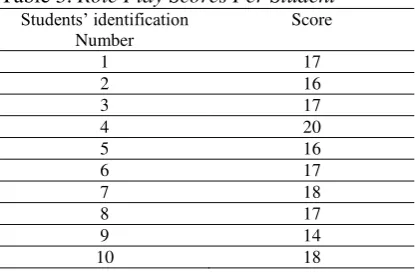
Understandably, all but two students received the maximum points of five. This category measured if students’ language was intelligible in the role plays. In the category of Included All Speech Acts, most of the students received the maximum of five points. Students were generally able to include all the information on the role play card for their role. In the category of Spoke Creatively, all students received no points. The previous practice in the all-class activity had a set structure. The results of total points per student were shown in Table 3. All pairs of students had a conversation that was presented to the class. The score range was at 14 points to 20 points. Three scores were near the maximum with points in the range of 18 points to 20 points. The overall scores help to answer the research question of the possibility of being successful with a role play activity with low ability students. Most of the students scored high on the rubric that evaluated the role play activity. This provides research results that low ability students can be successful in doing a role play activity.
Table 3. Role Play Scores Per Student Students’ identification
Number
Score
1 17
2 16
3 17
4 20
5 16
6 17
7 18
8 17
9 14
10 18
Student Questionnaire Results
After the role play was completed, the students filled out a questionnaire. The questionnaire asked if the students found the role play activity to be enjoyable, too easy, and too hard. The questionnaire also asked if the students believed that they could use English communication on blood pressure measurement. The results are shown in Table 4
Table 4. Student Questionnaire Responses ___________________________________
Questions Yes No
1) Did you like the role play activity? 10 0 2) Was the role play easy? 7 3 3) Was the role play too hard? 3 7 4) Can you use English communication during blood pressure measurement? 10 0 ____________________________________
DISCUSSION
One, the strategy which is from simple activities to more complex activities was an effective teaching method. In the role plays, the students were able to use language that would be similar to real world language, and the students were able to incorporate grammar and vocabulary previously taught in lessons. Improved grammar skills due to explicitly teaching grammar is consistent with Brown’s view (2007) that teaching grammar can aid in communicative competence. The second, planning activities for low-ability students limiting the number of choices that students have to select the correct answer makes that activity more guided, manageable, and successful. This is consistent with Hammond and Gibbons (2005) recommended design scaffolding technique of a task building and leading into the following task. The third, further scaffolding would have been helpful in defining the role play, and the students understand the aspect of role play of taking on a role and being responsible just for one role. The fourth, expectations for students need to be realistic and defined by improvements and not anticipated outcomes. The fifth, the lecturer can support students struggling by intentionally pairing with a more advanced peer. The sixth, activities can be modified to make them more manageable for low proficient student. The seventh, low-ability students will do role play activities well when they only need to add a few key pieces of information. The eighth, students need to feel an activity is beneficial before they put effort into repetitive practice that might lead to skill mastery. The ninth, role plays are positively received by students, and that their difficulty may be interpreted differently by the lecturer.
CONCLUSION
After conducting this research, the students have the ability to successfully participate in communicative activities, including role play. This can be a new way of structuring lessons that will progress from simple, more guided activities to more advanced, less supported activities that allowed students to manage their language. The recommendations are students should often present information in front of the class and they have to use their native language in the classroom, plan to do a task sets a long term
objective, role play video can be used to show and explain to students how to do a new task.
REFERENCES
Brown, H. D. (2007). Principles of language learning and teaching. White Plains, NY: Pearson Longman.
Ching, Y. H. 2014. Exploring the impact of role-playing on peer feedback in an online case- based learning activity. International Review of Research in Open & Distance Learning, 15(3), 292-311. ISNN: 1492-3831.
Hammond, J. & Gibbons, P. 2005. Putting scaffolding to work: The contribution of scaffolding in articulating ESL education. Prospect, v.20, no.1, April 2005, p.6-30. ISSN: 0814-7094.
Huff, C. 2012. Action research on using role play activity in an adult ESL level one class. Minnesota: Hamline University. Krashen, S. 2008. Language education: Past,
present, future. RELC Journal, 39 (2), 178-187.
Mufti, Ahmad. 2009. Peluang Perawat Indonesia Untuk Bekerja Di Luar Negeri http://moveamura.wordpress.com/pelua ng-perawat-indonesia-dalam-afta-2010/2009 accessed on December 25th, 2015.
Redden, Shari Lynn. 2015. The Effectiveness of Combining Simulation and Role Playing in Nursing Education. Cited from http://scholarworks.waldenu.edu/dissert ations accessed on December 30th, 2015. Ribes, Ramón, and Pablo R. Ros. 2005.