This paper has been presented at Sriwijaya University Learning and Education-International Conference 2014. Faculty of Teacher Training and Education, Sriwijaya University, Palembang, May 16—18, 2014.
C19-655
EFFECT OF LEARNING CYCLE 7E TOWARDS SCIENCE
PROCESS SKILLS OF ELEVENTH SCIENCE GRADERS IN
STATE SENIOR HIGH SCHOOL 4 IN PALEMBANG
Yuni Wijayanti
1, Hartono
2, and A. Rachman Ibrahim
2 1Alumni of Chemistry Education, Sriwijaya University
2
Lecturer at Chemistry Education, FKIP Sriwijaya University
Sriwijaya University
E-mail: [email protected]
Abstract
This research aimed to investigate the effect of using the learning cycle 7E towards science process skills of eleventh science graders in State Senior High School 4 in Palembang. To achieve this goal, 2 science classes were randomly selected by the simple random sampling technique. They were assigned to an experimental group for XI IPA 1 which was taught by using the learning cycle 7E model and XI IPA 2 which was taught by using direct instruction model. This study was a true experimental. The major findings have been revealed that the whole students in experimental group and control group showed gains in basic process science skills performance test in general and in 3 subscales (p<0.05) from before learning. The t-independent test analysis results showed there was a statistically significant difference 0.027 (p<0.05) between the averages of basic science process skills achievement of eleventh science graders who learned using the learning cycle 7E and who learned using direct instruction model. Therefore Ho in this research was rejected and Ha was accepted, it meant there wasthe significant effect of using the learning cycle 7E model towards science process skills of eleventh science graders in State Senior High School 4 in Palembang.
Key words : Learning cycle 7E, science process skills, chemistry, senior high school
INTRODUCTION
Science process skills are all necessary skills to acquire, develop and apply the concepts, principles, laws and theories of science, both in the form of intellectual skills, physical skills (manual), as well as social skills. Intellectual skills are the ability of learners to think like asking questions, interpret data, make observations, hypothesize, experiment plan and implement the concept. Manual skills involve the ability to use tools and materials experiments. While social skills are the ability to interact with fellow learners like, explain, communicate and discuss. Science process skill is essential trained and developed in learning, because through science process skills students can experience of the learning event through observation or experimentation.
Science process skills are divided into two levels, basic science process skills and integrated science process skills. Basic science process skills consist of six basic skills, they are observing, inferring, classifying, predicting, measuring, inferring, and communicating. While the integrated science process skills include identifying skills variable, making tabulation of data, presenting the data in graph, describe the relationship between variables, collect and process data, analyze research, formulate hypotheses, operationally defining variables, designing the study, and carry out experiments (Rezba, 1999).
This paper has been presented at Sriwijaya University Learning and Education-International Conference 2014. Faculty of Teacher Training and Education, Sriwijaya University, Palembang, May 16—18, 2014.
C19-656
2009).Learning Cycle 7E which was developed by Eisenkraft (2003) has seven cycles, they are elicit, engage, explore, explain, elaborate, evaluate and extend. Each cycle of the Learning Cycle is able to help students to be able to play an active role; motivate students’ interest of knowledge; stimulate students to observe, isolate variables, interpret the results of the investigation plan, develop hypotheses and organizing conclusion; train students to verbally convey concepts they have learned; provides the opportunity for students to think, explore, discover and explain examples of the application of the concept; helps students to see the development of students' understanding that has been obtained; train students how to transfer the lessons in everyday life.
Learning Cycle model was first introduced by Robert Kaplus in the Science Curriculum Improvement Study (SCIS) consists of three phases.The third phase includes the phase of exploration, invention, and discovery. In 1980, the terms of all three phases is modified by Lawson into exploration, term introduction,and concept application (Bybee et al, 2006).
The third phase introduced by Karplus expanded into five phases (Lorsbach, 2002). During its development, engagement phase is added at the beginning of the lesson which aims to generate interest and motivation of students to the concepts being taught. Then the Evaluate phase is added at the end of the lesson aims to assess students' understanding of concepts. Whereas the term introduction phase and concept application is replaced with a new term that is the phase explain and elaborate.
Eisenkraft (2003) expanded the Learning Cycle model that previously has five phases into seven phases. The development phase of the Learning Cycle is not intended to complicate but to ensure that teachers do not overlook important in the learning phase. The expansion phase of disengagement becomes elicit aims to continue to extend the phase of the cycle prior learning and also to explore the students' prior knowledge of the concept to be learned. The addition of the next phase is the extend phase which students develop the results of elaborate and evaluate phase and then communicate them back to train students how to transfer the lessons in everyday life.
This research aimed to investigate the effects of using the learning cycle 7E model towards science process skills of eleventh science graders in State Senior High School 4 in Palembang.
The hypothesis of this study was“There is significant effect of using the learning cycle 7E model towards science process skills of eleventh science graders in State Senior High School 4 in Palembang.”
METHOD
This research was conducted at State Senior High School 4 in Palembang. Learning process conducted four meetings, two meetings in control group and two meetings in the experimental group. The method in this study was true experimental with posttest only control design. The population was the entire classes of eleventh science graders, XI IPA 1 which had 38 students was chosen as experimental group and the control group was XI IPA 2 which had 32 students. They were randomly selected by the simple random sampling technique. The experimental group was taught by using learning cycle 7E model and the control group was taught by using direct instruction.
The instruments that were used in this study included 2 lesson plans of learning cycle 7E and 2 lesson plans of direct instruction model with each plans used 2 hours per learning. Performance test were used in order to assess the science process skills.
This paper has been presented at Sriwijaya University Learning and Education-International Conference 2014. Faculty of Teacher Training and Education, Sriwijaya University, Palembang, May 16—18, 2014.
C19-657
observation skill measured students’ ability to observe the changes of temperature, colour, shape, smell, etc using their senses.
Communication skill performance test measured students’ ability to read chart, table or diagram of the experimental results; to describe the empirical data with graphs, tables, or diagrams; to explain the experimental results; to prepare and submit a report systematically and clearly. In conclusion skill subscale, students should show their ability to elaborate the experimental results with some theories until they could get some conclusion.
Data Analysis
Performance test of science process skills was calculated by using:
(Sudjana, 2009)
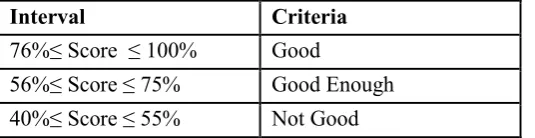
The percentage of student performance categorized based on the students' science process skills were shown in Table 1
Table 1.Categories for Science Process Skills Students
Interval Criteria
76%≤ Score ≤ 100% Good
56%≤ Score ≤ 75% Good Enough
40%≤ Score ≤ 55% Not Good
(Widayanto, 2009)
Normality test in the study carried out with the help of SPSS 17 program which used the Kolmogorov-Smirnov test. Normality test is intended to determine the distribution or score distribution of data science process skills of students. Data is said to have a normal distribution is obtained when the probability value (Asymp.Sig> 0.05).
Test of Homogeneity was performed to obtain the assumption that the two samples had the same variance. Homogeneity test data using Levene's test available in the statistical program SPSS 17. If the p-value obtained is greater than 0.05 (p> 0.05) has declared the data variance is homogeneous.
If the data has been ascertained normally distributed and homogeneous then proceed to test the hypothesis using independent t-test. If the p-value is greater than the specified significance level of 5% (p> 0.05), then Ho is accepted, and vice versa if p <0.05 then Ho is rejected.
RESULT
This paper has been presented at Sriwijaya University Learning and Education-International Conference 2014. Faculty of Teacher Training and Education, Sriwijaya University, Palembang, May 16—18, 2014.
C19-658
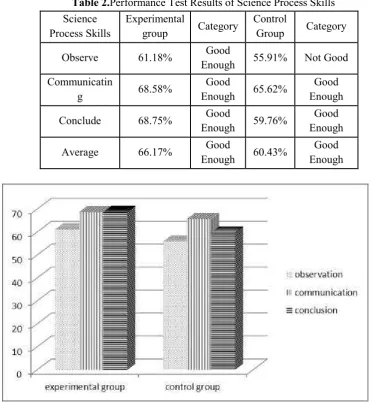
Table 2.Performance Test Results of Science Process Skills Science
Figure 1.Science Process Skills of Experiment Group and Control Group
The percentage of science process skills in Table 2 showed the students in the experimental group had greater science process skills than the control group.
Table 3.Normality Test, Homogeneity Tes and Hypothesis Test of Science Process Skills
This paper has been presented at Sriwijaya University Learning and Education-International Conference 2014. Faculty of Teacher Training and Education, Sriwijaya University, Palembang, May 16—18, 2014.
C19-659
Based on Table 2, the comparison mean test score performance between experimental class and control class showed a significant difference between the performance of science process skills in the experimental class and control class 0.027 (p<0.05).
Description of Learning Process in Experimental Group
In this research, the provision of material meetings conducted twice, each time meeting for 2 x 45 min. The first meeting students learned about exothermic and endothermic reactions, the second meeting the students learned the material determination based on the results of experimental reaction enthalpy.
In Elicit phase, teachers stimulated students with gave some questions "what is the difference between endothermic reactions and exothermic reactions?" Student respondents No 28 (group 4) replied "exothermic absorbs energy, endothermic reaction to expends energy", then the teacher asked again "how if the system temperature decrease?Exothermic or endothermic reaction "Almost all students answered simultaneously" exothermic reaction ".
Engage phase, students demonstrated an exothermic reaction and an endothermic reaction that was by dissolving the powder of larutanpenyejukpanasdalam with water and dissolved the calcium oxide with water solvent. Demonstration activities accompanied with some questions to make students explore their knowledge, students were encouraged to think and searched for answers.
In the explore phase students who had been divided into several groups were asked to do the experiment.At the first meeting, students used measuring cylinder to measure the volume of 3 ml of HCl solution, and then inserted the solution into a test tube and then added pieces of 3 cm Mg. Students observed by touching the surface of test tubes before and after Mg ribbon was added to sense temperature differences. The second experiment, students were asked to observe the temperature changes, gas odor, etc when 2 mL NH 4 Cl and 1 gram Ba (OH) 2 .8 H 2 O was reacted. At the second meeting, students observed the temperature changes of solution in calorimeter.
Teachers then guided students to make observations data table and then discussed the questions in students in explainphase , students presented the results of their experiments and discussions. There were four representatives of groups presented the results of experiments, respondent No. 6 (group 1), respondent No. 17 (group 2), respondent No. 25 (group 3), and respondent No. 28 (group 4).
After the teacher explained the learning material, students were given exercises as an application of the concepts that have been obtained which was include as elaborate phase. Evaluate phase ,students reviewed the results of their discussion and their performance during learning activity. Respondents No. 28 (group 4) said there were still many students who did not read the procedure, whereas the respondent No. 14 (group 2) revealed students too confident when lab worked.Extend phase, students were given the assignment for the next meeting which to look for the daily lifeapplication ofenergy conservation law.
Description of Learning Process in Control Group
This paper has been presented at Sriwijaya University Learning and Education-International Conference 2014. Faculty of Teacher Training and Education, Sriwijaya University, Palembang, May 16—18, 2014.
C19-660
Students did experiments in accordance with the instructions on the worksheet to apply the concepts they had been learned. Each representative of each group, DA (group 1), RL (group 2), AB (group 3) and LTG (group 4) were presented their group’s experiment results.
DISCUSSION
The analysis of t test with a level of significance of 5% obtained 0.027 (p <0.05), which meant that in this study Ho rejected and Ha accepted and there was the significant effect of using the learning cycle 7E model towards science process skills of eleventh science graders in State Senior High School 4 in Palembang.
Students’ science process skills who learned Learning Cycle 7E could be seen from the results of their average test performance (66.17%) which was greater compared with the average of the performance test who learned by direct instruction(55.91%) , this is due to the used of Learning Cycle 7E in the experimental group could facilitate students to practice their science process skills. Similar to the statement of Sornsakda (2009) that every phase in the 7E Learning Cycle could train students to develop their science process skills. Students could practice science process skills as often as possible continuesly like a cycle. Learning Cycle 7E oriented to constructivism theory who trained students to build an understanding of concepts and knowledge autonomously. During the discovery process, student'swas not just getting information from the teacher or learning resources but also could be obtained from scientific activities. Through a series of scientific activities such as observing, communicating and concluding, students who were required to be actively involved in the discovery of his own ideas,improved their science process skills.Retnaninganti (2011) stated that by using Learning Cycle 7E could foster students' desire to explore,cooperate , expressed their idea and also become active in the lab work.
The results of performance test of students’ science process skills in the experimental groupwas greater than the control group due because the experimental group who used Learning Cycle 7E, students were required to interact continueslynot only with friends in the same group but also with the member of other groups. From the beginning of Learning Cycle’s activities, studentsweare trained to communicate in a way to express their opinions, answered and responded to questions and shared information both orally and in writing. In contrast, the communication of control groupwho used direct instruction was dominated by teachers so students’ opportunity to communicate was smaller than the experimental group, it could be seen on communication skills performance test which students’experimental group grade (68, 58%) were higher than the control group(65.62%).
Conclude skill of experimental group (68.75%) was also greaterthan the control group (59.76%). Students who taught by using Learning Cycle 7E trained to find their own ideas so that students could better understand the concepts. Students who understand the concepts were much easier to organize the conclusions of their experiment’s results.
In the performance test of observation skills in both experimental group and control group were the lowest aspect than the other skills. The performance test of observation skillsin experimental group was 61.18% and in control group was 55.91% of the control clss. The low test performance in observation skills because students were less conscientious and less patient when did the experiments.
This paper has been presented at Sriwijaya University Learning and Education-International Conference 2014. Faculty of Teacher Training and Education, Sriwijaya University, Palembang, May 16—18, 2014.
C19-661
used of Learning Cycle 7E was more able to improve students' science process skills than the uses of direct instruction model.
CONCLUSIONS
Based on the analyze data, it obtained significance value of 0.027 (p <0.05), so it can be stated that H o is rejected andthere was the significant effect of using the learning cycle 7E model towards science process skills of eleventh science graders in State Senior High School 4 in Palembang.
The effect could be seen from students' performance test of science process skills during the learning activities. Students’science process skills in experimental group (66.17%)was greater than the control group(55.91%).
SUGGESTION
Based on the research that has been done, Learning Cycle 7E model could provide a positive influence on students' science process skills, therefore researchers suggest for schools and stakeholders in education, especially teachers, in order to choose a variety of learning model in this case using the model of Learning cycle 7Ein an effort to improve science process skills not only basic skills but also integrated skills. And also for another researcher, it was suggested to do another study to find another model to improve students’ integrated process skills.
REFERENCES
Bybee, W. Roger et. al. (2006). The BSCS 5E Instructional model: Origin,Effectivenes, and Application. http://www.bscs.org/pdf/bscs5eexecsummary.pdf. Was accessed at 28 January 28th 2013.
Eisenkraft, A. (2003). Expanding The 5E Model.The Science Teacher, 47(4): 56--59.
Kitjinda, et al.(2009). Effects of Learning Environmental Education Using the 7E-Learning Cycle with Metacognitive techniques and Teacher’s Handbook Approaches on Learning Achievement, Integrated Science Process Skills and Critical Thinking of High School (10 grades) Students. Medwell Journal : Pakistan Journal of Science, 6(5): 292-296.
Retnoningati, Dewi. (2011). Penerapan Model PembelajaranSiklusBelajar (LC)
untukMeningkatkanKeterampilan Proses SainsSiswaKelas X-2 SMA N 3 Surakarta. Skripsi.Surakarta : FKIP UNS
Rezba, R. J., C. Sparague, dan R. Fiel. (1995). Learning and Assesing Science Process Skills. 4th Edition.Iowa: Kendall/Hunt Publishing Company.
Sornsakda, et al(.2009). Effects of Learning Environmental Education Using the 7E-Learning Cycle with Metacognitive techniques and Teacher’s Handbook Approaches on Learning Achievement, Integrated Science Process Skills and Critical Thinking of Mathayomsuksa 5 Students with Different Learning Achievement. Medwell Journal : Pakistan Journal of Science, 6(5): 297--303.
Sudjana, Nana. (2009). Penelitian dan Penilaian Pendidikan. Bandung : Sinar Baru Algesindo