Accredited by DGHE No: 66b/DIKTI/Kep/2011 DOI: 10.5398/medpet.2012.35.3.152
*Corresponding author:
E-mail: [email protected]; phone 0741-582907
Microbial and Oligosaccharides Treatments of Feces and Slurry in Reducing
Ammonia of the Poultry Farm
Y. Yusrizal
Faculty of Animal Science,� �ambi �ni�ersity �ambi �ni�ersity Kampus Mandalo Darat �ambi 36361,� Indonesia (�ece��e�� 1��10�2012�� �e��e�e�� 1��02�2012�� �cce��e�� 21�0��2012��ece��e�� 1��10�2012�� �e��e�e�� 1��02�2012�� �cce��e�� 21�0��2012� 1��10�2012�� �e��e�e�� 1��02�2012�� �cce��e�� 21�0��2012�
ABSTRACT
This study was conducted to investigate the effectiveness of Lactobacillus sp and fructooligo-saccaride (FOS) to reduce the volatile ammonia formation from chicken excreta and layer slurry. For each treatment-replication, 150 g of fecal material were collected from the poultry farm and placed in 500 ml beaker glass. The fecal sample was then treated with 2% Lactobacillus sp (2.6x10⁶) cfu/g
and 2% FOS and covered with plastic wraps. The volatile ammonia contents and pH were measured after one hour of standing (0 d) and repeated at 48 h intervals for 6 d. For the dropping slurry study, 300 g of each layer dropping slurry sample were used. Results indicated that 2% Lactobacillus sp or FOS supplementations in the feces and dropping slurry after 1 h up to 6 d reduced the ammonia odor formation, fecal pH, and moisture content. The Lactobacillus sp and FOS treated manure resulted in increasing Lactobacillus sp count and reducing in E. coli, Salmonella, and Campylobacter in 6 days for both feces and layer dropping slurry. In addition, reducing moisture content was observed in treated manure. It is concluded that Lactobacillus sp and FOS reduced the volatile ammonia forma-tion and pathogenic bacteria from chicken excreta and layer slurry.
Key words: Lactobacillus, fructooligosaccaride, ammonia, feces, poultry farm
ABSTRAK
Penelitian ini bertujuan untuk mempelajari penggunaan Lactobacillus sp dan fruktooligosa-karida (FOS) dalam menurunkan ammonia feses dan limbah feses ayam (slurry). Feses sebanyak 150 g dikumpulkan dari kandang ayam dan ditempatkan pada 500 ml beaker glass untuk masing-masing perlakuan. Feses tersebut dicampur dengan 2% Lactobacillus sp (2,6 x10⁶) cfu/g dan 2% dari berat
feses FOS, permukaan beaker glass ditutup dengan plastik. Kadar ammonia dan pH diukur setelah 1 jam perlakuan (0 hari) dan diulang setiap 48 jam selama 6 hari pada beaker yang sama. Penelitian limbah feses ayam (slurry� menggunakan 300 g untuk masing-masing perlakuan. Hasil penelitian menunjukkan bahwa pemberian Lactobacillus sp dan FOS pada feses dan limbah feses sampai 6 hari perlakuan dapat menurunkan kadar ammonia, pH, dan kadar air feses. Lactobacillus sp dan FOS dapat meningkatkan jumlah Lactobacillus spdan menurunkan jumlah E. coli, Salmonella,dan
Campilobacter selama 6 hari perlakuan baik pada feses maupun pada limbah feses. Perlakuan juga
berpengaruh terhadap penurunan kadar air pada feses dan slurry. Dapat disimpulkan bahwa per-lakuan Lactobacillus spdan FOS dapat menurunkan kadar ammonia dan bakteri patogen pada feses dan limbah (slurry� feses ayam.
Kata kunci: Lactobacillus, fruktooligosakarida, amonia, feses
INTRODUCTION
Currently,� there is increased concern related to ammonia emission from poultry operations (Singh e� al.,� 2009). Ammonia is the aerial pollutant from li�estock
operations, with domestic animals being the largest global contributor of atmospheric NH3 emissions (Aneja
Concern about ammonia in poultry production is not new. Traditionally the concern has been with the le�el of ammonia in the poultry house. High ammonia concentrations affect bird performance,� including poor feed efficiency,� blindness,� and respiratory problem (Pescatore e� al.,� 2005). Beker e� al. (2004) also reported that gain to feed ration was depressed at 60 ppm am -monia and indicated that am-monia in poultry houses lowers performance and may increased diseased suscep -tibility. Li e� al. (2008) mentioned that ammonia emission from animal feeding operations not only decrease the fertilizer N �alue of the manure but also lead to en�iron -mental pollution.
Concern regarding ammonia (NH3) concentrations within poultry housing,� ammonia emissions from poul -try operation,� and subsequent negati�e en�ironmental effects of excessi�e ammonia emission ha�e emphasized the need for research to find ways to reduce the �olatil -ization of ammonia from poultry facilities (Coufal e� al. 2006). Se�eral direct applications of chemicals ha�e been tested for their ability to control or reduce ammonia re -lease from poultry manure. Li e� al. (2008) reported that application zeolite,� AL+Clear (aluminium sulfat,� Ferix-3
(ferric sulfate,� Poultry Litter Treatment (PLT,� sodium bisulfate) onto nearly 1-d-old laying hen manure led to considerable reduction in ammonia (NH3) emission from store manure. Singh e� al. (2009) mentioned that �arious abatement method,� including dietary manipulation,� chemical amendment of litter,� and impro�ement in �en -tilation system management ha�e been used to control ammonia concentrations in the housing,� howe�er these method are percei�ed to be expensi�e,� to impair bird growth,� or to add pollution in some other form.
The probiotics can be used as growth promoter in the poultry diet. (Azis e� al.,� 2010). Moreo�er,� Lac�obac�ll� and fructooligosaccharide (FOS) ha�e been used in poul -try diets to reduce urease acti�ity in poul-try intestines,� which in turn may reduce fecal ammonia production. Yusrizal & Chen (2003) mentioned that these microor -ganisms produce short chain fatty acids,� creating an acidic en�ironment which suppresses the growth of putrefacti�e proteolytic bacteria. Fructooligosaccharide also ha�e shown the ability to decrease colonization of bacteria such as E. col� and Salmonella, while increasing the growth of non-pathogenic microorganisms.
Howe�er,� no report is a�ailable on the effect of Lac�obac�llus and FOS on ammonia formation and microbial count in both the feces and dropping slurry of laying hens. Therefore,� the objecti�e of this research was to study the effecti�eness of Lac�obac�llus and FOS in reducing the �olatile ammonia formation and microflora on layer excreta and dropping slurry.
MATERIALS AND METHODS
Experimental
Fresh fecal and slurry samples were collected from poultry farm. One hundred and fifty gram of fecal were collected from the same sources and put into 500 ml bea -kers, covered with plastic wraps and randomly assigned
to three treatment as follows: 1) feces (control),� 2) feces + 2% Lac�obac�llus (2.6 x10⁶) cfu/g,� 3) feces + 2% FOS.
The samples having three replications were covered with plastic wraps and incubated at 24 oC for 6 d. The
�olatile ammonia contents and pH were measured e�ery 2 d for 6 d on the same beakers. For the dropping slurry study,� 300 g each of layer dropping slurry samples were used. The beakers were incubated at 37 oC for 60
min prior to the first measurement of ammonia on day 0 and repeated e�ery 2 d for 6 d on the same beakers. Total plate count (TPC),� Lac�obac�llus, E. col�, Salmonella,
and Cam�ylobac�er count also were measured between 1
h and 144 h of the experiment.
Laboratory Analysis
Volatile ammonia. Volatile ammonia contents of the
fecal material and slurry were measured by using a Kitagawa Toxic Gas Detector (Kitagawa,� Matheson,� N�) and ammonia detecting tubes (0-20 ppm and 0-130 ppm capacities,� Matheson,� N�). One hundred milliliter air samples were used for each measurement. One hundred fifty grams of each fecal material and 300 g of each layer dropping slurry were collected and placed into a 500 ml beaker and covered with wrapping polyethylene. The beakers were incubated at 37 oC for 60 min prior to the
first ammonia measurement. The �olatile ammonia con -tents were measured after one hour of standing (0 d) and then were repeated at 48 h inter�als for 6 d that incubated in the room temperature during measurement.
Fecal pH. The pH of fecal and slurry content was mea -sured by using a pH meter (Model LS,� Sargent-Welch Co.,� Springfield,� N�). One hundred fifty grams of each fe -cal material and 300 g of each layer dropping slurry were collected and placed into a 500 mL beaker for pH mea -surement. The pH was measured after one hour (0 d) and repeated at 48 h inter�als for 6 d.
Fecal moisture content. Fecal moisture contents were determined according to the method as described in AOAC (AOAC,� 2005).
Microbiological analysis. Fresh fecal samples were col -lected by placing a 54 x 81 cm sterile aluminum foil on the bottom of each cage,� 12 h prior to the fecal collection,� and slurry samples were collected from the pit on the bot -tom of cages. One gram of fecal material and slurry were taken from each treatment for microbial analysis. Total aerobe, Col�form/E. col�, and Salmonella were enumerated by using plate count agar (Difco,� Detroit,� MI),� 3 M E. col� Petri-Film (3M,� St. Paul,� MN) and Brilliant Green Agar (Difco,� Detroit,� MI),� respecti�ely. Plates were incubated at 30 oC for 24 h. Lac�obac�ll� count was enumerated by
using MRS Agar (Difco) and incubated in an anaerobic chamber at 37 oC for 48 h. Cam�ylobac�er agar kits with
Statistical analysis. The experiment applied a complete -ly randomized design (CRD) with three replications. Data were analyzed by analysis of �ariance (ANOVA) . When significant differences (P<0.05) among treatments were detected,� the least significant difference (LSD) test was used to separate the mean �alues (Steel & Torrie,� 1980).
RESULTS AND DISCUSSION
Volatile Ammonia for Feces and Dropping Slurry
�se of Lac�obac�llus and FOS to feces and dropping slurry reduced (P<0.05) the �olatile ammonia formation (Table 1). Liu e� al. (2007) reported that supplementation of the wheat-based diet with transformed Lac�obac�llus reu�er� Pg4 decreased excreta ammonia concentrations,� and increased the caecal total �olatile fatty acid (VFA) and lactic acid concentrations. Canh e� al. (1998) and Panetta e� al. (2005) said that the pH of slurry and NH3 emission are inversely related.
More effecti�eness on �olatile ammonia reduction was obser�ed for FOS than Lac�obac�lus. Roberts e� al. (2007) reported that inclusion of 10% corn dried distillers grains (DDGS),� 7% wheat middlings (WM),� or 5% soy -bean hulls (SH) in laying-hen diets lower total manure NH3 emission and the NH3 emission rate by up to 50%. This effect was mainly trough a decrease in manure pH. In addition,� Mobley & Hausinger (1989) reported that pH feces is a major determinant of the rate and extent of NH3 �olatilization from animal waste becauselower ma-nure pH shift the NH3 equilibrium toward NH4
+ which
more water soluble and therefore less �olatile than am -monia (NH3)
The reduction of �olatile ammonia by the treatment becomes less effecti�e after 6 d for Lac�obac�ll�. This prob-ably was due to the reduction of Lac�obac�ll� count during the treatment. Lac�obac�ll� reduction resulted in less short chain fatty acid (SCFA) production and increased the ammonia �olatilization. Howe�er,� the effecti�eness of FOS in reducing ammonia formation is consistent com -pared to other treatments during 6 d obser�ation period. These probably were due to the FOS as colonic food may increase the metabolism and growth of bacterial population in the feces and slurry and produce SCFA in long period of time. These SCFA cause a lower feces and slurry pH and result in the extend of decreasingly ammonia (NH3) �olatilization. In addition,� bacterial
enzymes that in�ol�ed in the breakdown of uric acid to NH3 ha�e relati�ely high optimum pH and are therefore less acti�e when manure pH is decreased (Mobley & Hausinger,� 1989).
Fecal pH and Moisture
In general,� fecal pH �alues were lower (P<0.05) for Lac�obac�llus and FOS reated feces and dropping slurry of laying hens during the obser�ation period (Table 2). This probably was due to the acti�ity from the lactic acid bacteria such as lactic acid and acetic acid in the fecal coming from Lac�obac�llus s�. and FOS fermentation. Yusrizal & Chen (2003) reported that the fecal pH �alues are lower for the the fructooligosaccaride treated broiler. Moreo�er,� Roberts e� al. (2007) reported that compared with manure from hens fed corn dried distillers grains (DDGS) or wheat middlings (WM) was lower,� whereas the manure from soybean hulls (SH)-fed hens tended to ha�e lower pH. Regardless of treatment,� it seems that reducing the ammonia formation was closely related with reducing fecal pH. Meda e� al. (2011) mentioned that manure pH is a major factor that influences NH3
emissions from poultry manure,� the pH influences enzymatic reaction in�ol�ed in the degradation of uric acid and undigested protein.
Moisture le�els were significantly reduced (P<0.05) in both feces and dropping slurry of the treatments (Table 2). This reduction was probably due to direct ap -plication of Lac�obac�llus and FOS in the fecal and slurry resulted in increasing bacteria acti�ity in the fecal that use up moisture content in the fecal and slurry. The results were similar to Yusrizal & Chen (2003) reported that during the 4th and 5th week experiment,� inulin and
oligofructose treated broilers had lower fecal moisture content. Furthermore Chang & Chen (2003) also re -ported that the moisture content can be reduced when broilers are fed a diet with lactobacilli.
Fecal Microbial Count
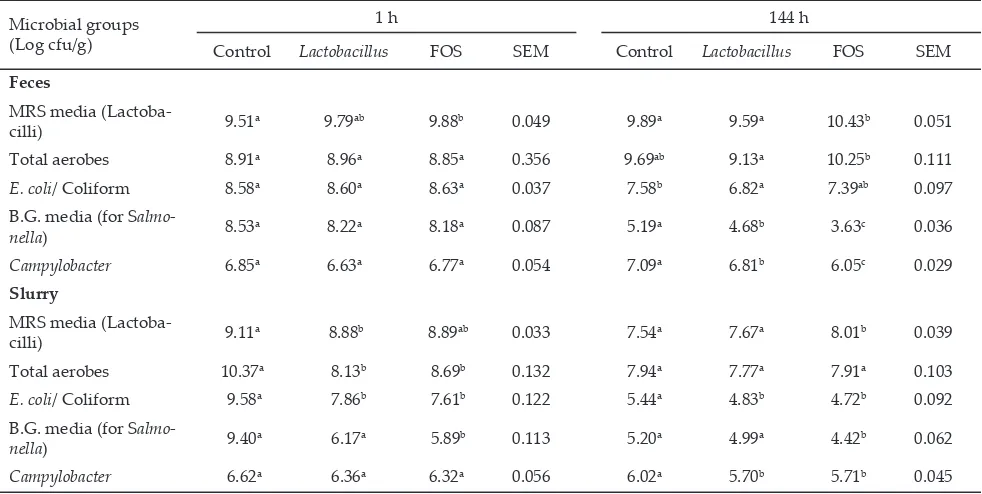
There was no difference (P>0.05) in fecal micro -bial count at 1 h of application of Lac�obac�llus and FOS. Howe�er,� increasing (P<0.05) Lac�obac�ll� count and reduction count (P<0.05) were obser�ed for E. col�, Salmonella, and Cam�ylobac�er at 144 h (6 d) of fecal treat -ment (Table 3). There were differences (P<0.05) in reduc
-Note: Means in the same row with different superscript differ significantly (P<0.05).
Stored time (h) Feces Slurry
Control Lac�obac�llus FOS SEM Control Lac�obac�llus FOS SEM
1 (37 oC) 20.00a 5.83b 4.33c 0.124 17.33a 5.33b 3.83b 0.385
48 (24 oC) 68.33a 22.00b 0.00c 3.105 3.50a 0.83b 1.17b 0.124
96 (24 oC) 90.00a 66.67b 0.00c 3.514 6.33a 2.08b 0.67b 0.329
144 (24 oC) 100.00a 95.00a 1.33b 3.968 8.00a 4.83b 2.00c 0.261
ing of the bacterial pathogen count for E. col�, Salmonella, and Cam�ylobac�er both in the 1 h and 144 h of dropping slurry. Liu e� al. 2007 reported that supplementation of the wheat-based diet with transformed L. reu�er� Pg4 decreased caecal coliform population from 0 to 21 d of age. It also decreased excreta ammonia concentrations,� and increased the caecal total �olatile fatty acid (VFA) and lactic acid concentrations from 0 to 21 d and 22 to 37 d of age. Furthermore Islam (2012) mentioned that the mode of action of organic acid on bacteria is the undisociated from of acid diffuse across cell membrane of pathogens,� destroying their cytoplasm or inhibiting growth. Akyurek e� al. (2011) reported that addition of organic acid in ileal digesta caused lactic acid bacteria count to be significantly increased,� whereas E. col� was significantly decreased.
Increasing (P<0.05) Lac�obac�llus count also was obser�ed in the 6 d treatment of dropping slurry. Little or no reports concerning the effect of Lactobacillus and FOS to slurry on the reducing pathogenic bacteria ha�e been reported. Reduction of harmful bacteria by using Lac�obac�llus and FOS should be of useful in food safety impro�ement. Howe�er,� Yusrizal & Chen (2003) report -ed that significant total r-eductions E. col� count recorded between the oligofructose treatment and control at the 4th wk for male bird. They also reported that among the
microflora tested,� the Cam�ylobac�er count of the male bird and the Salmonella count of the female birds were lower in the cecal contents for the oligofructose supple -mented bird.
It is noted that there was an increase (P <0.05) in Lac�obac�ll� count in both the feces and the dropping Table 2. Mean of pH and moisture content (%) of feces and dropping slurry from laying hen as affected by Lac�obac�llus sp and
fruc-tooligosaccaride (FOS)
Stored time (h)
Feces Slurry
Control Lac�obac�llus FOS SEM Control Lac�obac�llus FOS SEM
pH �alue
1 (37 oC) 6.83a 6.60b 6.51c 0.018 6.90a 6.84b 6.78c 0.006
48 (24 oC) 7.37a 7.12b 5.25c 0.025 7.78a 6.73ab 5.50b 0.303
96 (24 oC) 7.73a 7.20b 5.30c 0.029 7.08a 7.11a 5.43b 0.009
144 (24 oC) 7.56a 7.28b 5.40c 0.016 7.42a 7.23b 5.63c 0.009
Moisture (%)
1 76.81a 76.17b 76.17b 0.094 93.63a 92.48b 92.80b 0.133
144 80.20a 79.49b 77.90c 0.063 95.07a 93.46b 93.63b 0.183
Note: Means in the same row with different superscript differ significantly (P<0.05).
Note: Means in the same row with different superscript differ significantly (P<0.05). Microbial groups
(Log cfu/g)
1 h 144 h
Control Lac�obac�llus FOS SEM Control Lac�obac�llus FOS SEM
Feces
MRS media
(Lactoba-cilli) 9.51a 9.79ab 9.88b 0.049 9.89a 9.59a 10.43b 0.051
Total aerobes 8.91a 8.96a 8.85a 0.356 9.69ab 9.13a 10.25b 0.111
E. col�/ Coliform 8.58a 8.60a 8.63a 0.037 7.58b 6.82a 7.39ab 0.097 B.G. media (for Salmo�
nella) 8.53
a 8.22a 8.18a 0.087 5.19a 4.68b 3.63c 0.036
Cam�ylobac�er 6.85a 6.63a 6.77a 0.054 7.09a 6.81b 6.05c 0.029
Slurry
MRS media
(Lactoba-cilli) 9.11a 8.88b 8.89ab 0.033 7.54a 7.67a 8.01b 0.039
Total aerobes 10.37a 8.13b 8.69b 0.132 7.94a 7.77a 7.91a 0.103
E. col�/ Coliform 9.58a 7.86b 7.61b 0.122 5.44a 4.83b 4.72b 0.092 B.G. media (for Salmo�
nella) 9.40
a 6.17a 5.89b 0.113 5.20a 4.99a 4.42b 0.062
Cam�ylobac�er 6.62a 6.36a 6.32a 0.056 6.02a 5.70b 5.71b 0.045
slurry for FOS treatment as compared to the other treat -ments. It pro�ed that the FOS as colonic food can stimu -late the growth of Lac�obac�ll� in the feces or dropping slurry. Yusrizal & Chen (2003) report that supplement -ing diets with FOS increased Lactobacilli count in the gizzard,� and small intestine contents for female broiler. Rebole e� al. (2010) also reported that dietary prebiotic inulin had a positi�e and significant effect in increasing on bifidobacteria and lactobacilli count in both ileal and cecal contents.
CONCLUSION
Direct application of 2% Lac�obac�llus (2.6x10⁶cfu/g)
and 2% FOS in the feces and dropping slurry reduced 2011. The effect of supplementing an organic acid blend and/or microbial phytase to a corn-soybean based diet fed to broiler chickens. Afr. �. Agric. Res. 6:642-649.
Aneja, V. P., W. H. Schlesinger, D. Niyogi, G. Jennings, W. Gilliam, R. E. Knighon, C. S. Duke, J. Blunden, & S. Krishnan. 2006. Emerging national research needs for Agricultural air quality. Eos. Trans. Am. Geophys. �nion 87:25-29. http://dx.doi.org/10.1029/2006EO030001
AOAC, 2005. Official Method of Analysis of AOAC Internation-al.. 18th ed. Assoc. Off. Anal. Chem. Arlington.
Aziz, A., F. Manin, & Afriani. 2010. Performance of broiler chicken given bac�llus c�rculans and bac�llus sp. during reali-mentation period after feed restriction. Med. Pet. 33:12-17. Beker, A., S. L. Vanhooser, J. H. Swartlander, & R. G. Teeter. 2004. Atmosphere ammonia concentration effects on broil-er growth pbroil-erformance. �. Appl. Poult. Res 13:5-9.
Chang, M. H. & T. C. Chen. 2003. Reduction of broiler house malodor by direct feeding of a lactobacilli containing pro-biotic. Int. �. Poult. Sci. 2: 313-317. http://dx.doi.org/10.3923/ ijps.2003.313.317
Canh, T., T., A. J. A. Aarnink, Z. Mroz, A. W. Jongbloed, J. W. Schrama, & M. W. A. Verstegen. 1998. Influence of elec-trolyte balance and acidifying calcium salts in the diet of growing-finishing pigs on urinary pH,� slurry pH ammo-nia �olatilization from slurry. Li�est. Prod. Sci. 56:1-13. http://dx.doi.org/10.1016/S0301-6226(98)00148-1
Coufal, C. D. C. Chavez, P. R. Niemeyer, & J. B. Carey. 2006. Effets of top-dressing Recycled Broiler litter production,� litter characteristics,� and nitrogen mass balance. �. Poult. Sci. 85:392-397.
EPA (US Enviromental Protection Agency). 2004. National Emission In�entory-Ammonia emissions from Animal Husbandry Operations. Draft Report. �S EPA,� Washing-ton, DC.
Islam, K. M. S. 2012. �se of citric acid inbroiler diet. World Poult. Sci. �. 68:104-118. http://dx.doi.org/10.1017/0043933 912000116
Li, H., H. Xin, Y. Liang, & R. T. Burns. 2008. Reduction of am-monia emissions from stored laying hen manure through topical application of zeolite,� Al+Clear,� Ferix-3,� or poul-try litter treatment. �. Appl. Poult. Res. 17:421-431. http:// dx.doi.org/10.3382/japr.2007-00076
Liu, J. R., S.F. La, & B. Yu. 2007. E�aluation of an intestinal Lac-tobacillus reuteri strain expressing rumen fungal xylanase as a probiotic for broiler chickens fed on a wheat-based diet. British Poult. Sci. 48:507-514. http://dx.doi.org/10.108 0/00071660701485034
Meda, B., M. Hassouna, C. Aubert, P. Robin, & J. Y. Dourmad. 2011. Influence of rearing conditions and manure manage-ment practices on ammonia and greenhouse gas emissions from poultry houses. World Poult. Sci. �. 67:441-455. http:// dx.doi.org/10.1017/S0043933911000493
Mobley, D. F. & R. P. Hausinger. 1989. Microbial ureases: singnificance,� regulation,� and moleculer characterization. Mibiol. Re�. 53:85-108.
Panetta, D. M., W. J. Powers, & J. C. Lorimor. 2005. Manage-ment strategy impacts on ammonia �olatilization from swine manure. �. En�iron. Qual. 34:1119-1130. http:// dx.doi.org/10.2134/jeq2004.0313
Pescatore, A. J., K. D. Casey, & R. S. Gates. 2005. Ammonia emissions from broiler houses. �. Appl. Poult. Res. 14:635-637.
Rebole, A., L. T. Ortiz, M. L. Roddriguez, C. Alzueta, J. Tre-vino, & S. Velasco. 2010. Effects of inulin and enzyme complex,� indi�idually or in combination,� on growth per-formance,� intestinal microflora,� cecal fermentation charac-teristics,� and jejunal histomorphology in broiler chickens fed a wheat- and barley-based diet. Poult. Sci. 89:276-286. http://dx.doi.org/10.3382/ps.2009-00336
Roberts, S. A., H. Xin, B. J. Kerr, J. R. Russel, & K. Bregendahl. 2007. Effects of dietary fiber and reduced crude protein on ammonia emission from laying-Hen Manure. Poult. Sci. 86:1625-1632.
Steel, R. G. D. & J. H. Torrie. 1980. Principles and Procedures of Statistics: A Biometrical Approach. 2nd Ed. McGraw-Hill Book Co.,� New York,� NY.
Singh A., K. D. Casey, W. D. King, A. J. Pescatore, R. S. Gates, & M. J. Ford. 2009. Efficacy of urease inhibitor to reduce ammonia emission from poultry house. �. Appl. Poult. Res. 18:34-42. http://dx.doi.org/10.3382/japr.2008-00046 Yusrizal & T. C. Chen. 2003. The effect of adding chicory