Zambia is an example of how countries with rich natural resources can rely on taxation, specifically on natural resource extracting companies, to improve social protection services and programmes and to help mitigate inequality and to reduce poverty.
Developing countries often struggle to generate government revenues for social protection through taxation and social security contributions. Tax authorities tend to be weak and taxation lack transparency, while a relatively large share of the population is employed in the informal sector, making it difficult and costly to collect social security contribution or tax employees. This limits the means to redistribute income and to develop adequate social protection systems, including floors, to reduce poverty and inequality.
Main Lessons Learned:
• Natural resource rich countries can boost their social protection system through the taxation of natural resources, increasing government revenue and supporting the expansion of social protection expenditures. • Through strengthening tax collection
authorities and the revenue collection framework of the government, reduced tax leakage contributed to further increases in government revenues and the creation of fiscal space for social protection measures. • In 2013, Zambia’s extractive revenue was
US$ 1.5bn annually and represented 30 per cent of total government revenue.
• With the help of the extractive industry revenues, the government increased the budget for the social cash transfer schemes substantially, from KR 55 million in 2012 to KR 199.2 million in 2014.
• Through the taxation of natural resources and the expansion of social protection spending, the government managed to reduce poverty rates and improve health indicators fare above African standards.
A
Financing Social Protection through
Taxation of Natural Resources
Social Protection Floors (SPFs) guarantee access to healthcare for all and income security for children, persons of working-age and older persons.
185 countries have adopted the Social Protection Floors Recommendation, 2012 (no. 202) an approach to achieve universal social protection of the population.
This brief presents a successful country experience and gives a practical example of how SPFs can be implemented.
In 2013, Zambia’s extractive revenue was US$ 1.5bn annually and represented 30 per cent of total government revenue.
While the pre-2008 period is characterized by generous concessions for private sector companies and ineffective management under the state ownership, Zambia introduced various measures to increase efficiency and to widen the base for its government revenue. Zambia implemented institutional reforms such as the creation of a large taxpayers’ office and a gradual strengthening of its revenue collection framework. Tax administration today is relatively effective, and significantly reduced tax leakages compared with other African countries (Chamber of Mines of Zambia and ICMM; 2014).
The Mines and Minerals Act 2008 is a key legislation that paved the road of this paradigm shift. This started with introducing:
• A graduated windfall tax levied at a rate of 25 per cent on gross proceeds when the copper price exceeds US$ 2.50 per pound; 50 percent when the copper price exceeds US$ 3.00 per pound; and 75 per cent in excess of US$ 3.50 per pound. The windfall tax however was withdrawn in 2009, largely due to the effects of the financial crisis that began in 2008.
• A revision of the royalty rates that first increased to 3 per cent and since 2012 are set at 6 per cent. • A revision of the corporate income tax rate of
natural extractive industries, increasing it from 25 per cent to 30 per cent. Simultaneously, the rate applicable for non-mining sectors was reduced to 30 per cent from 35 per cent.
• A new variable profit tax rate under which the marginal tax rate would rise from 30 per cent to 45 per cent when taxable profits exceed 8 per cent of gross revenue.
Natural resource extraction tax in developing countries
Countries that can rely on non-renewable natural resources, have the potential to collect significant amounts of taxes from the sector to support social and socio-economic development. A government may either directly extract natural resources through state-owned enterprise or joint-ventures, or sell the exploitation rights and tax profits, both of which provide revenues for social investments. A number of developing and emerging economies have effectively managed their natural resources through public companies, including Botswana (diamonds), Brazil (oil), Indonesia (oil and gas) and Malaysia (forestry, tin, oil and gas).
Environmental and social externalities, such as the impact on local communities, which, if not adequately addressed, can serve as a subsidy to extracting companies and distort the true cost of exploitation. Natural resources from a property rights perspective are resources that ought to be accrued to the public at large rather than to private citizens. Revenues generated from natural resources should be distributed among society, leaving enough reward for companies to engage in exploitation, while taking into account the true cost of exploitation and equity from a property rights perspective as a whole.
Natural resource taxation in Zambia
Zambia is one of the prominent examples of a country having raised various taxes on mineral resources and thus generated significant government revenues that are among others funding social expenditures. Zambia, with a population of 16.2 million, is the 8th largest producer of copper (2013) and the 9th largest producer of cobalt (2012), with the mining sector accounting to 9 per cent of GDP and 77 per cent (2015) of exports.
Zambia: Fiscal revenues from the mining sector, 1995−2012
• A withholding tax on interest, royalties, management fees and payments to affiliates or subcontractors for all mining companies was reintroduced and set at a standard rate of 15 per cent. Reduction of capital allowances from 100 per cent of expenses to a conventional 25 per cent per annum (and deductible only in the year production commences rather than in the year when the expense is incurred).
• Hedging as a risk management mechanism that is treated as a separate activity from mining.
The abolition of the windfall tax is an example of political economy implications. Introduced in 2008 and abolished the year after in the aftermath of the global financial crisis and as a result of increased threats by TNCs to lower investments, to close mines and to take legal action against the measures. The table below summarizes the main shift in the taxation of natural extractive industries.
Note: * Introduced in 2008, but then abolished after the global financial crisis. Source: Simpasa et al., 2013, based on Zambia Revenue Authority and IMF, 2012.
An additional legislation aiming at curtailing capital flight and the underreporting of mineral earnings, was enacted in 2013 by the Zambian Government. The law applies to all international transactions, including profits, dividends, remittances, loans to non-residents and investments abroad by persons resident in Zambia.
Among mining countries (excluding petroleum) world-wide, Zambia’s mining receipts are the second highest after Botswana, and higher than revenues of the Chile, Democratic Republic of Congo or Guinea.1
In the year after the introduction of the 2008 Act, tax collection for the mining sector did not meet the expectation, with an increase from KW 1.1 billion in 2007 to KW 1.5 billion in 2008. The main reasons for this result were delays in tax payments due to disputes concerning the Act, combined with a fall in copper production due to the worldwide crisis. Since then, government revenues have improved considerably, from less than KW 1 billion per year before 2008 to KW 6.619 billion in 2012.
Natural resource taxation and social protection
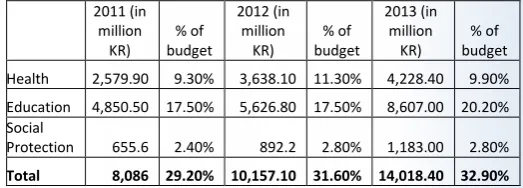
The government of Zambia emphasises health, education and social protection as a means to achieve their developmental goals. The 2014 budget confirms the government’s increase in spending on health, education and social protection. As illustrated in the table below, the government increased its total spending on Health, Education and Social Protection from KR 8,086 million (29.2 per cent of total budget) to KR 14,018 million (32.9 per cent) in 2013.
Furthermore, the government increased the budget for social cash transfer schemes substantially, from KR 55 million in 2012 to KR 199.2 million in 2014. These substantial shifts in Social Protection Spending can be linked to both a change in leadership as well as to an improved fiscal position that has been enabled through significantly increased government revenues from natural resource taxation.
Further, the government has taken steps towards developing a social protection policy with rights-based entitlements and created additional fiscal space for social protection by abolishing fuel and maize miller subsidies. Former patrimonial social protection programmes have been reformed to more structured and transparent programmes.
Conclusion
The case of Zambia exemplifies that resource rich developing countries can substantially expand fiscal space for social protection and other socio-economic expenditures. Taxing natural resource extracting industries allowed the Zambian government to improve their fiscal position and created the basis for the expansion of their social protection system.
4, route des Morillons
1211 Genève 22
Switzerland
www.facebook.com/SPplatform www.linkedin.com/groups?gid=6707223 www.twitter.com/soc_protection http://www.youtube.com/user/Ilotv
This Policy Brief was produced by Stefan Urban. It was reviewed by Isabel Ortiz and Hiroshi Yamabana.
The editor of the series is Isabel Ortiz, Director of the Social Protection
Department, International Labour Organization (ILO). For more information,
contact: [email protected]
Visit our website: www.social-protection.org
REFERENCES
Boadway R, Flatters F. 1993. “The taxation of natural resources – Principles and policy issues”, Policy Research Department, The World Bank, October 1993, WPS 1210, Washington, DC.
Ernst C. [Forthcoming 2016]. “Revenues from extractive industries: An opportunity to finance sustainable social spending”. International Labour Organization, Geneva.
Extractive Industries Transparency Initiative. 2015. “Seventh report of the Zambia extractive industries transparency initiative (ZEITI)”, ZEITI reconciliation report for the year 2014, BDO East Africa & BDO Zambia.
Kuss M. K. 2015. “The prospects and politics of social protection reform in Zambia”, IDS Working Paper Volume 2015, No. 453, CSP Working Paper Number 11, Center for Social Protection, Institute of Development Studies.
Ortiz, I., Cummins M. Karunanethy K. 2015. “Fiscal Space for social protection: Options to expand social investments in 187 Countries”, ESS Working Paper no. 48, International Labour Office, Geneva
Simpasa A., Hailu D., Levine S, Tibana R. J. 2013. “Capturing mineral revenues in Zambia: Past trends and future prospects” United Nations Development Programme & EU-UN Global Partnership on Land, Natural Resources and Conflict, New-York.
Chamber of Mines of Zambia. 2014. “Enhancing mining`s contribution to the Zambian economy and society”, International Council on Mining & Metals (ICMM), London.