This document can be found at http://www.crc.uri.edu/.
For more information contact:
Coastal Resources Center
University of Rhode Island
Narragansett Bay Campus
South Ferry Road
Narragansett, Rhode Island 02882, USA
Tel:
(401) 874-6224
Fax:
(401) 874-6920
Email:
[email protected]
Any part of this Guide may be photocopied or adapted without permission
from the BALANCED Project, provided that the parts copied are distributed
for free and duly recognize the BALANCED Project.
Citation:
Bruce, Linda. 2013. Developing Behavior Change
Communication Interventions for Population, Health and Environment
Projects: Facilitator Guide. University of Rhode Island. Narragansett, RI.
Disclaimer:
This publication is made possible by the generous support of
the American people through the United States Agency for International
Development (USAID). The contents are the responsibility of the Coastal
Resources Center, University of Rhode Island as part of the Building Actors
and Leaders for Advancing Community Excellence in Development
(BALANCED) Project and do not necessarily reflect the views of the
United States Government. Cooperative Agreement No.
GPO-A-00-08-00002-00.
Cover Photo
(top) Pangani FM radio spot on behavior change communication,
Tanzania
Photo Credit:
Woodrow Wilson Center
i
Acknowledgements
We thank Dr. Enrique Hernandez from PATH Foundation Philippines, Inc. for his invaluable input during the behavior change communication workshops, which helped inform this curriculum.
iii
FOREWORD
Developing Behavior Change Communication Interventions for Population, Health and
Environment Projects: Facilitator Guide was developed by the Building Actors and Leaders for Advancing Community Excellence in Development (BALANCED) Project with support from the United States Agency for International Development (USAID).
The BALANCED Project is a five-year, multi-million dollar population, health and environment (PHE) technical leadership initiative awarded by the USAID Office of Population and
Reproductive Health. The Project, which is implemented by the University of Rhode Island’s Coastal Resources Center (URI/CRC) and its partners—PATH Foundation Philippines Inc. (PFPI) and Conservation International (CI)— promotes wider adoption and use of effective PHE approaches worldwide by:
• Enabling local communities to become PHE champions by building their capacity to plan, implement and carry out demand-driven integrated programs in health and conservation. BALANCED builds capacity through peer-to-peer mentoring, south-to-south exchanges, and innovative learning techniques.
• Synthesizing and developing state-of-the art PHE knowledge and communicating that knowledge to key audiences. This includes demonstrating the value of integrated approaches for development that take into consideration the environment and the people who live in it.
• Scaling-up, building on, and fostering the implementation of field-based PHE initiatives in areas of high biodiversity, particularly in East Africa and Asia.
This Facilitator Guide draws on basic behavior change communication (BCC) principles used by key non-governmental organizations implementing health projects and the BALANCED Project’s experience developing, and assisting other organizations to develop BCC
v
Table of Contents
Foreword ... i
I ntroduction ... 1
Workshop Preparation ... 5
Workshop Objectives ... 7
Module 1: I ntroduction... 11
Module 2: PHE I ntegration ... 13
Module 3: PHE Conceptual Model and I ntegrated Theme ... 17
Module 4: The Behavior Change Process ... 23
Module 5: Studying Your Target Audience(s) ... 31
Module 6: Developing a BCC Strategy ... 41
Module 7: Developing I EC Materials and Activities... 69
Module 8 - Pre-testing Techniques ... 77
Module 9 - I mplement, Monitor and Evaluate BCC I nterventions ... 97
1
INTRODUCTION
This Guide was designed for facilitators/trainers who work with nongovernmental
organizations (NGOs) implementing population, health and environment (PHE) activities to develop a behavior change communication (BCC) intervention that supports the
achievement of the PHE project’s goals and objectives. It instructs the facilitator on how to train participants on the basic components of a BCC intervention. It also advises how to adapt these components for PHE projects that need integrated messages to raise community awareness of the PHE linkages of health and pro-conservation behaviors.
This training is best suited for NGOs and/or government agencies with existing PHE or core health/conservation activities. It is ideal for individuals from organizations that have already participated in a workshop on PHE project design or in a PHE-related workshop in which they developed a PHE conceptual framework, PHE project goal and objectives and activities. Other criteria that make individuals well-suited for this training include:
• Have had some experience developing BCC activities and/or information, education and communication (IEC) materials and activities on health,
conservation, family planning/reproductive (FP/RH) health, HIV, and/or water and sanitation
• Already have developed some core PHE, conservation, health, FP and/or water and sanitation messages
• Will be able to use the integrated PHE messages and IEC materials that are developed during the training in their PHE project intervention
• Have funding to implement the BCC strategy developed during this training What is Behavior Change Communication for PHE?
In the context of PHE, BCC is an essential part of a comprehensive program that seeks to improve reproductive health (RH), public health, natural resources and livelihoods
outcomes of communities living in areas of rich biodiversity. BCC is a crosscutting component and an interactive process with communities to develop tailored IEC
messages and BCC approaches using a variety of communication channels to promote positive behaviors and sustain individual, community and societal behavior change. BCC involves the development and implementation of communication messages,
2
BCC interventions for PHE programs will help to increase the target community’s perception and understanding of PHE linkages as well as promote and support pro-environment and pro-health attitudes and behaviors that will have a positive effect on families’ lives. While program planners and project staff do most of the planning for BCC interventions, the community is involved heavily in developing the actual BCC activities.
A BCC strategy should be developed as part of the very first stages of project design and then implemented throughout the life of the project. The actual BCC activities can be designed and implemented once other program components are in place. For example, the project may first want to establish (or improve) health product supply systems, organize and train community-based distributors (CBDs), and identify behavior change agents (e.g., district health officers, agricultural extension agents, fisheries groups, community groups, etc.) before it begins its BCC campaign. As part of their training, behavior change agents and community volunteers should be exposed to the BCC messages identified in the BCC strategy and how to deliver them effectively.
Who should use this Facilitator Guide?
This Guide was developed for facilitators/trainers responsible for training program planners and PHE practitioners on how to develop a BCC strategy and intervention for their PHE project/activity. The facilitator/trainer should already be familiar with BCC and PHE principles so s/he can effectively respond to participants’ questions and challenges related to the exercises in this curriculum.
What is included in this Facilitator Guide?
The Guide contains 10 modules on the BCC process, developing a BCC strategy, developing and pre-testing BCC activities and monitoring and evaluating BCC activities. The content is drawn from BALANCED Project experience in helping PHE practitioners develop BCC interventions and from other resources listed at the end of this document.
Each module contains one or more participatory learning exercises for teaching the topic covered in that module. Exercises are based on adult learning principles and designed to help participants retain the information learned. Each module includes the following:
Learning Objectives
Describes what participants will be able to do as a result of completing the exercises in the module and is an indicator of participants’ learning.
Time Indicates approximate total time allotted to conduct the module’s
3
Preparation Describes the materials needed for and the prerequisites to conducting the exercise.
Instructions Provides step-by-step guidance for conducting the exercises.
Facilitator Notes
Some modules contain Facilitator Notes. These include background information the facilitator/trainer needs to prepare for the session.
How should this Facilitator Guide be used?
The Facilitator/trainer should review the entire Guide before planning and implementing the training. Ideally, the training should take place over a period of four consecutive days in order to allow participants time to practice the concepts taught in the workshop. However, the workshop could be divided into two smaller trainings—first, modules 1 to 6 for developing a BCC strategy; and next, modules 7 to 9 for designing, testing, and implementing BCC activities. Facilitators/trainers are encouraged to adapt the sessions to the unique context and needs of the PHE project and the training workshop participants.
If the PHE project is an intricate one, more time may be needed to develop the BCC strategy. In such cases, a five-day (vs. four-day) training may be more appropriate.
Making this Guide as user-friendly as possible
5
WORKSHOP PREPARATION
Planning the Training
Workshop preparation requires careful planning. Planning should begin several days or weeks prior to the start of the training. As you prepare, identify ideal participants as:
• Project staff from one or more organizations that are implementing a PHE, conservation, health, FP and/or water and sanitation activities. This includes the project manager and/or field staff that would be responsible for the development and implementation of BCC activities.
• Key personnel from the project’s stakeholders and partners who will assist with and/or implement BCC activities.
• Individuals from organizations that plan to implement a PHE project and that have:
− Existing funds to implement a BCC strategy developed during the training
− Undergone a PHE design workshop or already have a project conceptual framework for their PHE project
− Experience developing IEC messages and materials on health, conservation, family planning, reproductive health, HIV and/or water and sanitation – (this criteria is optional but helpful)
Make the logistical arrangements:
• Decide on the training date and venue. These should accommodate participants’ and facilitator(s)’ needs in terms of travel time and potential time off from existing job responsibilities.
• Determine the per-participant costs for food, lodging, transportation to and from the training, workshop materials (see preparation notes for each module), and the field pre-test (see Module 8).
6
• If there is a need for external resource person(s) such as an artist or graphic design staff, narrow the list of possibilities based on their availability, eagerness to provide technical assistance, fees, etc.
• At least two weeks prior to the start of the workshop, inform the resource person(s) personally or via letter of invitation of the goals and objectives of the training
• Confirm participation of resource person(s).
• Determine the cost per resource person, facilitator and assistant for food, lodging and transportation.
• Determine the cost of supplies and materials needed by the resource person(s) and facilitator(s).
• Develop a budget for the training. Review this training guide:
• If appropriate, adapt activities and support materials based on your own BCC experience.
Prepare the training materials
• Read all the modules several days before the training and prepare the flipcharts, PowerPoints, etc. for each module. Some modules have lists to prepare
beforehand. Try to prepare these before the training begins.
• Collect all needed materials beforehand. This includes but is not necessarily limited to flipchart paper (newsprint), flipchart stands, marker pens, projectors, screens, electrical cords, nametags, notebooks, ballpoint pens, pencils and various other supplies as noted in the preparation section of each module.
• Gather sample IEC materials from participants or other organizations.
7
WORKSHOP OBJECTIVES
General Objective
To increase workshop participants’ understanding of BCC and capacity to develop a BCC intervention for their PHE project activities.
Specific objectives
By the end of the training, participants will be able to:
• Describe PHE and the benefits of PHE linkages/integration.
• Describe BCC, the stages of behavior change and the types of BCC activities appropriate for each stage of behavior change.
• Describe the importance of and ways to study the project’s target audience.
• Develop a BCC plan that has integrated PHE messages and IEC materials /activities.
• Develop effective IEC materials and activities.
• Pre-test IEC materials/activities for their PHE projects.
9
AGENDA
Day 1
8:00 – 8:30 Registration
8:30 – 9:00 Module 1- Introductions, Expectations, Agenda, House Rules
9:00 – 9:30 Module 2 - PHE Integration
9:30 – 11:00 Module 3 - Conceptual Framework and Integrated Theme
11:00 – 11:15 Break
11:15 – 12:00 Module 4 - Behavior Change Process
12:00 – 1:00 Lunch
1:00 – 2:30 Module 5 - Studying Your Audience
2:30 – 5:30 Module 6 - Developing a BCC Strategy: Exercise A (includes break)
Day 2
8:30 – 9:00 Review of Day 1
9:00 – 12:00 Module 6 - Developing a BCC Strategy – cont’d (includes break)
12:00 – 1:00 Lunch
1:00 - 3:30 Module 6 - Developing a BCC Strategy – cont’d
3:30 – 3:45 Break
10 Day 3
8::30 – 9:00 Review of Day 2
9:00 – 12:30 Module 7: Developing IEC Materials and Activities
12:30 – 1:30 Lunch
1:30 – 3:45 Module 8: Pre-testing Techniques
3:45 – 4:00 Break
4:00 – 4:30 Module 8: Pre-testing Techniques (cont’d)
4:30 – 5:30 Prepare for Field Pre-test
Day 4
8:30 – 9:30 Review of Day 3 (Pre-testing techniques and preparation)
9:30 – 12:30 Module 8 - Field Pre-test
12:30 – 1:30 Lunch
1:30 – 2:30 Module 8 - Field Pre-test Discussion
2:30 – 3:30 Module 9 – Implement, Monitor and Evaluate BCC Intervention
3:30 – 3:45 Break
3:45 – 5:15 Module 10 - Next steps
11
MODULE 1: INTRODUCTION
Learning Objectives:
After this exercise, the participants will be able to:
• Know the other participants.
• List their expectations for the workshop.
• Understand the objectives of the training, agenda and house rules. Time: 30 minutes
Preparation:
• Collect the materials needed:
− flipchart stand
− flipchart paper (newsprint)
− masking tape
− colored marker pens
− scissors
− name tags of participants
− basket or paper box
− a notebook (pad of paper) for each participant
− a pen for each participant
• Label one flipchart paper (newsprint) for each of the following words: “Expectations” and “House Rules”, respectively
12 Instructions:
1. Welcome everyone.
2. Pass around a basket or box with nametags of all participants. Ask each person to pick a nametag of one of the participants and try to find that person.
3. Once they locate that person, they should interview him/her.
4. Give the participants 10 minutes for the interview, in which they ask the following questions (list these on flipchart paper beforehand):
• Who are you?
• Share one positive childhood memory.
• What do you wish to learn from this training?
5. Ask participants to introduce the person they interviewed to the rest of the group and state their expectations from the training. (Note: List these on a flipchart paper labeled “Expectations”)
6. Review participants’ expectations.
7. Review workshop objectives prepared in advance on flipchart paper. Compare these with participants’ expectations. If there are participant expectations that will not be met during this workshop, assure participants these will be considered for future trainings.
8. Review the agenda for the training and explain how the agenda links to achieving the workshop objectives.
13
Module 2: PHE Integration
Learning objectives:
After this exercise, the participants will be able to describe PHE and the benefits of PHE linkages/integration.
Time: 30 minutes Preparation: None
Instructions:
1. Ask participants what they understand about PHE. Write their answers on a flipchart.
2. Review what PHE is.
P = Population refers to the provision of voluntary FP information and services to address unmet need for contraception and to promote birth-spacing and other RH practices.
H = Health can be a variety of interventions but usually involves water, sanitation, hygiene, malaria prevention, or child health.
E = Environment can include, but is not limited to, protected area management and biodiversity conservation (preserving the abundance and variety of all species including endemic, endangered, microscopic and more complex organisms on land and water). It can include a variety of approaches – watershed management, sustainable agriculture, natural resources management (NRM), coastal resources management (CRM), etc.
3. Explain that PHE:
14
• Can also be defined as “the linkage, within a community or group of communities, of NRM or similar environmental activities and the improvement of reproductive health—always including but not limited to the provision of family planning services” (Engelman).
• Interventions are conceptually linked and operationally coordinated and apply multi-disciplinary interventions delivered in a coordinated and cost-effective fashion.
4. Ask participants why it is important to integrate P, H, and E. Write their responses on a flipchart.
5. If not mentioned by participants, cover the following points:
• It makes sense to integrate. Projects that integrate sectors allow organizations to address the root cause of the situation in which they are working, rather than just proximate causes or symptoms. For example, in many areas, while there are immediate biodiversity threats such as habitat conversion, the underlying driver for it is population growth.
• Conservation organizations may be able to develop better relationships with communities by integrating a health component, which allows them to provide the communities with a tangible service.
• For health organizations, linking with NRM projects/activities often provides them with access to communities and clients that otherwise would be impractical or too expensive to reach.
• It can be cost effective. By combining resources, organizations can potentially implement their projects in a more efficient manner, sharing transportation and field staff expenses with other organizations.
• Integrated projects can fit within a wide range frameworks. This increases the chances of building on an existing framework. Integrated projects also provide the opportunity for the active involvement of a broader segment of the community and can increase women’s and youth’s participation in resource management as well as men’s participation in health decisions.
• There is better synergy. Qualitative evidence suggests that there may be a synergistic benefit derived from integrating sectors—combined activities can sometimes achieve more than the sum of individual activities.
15
7. Point out that the PHE approach encourages various sectors to work together toward a shared goal or vision. Partnerships among sectors such as health, environment, agriculture, rural development, etc.—whether public or private—can be beneficial in:
• Increasing the scale of effort—bringing together organizations that share the same services or outlook can create the critical mass necessary to tackle a problem.
• Combining complementary skills—bringing together organizations with different skills allows for working on projects that require in-house expertise that either one of the organizations individually might otherwise lack.
• Pooling financial resources—organizations can increase their power and impact by combining financial resources.
• Minimizing overlapping activities—working with multi-sectoral NGOs and community groups can help leverage resources, minimize overlapping activities and create stronger programs.
• Building on existing programs and social capital—organizations can contribute to projects that are already established in the field.
• Increasing the capacity of behavior change agents and community volunteers to be involved in and talk about holistic solutions for a community that involve health, conservation, livelihoods, etc.
• Gaining credibility—organizations may gain credibility by associating with other successful organizations.
• Filling in service gaps—many organizations (especially those working in conservation) reach remote communities that government health systems sometimes cannot. Such partnerships can help in accessing these remote and underserved communities with holistic interventions.
• Building capacity—organizations can gain new knowledge and technical skills by working with partners that have different backgrounds and expertise.
• Increasing sustainability—when organizations partner with local organizations, there is a greater chance the project will be sustainable.
16
8. Ask participants where they think PHE interventions will most likely succeed. List their responses on flipchart paper.
9. If not mentioned by participants, review the following types of areas/situations where PHE interventions make sense:
• In areas of high biodiversity—as a prevention model—when the area:
− has high richness of species, unique habitat (endemicity), or diversity of the ecosystem
− is environmentally threatened
− has a genetic, species and ecosystem composition that currently or in the future holds the potential to have significance for both natural ecosystem function and for human uses
− has a population that depends on their local natural resources
• Where there are other threats to health or livelihoods, i.e. water scarcity, unstable fisheries, deforestation, and food security.
• Where there is a need for interventions that addresses population pressure
resulting specifically from high fertility (when population pressure is the result of in-migration, an RH project may not be the best approach).
• In communities whose members want to participate in and support the project— and even in these, those already knowledgeable about conservation and/or population issues will be most likely to be interested.
17
Module 3: PHE Conceptual Framework and Integrated
Communication Theme
Learning objectives:
After this exercise, the participants will be able to:
• Describe his/her project’s integration through their conceptual framework.
• Identify an integrated communication theme. Time: 90 minutes
(Note: If the project does not already have a conceptual framework, developing a conceptual framework with participants will require additional time and the workshop schedule should be adjusted accordingly).
Preparation:
• Make sure the participants’ organization has a conceptual model for review and validation during the training.
It is assumed that the workshop is for participants from one organization implementing a PHE project/activity. If participants come from several organizations implementing PHE activities, follow the adjusted instructions.
• OPTIONAL: If the organization does not have a conceptual framework and if time permits, a framework can be developed during the workshop. If developing conceptual frameworks for several PHE projects, you may need to hold a session in the evening or a working group separate from the workshop (see Facilitator Notes for resources on how to develop conceptual frameworks for PHE Projects).
• Collect the materials needed:
− flipchart stand
− flipchart paper (newsprint)
− colored marker pens
18
• If you will be projecting your conceptual framework onto a screen or wall as you review and/or revise it, you will also need the following equipment:
− laptop
− projector
− screen or white wall for projecting
− power cord and power strip to plug in both laptop and projector Instructions:
Exercise A: Conceptual Frameworks (60 minutes)1
1. Ask participants to present the project’s goals, objectives and conceptual framework.
2. Review and discuss the current conceptual framework.
3. Validate the conceptual framework to determine if the issues, threats and
opportunities are still valid. Review the linkages between these threats, the targeted conditions and vision. (Note: If participants come from several organizations
implementing PHE activities, select one or two conceptual frameworks to review.)
4. Ask participants if the conceptual framework needs revisions in order to most effectively illustrate the threats and opportunities. If yes, work with participants to make any necessary revisions. (Note: if participants come from several organizations implementing PHE activities, ask them how they might revise their conceptual
frameworks based on the exercise just conducted.)
5. Explain that the conceptual framework can help stakeholders better understand the linkages and participate more fully in the project. The more people participating and understanding how their environment affects, and is affected by, health and population factors in the community, the more likely the project activities will be sustainable.
6. OPTIONAL: If the participants’ projects do not have a conceptual framework and if time permits, help them to develop one. This may require work in the evening or a separate session after the workshop to develop these (see Facilitator Notes for resources on how to develop a conceptual framework.)
1
19
Exercise B: Integrated Communication Theme(s) (60 minutes)
1. Based on the project’s goal, objectives and conceptual framework, help participants develop an overarching integrated communication theme or concept around which all their IEC messages can revolve. The theme/concept should be simple and resonate with the intent of the project.
2. Review integrated communication themes from various PHE projects. Examples include:
• “Secure Family, Healthy Communities and Healthy Environment” – from the BALANCED-Philippines Project, Philippines
• “Planned Family, Healthy Environment for a Better Future” – from the Pwani Project, Tanzania
• “Healthy Families and Environment for a Better Life” – from the Health of People and Environment in the Lake Victoria Basin (HOPE-LVB) Project, Uganda
• “Care for Your Family, Care for Your Environment for a Prosperous Life” – from the Integration of Family Planning Messages and Referrals into the Green Belt Movement Program, Kenya
• “A Healthy Family, Healthy Forest and Productive Land” – from the Tree Kangaroo Conservation Project (TKCP), Papua New Guinea
3. Point out that an integrated communication theme can help “brand” your project. It can be included on most print materials (where appropriate) including IEC materials, training manuals, job aids, and other documents related to your PHE project. It is the theme that the community will remember—even when there are various partners implementing the project.
4. Before the end of the session, make sure participants have developed an overarching communication theme for the project.
5. Remind participants that the integrated communication theme will need to be pre-tested with members of the target audience to ensure comprehension and acceptability of the theme. Based on the pre-test, the wording of the theme may change.
20
Facilitator Notes
Instructions on how to develop a conceptual framework
Instructions and PowerPoint presentations on how to develop a conceptual framework can be found in the series of workshop materials entitled: “Designing and Implementing
Integrated Approaches to Population, Health and Environment: Workshop for Planners and Managers” found on the PHE Toolkit at
http://www.k4health.org/toolkits/phe/designing-and-implementing-integrated-approaches-population-health-and-environment-phe
Examples of conceptual frameworks
21
22
23
Module 4: The Behavior Change Process
Learning Objective:
After this exercise, the participants will be able to:
• Explain the difference between behavior change communication (BCC) and information, education and communication (IEC).
• Describe the stages of behavior changes.
• Describe the BCC needs for each stage of behavior. Time: 45 minutes
Preparation:
• Make a flipchart paper (newsprint), PowerPoint slide or Word document (that can be projected on a screen/wall) with the definitions of BCC and IEC (see Facilitator Notes).
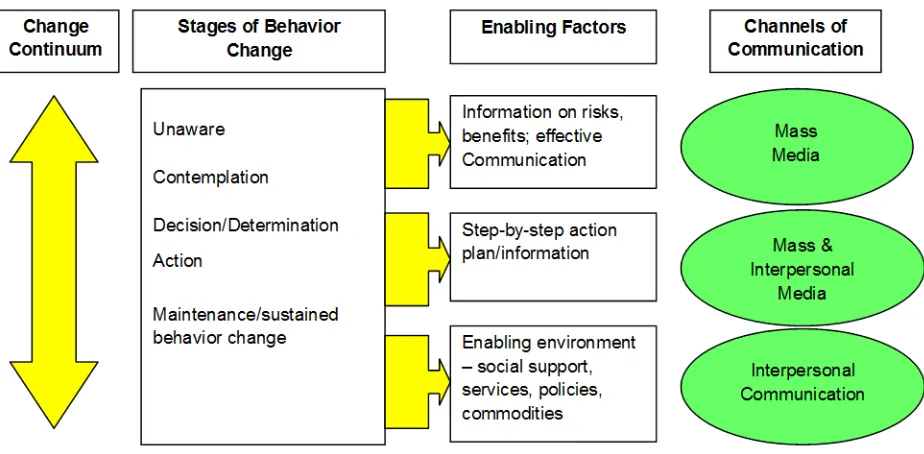
• Make a flipchart (newsprint), PowerPoint slide or Word document (that can be projected on a screen/wall) of Figure 1: Stages of Behavior Change Model (see Facilitator Notes).
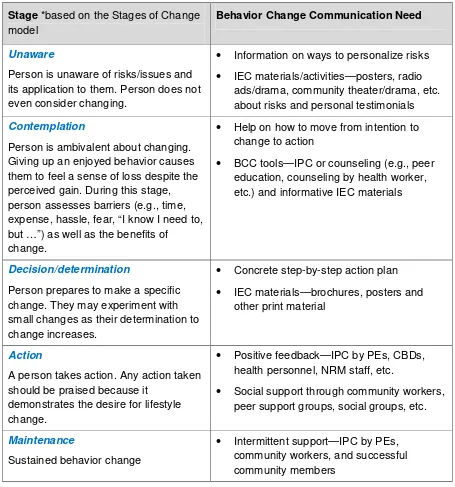
• Make a flipchart (newsprint), PowerPoint slide or Word document (that can be projected on a screen/ wall) of Table 1: Stages of Behavior Change and BCC Needs (see Facilitator Notes).
• Collect the materials/equipment needed:
− flipchart stand
− flipchart paper (newsprint)
− colored marker pens
24
− laptop
− projector
− screen or white wall for projecting
− power cord and power strip to plug in both the laptop and projector Instructions:
Exercise A: Definitions: (15 minutes)
1. Point out that providing people with information (IEC messages and materials) does not necessarily lead to desirable change in their behavior.
2. Explain BCC:
BCC isa process of working with individuals, communities and societies to develop communication strategies to promote positive behaviors that are appropriate to their settings and that provide a supportive environment that will enable people to initiate and sustain positive behaviors.
3. Explain IEC:
Information, Education and Communication (IEC) is a process of working with individuals, communities and societies to develop communication strategies to promote positive behaviors that are appropriate to their settings only.
4. Remind participants that individuals are influenced by the community and society in which they live. Therefore, behavior change should always include a supportive environment. When there is information, one-on-one interpersonal communication (IPC) and a supportive environment, desirable and sustainable behavior change among your target group(s) is more likely.
25
Exercise B: Stages of Behavior Change: (30 minutes)
1. Ask participants to list the stages of behavior change. Record these on flipchart paper.
2. If not mentioned by participants, review the following, which are based on the Stages of Change Model by Prochaska, DiClemente and Norcross (see references). Show PowerPoint or flipchart (newsprint) of Figure 1: Stages of Behavior Change prepared beforehand (see Facilitator Notes).
• Unaware – Person is unaware of risks/issues and its application to them
• Contemplation – Person is aware of risks but ambivalent about changing
• Decision/determination – Person prepares to make a change
• Action – A new behavior is put into action
• Maintenance – New behavior is established, but not necessarily sustained
3. Ask participants to share a behavior they changed or intend(ed) to change and identify which stage of behavior change they were/are in. List responses on a flipchart.
4. Mention that stages of behavior change do not always happen sequentially. Community members are at different levels of the process, and at different times. Also, not everyone goes through all the stages. One person may go from unaware to action straight away, while another may vacillate between contemplation and
decision/determination for a while before action is taken.
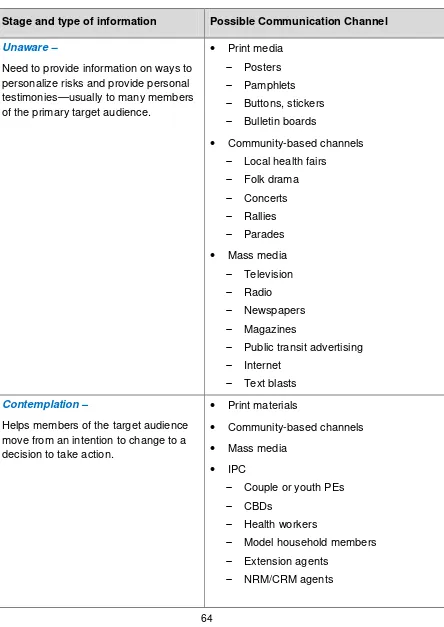
5. Review the types of BCC activities best suited for addressing each stage of behavior change—show Table 1 (prepare this beforehand—see Facilitator Notes).
6. Point out that a combination of BCC activities is usually the best approach for motivating and sustaining behavior change among a target group(s) because members of the target audience will be at different stages of behavior change.
7. Remind participants that some people implementing a desired behavior will fall back to the contemplation stage. Therefore, it is important to continue providing a variety of communication messages and channels to address various behavior change stages.
8. Ask participants to tell you which stage of behavior change and type of BCC activity to use for each sentence of the story that follows.
26
• A young boy has a girlfriend (your primary audience)
Unaware – The boy is possibly unaware of risks of unprotected sex. Potential BCC activities include: print materials (posters, pamphlets, etc.), mass media (TV and radio ads), and community drama that have IEC messages to raise awareness on the risks of unprotected sex.
• The young boy is thinking about using condoms but has heard that they reduce pleasure.
Contemplation – The boy needs help on how to move from intention to change to action. Potential BCC activities include: print materials, informative radio ads, community theater/drama, as well as IPC from a peer educator (PE) or trusted health worker.
• Young boy considers practicing safer sex.
Decision/determination – The boy needs a concrete step-by-step action plan. Potential BCC activities include: print materials, mass media (TV and radio ads) and peer education explaining how to practice safe sex.
• Young boy wants condoms.
Action – The boy needs to know where to get free (or inexpensive) condoms. Potential BCC activities include: print materials (stickers, posters, fliers) on where to purchase or get free condoms; pamphlets on how to use condoms correctly; and IPC from a PE, pharmacist, CBD, or health care provider on how to use condoms correctly.
• Young boy goes to buy more condoms, but
− Friends ridicule him, or
− Health clinic refuses to give him free condoms, or
− Pharmacist laughs at him when he asks for condoms, and price is too high Action/Maintenance – The boy needs support. The most ideal BCC activity would be IPC from peers, CBDs, and social support mechanisms, such as youth PEs or a youth club.
• Health care providers, pharmacists, parents (your secondary audience) are
27
Unaware/pre-contemplation – The project needs to create awareness among this secondary audience on the risks of unprotected sex among youth. Potential BCC activities include: fliers on the need to support youth and advocate for their needs; peer groups or advocacy groups organizing rallies to receive media attention and raise the issue among parent, teachers and politicians unaware of youth
vulnerability to STIs and unwanted pregnancy.
10. Remind participants that when trying to encourage the target audience(s) to adopt behaviors their project is promoting, the individual, community, or institution goes through a series of steps—sometimes moving forward, sometimes moving backward, and sometimes taking side steps. They may even revert back to old behaviors.
11. Understanding where the community is in the change process is critical when designing a BCC strategy.
12. Finish this session by explaining the BCC process, which participants will learn during this workshop, including how to design a BCC intervention for their PHE Project(s).
• Study your target audience(s)
• Develop a BCC strategy
• Develop IEC/BCC activities
• Pre-test techniques
• Implement, monitor and evaluate the BCC activities
28
Facilitator Notes
Definitions
BCC isa process of working with individuals, communities and societies to develop communication strategies to promote positive behaviors that are appropriate to their settings and that provide a supportive environment that will enable people to initiate and sustain positive behaviors.
IECis a process of working with individuals, communities and societies to develop communication strategies to promote positive behaviors that are appropriate to their settings only.
Stages of Behavior Change
BCC has its roots in behavior change theories that have evolved over time, and which include the following:
• Diffusion of Innovation (Everett Rogers)
• Stages of Behavior Change (Prochaska, DiClemente and Norcross),
• Self-Efficacy Model (Bandura)
• Behavior Change Continuum (World Bank)
29 Figure 1: Stages of Behavior Change Model
30
Table 1: Stages of Behavior Change and BCC Needs
Stage *based on the Stages of Change model
Behavior Change Communication Need
Unaware
Person is unaware of risks/issues and its application to them. Person does not even consider changing.
• Information on ways to personalize risks
• IEC materials/activities—posters, radio ads/drama, community theater/drama, etc. about risks and personal testimonials
Contemplation
Person is ambivalent about changing. Giving up an enjoyed behavior causes them to feel a sense of loss despite the perceived gain. During this stage, person assesses barriers (e.g., time, expense, hassle, fear, “I know I need to, but …”) as well as the benefits of
change.
• Help on how to move from intention to change to action
• BCC tools—IPC or counseling (e.g., peer education, counseling by health worker, etc.) and informative IEC materials
Decision/determination
Person prepares to make a specific change. They may experiment with small changes as their determination to change increases.
• Concrete step-by-step action plan
• IEC materials—brochures, posters and other print material
Action
A person takes action. Any action taken should be praised because it
demonstrates the desire for lifestyle change.
• Positive feedback—IPC by PEs, CBDs, health personnel, NRM staff, etc.
• Social support through community workers, peer support groups, social groups, etc.
Maintenance
Sustained behavior change
31
Module 5: Studying Your Target Audience(s)
Learning Objectives:
After this exercise, participants will be able to:
• Define the target audience for their BCC interventions.
• Describe the importance of studying the project’s target audience and the ways to do so.
Time: 90 minutes Preparation:
• Study the participants’ PHE project goals and objectives to be sure you know who should be the target audience (s) of the participants’ BCC interventions.
• Read any baseline studies and/or qualitative research on the participants’ project community and/or target audience conducted as part of or prior to the
implementation of the PHE project.
• List key baseline studies and/or qualitative research results on flipchart (newsprint), PowerPoint slide or Word document (that can be projected on a screen/wall).
• Label one flipchart (newsprint) paper “Ideal Woman.” Underneath the title draw a vertical line in the middle to make two columns (so you can list two sets of comments on what is an ideal woman).
• Label another flipchart (newsprint) paper “Ideal Man”. Underneath the title, draw a vertical line in the middle to make two columns (so you can list two sets of
comments on what is an ideal man).
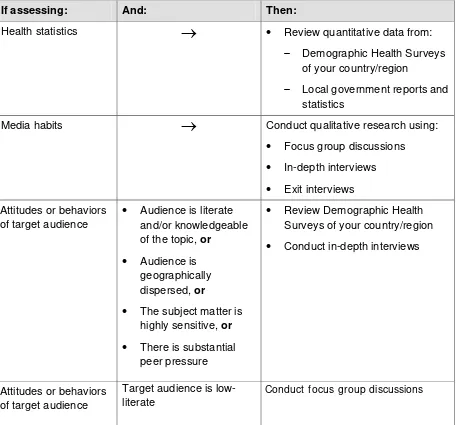
• Prepare a flipchart (newsprint), PowerPoint slide or Word document (that can be projected on a screen/wall) of Table 2: Types of Audience Research (see
Facilitator Notes).
32
− flipchart stand
− flipchart paper (newsprint)
− colored marker pens
• If using PowerPoint and/or a Word document to project on a screen/wall, you will need the following equipment:
− laptop
− projector
− screen or white wall for projecting
− power cord and power strip to plug in both laptop and projector Instructions:
Exercise A: Your target audience: (20 minutes)
1. Explain that the primary audience(s) is the main group(s) whose conservation, livelihood and/or health and FP behaviors the project is seeking to influence.
2. Mention that your primary audience(s) should share similar characteristics, such as age range, gender, occupation, residence (rural vs. urban), number of children, as well as access to print, radio and/or TV media.
3. Provide examples of types of primary audiences PHE projects have sought to influence:
• Women and men of reproductive age living around the Saadani National Park (Tanzania)
• Fishermen who live around the Lake Victoria Basin (Uganda and Kenya)
• Fishmongers or other persons who purchase fish from fishermen from the Western Coast (Ghana)
• Farmers living around all wetlands of Metu woreda (Ethiopia)
• Women agriculture producer groups living in the Luangwa Valley (Zambia)
33
4. Ask participants to identify and list the primary target audience(s) their PHE project is trying to influence. List responses on flipchart (newsprint) or on a Word document that is being projected on the screen/wall.
5. Help participants be very clear about the primary target audience(s) for the BCC interventions.
6. If participants list community health workers, PEs, extension agents, CBDs,
volunteers, or other “behavior change agents” as a primary audience(s), explain that these behavior change agents are also members of the community and will, by default, be recipients of the BCC activities. However, these behavior change agents actually form the part of your BCC intervention that helps the community initiate and sustain behavior change (which is why they are not part of the target audience).
7. Mention that behavior-change agents need to know the BCC messages and how to effectively provide the interpersonal communication and counseling (IPC/C) needed to help community members make and sustain behavior change. As such, they should be the primary audience for your capacity building efforts and not for your BCC interventions.
8. If participants mention politicians, advocacy groups, etc. explain that this audience is best influenced by and addressed with advocacy activities. Refer participants to the Population Reference Bureau’s Repositioning Family Planning: Guidelines for Advocacy Action, found on the PHE Toolkit at Repositioning Family Planning (see References)
9. Once the primary target audience(s) for the participants’ PHE project(s) is clearly defined, ask participants to list potential secondary target groups, i.e., those
individuals or groups who are not the primary focus of the project, but who influence your primary target members. Examples of secondary audiences could include:
• Grandparents
• Elders/village chiefs in the village
• Buyers or sellers of fish and/or agricultural products
• Health care providers
34 Exercise B: Ideal Man/Ideal Woman: (30 minutes)
1. Divide participants into two groups—one group of women (Group A) and the other of men (Group B). (Note: if there are no men (or women), divide by age, with the younger participants in Group A, and the older participants in Group B.)
2. Ask each group to discuss among themselves the characteristics of the “Ideal Woman” and the “Ideal Man.”
3. Explain that each group has to decide on only three characteristics of the “Ideal Woman” and three characteristics of the “Ideal Man.”
4. Allow participants approximately 10 minutes to develop their list. Anticipate some discussion and remind participants that each group needs to decide on only three characteristics for each sex.
5. Ask the women’s group (Group A) to tell you their three characteristics of the “Ideal Woman.” List these on the flipchart labeled “Ideal Woman” (prepared beforehand) in the left hand column.
6. Ask the men’s group (Group B) to tell you their three characteristics of the “Ideal Woman.” List these on the same flipchart labeled “Ideal Woman” in the right-hand column.
7. Circle the similar characteristics of the “Ideal Woman” between the two groups.
8. Explain that if you were trying to “market” the “Ideal Woman” to both women and men in the workshop, you would highlight the attributes that are common to both the “Ideal Woman” list developed by the men and the “Ideal Woman” list developed by the women.
9. Highlight the differences between the two lists (left versus right hand columns).
10. Explain that if Group A were trying to market the “Ideal Woman” to Group B, their campaign might not be successful, because they would be trying to sell attributes important to Group A, not to Group B. For example, if Group A says one characteristic of an “Ideal Woman” is that she is tall and slender, but Group B says she should be round and healthy, it would be hard to sell the tall slender woman to Group B and the round, healthy woman to Group A.
11. Now ask the women’s group (Group A) what they listed as the three characteristics of the “Ideal Man” and record their response on the flipchart labeled “Ideal Man”
35
12. Ask the men’s group (Group B) what they listed as the three characteristics of the “Ideal Man.” Record their responses in the right hand column of the same flipchart labeled “Ideal Man.”
13. Circle the similarities in characteristics of the Ideal Man among both groups.
14. Explain how you would use this information to sell the “Ideal Man” to both men and women in the workshop.
15. Highlight the differences between the two groups, and how this would affect women “selling” their idea of the “Ideal Man” to men, and men “selling” their idea of the “Ideal Man” to women.
16. Explain that this exercise demonstrates why it is so important to know your target audience’s preferences, knowledge, attitudes and practices before developing a BCC intervention designed to influence their behaviors.
Exercise C: Audience Research: (10 minutes)
1. Reinforce that it is important to understand your target audience as you develop your BCC interventions and IEC messages and materials.
2. Explain that many BCC interventions have failed because Program Managers did not understand what was important or acceptable to their target audience. Therefore, it is important to learn as much as possible about your target audience, such as:
• What do they already know about the topic (s), i.e. PHE linkages, reproductive health, family planning, sustainable fishing, sustainable agriculture, alternative livelihoods, etc.?
• What rumors or misinformation about a topic have they heard and believe?
• How comfortable do they feel talking or learning about certain topic(s)?
• What are the reasons for current behaviors/practices?
• What factors influence changing behavior?
• What are their ideas about the most appropriate ways to educate and inform other individuals like themselves?
• What are their hopes and dreams for the future, as well as their fears?
36
• Who are their role models; who do they look up to?
• How accessible is information?
• How accessible and reliable are health services?
• What are their media habits? For example, what kind of access do they have to print media/radio/TV? What are their listening and viewing habits and preferences? What are the most popular shows/stations? How frequently do they read or listen to media?
• Who are their preferred spokespersons?
3. Briefly mention the types of audience research that can be used to gather information about one’s target audience. Show a flipchart or project on a screen or wall a
PowerPoint or Word document of Table 2 (prepare this beforehand—see Facilitator Notes).
4. Review other sources of information that can be used to gather information about the target audience. This information can help Program Managers and staff to more effectively design BCC activities that address the audiences’ needs as well as project goals and objectives.
• Project baseline studies/research
• Household surveys of KAPs
• Participatory rapid appraisals
• Donor reports and country reports
• Technical assistance, workshop, and/or supervisory reports
• Service delivery reports
• Project progress reports and/or project evaluations
5. Mention that participants will not learn how to conduct audience research in this workshop. However, they will be reviewing any quantitative and/or qualitative research conducted for their project prior to the workshop in order to design their BCC strategy.
Exercise D: Knowing Your Audience (30 minutes)
37
2. List responses on a flipchart (newsprint). (Note: If you have studied the participants’ project(s) research results before this session and made a list of results beforehand, share with participants and ask them to add information to your list.)
3. Ask participants to comment on the findings listed on the flipchart and add other information that might be known about the target audience and that will influence the audience’s capacity to implement the behaviors promoted by the PHE project. (Note: You will need this information when facilitating the BCC strategy development
session.)
4. Brainstorm how these findings will help participants formulate their BCC activities. List responses on a flipchart.
38
Facilitator Notes
Table 2: Types of Audience Research
If assessing: And: Then:
Health statistics
→
• Review quantitative data from:− Demographic Health Surveys of your country/region
− Local government reports and statistics
Media habits
→
Conduct qualitative research using:• Focus group discussions
• Review Demographic Health Surveys of your country/region
• Conduct in-depth interviews
Attitudes or behaviors of target audience
Target audience is low-literate
39
If assessing: And: Then:
PHE links
→
Collect data from secondary sources,such as:
• Project reports
• Relevant people’s organizations (fisher folk associations,
forest/fish wardens, etc.)
• Resource users in the community
41
Module 6: Developing a BCC Strategy
Learning Objective:
After this exercise, the participants will be able to develop a BCC strategy.
Time: 8 to 14 hours (depending on how extensive the PHE Project is) Preparation:
• Collect the materials needed:
− flipchart stand
− flipchart paper (newsprint)
− masking tape
− colored marker pens
• If projecting a PowerPoint presentation or Word document, make sure to have the following equipment:
− laptop
− projector
− screen or white wall for projecting
− power cord and power strip to plug in Laptop and Projector
• Prepare a flipchart (newsprint) with the list of project behaviors from a previous PHE project—see Exercise A, instruction #3.
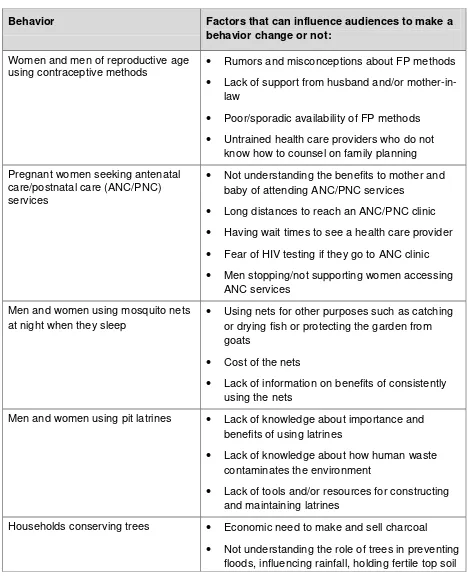
• Prepare a flipchart (newsprint), PowerPoint slide or Word document (that can be projected on a screen/wall) of Table 3: Behaviors and Influencing Factors (see Facilitator Notes).
42
• Prepare a flipchart (newsprint), PowerPoint slide or Word document (that will be projected on a screen/wall) of Tables 4, 5, 6 and 7 (see Facilitator Notes).
• Make enough copies of the Checklist for Developing an Action Plan and Timeline for a BCC Strategy for each participant (see Facilitator Notes).
• Note to Facilitator: It is helpful to note participants’ responses from the exercises in this module in/on a Word document. In this way, by the end of the session, the BCC strategy will be drafted. Otherwise, someone will have to transcribe all the responses written on flipcharts to a BCC strategy after the workshop.
Instructions:
Exercise A: Define Specific Behavior Changes: (2 to 4 hours, depending on how many PHE behaviors the project plans to address with its BCC intervention)
1. Explain that it is important to plan how to implement your BCC intervention before developing any IEC materials or BCC activities.
2. Mention that participants will develop a BCC strategy over the next day or two (depending on how many behaviors the BCC intervention seeks to influence). Based on participants’ BCC strategy, they will later draft IEC materials, which they will pre-test and revise during the workshop.
3. Explain that the first step in developing a BCC strategy is to define the desired
behavior your project is seeking to influence. Review some examples of behaviors that other PHE projects have identified in their BCC strategy (Note: have this list on a flipchart):
• Women and men of reproductive age using modern contraceptive methods
• Men and women washing their hands after using the latrine and before eating
• Men and women sleeping under mosquito nets
• Men and women using pit latrines
• Households planting new trees
• Farmers planting a mixture of nitrogen-fixing trees and crops
• Farmers practicing crop rotation
43
• Fishermen using the right size nets to fish
• Fishermen joining/forming a savings and credit cooperative organization (SACCO)
• Households engaged in alternative livelihoods (beekeeping, milk production, agriculture, basket weaving, etc.)
• Households using energy-saving (or fuel-efficient) stoves
4. Together with participants, list the behaviors their PHE project and BCC interventions seek to change or influence among its primary audience(s). Because PHE projects are multi-sectoral, you may need to list a number of behaviors per sector.
5. List each behavior on a flipchart (newsprint) or in a Word document that can be projected on a screen or wall. (Note: If possible, draft responses in a Word document that can be projected on a screen/wall, as this makes it easier for participants to add to and refine the list of behaviors over the course of the workshop.)
6. When listing each behavior, ask participants to include the audience for the behavior change. Example, “Men and women planting trees around their households.”
7. Remind participants that when identifying behaviors, the behaviors should support the achievement of the PHE project’s goal and objectives.
8. Be aware that it may take some time for participants to identify all of the behaviors for the primary audience(s) that their PHE project seeks to change. (Note: sometimes during this exercise, participants end up fine-tuning their project interventions as they think about the behaviors they are seeking to change or influence. Do not rush this process as it lays the foundation for all of your BCC efforts.)
Note to Facilitator:
It is unlikely you will finish developing the BCC strategy in one afternoon. If you cannot finish Exercise A – Identifying Desired Behaviors by the end of the first day, continue the next day. On the next day, be sure to review all behaviors previously listed and ask participants to revise as needed before proceeding. Once all
44
9. Once all of the behaviors have been listed, together with participants review and delete any that cannot be addressed with BCC interventions. For example, the following cannot be addressed with BCC activities:
• Increase FP supplies (this is a supply issue)
• Improve health care provider capacity to counsel clients (can be addressed with training)
• Develop/enforce environmental laws (advocacy may be needed to galvanize the government and environment NGOs to develop and/or enforce laws that protect the environment and/or rights of women).
10. Ask participants if they have questions before continuing to Exercise B.
Exercise B: List Factors Influencing Behavior Change: (1 to 2 hours, depending on how many behaviors there are)
1. Review any audience research discussed in the previous session (Module 5).
2. Explain the factors that positively and negatively influence whether a person will or is able to change behavior. These factors should be addressed in the BCC strategy. Review the following examples:
Behavior: Women and men using modern contraceptive methods
Influencing factors:
• Rumors and misconceptions about modern contraceptive methods
• Availability of FP methods
Behavior:Fishermen practicing sustainable fishing practices
Influencing factors:
• Fishermen do not see themselves to blame for lack of fish
• Lack of enforcement of gear use and of closed fishing areas
• Cost of legal gear
Behavior: Households planting a mixture of nitrogen-fixing trees and crops
45 Influencing factors:
• Unaware of benefits of nitrogen-fixing crops or crop rotation
• Source of nitrogen-fixing trees not known or easily available
3. Review examples of BCC behaviors and influencing factors gathered from other PHE projects. Refer to the flipchart, PowerPoint slide or a Word document (that can be projected on a screen/wall) of Table 3 prepared beforehand (see Facilitator Notes).
4. Based on any audience research that is available, together with the participants, list factors that influence a person’s ability to adopt each behavior identified in Exercise A above. Allow sufficient time for this discussion. (Note: If possible, list responses on a Word document as you may be refining these during the workshop.)
5. Once the influencing factors for each behavior have been identified, review each one and highlight only the factors that can be addressed by BCC activities. (Note: If you are listing responses on a Word document, delete the influencing factors that cannot be addressed with BCC.)
6. Mention that influencing factors such as the need for FP supplies, equipment, cost of fishing gear, better trained health care staff, agricultural agents, etc., costs of services, existence/enforcement of laws, etc. cannot be addressed with BCC activities. These require improved supply chain systems, training, advocacy, etc. at a higher level, and thus, are not part of a BCC strategy.
7. Remind participants that BCC activities are designed to address KAPs—they cannot change systems, make supplies and/or equipment available, build capacity or influence law enforcement.
8. Explain that the influencing factors identified will be addressed when developing BCC objectives and IEC messages.
9. Ask participants if they have questions before continuing to Exercise C.
Exercise C: Develop BCC Objectives: (1.5 to 2 hours)
1. Explain that the next step is to develop BCC objectives for the behaviors listed during Exercise A.
2. Mention that BCC objectives should address different stages of behavior of your target audience. It is likely that community members are at various levels of behavior
46
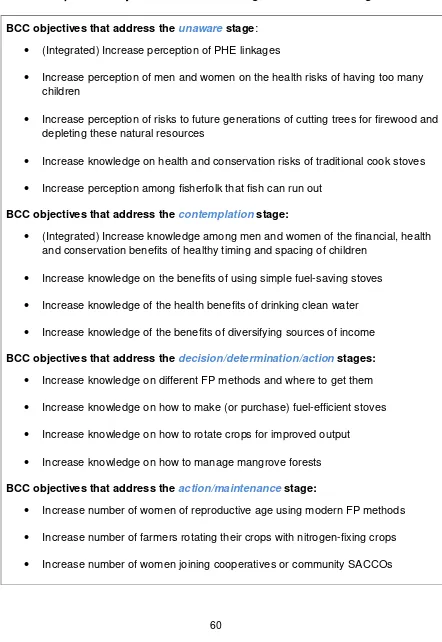
3. Review examples of BCC objectives that address different stages of behavior change, referring to a flipchart, PowerPoint slide or a Word document (projected on a
screen/wall) of Table 4 prepared beforehand (see Facilitator Notes).
4. Review examples of BCC objectives from previous PHE projects that addressed all four stages of change for one behavior. Show Table 5 prepared beforehand (see Facilitator Notes) or an example from your own experience.
5. Point out that your BCC objectives should also address factors that influence the desired behavior change(s).
47
Factor influencing men and women using modern contraceptive methods:
• Rumors and misconceptions about modern contraceptive methods BCC Objective (with stage of behavior it addresses)
• Increase knowledge of men and women about FP methods (decision/determination)
Factors influencing fishermen practicing sustainable fishing practices
• Fishermen do not see themselves to blame for lack of fish
• Misuse of other types of nets for fishing and drying BCC objectives
• Increase knowledge among the fishing community about the risks unsustainable fishing practices (unaware)
• Increase knowledge among fishing community on what are sustainable fishing practices.(action)
Factors influencing households planting both nitrogen-fixing trees and crops
• Source of nitrogen-fixing trees and crops not known or easily available BCC Objective
• Increase knowledge about what are nitrogen-fixing plants and crops and where to get them
7. Help participants develop BCC objectives for the behaviors identified previously in Exercise A. Try to develop BCC objectives for the various stages of behavior change. You can assume that a community ranges from “unaware” to already “taking action,” so you will want your BCC intervention to address all levels of behavior change.
48
9. Allow sufficient time for the development of the BCC objectives. (Note: Take the time to think through the process and how to address each stage of behavior change.)
10. After listing the BCC objectives, remind participants that the BCC strategy is for an integrated PHE project. Therefore, it needs to promote awareness of the PHE linkages among its target audience. This means that BCC objectives are needed for increasing perception of PHE linkages.
11. Mention that BCC objectives that address PHE linkages should link the impact of one behavior on one or two different sectors, i.e. the impact of using family planning on preserving natural resources, the impact of using sustainable fishing practices on livelihoods and health, etc.
12. Review examples of BCC objectives for promoting awareness of PHE linkages: Explain that BCC objectives for PHE linkages most often address the “unaware” and/or “contemplation” stage of behavior change. (Note: List the examples below on a flipchart and post on the wall so that participants can be reminded of BCC objectives for PHE linkages.)
• Increase perception of how large families deplete natural resources and livelihoods for future generations (unaware)
• Increase knowledge on the economic and natural resource benefits of healthy timing and spacing of children.(contemplation)
• Increase awareness of the impact of cutting trees on agriculture, livelihoods and food security for future generations (unaware)
• Increase awareness of how trees improve the environment and the health of the people who depend on it (contemplation)
• Increase awareness of risks of overfishing on livelihoods and food security for future generations (unaware)
• Increase knowledge on the benefits to children’s health, livelihoods and the environment of using fuel-efficient stoves (contemplation)
• Increase knowledge on how joining a community SACCO can reduce pressure on the environment and make money available for the household and for children’s education (contemplation)
13. Allow participants time to review their BCC objectives and add ones that address PHE linkages as described above. Remind participants that not all behaviors lend
49
14. Review the BCC objectives with the group and fine-tine the integrated ones, if needed.
15. Ask participants if they have questions before continuing to Exercise D.
Exercise D: Develop IEC messages: (1.5 to 2 hours)
1. Now that behaviors have been identified and BCC objectives have been developed, it is time to develop IEC messages for each behavior listed. The messages should contribute to the achievement of the BCC objectives. The IEC messages will be incorporated into the BCC activities that will be identified shortly.
2. Explain that IEC messages need to be pre-tested with members of the target audience to ensure comprehension and acceptability of the message. Pre-testing also helps to fine tune the wording so that the messages are well understood and received by the target audience. Participants will learn pre-testing techniques later in the workshop.
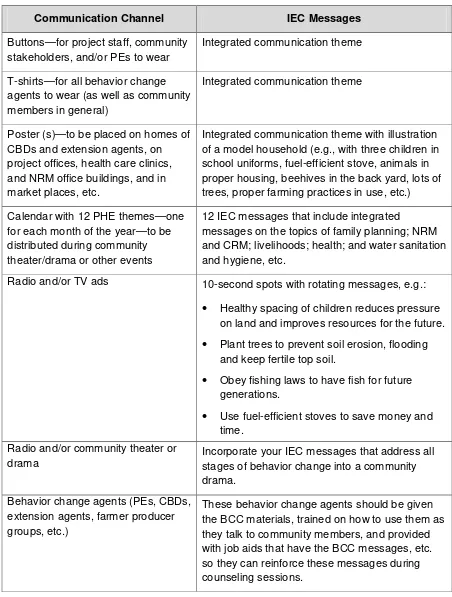
3. Review examples of IEC messages and how they contribute to BCC objectives. Show the examples of IEC messages in Table 6 prepared beforehand (see Facilitator Notes) or examples from other projects.
4. Mention that the participants will also need to develop an integrated IEC message(s) for the integrated BCC objective(s).
5. Reinforce the following:
• IEC messages are needed for each stage of behavior change—or the stage of behavior where project managers find their primary target audience.
• Integrated IEC messages should show the impact of a behavior on two or more sectors.
• Integrated IEC messages most often address the unaware stage (explaining risks of not doing a certain behavior on several sectors) or contemplationstage (explaining benefits of doing the behavior on several sectors). However, they can be used for action stage as well (explaining how to implement the behavior and its impact on another separate sector). For example:
− Catching juvenile fish does not allow them to grow, reproduce and provide a food source for the future. (unaware)
− Allowing juvenile fish to mature and reproduce will help to provide food and income for the future. (contemplation)