An Assay of Antioxidant Activity of Methanolic Extract of Various
Types of Soybean
Rika Yulia, Azminah, Michella & Andre Tanzil
ABSTRACT: This study aimed to examine the antioxidant activity of methanolic
extract of various type of soybean (Glycine max L.Merill) i.e Argomulyo, Burangrang, Ijen, and Kaba by using DPPH (1,1-Diphenyl-2-picryhydrazyl) method. The soybean was crushed, defatted using n-hexan, and extracted using methanol 90%. The processes of defatting and extracting were conducted by kinesthetic maceration. Identification of flavonoid content using KLT and an assay of the antioxidant activity of soybean were carried out qualitatively and quantitavely. Qualitative analysis, the color of DPPH solution was fading from violet into yellowish. Quantitative analysis showed that the maximum wave-length of DPPH in methanol was 516,00 nm within 15-minute reaction time. The effective concentration 50% (EC50) of each extract was alsa determined. Results of this study revealed that the methanolic extract of soybean taken from varieties of Argomulyo, Burangrang, Ijen, and Kaba contained flavonoid, with EC50 value of each variety subsequently ranging from 3620.22 bpj; 5290.71 bpj; 4145.99 bpj; and 4253.50 bpj. Argomulyo variety showed the highest antioxidant activity.
Keywords: Soybean (Glycine max L.Merill), Argomulyo variety, Burangrang variety, Ijen variety, Kaba variety, antioxidant power, DPPH
(1,1-Diphenyl-2-picryhydrazyl).
Faculty of Pharmacy, University of Surabaya
Korespondensi: Rika Yulia
INTRODUCTION
Nowadays, free radicals and antioxidant have become one of the issues the health practitioners frequently talk about. This is because most of the illnesses are claimed to be correlated with excessive oxidation reaction in the body. Such reaction initiates the forming of very active free radicals, which later results in cell or tissue impairment, autoimmune diseases, degenerative diseases and cancer (1).
Reactivity of free radicals might be hampered by means of antioxidant activities in a system. In fact, human’s body already has natural antioxidant to reduce cell impairment. The problem is that free radicals could develop faster with the amount outweigh the natural antioxidant formed within the body. Therefore, there is a need for additional antioxidant intake to help protecting the body from free radicals and minimizing their negative effects. Flavonoid is wellknown as good antioxidant
Soybeans (Glycine max L.Merill) appear to be one of the plants contain flavonoids which is known as antioxidant component and which is widely spread and easily found in Indonesia. Soybeans contain flavonoid derivatives classified as fitoestrogen category and it is called isoflavones. The primary isoflavones contained in the soybeans are genistein and daidzein (1). Most of the isoflavones in the soybeans are available in the form of glycoside, only few in the aglycone form (2). The existence of sugar tied to aglycone isoflavone (glycoside form) causes glycoside isoflavone to dissolve more easily in the polar solution, such as ethanol, methanol, butanol, acetone, dimethylsulfoxide, dimethylformamide and
water. Meanwhile, aglycones dissolve faster on ether and chloroform (3).
In Indonesia, Balai Penelitian Kacang-kacangan dan Umbi-umbian, Malang (Balitkabi-Nuts and Tubers Research Center) has issued superior soybean varieties in Indonesia since 1918. By 2005, there had been 62 soybean varieties entitled to be superior (4). According to Lee et al. (2003), genetic and environmental influences contributed to the differences of genistein, daidzein and total isoflavone content. High content of total isoflavone is related to high antioxidant power (5).
Therefore, there should be studies on the determination of the antioxidant power of various type of soybean in Indonesia. This study examined the antioxidant power of four soybean varieties, i.e., Argomulyo, Burangrang, Ijen, and Kaba by using DPPH (1,1-Diphenyl-2-picryhydrazyl) method. The antioxidant power of the soybeans (Glycine max L.Merill) in reducing free radicals DPPH was determined by calculation of the EC50 (Effective Concentration 50). EC50 is effective concentration to hamper or reduce 50% of free radicals. Accordingly, this study was expected to provide sufficient information regarding flavonoid contents and antioxidant power of methanolic extract of the four soybean varieties.
METHODS
Research Materials
Center), Malang on August 26, 2013. Those four varieties have been certified by Balitkabi, Malang.
Chemical Substances
The chemical substances utilized in this research included methanol p.a (Mallinckrodt Chemicals), n-hexan p.a (Mallinckrodt Chemicals), DPPH (1,1-Diphenyl-2-picryhydrazyl), Silica gel GF254 (Merck), aquadem (Chemistry Laboratory of University of Surabaya).
Equipment
This research utilized an analytical scale (AND GR-202), kinetic macerator (Stirring Motor IKA Rw 20 N) with 10 rpm stirring speed, rotary evaporator (heidolph), Ultrasonic cleaner (Branson 1200), electric waterbath, filter paper Whatmann, blender, siever mesh 20, stopwatch, spectrophotometer UV-Visible (Shimadzu U-1800), Chromatography instrument (CAMAG), capillary pipes 5 µl, and laboratory glasses.
Preparation of the Research Materials
Each of soybean variety was cleaned, dried in natural air, and later mashed using the blender. The powder obtained was sifted using siever mesh 20. Finally, the powder of each variety was scaled up to 300 g each.
Extraction of the Soybeans
Firstly, the soybean powder was macerated kinetically using 1 L n-hexan for an hour. Then, it was left unprocessed for 24 hours. After 24 hours, it was sifted into a container, while the residue was re-extracted using n-hexan. The maceration process using n-hexan was conducted 5 times. The results of all the five processes were
collected in a container. This procedure was done to extract the oil from soybean seeds.
Secondly, the residue was macerated kinetically using 1 L methanol 90% for an hour. It was let unprocessed again 24 hours. The results, then, sifted into a container and the remains were macerated using the same technique. The kinetic maceration using methanol 90% was conducted for 4 times. The results of the first, second, third, and fourth processes were collected in one container. The liquid extract was later concentrated by means of rotary evaporator to one third of the initial volume. The concentration process was continued in electric water bath until viscous extract with constant weight was obtained.
Identification of Flavonoid in Methanol
Extract of Soybeans
The viscous extract of the soybeans was later dissolved in water, then it was extracted by using chloroform for 3 times 10 ml in separate funnels. A qualitative analysis of chloroform fraction was conducted using a thin layer chromatography (TLC) method to identify the presence of flavonoid in the extract. The stationary phase used included silica gel GF254 (Merck) and the mobile phase was a mixture of CHCL3:ethyl acetate (60:40). As much as 3 to 4 capillaries of the extract were gently tapped ontoTLC plate and eluted after saturation of the chromatographic chamber. The plate was then examined under the UV rays of 365 nm, flavonoids showed yellow, blue and green fluorescence.
Each variety of the soybeans was scaled as much as 300 mg and 50,0 ml methanol was added (stock solution 6000 bpj). The stock solution was diluted with methanol to obtain concentrations 1200, 2400, 3600 and 4800 bpj respectively. Then, 1.5 ml of each solution (1200 bpj, 2400 bpj, 3600 bpj, 4800 bpj, and 6000 bpj) was drawn into a pipette and 3,0 ml, 40,0 bpj DPPH solution was added. Each of solution sample was evaluated in terms of the color change (the purple color of DPPH solution would turn into pale yellow and finally colorless).
Determination of the Maximum
Wave-Length
As much as 3.0 ml of DPPH solution 40.0 bpj and 1.5 ml of methanol were put in a test tube, shaken homogeneously, and finally observed in terms of the absorbance in λ 400-700 nm. The wave-length with the highest absorbance was the maximum wave-length.
Determination Reaction Time
As much as 3.0 ml of DPPH solution 40.0 bpj and 1.5 ml of methanol were put ini a test tube, shaken homogeneously, and finally observed in terms of the absorbance in λ 400-700 nm within the interval of 5, 10, 15, 20, 25, and 30 minutes. As a comparison, 3.0 ml of DPPH solution 40.0 bpj and 1.5 ml of methanol were used.
Quantitative Measurement of the
Antioxidant power of the Soybean
Methanolic Extract
3,0 ml 40,0 bpj DPPH solution and 1,5 ml sample solution at various concentration (1200, 2400, 3600, 4800, and 6000 bpj) were mixed homogenously and left for a period of
time to provide optimum reaction (based on the reaction time determined previously). Afterwards, the mixture was observed at the maximum wave-length. As a comparison, 3.0 ml of DPPH 40.0 bpj and 1.5 ml of methanol were used. This activity was replicated for 3 times.
Data Analysis
The antioxidant power was calculated from the percentage of damping by using the following formula:
If the value showed 0%, the solution had no free radical damping power, on the other hand, if the value showed 100% value, it implied that the solution totally had damping power. The testing needed to be continued by diluting the sample solution in order to observe its concentration limit.
The percentage (%) of the damping at various concentration was later put into regression equation with extract concentration (bpj) as the axis (X) and the percentage value of the damping as the ordinate (Y). The value of EC50 was obtained from calculating the percentage of damping as much as 50%. In this study, The value of EC50of 4 soybean varieties will be compared using statistics method of One-way ANOVA. EC50was an effective concentration to hamper or to reduce 50% of free radicals (6).
in the table within α = 0.05, it entailed that there was a significant correlation between the concentration of sample solution and the percentage of the damping (7).
RESULTS AND DISCUSSION
Extraction of Soybeans (Glycine max
L.Merill) Using Methanol 90%
From 300 gr of soybean powder of each variety, viscous extract of each soybean
variety was obtained. As much as 27.96 grams of Argomulyo variety, 28.94 gram of Burangrang variety, 29.35 gram of Ijen variety, and 28.11 gram of Kaba variety were obtained.
Identification of Flavonoid in the Methanol
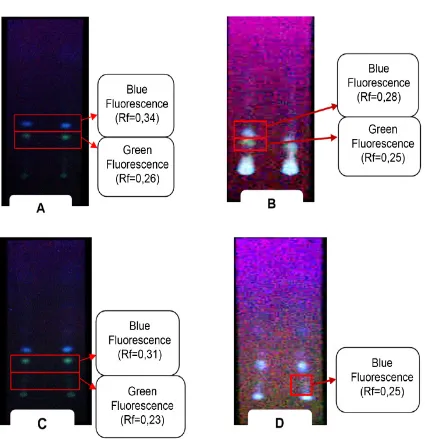
Extract of Soybeans (Glycine max L.Merill) Qualitative analysis of flavonoid in each extract was done by using TLC method (Figure 1) Figure 1 showed blue and
Figure 1. TLC Chromatogram of Chloroform Fraction of methanolic Extract of Soybean Observed under UV Ray λ 365 nm a. Argomulyo
green fluorescence stain on the plate that was spotted with chloroform phase from each methanol extract of soybean variety observed under UV ray at λ 365 nm. The presence of blue and green fluorescence stain entailed that there was flavonoid in the methanolic extract of those four varieties (Argomulyo, Burangrang, Ijen and Kaba).
The results of the observation of the antioxidant power of methanol extract of
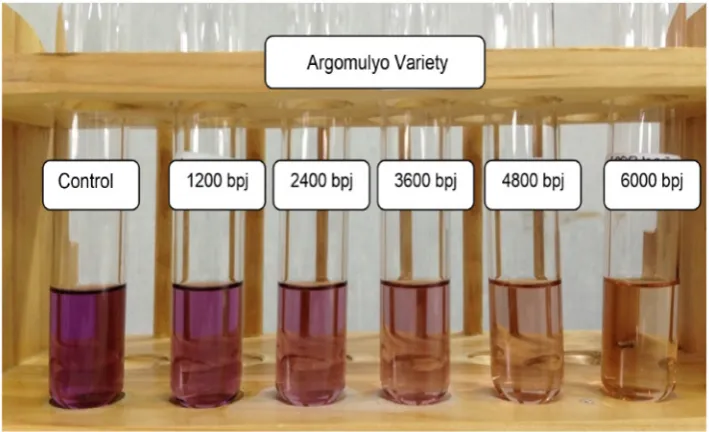
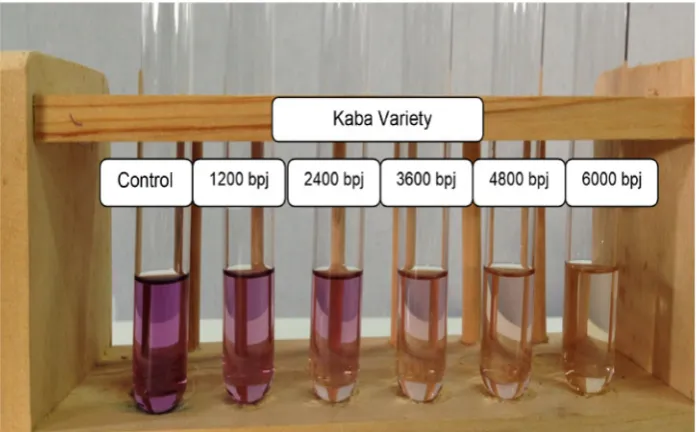
soybeans Soybean (Glycine max L.Merill) of Argomulyo, Burangrang, Ijen, and Kaba varieties using DPPH methodat various concentration using DPPH solution 40.0 bpj could be seen in Figure 2, Figure 3, Figure 4, Figure 5. In the figures, the test tube containing 3.0 ml DPPH 40.0 bpj + 1.5 ml of methanol extract solution of soybean (sample) at various concentrarion. From the left to the right, in the sample concentrations,
Figure 2. The Results of Qualitative Testing of Antioxidant Power Using DPPH Method of Methanol Extract of Soybean of Argomulyo variety
i.e., 1200 bpj, 2400 bpj, 3600 bpj, 4800 bpj, and 6000 bpj, there could be seen that the higher the concentration, the more the color of DPPH solution faded. It implied that there were more DPPH free radicals being reduced by the antioxidant available in the sample. The fading violet color of DPPH free radicals was caused by the reduction of DPPH when its molecules that had one N atom whose electrons were not in pairs
reacted with a compound that could donate hydrogen atoms (8).
Determination of the DPPH maximum
wavelength
The maximum wave-length of DPPH solution 40.0 bpj measured at wavelength 400-700 nm was 516.00 nm. This wave-length was used to determine rection time and to examine the antioxidant power of the
Figure 4. The Results of Qualitative Testing of Antioxidant Power Using DPPH Method of Methanol Extract of Soybean of Ijen variety
sample. The measurement of the maximum wave-length of DPPH in the methanol was carried out because every absorbance measurement of the tested solution was conducted at that wave-length as any change in absorbance of each concentrate unit was deemed to be the biggest. The data indicated a maximum sensitivity of the analysis
Determination of the reaction time
By defining the reaction time methanolic of the four varieties of methanolic extract of soybean, it was found out that at minute 15th, the reaction of DPPH free radicals and the antioxidant in the methanolic extract of the soybeans of each variety was optimal. It could be seen from the difference of absorbance reduction at minutes 15th and 20th was relatively smaller and the time used was more efficient.
The Linear Regression Equation and
EC50 of Methanol Extract of Soybeans
(Glycine max L.Merill)
Based on the calculation of % of damping, a linear regression equation of
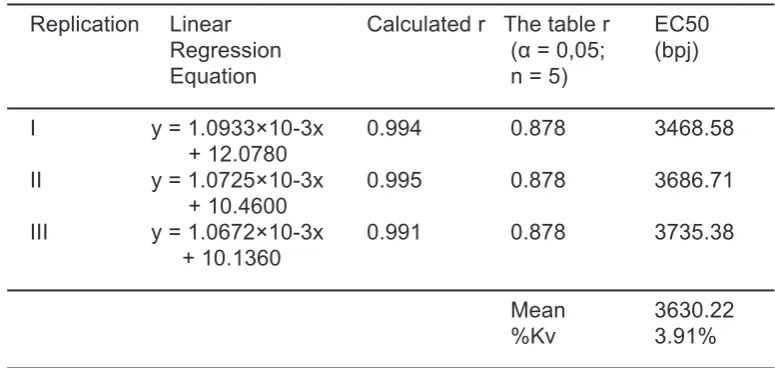
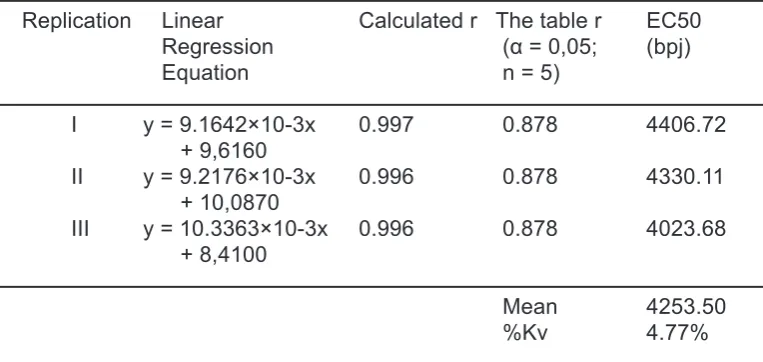
concentration (bpj) and % of damping was formulated. The equation and value of EC50 of each replication of the methanol extract of the tested soybeans were presented in tables 1-4 The value of calculated r from each linear regression equation was compared to table r. It was clear that calculated r was greater than the table r (0.878). this data confirmed the correlation between that there was a significant correlation between concentration and % of damping. The EC50 parameter was in inverse proportion to the antioxidant activity; the lower the value of EC50, the greater the antioxidant activity of a compund (8).
From the calculation of linear regression equation, the mean value of EC50 of methanol extract of soybean of Argomulyo variety was 3630.22 bpj, of Burangrang variety was as much as 5290.71 bpj, of Ijen variety was 4145.99 bpj, and of Kaba variety was 4253.50 bpj respectively. Argomulyo variety showed the greatest antioxidant power with the lowest of value of EC50 compared with another varieties using One-Way ANOVA method.
Tabel 1. Linear Regression Equation and EC50 Value of Methanol Extract of Soybean (Glycine max L.Merill) of Argomulyo variety
Tabel 2. Linear Regression Equation and EC50 Value of Methanol Extract of Soybean (Glycine max L.Merill) of Burangrang variety
Replication Linear Calculated r The table r EC50 Regression (α = 0,05; (bpj) Equation n = 5)
I y = 8.5268×10-3x 0.995 0.878 5027.68 + 7.1300
II y = 7.8169×10-3x 0.996 0.878 5442.17 + 7.4590
III y = 8.0523×10-3x 0.998 0.878 5402.28 + 6.4990
Mean 5290.71
%Kv 4.32%
Tabel 4. Linear Regression Equation and EC50 Value of Methanol Extract of Soybean (Glycine max L.Merill) of Ijen variety
Replication Linear Calculated r The table r EC50 Regression (α = 0,05; (bpj) Equation n = 5)
I y = 9.1642×10-3x 0.997 0.878 4406.72 + 9,6160
II y = 9.2176×10-3x 0.996 0.878 4330.11 + 10,0870
III y = 10.3363×10-3x 0.996 0.878 4023.68 + 8,4100
Mean 4253.50
%Kv 4.77%
Tabel 3. Linear Regression Equation and EC50 Value of Methanol Extract of Soybean (Glycine max L.Merill) of Ijen variety
Replication Linear Calculated r The table r EC50 Regression (α = 0,05; (bpj) Equation n = 5)
I y = 9.2027×10-3x 0.991 0.878 4276.35 + 10,6460
II y = 1.0139×10-3x 0.997 0.878 4010.06 + 9,3420
III y = 9.4762×10-3x 0.994 0.878 4151.56 + 10,6590
Mean 4145.99
CONCLUSION
The methanolic extract of soybean seeds (Glycine max L.Merill) of Argomulyo, Burangrang, Ijen, and Kaba varieties contained flavonoid. Also, all those four resulted in EC50 values subsequently as
much as 3620.22 bpj; 5290.71 bpj; 4145.99 bpj; and 4253.50 bpj. Argomulyo variety had the greatest antioxidant power among the tested varieties.
REFERENCES
1. Winarsi, H. 2007. Antioksidan Alami dan Radikal Bebas: Potensi dan Aplikasinya dalam Kesehatan. Kanisius, Yogyakarta, 11-22, 77-82
2. Lee Jae-Hwan, Marjory R, Ronald JF, Steve K, Martin ST, Steven JS, Yael V. 2004. Isoflavone Characterization and Antioxidant Activity of Ohio Soybeans. Journal of Agricultural and Food Chemistry, 52:2647-2651
3. Markham, KR. 1982. Cara Mengidentifikasi Flavonoid. Bandung, Penerbit ITB, pp. 13-15
4. Suhartina. 2005. Deskripsi Varietas Unggul Kacang-kacangan dan Umbi-umbian. Malang, Balai Penelitian Tanaman Kacang-kacangan dan Umbi-umbian
5. Mujic, Sertovic E, Jokic S, et al, 2011, Isoflavone Content and Antioxidant Properties of Soybean Seeds. Croat. J.
Food Sci. Technol. 3(1): 16-20
6. Marxen K, Vanselow KH, Lippemeier S, et al. 2007. Determination of DPPH Radical Oxidation Caused by Methanolic Extracts of Some Microalgal Species by Linear Regression Analysis of Spectrophotometric Measurements. Sensors. 7: 2080-2095.
7. Hadi S. 2000. Analisis Regresi jilid 1 Cetakan ke-7, Penerbit Andi, Yogyakarta, 68.
8. Molyneux, P. 2004. The Use of Stable Free Radical Diphenylpicrylhydrazyl (DPPH) for Estimating Antioxidant Activity. Songklanakarin Journal of Science and Technology 26(2):211-219 9. Suharman, MM. 1995. Analisis