Wacana
–
Vol. 15, No. 1(2012)
ISSN E-ISSN : : 1411-01992338-1884EMPOWERMENT OF FARMER GROUP IN IMPROVING CHILLI FARMING
INCOME IN KERINCI DISTRICT, INDONESIA
Indra Karim, Hani Sri Handayawati, Wiwiek Ruminarti
Agribusiness Undergraduate Program, Faculty of Agriculture, Malang Agriculture Institute, Indonesia
Abstract
Purpose of the agricultural development is to raise the quality of human resources and the livelihood of farmers and their families. The role of farmer groups are very important in supporting the agricultural intensification program, but their ability to adopt new technologies are still very limited. Base on these facts then problems of this research is role of the chilli farmers group empowerment in improving the farming revenues. The research was carried out in the Air Hangat Timur Subdistrict, Kerinci District, many farmers who insist the chili farming traditionally, they have not implemented the recommended agrotechnologies package. The number of samples as much as two groups of farmers, including 28 farmers from the Pinang-Jaya farmers group and 17 farmers from Usaha-Sepakat farmer groups. To find out the improvement level of farmers ability in improving farmer income, it is conducted the Coefficient Spearman test. The results showed that the ability of chilli agrotechnology implementation is included in the category of
“intermediate”. There is a strong relationship between farmer age, educational level, experience farming and the
number of family member with the farmer capability in implementing chilli agrotechnologies.
Keywords: farmer group, chili farming, farming income
INTRODUCTION
Red chili farming is a source of revenue and employment for rural communities. If in terms of demand, chilli crop have the importance to meet the daily human needs. According to
Santika (1995), chili is a horticultural
commodities consumed by the majority of Indonesia's population. Chilli crop have a high prospects for commercial farming because it can be used as industrial raw materials such as spices, sauce, gravy and a source of vitamins [10]. One of the agricultural development activities is improving the quality of human resources (HR) of farmer and their families. It aims to increase the knowledge, attitudes and skills of farmers and their families, so that they can develop a more productive farming and at the same time improving the welfare of their families [12].
The lower crop production will cause a lower level of farming income. To obtain maximum yield and higher incomes it is needed empowerment invoving the technical aspects, social and institutional aspects. An agricultural extension activities implemented in rural areas can involve the agricultural extension workers through the coaching and guidance approaches on a regular basis and sustainable to the farmers.
Corresponding Address:
Indra Karim
Email : [email protected]
Address : Agribusiness Undergraduate Program, Faculty of Agriculture, Malang Agriculture Institute, Indonesia
These activities aimed to strengthen the cooperative spirit among farmers and co-operation with other stakeholders in farming system. Farmers who are members of a farmer group is expected able to implement any new agrotechnologies and gain better revenues of farming.
The role of the farmer groups in the agriculture communities is as a medium of communication and social interactions that are
natural, sustainable and dynamic; as a
foundation for achieving improvement evenly. Farmer groups that are aspirational and health, can be an effective vehicles for the government extension programs in the development of agriculture and rural community development [7].
Farmers group function is as a medium of learning and teaching, as production units and as a vehicle for farming co-operation in order to become more productive. The farmers group is a vehicle for farmers in order to integrate in improving their knowledge, skills, attitudes and ambitions, so their farming is better and profitable, and more prosperous life [18]. The role and function of the farmer groups are required to improve the quality of farming system, also as a medium of communication, so it is expected to be an effective vehicle in agricultural development at the village level [15].
Farming Analysis Of The Juai-Pumpkin In The Juai Village, South Kalimantan(Prihanantoet al.)
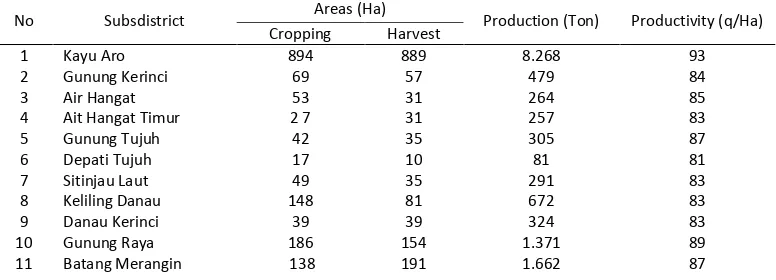
Table 1. Cropping areas, Harvest areas, Production and Productivity of Chili Farming
No Subsdistrict Areas (Ha) Production (Ton) Productivity (q/Ha)
Cropping Harvest
Source : Agriculture Statistic, The Agriculture Office, Kerinci District.
socioeconomic factors, cultural and traditional habits and environmental factors which all affect on farming productivity [11].
By looking at the high potential of farmland in the Subdistrict of Air Hangat Timur, the level of farmers knowledge and skills in the application of agro-technology is not good, it is required informations about the importance of farmer group empowerment in improving the chili farming. This research aims to analyze (1)
This study used a survey method of chillies farming in the research area. The focus of this research is the ability of chilli agro technology on the Pinang Jaya farmers group and the Usaha Sepakat farmers group, these farmers group and their members do a chilli farming traditionally, have not implemented the recommended packages of agrotechnologies.
Primary data were collected through interviews using a list of questions that had been prepared. While secondary data were obtained from the government agencies and institution as well as reading materials that are relevant to the research problems.
In the Subdistrict of Air Hangat Timur are 14 villages. Determination of village sample is conducted purposively, by reason of the number of farmers who do chilli farming, then the Koto Lanang village is selected. In the village of Koto Lanang, the number of farmers groups are 23 groups and their member are 714 farmers. Of the 23 groups of farmers is the 18 farmers groups who are less active. From these 18 farmers' groups were selected two sample of farmer
groups randomly, then it is selected the farmer group of Pinang Raya dan farmer groups of Usaha Sepakat. Member of the farmers group Pinang Raya are 28 persons and members of the Usaha Sepakat are 17 persons. From these 45 members are determined the samples as many as 20 persons as respondents, 10 persons from each farmer group. Sample of farmer is determined randomly (simple random sampling).
Data were analyzed by descriptive and non-parametric statistical methods. To test the hypothesis on the relationship between two variables, the correlation coefficient Spearman test was conducted by the following formula [8]:
rs = Correlation coefficient of Spearman; di = different of exponent value of observation Xi and Yi; n = number of rank pairs.
RESULTS AND DISCUSSION Areas of Chili Farming
In the District of Kerinci, chilli is cultivated in every sub-districts areas. Cropping areas, harvest areas, total production and average production of chili in the Kerinci district are presented in Table 1.
Characteristics of Farmer Respondents Farmer Age.
Farming Analysis Of The Juai-Pumpkin In The Juai Village, South Kalimantan(Prihanantoet al.)
then 90% of the farmer respondents considered to be the productive labor. According to Soeharjo and Patong (1977), the farmer age will affect physical ability to work and think. In General, young farmers have the physical ability higher than the older farmers. Young farmers are also more quickly accept any innovative things. This is because young farmers more risk taking. Fadholi Hernanto (1979) states that young farmers are relatively more dynamic and mobile, while older farmers less mobile. Similarly, in decision making, the old farmer is usually very careful in their decision making, so it is risky or small risks.
Table 2. Distribution of respondent age in the making in planning and cultivating their farming system.
Farmer education.
Formal education is the level of formal schooling has been followed by the farmers.
Formal education is classified as: “Did not finish Elementary School”, “graduated from elementary school”, and “graduated from secondary high schools”. The frequency distribution of education level can be seen in Table 3.
Table 3. Distribution of formal education level among the farmer respondent
No Level of formal
Not finished primary school Elementary School” and “Graduated from Elementary School” are categorized as “the low education level”, most of respondents (15
people) or 75% are the low educated level. The level of formal education is basically greatly affects farmers in managing their farming, both in the planning stage and cultivating stages , the
decision taken may affect the farming
productivity (Hernanto, 1987). The level of formal education have an effect on the willingness to accept and to try the new technologies (innovation) as well as farmers' way of thinking.
Farming experiences.
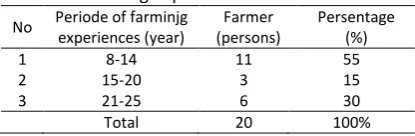
The experience of farming is the length of farmer do their farming. The length of farming experiences among the farmers respondents is about 15.45 years. Farming experience of maximum is 24 years and most short experience is 8 years. Distribution of farming experience among the farmer respondents can be seen in Table 4.
Table 4. Distribution of farmer based on their farming experiences
No Periode of farminjg
experiences (year)
Work experience in the field of agriculture has a positive influence on the mastery of knowledge and skills. The longer the more farming experiences is usually learned by the farmers, so that they are easier to adopt new
technologies in improving their farming
performances.
Number of family member (Family dependants).
The number of family dependants are a number of people are borne by farmers in his family. The largest number of family dependants is 8 persons and the lowest is 3 persons. Frequency distribution of the family dependants number can be seen in Table 5.
Table 5. Number of farmer family members
Farming Analysis Of The Juai-Pumpkin In The Juai Village, South Kalimantan(Prihanantoet al.)
The ability of farmers to Raise the chili farming revenues
Farmer ability is defined as the knowledge and skills of farmers in doing chilli farming. The ability of farmers being estimated with the scoring method, it is conducted before and after they practice the chilli farming.
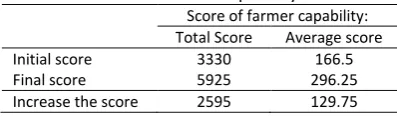
The results showed the existence of differences between the initial score and the final score. Improvement of scores are quite high. The difference between the initial average score and the final score suggests the improvement of farmer ability in implementing chilli farming (Table 6).
Table 6. Initial score, Final score and Increase score of farmer capability
Score of farmer capability:
Total Score Average score
Initial score Final score
3330 5925
166.5 296.25
Increase the score 2595 129.75
From Table 6 it appears that score of farmers ability before following the practice of the new technology of 166.5. After following the application of chilli cultivation technology, the score of farmers ability of 296,25. Through the training of the cultivation technology of chilli, the ability of farmers have increased about 77.93%.
Based on the level of its ability, before the training activities the score of farmer ability is
“Low” (score 166.6; low category < 190) and after following the training, the score of farmer ability
is “Medium” (score 296.25; Medium category = 195 - 295).
The results showed that empowerment of farmers through the field demonstration and field-trial can enhance farmer ability in applying chilli agrotechnologies. The method of field demonstration and field practices should involve all five senses of farmers. This is in accordance with the Socony Vacuum Oil Copen Co. research (Padmowiharjo, 1994) that 83% of learning effects is through the senses of vision and 11% is through the hearing senses.
Relationship between farmers age and technical capability in application of chili agroteknologi
Farmer respondents have the youngest age 30 years and the oldest aged 60 years. In terms of this age can be estimated their skills and degree of wisdom in thinking and take a decision what should be adopted in their farming, includes the cultivation of chili. Results of statistical analyses showed the significant positive relationship between age of farmer
respondents and their ability in application of chilli cultivation technologies.
The Relationship between Farmer Education and their Technical Skills in Application of Chili Agrotechnologies
Formal education level of farmer
respondents are very diverse, ranging from “Did not finished Elementary School” , “Finished elementary school”, up to “Finished secondary high school”. Score of farmer ability in
application of chilli agrotechnology based on education level of farmers can be seen in Table 7.
Table 7. Technical ability of farmer in implementing chili agrotechnology based on their formal education level
Score of farmer ability : Not finished
primary school (n = 5)
Primary school (n = 10)
High school (n = 5)
Total 1.385 2.995 1.545
Average 277 299.50 309
The highest score is obtained by a group of farmers who finished the secondary school,
followed by respondents who completed
elementary school. Respondents with the low technical capabilities in the application of chilli agrotechnologies in the intensive farming is a group of farmers who did not finish elementary school. Thus, the higher level of education of farmers will be the higher ability for application of chilli agrotechnologies in the intensive farming. Results of the statistical analysis shows the value of rs = 0.860, it is significant at the 95% confidence level. It means there is a significant positive relationship between the level of education and technical skills in implementing the chilli agrotechnologies in intensive farming system.
The Relationship between the farming experiences and technical skills in application of chili Agrotechnologies
In this study it is assumed that more and more farmers experiences in farming activities, then the higher ability to adopt agrotechnologies of chilli. Result of statistical analysis shows rs = 0.555, this value is significant at the 95% level of confidence. This means there is a positive significant relation between farming experiences and technical ability in applying agrotechnologies in chilli farming.
The relationship between Number of family member and Technical Skills in application of Chili Agrotechnologies
Farming Analysis Of The Juai-Pumpkin In The Juai Village, South Kalimantan(Prihanantoet al.)
family is very diverse, i.e. 3-8 persons. The greater number of family member will be the greater cost of family needs. This will affect farmers ' responsibilities in supplying the family needs. Relationship between the number of family members and the technical ability of farmers in applying chilli agrotechnology can be known with the analysis of Spearman correlation. Statistical analysis resulted in a value of rs = 0.337 , it is significant at the 95% of confidence level. Thus there is a positive significantly relationship between the number of family members of the technical skills of farmer in the application of chilli agrotechnologies.
CONCLUSIONS
Based on the results of study can be concluded as follows:
1. The level of technical ability in the
application of chilli agrotechnology included in the medium category (average score 296,25 and maximum score of 400).
2. There is a significant positive relationship
between age of farmers and technical skills in the application of chilli agrotechnology.
3. There is a significant positive relationship
between the level of education and
technical ability of respondents in
application of chilli cultivation technology.
4. There is a significant positive relationship
between the experience of farming and technical skills in the application of chilli cultivation technology.
5. There is a significant positive relationship
between the number of family members and technical skills in the application of chilli cultivation technology.
REFERENCES
[1]. Anonymous. 1978. Kelompok Tani.
Depertemen Pertanian Pusat
Penyuluhan Pertanian. Jakarta.
[2]. ______ , 1987. Pembinaan Kelompok Tani.
Depertemen Pertanian Pusat
Penyuluh Pertanian. Jakarta.
[3]. ______, 1997. Pengembangan dan
Pembinaan Kelompok Tani
Intensifikasi Tanaman Pangan Motor Penggerak Menimbulkan Dinamika
Kelompok Tani. Depertemen
Pertanian. Jalarta.
[4]. _____, 1997. Tolak Ukur Jurus Kemampuan
Kelompok Tani. Depertemen
Pertanian Pusat Penyuluh Pertanian. Jakarta.
[5]. _____, 1980. Pengembangan dan
Pembinaan Kelompok Tani dalam
Intensifikasi Tanaman Pangan.
Satuan Pengendali Bimas. Jakarta.
[6]. Ajid. 1978. Pembinaan dan Pengembangan
Kelompok Tani. Satuan Pengendali Bimas. Jakarta.
[7]. Aphunu, A. and C. S. O. Otoikhian. 2008.
Farmers’ perception of the
effectiveness of extension agents of Delta State Agricultural Development Programme (DADP). African Journal of General Agriculture. Vol. 4, No. 3, September 30, 2008. p.165-169.
[8]. Djarwanto, P.S. 1981. Statistik Non
Parametrik. BPFE – UGM. Yogyakarta
[9]. Hernanto, Fadholi. 1979. Ilmu Usahatani.
Faperta IPB Bogor.
[10].Howard, L.R., R. T. Smith, A. B. Wagner, B.
Villalon, E. E. Burns. 2006. Provitamin A and Ascorbic Acid Content of Fresh Pepper Cultivars (Capsicum annuum)
and Processed Jalapeños. Journal of
Food Science. 2006; 59(2):362 - 365..
[11].Kasmiyati. 2006. Pengaruh karakteristik
sosial budaya masyarakat terhadap penerapan teknologi pertanian: Studi pada petani sayuran dataran tinggi Kota Batu Propinsi Jawa Timur. Buletin Teknologi dan Informasi Pertanian BPTP Jawa Timur. ISSN 1410-8976 (2006) v. 9 p. 7-22.
[12].Kepe,T.V. and G.C.Filson.1993. Perceived
levels of farming skills and problems
of small‐scale commercial farmers in
Ciskei. Development Southern Africa.
Volume 10, Issue 3, 1993. pages
427-435.
[13].Moslow. 1959. Pertanian dan
Pembangunan. Pengendalian Bimas. Jakarta.
[14].Myrdal. 1978. Kemajuan Kemampuan
Kelompok Tani Nelayan. Balai
Informasi Pertanian Ciawi. Bogor
[15].Purwanto, M. Syukur dan P. Santoso. 2006.
Penguatan kelembagaan kelompok
tani dalam mendukung
pembangunan pertanian di Jawa
Timur. Buletin Teknologi dan
Informasi Pertanian BPTP Jawa
Timur. ISSN 1410-8976 (2006) v. 9 p. 41-51.
[16].Rusidi. 1978. Peranan Kelompok Tani dalam
Pembangunan Pertanian. Badan
Farming Analysis Of The Juai-Pumpkin In The Juai Village, South Kalimantan(Prihanantoet al.)
[17].Soeharjo dan Dahlan Patong. 1977. Sendi –
Sendi Ilmu Usahatani IPB. Bogor.
[18].Sri Wahyuni. 2003. Kinerja kelompok tani