The new england journal of medicine
review article
current concepts
Bacterial Infections in Drug Users
Rachel J. Gordon, M.D., M.P.H., and Franklin D. Lowy, M.D.
From the Division of Infectious Diseases, Departments of Medicine (R.J.G., F.D.L.) and Pathology (F.D.L.), Columbia Univer-sity College of Physicians and Surgeons, New York. Address reprint requests to Dr. Gordon at the Division of Infectious Dis-eases, Box 82, Columbia University Col-lege of Physicians and Surgeons, 630 W. 168th St., New York, NY 10032, or at [email protected].
N Engl J Med 2005;353:1945-54. Copyright © 2005 Massachusetts Medical Society. llicit drug use is a worldwide health problem. annually,
approx-imately 5 percent of the global population, or 200 million people, use illicit drugs.1
In a U.S. survey, 19.5 million people 12 years of age or older, or 8.2 percent of the population, had used an illicit drug in the prior month.2 Injection is one of the most
harmful routes of administration. There are an estimated 13 million injection-drug us-ers worldwide, 78 percent of whom live in developing nations.3
Infections are among the most serious complications of drug use.4,5 Drug use plays
a major role in the transmission of human immunodeficiency virus (HIV), sexually transmitted diseases, and viral hepatitis. In addition to these infections, drug users risk acquiring a diversity of bacterial infections.4,6-9 This review summarizes recent
infor-mation on bacterial infections associated with drug use and examines the interactions among the drug user, the preferred drug, and the method of administration that define the nature of these infections.
Most bacterial infections among drug users are caused by the subject’s own commen-sal flora, with Staphylococcus aureus and streptococcus species being the most common pathogens.6-11 Outbreaks among drug users that are caused by unusual organisms, such
as clostridia species and Pseudomonas aeruginosa, may indicate that a particular drug or drug-use behavior is involved.12,13
Skin and soft-tissue infections are some of the most common infections among in-jection-drug users. Their incidence is difficult to estimate because such infections are often self-treated. A prospective study of injection-drug users in Amsterdam reported an approximate incidence of one abscess per three years of injection-drug use.14 A
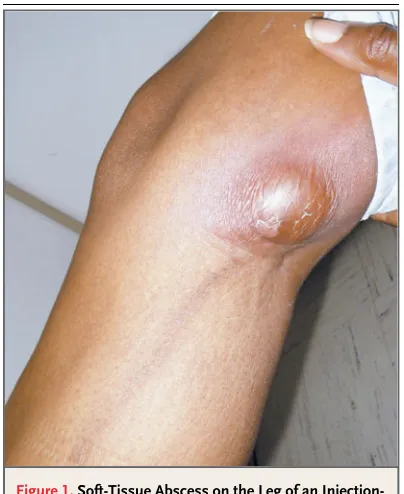
cross-sectional study of injection-drug users in San Francisco found that 32 percent had an abscess, cellulitis, or both, as confirmed by physical examination (Fig. 1).15
Inexperience with injection may predispose the drug user to soft-tissue infection. Experienced injection-drug users who lack viable veins for use commonly resort to “skin popping” (subcutaneous or intramuscular injection). Binswanger et al.15 reported that
injection-drug users who had skin-popped within the preceding 30 days had a higher risk of soft-tissue infection than those who injected only intravenously. Injecting “speed-balls” (mixtures of cocaine and heroin), injecting more frequently, and being positive for HIV infection were also associated with skin abscesses.14 Using dirty needles,
fail-ing to clean the skin before injection, and “bootfail-ing” (repeatedly flushfail-ing and pullfail-ing back during injection) may also increase the risk of abscess.16,17
An upsurge in skin infections, primarily abscesses, as well as more invasive infec-tions, among injection-drug users in California has been caused by community-associ-ated methicillin-resistant S. aureus (MRSA).18 Six of 14 patients with necrotizing
fasci-itis due to community-associated MRSA at Harbor–UCLA Medical Center were current or former injection-drug users.19 Community-associated MRSA infections have also
i
The new england journal of medicine
been reported among prisoners, military recruits, and men who have sex with men who use crystal methamphetamine.20-24 These infections, most
of which are positive for the mobile genetic ele-ment staphylococcal chromosomal cassette (SCC) mec type IV, in part reflect the clonal dissemination of toxin-producing (i.e., Panton–Valentine leuko-cidin) strains with a predilection to cause cutane-ous and respiratory tract infections.25
Infective endocarditis has an estimated inci-dence of 1.5 to 3.3 cases per 1000 injection-drug users per year.26,27 Infection at other sites,
coloni-zation with S. aureus, and a history of infective en-docarditis increase the drug user’s risk.14,26,28 The
risk appears augmented when the injected drug is cocaine, perhaps owing to the vasoconstrictive ef-fects of the drug or the increased frequency of in-jection.29
HIV infection also predisposes the drug user to infective endocarditis. In a Baltimore cohort of 2946 injection-drug users, the incidence was 3.3 cas-es per 1000 person-years among HIV-negative sub-jects and 13.8 cases per 1000 person-years among HIV-positive subjects. Risk factors for infective en-docarditis included immunosuppression (defined as fewer than 200 CD4 cells per cubic millimeter) and more frequent injection (at least daily).26
Drug users have a 10-fold increase in the risk of community-acquired pneumonia.30 Drug
us-ers, who are often smokus-ers, may have impaired re-spiratory-clearance mechanisms as well as an in-creased risk of aspiration.31 Immunocompromise,
resulting from poor nutrition or HIV infection, may also contribute to the increased risk of respiratory tract infection.6,32,33
The risk of pulmonary tuberculosis (including drug-resistant cases) appears to be increased among drug users as a result of crowded living conditions (including residence in homeless shelters and drug use in “crack” cocaine houses and “shooting galler-ies”), delays in diagnosis, poor adherence to treat-ment (which increases the duration of infectious-ness), and the prevalence of HIV infection or the acquired immunodeficiency syndrome (AIDS).34-37
Tuberculosis and other respiratory pathogens may also be transmitted through a practice known as “shotgunning” (smoking and inhaling a drug and then expelling the smoke into another person’s mouth), a common practice among smokers of crack cocaine.38 Inhaling cocaine also predisposes
drug users to upper respiratory tract infections, in-cluding sinusitis and, in rare instances, septal ab-scesses.39,40
A unique association exists between clostridial infections and the use of black-tar heroin, a form of heroin produced in Mexico. An epidemic of wound botulism occurred in California during the 1990s in conjunction with the increased use of black-tar heroin. Most patients had injected the drug subcu-taneously, suggesting the combined role of black-tar heroin and skin popping in heightening the risk of wound botulism.13
The number of tetanus cases climbed in con-cert with California’s epidemic of wound botu-lism. Twenty-seven (40 percent) of the identified cases occurred in injection-drug users, all of whom reported subcutaneous injection of heroin.41
Na-tionally, injection-drug users accounted for 19 of the 130 cases reported from 1998 to 2000 (15 per-cent).42 England had an outbreak of eight cases
among injection-drug users in 2003. The close clus-tering of cases suggested contamination of drugs with Clostridium tetani.43
Necrotizing fasciitis with toxic shock syndrome complicated C. sordellii infection in at least six us-ers of black-tar heroin in California.44 Eighty-eight
injection-drug users in England, Scotland, and Ire-land were hospitalized with a soft-tissue infection at an injection site and more than 30 died in 2000.45
Twenty-six percent of patients (9 of 35 patients who
Figure 1. Soft-Tissue Abscess on the Leg of an Injection-Drug User.
current concepts
met the case definition) had microbiologic evidence of clostridial infections, including C. novyi and C. per-fringens.
The bacteria responsible for infections in drug us-ers are acquired either from the drug user’s com-mensal flora or from organisms contaminating the drugs, drug adulterants, or paraphernalia. Exam-ples of these different modes of transmission and the pathogenesis of these infections are discussed below.
the role of commensal flora
The majority of nonpulmonary bacterial infec-tions among drug users are caused by S. aureus or streptococcus species.7,10,11,26,28,46 Drug users
may have a higher rate of nasal or skin coloniza-tion with S. aureus than do those who do not use drugs,47 perhaps because their nasal epithelium
has been damaged by drug inhalation or their skin has been damaged by drug injection. Colonization with S. aureus is a risk factor for infection.47 These
infections occur when commensal flora is intro-duced into the surrounding tissues or bloodstream through injection. Tuazon and Sheagren48
dem-onstrated that 12 injection-drug users hospital-ized with S. aureus infective endocarditis were in-fected with their own colonizing strain.
Poor hygiene may exacerbate the risk of infec-tion with commensal flora. Before “shooting up,” drug users often fail to clean injection sites, or do so insufficiently.6,15-17 In a study of 1057
injec-tion-drug users in Baltimore, abscesses were twice as common among those who reported never clean-ing the skin as among those who reported always cleaning the skin before injection.16 Injection at
heavily colonized sites, such as the femoral vein, may also increase the risk of infection with gram-negative flora.15,31 Drug users often crush
cap-sules and tablets in their mouth when preparing them for intravenous injection. They also blow out needle clots or lick their needles to facilitate injec-tion. Needle licking may double the risk of celluli-tis or abscess with oral streptococcal and anaero-bic species.15
bacterial transmission through sharing
of drug paraphernalia
Drug users may also transmit bacteria by sharing drug paraphernalia. Such equipment may be rinsed only with water, or if running water is unavailable,
saliva or even toilet water may be used.31 In the
first U.S. outbreak of community-associated MRSA among injection-drug users, the epidemic strain was cultured from a needle used by one of the pa-tients.49
In Boston, seven injection-drug users with bac-teremia caused by a single strain of S. aureus had been injected by a “street doctor” at the same “shooting gallery,” using the gallery’s drug para-phernalia.50 In Zurich, 31 injection-drug users were
infected and hospitalized with the same MRSA clone.51 This phenomenon has also been reported
with Streptococcus pyogenes.52 Quagliarello et al.53
re-ported that 14 of 54 subjects who used inhalational drugs (56 percent of whom also injected drugs) had nasal colonization with S. aureus (26 percent) and that 4 of 48 pieces of their inhalational parapherna-lia were positive for S. aureus (8 percent). Closely re-lated clusters of S. aureus strains were present among users of four drug-use networks, all of whom fre-quented the same crack house.53 These studies
sug-gest that S. aureus is transmitted through drug-use networks and shared drug paraphernalia.
transmission through drugs or drug
adulterants
The drug of choice and techniques of drug prepa-ration may affect the risk of infection with particu-lar organisms. The association between black-tar heroin and clostridial infections is a case in point. Investigators believe that black-tar heroin becomes contaminated with spores when mixed with adul-terants (e.g., methamphetamine or strychnine) or diluted (“cut”) with substances such as dextrose or dyed paper. Although black-tar heroin is typically heated in water before use, clostridial spores survive boiling and may even begin to germinate.13,54
Intravenous use of black-tar heroin causes ve-nous sclerosis and promotes the practice of skin popping with the loss of usable veins. Repeated in-jection of the drug into soft tissue leads to local tissue ischemia and necrosis, establishing an anaer-obic environment that favors clostridial germina-tion and elaboragermina-tion of toxin.42,54 The use of
speed-balls may potentiate the formation of abscesses and the growth of anaerobic organisms by caus-ing local tissue damage.14,17,55
Skin popping may increase the odds of wound botulism by a factor of more than 15. Investigators have also demonstrated a dose–response relation-ship between the quantities of black-tar heroin in-troduced by skin popping and the risk of wound botulism. Cleaning the skin, cleaning old needles,
The new england journal of medicine
or using new needles before injection were not pro-tective, another indication that black-tar heroin was the source of the infection.54
drug preparation
Unique features of drug preparation may predis-pose drug users to unusual infections. The intra-venous combination of pentazocine (an analgesic) and tripelennamine (an antihistamine), referred to as “Ts and Blues,” or TaBs, which was popular in Chicago in the late 1970s, was associated with an outbreak of infective endocarditis caused by P. aeru-ginosa.12 The tablets were crushed and then mixed
with warm tap water before injection. Unlike hero-in-containing mixtures, the mixture was soluble and did not require heating before injection. The pres-ence of P. aeruginosa in the tap water often used to
rinse syringes, combined with the solubility of TaBs, was believed to explain the association be-tween TaBs and P. aeruginosa infection.12 A series of
groin abscesses due to S. milleri was identified in Scotland, where it was common to crush buprenor-phine (an opioid) and temazepam (a benzodiaz-epine) between the teeth and then inject it after cleaning the skin with saliva.56
In addition to the role of hygiene, living condi-tions, and tissue trauma, other factors such as mal-nutrition and the presence of coexisting conditions may impair host defenses and exacerbate the risk of infection among drug users. HIV infection, a common coexisting medical condition, increases
h o s t s u s c e p t i b i l i t y
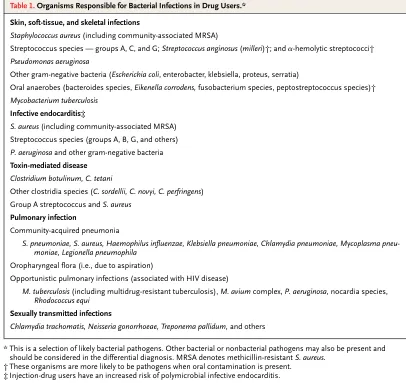
* This is a selection of likely bacterial pathogens. Other bacterial or nonbacterial pathogens may also be present and should be considered in the differential diagnosis. MRSA denotes methicillin-resistant S. aureus.
† These organisms are more likely to be pathogens when oral contamination is present. ‡ Injection-drug users have an increased risk of polymicrobial infective endocarditis.
Table 1. Organisms Responsible for Bacterial Infections in Drug Users.*
Skin, soft-tissue, and skeletal infections
Staphylococcus aureus (including community-associated MRSA)
Streptococcus species — groups A, C, and G; Streptococcus anginosus (milleri)†; and a-hemolytic streptococci†
Pseudomonas aeruginosa
Other gram-negative bacteria (Escherichia coli, enterobacter, klebsiella, proteus, serratia)
Oral anaerobes (bacteroides species, Eikenella corrodens, fusobacterium species, peptostreptococcus species)† Mycobacterium tuberculosis
Infective endocarditis‡
S. aureus (including community-associated MRSA)
Streptococcus species (groups A, B, G, and others)
P. aeruginosa and other gram-negative bacteria
Toxin-mediated disease Clostridium botulinum, C. tetani
Other clostridia species (C. sordellii, C. novyi, C. perfringens) Group A streptococcus and S. aureus
Pulmonary infection
Community-acquired pneumonia
S. pneumoniae, S. aureus, Haemophilus influenzae, Klebsiella pneumoniae, Chlamydia pneumoniae, Mycoplasma pneu-moniae, Legionella pneumophila
Oropharyngeal flora (i.e., due to aspiration)
Opportunistic pulmonary infections (associated with HIV disease)
M. tuberculosis (including multidrug-resistant tuberculosis), M. avium complex, P. aeruginosa, nocardia species,
Rhodococcus equi Sexually transmitted infections
current concepts
drug users’ susceptibility to bacterial infections.36,57
First reported by Stoneburner et al.,58 others have
also noted an increased risk of death from bacterial infection among HIV-infected drug users.59
The clinical presentation of bacterial infections in drug users is generally similar to that encountered in patients who do not use drugs. This section will highlight features that are unique to the drug user. Bacteria associated with infections in drug users are noted in Table 1.
skin and soft-tissue infections
Although the abscesses associated with communi-ty-acquired MRSA generally appear similar to other abscesses, they have occasionally been confused with spider bites.21,23 Community-associated MRSA
should be considered as a potential cause in patients who have a history of such infections, patients in potential risk groups who live in high-risk regions who have abscesses (especially complicated ones), and patients with infections that are not respond-ing to conventional antibiotics (photographs of ab-scesses are available at http://lapublichealth.org/ acd/docs/mrsa_colorenhanced.pdf ).60,61
musculoskeletal infections
Musculoskeletal infections, including septic ar-thritis and osteomyelitis, generally result from he-matogenous seeding or, less commonly, local ex-tension of a skin or soft-tissue infection in drug users. These infections may be indolent, and the only symptom may be pain without fever.62,63
In-jection-drug users are susceptible to skeletal infec-tions in uncommon places such as the sternocla-vicular and sacroiliac joints, in addition to more usual sites, such as the vertebral spine (Fig. 2) and knee.62,63 These infections may result, in part, from
injecting in high-risk areas such as the jugular vein (“pocket shot”) and femoral vein (“groin hit”).31,63
Such musculoskeletal infections are also more like-ly to be polike-lymicrobial or anaerobic, especiallike-ly if the injection-drug user contaminates the injection site, equipment, or drugs with saliva.
endovascular infections
Endovascular infections, including infective en-docarditis, septic thrombophlebitis, mycotic an-eurysms, and sepsis, are among the most serious complications of injection-drug use. An
endovas-cular source should be investigated in all injec-tion-drug users with bacteremia. Although left-sid-ed infective endocarditis in drug users is similar to that seen in non–drug users, infective endocardi-tis in injection-drug users is most commonly due to S. aureus and involves the tricuspid valve in 70 percent of patients. Symptoms may include fever, dyspnea, pleuritic chest pain, and cough. A murmur may be absent. The mortality rate in these cases is less than 5 percent.9,27,28 HIV-infected
injection-drug users with fewer than 200 CD4 cells per cubic millimeter have a higher mortality rate than those with less advanced HIV disease.64 If infective
en-docarditis is left-sided, complications such as brain and splenic abscess may occur owing to septic em-bolization. Infective endocarditis associated with injection-drug use is also one of the rare settings in which polymicrobial endocarditis is encoun-tered.28,64,65
respiratory tract infections
Respiratory tract infections are among the most frequent sequelae of drug use, and patients may present with atypical clinical and radiographic find-ings.4,6,30,33 A thorough medical history taking
includes questions regarding tuberculosis, HIV, and risk factors for aspiration. Aspiration pneu-monia as well as pneupneu-monia caused by S.
pneumoni-c l i n i pneumoni-c a l f e a t u r e s
Figure 2. Sagittal View of Magnetic Resonance Image in an Injection-Drug User with Vertebral Osteomyelitis Involving T6–T7 (Arrow) with an Adjacent Epidural Abscess.
The new england journal of medicine
ae, Haemophilus influenzae,S. aureus, and Klebsiella pneu-moniae are among the most common reasons for hospitalization.4,5,32,33 Undiagnosed HIV can first
become evident as the result of an opportunistic in-fection such as pneumocystis pneumonia. Endovas-cular infections can cause septic pulmonary emboli producing pneumonias and lung abscesses.7,31
Tuberculosis must be considered in drug users presenting with pneumonia and known or suspect-ed HIV infection. Drug users who have tuberculosis associated with HIV disease can present
atypi-cally (i.e., without cavitary lesions), and the puri-fied-protein-derivative test may be negative. Hilar or mediastinal lymphadenopathy may be the only finding.66
miscellaneous infections
Among the most important of the unusual tions related to drug use are the clostridial infec-tions that have been associated with the use of black-tar heroin. These may have typical presentations, as with the cases of tetanus, or an unusual
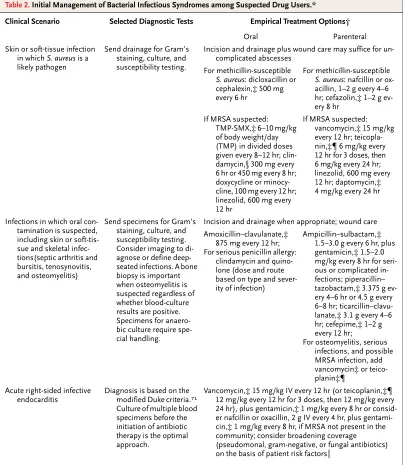
presenta-Table 2. Initial Management of Bacterial Infectious Syndromes among Suspected Drug Users.*
Clinical Scenario Selected Diagnostic Tests Empirical Treatment Options†
Oral Parenteral
Skin or soft-tissue infection in which S. aureus is a likely pathogen
Send drainage for Gram’s staining, culture, and susceptibility testing.
Incision and drainage plus wound care may suffice for un-complicated abscesses
For methicillin-susceptible S. aureus: dicloxacillin or cephalexin,‡ 500 mg every 6 hr
For methicillin-susceptible S. aureus: nafcillin or ox-acillin, 1–2 g every 4–6 hr; cefazolin,‡ 1–2 g ev-ery 8 hr
If MRSA suspected: TMP-SMX,‡ 6–10 mg/kg of body weight/day (TMP) in divided doses given every 8–12 hr; clin-damycin,§ 300 mg every 6 hr or 450 mg every 8 hr; doxycycline or minocy-cline, 100 mg every 12 hr; linezolid, 600 mg every 12 hr
If MRSA suspected: vancomycin,‡ 15 mg/kg every 12 hr; teicopla-nin,‡¶ 6 mg/kg every 12 hr for 3 doses, then 6 mg/kg every 24 hr; linezolid, 600 mg every 12 hr; daptomycin,‡ 4 mg/kg every 24 hr
Infections in which oral con-tamination is suspected, including skin or soft-tis-sue and skeletal infec-tions(septic arthritis and bursitis, tenosynovitis, and osteomyelitis)
Send specimens for Gram’s staining, culture, and susceptibility testing. Consider imaging to di-agnose or define deep-seated infections. A bone biopsy is important when osteomyelitis is suspected regardless of whether blood-culture results are positive. Specimens for anaero-bic culture require spe-cial handling.
Incision and drainage when appropriate; wound care Amoxicillin–clavulanate,‡
875 mg every 12 hr; For serious penicillin allergy:
clindamycin and quino-lone (dose and route based on type and sever-ity of infection)
Ampicillin–sulbactam,‡ 1.5–3.0 g every 6 hr, plus gentamicin,‡ 1.5–2.0 mg/kg every 8 hr for seri-ous or complicated in-fections; piperacillin– tazobactam,‡ 3.375 g ev-ery 4–6 hr or 4.5 g evev-ery 6–8 hr; ticarcillin–clavu-lanate,‡ 3.1 g every 4–6 hr; cefepime,‡ 1–2 g every 12 hr;
For osteomyelitis, serious infections, and possible MRSA infection, add vancomycin‡ or teico-planin‡¶
Acute right-sided infective
endocarditis Diagnosis is based on the modified Duke criteria.71
Culture of multiple blood specimens before the initiation of antibiotic therapy is the optimal approach.
current concepts
tion, as with the cases of C. sordellii infection in which patients presented with toxic shock syndrome (with or without cutaneous lesions).44,45 Patients should
be asked about the use of subcutaneous and intra-muscular injections, the use of black-tar heroin, and the date of the last tetanus immunization. Seri-ous toxin-mediated disease, such as botulism, may masquerade as intoxication (e.g., slurred speech).
Eliminating drug use is the surest way to control associated infections, but this goal may not always
be possible. Numerous risk-reducing strategies may help prevent bacterial infections among drug us-ers, particularly among new usus-ers, the ones at great-est risk. These programs include the provision of medically supervised injection facilities, syringe-exchange programs, and street-based education pro-grams directed at the use of sterile injection prac-tices.67,68 Safer injection practices include boiling
the drug, cleaning the skin with alcohol and the drug paraphernalia with bleach, avoiding contam-inating or sharing needles with others, and avoid-ing the use of dangerous injection sites such as the neck and groin.17,69 High-risk behavior such as hav-p r e v e n t i o n
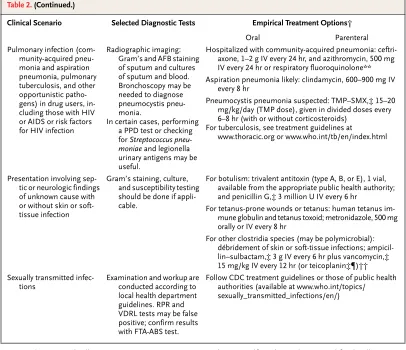
* MRSA denotes methicillin-resistant S. aureus, TMP-SMX trimethoprim–sulfamethoxazole, AFB acid-fast bacilli, RPR rapid plasma reagin, VDRL Venereal Disease Research Laboratory, FTA-ABS fluorescent treponemal antibody absorption, IV intravenously, and CDC Centers for Disease Control and Prevention.
† Therapy should be adjusted on the basis of the culture results and antibiotic susceptibilities. ‡ The dose must be adjusted in patients with reduced creatinine clearance.
§ Clindamycin should not be used if the isolate is resistant to erythromycin. ¶ This drug is not available in the United States.
¿ Therapy is generally continued for four to six weeks. Baddour et al.72 provide specific recommendations.
** Respiratory quinolones include gatifloxacin, levofloxacin, and moxifloxacin. ††Hyperbaric oxygen has also been used.
Table 2. (Continued.)
Clinical Scenario Selected Diagnostic Tests Empirical Treatment Options†
Oral Parenteral
Pulmonary infection (com-munity-acquired pneu-monia and aspiration pneumonia, pulmonary tuberculosis, and other opportunistic patho-gens) in drug users, in-cluding those with HIV or AIDS or risk factors for HIV infection
Radiographic imaging: Gram’s and AFB staining of sputum and cultures of sputum and blood. Bronchoscopy may be needed to diagnose pneumocystis pneu-monia.
In certain cases, performing a PPD test or checking
for Streptococcus
pneu-moniae and legionella
urinary antigens may be useful.
Hospitalized with community-acquired pneumonia: ceftri-axone, 1–2 g IV every 24 hr, and azithromycin, 500 mg IV every 24 hr or respiratory fluoroquinolone** Aspiration pneumonia likely: clindamycin, 600–900 mg IV
every 8 hr
Pneumocystis pneumonia suspected: TMP–SMX,‡ 15–20 mg/kg/day (TMP dose), given in divided doses every 6–8 hr (with or without corticosteroids)
For tuberculosis, see treatment guidelines at www.thoracic.org or www.who.int/tb/en/index.html
Presentation involving sep-tic or neurologic findings of unknown cause with or without skin or soft-tissue infection
Gram’s staining, culture, and susceptibility testing should be done if appli-cable.
For botulism: trivalent antitoxin (type A, B, or E), 1 vial, available from the appropriate public health authority; and penicillin G,‡ 3 million U IV every 6 hr
For tetanus-prone wounds or tetanus: human tetanus im-mune globulin and tetanus toxoid; metronidazole, 500 mg orally or IV every 8 hr
For other clostridia species (may be polymicrobial): débridement of skin or soft-tissue infections; ampicil-lin–sulbactam,‡ 3 g IV every 6 hr plus vancomycin,‡ 15 mg/kg IV every 12 hr (or teicoplanin‡¶)†† Sexually transmitted
infec-tions Examination and workup are conducted according to local health department guidelines. RPR and VDRL tests may be false positive; confirm results with FTA-ABS test.
The new england journal of medicine
ing unprotected sex and sex with multiple partners, which facilitates the transmission of HIV, sexually transmitted diseases, and community-associated MRSA, should be discouraged.22 In a Baltimore
study of injection-drug users, 60 percent reported a history of a sexually transmitted infection.70
Vac-cination with pneumococcal, H. influenzae type b, and tetanus vaccines41,42 as well as routine
screen-ing for tuberculosis, HIV infection, and sexually transmitted diseases may help prevent bacterial in-fection and disease transmission.
The medical management of bacterial infections in drug users begins with the recognition of drug use and its associated coexisting conditions. The spe-cific issues of the management of drug withdraw-al, adherence to therapy, and difficulties of intra-venous access must be a part of the therapeutic strategy. Close attention to local outbreaks and bac-terial antibiotic-resistance profiles is important. Management suggestions for selected syndromes related to drug use are included in Table 2.
Although conventional treatment is suggested, short courses of parenteral and oral regimens have been investigated for right-sided infective endo-carditis associated with injection-drug use. Selected cases of right-sided infective endocarditis due to methicillin-susceptible S.aureus have been success-fully treated with a penicillinase-resistant penicil-lin and an aminoglycoside (for two weeks) or cipro-floxacin and rifampin (for four weeks). Exclusion criteria for short-course or oral therapy for right-sided S. aureus infective endocarditis have included infections caused by MRSA, complicated cases char-acterized by a slow clinical response (more than 96 hours), large valvular vegetations (more than 2 cm), extracardiac complications, or injection-drug use
in a patient with AIDS.27,73-75 For regimens that
re-quire prolonged therapy such as those for tubercu-losis, the use of directly observed therapy is now standard.76 For drug users with sexually
transmit-ted diseases, in addition to the use of standard rec-ommendations, the use of single-dose therapy when possible has been successful.77
The choice of therapy also requires consider-ation of regional differences in antibiotic suscep-tibility among prevalent bacteria. With the emer-gence of community-associated MRSA as a virulent pathogen, it is crucial to obtain cultures for sensi-tivity testing before therapy is initiated.18,60 As we
noted earlier, unlikely pathogens must be consid-ered on the basis of the patient’s drug-use behav-ior, including the type of drug used and the route of administration.
Injection-drug users who report having a fever with no localizing findings pose a particular diag-nostic problem. Infection is just one of many po-tential diagnoses in these patients. Infective en-docarditis will be diagnosed in up to 20 percent of injection-drug users hospitalized with fever.29
However, the diagnosis of infective endocarditis in these patients is difficult when based solely on clinical and laboratory criteria.78 Therefore, it has
been recommended that these patients be admit-ted for further evaluation. Hospitalization of drug users also provides an important opportunity to of-fer comprehensive medical care.
Supported by grants (DA-09655 and DA-15018) from the Nation-al Institute on Drug Abuse and by a grant (CCR223380-01) from the Centers for Disease Control and Prevention.
Dr. Gordon reports having received grant support from Glaxo-SmithKline. Dr. Lowy reports having received consulting or lecture fees from Wyeth, Pfizer, and Cubist; having received grant support from GlaxoSmithKline; and holding stock in Merck and Pfizer.
We are indebted to Christine Kubin, Michael Tapper, and Abigail Zuger for their critical review of this manuscript, and to Robert Gwizdala for providing Figure 1.
t r e a t m e n t
r e f e r e n c e s
1. World drug report. Vol. 1. Analysis. New York: United Nations Office on Drugs and Crime, 2005.
2. 2003 National Survey on Drug Use and
Health. Rockville, Md.: Office of Applied Studies, Substance Abuse and Mental Health Services Administration, 2004.
3. World drug report. Vol. 1. Analysis. New York: United Nations Office on Drugs and Crime, 2004.
4. Scheidegger C, Zimmerli W. Infectious
complications in drug addicts: seven-year review of 269 hospitalized narcotics abusers in Switzerland. Rev Infect Dis 1989;11:486-93. [Erratum, Rev Infect Dis 1990;12:165.]
5. Palepu A, Tyndall MW, Leon H, et al. Hos-pital utilization and costs in a cohort of in-jection drug users. CMAJ 2001;165:415-20.
6. Louria DB, Hensle T, Rose J. The major
medical complications of heroin addiction. Ann Intern Med 1967;67:1-22.
7. Cherubin CE, Sapira JD. The medical
complications of drug addiction and the medical assessment of the intravenous drug user: 25 years later. Ann Intern Med 1993; 119:1017-28.
8. Levine DP, Sobel JD, eds. Infections in intravenous drug abusers. New York: Ox-ford University Press, 1991.
9. Levine DP, Brown PV. Infections in
in-jection drug users. In: Mandell GL, Bennett JE, Dolin R, eds. Mandell, Douglas, and Bennett’s principles and practice of infec-tious diseases. 6th ed. Vol. 2. Philadelphia: Churchill Livingstone, 2005:3462-76.
10.Crane LR, Levine DP, Zervos MJ,
Cum-mings G. Bacteremia in narcotic addicts at the Detroit Medical Center. I. Microbiology, epidemiology, risk factors, and empiric ther-apy. Rev Infect Dis 1986;8:364-73. 11.Bassetti S, Battegay M. Staphylococcus au-reus infections in injection drug users: risk factors and prevention strategies. Infection 2004;32:163-9.
current concepts
CA. Outbreak of endocarditis caused by
Pseudomonas aeruginosa serotype O11 among pentazocine and tripelennamine abusers in Chicago. J Infect Dis 1985;151:203-8.
13.Werner SB, Passaro D, McGee J,
Schechter R, Vugia DJ. Wound botulism in California, 1951-1998: recent epidemic in heroin injectors. Clin Infect Dis 2000;31: 1018-24.
14.Spijkerman IJ, van Ameijden EJ, Mientjes GH, Coutinho RA, van den Hoek A. Human immunodeficiency virus infection and other risk factors for skin abscesses and endocar-ditis among injection drug users. J Clin Epi-demiol 1996;49:1149-54.
15.Binswanger IA, Kral AH, Bluthenthal
RN, Rybold DJ, Edlin BR. High prevalence of abscesses and cellulitis among community-recruited injection drug users in San Fran-cisco. Clin Infect Dis 2000;30:579-81.
16.Vlahov D, Sullivan M, Astemborski J,
Nelson KE. Bacterial infections and skin cleaning prior to injection among intrave-nous drug users. Public Health Rep 1992; 107:595-8.
17.Murphy EL, DeVita D, Liu H, et al. Risk factors for skin and soft-tissue abscesses among injection drug users: a case-control study. Clin Infect Dis 2001;33:35-40. 18.Soft tissue infections among injection drug users — San Francisco, California, 1996–2000. MMWR Morb Mortal Wkly Rep 2001;50:381-4.
19.Miller LG, Perdreau-Remington F, Rieg
G, et al. Necrotizing fasciitis caused by com-munity-associated methicillin-resistant Staph-ylococcus aureus in Los Angeles. N Engl J Med 2005;352:1445-53.
20.Methicillin-resistant Staphylococcus au-reus skin or soft tissue infections in a state prison — Mississippi, 2000. MMWR Morb Mortal Wkly Rep 2001;50:919-22.
21.Public health dispatch: outbreaks of
community-associated methicillin-resistant
Staphylococcus aureus skin infections — Los Angeles County, California, 2002–2003. MMWR Morb Mortal Wkly Rep 2003;52:88. 22.Ly LT, Revuelta MP, Hongo I, Kreiswirth BN, Davis S, Saltzman BR. Clonal outbreak of community-acquired methicillin resis-tant Staphylococcus aureus skin abscesses in men who have sex with men in New York City: possible association with crystal meth-amphetamine usage. Presented at the annu-al meeting of the Infectious Diseases Society of America, Boston, September 30–October 3, 2004. abstract.
23.Methicillin-resistant Staphylococcus au-reus infections in correctional facilities — Georgia, California, and Texas, 2001–2003. MMWR Morb Mortal Wkly Rep 2003;52: 992-6.
24.Zinderman CE, Conner B, Malakooti
MA, LaMar JE, Armstrong A, Bohnker BK. Community-acquired methicillin-resistant
Staphylococcus aureus among military recruits. Emerg Infect Dis 2004;10:941-4.
25.Lina G, Piemont Y, Godail-Gamot F, et
al. Involvement of Panton-Valentine
leuko-cidin-producing Staphylococcus aureus in pri-mary skin infections and pneumonia. Clin Infect Dis 1999;29:1128-32.
26.Wilson LE, Thomas DL, Astemborski J,
Freedman TL, Vlahov D. Prospective study of infective endocarditis among injection drug users. J Infect Dis 2002;185:1761-6. 27.Miro JM, del Rio A, Mestres CA. Infec-tive endocarditis in intravenous drug abus-ers and HIV-1 infected patients. Infect Dis Clin North Am 2002;16:273-95.
28.Hecht SR, Berger M. Right-sided
endo-carditis in intravenous drug users: prognos-tic features in 102 episodes. Ann Intern Med 1992;117:560-6.
29.Chambers HF, Morris DL, Tauber MG,
Modin G. Cocaine use and the risk for endo-carditis in intravenous drug users. Ann In-tern Med 1987;106:833-6.
30.Hind CR. Pulmonary complications of
intravenous drug misuse. 2. Infective and HIV related complications. Thorax 1990;45: 957-61.
31.Stein MD. Medical complications of in-travenous drug use. J Gen Intern Med 1990; 5:249-57.
32.Boschini A, Smacchia C, Di Fine M, et
al. Community-acquired pneumonia in a co-hort of former injection drug users with and without human immunodeficiency virus in-fection: incidence, etiologies, and clinical aspects. Clin Infect Dis 1996;23:107-13. 33.Tumbarello M, Tacconelli E, de Gaetano K, et al. Bacterial pneumonia in HIV-infect-ed patients: analysis of risk factors and prognostic indicators. J Acquir Immune Def-ic Syndr Hum Retrovirol 1998;18:39-45.
34.Crack cocaine use among persons with
tuberculosis — Contra Costa County, Cali-fornia, 1987–1990. MMWR Morb Mortal Wkly Rep 1991;40:485-9.
35.Chin DP, Crane CM, Diul MY, et al.
Spread of Mycobacterium tuberculosis in a com-munity implementing recommended ele-ments of tuberculosis control. JAMA 2000; 283:2968-74.
36.Alcabes P, Friedland G. Injection drug use and human immunodeficiency virus in-fection. Clin Infect Dis 1995;20:1467-79.
37.Malakmadze N, Gonzalez IM, Oemig T,
et al. Unsuspected recent transmission of tuberculosis among high-risk groups: im-plications of universal tuberculosis geno-typing in its detection. Clin Infect Dis 2005; 40:366-73.
38.Perlman DC, Henman AR, Kochems L,
Paone D, Salomon N, Des Jarlais DC. Doing a shotgun: a drug use practice and its rela-tionship to sexual behaviors and infection risk. Soc Sci Med 1999;48:1441-8.
39.Perper JA, Van Thiel DH. Respiratory
complications of cocaine abuse. In: Galant-er M, ed. Recent developments in alcohol-ism: alcohol and cocaine. Vol. 10. New York: Plenum Press, 1992:363-77.
40.Silverman HS, Smith AL.
Staphylococ-cal sepsis precipitated by cocaine sniffing. N Engl J Med 1985;312:1706.
41.Tetanus among injecting-drug users —
California, 1997. MMWR Morb Mortal Wkly Rep 1998;47:149-51.
42.Pascual FB, McGinley EL, Zarardi LR,
Cortese MM, Murphy TV. Tetanus surveil-lance — United States, 1998–2000. MMWR Surveill Summ 2003;52:1-8.
43.Cluster of cases of tetanus in injecting drug users in England: update. Eurosurvell Wkly 2003;7:5-7.
44.Kimura AC, Higa JI, Levin RM, Simpson
G, Vargas Y, Vugia DJ. Outbreak of necrotiz-ing fasciitis due to Clostridium sordelli among black-tar heroin users. Clin Infect Dis 2004; 38:e87-e91.
45.Update: Clostridium novyi and
unex-plained illness and death among injecting-drug users — Scotland, Ireland, and En-gland. MMWR Morb Mortal Wkly Rep 2000; 49:543-5.
46.Summanen PH, Talan DA, Strong C, et
al. Bacteriology of skin and soft-tissue infec-tions: comparison of infections in intrave-nous drug users and individuals with no his-tory of intravenous drug use. Clin Infect Dis 1995;20:Suppl 2:S279-S282.
47.Kluytmans J, van Belkum A, Verbrugh
H. Nasal carriage of Staphylococcus aureus: ep-idemiology, underlying mechanisms, and associated risks. Clin Microbiol Rev 1997; 10:505-20.
48.Tuazon CU, Sheagren JN.
Staphylococ-cal endocarditis in parenteral drug abusers: source of the organism. Ann Intern Med 1975;82:788-90.
49.Saravolatz LD, Markowitz N, Arking L,
Pohlod D, Fisher E. Methicillin-resistant
Staphylococcus aureus: epidemiologic observa-tions during a community-acquired out-break. Ann Intern Med 1982;96:11-6.
50.Craven DE, Rixinger AI, Goularte TA,
McCabe WR. Methicillin-resistant Staphylo-coccus aureus bacteremia linked to intrave-nous drug abusers using a “shooting gal-lery.” Am J Med 1986;80:770-6.
51.Fleisch F, Zbinden R, Vanoli C, Ruef C. Epidemic spread of a single clone of methi-cillin-resistant Staphylococcus aureus among injection drug users in Zurich, Switzerland. Clin Infect Dis 2001;32:581-6.
52.Bohlen LM, Muhlemann K, Dubuis O,
Aebi C, Tauber MG. Outbreak among drug users caused by a clonal strain of group A streptococcus. Emerg Infect Dis 2000;6: 175-9.
53.Quagliarello B, Cespedes C, Miller M, et al. Strains of Staphylococcus aureus obtained from drug-use networks are closely linked. Clin Infect Dis 2002;35:671-7.
54.Passaro DJ, Werner SB, McGee J,
MacKenzie WR, Vugia DJ. Wound botulism associated with black tar heroin among in-jecting drug users. JAMA 1998;279:859-63.
55.Hoeger PH, Haupt G, Hoelzle E. Acute
multifocal skin necrosis: synergism between invasive streptococcal infection and cocaine-induced tissue ischaemia? Acta Derm Ve-nereol 1996;76:239-41.
McCart-current concepts
ney AC, Leiberman DP. Streptococcus milleri
and complex groin abscesses in intravenous drug abusers. Scott Med J 1992;37:116-7.
57.Maenza JR, Chaisson RE. Bacterial
in-fections in HIV disease. In: Cohen J, Pow-derly W, eds. Infectious diseases. 2nd ed. Edinburgh: Mosby, 2004:1297-302.
58.Stoneburner RL, Des Jarlais DC,
Ben-ezra D, et al. A larger spectrum of severe HIV-1–related disease in intravenous drug users in New York City. Science 1988;242: 916-9.
59.Petrosillo N, Viale P, Nicastri E, et al. Nosocomial bloodstream infections among human immunodeficiency virus-infected patients: incidence and risk factors. Clin In-fect Dis 2002;34:677-85.
60.Charlebois ED, Bangsberg DR, Moss
NJ, et al. Population-based community prev-alence of methicillin-resistant Staphylococcus aureus in the urban poor of San Francisco. Clin Infect Dis 2002;34:425-33.
61.Zetola N, Francis JS, Nuermberger EL,
Bishai WR. Community-acquired methicil-lin-resistant Staphylococcus aureus: an emerg-ing threat. Lancet Infect Dis 2005;5:275-86.
62.Sapico FL, Montgomerie JZ. Vertebral
osteomyelitis in intravenous drug abusers: report of three cases and review of the litera-ture. Rev Infect Dis 1980;2:196-206.
63.Chandrasekar PH, Narula AP. Bone and
joint infections in intravenous drug abusers. Rev Infect Dis 1986;8:904-11.
64.Cicalini S, Forcina G, De Rosa FG. In-fective endocarditis in patients with human
immunodeficiency virus infection. J Infect 2001;42:267-71.
65.Levine DP, Crane LR, Zervos MJ. Bacter-emia in narcotic addicts at the Detroit Medi-cal Center. II. Infectious endocarditis: a pro-spective comparative study. Rev Infect Dis 1986;8:374-96.
66.Havlir DV, Barnes PF. Tuberculosis in
patients with human immunodeficiency vi-rus infection. N Engl J Med 1999;340:367-73. 67.Selwyn PA. Illicit drug use revisited: what a long, strange trip it’s been. Ann In-tern Med 1993;119:1044-6.
68.Hart GJ, Carvell AL, Woodward N,
Johnson AM, Williams P, Parry JV. Evaluation of needle exchange in central London: be-havior change and anti-HIV status over one year. AIDS 1989;3:261-5.
69.HIV-prevention bulletin for health-care providers regarding advice to persons who inject illicit drugs. MMWR Morb Mortal Wkly Rep 1997;46:510.
70.Nelson KE, Vlahov D, Cohn S, et al. Sex-ually transmitted diseases in a population of intravenous drug users: association with se-ropositivity to the human immunodeficien-cy virus (HIV). J Infect Dis 1991;164:457-63. 71.Li JS, Sexton DJ, Mick N, et al. Proposed modifications to the Duke criteria for the di-agnosis of infective endocarditis. Clin Infect Dis 2000;30:633.
72.Baddour LM, Wilson WR, Bayer AS, et
al. Infective endocarditis: diagnosis, antimi-crobial therapy, and management of com-plications: a statement for healthcare pro-fessionals from the Committee on Rheumatic
Fever, Endocarditis, and Kawasaki Disease, Council on Cardiovascular Disease in the Young, and the Councils on Clinical Cardi-ology, Stroke, and Cardiovascular Surgery and Anesthesia, American Heart Associa-tion: endorsed by the Infectious Diseases Society of America. Circulation 2005;111: e394-e434.
73.Dworkin RJ, Lee BL, Sande MA,
Cham-bers HF. Treatment of right-sided Staphylo-coccus aureus endocarditis in intravenous drug users with ciprofloxacin and rifampicin. Lan-cet 1989;2:1071-3.
74.Chambers HF, Miller RT, Newman MD.
Right-sided Staphylococcus aureus endocardi-tis in intravenous drug abusers: two-week combination therapy. Ann Intern Med 1988; 109:619-24.
75.Torres-Tortosa M, de Cueto M, Vergara
A, et al. Prospective evaluation of a two-week course of intravenous antibiotics in in-travenous drug addicts with infective endo-carditis. Eur J Clin Microbiol Infect Dis 1994;13:559-64.
76.Treatment of tuberculosis. MMWR
Re-comm Rep 2003;52(RR-11):1-77. 77.Sexually transmitted diseases treatment guidelines 2002. MMWR Recomm Rep 2002; 51(RR-6):1-78.
78.Marantz PR, Linzer M, Feiner CJ, Fein-stein SA, Kozin AM, Friedland GH. Inability to predict diagnosis in febrile intravenous drug abusers. Ann Intern Med 1987;106: 823-8.
Copyright © 2005 Massachusetts Medical Society.
electronic access to the journal’ s cumulative index
At the Journal’s site on the World Wide Web (www.nejm.org), you can search an index of all articles published since January 1975 (abstracts 1975–1992, full text 1993–present). You can search by author, key word, title, type of article, and date. The results will include the citations for the articles plus links to the full text of articles published since 1993. For nonsubscribers, time-limited access to single articles and 24-hour site access can also be ordered for a fee through the Internet