Effect of Age and Socio Economic Status on the Quality of Life
of Patients with Cervical Cancer Undertaking Chemotherapy
at Dr. Moewardi Hospital Surakarta
Hidayah Nur Fadhilla1), Ambar Mudigdo2), Setyo Sri Rahardjo2)
1)Masters Program in Public Health,Universitas Sebelas Maret, Surakarta 2)Faculty of Medicine,Universitas Sebelas Maret, Surakarta
ABSTRACT
Background: Cervical cancer is a type of cancer affecting women with high incidence and mortality in the world.Patient with cervical cancer have to undertake prolonged sequential treatment and therefore may experience physical, physicological and social changes, which may affect their quality of life. This study aimed to examine effect of age and socio economic status on the quality of life of patients with cervical cancer undertaking chemotherapy at Dr. Moewardi hospital, Surakarta.
Subjects and Method: This was an analytic observational study with cross-sectional design. This study was conducted at Dr. Moewardi Hospital, Surakarta, from February to March 2017. A sample of 100 patients was selected by fixed disease sampling. The dependent variable was quality of life. The independent variables were age, education and family income. The data were collected by questionnaire and medical record, and then were analyzed by linear regression model.
Results: Education≥ Senior High School (b= 10.25; 95% CI=5.24 to 15.26; p<0.001) andfamily income ≥ Minimum Regional Wage (b= 0.47; 95% CI=0.12 to 0.83; p=0.009) increased quality of life in patients with cervical cancer. Age ≥45 years (b=-0.53; 95% CI=-0.84 to -0.21; p=0.001) decreased quality of life in patients with cervical cancer.
Conclusion: The quality of life of patient with cervical cancer is determine by age, education, and family income.
Keywords: age, social economic status, quality of life, cervical cancer, chemotherapy
Correspondence:
Hidayah Nur Fadhilla. Masters Program in Public Health, Sebelas Maret University, Surakarta. Email: [email protected]. Mobile: +6285729955373.
BACKGROUND
Cervical cancer is the most commonly found cancer on women with the highest morbidity and mortality rate in the world. The malignancy of cervical cancer is generated from Human Papilloma Virus (HPV) infection (Kemenkes, 2015).
According to a survey by Globocan (2012) annually, there were 527,600 new cases of invasive cancer and 265,700 deaths all over the world in 2012. According to American Cancer Society, it is estimated there were 12,990 new cases of invasive cancer and 4,120 deaths from cervical cancer in US in 2016 (Siegel et al., 2016). In
Indonesia cervical cancer is in the top place among the other types of cancer. The data from Basic Health Research (RISKESDAS) 2013 shows that cervical cancer share 0.8% or 98,692 of all cancer cases. Region with the highest prevalence of cervical cancer is East Java Province with as many as 21,313 and Central Java with as many as 19,990 (Kemenkes, 2015).
Cancer is described as a disease in a continuum which is stated from diagnosis, therapy, remission, recurrence or deteriora-tion and terminal stadium. It makes patients difficult to accept the diagnosis and it takes an adjustment in each stadium and its treatment. In diagnostic phase, doctors are able to decide the appropriate procedure whether it is surgery, radio-therapy or chemoradio-therapy (Arum, 2015).
Chemotherapy is one of the proce-dures that use medicines to terminate cancer cells. Chemotherapy also gives impact toward life such as physical and psychological impact (Arum, 2015). Physi-cal impact that is generated post chemo-therapy was nausea and vomiting, consti-pation, taste changes, weight lost, skin toxicity, alopecia, appetite loss, pain, peri-pheral neuropathy. Psychological impact that is possible to happen including anxiety, try to be normal, negative self esteem and giving up (Wardani, 2014).
The changes of bodily functions that happen on cervical cancer patients may generate self concept disorder where cervical cancer patients are becoming dependent to other people to meet their basic needs and the fulfillment of body parts functions (Fitriana dan Ambarini, 2012).
The quality of life can be illustrated with the well fulfilled human needs or how far an individual or group understands satisfaction or dissatisfaction toward various domains of life such as physical health, psychological state, autonomy level, social relationship, self confidence and their relationship with their environment (Costanza et al., 2007).
Age is a natural factor that can trigger cervical cancer. People who suffer from cervical cancer are women over the age of 40. The result of a study in 2001 showed that the peak age of cancer in Indonesia is
45-54 years. According Norwitz dan Schorge (2011) the most common ages for cervical cancer range from 41-54 years since it is the age of premenopause that has bigger possibility to suffer from multifocal lesion that is related to HPV which is one of
cervical cancer’s causes. Age affects the risk of cervical cancer incidences, in which the older the person means the longer she is exposed to carcinogens and the weaker the body immune is, that generates the risk for cervical cancer and also reduce the life quality of cervical cancer patients.
Patients’ level of education affects the
health condition of cervical cancer patients, in which patients with low level of edu-cation will be difficult to receive a relatively large amount of information about cervical
cancer. Family’s socioeconomic condition directly contributes in the process of treat-ment. Prolonged treatment has high effect of pain and worries over the treatment bill (Prastiwi, 2012). Family’s involvement in helping patients to cope with the process of cancer treatment may help patients to attain optimal quality of life (Kusuma-ningrum et al., 2016).
In connection with a lot of cases of cervical cancer that undergo chemotherapy treatment and affects the quality of life, therefore the study aimed to explain the effect of age and socioeconomic status toward the quality of life of RSUD Dr. Moewardi, Surakarta.
SUBJECTS AND METHOD 1. Design of the Study
The study use analytic observational study with cross sectional approach. The study was conducted in Dr. Moewardi Hospital, Surakarta from February up to March 2017.
2.Population and Sample
subjects of the study were 100 cervical cancer patients who obtained chemo-therapy treatment and met the inclusion also exclusion criteria. They were selected by using fixed disease sampling.
3.Variables of the Study
Independent variables of the study were age, education and family income. Depen-dent variable of the study was quality of life.
4.Instruments of the Study
Data collection was conducted by doing interview with questionnaires and medical record data. Questionnaires on quality of life were measured by using The European Organisation for Research and Treatment of Cancer (EORTC) C30 and QLQ-CX24 that are specialized to evaluate the quality of life of cervical cancer patients (Perwitasari et al., 2011).
EORTC QLQ-C30 consists of some criteria that were 5 items of functional scale, 3 items of symptom scale, global health status, and 6 single items. Functio-nal scales including physical function, role function, emotional function, cognitive function, and social function. For the symp-tom including fatigue, nausea & vomiting and pain, whereas single item consists of dyspnoea, insomnia, appetite, constipation, diarrhea, and financial difficult.
QLQ-CX24 consists of 4 items of functional scale and 5 items of symptom scale. Functional scales includes body image, sexual activity, sexual enjoyment, sexual functioning. Symptom scales include symptom experience, lymphoedema, peri-pheral neuropathy, menopausal symptoms, sexual worry.
Higher scoring represents better functional and worse symptoms. Evalua-tion on quality of life can be concluded based on global health status (Aaronson et al, 1993; Frayer et al, 2001).
The researchers noticed the study ethics by giving inform consent to the
subjects of the study to understand the purpose of the study, anonymity which means do not mention the name of study subjects and confidentiality which means keeping the privacy of information given by the study subjects
5.Data Analysis
Data processing was conducted by using editing technique by reexamining the instruments that were filled out during data collection; scoring was giving score on each question item; data coding was giving code onto data; data entry was inputting all coded data into computer file; and tabulating was data processing by making tables that gave statistical illustration.
Data analysis used SPSS version 22. Data analysis technique includes univariate analysis, bivariate analysis, and multi-variate analysis by using multiple linear regression (Murti, 2013).
RESULT
Characteristics of study subjects in Table 1 were identified based on sociodemographic and clinical data as the result of univariate analysis. Data in Table 1 showed that out of 100 study subjects, most of them were ≥45 years old (61.0%) ranged from 35 up to 60 years old. Majority of the subjects suffered from stage III cervical cancer (56.0%). Most of the education level of study subjects were <Senior High School (61.0%), and most of the study subjects were employed (58.0%). Income of most of the study subjects, that was 70.0%, was ≥ Regional Minimum Wage (Rp 1,534,985). Most of the study subjects were married (79.0%).
Table 1. Characteristics of the study subjects
Characteristics Criteria Frequency (n) Percentage (%)
Age <45 years old 39 39.0
Income <Regional Minimum Wages 30 30.0
≥Regional Minimum Wages 70 70.0
Marital Status Married 79 79.0
Widow 21 21.0
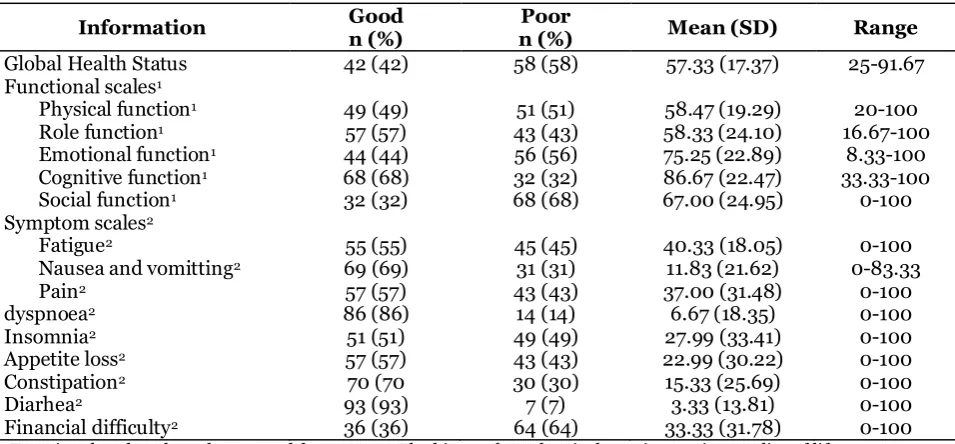
Table 2. Description of quality of life value based on EORTC QLQ-C30
Information Good n (%) n (%) Poor Mean (SD) Range
1 Functional scales, the value ranged from 0-100. The bigger the value, it shows increasing quality of life
2 Symptom scales and the impact of the problem, the value ranged from 0-100.The bigger the value, it shows increasing symptoms, therefore the quality of life was worsening
Table 3. Distribution of quality of life value based on EORTC QLQ-CX24
Information Good n (%) n (%) Poor Mean (SD) Range
1 Functional scales, the value ranged from 0-100. The bigger the value, shows increasing quality of life
On global health status and functional status, the bigger the value means the increasing quality of life, whereas on symptoms scale and 6 items of single scale of disease impact, the bigger the value means the quality of life was worsening.
Table 2 showed that the domain of functional scales of cervical cancer patients such as physical function, emotional func-tion, and social function were decreasing after obtaining chemotherapy treatment. Financial difficulty was increasing along with gradually implemented chemotherapy treatment. Table 3 showed that the decreasing sexual function, sexual activity
and sexual enjoyment of cervical cancer patients were generated by the effect of the treatment. Worry was also arising because of the disease being suffered. Meanwhile, there was also an increase on symptom scale such as menopause and peripheral neuropathy.
Table 4 showed the data of bivariat analysis result that explained the effect of independent variables toward one depen-dent variable. Independepen-dent variables of the study were age, education and family income toward dependent variable that was the quality of life of cervical cancer patients who underwent chemotherapy.
Table 4. The analysis result of Pearson correlation about the effect of age and social economic status toward the quality of life of cervical cancer patients
Independent Variables p R
Age (years) <0.001 -0.46
Education <0.001 0.74
Family Income (rupiah) <0.001 0.67
Table 4 presented the analysis result of Pearson correlation test about the effect of independent variables toward dependent variable. Age was negatively affected to
quality of life (r= -0.46; p<0.001). Educa-tion (r= 0.74; p<0.001) and family income (r= 0.67; p<0.001) were positively affected to quality of life.
Table 5. The analysis result of multiple linear regression on age and
socio-economic status toward cervical cancer patients’ quality of life.
Independent Variables Regression Coefficient b
CI 95%
p Lower Limit Upper Limit
Intercept 67.61 50.25 84.97 <0.001
Age (≥45 years) -0.60 -0.94 -0.27 <0.001
Education (≥ High School) 12.41 7.10 17.72 <0.001 Family Income (≥Regional Minimum
Wage)
0.67 0.46 0.88 <0.001
N observation = 100 AdjustedR2= 70.9%
p<0.001
Table 5 presented the result of multivariate analysis between independent variables toward dependent variable. The result of analysis showed there was an effect that was statistically significant between age toward the quality of life, after controlling the effect of education and family income. Each year of increasing age decreased the
quality of life by 0.60 (b0.60; 95% CI =-0.94 to -0.27; p<0.001).
The result of analysis showed there was an effect that was statistically signi-ficant between education toward the quality of life, after controlling the effect of age and family income. High level of education
of life by 12.41 compared to low level of education (<High School) (b=12.41; 95% CI= 7.10 to 17.72; p<0.001).
The result of analysis showed there was an effect that was statistically signi-ficant between family income toward the quality of life, after controlling the effect of age and education. High family income
(≥Regional Minimum Wages) would increase the quality of life by 0.67 compa-red to low family income (b=0.67; 95% CI= 0.46 to 0.88; p<0.001).
The value of Adjusted R2 was as much
as 70.9% meant that three independent variables (age, education, family income) were able to explain the quality of life of cervical cancer patients who underwent chemotherapy by 70.9%, the rest of 29.1% was explained by other factors outside the model of the study.
DISCUSSION
1. The Effect of Age toward the Qua-lity of Life of Cervical Cancer Pati-ents who Obtained Chemotherapy
The result of the study showed that there was negative effect of age toward the quality of life of cervical cancer patients who obtained chemotherapy and statisti-cally significant. The older the patients would increase the risk for cervical cancer. It happens since the older the person the longer she is exposed to carcinogens as well as the weaker the immune system is, therefore it generates the risk for cervical cancer as well as reduce the quality of life of cervical cancer patients.
The subjects of the study ranged between 35 years old up to 60 years old, with the average age was 47 years, which belongs to productive age group and below the life expectancy age of Indonesia citizen which is currently up to 65 years. Produc-tive age is the peak of the high risk for having cervical cancer, that is able to
generate disorders toward the quality of life, physically as well as psychologically and sexual health. It is similar to what is stated by Susilawati (2013) that commonly cervical cancer patients are found at the age of above 40, in which it is the vulnerable age toward health problems since degene-rative process.
Most of the patients of cervical cancer in the study had poor quality of life because of the age factor, in which most of them were above 45 years old and also were affected by the effect of gradual chemo-therapy treatment. There are several domains of quality of life that endure disorders such as on physical function, in which the older the person it affects physical activities since the strength loss of body muscle mass. It is in accordance with the study conducted by Einstein et al, (2011) that states 20% out of cervical cancer patients endure sexual function disorder including vaginal dryness, the fear to have sexual intercourse as the result of cancer.
2.The Effect of Education toward the Quality of Life of Cervical Cancer Patients who Obtained Chemo-therapy
The high rate of cervical cancer cases in Indonesia is generated by the low coverage of preventive screening. It is affected by several factors such as Indo-nesian women are often reluctant to have their health checked because of ignorance, shame, fear and cost factor. It commonly
happens since the low level of people’s edu -cation and knowledge (Susilawati, 2013).
The result of the study conducted by Pradono dan Sulistyowati (2013), states that health status has positive and signi-ficant correlation with knowledge (51.6%), healthy lifestyle behavior 48.2%) and level of education (47.1%). The duration of edu-cation may develop the effective life capacity which in the end will influence one’s health, including working part time, able to run jobs well, improve economic welfare, able to self control, bigger social support, and healthy lifestyle.
Level of education also affect indi-vidual capability in controlling her life in which she will be motivated to maintain her health better with positive attitude by doing regular medical check up.
3.Effect of Family Income toward the Quality of life of Cervical Cancer Patients who obtained Chemo-therapy
The result of the study showed positive effect of family income toward the quality of life of cervical cancer patients who underwent chemotherapy and statistically significant. Most of the cervical cancer
patients’ family income in this study was
above regional minimum wages of Sura-karta City. The average cervical cancer patients came from middle lower class, whose treatment cost was covered by BPJS Healthcare Security from government. Most of the cervical cancer patients were not able to work and depended on either
husband’s or children’s income.
Although being covered by BPJS Healthcare Security however the families were still facing financial difficulties, in which it took big amount of money for the operating cost during gradual and conti-nuous medical examinations also chemo-therapy treatment. It is in accordance with a study conducted by Wan et al., (2008), that financial difficulties are increasing significantly since after the patients were discharged from the hospitals, they will notice the amount of cost expensed during chemotherapy. The result of the study is similar with the previous study conducted in China, where almost all quality of life domains are decreasing significantly after chemotherapy.
The socio economic condition in general is related to various health pro-blems being faced. In middle upper class the exposure of cancer will be bigger than middle lower class (Oemiati et al, 2011). Some of cervical cancer patients come during advanced stage and need rapid medical procedure that family do not have much choice and time in deciding what to do to the sick family members. In addition to the understanding toward the disease, treatment cost also becomes one special concern for cancer patients, thus will affect the quality of life of cancer patients (Prastiwi, 2012).
Cancer is the world’s primary cause of death with a relatively heavy economic burden. The big impact toward the cost is seen from the primary treatment cost (including home care), outpatient care at the hospital, and inpatient care at the hospital such as medicines, oncologist care, radiation therapy, imaging diagnosis, and laboratory investigation Kovacevia et al., (2015).
is affected by age ≤ 45 years (b=-0.60; 95% CI= -0.94 to -0.27; p<0.001); high level of education ≥ High School (b=12.41; 95% CI= 7.10 to 17.72; p<0.001); and high family income ≥Regional Minimum Wages (b= 0.67; 95% CI= 0.46s to 0.88; p<0.001).
FERERENCE
Aaronson NK, Ahmedzai S, Bergman B, Bullinger M, Cull A, Duez NJ, Filiberti A, Flechtner H, Fleishman SB, de Haes JCJM, Kaasa S, Klee MC, Osoba D, Razavi D, Rofe PB, Schraub S, Sneeuw KCA, Sullivan M, Takeda F (1993). The European Organisation for Research and Treatment of Cancer QLQ-C30: A Quality of Life Instru-ment for use in International Clinical Trial in oncology. Journal of the National Cancer Institute. 85: 365-375.
Arum SP (2015). Kanker Serviks– Panduan Bagi Wanita Untuk Mengenal, Men-cegah Dan Mengobati. Yogyakarta: Notebook.
Costanza R, Fisher B, Ali S, Beer C, Bond L, Boumans R, Danigelis NL, Dickinson J, Elliott C, Farley J, Gayer DE, Glenn LM, Hudspeth T, Mahoney D, McCahill L, Mclntosh B, Reed B, Rizvi SAT, Rizzo DM, Simpatico T, Snapp R (2007). Quality of Life: An approach Integrating Opportunitis, Human Needs, and Subjective well-being. Sciencedirect. Ecological Economics, 267-276.
Einstein MH, Joanne KR, Richard JC, Jacquelyn MS, James PH, Joseph PC (2011). Quality of life in cervical cancer survivors: Patient and provider perspectives on common complica-tions of cervical cancer and treatment. Gynecologic Oncology.125(1): 163-7. Fayers PM, Aaronson NK, Bjordal K,
Groenvold M, Curran D, Bottomley A
(2001). The EORTC QLQ-C30 Scoring Manual (3rd Edition). European Organisation for Research and Treat-ment of Cancer. Brussels.
Fitriana NA, Ambarini TK (2012). Kualitas Hidup Pada Penderita Kanker Serviks Yang Menjalani Pengobatan Radio-terapi. Jurnal Psikologi Klinis dan Kesehatan Mental 123. 1(02).
Globocan (2012). Estimated Cancer Inci-dence, Mortality and Prevalence Worldwide. International Agency for Research on Cancer (IARC). WHO. Kementrian Kesehatan RI (2013). Riset
Kesehatan Dasar Tahun 2013. Jakarta.
_____ (2015). Situasi Penyakit Kanker. Buletin Jendela Data dan Informasi Kesehatan, 1: 1-11. ISSN 2088-270X. Jakarta: Pusat Data dan Informasi Kementrian Kesehatan RI.
Kovaceia A, Dragojevic SV, Rancic N, Jurisevic M, Gutzwiller FS, Matter WK, Jakovljevic M (2015). End-of-Life Cost of Medical Care for Advan-ced Stage Cancer Patient. US National Library of Medicine National Institute of Health. 72 (4): 334-41.
Kusumaningrum T, Pradanie R, Yunitasari E, Kinanti S (2016). The Role of Family and Quality of Life in Patients with Cervical Cancer. Jurnal Ners. 11 (1): 112-117.
Murti B (2013). Desain dan Ukuran Sampel untuk Penelitian Kuantitatif dan Kua-litatif di Bidang Kesehatan. Yogya-karta: Gadjah Mada University Press. Norwitz E, Schorge J (2011). At a Glance
Obstetri dan Ginokologi. Jakarta. Er-langga. Medical Series.
Perwitasari DA (2009). Pengukuran kuali-tas hidup pasien kanker sebelum dan sesudah kemoterapi dengan EORTC QLQ-C30 di RSUP Dr. Sardjito Yog-yakarta. Majalah Farmasi Indonesia. 20(2), 68 – 72.
Perwitasari DA, Atthobari J, Dwiprahasto I, Hakimi M, Gelderblom H, Putter H, Nortier JW, Guchelaar HJ, Kaptein AA (2011). Translation and validation of EORTC QLQ-C30 into Indonesian version for cancer patients in Indo-nesia. Jpn J Clin Oncol, 41(4): 519-29. Pradono J, Sulistyowati N (2013). Hubung-an Hubung-antara Tingkat PendidikHubung-an, Penge-tahuan tentang Kesehatan Lingkung-an, Perilaku Hidup Sehat dengan Status Kesehatan. Jakarta: Pusat Tek-nologi Intervensi Kesehatan Masya-rakat, Badan Litbang Kemenkes RI.
Prastiwi TF (2012). Kualitas hidup pende-rita kanker. Journal Unnes. Univer-sitas Negeri Semarang.
Siegel RL, Miller KD, Jemal A (2016). Cancer statistics 2016. CA: A Cancer Journal Clinicians. 66(1): 7–30
Susilawati D. (2013). Relationship between family support and anxiety level on palliative cervix cancer patients in RSUP Dr Sardjito Yogyakarta. Jurnal Keperawatan. ISSN 2086-3071. 4(2). Wan C, Meng Q, Yang Z, Tu X, Feng C,