i
AN UNDERGRADUATE THESIS
IMPROVING THE STUDENTS’ READING COMPREHENSION BY USING IT SAYS – I SAY AND SO STRATEGY
AMONG THE ELEVENTH GRADERS AT MA WALI SONGO CENTRAL LAMPUNG
By : KHOIRUNISA
Student Number : 1501070182
Tarbiyah and Teachers Training Faculty English Education Department
STATE INSTITUTE FOR ISLAMIC STUDIES OF METRO
1441 H / 2020 M
ii
IMPROVING THE STUDENTS’ READING COMPREHENSION BY USING IT SAYS – I SAY AND SO STRATEGY
AMONG THE ELEVENTH GRADERS AT MA WALI SONGO CENTRAL LAMPUNG
Presented as a Partial Fulfillment of the Requirements for the Degree of Sarjana Pendidikan (S.Pd)
in English Education Department
By: KHOIRUNISA
Student Number : 1501070182
Tarbiyah and Teacher Training Faculty English Education Department
Sponsor : Dr.Umi Yawisah, M.Hum Co-Sponsor : Syahreni Siregar, M.Hum
STATE INSTITUTE FOR ISLAMIC STUDIES OF METRO
1441 H / 2020 M
vii
IMPROVING THE STUDENTS’ READING COMPREHENSION BY USING IT SAYS – I SAY AND SO STRATEGY
AMONG THE ELEVENTH GRADERS AT MA WALI SONGO CENTRAL LAMPUNG
ABSTRACT By: KHOIRUNISA
The purposes of this research are to show that using It Says –I Say
and So strategy can improve the students’ reading comprehension ability
and students’ learning activities at the eleventh grade of MA Wali Songo Central Lampung.The writer had outlined the problem in this research that focused on reading comprehension abilities. It is related on the problem identification that the students have low motivation to learn English especially in reading, they get the difficulties to comprehend the main idea and information from the text, and they are also not interested about the learning method in the class. They always feel bored in reading subject.
The kind of this research is classroom action research (CAR) which was conducted in two cycles. Each cycle consist of planing, acting, observing and reflecting. Object of this research is the students’ reading comprehension ability. In collecting the data, the writer used test, observation and documentation. This research was conducted which an English teacher of MA Wali Songo that was Mr. Komari, S.S.
Finally, the data confirmed that pre-test just 16% students that can fulfill Minimum Mastery Criteria (MMC) and the average score of the pre-test was 53. it can say that the result of pre-pre-test was unsatisfactory. And, in post-test I there are 48% students that can fulfill MMC and the average score of the post-test I was 65. Then, the resultin post-test II was 88% students that can fulfil MMC with the average score was 73. It means that the use of It Says – I Say andSo strategy in reading can improve the student’s reading comprehensionsat the eleventh grade ofMA Wali Songo Central Lampung.
Keywords: Reading Comprehension, It Says – I Say and So Strategy,
viii
PENINGKATAN KEMAMPUAN PEMAHAMAN MEMBACA DENGAN MENGGUNAKAN STRATEGI IT SAYS – I SAY AND SO
PADA SISWA KELAS SEBELAS MA WALI SONGO LAMPUNG TENGAH
ABSTRAK
OLEH: KHOIRUNISA
Tujuan dari penelitian ini adalah untuk menunjukkan bahwa penggunaan It Says – I Say and So strategy dapat meningkatkan kemampuan pemahaman membaca dan aktifitas pembelajaran pada siswa kelas sebelas MA Wali Songo Lampung Tengah. Permasalahan yang diangkat oleh penulis dalam penelitian ini berkaitan dengan kemampuan pemahaman membaca. Hal ini berdasarkan pada identifikasi masalah yang menjelaskan bahwa siswa mempunyai motivasi rendah untuk belajar bahasa Inggris khususnya materi pemahaman membaca, mereka mengalami kesulitan dalam memahami topik utama dan informasi pada teks, dan mereka pula tidak tertarik terhadap metode yang digunakan di kelas. Merekaselalu bosanpada saat materi membaca bahasa Inggris.
Bentuk dalam penelitian ini adalah penelitian tindak kelas (PTK) yang dilakukan dalam dua siklus. Setiap siklus terdiri dari perencanaan, tindakan, pengamatan dan refleksi. Objek dari penelitian ini adalah kemampuan pemahaman siswa. Dalam pengumpulan data, penulis menggunakan test, observasi, dokumentasi dan catatan lapangan. Penelitian ini dilaksanakan dengan guru mata pelajaran bahasa inggris kelas sebelas MA Wali Songo yaitu bapak Komari, S.S.
Akhirnya, setelahdata diteliti dapat disimpulkan bahwa hasil pre-test hanya 16% siswa yang dapat memenuhi Kriteria Ketuntasan Minimum (KKM) dengan rata-rata 53. Hal ini dapat dikatakan bahwa hasil pre-test tidak memuaskan. Dan hasil post-test I adalah48% siswa yang dapat memenuhiKKM dengan rata-rata 65. Kemudian, hasil post-test II adalah 88% siswa yang dapat memenuhi KKM dengan rata-rata 73. Hal ini dapat disimpulkan bahwa penggunaan strategi It Says – I Say and So dalam membaca dapat meningkatkan kemampuan pemahaman siswa pada kelas XI MA Wali Songo Lampung Tengah.
Kata Kunci : KemampuanPemahaman Membaca Siswa, Strategi It Says – I
xi
MOTTO
َقَلَخ يِذَّلا َكِّبَر ِمْساِب ْأَرْقا
“Read in the name of your Lord Who created”
xii
DEDICATION PAGE
This undergraduate thesis is dedicated to:
Allah SWT, The Almigthy God for my talents and many perfect things having been blessed. Allah who always accompany my action anywhere.
My dearly loved father (Junaidi), mother (Sholeha), brother (Arfan Nur Hajid Jupri), second brother (M. Dedi Wiyahya). Thanks for always pray, motivation, support, love and care. My Sponsor and Co-sponsor, thanks for guiding. My beloved Almamater of State Institute for Islamic Studies of Metro.
xiii
ACKNOWLEDGEMENT
Thanks to Allah SWT who has given the researcher mercies and blessing so that the researcher can complete this undergarduate thesis under the title “Improving The Students’ Reading Comprehension By Using It Says – I Say And
So Strategy Among The Eleventh Grade At Ma Wali Songo Central Lampung”.
Sholawat and salam may always be given to our prophet Muhammad SAW who has guide us from the darkness to the brightness.
Furthermore, this research could not be succesful without support, guidence, advice, help, and ancouragement. Regarding to the undergraduate thesis, the researcher offers big thanks for:
1. Dr. Hj. Akla, M.Pd, as the dean of Tarbiyah and Teacher Training Faculty of State Institute for Islamic Studies of Metro.
2. Ahmad Subhan Roza, M.Pd, as the head of English Education Department. 3. Dr. Umi Yawisah, M.Hum, as the sponsor who has given the researcher
advice and suggestion for this undergraduate thesis.
4. Syahreni Siregar, M.Hum, who has given the knowledge to complete this undergrduate thesis.
5. All of the lecturer in English education department, who always give knowledge and information.All of the staff in English education department, who helped the researcher in processing of administration. 6. All of the teacher of MA Wali Songo who has given the researcher
xv
TABLE OF CONTENTS
COVER ... i
TITLE PAGE ... ii
APROVAL PAGE ... iii
NOTIFICATION LETTER ... iv
NOTA DINAS ... v
RATIFICATION LETTER... vi
ABSTRACT ... vii
ABSTRAK ... viii
STATEMENT OF RESEARCH ORIGINALITY ... ix
ORISINALITAS PENELITIAN ... x
MOTTO ... xi
DEDICATION PAGE ... xii
ACKNOWLEDGEMENT ... xiii
TABLE OF CONTENTS ... xv
LIST OF TABLES ... xviii
LISt OF FIGURES ... xix
LIST OF APPENDICES... xx
CHAPTER I INTRODUCTION ... 1
A. Background of the Study ... 1
B. Problem Identification ... 5
C. Problem Limitation... 6
D. Problem Formulation ... 6
E. Objectives and Benefits of the Study ... 6
F. Prior Research ... 8
CHAPTER II LITERATURE REVIEW ... 11
A. Concept of Reading ... 11
xvi
2. Types of Reading ... 12
3. Definition of Comprehension... 13
4. Definition of Reading Comprehension ... 14
5. The Assessment of Reading Comprehension ... 15
B. Concept of “It Says- I Say and So” Strategy ... 16
1. Definition of “It Says – I Say and So” Strategy ... 16
2. The Benefit of “It Says I Say and So” strategy ... 17
3. The Implementation of It Says I Say and So strategy in Teaching Reading Comprehension ... 18
4. The Example of “It Says I Say and So” activity sheet ... 19
C. Action Hypothesis ... 20
CHAPTER III RESEARCH METHOD ... 21
A. Variables and Operational Definition of Variables ... 21
B. The Research Setting ... 23
C. The Subject of the Research... 24
D. The Classroom Action Research ... 24
E. The Data Collecting Technique ... 33
F. Research Instrument ... 35
G. Data Analysis Technique ... 36
H. The Indicator of Success ... 37
CHAPTER IVRESULT OF THE RESEARCH ANDINTERPRETATION ... 38
A. Result Of The Research ... 38
1. Description of Research Location ... 38
2. Description of the Research ... 43
B. Interpretation ... 70
1. Result of Students Learning ... 70
2. Comparison of Score in Pre-Test, Post-Test I in cycle I, and Post-Test II in Cycle II ... 72
xvii
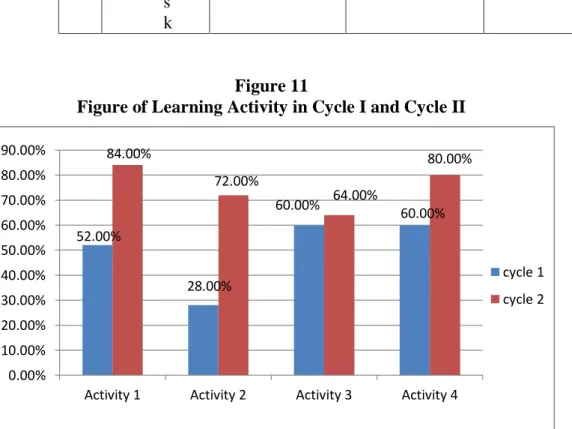
3. The Result of Students’ Learning Activities in Cycle I and
Cycle II ... 75
C.
Discussion ... 78CHAPTER VCONCLUSION AND SUGGESTION ... 80
A. Conclusion ... 80
B. Suggestion ... 81
xviii
LIST OF TABLES
Table 1. The Result of Pre Survey of Reading Comprehension Ability ... 2
Table 2. The Categorization of the Reading Comprehension Scores ... 3
Table 3. The Number of Students ... 24
Table 4. The Students Pre-test Score... 44
Table 5. The Frequency of Students Score ( Pre-test ) ... 44
Table 6. The Students Post – Test 1 Score ... 50
Table 7. The Frequency of Students Score ( Post – test I ) ... 51
Table 8. The Students Learning Activities Observation ( Cycle I ) ... 53
Table 9. The Frequency of Students Activities ( Cycle I ) ... 54
Tabe 10. The Comparison of Students Pre-test and Post-test I ( Cycle I).... 56
Table 11. The Students Post-Test II Score ... 63
Table 12. The Frequency of Students Score ( Post-test II ) ... 64
Table 13. The Students Activity Result ( Cycle II ) ... 65
Table 14. The Frequency of Students Activity ( Cycle II) ... 66
Table 15. The Comparison Between Post-test I and Post-test II Score... ... 67
Table 16. The Comparison of Reading Comprehension of Pre-test, Post-test I ( Cycle I ) and Post-Post-test II ( Cycle II) ... 72
Table 17. The Comparison of Students’ Pre-Test, Post-Test I Score (Cycle I) and Post-Test II Score (Cycle II)... ... 73
xix
LIST OF FIGURES
Figure 1. Teachers Educational Background in MA Wali Songo.. ... 39 Figure 2. The Quantity of MA Wali Songo Central Lampung... . 41 Figure 3. The Percentage of the Students Completeness Score (Pre-test).. 45 Figure 4. The Percentage of the Students Completeness Score (Post-test
I) ... 52 Figure 5. The Percentage of Students Activities (Cycle I) ... 55 Figure 6. The Comparison of Students Frequency Pre-test and Post-test I 56 Figure 7. The Frequency of Students Score (Post-test II) ... 64 Figure 8. The Percentage of Students Learning Activity (Cycle II) ... 66 Figure 9. The Comparison of Students Frequency test I and
Post-test II.. ... 69 Figure 10. The Comparison Score Pre-test, test I (Cycle I) and
Post-test II (Cycle II) ... 74 Figure 11. Learning Activity Cycle I and Cycle II ... 76
1 CHAPTER I INTRODUCTION
A. Background of the Study
Education is any act or experience that has a formative effect on the mind, character or physical ability of an individual. In its technical sense, education is the process by which society deliberately transmits its accumulated knowledge, skills and values from one generation to another.
Teaching learning students in the Senior High School about the foreign language is not really easy, because it is unfamiliar language for them, in this case English language. English is one of the subject that has been taught from elementary school up to university. The aim of teaching English is to equip the students with some English knowledge, in order that, they can develop and add their knowledge through reading text book written in English.
Considering that English is very important, there are four skills the students master, they are listening, speaking, writing, and reading. Although reading skill is given the first priority. Those skills are further divided into two categories. Listening and speaking as oral skills, while reading and writing as written skills. They can also be categorized into reading and listening as receptive skills while writing and speaking as productive skills.
Reading is the basic communicative skill, but it has a very complex process. It can be said that reading is a process in which reader finds
2
information given by the writer the written form. In this case, reading can be said as an interactive question about what the text about.
Related to the statements above, the researcher did pre – survey that is done on july 16, 2019 at the MA Wali Songo central lampung, the researcher faced some problems in teaching learning English. One of them is the students’ problem in reading comprehension. Researcher give the students test form multiple choice about reading comprehension to know the score from the students and based on the result interview of the English teacher at the MA Wali Songo central lampung, he said that the mean score of the students’ achievement in reading comprehension is very low. It is 4.97 mean score while the target score is 70.
It Says - I Say and So is a teaching-learning strategy which helps
teacher relates their teaching materials to be presented which by pupils’ real learning, so it can improve the comprehension of the subject matter. It Says -
I Say and So strategy is a strategy represents one part of elaborated strategy.
This strategy was used to assist students remember what they read, and help teaching-learning process in the classroom .
Table I
The Data of Pre-Survey Result of Reading Comprehension Ability among the Eleventh Graders at MA Wali Songo Central Lampung
No Students’ Name Grade Criteria 1 A F 15 Incomplete 2 A P L 30 Incomplete 3 A W 45 Incomplete 4 A Y S 50 Incomplete 5 AW S 60 Incomplete 6 B J P 45 Incomplete
3 7 C M 35 Incomplete 8 D R 45 Incomplete 9 D R P 20 Incomplete 10 D F S 5 Incomplete 11 E B 45 Incomplete 12 F H 35 Incomplete 13 F W 40 Incomplete 14 F F 60 Incomplete 15 H N 75 Complete 16 I S 50 Incomplete 17 L H 55 Incomplete 18 L N 40 Incomplete 19 N H 35 Incomplete 20 N K F 20 Incomplete 21 N A 45 Incomplete 22 N T E 65 Incomplete 23 R A K 20 Incomplete 24 R N H 20 Incomplete 25 R A 45 Incomplete
Source : based on the pre-survey, july 16, 2019.
The results of reading comprehension test among the eleventh grade students at MA Wali Songo central lampung are illustrated based on the eleventh grade students Minimum Mastery Criteria (MMC) is 70. The categorization results are presented in the following table:
Table 2
The Categorization of the Reading Comprehension Scores Among the Eleventh Grade students at MA Wali Songo
No Grade Frequency Percentage Criteria
1 ≥ 60 1 4% Complete
2 < 60 24 96% Incomplete
Based on the table above, it can be seen that most of the students cannot achieve the Minimum Mastery Criteria (MMC), that is 70. That is because the number of students who are able to achieve the MMC is 1 student (4%). While the number of students who are unable to reach the MMC is 24
4
students (96%). Therefore, it is concluded that the students of class XI MA Wali Songo who have unsatisfactory or low reading abilities.
Based on the results of Pre - survey, the problems faced by the eleventh grade at MA Wali Songo central lampung in reading English are due to the limited English words they had, they have limitations in English grammar, and low motivation in reading, they also have difficulty in determining the main ideas and supporting ideas during the process of reading English. It can be said they have that difficulties in understanding the contents of the the text.
In line with reading problems gotby students of class XI MA Wali Songo central lampung, it needs for an effort to improve students' reading comprehension, that is through the application of appropriate teaching strategies. It Says - I Say and So strategy is one of the right strategies used to improve students' reading comprehension. It Says - I Say and So is an inferencing strategy. This graphic organizer is used to teach the skill of making inferences. The teacher must model and revise it often, so providing students with sample opportunities for practice.
Furthermore, It Says - I Say and So strategy will support students in developing skills to know what they already know. This strategy is effective with all content areas. It Says - I Say and So is a visual scaffold to teach the skill of making inferences. As always, the teacher must model and revise it often, so providing students with sample opportunities for practice. Beginning
5
with providing a question with students about the text that requires some inferential thingking.
It Says - I Say and So stategy has tremendous benefits in the process
of teaching reading. This strategy helps students to understand and to create meaning that draws a conclusion from the text. This strategy also helps students in organizing their thoughts, existing knowledge and prior knowledge to make conclusions.
Based on the illustration above, the researcher will try to improve the reading comprehension of class XI students of MA Wali Songo. Improving the reading comprehension of students will be carried out by researcher with the application of It Says - I Say and So strategies through a classroom action research. In this case, the researcher formulated a research proposal entitled: "IMPROVING THE STUDENTS’ READING COMPREHENSION BY USING IT SAYS - I SAY AND SO STRATEGY AMONG THE ELEVENTH GRADERS AT MA WALISONGO CENTRAL LAMPUNG ".
B. Problem Identification
Based on the results of the pre-survey conducted at MA Wali Songo, the researcher has identified several research problems in the background study as follows:
1. Students have limitations in mastering English vocabulary. 2. Students have low English grammar mastery.
3. Students have difficulty in determining the main ideas and supporting ideas.
6
4. Students have low reading motivation.
5. Students have unsatisfied reading comprehension.
C. Problem Limitation
Based on a number of problems that have been identified, the researcher limits the problem by focusing on the problem of number 5 that is the unsatisfied reading comprehension.
D. Problem Formulation
Based on the problems that had been limited, the researcher formulated the research problem as follows:
1. Can It Says – I Say and So strategy improve the students reading comprehension among the eleventh graders at MA Wali Songo central lampung?
2. Can It Says – I Say and So strategy improve the students’ learning activity among the eleventh graders at MA Wali Songo central lampung? E. Objectives and Benefits of the Study
1. Objective of the Study
Based on the problem formulation above, the objectives of this research are as follow :
a. To improve reading comprehension by using It Says – I Say and So strategy among the eleventh graders at MA Wali Songo central lampung.
7
b. To improve the students’ learning activity by using It Says – I Say
and So strategy among the eleventh grade at MA Wali Songo central
lampung. 2. Benefit of the Study
This research can be useful for researcher following students, teachers, and researcher.
a. For the Student
This research is expected that students can improve their reading comprehension through the strategy. From this study students can read well from the conclusions that have been made. Through the use of It
Says - I Say and So strategy students will be actively involved in reading
because this strategy has steps that will motivate students to read a text. b. For the Teacher
As a information to English teach if It Says – I Say and So strategy can be effectiveness to improve students reading comprehension.
c. For the Next Researcher
This research is expected to be one of the references and references for future researcher who will seek to improve reading comprehension through the application of It Says - I Say and So Strategy. From this study, the next researcher can get a detailed description of It Says -ISay
8 F. Prior Research
This research will be conducted by considering several previous studies that used It Says - I Say and So strategy in reading lessons.
The first prior research is conducted by SY. Oktiya Sari with the research title The Effect of Using It Says - I Say and SoStrategy Towards the
Reading Comprehension of Second Year Students at State Senior High School 1 Kampar Timur Kampar Regency. The teaching strategy used in the first
prior research is It Says - I Say and So strategy. The research method used in the first prior research is quasi-experiment. The sample from the first prior research is two classes as sample XI IPA 3 which consists of 35 students as the experimental class, and XI IPA 2 which consists of 35 students as the control class. So the number of samples from the two classes is 70 students. The results of the first prior research are to determine the level of understanding of students taught using this strategy.1
This research and the first prior research have similarities and differences. The similarity between the first prior research and this research lies in the teaching strategy. This research and the first prior research applied the teaching strategy of It Says - I Say and So. Whereas the difference between this research and the first prior research lies in the differences in the study sample and the research method. The method of this research is classroom action reasearch while the first prior method is research quasi-Experiment research method.
1SY.Oktiya Sari.” The Effect of Using It Says - I Say and SoStrategy Towards the Reading
Comprehension of Second Year Students at State Senior High School 1 Kampar Timur Kampar Regency.”
9
The second prior Research is carried out by Muhammad Iqbal with the research title The Effect of It I Say and So Strategy Towards Students Reading
Comprehension A Study at Eighth Grade Students of Panti 2 Public Middle School, Pasaman. The teaching strategy used in the second prior reasearch is It Says - I Say and So strategy. The research method used in the second prior
reasearch is the experimental method, using two qualifications, namely the experimental class and the control class. The results of the second prior research prove that the It Says - I Say and So Strategy can be more effectively applied in teaching reading so that this strategy can build students' interest in the teaching and learning process.2
This research and the second prior research have similarities and differences. The equation between the second prior research and this research lies in teaching strategy. This study and the second prior research applied the teaching strategy of It Says - I Say and So. Whereas the difference between this research and the second prior research lies in the method, the research method is classroom action reasearch while the second prior method researches the experimental method using two qualifications namely the experimental class and the control class.
The third research is conducted by Sulung Susanti with the title of research Improving The Eighth Grade Students Narrative Reading
Comprehension By Using It Says - I Say and SoStrategy At SMP Nurul Iman Palembang. The teaching strategy used in the third prior reasearch is It Says -
2Muhammad Iqbal,” The Effect of It I Say and So Strategy Towards Students
ReadingComprehension A Study at Eighth Grade Students of Panti 2 Public Middle School, Pasaman.”
10
I Says And So strategy. The research methods used in the third prior research
are quasi-experimental. The results of the third prior research prove that the achievement of the students who have taught improvement in their grades of achievement is who are taught by using it. It can be seen from the students' pretest to posttest scores that.3
This research and the third prior research have similarities and differences. The equation between the third prior reasearch and this study lies in the teaching strategy. This research and the third prior researches applied the teaching strategy of It Says - I Say and So. While the difference between this research and the third prior researches lies in the differences in research methods. This research method is classrom action research while the method used in the third prior researches is a quasi-experimental research method.
Based on all the contents of prior research, it is known that It Says – I
Say and So strategy is a very effective teaching strategy to build students'
interest in the teaching and learning process, understanding strategy in reading lessons with their advantages and disadvantages. Therefore, researcher in this case will conduct classroom action research by considering several previous studies with the aim of improving reading comprehension of eleventh grade students of MA Wali Songo central lampung.
3Sulung Susanti,” Improving The Eighth Grade Students Narrative Reading
11
CHAPTER II LITERATURE REVIEW
A. Concept of Reading 1. Definition of Reading
In learning English there are four skills that must be mastered by students, namely listening, speaking, writing and reading. All skills are very important for learning English directly. In this study the research focuses on reading because in reality teaching students have difficulty in reading English skills.
Karen Tankersley defines reading is a complex process made up of several interlocking skills and processes.4 It can be said that reading is one of basic skills that have a positive effect, because in reading the students not only get the information of the text but also increasing their vocabulary knowledge on their spelling and on their writing through reading.
In addition, reading is an active process which consists of recognition and recognition and comprehension skill. Reading is an important activity in life with which one can update his/ her knowledge.5 It means that reading is a process to know a science because by reading
4
Karen Tankersley, Threads of Reading Strategies For Literacy Development(Virginia: Association for Supervision and Curriculum Development Alexandra, 2003), 2.
5
M.F. Patel. Praveen M. Jain, English Language Teaching Methods, Tools and
12
people can find various information both from national and international news.
Then, Mark Sadoski defines reading is a way to deal with everyday problem where printed language is a feasible or requisite solution.6
Based on the theory above, it is concluded that reading is a process to find meaning in a text. When people reads, they have tried to understand the text and to find out the main idea or can find information in a text.
2. Types of Reading 1) Intensive Reading
Intensive reading is text reading or passage reading. In this reading the learner read the text to get knowledge or analysis. The goal of this reading is to read shorter text. This reading is done to carry out to get specific information. Learner reads book to acquire knowledge is the kind of intensive reading.7
2) Extensive Reading
Extensive reading is the reading for pleasure. The reader wants to know about something. The reader does not care about
6
Mark Sadoski, Concpetual Foundations of Teaching Reading (New York:The Guilfords Press, 2004), 52.
7
M.F. Patel and Praveen M. Jain, English Language TeachingMethods,
13
specific or important information after reading. Usually people read for to keep them update8.
3) Aloud Reading
Reading aloud also play important role in teaching of English. Teacher should know that the training of reading aloud must be given at primary level because it is the base of words pronunciation. If it is not cared, it will be vary difficult at secondary level9.
4) Silent Reading
Silent reading is a very important skill in teaching of English. This reading should be employed to increase reading comprehension among learners. Silent reading is done to acquire a lot of information. Teacher has to make them read silently as and when they are able to read without any difficulties. It is kind of habit in which learner are enabled to read without any audible whisper.10
3. Definition of Comprehension
Comprehension is not always effortless and fast, of course. When beginning readers struggle over individual words, reading is slowed to a near halt and deeper levels of comprehension are seriously compromised.11
8 Ibid., 120 9 Ibid., 120 10 Ibid, 122 11
Danielle S. McNamara, Reading Comprehension Strategies Theories, Interventions and
14
Therefore, comprehension of the someone's in reading is not the same, because each individual has a difference in understanding a word.
Moreover, comprehension is a process, not a product. Readers filter understanding through the lens of their motivation, knowledge, cognitive abilities, and experiences.12 Therefore, comprehension is a stage to reach a knowledge, and understanding through the existence of an experience.
Comprehension is “putting it all together” to understand what has been read so that students become activereaders as they learn to use specific comprehension strategies before,during, and after reading.13
Based on the theory above, it is concluded that comprehension is the ability to understand a meaning in a text. 4. Definition of Reading Comprehension
Reading comprehension is the process of making meaning from text. The goal, therefore is to gain an overall understanding of what is described in the text rather than to obtain meaning from isolated words or sentences.14 It means that reading comprehension skills become more important as children progress through the educational system.
Reading comprehension is a multicomponent, highly complex process that involves many interactions between readers and what
12
Karen Tankersley, Literacy Strategies for Grades 4-12 Reinforcing the Threads of
Reading, (Virginia:Association for Supervision and Curriculum Development Alexandria,2005),
108.
13
Karen Breitbart, Reading for Every Child Comprehension, ( Michigan:Frank Schaffer Publications, 2005), 4.
14
Gary Woolley, Reading Comprehension: Assisting Children with Learning Difficulties, (Queensland:Springer, 2011), 15.
15
they bring to the text (previousknowledge, strategy use) as well as variables related to the text itself (interest in text, understanding of text types).15
5. The Assessment of Reading Comprehension
Assessment is a popular and sometimes misunderstood term in current educational practice.You might be tempted to think of testing and assessing as synonymous terms, but they are not. Tests are prepared administranivc proccedures that occur at idenrifiable times in a curriculum when learners muster all their fuculties to offer speak perfornlance, knowing that their responses are being measured and evaluated.16
According to Brown there are some criteria commonly used in indicating students’ reading comprehension, those are:17
a. Main idea (topic)
b. Expression/ idiom/phrases in context c. Inference (implied detail)
d. Grammatical features
e. Detail (scanning for a specifically stated detail) f. Excluding facts not written (unstated details) g. Supporting ideas
h. Vocabulary in context
15
Janette K. Klinger and Sharon Vaughn & Alison Boardman, Teaching Reading Compre
hension to Students with Learning Difficulties, ( New York : The Guilford Press,2007), 8.
16
H. Douglas Brown, Language Assessment Principles and Classroom Practices, (New York : Longman,2004), 4.
17
16
Based on the indicator above, the preparation process of reading comprehension test must considered completeness of the indicators of reading comprehension.
B. Concept of “It Says- I Say and So” Strategy 1. Definition of “It Says – I Say and So” Strategy
In the teaching and learning process writing in English will be easier when using strategies. In this case, It Says – I Say and So Strategy is suitable for teachers to use in the learning process in reading in the English class. Below are some insights about It Says – I Say and So strategies.
According to Kathleen Kopp, It Says - I Say and So is an inferencing strategy developed by Kylene Beers in 2003.18 It means that It
Says - I Say and So is stategy used for students in improving reading
comprehension by inferring the content or information of a text.
It Says - I Say and So strategy will support students in developing
the skills to make an inference by combining information from the text with what they already know. This strategy is effective with all content areas.19 It means that It Says - I Say and So strategy support students in making a conclusion that is developed by combining information from a text using this strategy, then this starategy will facilitate students.
It Says - I Say and So is a visual scaffold to teach the skill of
making inferences. As always, be sure to model the strategy and revisit it
18
Kathleen Kopp, Teaching Science Today 2nd Education, (Huntington Beach:Shell Education, 2015), 84.
19
Andreal Davis and Eric Andrew, Strategies for Culturally and Linguistically Responsive
17
often, thereby providing students with ample opportunities for practice.20 It means that It Says - I Say and So strategy provides many opportunities for students to practice the skills in making conclusions from a text, with students continuing to practice students will quickly understand the contents of the text.
It Says - I Say and Sois a strategy that is begun by providing
students with a question about the text that requires some inferential thinking.21 It means It Says - I Say and Sostrategy make students think to make a conclusion that can be obtained in a text easily by using the steps in this stategy.
Based on definition above, it is concludedthat It Says - I Say
and Sois a strategy that makes it easy for students to get information
in a text.
2. The Benefit of “It Says - I Say and So” strategy
1. It Says - I Say and So strategy will support students in developing the skills to make an inferences by combining information from the text what they already know. This strategy is effective with all content areas.22
2. This strategy is used to teach the skill of making inferences.23
20
Kathleen Kopp, Teaching Social Studies Today 2nd Edition, (Huntington Beach:Shell Education,2017), 59.
21
Sara Shoob and Cynthia Stout, Teaching Social Studies Today, (Huntington Beach:Shell Education, 2008), 64.
22
Andreal Davis and Eric Andrew, Strategies for Culturally and Linguistically Responsive
Teaching and Learning,(Huntington Beach:Shell Education, 2015), 215.
23
Kathleen Kopp, Teaching Science Today 2nd Education, (Huntington Beach:Shell Education, 2015), 84.
18
3. The Implementation of It Says - I Say and So strategy in Teaching Reading Comprehension Ability
The implementation of It Says - I Say and Sostrategy in teaching reading comprehension are as follow:24
The teacher models the strategy or asks a student to model it with a familiar text.
a. Model the strategy (or ask a student to model it) with a familiar text.
b. The teacher provides students with inferential questions by asking them to combine his or her prior knowledge with information in the text to make an inference.
c. The teacher gives each student a copy of the It Says... I Say... And So... activity sheet.
d. The teacher asks students to read the question.
e. The teacher invites students to look at the text and write what the text says about the question. (It Says)
f. The teacher encourages the students to write what they already know about the question. (I Say)
g. The students write their conclusions or what they can infer about the question or answer. (And So)
h. The teacher facilitates a classroom discussion about the students conclusions.
24
Andreal Davis and Eric Andrew, Strategies for Culturally and Linguistically Responsive
19
4. The Example of “It Says - I Say and So” activity sheet
The example of “It Says - I Say and So” activity sheet is as follows:25 Question It Says... I Say... and So... Read the question. Find
informati on from the text to help you answer the question. Consider what you know about the informat ion. Put the informa tion together from the text with what you know to answer the questio n. What can we infer
about the lives of volcano chasers? They travel the world studying volcanoes . They measure earth quakes. They check for They use what they find to warn people of the dangers People who are volcano chasers have a very importa nt job 25
Kathleen Kopp, Teaching Science Today 2nd Education, (Huntington Beach:Shell Education, 2015), 84.
20 dangerous gases spewing from volcanoes . in the area where they live. and they end up saving many lives. C. Action Hypothesis
Action hiphotesis of this research is outlined, as follows:
"It Says - I Say and So Strategy can improve the students’ reading comprehension and their learning activity among the eleventh graders of MA Wali Songo Central Lampung".
22 CHAPTER III RESEARCH METHOD
A. Variables and Operational Definition of Variables 1. Variables of Research
This research consists of two variables; they are independent and dependent variables. The independent variable of this research is “It Says - I Say and So” strategy that will be implemented to increase the students’ reading comprehension in easy way. This strategy is useful to help the students in the process of reading comprehension.
The dependent variable of this research is reading comprehension as an important language skill that has to be mastered by the students in order to be able to read the text effectively.
2. Operational Definition of Variable
An operational definition is the specification of how you will define and measure the variable in your study. You can find definitions in published research studies on your topic. Sometimes published studies have sections titled “Definition of Terms.” Alternatively, you might examine definitions in research summaries such as handbooks or encyclopedias.26
Based on the statement, the definition operational of the variable in this research are:
26
John W. Creswell, Educational Research: Planning, Conducting, and Evaluating
23 a. Dependent Variable
According to David Nunan, dependent variable is a written cloze test, then the default definition of 'listening comprehensions’ is 'the ability to complete written cloze passage'.27 The dependent variable of this research is students’ reading comprehension that focuses on the students’ ability.
To measure reading comprehension of students, the students will get the reading comprehension test. The students will answer twenty reading comprehension questions based on the text. It is a simple test as a sample to know about the students’ reading comprehension. The indicators of a reading test in this variable are: 1) The students are able to identify reading topic.
2) The students are able to understand the author’s purpose. 3) The students are able to identify text structure.
4) The students are able to comprehend the main idea and supporting the idea of the text.
5) The student are able to know the meaning of vocabulary provided in the text.
6) The student are able to compare text information with prior knowledge of topic.
27
David Nunan, Research Methods in Language Learning (Cambridge: Cambridge University Press, 1992),15.
24 b. The Independent Variable
The independent variable are variable (probably) cause, influence or effect outcome. They are also called treatment, independent variable of this research is It Says - I Say and Sostrategy which is defined as an intructional strategy where by teacher models the desired learning strategy or task, then gradually shifts responsibility to the students. In reading comprehension there are some indicators that indicated the students be able to comprehend a reading text as follows:
a. The student show good respond to learn reading using text structure strategy.
b. The student have more concentration in reading the text.
Moreover, based on the explanation above, in this research the researcher will use It Says - I Say and Sostrategy to conduct a treatment for the students the elevent graders of MA Wali Songo Central Lampung. In addition researcher will collect the data by using a multiple choice test.
B. The Research Setting
The researcher will conduct Classroom Action research (CAR) at MA Wali Songo Sukajadi Bumiratu Nuban. The subject of this research is the students’ at class XI IPS 3 of MA Walisongo which consists of 25
25
students. The school located at Sukajadi, Kec. Bumiratu Nuban, Kab.Central Lampung.
C. The Subject of the Research
This research is the Classroom Action Research (CAR). The subject of this action research is the students of XI IPS 3 at MA Wali Songo central lampung. The teacher chooses one of the classes that the students had a lower average score in reading comprehension. The collaborator is Mr. Komari. S.S.
Table 3
Number of students at XI IPS 3 of MA Wali Songo Central Lampung
No Sex Total
Male Female
1 7 18 25
D. The Classroom Action Research
The design of this research is classroom action research. It is called CAR because the research is aimed at developing a certain instructional technique to solve problems in a class.
According to Anne Burns, classroom action research is part of a broad movement that has been going on in education generally for some time. So, one of the main aims of classroom action research is to identify a problems situation or issue that the participants who may
26
include teachers, students, managers, administrators, or even parents consider worth looking into more deeply and systematically.28
According to Jean Mc Niff and Jack Whitehead, action research is a form of enquiry that enables practitioners everywhere toinvestigate and evaluate their work.29
Action research is different from otmeanher kinds of research, it is useful to look at the underpinning assumptions, and see how these can transform into different kinds of practices. Doing this also reveals the main features of action research.30
Meanwhile, Paul McIntosh State that action research is grounded in an eclectic mixture of philosophical thinking around transcendence, of ethical thinking around values, and of recognition that it operates in a domain of uncertainty as to how it apprehends the nature of an ‘action’.31
Moreover, Karen Goodnough states thataction research is one of the best types of professional development that can benefit teachers willing to try new methods of learning and teaching and to learn from mistakes in order to experience growth as teachers. As teachers, we often encourage our students to be risk-takers and think outside of the
27
Anne Burns, Doing Action Resaerch in English Language Teaching(New York: Routledge, 2010), 2.
28
Jean McNiff and Jack Whitehead, All You Need To Know About Action Research An
Introduction, (London : SAGE Publications, 2006), 7.
30
Ibid, 22.
31
Paul McIntosh, Action Research and Reflective Practice: Creative and Visual Methods
27
box. So, like our students, we should be willing to take risks and try new approaches to teaching if it is beneficial to our students’ growth.32
Based on the statement above, the students can say that Classroom Action Research is a reflective study done by the teacher in a classroom for getting solution about the problem until it can be solved. In addition, classroom action research helps the teacher to solve problem by applying a new method, strategy, or technique as an alternative way leading to innovation.
Classroom action research (CAR) has various models but in this research, the researcher will use O’Leary research design. O’Leary report that action research is a cyclical process that takes shape as knowledge emerges. Cycles converge towards better situation understanding and improved action implementation and are based in evaluative practice that alters between action and critical reflection.33
32
Karen Goodnough, Taking Action in Science Classrooms Through Collaborative Action
Research: A Guide For Educators (Rosterdam: Sense Publisher, 2011), 86.
33
Zina O’Leary, The Essential Guide To Doing Research, (London:Sage Publications, 2004), 140.
28 Figure 1
Adapted Zina O’Leary Model34
This figure describes the sequence of the research that is preceded by a preliminary study and followed by generally involve some variation on planning, acting, observation, and reflection. The researcher makes a plan, how to stimulate the students by the technique and based the cycle.
CAR will be applied in this research since it is regarded important to develop reading comprehension of the eleventh grader of MA Walisongo by ItSays I Say and So strategy, by applying this strategy it is expected to solve students’ problems in teaching-learning process of reading comprehension ability.
34
29
The classroom action research design applied in this research is a collaborative classroom action research. In conducting the research, the students will collaborate with the real English teacher of MA Walisongo as an observer and collaborator. The reseacher will play a role as an English teacher who teaches reading comprehension trough “It Says I Say and So” strategy to the students, while the real English teacher’s role is as an observer who observes the action of the research while teaching-learning activities happens in the classroom. Also the real English teacher acts as a collaborator when helps the students in designing lesson plan, carrying out the reflection, and determining the follow up of the study. Here, the real teacher is not only as an observer but the students also took actions by making lesson plan and giving assessment. Then, the researcher will collect and analyze data together with the teacher to know the result of their student reading comprehension result.
The steps of cycle 1 will be as follows: 1. Cycle 1
a. Planning
After interviewing, observing and conducting test before CAR. The researcher can make in planning, as follows:
1) The researcher prepares the lesson plan based on the 2013 curriculum and English syllabus.
30
3) The researcher prepares the instrument of written tests before and after CAR.
b. Acting
In this phase, the researcher acts as the teacher and the real teacher becomes the observer. The students conduct some activities in the class as follows:
1) Pre-Teaching
a) The researcher greets the students and checks the attendance list. b) The researcher gives warm up activities.
c) The researcher explains general overview related to the topics of factual report text.
d) The researcher confirms the students their comprehension about the factual report text.
2) While Teaching Activity
a) The researcher implements “It Says I Say and So” strategy. b) The researcher give students familiar text.
c) The researcher provides students with inferential questions by asking them to combine his or her prior knowledge with information in the text to make an inference.
d) The researcher gives each student a copy of the It Says... I Say... And So... activity sheet.
31
f) The researcher invites students to look at the text and write what the text says about the question. (It Says)
g) The researcher encourages the students to write what they already know about the question. (I Say)
h) The researcher write their conclusions or what they can infer about the question or answer. (And So)
i) The researcher facilitates a classroom discussion about the students conclusions.35
3) Post-Teaching
a) The researcher gives a conclusion about factual report text. b) The researcher closes the class.
a. Observing
In this phase, the students will conduct some activities as follows:
1) The real teacher observers teaching learning activity in the classroom, such as class situation, teacher’s performance, and students’ response.
2) Identifies the students’ achievement in learning reading comprehension by giving the test after CAR in cycle 1.
35
Andreal Davis and Eric Andrew, Strategies for Culturally and
32
3) The researcher calculates students’ improvement scores from test before CAR to test after CAR in cycle 1 whether improving or not. b. Reflecting
In this phase, the researcher and teacher have some activities as follows:
1) The researcher and the students discuss not only about the result of the implementation of CAR, but also students’ achievement and the media.
2) The researcher and the students prepare the lesson plan for the next cycle and for test after CAR in cycle 2 in order to know the improvement of students’ score and to solve the problem unfinished yet.
2. Cycle 2 a. Planning
After interviewing, observing and conducting test before CAR. The researcher and the students make instruments, as follows:
1) The researcher prepares the lesson plan based on the 2013 curriculum and English syllabus.
33
2) The researcher prepares the observational note and guidelines
3) The researcher prepares the instrument of written tests before and after CAR.
b. Acting
In this phase, the researcher acts as the teacher and the real teacher becomes the observer. The student conducts some activities in the class as follows:
1) Pre-Teaching Activity
a) The researcher greets the students and checks the attendance list.
b) The researcher gives warm up activities.
c) The researcher explains general overview related to the topics of factual report text.
d) The researcher confirms the students their comprehension about the factual report text.
2) While Teaching Activity
a) The researcher implements It Says - I Say and So strategy. b) The researcher give students familiar text.
c) The researcher provides students with inferential questions by asking them to combine his or her prior knowledge with information in the text to make an inference.
d) The researcher gives each student a copy of the It Says... I Say... And So... activity sheet.
34
e) The researcher asks students to read the question.
f) The researcher invites students to look at the text and write what the text says about the question. (It Says)
g) The researcher encourages the students to write what they already know about the question. (I Say)
h) The students write their conclusions or what they can infer about the question or answer. (And So)
i) The researcher facilitates a classroom discussion about the students’ conclusions.36
2) Post-Teaching
a) The researcher gives a conclusion about factual report text. b) The researcher closes the class.
c. Observing
1) The real teacher observes of teaching learning activity in the classroom, which includes class situation, teacher’s performance, and students’ response.
2) Students are given the test after CAR in cycle 2.
3) The researcher calculates students’ improvement scores from test before CAR to test after CAR in cycle 1 to test after CAR in cycle 2.
d. Reflecting
36
Andreal Davis and Eric Andrew, Strategies for Culturally and Linguistically Responsive
35
1) The students and the teacher discuss about the result of the implementation of CAR by modifying a new strategy in action, about students’ response with the media, about improvement students’ score in reading comprehension and about analyzing the result from test after CAR in cycle 1 to test after CAR in cycle 2. 2) The students and the teacher make an agreement, if the target is
not achieved, the action will be continued to cycle 3, but if the target is achieved, the action will be stopped.
E. The Data Collecting Technique
There are two type of collecting data: qualitative data and quantitative data. The researcher uses observation dealing with the qualitative data. On the other side, the students uses the students’ final result score of reading comprehension as a pre-test and post-test to obtain the quantitative data.
Some instruments are applied to obtain the data in this study. The completely explanation of those instruments as follows:
1. Test
The researcher used test to get data result of the students’ reading comprehension. The result of this test is students’ reading comprehension score based on the media applied. The aim of this test is to measure the students’ reading comprehension ability. The tests consist of the some types, as follows:
36
The pre-test will be conducted before implementing “It
Says - I Say and So” strategy in preparations study. Pre-test of this
research will be in the form of reading comprehension test that ask the students to answer the question based on the text.
b. Post-test
The post-test is implemented after using “It Says - I Say
and So” strategy in teaching reading comprehension. Post-test of
this research will be in the form of reading comprehension test that ask the students to answer the question based on the text.
2. Observation
In this case, the researcher observes the students directly in the classroom and gets the description about students’ activity in learning reading comprehension process. The real teacher also observes the researcher who teaches in the classroom and the implementation of CAR based on observation notes which already made before.
The data is taken based on the students’ participants during teaching and learning activity according to lesson plan. The information obtained from this observation is used to as a basis to determine the planning for following cycle.
3. Documentation
Documentation is the method which is used to get information from the written source or document. The researcher uses the documentation method to get some information about:
37
a. The history of MA Wali Songo Central Lampung.
b. The condition teachers and officials employes in MA Wali Songo Central Lampung.
c. The quantity of the students of MA Wali Songo Central Lampung. d. Organization structure of MA Wali Songo Central Lampung.
e. Reading comprehension worksheet, course overviews and classroom materials of the students at MA Wali Songo Central Lampung.
4. Field Note
In this research, the researcher will use field note to focus on a particular issue or teaching behavior over a period of time. Moreover, the reaseracher will take field note related to the classroom situation, classroom management, classroom interaction between teacher and students or students with students and etc.
F. Research Instrument
1. Reading Comprehension Test
To identify the students’ reading comprehension of the eleventh grade of MA Wali Songo, the students will apply reading comprehension test. The test measures the ability of the students in reading comprehension subject.
38
The test consists of pre-test and post-test that will be in the form of reading comprehension test that asks the student to answer the question based on the text.
G. Data Analysis Technique
Data analysis will be conducted by taking the average score of the pre-test, and post test.To know students achievements after the actions are conducted and given test at the early and the last cycles.In scoring the test, the students score is counted with the following formula:37 Notes: = mean Σ = sum of X = raw score N = number of cases
The formula to figure our the percentage of the students who pass the minimum mastery criteria in each cycle as follow :38
P = 𝑭𝑵× 𝟏𝟎𝟎% Notes: P = Class percentage F = Frequency N = Number of student 37
Ary Donald et all, Introduction to Research in Education (California: Wadsworth Cengange Learning 2010), 108-109.
38
Neil A Weiss, Introductory Statistics (Boston, MA: Addison Wesley, 2012), 41. N
X
X
39
Moreover, to know the result the researcher will compare between pre-test and post-test. The result will be matched by the minimum standard in this school at least 70. If from cycle 1, there are some students not successful, so the researcher will conduct cycle II.
H. The Indicator of Succes
The indicator of success was taken from the process and result of the classroom action research. Then, the researcher is called successful when there is 70% numbers of students could pass the target of the minimum mastery criteria (MMC) at the school at least 70 and 70% students can participate actively in the learning activity.
40 CHAPTER IV
RESULT OF THE RESEARCH AND INTERPRETATION
D. Result Of The Research
3. Description of Research Location
a. The History of MA Wali Songo Central Lampung
This research is conducted at MA Wali Songo which is located in Sukajadi. It was established in May, 25 1993. This school is under the shade of the Islamic Boarding School of Wali Songo, Sukajadi Subdistrict Bumi Ratu Nuban, Central Lampung. MA Wali Songo has accreditation of B and had been lead by the following principals:
1) 1993 had been lead by Mr. Drs. Saipul Parjono 2) 1994 – 2001 had been lead by Mr. Zainuri
3) 2002 – 2009 had been lead by Mr. Joko Susanto, S.Pd 4) 2009 – 2011 had been lead by Mr. Komari, S.S 5) 2011 – 2015 had been lead by Mr. Munandar, S.Pd.I 6) 2015-2016 had been lead by Mr. Khoiril Anam, S.Pd. 7) 2016 till now is lead by Mr. Komari, S.S
MA Wali Songo established with school statistic number 31 21 80 20 405. Now, MA Wali Songo has three levels of class. Those are the tenth, eleventh, twelveth grades with the total class are 13. MA Wali Songo has 27 teachers and 1 the staff.
41
b. The Teachers Educational Background in MA Wali Songo The number of teacher educational background at MA Wali Songo that can be identified as follow:
Figure 1
Teachers Educational Background in MA Wali Songo
c. Vision and Mission of MA Wali Songo 1) Vision of School
MA WALI SONGO versed in deeds, proficient in creation, rooted in the nation's cultural values, faith, piety and morality.
2) Mission of School 3
22 1 1 1
Teacher Educational Background
S2 S1 DII DIII SMA
42
a) Improve the quality of education in accordance with the times and the demands of society.
b) Improve achievements in the intracuricular and extracurricular fields in view of existing human resources. c) Carry out educational programs that are always rooted in
the values of customs, religious norms, social culture, and keep abreast of the times.
d. Purpose of School
a) There is an atmosphere of quality, orderly and safe teaching and learning process.
b) Achieve high quality graduates and be able to continue their level of education.
c) Availability of learning facilities, laboratories, libraries, and sports equipment and adequate skills.
d) Available teachers and employees who master their respective fields
e) Relationships with other agencies, and the community and parents of students.
43
e. The Quantity Students of MA Wali Songo Central Lampung The students’ quantityat MA Wali Songo Central Lampung is identified, as follows:
Figure 2
The Students’ Quantity at MA Wali Songo in Academic Year of 2019/2020 150 120 110 Class X Class XI Class XII
44 f. The Organization of MA Wali Songo Central Lampung
The organization of MA Wali Songo Central Lampung in the Academic Year of 2019 / 2020 could be shown in the figure as follows :
4. Description of the Research
This research used classroom action research. It conducted two cycles: cycle I and cycle II. Each cycle consist of two meetings and each meeting takes 2x45 minutes. Each cycle comprised of planning, action, observation and reflection. In relation to manage the class the writer made lesson plan. The researcher is as an English teacher and Mr. Komari, SS as the collaborator. The action of this research was using It Says – I Say and Sostrategy to improve the students’ reading comprehension.
a. Pre-test activity
The researcher conducted the pre-test on Wednesday, November 20th, 2019 at 7.30 until 09.00. All the students had already prepared when the teaching time came. The researcher greeted the students. The researcher told the students that the researcher would conduct the research in their class in order to know their ability of reading comprehension testbefore doing the action of the classroom action research. The pre-test was administrated to the students to be finished individually. The kind of the test was multiple-choice consisted of 10 items. Then, the students’ pre-test result can be seen on the table below:
Table 4
Students’ Pre-test Score N o Students’Nam e Grad e Criteria 1 A F 60 Incomplet e 2 A P L 40 Incomplet e 3 A W 50 Incomplet e 4 A Y S 60 Incomplet e 5 AW S 70 Complete 6 B J P 50 Incomplet e 7 C M 40 Incomplet e 8 D R 50 Incomplet e 9 D R P 40 Incomplet e 10 D F S 40 Incomplet e 11 E B 50 Incomplet e 12 F H 40 Incomplet e 13 F W 50 Incomplet e 14 F F 70 Complete 15 H N 70 Complete 16 I S 60 Incomplet e 17 L H 60 Incomplet e 18 L N 60 Incomplet e 19 N H 50 Incomplet e 20 N K F 40 Incomplet e 21 N A 60 Incomplet e