LARAP Link 047.1
MINISTRY OF PUBLIC WORKS
DIRECTORATE GENERAL OF HIGWAY AND ROAD MAINTENANCE
SPECIFIC NON-VERTICAL TASK FORCE OF ROAD AND BRIDGE PLANNING AND SUPERVISION (P2JJ)
PROVINCE OF WEST SUMATERA
JL. Rasuna Said No. 85 A Padang 25114 Phone (0751) 70 51556 Fax (0751) 70 51556
MAIN REPORT DRAFT
LARAP
(LAND ACQUSITION AND RESETTLEMENT ACTION PLAN)
ROAD WIDENING OF MANGGOPOH - PADANGSAWAH (LINK 047.1)
March 2011
TABLE OF CONTENTS
I.
INTRODUCTION AND PROJECT DESCRIPTION ... 1
BACKGROUND ... 1
PROJECT LOCATION ... 1
TECHNICAL DIMENSION ... 2
METHODOLOGY ... 2
II.
SOCIAL ECONOMIC SURVEY AND ASSET INVENTORY ... 4
GENERAL DESCRIPTION OF THE STUDY AREAS ... 4
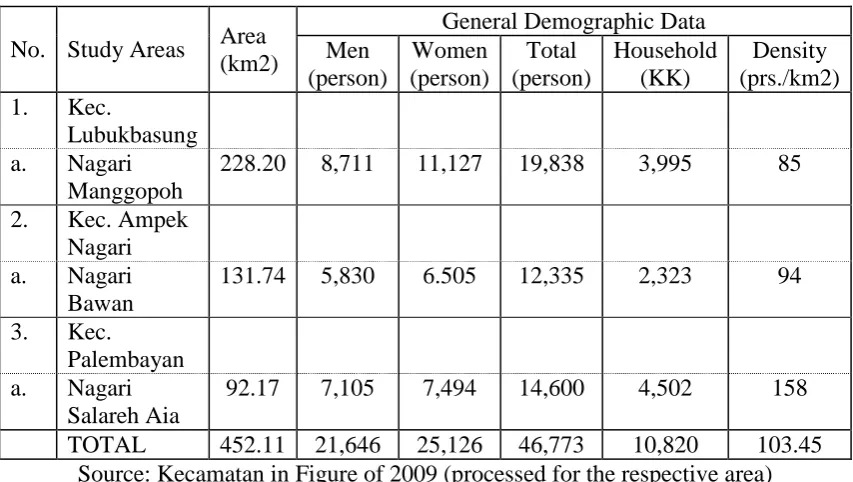
FIELD DATA IDENTIFICATION ... 7
III.
COMPENSATION FOR BUILDINGS, PLANTS AND PASAR BAWAN
RESTRUCTURING ... 16
COMPENSATION PRINCIPLE ... 16
COMPENSATION BUDGET ESTIMATE ... 18
IV.
ACTION PLAN ... 22
LAND ACQUISITION AND RESETTLEMENT POLICY ... 22
COMPLAINT RESOLUTION PROCEDURE ... 25
MONITORING AND REPORTING ... 25
IMPLEMENTATION SCHEDULE ... 26
TABLES
Table 1.1
Project Site for 047.1 Link Widening in Kabupaten Agam
1
Table 1.2
Technical Dimension of Manggopoh – Padangsawah Link Widening
Plan
2
Table 2.1
Population in Nagari Passed by Project Link in Kabupaten Agam
(situation as of 2008)
5
Table 2.2
Population in Study Area (situation as of 2008)
6
Table 2.3
Primary Professions of Local Residents (10 years old and over) in
Nagari Ladangpanjang (situation as of 2008)
6
Table 2.4
Questionnaire Distribution by Kecamatan and Nagari
9
Table 3.1
Price Set by the Government Based on Building Construction
16
Table 3.2
Market Price of Buildings based on Functions and Construction
16
Table 3.3
Market Price of Other Building Structures by Dimension and Type of
Construction
17
Table 3.4
LARAP Study for Economic Plants
17
Table 3.5
Rate Set by the Government for Economic Plants
17
Table 3.6
Market Price (Estimate) for Economic Plants
18
Table 3.7
Recapitulated Budget for Manggopoh – Padangsawah Link
Improvement in Kabupaten Agam
19
Table 3.8
Compensation Calculation for Buildings in Kabupaten Agam
19
Table 3.9
Compensation Calculation for Other Building Structure in Kabupaten
Agam
20
Table 3.10 Compensation Calculation for Economic Plant in Kabupaten Agam
20
Table 3.11 Budget for Pasar Bawan Restructuring
21
FIGURES
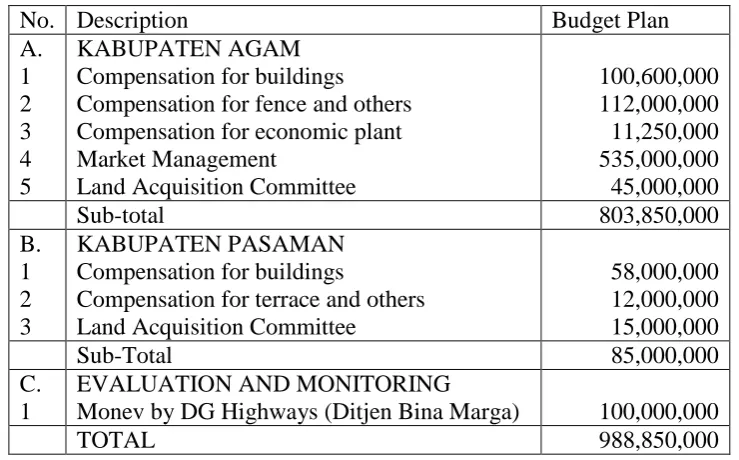
Figure 1.1
Accessibility to 047.1 Link Location
2
Figure 1.2
LARAP Study Flow Chart
4
Figure 2.1
Diagram of Respondents by Professions in Kabupaten Agam
10
Figure 2.2
Diagram of Respondents by Profession in Kabupaten Pasaman
10
Figure 2.3
Diagram of Respondents’ Income in Kabupaten Agam
10
Figure 2.4
Diagram of Respondents’ Additional Income in Kabupaten Agam
11
Figure 2.5
Diagram of Respondents’ Income in Kabupaten Pasaman
11
Figure 2.6
Diagram of Respondents’ Additional Income in Kabupaten Pasaman
11
Figure 2.7
Diagram of Respondents by Family Members [in Kabupaten Agam]
11
Figure 2.8
Diagram of Respondents by Family Members [in Kabupaten Pasaman]
12
Figure 2.9
Diagram of Respondents by Education in Kabupaten Agam
12
Figure 2.10
Diagram of Respondents by Education in Kabupaten Pasaman
12
Figure 2.11
Diagram of Project Impacts to the Economy of Kabupaten Agam
13
Figure 2.12
Diagram of Project Impacts to the Economy of Kabupaten Pasaman
13
Figure 2.13
Diagram of K5 Vendor Respondents’ Incomes in Pasar Bawan
13
Figure 2.14
Diagram of [K5] Vendor Respondents by Family Members [in Kab.
Agam]
13
Figure 2.15
Diagram of [K5] Vendor Respondents by Family Members [in Kab.
Pasaman]
14
Figure 2.16
Diagram of K5 Vendors’ Perception on Project Plan
14
Figure 2.17
Diagram of K5 Vendors’ Comments on Market Restructuring
14
Figure 2.18
Diagram of Community Perception to Project Plan in Kabupaten Agam
14
Figure 2.19
Diagram of Community Perception to Project Plan in Kabupaten
Pasaman
15
I.
INTRODUCTION AND PROJECT DESCRIPTION
BACKGROUND
1. The Indonesian Government, through the Ministry of Public works, plans to implement a project of capacity improvement for the National Road segment of Mangopoh – Padangsawah (herein referred to as ‘the Project’). This project is mandated by the Government’s Law Number 38/2004 calling for the improvement of National Roads so as to provide convenient and smooth-running transport service to users. This road widening project will be completely executed within the existing Right of Way, which is extends 32,000km from KM 102+200 to KM 134+200 of Kota Padang. In specific terms this is from Manggopoh in rural district (kabupaten) Agam to Padangsawah Nagari Ladang Panjang in Kabupaten Pasaman.
2. While the road widening project will be carried out on state-owned land, some acquisition activities will be necessary, especially for building structures and plants owned by local residents that fall within the Right of Way. For this project, there will be no need to acquire land since the work will be within the existing Right of way. Other issues that must be seriously taken into account include sidewalk vendors (K5 vendors) operating along the roadsides, and the use of road shoulders as parking lots. The latter is indeed the main contributing factor for traffic congestion in front of Pasar Bawan market, notably on local market day (the market is normally held on Fridays). Since land acquisition and market restructuring will frequently generate social and economic impacts, these activities as indicated in World Bank’s Operational Procedures, OP 4.12 must be handled with well-cut guidelines or terms of reference, i.e. Land Acquisition and Resettlement Action Plan (LARAP).
3. LARAP is an activity to look for action plan with respect to the acquisition of lands, buildings and plants (Land Acquisition) and the displacement of the affected people (Resettlement) with the adoption of participatory approach to formulate an acquisition framework for the implementation of a development project. While no resettlement process of local residents is necessary for this Manggopoh – Padangsawah link widening project, the findings of study on the affected people including other relevant data can serve as basis in conducting land acquisition process inclusive of:
a.
Precisely and accurately estimate the number of residents, building structures and plants to be affected by road widening project.b.
Precisely and accurately estimate the value or price of buildings and plants to be affected by project.c.
Propose a market restructuring pattern for Pasar Bawan according to the aspiration of local communities. Given that it is expected that road widening able to enhance road performance without sparking any social conflict.PROJECT LOCATION
4. The link to be widened is part of Western Trans Sumatra Corridor exending 32,000 km long. The widening itself is to enhance the performance of link in question that in turn will provide smooth-running traffic of transport modes from and to Padang (Teluk Bayur Port). From administration wise, this project will cover 2 kabupaten (Regencies) and 4 kecamatan (sub-district). One kecamatan is locally equal to one Nagari (village). For further details see table that follows.
Table 1.1 Project Sites for 047.1 Link Widening in Kabupaten Agam
No. Regency / sub district Nagari
A. AGAM regency
1. Lubuakbasuang Sub district Manggopoh
2. IV Nagari Sub district Bawan
3. Palembayan Sub district Silareh Aia
B. PASAMAN regency
5. Link 047.1 extends as long as 32.000 km starting from Sta 0.000 in Simpang Manggopoh Kecamatan Lubukbasung Kabupaten Agam or KM 102+200 from Kota Padang, to Padangsawah Nagari Ladang Panjang Kecamatan III Nagari Kabupaten Pasaman or Sta 32+090.337 or KM 134+200 from Kota Padang. Administratively speaking, out of this massive length, 31.650 Km of the link is within Kabupaten Agam, i.e. from Sta 0+000 to Sta 31+650 or (KM 102+200 or KM 133+850) from Kota Padang, and only little part of 0.350 Km is located in Kabupaten Pasaman, i.e. from KM 133+850 to KM 134+200.
6. As noted previously, along this link there is a market, namely Pasar Bawan. The market is located within or in very close proximity with the road alignment. On local market day, i.e. every Friday, severe traffic congestion always takes place in this market as the result of trading activities and vehicles on-street parking. Despite intensive advocacy to the traders, the result remains not optimum. Meanwile, field observation found that roilen plots – vacant land between the frontage of buildings and right of way – had been leased to sidewalk vendors (K5 vendors) by the owners. These K5 vendors displayed their merchandise over the shoulders of road. This is the main contributing factor of heavy traffic congestion during Market Days.
TECHNICAL DIMENSION
7. Based on Detail Engineering Design (DED) document, this project will widen the carriageway width to 7.0 m complete with road shoulders and drainage ditches. Technical dimension of this road widening plan are presented in Table 1.2. As for its typical cross section, it can be seen in the Annex.
Table 1.2 Technical Dimensions of Manggopoh – Padangsawah Link Widening Plan
No. Description Unit Dimension
1. Lane Width meter 7.00
2. Shoulder Width (Left and Right) meter 4.00 3. Side Ditch Width (Left and Right) meter 1.00
4. Normal Grade of Pavement % 2.00
5. Grade of Shoulder % 4.00
Source : P2JJ of West Sumatra Province, 2010.
METHODOLOGY
8. Identification of Assets. Identification of assets affected by project either owned by local communities, companies or government will be carried out through field survey to detect their positions against right of way. Assets within right of way alignment will be recorded for further verification. Assets belong to the communities will be verified through enumeration method as follows:
9. People’s Assets. Buildings owned by the communities will be identified according to their construction types, differentiating into permanent, semi-permanent and non-permanent or wooden construction; function and use of either house or business place; and location against KM or Sta of link, and position of either left or right from Kota Padang.
11. Plants with economic values owned by the communities will be identified of their quantity, type and locations against KM or STA and position of either left or right from Kota Padang. Plants farmed include Oil Palms, Cacao, Coconut, Pinang, Jati (Teak), and fruit trees such as Mango, Jambu, Durian, etc.
12. Public Assets. Public facilities owned by government or company inclusive of electrical poles, telephone poles and underground cable networks or piped water networks in right of way will be recorded of their quantities and locations. The removal will be made under coordination with the related institutions.
13. Market activities in Pasar Bawan always cause congestion during market day, i.e. on Fridays. An in-depth study will be made for these trading activities to look for alternative sites for the relocation of K5 vendors and parking lots that are currently encroaching roadsides. The study will be conducted through focused group discussion (FGD) with participants of government officials (Kabupaten, Kecamatan and Nagari), communal leaders, and representatives of the affected communities. In addition, spotcheck interviews will be made to selected respondents.
14. Social Data. LARAP is descriptive study to collect information of social-economic conditions of the studied communities in detailed and complete manner and to describe social phenomenon and the opinions of local residents about road widening project of Manggopoh – Padangsawah Link in Kabupaten Agam and Kabupaten Pasaman.
15. This descriptive-analitical study uses survey method, in which the information is collected from respondents whose assets to be acquired for road widening and K5 vendors in Pasar Bawan occupying right of way, with questionnaires to explore the living aspects of respondents against the planned project. Generally speaking, there are 4 aspects to be reviewed under this study, i.e.:
(i)
Social-economic characteristics or conditions of local residents,
(ii)
Social-economic environment of local residents,
(iii)
The knowledge of local residents about the project plan,
(iv)
Perception of local residents concerning the project plan.
16. In addition to the above primary data, secondary data from the related agencies including BPS (Statistic Office), District Administration Office, Kecamatan Office and Nagari Office will be used. This information may relate to social-economic and cultural data or regulations concerning price setting and payment procedures for compensation of lands and plants.
17. Secondary data from literature sources and primary data (of survey findings) are further evaluated and analyzed using the generally accepted formula. The findings of survey are put into a basic table (database entries) using a program specifically designed for this purpose, i.e. WEB_php program. The output will be presented into tables, figures or maps or displays accessible by all people affected by project.
Figure 1.2. LARAP Study Flow Chart
II.
SOCIAL ECONOMIC SURVEY AND ASSET INVENTORY
GENERAL DESCRIPTION OF THE STUDY AREAS
19. The administrative areas of LARAP study for Road Widening Project of Manggopoh – Padangsawah Link (Link 047.1) are within 4 (four) sub-districts/kecamatan, 3 kecamatans are included in Kabupaten Agam, namely, Lubukbasung, IV Nagari and Palembayan, and 1 kecamatan in Kabupaten Pasaman, i.e. Kecamatan III Nagari. Each kecamatan embraces one Nagari (equal to village) i.e. Manggopoh, Bawan and Silareh Aia in Kabupaten Agam and Nagari Ladang Padanjang in Kabupaten Pasaman.
20. Land use along the route of this national link is dedicated for built-up areas and plantation estates with the main products of oil palm fruits, cacao, corn, etc. In kecamatan IV Nagari, i.e. in Bawan, there is a market where every Fridays the traffic experience heavy congestion due to market activities and motor vehicles on-street parking.
Kabupaten Agam
Demography
21. Population. Total population in the administrative areas of nagari in Kabupaten Agam passed by this link in 2008 recorded 46,773 persons consisting of 10,820 households (HHs). The distribution of population by administrative area is presented in Table 2.1. The majority of this population is female.
Data on Regulaton and Tariff Secondary Data Collection
Buildings and Enconomic Plant Identification
Data on the Identified Buildings and Plants Work Planning
Obseervation of Buildings and Plants in Rumija Activity Implementation
Activity Identification
Field Survey
Data on Social, Economic and Culture Condition
Data on Administrative Arrea, Demography
Compensation Amount and Market Rrstructurring Budget Web php Software
Presentaton in PHP Program
The largest population is found in Kenagarian Manggopoh (19,838 persons) with the smallest in Kenagarian Bawan (12,335 persons). No Indigenous People presents in this location.
Table 2.1 Population in Nagari Passed by Project Link in Kabupaten Agam
(situation as of 2008)
No. Study Areas
Area
(km2)
General Demographic Data
Men
(person)
Women
(person)
Total
(person)
Household
(KK)
Density
(prs./km2)
1.
Kec.
Lubukbasung
a.
Nagari
Manggopoh
228.20
8,711
11,127
19,838
3,995
85
2.
Kec. Ampek
Nagari
a.
Nagari
Bawan
131.74
5,830
6.505
12,335
2,323
94
3.
Kec.
Palembayan
a.
Nagari
Salareh Aia
92.17
7,105
7,494
14,600
4,502
158
TOTAL
452.11
21,646
25,126
46,773
10,820
103.45
Source: Kecamatan in Figure of 2009 (processed for the respective area)
22. Population Density. From demography wise, population density will depict the number of persons per km2 in the lowest administrative area (Nagari). Based on administrative areas crossed by this project link, they reach 451.11 km2 with population density ranging from 80 – 158 persons per km2 or 103.45 persons/km2 on the average. The most populous area (158 person per km2) is in Kenagarian Silareh Aia in Kecamatan Palembayan. Meanwhile, area with the least population is that of Kenagarian Manggopoh, Kecamatan Lubukbasung, i.e. 85 persons per km2.
Economy
23. Livelihood. Residents living along the link to be widened in majority work in agriculture sector including in plantation sector supported by processing industries of plantation products. Some of them are also enganged in financial sector, rental & corporate service and miscellenous services with close business relation to plantation sector, such as banking, cooperatives of heavy duty vehicle rental and other plantation production equipment.
24. Land Use and Land Title. Land use in an area is considerably dependent on its natural and human resources potentials, topography, geomorphology and culture. The project sites are situated in areas that have been developed into plantation estates with high productivity. The vast majority of lands have been farmed as plantation estates.
25. If reviewed at kecamatan level, the existing lands have been almost totally used by local communities, either local residents or members of cooperatives as non-permanent residence, or plantation investors. The lands may be owned under communal land titles (Milik Ulayat Kaum and Ulayat Nagari) or land certifications under the name of companies or individuals). This kind of land titles indicates the general character of land ownership in Minangkabau and regional development policy stressing on plantation estate development by big plantation companies in association with local plantation farmers.
exclusive group. Instead, they collaborate in social-economic groups of plantation cooperatives or other social organizations.
Kabupaten Pasaman
Demography
27. Population. Total population in Nagari (equal to village) Ladangpanjang in 2008 was 10,434 persons consisting of 2,613 households (Table 2.2).
Table 2.2 Population in Study Areas (situation as of 2008)
No. Study Area Area (km2)
General Demographic Data Men
(person)
Women (person)
Total
(person) Household
Density (prs./km2) 1. Kec. Tigo
Nagari a. Nagari
Ladang Panjang
62.16 5,289 5,145 10,434 2,613 168
Source: Kecamatan in Figure of 2009 (processed for the respective area)
No Indigenous People present in the project area.
28. Population Density. Demographically, population density decribes the number of persons per km2 in the lowest administrative area (Nagari). With total administrative areas reaching 62.16 km2, population density in Nagari Ladangpanjang is 168 persons per km2. This density is also attributed to its position in a three-legged juction bound for 3 district administration centers, i.e. Lubukbasung in Agam, Simpangempat in Pasaman Barat and Lubuksikaping in Pasaman.
Economy
29. Livelihood. Livelihood of local residents along the link to be widened, as shown in Table 2.3, is dominated by agriculture activities, including plantation sector supported with processing industries of plantation products. Some local people also work in financial sector, rental & corporate service and miscellenous services with close relation to plantation sector, such as banking, cooperatives of heavy duty vehicle rental and other plantation production equipment.
Table 2.3. Primary Professions of Local Residents (10 years old and over) in Nagari
Ladangpanjang (situation as of 2008)
No.
Primary Profession
Total (persons)
Remarks
1
Agriculture
7.653
2
Excavation Mining
95
3
Processing Industries
134
4
Construction
41
5
Trade, Hotel & Restaurant
490
6
Transport & Communication
111
7
Finance, Rental & Service
416
8
Services
323
9
Others
564
Total
9.427
30. Land Use and Land Titles. Land use in an area is considerably dependent on its natural and human resources potentials, topography, geomorphology and culture. The project sites are situated in areas that have been developed into plantation estates with high productivity. The vast majority of lands have been farmed as plantation estates.
31. If reviewed at kecamatan level, the existing lands have been nearly used by local communities, either local residents or members of cooperatives as non-permanent residence, or plantation investors. The lands may be owned under communal land titles (Milik Ulayat Kaum and Ulayat Nagari) or land certifications under the name of companies or individuals. This kind of land titles indicates the general character of land ownership in Minangkabau and regional development policy stressing on plantation estate development run by big plantation companies in association with local plantation farmers.
32. Social Culture. Generally speaking, the communities in study areas are dominated by Minangkabau ethnic, apart from other ethnics of Mandailing, Javanese and Nias. Despite this ethnic domination, social interaction within the society is relatively harmonious without any ethnic-based exclusive group. Instead, they collaborate in social-economic groups of plantation cooperatives or other social organizations
FIELD DATA IDENTIFICATION
33. The Affected Assets. Census survey was conducted from 16-30 November 2010 using questionnaires initiated with socialization and spotcheck interviews and focus group discussion (FGD) aimed at collecting or identifying all building structures and plants with economic values owned by the communities within right of way, and looking for alternative solutions to lessen or eliminate traffic congestion in market vicinity. This date will be the cut of date to record affected persons in the project area who are entitled to compensation, resettlement assistance and livelihood restoration assistance. In case there is a time gap between the LARAP approval and the implementation of the WINRIP project or sub-projects under WINRIP, the Land Acquisition Committee will do verification of the current situation based on the list of affected people and assets from the survey. The LAC will announce the affected persons in the project area and start to do consultation and negotiation
34. Assets found within right of way at Link 047.1 in two kabupaten are owned by 58 persons (PAP). Some of these assets consist of houses or business places put up within rigth of way alignment. They are owned by 31 (PAP). There are also other structures of fence, box culvert or terrace constructed in right of way owned by 20 HHs. In addition, 7 HHs grow plants with economic value over right of way. For this project, no land acquisition will be necessary. Description of each asset for the administrative area concerned is presented below. As to detailed data on PAP and their assets affected by project, see Annex 1 (from a to e).
Kabupaten Agam
People’s Assets
35. Buildings within right of way. Field data processing found that total buildings owned by local residents to be affected by road widening project of Manggopoh – Padangsawah link in Kabupaten Agam consist of 27 units owned by 27 PAP. These buildings can be further elaborated as follows:
a)Non-permanent building, 13 units, as food stalls
b)Semi-permanent building, 9 units, out of them 5 units used as houses, the other 4 units used to run business activities
c)Permanent building, 5 units, as business places
37. As for 5 units of semi-permanent buildings and 5 units of permanent buildings, only little parts of these buildings will be acquired. According to the survey, they ask for cash compensation with the amount as mutually agreed later.
38. Other building structure within right of way. Other structures of fence and terrace are found in 17 locations owned by 17 PAP with details as follows:
a)Terrace in 6 locations
b)Fence and land border structures in 11 locations
39. Economic Plants within right of way. Plants with economic value growing in right of way of Manggopoh – Padangsawah link in Kabupaten Agam consist of 22 trees owned by 7 PAP with description as follows:
a)Oil Palm 9 trees b)Coconut 1 tree c)Pinang 22 trees d)Other (Jati) 5 trees
40. Government and Corporate Assets. Public and corporate assets to be affected by this road widening project are inclusive of electrical poles, telephone poles, underground optical fibre networks, pipe networks of PDAM in Bawan. .
41. Bawan Market. Pasar Bawan is a Nagari (village) market where the market activities are held on Fridays. During the other days, some shops or stalls are opened just to serve the needs of local residents and no K5 vendor operates, especially those who use road shoulder to display their merchandise. However, on market day, because more people engage in business transactions, the situation will be considerably crowded. K5 vendors will promote their marchandise in road shoulders, and for sure heavy congestion will follow. This condition is compounded with messy parking.
42. Despite some market restructuring measures by Nagari Bawan administration as the market authority, no optimum result has been perceived. It is identified that some roilen plots (i.e. vacant land between Rumija alignment and the frontage of buildings) have been leased to K5 vendors. It is worthwhile noting here that roilen plots are owned by Nagari (communal parcel). Pasar Bawan is a Nagari market. While these street vendors operate on temporary basis, they will display their merchandise along road shoulder when operating. According to data of Wali Nagari, the number of these weekly K5 vendors occupying right of way to run their business may reach 30 persons and those who use roilen plots consist of 15 vendors. These numbers are fluctuating and constantly changing.
43. K5 vendors operating in Bawan market normally sell daily domestic needs such as vegetables, chilly, fruits, salted fish, foods, kitchen wares or apparels. For traders selling agriculture products of vegetables, chilly and fruits they will operate only if they get these agricultural goods from farmers.
44. The study interviewed 16 K5 vendors, who out of them 8 vendors operate in roilen plots and the other 8 vendors along road shoulders (survey was performed on 16 January 2011). The interview revealed that they also operated in other nearby markets such as in Tampuruang or Kinali on Sundays and Mondays respectively. However, since these two market locations are also along the link to be widened, K5 vendors in other locations must be identified.
Kabupaten Pasaman
45. Buildings within right of way. Field data processing found that buildings owned by local residents to be affected by this road widening project consist of 3 units as follows:
b)Semi-permanent structure, 1 unit, as food stalls
46. Similar to assets owned by residents in Kabupaten Agam, these three buildings will be partly or totally demolished, i.e. 75% to 100%. They must be displaced in their own lands, which are precisely located close to or behind right of way.
47. Other buildings in right of way. Other buildings owned by local residents within rigth of way are inclusive of terrace and box culverts in 3 locations.
a)Terrace, 1 location b)Box culvert, 1 location
Questionnaires
48. People Assets Affected by Project. Total respondents interviewed for this study from 16 to 26 November 2010 in two kabupaten reached 58 persons distributed in 4 kecamatan and 4 Nagari. This figure reflects exactly the number of households to be affected either as individuals or members of Ulayat. The assets of buildings and plants owned by 57 respondents will be acquired (100%). There is only one respondent whose asset will not be affected.
49. Data in Table 2-4 shows that many respondents in Nagari Manggopoh Kecamatan Lubukbasung put up their buildings or appurtenances or grow economic plants within right of way. This is because of their lack of knowledge about the function and ownership of right of way and weak supervision from the related institutions.
Table 2.4 Questionnaire Distribution by Kecamatan and Nagari
No. Study Area Area (km2) Total (person) Respondent (KK) Remarks Population HHs Total %
A. Kabupaten Agam 1. Kec. Lubukbasung
Nagari Manggopoh 228.20 19,838 3,995 23 0.575 100% PAP 2. Kec. Ampek Nagari
Nagari Bawan 131.74 12,335 2,323 17 0.731 100% PAP 3. Kec. Palembayan
Nagari Salareh Aia 92.17 14,600 4,502 13 0.288 100% PAP Sub-Total 452.11 46,773 10,820 53 0.489
B. Kabupaten Pasaman Kec. III Nagari
Nagari Ladang Panjang 62.16 10,434 2,613 5 0.383 100% PAP Sub-Total 62.16 10,434 2,613 5 0.383
Source: Kecamatan in Figure of 2009 (processed) and field survey 2010
50. Sidewalk Vendors (K5) at Pasar Bawan. Total respondents of K5 vendors in Pasar Bawan interviewed on Friday of 21 January were 16 persons. Out of them, 8 respondents sell their merchandise in roilen plots and the other 8 vendors operate in road shoulders. They represent vendors to be affected by project.
The Output of Social-Economic Survey
The Affected People (PAP)
Primary Professions of PAP
51. The social-economic conditions of respondents can be identified from their primary profession. Of 53 HHs interviewed, all of them (100%) are the owners or authorized representatives of owners [of houses they live in]. Their professions are respectively farmers (50.95%), traders (16.98%) and PNS/TNI/Polisi or public servants/armed forces/police (7.55%). The other 11.33% respondents give no answer.
Figure 2.1. Diagram of Respondents by Profession in Kabupaten Agam
Kabupaten Pasaman
52. Of 5 respondents interviewed for this survey, 2 respondents have profession of farmers and the other 2 respondents as traders. The remaining 1 PAP is a housewife. Pasaman is located in populous area and at a road intersection.
Figure 2.2. Diagram of Respondents by Profession in Kabupaten Pasaman
PAP Income
Kabupaten Agam
53. Of 53 respondents surveyed from income aspects, 6 respondents refused to reply. The questionnaires indicated that one respondent admitted his income was less than Rp. 500,100.00 per month; the other 15 respondents said that they earned monthly income of more than Rp. 1,500,000.00 per month. The output of survey is presented in Graph 2.3 that follows.
Figure 2.3. Diagram of Respondents by Monthly Income in Kabupaten Agam
No reply Farmer Labor Housewives Service providers
Motocycle taxi (ojek)/driver Traders
Handicraftmen
Farmers
Civil Servant/Armed Forces/Police
Respondents by primary profession
Housewives Traders Farmers
Respondents by primary professions
No reply
< Rp. 500,000,-/month > Rp. 1,500,100,- / month
Rp. 1,000,100 – 1,500,000,- / month Rp. 500,100 – 1,000,000,- / month
54. Furthermore, 18 respondents of PAP in project location confessed that they had no additional income and the other 20 respondents gave no answer. Of 15 respondents giving the replies, 5 respondents had additional income of more than Rp. 800,100,- per month as indicated in Graph 2.4 that follows.
Figure 2.4. Diagram of Respondents’ Additional Income
Kabupaten Pasaman
55. From 5 respondents who have been interviewed about their income, 3 respondents revealed their monthly income of more than Rp. 1,500,100 per month with the other 2 respondents earning monthly income ranging from Rp. 500,000 to Rp. 1,000,000 per month.
Figure 2.5. Diagram of Respondents’ Income in Kab. Pasaman
56. In addition, 3 respondents or PAP admitted that they had additional income of more than Rp. 800,000 per month. As for the remainder respondents, their additional income ranged from Rp. 300,000 to Rp. 500,000 per month.
Figure 2.6. Diagram of Respondents’ Additional Income in Kabupaten Pasaman
Members of PAP Families
Kabupaten Agam
57. The respondent households are dominated by family consisting of 4 – 6 members. This is particularly true in 5 HHs or 66.04%. Respondents with smaller family composition of 4 members are 8 HHs or 15.09%.
Figure 2.7. Respondent Diagram by Family Members [in Kab. Agam]
Kabupaten Pasaman
No reply
< Rp. 300,000/month > Rp. 800,100/month Rp. 300,100 –
500,000/month None
Respondents by additional income earned from side jobs
> Rp. 1,500,100,-/month
Rp. 500,100 – 1,000,000,-/month
Respondents by income earned from the primary professions
> 800,100,- / month
Rp. 300,100 – 500,000,- / month
Respondents by income earned from the side jobs
Respondents’ Family Members as Dependants
58. Five (5) respondents have family members of 4 – 6 persons with 1 respondent having family consisting of 7 – 9 members. This data indicates that the majority of respondents has relatively medium or large dependants.
Figure 2.8 Diagram of Respondents by Family Members [in Kab. Pasaman]
PAP’s Education Degree
Kabupaten Agam
59. Respondents in Kabupaten Agam are mostly the graduates of Junior Secondary School or SMP (37.47%) or Senior Secondary School or SMA (26.42%). Of them only 1 household head (1.89%) attends tertiary education. Education level will have great influence over the understanding and mindset of respondents in responding and completing the questionnaires and their comments on project.
Figure 2.9. Diagram of Respondents by Education in Kabupaten Agam
Kabupaten Pasaman
60. Education degree of respondents in Kabupaten Pasaman shows that out of 5 respondents, 4 respondents graduates from SMA (Senior Secondary School) and 1 respondent completes his elementary education (SD). Education level will have great influence over the understanding and mindset of respondents in responding and completing the questionnaires and their comments on project.
Figure 2.10. Diagram of Respondents by Education in Kabupaten Pasaman
The Impacts of Project to the Economy
Kabupaten Agam
61. This road widening project will bring about broad impacts to the social and economic lives of local communities. However, only around 24.52% respondents expressed their no objection to the project. Meanwhile, the other 22.64% respondents demonstrate contrary stance to project. The majority (50.49%) gives no opinion.
62. From FGD it is identified that all participants understand that trading activities in market have hampered traffic flow of vehicles transporting agriculture products and other staples goods. However, on the other side, they tolerate the behavior of traders displaying their mechandise along road shoulders.
Respondents’ family members as
4-6 persons 7-9 persons
Respondents by Education Degree
No reply Academy
Elementary School (SD)
Senior Secondary School (SLTA) Junior Secondary School (SLTP) Not Graduated from SD
Respondents by Education Degree
Figure 2.11. Diagram of Project Impacts to the Economy of Kabupaten Agam
63. During FGD, the participants expect on more concern and supervision from local administration to the price of their plantation products. They also express their expection on compensation for their sacrifice and lands affected. On the other side, smooth-running transport traffic will be more enjoyed by large plantation companies or the owners of CPO processing factories.
Kabupaten Pasaman
64. This road widening project will give impacts to the social and economic lives of local communities. All respondents admit that their economic activities will be disrupted during road widening construction.
Figure 2.12. Diagram of Project Impacts to the Economy of Kabupaten Pasaman
Pasar Bawan Traders affected by Project
PAP’s Income
65. Of 16 respondents of K5 vendors operating in Pasar Bawan who were asked about their income, 10 respondents said that their income ranged from Rp. 1,000,000,000 to Rp. 1,500,000 per month. The other 15 respondents earned income of Rp. 500,000 to Rp. 1,000,000 per month as presented in Graph 2.13 below.
66. From family member aspect, respondents’ households are not dominated by either small family (< 4 members) or large family (7-8 members) as presented in Graph 2.14 that follows.
Figure 2.13. Diagram of Respondents of K5 Vendors in Pasar Bawan
Figure 2.14 Diagram of Respondents of K5 Vendors by Family Members
Will this road widening project disturb your economy/business activities?
No reply No Not Know Yes
Will this road widening project disturb your economic/business activities?
Yes
Respondents by income earned from trading activities
< Rp. 500,000,-/month > Rp. 1,500,100,- / month
Rp. 1,000,100 – 1,500,000,- / month Rp. 500,100 – 1,000,000,- / month
Respondents’ dependants
67. PAP Education. Respondents’ education in Pasar Bawan is dominated by elementary school degree (either graduated or not graduated from SD), i.e. 62.5%. The others possess SMP or SMA certificates (i.e. 18.75% each). Education level will have great influence over the understanding and mindset of respondents in responding and completing the questionnaires and their comments on project.
Figure 2.15 Diagram of Respondents [of K5 vendors] by Family Members
68. The Perception of K5 Vendors on Project. Before commencing road widening project, it is necessary to invite the perception of K5 vendors to be affected by project in order to identify their acceptance or rejection of project. Out of 16 vendors interviewed, 12 respondents express their acceptance to project and 4 respondents or 9.43% said that they are very supportive to the planned project.
Figure 2.16 Diagram of K5 Vendors’ Perception on Project Plan
69. On the other side, they fully understand the consequences of this road widening project that will disrupt their productive activities in Pasar Bawan. However, based on questionnaires, it is evident that 13 of 16 vendors will have no objection if they are removed to other place as provided by the local government. Two respondents give no opinion.
Figure 2.17 Diagram of K5 Vendors’ Comments on Market Restructuring
Community Perception of Project
Kabupaten Agam
70. Before commencing road widening project, it is necessary to invite the perception of K5 vendors to be affected by project in order to identify their acceptance or rejection of project. Survey shows that of 53 HHs affected by project, 40 HHs or 75.47% express their acceptance to the project and even 5 HHs or 9.43% stated their high agreement. The others give no opinion.
Figure 2.18. Diagram of Community Perception to Project Plan in Kabupaten Agam
Kabupaten Pasaman
Respondents by Education Level
Elementary School (SD) Senior High School (SLTA) Junior High School (SLTP) Not Graduated from SD
What do you think about this road widening plan?
Highly Agree Agree
No reply
Moved to other locations close to the previous site
Moved to other locations offered by local government
What is your opinion about this road widening project?
71. While all HHs (100%) feel that their economic activities will be disturbed by project during construction, they basically have no objection to this road widening project.
Figure 2.19. Diagram of Community Perception to Project Plan in Kabupaten Pasaman
Compensation
Kabupaten Agam
72. Before setting the sum of compensation to buildings and plants affected by project, the local residents normally demand on consensus meeting. The amount of compensation will be set according to the applicable government regulations.
Figure 2.20. Diagram of Compensation Preferred by Communities in Agam
73. According to the form of compensation, cash compensation is the most preferred compensation by the respondents, i.e. 79.25% and only 2 HHs or 3.77% expect on compensation of building renovation.
74. FGD in the market indicates that the majority of communities has no objection to the planned project since it will promote and develop their Nagari. Nevertheless, some participants expect on market restructuring. They are fully aware that exceeding trading activities are the main factor for heavy congestion thus far.
75. In light of that, they ask the local government, especially agency executing this road widening project, in this case P2JJ West Sumatra, to restructure the market premises by providing parking lots and space for K5 vendors.
Kabupaten Pasaman
76. Before setting the sum of compensation to buildings and plants affected by project, the local residents normally demand on consensus meeting. However, they will agree any compensation set by the local government. All respondents (100%) expect on compensation for their assets affected by project.
Figure 2.21. Diagram of Compensation Mostly Preferred by Communities in Pasaman
What is your opinion about this road widening project?
Agree
What compensation form do you prefer most?
No reply
Building rehabilitation
Cash compensation
What do you expect for the replacement of buildings/economic plants affected by this road widening project?
III.
COMPENSATION FOR BUILDINGS, PLANTS AND PASAR BAWAN
RESTRUCTURING
COMPENSATION PRINCIPLE
77. Policy taken by the project’s executing agency is that all assets belong to the communities affected by project will receive compensation. The compensation may consist of cash payment or reconstruction of assets acquired as mutually agreed between the asset owners and the local government. LARAP is to compute the budget required for compensation.
78. The Price of Buildings. Affected building will be compensated at replacement cost based on material market price to build replacement building. An LARAP’s analysis on market price of affected building is conducted in order that PAP involved really can rebuild their acquired assets and for budget estimation. This analysis is conducted by considering Government Standard Price and market price of material, type and function/usage of the building and asset dimension. The analysis is conducted without calculating depreciation value. This price is proposed as input to responsible institution for building (Human Settlement Agency) and then to be established by the Regent as reference that will be used by LAC for negotiation with PAP. The result of analysis is that the market price ranges of the building from Rp. 2.000.000 – 3.000.000/m2 for permanent buildings and Rp. 1.000.000 – 1.500.000/m2 for semipermanent buildings, and Rp. 175.000-500.000/m2 for shack buildings. As comparison also it is presented standar price from government and from market price.
79. As comparison also it is presented standar price from government and from market price.
Table 3.1. Price Set by the Government based on Building Construction
No. Building Construction
Price x Rp.1.000/m2)
1.
Permanent shop
425.000,0
2.
Semi-permanent shop
310.000,0
3.
Food stalls
145.000,0
4.
Permanent house
550.000,0
5.
Semi-permanent house 400.000,0
6.
Non-permanent house
175.000
Source: the related district government 2010 (processed)
Table 3.2. Market Price of Buildings Based on Function and Construction
No. Building Construction
Price x Rp.1.000/m2)
1.
Permanent shop
3.000.000,0
2.
Semi-permanent shop
1.500.000,0
3.
Food stalls
250.000,0
4.
Permanent house
2.500.000,0
5.
Semi-permanent house 1.250.000,0
6.
Non-permanent house
200.000
Source: the related district government 2010 (processed).
responsible institution (Human Settlement Agency) on providing reference for market price of the affected structure and usually will become input for LAC.
Table 3.3. The Market Price of Other Building Structure by Dimension and Type of
Construction
No. Function of Structure
LARAP Price
Remarks
A.
Terrace
1.
Permanent cement floor
250,000
2
Semi-permanent cement floor
200,000
3.
Wooden frame of cement floor
150,000
4.
Wooden frame of uncement floor
100,000
B.
Fence
Iron fence with stone foundation
100,000
Stone fence
150,000
C.
Foundation
Foundation removal
50,000
Source: 2010 Study (processed)
81. Price for Economic Plants. The compensation for affected plants will be based on age and size of the affected plant and also presently crop price. An analysis on the compensation rate for the affected plant was conducted as input for responsible institution (Agriculture/Plantation Agency) and also for LAC and to estimate budget. This analysis used Government Standard Price and also market price from the survey result. The result of the analysis is on Table 3.6 ranges from Rp. 2.500.000 – 1.500.000/tree for harvest ready and relatively young oil palm trees (very productive) and Rp 1.500.000 – 1.000.000/tree for oil palm tree of 20 years old and over.
Table 3.4. LARAP Study for Economic Plants
No.
Plants
Standard Rate (Rp./tree)
Big
Medium
Small
1.
Oil Palm
600,000
1,000,000
350,000
2.
Coconut
200,000
300,000
150,000
3.
Cacao
450,000
600,000
200,000
4.
Pinang
150,000
200,000
100,000
5.
Fruits
150,000
250,000
100,000
Source: the respective district government 2010 (processed).
82. The government standard price and the market price of plants are also presented:
Table 3.5. Rate Set by the Government for Economic Plants
No.
Plants
Standard Rate (Rp./tree)
Big
Medium
Small
1.
Oil Palm
250,000
200,000
100,000
2.
Coconut
75,000
60,000
40,000
3.
Cacao
200,000
175,000
100,000
4.
Pinang
75,000
60,000
40,000
5.
Fruits
100,000
75,000
50,000
Source: the respective district government 2010 (processed).
83. Price set by Government is dependent on the type and age or size of tree as presented in table that follows.
Table 3.6. Market Price (Estimate) for Economic Price
No.
Plants
Standard Rate (Rp./tree)
Big
Medium
Small
1.
Oil Palm
500.000,0
750.000,0
250.000,0
2.
Coconut
175.000,0
250.000,0
100.000,-
3.
Cacao
350.000,0
600,000,0
150.000,0
4.
Pinang
125.000,0
160.000,0
60.000,0
5.
Fruits
125.000,0
250.000,0
75,000,0
Source: the respective district government 2010 (processed).
85. The affected buildings and other assets will be demolished when the compensation has been fully paid or the replacement buildings available.
86. Pasar Bawan Restructuring . Study to the existing market and measures taken to deal with road widening project and considerably crowded market during market day is carried out through discussion and structured interview, and followed with focus group discussion (FGD). It is identified that local communities are aware about such heavy congestion during market day and they expect on market premise restructuring. Thus, project implementing agency, i.e. P2JJ of West Sumatra Province can simultaneously restructure the market by providing parking lots and space for sidewalk vendors (K5 vendors).
87. Exceeding trading activities by K5 vendors coupled with messy parking of traders’ vehicles or rural modes or private motorcycles and ojek (motorcycle taxi) on market days, i.e. on Fridays have caused heavy congestion in road segment in front of the market. While they are fully aware about this congestion, to date no significant measure has been taken to cope with this problem, such as vendor or parking management.
88. Action plan to deal with this problem is to provide parking lots and space for K5 vendors. The required area will be 1,000 m2 with asphalt floor. This plan not only requires land, but also asphalt pavement, in the surroundings of Pasar Bawan of some 20 – 30 m from right of way alignment. As to business places, they will be managed by market authority, i.e. Nagari Government, in which the affected vendors will be prioritized to occupy these lots.
89. This study through discussion and structured interviews continued with focus group discussion (FGD) concludes that the management measures should be taken by the project implementing agency, i.e. P2JJ West Sumatra Province. The discussion also reveals the expectation of local communities on the provision of the above facilities parking and selling lots prior to road widening project. They also demand on preliminary consultation and discussion with K5 vendors. The replacement lots must be first prepared before relocating the vendors.
COMPENSATION BUDGET ESTIMATE
Table 3.7 Recapitulated Budget for Manggopoh – Padangsawah Link Improvement according to
Larap
No. Description
Budget Plan
A.
1
2
3
4
5
KABUPATEN AGAM
Compensation for buildings
Compensation for fence and others
Compensation for economic plant
Market Management
Land Acquisition Committee
100,600,000
112,000,000
11,250,000
535,000,000
45,000,000
Sub-total
803,850,000
B.
1
2
3
KABUPATEN PASAMAN
Compensation for buildings
Compensation for terrace and others
Land Acquisition Committee
58,000,000
12,000,000
15,000,000
Sub-Total
85,000,000
C.
1
EVALUATION AND MONITORING
Monev by DG Highways (Ditjen Bina Marga)
100,000,000
TOTAL
988,850,000
Kabupaten Agam
91. Compensation for Buildings. The amount of compensation for buildings operating as houses cum shops and food stalls within rigth of way of Monggopoh – Padangsawah link based on LARAP study, which is calculated according to the market price of current construction materials without depreciation has taken the output of interviews, FGD and questionnaire into account. The calculation produces a sum of Rp. 100,600,000.00 as indicated in Table 3.8. Meanwhile price calculation according to government regulation and NJOP or market price can be seen in Annex.
Table 3.8 Compensation Calculation for Buildings by Administration Areas
No.
Administration
Area
Construction
Total
Building
(Unit) *)
Area of
Building
(M2) *)
LARAP Analysis
Price/m2
(Rp)
Total
(Rp.)
1
Nagari Monggopoh Permanent
3
34
500,000
17,000,000
Semi-Permanent
2
16
350,000
5,600,000
Non-Permanent
3
58
250,000
14,500,000
2
Nagari Bawan
Permanent
2
10
500,000
5,000,000
Semi-Permanent
5
64
350,000
22,400,000
Non-Permanent
6
65
250,000
16,250,000
3
Nagari Salareh Aia
Permanent
500,000
-
Semi-Permanent
2
16
350,000
5,600,000
Non-Permanent
4
57
250,000
100,600,000
Total
100,600,000
Table 3.9 Compensation Calculation for Other affected Structure
No.
Administration
Area
Construction
Total
Building
(Unit) *)
Area of
Building
(M2) *)
LARAP Analysis
Price/m2
(Rp)
Total (Rp.)
1
Nagari
Monggopoh
Terrace
5
102
500,000
51,000,000
Fence
6
95
350,000
33,250,000
Other
structure
2
18
250,000
4,500,000
2
Nagari Bawan
Terrace
1
5
500,000
2,500,000
Fence
1
15
350,000
5,250,000
Other
structure
1
20
250,000
5,000,000
3
Nagari Salareh
Aia
Terrace
500,000
-
Fence
1
30
350,000
10,500,000
Other
structure
250,000
Total
112,000,000
Source: *) based on field data calculation in 2010
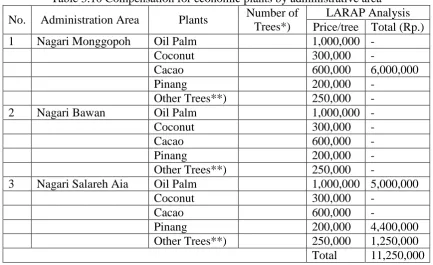
93. Compensation for Economic Plant. Budget required for the compensation of economic plants within right of way, as indicated in Table 3.10, reaches Rp. 11,250,000.00. This calculation is based on government regulations and market price. For further details see the annex.
Table 3.10 Compensation for economic plants by administrative area
No.
Administration Area
Plants
Number of
Trees*)
LARAP Analysis
Price/tree Total (Rp.)
1
Nagari Monggopoh
Oil Palm
1,000,000 -
Coconut
300,000
-
Cacao
600,000
6,000,000
Pinang
200,000
-
Other Trees**)
250,000
-
2
Nagari Bawan
Oil Palm
1,000,000 -
Coconut
300,000
-
Cacao
600,000
-
Pinang
200,000
-
Other Trees**)
250,000
-
3
Nagari Salareh Aia
Oil Palm
1,000,000 5,000,000
Coconut
300,000
-
Cacao
600,000
-
Pinang
200,000
4,400,000
Other Trees**)
250,000
1,250,000
Total
11,250,000
Source: *) based on field data calculation in 2010
**) Jati or teak trees
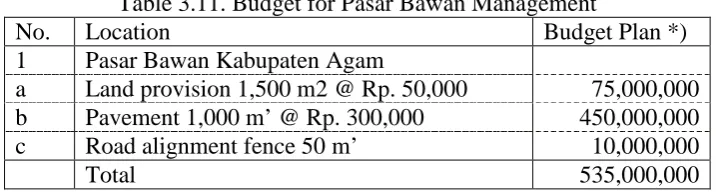
95. Budget for Market Restructuring. Budget required for the management of Bawan market in Kanagarian IV nagari is as indicated in 3.11 that follows. Despite parking lots and space for K5 vendors, additional structures of fence to secure road users will be still needed. Land provision in market premise is relative more expensive than other vicinities.
Table 3.11. Budget for Pasar Bawan Management
No.
Location
Budget Plan *)
1
Pasar Bawan Kabupaten Agam
a
Land provision 1,500 m2 @ Rp. 50,000
75,000,000
b
Pavement 1,000 m’ @ Rp. 300,000
450,000,000
c
Road alignment fence 50 m’
10,000,000
Total
535,000,000
Kabupaten Pasaman
96. Compensation for Buildings. The amount of compensation for buildings operating as houses cum shops and food stalls within right of way of Monggopoh – Padangsawah link based on LARAP study, which is calculated according to the market price of current construction materials without depreciation has taken the output of interviews, FGD and questionnaire into account. The calculation produces a sum of Rp. 58,000,000.00 as indicated in Table 3.12.
Table 3.12 Compensation for buildings in Kabupaten Pasaman
No.
Administration
Area
Construction
Number of
buildings
(Unit) *)
Area of
Building
(m2) *)
Larap Analysis
Price/m2
(Rp)
Total (Rp.)
1.
Nagari Ladang
Panjang
Semi
Permanent
1,500,000
48,000,000
Non
Permanent
400,000
10,000,000
Total
58,000,000
97. Compensation for Other Assets. Compensation for other building structures of terrace and box culvert within right of way, in this calculation, has been separately computed from their main structures. Budget for this kind of compensation reached Rp. 12,000,000.00 as indicated in Table 2.13. This sum is calculated based on justification of LARAP team and expected be approved by the local administration during compensation payment.
Table 3.13 Compensation for other building structure in Kabupaten Pasaman
No.
Administration
Area
Construction
Number
of
buildings
(Unit) *)
Area of
Building
(m2) *)
Larap Analysis
Price/m2
(Rp)
Total (Rp.)
1.
Ladang Panjang
Terrace
500,000 10,000,000
Box culvert
250,000
2,000,000
IV.
ACTION PLAN
LAND ACQUISITION AND RESETTLEMENT POLICY
98. Legal Basis Underlying Land Acquisition Process. While this road quality improvement project needs no land acquisition, since it will be executed within the existing right of way, there are some buildings and economic plants that must be acquired. These assets are within the right of way alignment. Laws and regulations underlying land acquisition process for the development activities for public interest are:
1)
Law Number 5 of 1960 concerning Basic Agrarian (State Gazette of Republic of Indonesia of 1960 Number 104, Supplement to State Gazette Number 2043);2)
Law Number 51 prp of 1960 concerning Illegal Land Use Ban without Prior Consent of the Rightful Owners or their Proxies (State Gazette of Republic of Indonesia of 1960 Number 158, Supplement to State Gazette Number 2106);3)
Law Number 20 of 1961 concerning The Revocation of Land Titles and Their Fixtures (State Gazette of Republic of Indonesia of 1961 Number 288, Supplement to State Gazette Number 2324);4)
Law Number 14 of 1992 concerning Road Traffics;5)
Law Number 24 of 1992 concerning Spatial Planning (State Gazette of Republic of Indonesia of 1992 Number 115, Supplement to State Gazette Number 3501)6)
Law No. 32 of 2004 concerning Regional Governance;7)
Law No. 38 of 2004 concerning Roads;8)
Presidential Regulation No. 36 of 2005 concerning Land Provision for the Development Activities for Public Interest;9)
Presidential Regulation No. 65 of 2006 concerning Amendment to Presidential Regulation No. 36 of 2005 concerning Land Provision for the Development Activities for Public Interest;10)
Decree of BPN Head No. 3 of 2007 concerning the implementation of Presidential Regulation No. 36 of 2005 concerning Land Provision for the Development Activities for Public Interest as amended with Presidential Regulation No. 65 of 2006 concerning Amendment to Presidential Regulation No. 36 of 2005 concerning Land Provision for the Development Activities for Public Interest;11)
Governor Decree No. 600/335/P.II/Bang-2010 dated 8 October 2010 concerning Free Land Statement;12)
Letter of Head of Satuan Kerja Non Vertikal Tertentu Pembangunan Jalan dan Jembatan of West Sumatra dated 11 October 2010 concerning Environmental Management and Monitoring Statement Letter;13)
WB’s Operational Procedure (OP) No. 4.12 concerning Involuntary Resettlement;99. Policy on the Formation of Land Acquisition Committee. Manggopoh – Padangsawah link is part of Western Trans Sumatra Corridor, which administratively passes over two kabupaten (districts), i.e. Agam and Pasaman. To free the link from any settlement and economic plants, according to Perpres Article 6 paragraph (3), a provincial land acquisition committee established by Governor will be necessary. This provincial team along with project executing agency will coordinate with kabupaten land acquisition team established by Regent.
ACQUISITION PROCEDURE AND PROCESS
101. The study will prepare an asset inventory of buildings and economic plants within right of way alignment, which are very likely affected by project, and to conduct social-economic survey and socialization, consultation and discussion with local residents. This study is to collect accurate information with respect of buildings, economic plants, public facilities and infrastructure in right of way alighments to be acquired and the amount and procedure of compensation payment. Action plan for each kabupaten on this issue is presented in the end of this report.
102. Administrative Preparation. According to LARAP, Road and Bridge Improvement Project of West Sumatra, c.q. Head of Road Infrastructure, Spatial Planning and Human Settlement Agency of West Sumatra Province will submit letter to the Governor of West Sumatra Province concerning the formation of Provincial Land Acquisition Committee with team composision comprising nine elements representing all related parties within the government. The team is then called as Provincial Nine Committee (Provincial LAC).
103. The Governor of West Sumatra province is then sent letters to the Regents (Bupati) of Kabupaten Agam and Pasaman informing the acquisition of buildings and economic plants owned by local communities within right of way alignment along Manggopoh – Padangsawah link where road widening project will take place. Each Regent (Bupati) is then required to set Kabupaten Nine Committee (Regency Land Acquisition Committee) tasked to support Provincial Nine Committee during compensation process.
104. In addition, as preliminary step in LARAP preparation, Directorate General of Highways organized a workshop on 16 December 2010 through Directorate of Technical Engineering involving stakeholders of kecamatan (sub-districts of these two districts), district administration represented by Bappeda, Public Works Agency, BPN Office and provincial administration also represented by Bappeda, Public Works Agency and BPN Office at province level and Consultants.
105. Socialization and Consultation. Provincial Land Acquisition Committee. To commence their task in compensation process, this Provincial LAC will invite their counterparts at kabupaten level, i.e. kabupaten LAC to coordinate and furnish information of materials contained in LARAP inclusive of:
1)
The submission of LARAP study2)
Coordination project. and task and authority allocation3)
Prepare land acquisition schedule4)
Prepare draft Regential Decree concerning Price Set for Compensation of Buildings – including terrace and fence and other structures – and economic plants affected by Manggopoh – Padangsawah link widening106. Kabupaten Land Acquisition Committee. Kabuppaten LAC will conduct socialization to their respective work area to the local communities concerning land acquisition process and compensation payment for buildings and plants affected by project with assistance of Kecamatan, Nagari and local leaders. Attendance of this socialization includes also Provincial LAC and Project. For the socialization, this kabupaten team will receive assistance from Camat and Walinagari.
107. Camat is assigned to invite all stakeholders including Walinagari, local leaders of each Nagari, and particularly residents whose buildings and plants to be acquired by road widening project. Socialization of physical work activities will be presented by Project. Socialization on compensation will be presented by Kabupaten LAC assisted by Provincial LAC. All consultation and socialization will be documented (see annex 2)
108. In addition to socialization, Kabupaten LAC shall assume the following tasks:
1)
Measurement and staking out to the affected assets.2)
Prepare inventory/calculation of assets owned by the communities to be compensated.3)
Announce the output of study and asset inventory to PAP.5)
Receive the rates set for buildings or plants and other assets from by responsible institution Price for building from Human Settlement Agency and price for plant for Agriculture/Plantation Agency.6)
Conduct consensus meeting/negotiation to reach agreement with PAP on the form and amount of compensation.7)
Set the agreement of the compensation for the affected assets.8)
Pay compensation to PAP.9)
Accommodate complaints, objections and proposals from PAP for discussion to look for the best resolution and publish the results.10)
Prepare monthly progress report of LARAP implementation during their service.11)
Submit LARAP implementation report to Regent, Monitoring and Reporting Team and WINRIP109. Measurement and Compensation Calculation. Detailed measurement and calculation in the field to buildings and economic plants acquired by Project must be witnessed owners and performed by Kabupaten LAC with attendance of Project and Province LAC.
110. Submit the results of measurement and calculation to local community during socialization stage II. For those who have any doubt about the measurement of buildings and plants affected by project, they can ask the committee to measure again the areas of their buildings and plants to ensure the sum of compensation to be received. Compliant and Grievance Resoulation mechanism can be seen in Annex 3.
111. After site measurement and the number of buildings and plants has been accurately identified, responsible institution for Building and Plant Prices will compute the values of buildings and plants to be acquired by Project for compensation as established in Regent Decree.
112. Local communities will have opportunity to express their objections agains the assets affected by project during consultation stage.
113. Compensation Payment Stage. Province and Kabupaten LAC along with Project organize an internal meeting dicussing compensation payment procedure for the affected buildings and plants. The payment will be made to PAP who agree the set compensation. However, they must prepare some documents that must be demonstrated and attached during compensation payment.
114. Any PAP receiving compensation will be taken his/her photo with foreground indicating the compensation value received according to the asset released. Committee will prepare all documents and documentations as necessary for accountability.
115. Compensation for Buildings and Other Structure
1)
Copy of ID residence Card.2)
Copy of Land Certificate or other lant title evidence for the buildings which are partly put up in right of way alignment, and or,3)
For Communal (Ulayat) land, letter issued by Ninik Mamak, Walingari, Camat and the said land must not engage in any legal dispute, and or4)
Letter of Walinagari certifying the ownership of builidngs totally constructed over right of way alignment.116. Compensation for Economic Plant
1)
Copy of ID residence Card.COMPLAINT RESOLUTION PROCEDURE
117. PAP who feel discontent about land acquisition process can put forward complaint, grievance or recommendation to kabupaten administration or to LAC, which is held responsible for project implementation. This complaint, grievance or recommendation may personally submitted or by letter to the address of Bupati Office or to Head of Satuan Kerja Non Vertikal (SNVT) Pembangunan Jalan dan Jembatan Provinsi Sumatra Barat, Jl. Rasuna Said No. 85 A Padang, 25114 Telp. (0751) 70 51556 Fax. (0751) 70 51556.
118. Any compliant, grievance or recommendation to LARAP implementation will be processed as follows:
1)
Kabupaten administration and WINRIP via Bappeda Chief and Head of SNVT Pembangunan Jalan dan Jembatan Provinsi Sumatrera Barat and Monitoring and Reporting Team will verify the addressed complaint, grievance and recommendation.2)
The result of verification will be informed to PAP no later than 12 days for discussion with PAP to look for win-win solution.3)
The resolution of complaint, grievance and recommendation will be documented and accessible by communities in general. To facilitate public accessibility, the resolution will be published in public space such as billboards in project office, Camat office and Nagari office. (Please see flow chart below on annex 3).119. In case of no consensus about the sum of compensation between the PAP and Local Government after more than a year, the sub-project will be excluded from WNRIP Program or will seek alternative to do realignment.
MONITORING AND REPORTING
120. Acquisition performed after LARAP preparation will need Evaluation and Monitoring by Kabupaten Administration, Province Administration or DG Highways (Ditjen Bina Marga) c.q. institutions specifically assigned for this task. Monitoring and ealuation refers to format as provided in the Annex 4.
121. Kabupaten Monitoring and Reporting Teams will be set by Kabupaten Agam and Pasaman administrations before starting the implementation of Land Acquisition Action Plan. The team has members of representatives from Kabupaten Agam and Pasaman administrations (Bapp