1 INTRODUCTION
Angiogenesis is a normal and vital process in growth and development, as well as in wound healing and in the formation of granulation tissue. However, it is also a fundamental step in the transition of tumors from a benign state to a malignant one, leading to the use of angiogenesis inhibitors in the treatment of cancer.
An angiogenesis inhibitor is a substance that in-hibits the growth of new blood vessels (angiogene-sis). Some angiogenesis inhibitors are endogenous and a normal part of the body's control and others are obtained exogenously through pharmaceutical drugs or diet.
Angiogenesis inhibitors were once thought to have potential as a "silver bullet" treatment applica-ble to many types of cancer, but the limitations of anti-angiogenic therapy have been shown in
prac-tice. Therefore, a novel effective angiogenesis inhib-itor is urgently needed.
VEGF (Vascular endothelial growth factor) sig-naling is critical for blood vessel formation and is involved in all stages of angiogenesis, its inhibition is an attractive therapy target in a wide range of tu-mor types, and disruption of the VEGF signal has become one of the dominant strategies for the angi-ogenesis-related treatment of cancer (Avendano,2015).
Inhibiting angiogenesis requires treatment with anti-angiogenic factors or drugs which prevent pro-angiogenic factors to bind with their receptors or to block their actions. All members of the VEGF fami-ly stimulate cellular responses by being bound to the tyrosine kinase receptors (the VEGFRs) on the cell surface, causing them to dimerize and activating them through transphosphorylation. Inhibition of the VEGF pathway has become the focus of angiogene-sis research as approximately 60% of malignant tu-mors express high concentrations of VEGF. Strate-gies to inhibit the VEGF pathway directed against
In silico QSAR of 1-benzoyl-3-benzylurea lead and its analogue
com-pounds as anticancer by VEGFR-2 inhibition
F. Suhud & C. Effendi
Faculty of Pharmacy, The University of Surabaya
Siswandono
Faculty of Pharmacy, Airlangga University
ABSTRACT: VEGFR-2 plays a role in proangiogenic activity. An in-silico study was conducted on 1-benzoyl-3-benzylurea lead and its analogue compounds as anticancer by VEGFR-2 (PDB code: 4ASD) inhi-bition. The purpose of this study is to find Quantitative Structure Activity Relationship (QSAR) by design-ing novel compounds and predictdesign-ing their bioavailability and toxicity. Structural modification was carried out by substituting some substituent with certain physicochemical properties (lipophilic, electronic, and steric) in-to benzoyl group. The prediction of bioavailability (F) and in-toxicity (LD50) were performed by ACD-I/Lab.
The prediction of activity (Rerank Score/RS) was carried out by Molegro Virtual Docker (MVD) 5.0. The re-sult of regression from 1-benzyl-3-benzoylurea lead and its analogue compounds by IBM® SPSS® Statistic 20 shows that there are nonlinear relationships between modification of physicochemical properties with bioa-vailability prediction (F>70% oral = -1.548 ClogP + 0.198 ClogP2 + 0.125 pKa – 0.168 CMR + 3.502) and modification of physicochemical properties with activity prediction (Rerank Score = 1.802 Es + 5.421 ClogP2 – 44.744 ClogP – 11.152). Also, there is a linear relationship between modification of physicochemical prop-erties and toxicity prediction (LD-50 Mouse = -7.422 Mw – 117.197 pKa + 260.565 π + 4342.379 and LD-50
Rat = 691.028 CMR – 21.453 Etot – 430.187 π – 4775.208). These quantitative equations can be used as foundations for further structural modification to discover a novel potential anticancer drug with better bioa-vailability, activity, and minimum toxicity.
VEGF or VEGFR. VEGFR-2, a type II transmembrane TK receptor, expressed on endothe-lial cells and on circulating bone marrow-derived endothelial progenitor cells, is the principal mediator of the VEGF-induced angiogenic signaling. VEGFR-2 is also a novel target. Biological and pre-clinical evidence suggests that the blockage of VEGFR-2 could be a promising strategy to inhibit tumor-induced angiogenesis (Fontanella C et al.,2014).
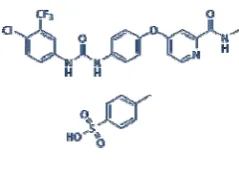
One of proved VEGFR-2 inhibitor on the market today is Sorafenib tosylate (Fig.1). In vitro study, sorafenib tosylate inhibits both wild-type and V599E mutant B-Raf activity with IC50 of 22 nM and 38 nM, respectively. Sorafenib tosylate also potently inhibits mVEGFR-2 (Flk-1), mVEGFR-3, mPDGFRβ, Flt3, and c-Kit with IC50 of 15 nM, 20 nM, 57 nM, 58 nM, and 68 nM, respectively(Lu et al., 2013)
Figure 1. Sorafenib tosylate
Suhud et al. (2015) has proven that a lead com-pound 1-benzoyl-3-benzylurea (Fig.2) in- silico in-hibits Raf-kinase (PDB code 1-UWH) with Rerank Score -90,5615 Kcal/mol and in-vitro against MCF-7 cell line with IC50 384,87 µM.
Figure 2. 1-Benzoyl-3-benzylurea
Both of sorafenib and 1- benzoyl-3-benzylurea have the same urea functional group. In order to find a novel effective angiogenesis inhibitor, the recent study on structural modification 1-benzoyl-3-benzylurea was conducted. All compounds will terfere with the binding of VEGF to VEGFR-2, in-hibiting VEGF-induced signal, and block cancer growth. Prediction of activity as VEGFR-2 inhibitor would be performed by MVD 5.0 molecular dock-ing. Prediction of bioavailability and toxicity will be performed by ACD-I/ Lab.
2 METHODS
Structural modification was carried out by substitut-ing 22 substituents with certain physicochemical properties (lipophilic, electronic, and steric) into benzoyl group of the lead compound 1-benzoyl-3-benzylurea:
2-chloro; 3-chloro; 4-chloro; 2,4-dichloro; 3,4-dichloro; 4-chlorometil; 3-chloromethyl; 2-chloromethyl; methyl; ethyl; 3-ethyl; 2-ethyl; 4-prophyl; 4-t-buthyl; 4-fluoro; 2-trifluoromethyl; 3-trifluoromethyl; 3-trifluoromethyl; bromo; 4-bromomethyl; 4-nitro; 4-methoxy.
2.1 Molecular docking
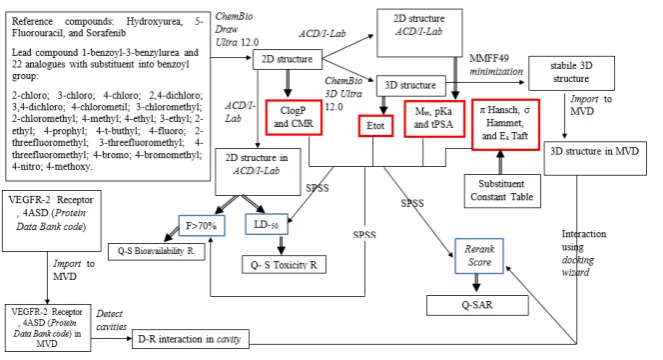
Computational method in term of in-silico activity test is started with searching Protein Data Bank /PDB database (Yanuar, 2012). Molecular docking was done to 1-benzoyl-3-benzylurea lead and its an-alogue compounds, also the reference hydroxyurea and 5-fluorouracil by Molegro Virtual Dock-er(MVD) 2011.5. Two dimention (2D) and 3D struc-tures were performed by ChemBioDraw Ultra 12.0 2010 from CambridgeSoft®.
2.2 Test parameter
Figure 3. Research Procedure
3 RESULTS AND DISCUSSION
Computational (in silico) methods has been done to bioavailability, activity and toxicity test. These in silico methods include databases, quantitative struc-ture- bioavailability/ activity and toxicity relation-ships using computer and software as tools. Such methods are frequently used in the discovery and op-timization of novel compounds with affinity to a tar-get. The aim of these in silico methods for pharma-cology in terms of the targets addressed (Ekins S et al.,2007)).
VEGFR-2 appears to mediate almost all of the known cellular responses to VEGF (https://www.ncbi.nlm.nih.gov/pmc/articles/PMC42 60048/ downloaded on 04/16/2017)
VEGFR2 is considered to be one of the most im-portant regulators of angiogenesis, and is a key tar-get in anti-cancer treatment (Avendano, 2015; Endo et al., 2003; http://jcp.bmj.com downloaded on 09/12/2016,).
Inhibition of VEGFR-2 thus blocked all VEGF-induced endothelial cellular responses tested, and became a potentially targeted therapy as antiangiogenesis (Cervello, et al., 2012; Endo et al.,2003)
VEGFR-2 with PDB code (Protein Data Bank) 4ASD was chosen because of sorafenib as a ligand. Sorafenib (Nexavar), approved by Food and Drug Administration (FDA) for the treatment of advanced renal cell carcinoma (RCC) in 2005 and unresectable hepatocellular cell carcinoma (HCC) in 2007, is the first orally bioavailable, multi-receptor tyrosine kinase inhibitor. This diaryl urea small molecule inhibits several kinases involved in tumor proliferation and tumor angiogenesis including Raf, vascular endothelial growth factor receptor
(VEGFR), and platelet derived growth factor recep-tor (PDGFR), (Lu et al., 2013; Avendano, 2015).
Sorafenib is also used as a reference beside of hydroxyurea and 5-fluorouracil which were estab-lished as anticancer. The same urea functional group in these compounds becomes the reason to dock hydroxyurea, 5-fluorouracil, 1-benzoyl-3-benzylurea lead and its analogue compounds as antianticancer by VEGFR-2 inhibition. The docking result is pre-sented in Table 1.
Table 1. Docking results of all compounds
No. Compound Rerank Score (kcal/mol)
1 1-benzoyl-3-benzylurea -96,9887
2 1-(2-chlorobenzoyl) -3-benzylurea -97,0605
3 1- (3-chlorobenzoyl) -3-benzylurea -100,64
4 1- (4-chlorobenzoyl) -3-benzylurea -99,0598
5 1- (2,4-dichlorobenzoyl) -3-benzylurea -98,7292
6 1- (3,4-dichlorobenzoyl) -3-benzylurea -104,613
7 1- (4-chloromethylbenzoyl) -3-benzylurea -102,067
8 1- (3-chloromethylbenzoyl) -3-benzylurea -106,427
9 1-(2-chloromethylbenzoyl) -3-benzylurea -102,834
10 1- (4-methylbenzoyl) -3-benzylurea -100,401
11 1- (4-ethylbenzoyl) -3-benzylurea -101,873
12 1- (3-ethylbenzoyl) -3-benzylurea -109,53
13 1- (2-ethylbenzoyl) -3-benzylurea -104,537
14 1- (4-prophylbenzoyl) -3-benzylurea -105,938
15 1- (4-t-buthylbenzoyl) -3-benzylurea -100,14
16 1-(4-fluorobenzoyl) -3-benzylurea -98,4593
17 1-(2-trifluoromethylbenzoyl) -3- benzylurea -93,2305
18 1- (3-trifluoromethylbenzoyl) -3- benzylurea -111,711
19 1- (4-trifluoromethylbenzoyl) -3- benzylurea -104,119
20 1-(4-bromobenzoyl) -3- benzylurea -99,6173
21 1-(4-bromomethylbenzoyl) -3- benzylurea -100,269
22 1- (4-nitrobenzoyl)-3- benzylurea -104,774
23 1-(4-methoxybenzoyl) -3- benzylurea -98,6492
24 Hydroxyurea -41,5724
25 5-Fluorouracil -60,7791
26 Sorafenib -136,297
Rerank score -111,711 kcal/mol indicates that 1- (3-trifluoromethylbenzoyl)-3- benzylurea is the most stable D-R interaction and is predicted to have the best activity as VEGFR 2 inhibitor. Theoretically, trifluoromethyl (-CF3)changes the electronic
distri-bution because of its most electronegativity. Elec-tronegativity is based on an arbitrary scale, with flu-orine being the most electronegative (EN4.0). Fluorine attracts electrons strongly. Group with elec-tronic effect induced D-R interaction and reduced electronic density (Thomas, 2003; Mc.Murry, 2011). Hydroxyurea and 5-fluorouracil showed rerank score -41,5724 Kcal/mol and -60,7791 kcal/mol that mean less stable D-R interaction compared to all tested compounds. Lipophilic groups like benzyl and benzoyl could stabilize D-R interaction leading to increasing activity. Moreover, other substituents with variety in lipophilic, electronic, and steric properties into benzoyl group seem to increase activ-ity. Unfortunately, all tested compounds have high-er rerank score (in range -93,2305 to -111,711 Kcal/mol) compared to sorafenib (-136,297 Kcal/mol). It was probably influenced by the differ-ence of aminoacids site bonding to sorafenib and all tested compounds. Sorafenib bound Asp 1046 on one site of –CO group and also bound Glu 885 on two sites of –NH from urea pharmacophore. On the
other hand, almost all of the tested compounds bound Asp 1046 on one site of –CO group and only bound Glu 885 on one site of –NH from urea pharmacophore. Based on these results, all tested compounds have higher VEGFR-2 inhibitor activity compared to hydroxyurea and 5-fluorouracil but lower than sorafenib. That is necessary to develop activity with equations below:
- Non linear relationships between modification of physicochemical properties and bioavailability prediction
F>70% oral = -1.548 ClogP + 0.198 ClogP2 + 0.125 pKa – 0.168 CMR + 3.502)
(n = 23; r = 0,717; SE = 0,093351; F = 4,757; sig = 0,009)
There is a nonlinear significant relationship be-tween physicochemical properties and ability. ClogP dominantly influenced bioavail-ability. Increasing ClogP will be followed by increasing in bioavailability until a certain point. After that, the bioavailability will decrease if ClogP is increased.
Rerank Score = 1.802 Es + 5.421 ClogP2 – 44.744 ClogP – 11.152
(n = 23; r = 0,622; SE = 3,5801997; F = 4,004; sig = 0,023)
There is also a non linear significant relationship between physicochemical properties and activity. ClogP take the main role in activity compared to Es. Increasing ClogP will be followed by increasing in activity until a certain point. After that, the ac-tivity will decrease if ClogP is increased.
- A linear relationship between modification of physicochemical properties and toxicity prediction
LD-50 Mouse = -7.422 Mw – 117.197 pKa +
260.565 π + 4342.379 (n = 23; r = 0,793; SE = 140,87733; F = 10,062; sig = 0,000) There is a linear significant relationship between physico-chemical properties and toxicity. π take the main role in reducing toxicity in mouse. Increasing π will befollowed by increasing LD-50 Mouse.
Thus mean the toxicity will decrease.
LD-50 Rat = 691.028 CMR – 21.453 Etot –
430.187 π – 4775.208). (n = 23; r = 0,733; SE = 288,67963; F = 7,353; sig = 0,002)
There is also a linear significant relationship be-tween physicochemical properties and toxicity in rat. CMR take the main role in reducing toxicity in rat. Increasing CMR will be followed by in-creasing LD-50 Rat. Thus mean the toxicity will
decrease.
These quantitative equations can be used as foun-dations for further structural modification to discov-er a novel potential anticancdiscov-er drug with bettdiscov-er bioa-vailability, activity, and minimum toxicity.
4 CONCLUSION
There are nonlinear relationships between modifica-tion of physicochemical properties with bioavailabil-ity prediction (F>70% oral = -1.548 ClogP + 0.198 ClogP2 + 0.125 pKa – 0.168 CMR + 3.502) and modification of physicochemical properties with ac-tivity prediction (Rerank Score = 1.802 Es + 5.421 ClogP2 – 44.744 ClogP – 11.152). Also, there is a linear relationship between modification of physico-chemical properties and toxicity prediction (LD-50
Mouse = -7.422 Mw – 117.197 pKa + 260.565 π + 4342.379 and LD-50 Rat = 691.028 CMR – 21.453
Etot – 430.187 π – 4775.208). These quantitative equations can be used as foundations for further structural modification to discover a novel potential anticancer drug with better bioavailability, activity, and minimum toxicity.
ACKNOWLEDGEMENTS
We would like to thank Faculty of Pharmacy The University of Surabaya and Airlangga University for all their supports in this research.
REFERENCES
ACD Labs. 2014. ACD/I-Lab Online Property Prediction.
Ad-vanced Chemistry Development, Inc., Toronto, ON, Cana-da. www.acdlabs.com.
American Cancer Society. 2013. Targeted Therapy. American
Cancer Society, Inc., Atlanta, Georgia. www.cancer.org.
Ammiraju Y, Dasari C, Venkata T, et al. 2012. In Silico Mo-lecular Docking Analysis of Few Plant Compounds as Al-dose Reductase Inhibitor. Journal of Bioinformatics & Re-search 1(2): 33-35.
Avendano C, Menendez CJ. 2015. Medicinal Chemistry of
An-ticancer Drugs 2nd edition. Elsevier, USA.
Cervello M, McCubrey J, Cusimano A., et al.. 2012. Targeted Therapy for Hepatocellular Carcinoma: Novel Agents on the Horizon. Oncotarget 3: 236-260.
Ekins S, Mestres J, Testa B. 2007. In Silico Pharmacology for
Drug Discovery: Applications to Targets and Beyond.
Brit-ish Journal of Pharmacology 152: 21-37.
Endo A, Fukuhara S, Masuda M, et al.2003. Selective
inhibi-tion of vascular endothelial growth factor receptor-2 (VEGFR-2) identifies a central role for VEGFR-2 in human
aortic endothelial cell responses to VEGF.J Recept Signal
Transduct Res.23(2-3):239-54.
FDA. 2003. Guidance for Industry: Bioavailability and
Bioe-quivalence Studies for Orally Administered Drug Product-General Consederations, Center for Drug Evaluation and Research, Rockeville
Fontanella C, Ongaro E, Bolzonello S, et al.. 2014. Clinical
advances in the development of novel VEGFR2 inhibitors.
Ann Transl Med 2(12): 123.
Huang J, Zhang X, Tang Q, et al. 2011. Prognostic
Signifi-cance and Potential Therapeutic Target of VEGFR2 in
Hepatocellular Carcinoma. Journal of Clinical Pathology
64: 343-348.
Lu CS, Tang K, Li Y, et al. 2013. Synthesis and In Vitro
Anti-tumor Activities of Novel Benzyl Urea Analogues of
Sorafenib. Acta PharmaceuticaSinica 48(5): 709-717.
McCurry J. 2011. Organic Chemistry with Biological
Applica-tions. Brooks/Cole Belmont, CA
McTigue M, Murray BW, Chen JH, et al. 2012. Molecular
Conformations, Interactions, and Properties Associated with Drug Efficiency and Clinical Performance among
VEGFR TK Inhibitors. Proceedings of the National
Acad-emy of Sciences of the United States of America
109(45):18281-18289.
Molegro ApS. 2011. Molegro Virtual Docker: User Manual,
ApS. Aarhus, Denmark.
RCSB PDB. 2016. Protein Data Bank, New Jersey, USA,
www.rcsb.org.
Shibuya, Masabumi. 2011. Vascular Endothelial Growth Fac-tor (VEGF) and Its RecepFac-tor (VEGFR) Signaling in Angi-ogenesis: A Crucial Target for Anti- and Pro-Angiogenic Therapies. Genes & Cancer 2(12): 1097-1105.
Sigma Aldrich. 2015. Sigma-Aldrich, Sigma-Aldrich Co. LLC,
Canada, USA. www.sigmaaldrich.com.
Steven E. 2014. Medicinal Chemistry The Modern Drug
Dis-covery Process. Pearson Education Inc, United States of America, 298-317.
Suhud F, Siswandono, Budiati T. 2015.Synthesis and Activity
Evaluation of a Novel Lead Compound
Benzylurea as Antiproliferative Agent. World Journal of Pharmaceutical Sciences 3(2): 192-195.
Thomas G. 2003. Fundamental of Medicinal Chemistry. John
Wiley & Sons Ltd, England.
Yanuar A. 2012. Penambatan Molekular: Praktek pada