borderless communities
& nations with borders
rd
The 3 International
Indonesian Forum for Asian Studies
Challenges of globalisation
Universitas Gadjah Mada & Universitas Islam Indonesia
Yogyakarta
INTERNATIONAL INDONESIAN FORUM FOR ASIAN STUDIES
borderless communities
& nation with borders
rd
The 3 International
Indonesian Forum for Asian Studies
Challenges of globalisation
thFebruary 8-9 2017 | Gedung Lengkung UII Yogyakarta
welcome address
International Indonesian Forum for Asian Studies
The International Indonesian Forum for Asian Studies (IIFAS) is an organically grown academic
network to enhance the study of the Asia-Paci c region. It was initiated by several doctoral
students from Indonesia, Australia and several other countries with the aim to provide an
opportunity for young academics in their start-up phase of their career and established academics
to meet together in academic exchanges. Sharing research ndings and opening discussion in an
interchange of knowledge at renown academic venues was the desire for the founding members.
Building on a series of successful conferences and public lectures of some of its initial members
has made IIFAS grown considerably.
After receiving a keen invitation from two hosting partners, Universitas Gadjah Mada (UGM) and
the Universitas Islam Indonesia (UII), IIFAS has come to Yogyakarta in 2017. The Forum is dedicated
to friendly and open exchanges in a truly academic tradition, thus actively welcoming participants
from Asia, the Paci c and the rest of the world. The call for papers was circulated in May 2016 and
by request extended till the 15th of January 2017. IIFAS is aware of the difficulties some far away
students might face to present a paper in person at the conference venue in Yogyakarta. As a result
of those difficulties, some presenters have been permitted to prepare a poster or absentee
presentation at the conference.
I wish to thank the generous UII and UGM rectors, deans, heads of departments, lecturers, staff and
volunteer students for the outstanding facilities granted and services provided at this 3rd IIFAS
Borderless Communities and Nations with Borders: Challenges of Globalisation Conference. I
encourage all delegates and guests a constructive time in creative exploration of innovative
interdisciplinary research ideas. I wish you an enjoyable time at the conference, a wonderful
experience meeting the Yogyakarta residents and visiting the magni cent sites of interest that
virtually stretch between the beach of Parangtritis and the top of Mount Merapi volcano.
Welcome and thank you for your endeavours meeting here together.
Foreword
Center for Southeast Asian Social Studies (CESASS),
Universitas Gadjah Mada
We are pleased to welcome all the honourable speakers, guests, and participants to the heart of
Java in Yogyakarta, Indonesia, a city of arts surrounded by traditional ambience as a source of
Southeast Asian treasure.
Universitas Gadjah Mada, through its CESASS, promotes a social transformation in Southeast Asian
epistemic community based on how Southeast Asian see themselves, and to be a hub for its
studies network in global scale. CESASS was also pointed as a Center of Excellence (PUI) in social
science by Ministry of Research and Higher Education of the Republic of Indonesia since 2016. By
this mandate, the Center prioritizes to develop advanced research management and to promote
inclusiveness in reconstruction of Southeast Asian studies.
In regard to those roles, the Center aims to bound an epistemic community of Southeast Asian
studies for knowledge transfer and scholars networking. 3rd IIFAS Conference is one of the
signi cant agendas from CESASS, as well as our partners; IIFAS and UII, to deliver that purpose. By
gather all the scholars to discuss a discourse in the studies, it might be useful for our research
development near future. I do hope that you will take this opportunity to explore the potential
knowledge and broadening your network.
We are glad for meeting you in this Conference and wish you have fruitful forums. Hopefully, it can
contribute to the development of Southeast Asia and Social Studies.
Foreword
International Relations Department,
Universitas Islam Indonesia
Welcome or selamat datang to the 3rd International Indonesia Forum for Asian Studies (IIFAS). This
year the 3rd IIFAS Conference is held in Yogyakarta and co-hosted by the Department of
International Relations of Universitas Islam Indonesia (UII) and the Center for Southeast Asian
Social Studies of Universitas Gadjah Mada (PSSAT UGM). We are delighted to share with you the
city of Yogyakarta, a well-known academic magnet for many students of the Indonesian
Archipelago and international visitors alike who visit Indonesia every year. The city is a host to
several hundred institutions of higher education and also truly one of the most important centers
of Javanese culture. Therefore, Yogyakarta ought to be a perfect spot for this conference event and
for us to meet at this occasion.
The two host universities of this year's conference have both their own uniqueness. It is not very
well known but UII holds the title of the oldest national private university in Indonesia, while our
partner in this conference, UGM, holds the title of the oldest state university here in Yogyakarta. UII
has committed itself to provide study opportunities in the many elds of sciences and the religion
of Islam for the bene t of the society. This IIFAS conference is one of UII efforts to ful ll its
commitment in sciences and to provide a greater understanding of our particular religious'
feelings. The conference has opened an opportunity for a greater interaction among academics
and guests. As the conference theme indicates, we hope in these two days to explore and share
ideas on how borderless communities interact in a eld of nations with xed borders. We hope
that the conference will expose signi cant results for the development of knowledge and society.
TABLE OF CONTENTS
Facing Asean Economic Community Opportunities and Challenges by
Optimizing Distribution Route – A Case Study at X Logistic SDN BH
I-FOCUS Model: Today and Future OOH Media Industry – Ethical Consideration
Determinants of Innovativeness in ICT-Based Firms in Indonesia: The Role of
Institutional Conditions, Network Strength and Network Open
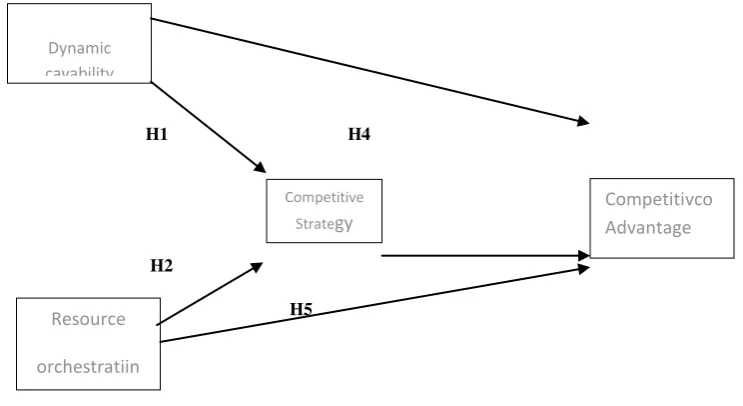
The In uence of Resource Orchestration and Dynamic Capability on
Competitive Strategy and Their Implications Toward Competitive Advantage
Innovation Leadership to Enhance the Performance of Construction State
Owned Company in Indonesia
Predicting Data-Driven Power Shifts Through Decision Maker Cognitive Styles
Open Career System and the Opportunity for Female Civil Service to Occupy
the High Leader Position in Local Bureaucracy in Indonesia
Business Swing: Flexibility to Agility
Developing Values-Based Leadership in Family Business for Sustaining
Business Success across Generations
Followership and Leadership Role in Improving the Competitive Advantage of
Companies at The Global Market (Case Study on Quick Service Restaurant)
Innovate or Die: Future Management is an Integrated Innovation
Internalization of Idealism and Relativism on the Perception of Accountants'
Ethics Code
The In uence of Locus of Control and Professional Commitment Toward
Auditor's Behavior in Con ict Situation
The Kebon Rojo Incident on 3 October 1945 in Pekalongan
Dealing with Distinction: Challenge for International Students of Public
University in Surabaya
Principle Of Non – Discrimination As A Result Of Parallelism Of Human Rights
And International Economic Law In Southeast Asia
“Cabotage” as the Final Stages of Open Sky Policy: Indonesia Challenges and
Implementation in Asean Community Framework
Digital Generation in the Indonesia Palm Oil Industry
Dynamic Cross-Cultural Competencies for Future Global Leader: A Systematic
Literature Review
Implementation of Camat's Performance Agreement in Improving the Quality
of Public Services in Bandung City
Making Home in a New Space: The Birth of a Community
Evolution Knowledge based Dynamic Capabilities: Indonesian SME
Perspectives
From Local to Global: Culture Oriented Product Design
ASEAN's Non-Interference Principle as an Obstacle in Surmounting the
Problem of Indigenous Tribes in the Region Case Study: The Existence and
Acknowledgement of Sama Bajau People in Contemporary World
New Actors on a Global Stage: Grassroots Responses to Globalisation in
Myanmar
Analysis of Community's Willingness to Accept (WTA) on Waste Management
of Waste Bank Programme in Yogyakarta City
Governments' Responses in Facing The Disbandment of Stephen Tong's
Revival Worship in Bandung as The Test of City Tolerance
Contesting ISIS in Indonesia: Leadership and Ideological Barriers on Radicalism
as Foundation to Counterterrorism
Challenges Of Negative Globalisation: The Role Of Pesantren In Counter To
The Spreading Of Salafy Jihadism In Indonesia
365
The Use Of Learning Digital Media To Increase Interest And Learning
Achievements History At High School Students
The In uence of Dialogue towards English Speaking Ability for Eleventh Grade
Senior High School at SMAN 3 Kota Serang
The Effectiveness of Word Wall Strategy on Students' Vocabulary Mastery
The Strategy to Make Themes and Develop Teaching Materials of Integrated
Science in Junior High School
The Multimodal Analysis in Printed Advertisement and Its Application in
Language Teaching
The Importance of Integrated Sciences Teaching Materials Based on the
Potential Advantages of Lombok to Improve Students' Understanding on the
Environment
Authentic Assessment of Reading Skill in Learning Indonesian Authentic
Assessment of Reading Skill in Learning Indonesian
Pre-Service Teachers Performance in Field Study Courses and Practice
Teaching
Increase Nationality Insight Through Learning History
History Learning in Nonformal Education
Developing Students' Patriotism at Indonesian School in Singapore
Serat Mudhatanya : The Values Of Leadership And The Utilization Of The
History Learning in High School
Religious Education Having Multiculturalism
Investigation Students' Logical Thinking Abilities on Chemistry Learning
Students' Creative Disposition, Creative Thinking Skill, and Creative Product in
Engineering Design-Based Science Learning Activity
Probing Environmental Wisdom In Bahasa Indonesia Curriculum 2013 Grade
Vii And X Textbook Published By Kemendikbud: An Ecocriticism Assessment By
Greg Garrard
English Acquisition Towards Students With Special Needs Through Inclusive
Education In Central Java Province
EFL Undergraduate Students' Learning Style Preference
537
Democracy, Is It Ideal or Just Another Things to Deal?
Indonesian Government Policy In Prevention And Combating Corruption In
The Public Sector In 2014-2015
Compliance on Fragmented Regimes: A Southeast Asian Perspective on
International Refugee Law
Interpretation of Political Communication: The Al-Maidah 51 Case
The Challenge of Sustainable Innovation in Palm Oil Industry
The Role of Sogo Shosha Companies toward Japan Security Posture
Shifting:nGlobalized Economy-Security Nexus
The De ciency of Deradicalization Program by The National Counter Terrorism
Agency (NCTA) Indonesia
Demolition Of Foreign Ship With Illegal Fishing As A Form Of Protection Of
Marine Sovereignty In Indonesia
The Urgency of Border Markers Revitalization at Land Border between
Indonesia-Malaysia as Manifestations of Indonesia's Sovereignty and Territorial
Stability (Case Study Temajuk Village, Sambas Regency, West Borneo Province)
The Role of Indonesia's Public Diplomacy in Combating Islamophobia after the
Rise of ISIS
The Thinking of Economic Independence by Muhammad Husni Tham
Fukuda Doctrine in The Middle of Growing ASEAN: Is It still Relevant?
Ideology about Post-Indonesia Human According to Novel Burung-burung
Manyar (Critical Discourse Analysis on Y.B.Mangunwijaya Work)
The Implementation of R.A Kartini's Heroism Values in Learning of Social
Science In SMPS Kartini Mataloko, Ngada - East Nusa Tenggara
Idolizing Westernized Bodily Practices: A Deconstruction of Men's Lifestyle
Magazine in Indonesia
The Western-Eastern Concept Found In The Trends Of Indonesian Celebrity
Wedding Ceremonies
Social Factors In uencing Generation Y's Purchase Intention of Local Brand
Fashion in Bandung
716
Does Arabic Brand Name The Most In uencing Factor in Halal Cosmetic
Purchase Intention? A preliminary Study
Is There Any Difference between Muslim and Non-Muslim Consumer's
Purchase Intention Towards Halal Cosmetic? A Preliminary Study
The Shift in Responsibility to Pesantren: From Collective Efforts to
Self-Struggle
Quranic-Sociological Perspectives on Environmental Issues within Tambak
Cemandi Sidoarjo Fisherman Community
The Relationship of Parental Verbal Aggression and Delinquency among Early
Adolescents in Banda Aceh
The Prohibition of Pregnant Marriage by Modin: Case Study in Temas Village,
Batu
Politeness Strategies In The Way Of Rejection Utterance Based On Gender
The effect of Work-Family Con ict at the Ministry of Health in Indonesia
Does Greener Really Seem Healthy? Investigating the Effect of Packaging Color
on Consumer's Healthfulness Perception
Ustaz Abdullah Gymnastiar's Speaking Politeness Strategy in Indonesia
Lawyers Club Talkshow on TV One
Local Culture and Tradition: Local Tradition Preservation Ruwatan Rambut
Gembel as a Culture Heritage
Mangatawa Ta: A Study on the Humor in Mindanaon Memes
Enkulturation of Suluk Wujil Value of Build Social Solidarity in Multicultural
Society
The Relevance of Abdul Rivai's Thought in Teaching History in the
Globalization Era
Gender Gap In Granting The Customary Title “Pohutu Momulanga” In
Gorontalo
The Role of Berasan bekule Culture As The Customary Law within the Society
of Pasemah in South Bengkulu
Begging Tradition : A Challenge To Develop Muntigunung Village As A Tourist
Village In Globalization Era
Women and Men Portrayal – A Critical Discourse Analysis of Indonesian
Folklore
Bubuksah Gagangaking Relief is as Religious Tolerance Symbolism of
Majapahit
Interpretation of the Values of Babad Wirasaba as the Form of Leadership
Local Belief System, Tatouage, Tradition and Adaptation in Mentawai
Multiculturalism Discourse in South Korea: Re ection on Internationalisation
of Korean Higher Education
The Translation of Risalah Al-Mu'awanah as The Base Foundation of
Multicultural Studies Between Arabic and Javanese Language
A Proposed ICT Framework for Natural Language Processing to Detect Hate
Speeches within Online Media
A Critical Discourse Analysis of Donald Trump Victory Speech and Its
Application in Elt
Films Based on Adaptation, Sequel, Prequel, and Remake: Between Creativity
and Market Dominance
The Inferiority of Southeast Asian Women toward Korean Women
Objectivity of republika.co.id in Reporting the Trial Court of Religion
Blasphemy with Ahok as Defendant
Superhero: Modern Role Model in Pop Culture Society
Social Media and Globalization: The Importance of Instagram for
Communicating World-Class University
Citizen Journalism on the Twittersphere:The shift from alternative journalism
to citizen journalism
Pseudo-Identity: Lifestyle's Ecstasy Society in Whatsappization
Law of Information and Electronic Transactions vs Twitter: Which one
Stronger?
The Meaning of Dependent Clause in German Teen Book “Die Ilse ist Weg” by
Christine Nöstlinger
Adolescent's Beauty and Body Images in Joyce Carol Oates' Novels
The Portrayal of Women in a Collection of Short Stories Kumpulan Budak Setan
Margaret's Loneliness in Tennessee William's a Cat on the Hot Tin Roof
The Values and Functions of Proverbs in Pasemah language by The Society of
Kedurang, South Bengkulu
The Governmentality System in Dystopian Society in Veronica Roth's
Divergent
Between Dynamic Strategies, Competitive Reality, and Borderless Consumers:
Price War in the Indonesian Lighting Industry
Accelerated Transformation of Indonesian SME's: Embracing Entrepreneurial
Orientation and Innovation on Achieving Dynamic Capability to Increase
Competitiveness
Absorptive Capacity on External Knowledge Acquisition: Predicting Innovation
that Helps Indonesian SMEs
The End of Competitive Advantage of Palm Oil Industry and How Sustainable
Development Affect Competitive Advantage
Role of Palm Oil Companies in Indonesia as a Nation Competitive Advantage
Does Poverty Affects Child Labour and School Attendance? : Evidence from
Indonesia
A Quest for Public – Private Partnership Form in Achieving Indonesian's Food
Security Goals : A Case Study on Beef Industry in Indonesia
The Spatial Pattern and Determinants of Poverty: Case of Central Java Province
in Indonesia
Culture As A Capital To Improve The Local Economy Case Study In Cibuntu
Village, Kuningan
Relationship between Exchange Rate Market and Stock Market in Indonesia
Indonesian Talent Go Global: Preliminary Study on Millennials
Labour Commodi cation In Indonesian Television Industry: Exploitation And
Capitalization of Labours on False Consciousness (The Political Economic of
Media Research on Television Program Production in Indonesia)
Analysis of Global Scale Meteorology to Food Security in East Java Province
Phytoremediation of Rice Field Contaminated by Chromium with Mendong
(Fimbristylis globulosa) To Supporting Sustainable Agriculture
Occupational Diseases Prevention In The Use Of Pesticides In Agricultural
Sector Karanganyar
Limited Dual Nationality in Indonesia, A Study of Human Right Protection
The Determinant Factors of Developing Type 2 Diabetes Mellits: Case - Control
Study in Primary Health Care in Surabaya 2016
Potential Hazard Analysis With Fishbone Method Due To High Noise At Pt. X
Hazard Identi cation Risk Assessment And Determinating Control Model For
Work Related Diseases Prevention In Informal Sector Batik Karanganyar
Androgynous Male Gender Performativity in Padang
Women Demysti cation in Terrorism: Critical Analysis of Terrorists' Wives as the
Ignored Group
Analysis Of Gender Issues Comfort Women Issues In Yogyakarta
Women Construction Worker and Future in The Era of Globalization
Problem Solving Method Development for Improving the Quality of
Indonesian History Learning in Vocational High School
Comparative Study Between Project-Based Approach and Inter-Question
Approach in Teaching the Voice Over Internet Protocol Course
Acceleration Of Illiteratacy Eradication By Peer-Tutor Method
The Effect of Using Teams-Games-Tournament (TGT) Technique on the
Eleventh Graders' Reading Comprehension at SMAN 55 Jakarta
Opportunities to Integrate Disaster Education in Junior High School Science
Learning
Facing Asean Economic Community Opportunities and
Challenges by Optimizing Distribution Route
–
A Case
Study at X Logistic SDN BH
Facing Asean Economic Community Opportunities and
Challenges by Optimizing Distribution Route
–
A Case Study at X Logistic SDN BHD
Audria Ineswari
1and Ratih Hendayani, S.T, M.M.
21 [email protected] 2 [email protected]
ABSTRACT
X Logistic Sdn Bhd is one of the logistic company located in Malaysia. Its service is to deliver Fast Moving Consumer Goods (FMCG) to all over Malaysia and some other South East Asia countries (Singapore and Brunei). The establishment of the ASEAN Economic Community (AEC) allows participating countries to make easier transactions so that market competitivesness will be increasing. On the other hand, Indonesia retail market is now experiencing growth. This phenomena leads enterprises to produce more FMCG products, therefore not only the quantities of products that is increasing but also the variety, especially, food
and beverage products. Due to the interesting variety, foreign people imports Indonesia‘s products, including Malaysia. In the last 2015, Indonesia‘s ambassador for Malaysia, Herman Priyatno said that the import rate of
Indonesia to Malaysia is increasing up to 14,08% every year. X Logistic Sdn Bhd saw this phenomena as a
business opportunity. The company delivers FMCG products including Indonesia‘s product to more than 150
retailers in Malaysia, Singapore, and Brunei. Unfortunately, X Logistic Sdn Bhd does not implement any distribution method which leads company to losses because of its service. Therefore, company needs to implement a method to improve its service. Delivery route optimalization can be implemented using saving matrix method. The point is to arrange shortest and fastest delivery route to prevent delays. The result of this research is X Logistic Sdn Bhd is able to save 4.070,63 Ringgit Malaysia. Now, company can compete with other logistic companies in facing AEC as a manifestation of economic globalisation.
Keywords: logistic, AEC, routes, productivity, efficiency, globalisation. community to consume Indonesian products, including Malaysian. In 2015, Indonesian Ambassador to Malaysia, Herman Prayitno said that food and beverages market originated from Indonesia in Malaysia has increased by 14,08%.
There was Malaysian company that saw this phenomenon as a business opportunity. X Sdn Bhd is a
logistic company which its main business is distributing FMCG products, mostly from Indonesia to hundreds retailers located throughout Malaysia. Unfortunately, X Sdn Bhd has transportation problem. X Sdn Bhd does not apply any specific distribution route, so there is a possibility that the distribution route used is not the shortest route and company should pay more for fuel cost. This problem leads company to distribution delays,
impacting the company‘s losses. Final loss felt by company is, X Sdn Bhd is forced to raise its price of products
offered so the prices set are not a competitive price.
Saving matrix method is used to find the shortest distribution route so company is now able to reduce
2.
METHOD
2.1.
Theories
1. Operation Management
Krajewski, Ritzman, dan Malhotra (2010:24) defined Operation management as a sistematic design, directions, and control of a process that changes input into products or services for consumers. While the operation itself is a group of sources that do all or some parts of processes. These processes can be combined into a supply chain which connects internal and external processes of company.
2. Supply Chain Management
According to Hiezer dan Reinder (2014:468), Supply chain management is a coordination between all supply chain activities, started with raw materials and ended with a satisfied customer. Thus, a supply chain is consisted of suppliers, factories, distributor, retailers and/or wholesalers who ship products and/or services to the end customer. The purpose of supply chain management is to coordinate the activites of the supply chain to maximize its competitive advantage and benefits to consumers.
3. Saving Matrix
Wongso (2012) in Putranto and Hendayani (2014) stated that saving matrix is a tool do determine distribution routes based on customers coordinate and transporter capacity.
4. Efficiency
According to Horngren (2008) in Hapsari, Saputra, dan Rismadi (2013), efficiency is the amount of input used to achieve a certain level of output. Thus, efficiency value reflects how many inputs required to produce a given outputs. In this research, the percentage describes the efficiency of fuel
costs after implementing the new routes. The formula used is:
𝐸𝑓𝑓𝑖𝑐𝑖𝑒𝑛𝑐𝑦= 𝐹𝑢𝑒𝑙𝑐𝑜𝑠𝑡𝑠𝑎𝑓𝑡𝑒𝑟𝑖𝑚𝑝𝑙𝑒𝑚𝑒𝑛𝑡𝑖𝑛𝑔𝑡ℎ𝑒𝑛𝑒𝑤𝑟𝑜𝑢𝑡𝑒𝑠 𝐹𝑢𝑒𝑙𝑐𝑜𝑠𝑡𝑠𝑏𝑒𝑓𝑜𝑟𝑒𝑖𝑚𝑝𝑙𝑒𝑚𝑒𝑛𝑡𝑖𝑛𝑔𝑡ℎ𝑒𝑛𝑒𝑤𝑟𝑜𝑢𝑡𝑒𝑠
5. Productivity
Acoording to the OECD Compedion of Productivity Indicators (2015), productivity measures how efficient inputs of a production such as labor and capital which are used to produce an output. This research measures productivity of the new routes compred with the old ones. The formula is
𝑃𝑟𝑜𝑑𝑢𝑐𝑡𝑖𝑣𝑖𝑡𝑦= 𝑁𝑒𝑤𝑟𝑜𝑢𝑡𝑒𝑠 (𝑘𝑚) 𝑂𝑙𝑑𝑟𝑜𝑢𝑡𝑒𝑠 (𝑘𝑚)
2.2.
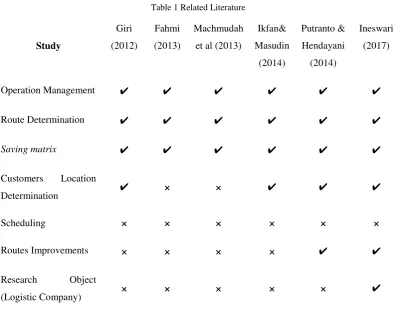
Related Literature
1. Giri (2012) wrote a journal titled ―Routing and Scheduling Analysis Using Saving Matrix Method
for Modern Trade Area Delivery in Desc Kimberli Indonesia‖. Eventhough there is no routes
improvements, Giri made a delivery schedule and transporters testing. The result of this study is the discovery of the shortest route and transporter costs decreased by Rp. 1.2375 million.
2. Fahmi (2013) conducted a study titled "Capacitated Vehicle Routing Problem (CRVP)
Completion Comparative Study Using Saving Matrix and Generalized Assignment Methods‖.
What makes this study different is Fahmi added Generalized Assignment method. Both methods are compared and the result that is saving matrix method produced a shorter distance compared with with generalized assignment method.
3. Machmudah et al (2013) conducted a research entitled ―Design of Information Systems
Determination of Routes and Transport Costs in New Sehati SMEs‖. SMEs New Sehati is the
Small and Medium Enterprises (SMEs) that produce home-cooked chips. SMEs New Sehati is the Small and Medium Enterprises (SMEs) that produce home-cooked chips. SMEs did not have a distribution method so that the transportation costs incurred quite high. After saving matrix method was applied, SMEs was able to save its distribution costs by 30%. This study does not propose delivery schedule.
4. Ikfan and Masudin (2014) wrote a journal entitled ―Saving Matrix for Determining Distribution
Route‖. The research subject was shuttlecock manufacture. This research discusses the application
of saving matrix method to solve XYZ company distribution problem. . Results from this study is the distribution cost is saved up to 10.94% in each period. This research also did not implement any improvement method.
productivity generated by 85.11%. Unlike the others, Putranto and Hendayani calculated routes
This research is done based on the related literatures by Giri (2012), Fahmi (2013), Machmudah et
al (2013), Ikfan (2014), and Putranto & Hendayani (2014).
2.3.
Research Method
First, it is assumed that every customer will be exclusively visited by one transporter. So, there
3. Alocate customers into distribution routes
The calculation in this step is based on the calculation result on the preveious step. Customers
will be divided into some routes by considering the saving matrix distance and also the capacity of each transporter used. A route will be categorized as a feasible route when the number of total customers do not exceed the limit of transporters and the total demand can be carried by one transporter. This step is started by sorting the saving matrix value between two different customers from the biggest to the smallest. Then, those customer will be placed into some transporters which are able to carry all the demands. If the capacity of the transporter is full, then the next customer will be placed in a different transproter which also be the different route.
4. Sort customers on route into a correct order
There are two similar ways to create optimal customers orders, nearest insert and nearest neighbor.
a. Nearest neighbor
First thing to do in this step is identify the nearest customer from warehouse. Then, that customer becomes the first visited customer in the route. After that, identify the second different point. The analysis technique can be seen in the following figure
b. Or-opt
Or-Opt method is identical to 2-opt method. The difference is, the number of paths that
can be removed and added are more than two. The basic concept of this method is to relocate several nearby customers.
literature, company‘s documents, and books. The secondary data gathered are company profile,
vission, and mission from its website, distance among customers from Google Maps, and some
information about research methods from books, thesis, papers, and other references.
2.5.
Framework of Thinking
Naik and Glickfeld (2015) stated that distribution system efficiecny reflects retailers ability to
maintain, operate, and control the distribution system. Putranto and Hendayani (2014) declared that as an effort to increase sales, company needs to make a system or route that well managed to ease distribution process. Therefore, saving matrix method is used to obtain the optimal routes. After calculating the saving matrix method, there is two additional methods, 2-opt and or-opt to get the shortest routes as the output. These methods are proved by Baldacci, Battara, and Vigo (2008) to produce better service by providing shortest routes. While Indrawati (2014) stated that in the VRP, achievable goal is to find the shortest route distribution using a minimum number of vehicles.
This objective of this research is to create system efficiency. This efficiency can be obtained
improvements is used as a reference to compare the distribution cost before and after the saving matrix method is applied. The smallest will be used by company to reduce its distribution cost.
3.
DISCUSSION
X Logistic Sdn Bhd main business activity is to distribute FMCG products to its customers which are seperated among Malaysia. The transporters used is Proton trucks with 3000 cartons capacity. The distribution area is divided into four main regions; Central, Southern, Northern, and East Coast. There are some sub regions in every region. The main calculation is using saving matrix methode. This method can be done only if the data required are complete, there are: total demand (in carton) of each sub region, the coordinate of each sub region that was obtained using Google Maps, and the distance between
each sub region to X Logistic Sdn Bhd‘s warehouse which also obtained using Google Maps.
Saving matrix method created delivery routes and the order of customers that will be visited. The results are divided based on the main distribution regions:
1. Central
Table 2 Calculation Result for Central Region
Route Customer Total Distance (km)
1 G-3-4-46-45-44-41-43-40-42-51-21- 54-56-53-55-19-26-52-49-48-50-47-36-34-G
286.23
2 G-6-8-7-2-9-29-5-23-G 122.29
3
G-20-22-16-18-17-27-25-24-30-33-32-G 149.04
4
G-28-31-35-37-38-39-15-10-14-11-12-13-G 119.68
Total 677.24
For the Central region, before saving matrix method is implemented, the total
distance is 625.63 kilometers. After combining or-opt and 2-opt method, the total distance
became higher which is 677.24 kilometers with the productivity level of 108,24%. The
maximum level of productivity is only 100%, so it can be concluded that the new route is less
productive than the old one. So, the Central region will use only the saving matrix method
without the combination of or-opt and 2-opt method.
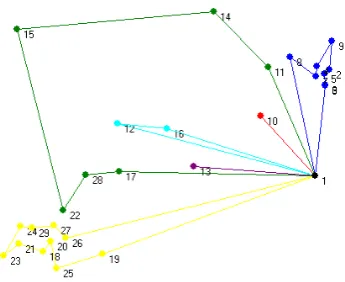
Figure 1: Central Region Routes Visualization
47-customer 36-customer 34-warehouse is indicated by dark blue line. Second route which is warehouse-customer 6-warehouse-customer 8-warehouse-customer 7-warehouse-customer 2-warehouse-customer 9-warehouse-customer 29-warehouse-customer 5-warehouse-customer 23-warehouse is indicated by red line. Third route which is 23-warehouse-customer 20-customer 22-customer 16-customer 18-customer 17-customer 27-customer 25-customer 24-customer 30-customer 33-customer 32-warehouse is indicated by green line. Last route which is warehouse-customer 28-customer 31-customer 35-31-customer 37-31-customer 38-31-customer 39-31-customer 15-31-customer 10-31-customer 14-31-customer
11-customer 12 –customer 13- warehouse is indicated by light blue line.
2. Southern
Table 3 Calculation Result for Southern Region
Route Customer Total Distance (km)
1 G-3-6-5-2-9-4-7-8-G 159.87
2 G-10-G 83.65
3 G-11-14-15-22-28-17-G 452.82
4 G-12-16-G 231.82
5 G-13-G 139.23
6 G-19-25-20-19-21-23-24-29-27-26-G 388.77
Total 1456.16
The second region is Southern. Before saving matrix method is implemented, the total distance is 3945.40 kilometers and the total routes is seven. After combining or-opt and 2-opt method, the total distance and routes were reducing to 1456.16 kilometers and six routes. Then, the productivity level of this region is calculated. The result is 37.09%.
Figure 2: Southern Region Routes Visualization
First route which is warehouse-customer 1-customer 3-customer 6-customer 5-customer 2 –
3. Norhtern
Table 3 Calculation Result for Northern Region
Route Customer Total Distance (km)
1
G-6-9-15-16-20-22-23-25-24-21-18-19-14-13-8-19-7-G 649.63
2 G-5-2-3-4-12-11-17-G 519.02
Total 1168.65
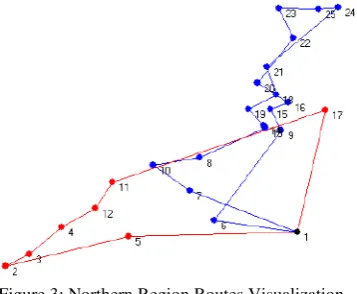
The third region is Northern. The or-opt and 2-opt method did not reduce the total routes but reduce only the total distance. Before saving matrix method is implemented, the total distance is 1880.91 kilometers. After combining or-opt and 2-opt method, the total distance is now 1168.65 kilometers with the productivity level of 62.13%.
Figure 3: Northern Region Routes Visualization
Dark blue line represents the first route which is warehouse-customer 6-customer 9-customer
15-customer 16-customer 20-customer 22-customer 22-customer 23-customer 25-customer 24-customer 21-customer 18-customer 19-customer 14-customer 13-customer 8-customer 19-customer 7-warehouse. While the red one represents the second route which is warehouse-customer 5-customer 2-customer 3-customer 4-3-customer 12-3-customer 11-3-customer 17-warehouse.
4. East Coast
Table 5 Calculation Result for East Coast Region
Route Customer Total Distance (km)
1 G-4-G 256.13
2 G-5-6-9-G 363.88
3 G-7-2-19-13-15-21-18-20-16-8-10-G 686.94
4 G-11-12-14-17-3-G 1399.64
Total 2706.59
The last region is East Coast. The or-opt and 2-opt method did not reduce the total routes but
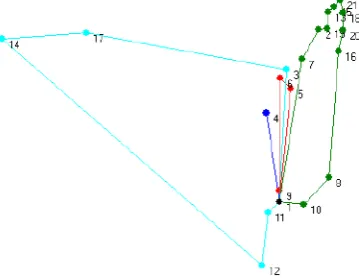
Figure 4: East Coast Region Routes Visualization
The first route is represented by the dark blue line which is warehouse-customer 4- warehouse. The red line represents the second route which is warehouse-customer 5-customer 6-customer 9-warehouse. The green line represents the third route which is warehouse-6-customer 3-warehouse. The last route is indicated by the light blue line which is warehouse-customer 11-customer 12-customer 14-customer17-customer 3-warehouse.
4.
CONCLUSION
This research object is located in X Logistic Sdn Bhd, Subang Jaya, Selangor, Malaysia. The study was conducted for approximately four months, from September 2016 to December 2016. X Logistic Sdn Bhd has more than 300 customers, spread all over Malaysia. However, the company refused to give all the customers data. Therefore, the location of customers which belong to the same sub region seen as a single distribution poin that represents that sub region. While the quantity of demanded products is accordance with the original conditions. Due to the limited data given by company, there are some assumptions applied in this study; paths used are two-way roads so the distance from origin (warehouse) to destination (customers) and vice versa are the same, all customer orders can be fulfilled by the company, customers demand is fixed and known in advance, the distance from customer A to B equals the discance from customer B to A, and the diesel price is stable at 2.05 Ringgit Malaysia (RM)/Liter.
From the calculation that had been done, it can be concluded that the distribution routes that should be taken by X Logistic Sdn Bhd is divided into four major regions. For the Central region, the routes that should be implemented is the route before improvements. There are four routes and the total distance is 625.63 kilometers. For the Southern region, the improved routes that should be implemented. There are six routes, the total mileage is 1456.56 kilometers. The best routes for Northern region are the result of improvements method, the total routes are two and a total distance is 1168.65 kilometers. The last region, East Coast also should implement the improved routes. The total distance is 2706.59 and the total routes are four. The other things that can be concluded is the productivity level. Productivity of Central region is 108,24%, Southern region is 37,09%, Northern region is 62, 13%, and East Coast region is 52.29%. While the distribution cost efficiency that successfully obtained is 30,37%, equals 4.070,63 RM.
There are also some suggestions for future studies, which are: future studies should compare
and combine saving matrix method with other VRP method to create shortest routes and also. Future research should also help company to implement distribution routes periodically.
5.
REFERENCES
Anonymous. (2014). Thirst Quenching: Indonesia‘s Food & Beverage Industry. [online].
Available:http://www.gbgindonesia.com/en/manufacturing/article/2014/thirst_quenching_indon esia_s_food_andamp_beverage_industry.php. 24 September 2016.
Fahmi. (2013). Studi Komparasi Penyelesaian Capacitated Vehicle Routing Problem (CVRP) dengan
Metode Saving Matrix dan Generalized Assignment – Jurnal Jurusan Matematika, 1. Taken from Universitas Brawijaya Journal.
Giri. (2012). Analisis Routing dan Scheduling dengan Menggunakan Metode Saving Matrix untuk
Muhammadiyah Surakarta Online Journal.
Hapsari, Saputra, and Rismadi. (2013). Evaluasi Efektivitas Pengendalian Biaya Produksi dan Efisiensi
Biaya Produksi (Studi Kasus di PT. XYZ). JAMS – Journal of Management Studies Vol. 02, No. 01. 41. Diambil dari Research Gate.
Heizer and Render. (2014). Operations Management: Sustainibility and Supply Chain Management.
New York:Pearson Education Limited.
Ikfan, Noer dand Ilyas Masudin. (2014). Saving Matrix untuk Menentukan Rute Distribusi - Jurnal
Ilmiah Teknik Industri, 2 (1), 14. Taken from Jurnal Ilmiah Universitas Muhammadiyah Malang.
Ilham. (4 May 2016). Produk Makanan Indonesia Digemari Warga Malaysia. [online]. Available:
http://republika.co.id/berita/ekonomi/makro/15/05/04/nnt4rj-produk-makanan-indonesia-digemari-warga-malaysia. 25 September 2016.
Krajewski, Ritzman, dan Malhotra. (2010). Operations Management: Process and Supply Chains. New
York:Pearson Education Limited.
Machmudah, dkk. (2013). Rancang Bangun Sistem Informasi Penentuan Rute Dan Biaya Transportasi
pada UKM New Sehati – Jurnal Sistem Informasi, 2 (2), 49. Taken from STIKOM Surabaya Journal.
Putranto, Rizal dan Ratih Hendayani. (2014). Distribution Route Optimization by Utilizing Saving
Matrix: Case Study In. Limas Raga Inti Bandung – European Journal of Economics and Management, 1 (2), 167. Taken from Research Gate.
Secretary-General of the OECD. (2015). OECD Compendium of Productivity Indicators 2015. Paris: OECD Publishing.
Wongso, Teodora. (2012). Optimalisasi Penentuan Rute dengan Pendekatan Forecasting dan Metode
I-FOCUS Model: Today and Future OOH Media Industry
–
Ethical Consideration
I-FOCUS Model: Today and Future OOH Media Industry
–
Ethical Considerations
Jimmy Lizardo
1, Yosef Dedy Pradipto
21Doctor of Research in Management / Bina Nusantara University, Indonesia, [email protected] ,
2Psychology Department, Faculty of Humanities / Bina Nusantara University, Indonesia, [email protected]
ABSTRACT
Out of home media as part of the creative industry is a business that has huge growth potential, even the out of home media penetration in Indonesia become the second highest after television. However, this growth leads to changes in the out of home media industry that become a phenomenon in the strength of industry competition and affect the business performance of the out of home media industry. This study examines the strategic management as an alternative model (I-FOCUS Model) of the solution in improving the business performance of the out of home media, which is based on four aspects: the implementation of Digital Innovation, an adaptation of the Forces Driving Competition, increasing the Core and Unique capabilities. The process of I-FOCUS Model in the business of Out of Home Media must think about the ethical side, because creativity in advertising content is shown in digital out of home media that is personal and fulfill the current ethics.
Key Words : Business Ethics, Digital Innovation, Strategic Management
I.
Introduction
Currently, there is a major transformation in the world economic order. Business persons are required to have insight, imagination, and high creativity to generate a competitive advantage in generating an economic added value. To succeed in the intense competition and rapid changes in the global economy the competition is no longer limited to the efficient management of raw material, service standard, and development of technology. The ability to focus on the power of innovation and seize every opportunity to offer products and services produced in a creative, artistic, and always foremost with brilliant ideas will gain a major place in the present.
That phenomenon has been explained partly by some of the classic modern theory in the period of 1950 - 1960; Walt Whitman Rostow pioneered one of them in The Stages of Economic Growth (1960). Modernization theory by Rostow shows that every stage of development can be attributed to the change from an agrarian society with traditional culture into the society of rational, industrial, and focuses on the service economy. In the last stage of development, the consumption is no longer limited to the necessities of life but has turned to a higher need. There were changes in the orientation of production and economic surplus that is not solely used for investments but also used for social welfare and sustainable development.
Economic development that had been providing increased prosperity for mankind portrayed by Pink (2005) went through several stages. Development of the world economy begins with the growth of the agricultural sector, followed by the industrial era, the dominance of information technology, up to the current conceptual era. Figure 1.1 shows how from time to time there has been a shift in the global economic order of the agricultural era to the conceptual era which in parallel followed by increased Affluence (prosperity), technology and globalization (ATG) in that era. This indicates that there is a positive correlation between the developments of the world economy with the increased of ATG as described in the classic modern theory.
Figure1.1 World Economy Experiencing Shift and the 21st Century is a ―Conceptual Age‖ Source: Daniel H. Pink, A Whole New Mind, New York, Riverhead Books, 2005
The agricultural era in the 18th century has the lowest level of ATG; there were a lot of local and regional only products with the use of simple technology so that the level of prosperity in the era was limited. The 19th century was the century of industry; in 1876 a steam engine was introduced that resulted in the revolution of the system of manufacture goods to become bulk and faster. This era showed a higher level of ATG because of advances in technology and the ability to market goods become more widely thanks to the application of steam engines on ships.
The 20th century is the information era. At this time, a microprocessor began to be created for a computer device that plays a significant role in encouraging the exchange of data and information through the Internet, so that space and time to access the information became unlimited. The opening of opportunities in accessing information data encourages faster economic growth, so capitalization is growing and has caused the rising of ATG in all regions of the world.
The 21st century or present time is a conceptual era. The new idea to make people more prosperous becomes the primary focus in the development of the world economy. Innovations, inventions, and creativity are the main assets to enhance the excellence and provide an opportunity to lead the global economy. ATG value in this era is higher than ever because technology and globalization are the main requirements so that a country's prosperity becomes unlimited. When the era of labor or skilled worker intensive then it takes about 10,000 or 100,000 people for 100 industries, hence the knowledge-creative intensive of a person will contribute economically start from himself up to other elements of the industry. The industry with conceptual and creativity basis is known as the creative industry.
II.
Theoritical Framework
Creative Industry, Advertising Industry and Out of Home Media
The creative industry has been around since the era of the agricultural, industrial, and information. But, at that time the level of human needs and the level of social interaction have not reached its present state, so in the era before the creative economy, the industry was not the center of attention or focus in the industrial development which is believed to contribute positively to the economy of a nation. This was revealed by Peter Drucker (2000) that "The success and failure of each country will be decided by the cultural industries in the 21st century. The final battleground is the cultural industry ".
The unlimited innovation opportunities in the creative industry had also been formalized by the Indonesian government through Presidential Decree No. 6 of 2009 on the Development of Creative Economy and Creative Economy Development Plan 2009-2015, as well as the Development Plan of 14 sub-sectors of creative industry 2009-2015 by the Department of Tourism and the Creative Economy. Indonesian Ministry of Trade has also developed Guidelines for Development of Creative Economy Indonesia towards 2025
identity of the nation, foster innovation, and creativity of the nation, promotes the environment-friendly industry because using renewable resources, as well as having a positive impact in improving social relationships between people. Due to these reasons, it is very necessary for the creative industry to be developed in Indonesia. Creative industry today which is growing rapidly is the digital technology-based creative industry. The future of the creative industry cannot be separated from the ability of the digital creative industry players in the use of Information and Communication Technology (ICT). Technology plays a significant role in the digital creative industry to stimulate the development of new product and service, distribution channel, business model, and even the possibility of expansion into the new sector of the economy. The example of ICT great role for the digital creative industry is in distributing content and software application by establishing a market for the digital industry players.
ICT has also boosted economic activity in a sustainable manner and provide an unlimited innovation space. With a variety of systems and gadget support, the users of information technology will be connected to the network and together using a variety of applications at a cost that is relatively cheap.
According to the book of Indonesia Creative Economy Development 2009-2015, the study of Creative Industry of Indonesia (2008), the development of creative industry in Indonesia is directed at several subsectors which are the creativity-based industries. First, Advertising subsector that includes creative activities related to advertising service (one-way communication using a specific medium). Second, the architecture subsector that includes creative activities associated with services related to the building. Third, subsector Art Goods that include creative activities related to the trade of original, unique and rare goods and has a high aesthetic value. Fourth, subsector handicraft that includes creative activities related to the creation, production and distribution of products created which produced by the skilled craftsmen. Fifth, Creative Design subsector that includes creative activities associated with the creation of graphic design, interior design, product design, industrial design, corporate identity consulting and marketing research service as well as the production of packaging and packing service. Sixth, Fashion that includes creative activities associated with the design creation of clothing, footwear, and other fashion accessories, production of fashion apparel, consulting of fashion product line, as well as the distribution of fashion product. Seventh, Video, Film and Photography that include creative activities associated with the creation of video production, film, and photography, as well as the distribution of video recording and film. Eighth, Interactive Game that includes creative activities related to the creation, production, and distribution of computer and video games for entertainment, agility, and education. Ninth, Music which includes creative activities associated with the creation or composition, performance, reproduction, and distribution of sound recording. Tenth, Performance that includes creative activities related to the business of content development, production of the performance, design and manufacture of performance clothing, stage design, and lighting system. Eleventh, Publishing, and Printing which includes creative activities related to content writing and publishing of book, journal, newspaper, magazine, tabloid, and digital content as well as the activities of news agency and news seeker. Twelfth, Computer and Software Services that include creative activities related to the development of information technologies including computer service, data processing, database development, software development, systems integration, analysis and design of systems, the architectural design of software, design of infrastructure of software and hardware, as well as portal design including maintenance. Thirteenth, Television, and Radio that include creative activities related to the business creation, production and packaging of the television program, broadcasting and transmission of television and radio content, including the activity of station relay of radio broadcast and television. And Fourteenth research and development, this subsector includes creative activities related to innovative businesses that offer science and technology invention and application of science and knowledge.
Those three Parties should synergize, so that what is required of the business can be supported or encouraged by the government, businessmen, and scholars. The synergy between these parties would increase economic activity based on the creative industry and provide unlimited development space and direct application in the real world or the working world. The result expected is the creative industry is always Services which released by Nielsen Indonesia on May 17th, 2016, in the first quarter of 2016, the total value of advertising expenditure on the television media was increased to Rp 24.2 trillion or 24 percent from the first quarter of 2015.
The advertising expenditure on the television media is the biggest share in the total of advertising expenditure in Indonesia, but when viewed precisely the share growth of Internet media and out of home media experienced significant growth. Adrian Syarkawie, President Director of PT Mahaka Media Tbk, said that the growth of advertising expenditure on the internet media is expected to reach 43 percent while the out of home media, particularly the digital out of home media (DOOH) grew by 34 percent with a share of 20 percent compared to traditional out of home media.
Facing the phenomenon of the growth of advertising expenditure on out of home media, Nielsen as a global performance management company announced a strategic partnership on July 6th, 2015 with Fractal as the local leader in the research of out of home media in releasing measurement syndication services for the out of home media in Indonesia. This partnership will provide a better picture of the effectiveness of out of home advertising, to help advertisers to get the best return-on-investment from their advertising strategies through proper competitive analysis, selecting the right location, selecting the right target and the right investment.
The growth potential of out of home media industry in Indonesia is still high, even the penetration of out of home media in Indonesia is estimated at around 52 percent, the second highest after television. With more than two-thirds of consumers to go outside either on weekdays or weekends, twenty-five percent of consumers spend more time outdoors, and averagely dedicated to a trip for one to two hours, so the out of home media is a significant opportunity for advertisers.
A change of advertising paradigm is changing, advertising which is a paid impersonal message with packaging and a certain condition is delivered to the public by mass media in one way, it turns out being transformed into a two-way communication and is personal. With the development of technology, Digital Out of Home Media can be a means of interaction between the product or brand with consumers more personally. With the growth of technology and application, then Outdoor Digital Media can become the communication
interaction medium between product or brand with the consumers more personally. Of course this will affect the
Media Habit and Business Ethic in the advertising sphere. Business Ethic became so important because of the communication message that is personal will experience obstacles in communication ethical quandaries because
the media‘s medium in this is the Out of home media in the public.
Out of Home Media
According to Grant, A. E. & Meadows, J.H. (2010), Out of home media is any form that could deliver
a message from the message owner to recipient where the placement location are outdoors or outside their home. Business format of out of home media consists of Digital Out of home includes plasma screens, LCD monitors, LED monitors and projection screen; Analog Out of home includes billboards, banners, banners, banners and billboards, Mall Solution, Building Wrap and Ambient Branding in all places (offices, shopping centers, transport and so on)
Digital out of home media uses electronic media such as plasma screens, LCD monitors, LED monitors, and projection screen connected with a network system that is processed digitally. Digital out of home media is different from other media, because the out of home media is a combination of several technologies, which are the combination of the Internet network and the broadcast system (delivery system messages that enable the dissemination of messages to multiple points at the same time) in processing the data into information.
recipients in the same time by using streaming system so it can present a message directly from a television program or taken from an internet server. Thus, the messages are real-time and dynamic.
The location of digital out of home media can be everywhere, on the streets, in pedestrian bridges, in the building (both inside and outside the building), at the train station, at the bus station, at the bus stop, at the airport , in front of the restaurant or cafe, in buses, trains and planes, in hotels, in malls, supermarkets, and even in public restrooms. Because of its position in certain locations, it can be said that the use of out of home media is directional, which acts as the primary media for its position closer to the intended recipient.
Business Ethics and Advertising Ethics
According to Sonny Keraf (1993:66), business ethics is a special ethics that started to grow in the United States of America. As the first applied philosophy branch. Business ethics highlighted moral principles of humans that has a profession in business and management. Because of that, business ethics can be seen as a business to formulate and apply ethic principles in the economic relation field between humans. Where the business ethics principles are as follows: First, the autonomy principle, is the attitude and skills of a human to take decisions and act based on consciousness about what is good to do. Second, the truth principle where there are 3 business activities that can be seen clearly that business cannot last long and succeed if it‘s not based on trust. (1) Truth in fulfilling agreement and contract requirements. (2) Truth in offering goods and services with the equal amount of price and quality. (3) Truth in internal work relations in a company. Third, the equal principle require that every person is treated the same as the rules, equal and fit the objective and rational criteria and can be accounted for. Fourth, mutual benefit principle is required so that business is run in such a way, so its beneficial for all parties. The meaning of Advertising is: ―Marketing communication messages or public communication about a product that is delivered through a media, paid by an initiator and is aimed to a certain or the whole community.‖ Therefore, there has to be 4 components in an advertisement, which is: (1) message, (2) product/service from an initiator/producer, (3) economic transaction, and (4) target audience. The message in an advertisement would be effective if it has a persuasive element, it has to persuade the audience, at least for them to pay attention to the advertisement and urge the audience to become the consumers of the product/service that is being advertised. News doesn‘t have a persuasive element because news in general has to be neutral.
Advertising ethics is regulated in the book of Etika Pariwara Indonesia (DPI, 2014) which mentioned 3 main advertising principles, which is: first, truth, valid, and reliable. Second, to have a healthy competition. solution in improving the business performance of the out of home media, which is based on four aspects : the implementation of Digital Innovation, an adaptation of the Forces Driving Competition, increasing the Core and
Unique capabilities.
Parallel with the development of Digital innovation, then the effect for out of home media is the increase in flexibility with the current digital screen. In one of the articles (www.thedrum.com: Thinking outside
the box: innovations in Out of Home advertising, 2012) explained that the additional flexibility that comes with
digital screens has enabled brands to run campaigns with levels of connection and relevance previously unthinkable. with Digital Innovation, we look at the host of interactive elements being built into outdoor formats, such as billboards enabled with augmented reality, NFC and QR codes, as well as developments such as multi-sensory advertising and its use of scent, touch, sound and taste to add new dimensions to the out of home brand experience.
times more in-depth than Facebook and including details such as body shape, allergies, anniversaries and favorite food. Phones that talk to adverts: ads identify a person via their PPP (personal preference profile) and customize accordingly. Gesture recognition: similar to technology used in Microsoft‘s Xbox Kinect, interactive, gesture-based games will set consumers physical challenges and reward them via coupons sent to their phones.
The connection between out of home media with business ethics became interesting to study when the advertisement has a personal characteristic. Business ethics constitute a way to do business activities that covers the whole aspect connected to an individual, a company and also the community. Business Ethics in a company can shape the value, norm and the behavior of the staff and leaders in building a fair and healthy relationship with the customer/partner, shareholder, community (Bertens, 2009). The company believes that a good business principle that is ethical, is a business with a good and sustainable performance that is run with obeying the rules and laws that apply. Three basic approach in formulating a business ethics behavior (Embse dan Wagley, 1988), is: first Utilitarian Approach: that every action needs to be based on its consequences. Because of that, in taking actions someone should follow the way that delivers the best benefit for the people, with a way that doesn‘t endanger them and also with the lowest cost possible. Second, Individual Rights Approach: every person in taking actions and behavior should have respected natural rights. However, those actions should be avoided if it‘s thought to cause a disruption with other‘s rights. Third Justice Approach: the decision makers have the same position and act equally in providing services to customers individually or even corporately.
Advertising ethics is regulated in the book of Etika Pariwara Indonesia (DPI, 2014) which mentioned 3 main advertising principles, which is: first, truth, valid, and reliable. Second, to have a healthy competition. Third, protect and appreciate the target audience and not discriminate religion, culture, country or a certain group, and not violating the law. An ethic advertisement is an advertisement that displays the truth and authenticity. The advertising contents in out of home media in principle should persuade the target audience in any creative way, the content has to stay truthful, valid and responsible. We are often given creativity content that is persuading consumers that precisely pass moral boundaries, because the objective is how this advertisement is seen and entry the minds of the consumers.
Interestingly when out of home media enters more personally then the content control function from the advertisement is hard to monitor. The control function is a way or a rule for advertisement content in out of home media where it fits the moral standards and appropriateness. If so, then there should be a rule that fits standard moral and appropriateness of an advertisement for the future of advertisement content in the whole digital out of home media.
IV.
Conclusion
The research entitled ―I-FOCUS Model: Today and Future OOH Media Industry – Ethical
Considerations‖ where I-FOCUS Model is an alternative model as a solution to increasing out of home media
industry business performance convergent to four aspects that implements Digital Innovation, an adaptation of
the Forces Driving Competition, increasing the Core and Unique Capabilities. The process of I-FOCUS Model in the business of Out of Home Media must think about the ethical side. Because of developing technologies and application, then Outdoor Digital Media is able to become a communication interaction
medium between product and brand with the consumer that is more personal. Of course this change will effect
Media Habit and Business Ethic that is in the advertisement sphere. Business ethic becomes very important because a communication message that is personal will experience a problem in communication ethics
restriction because the media‘s medium in this case is Out of home media in a public area.
Out of home media advertisement, in principle should persuade the target audience with any available creativity, the content should stay truthful, valid and responsible. An obstacle that we have to face is creativity from a content that is persuading the consumer that pass moral boundaries and appropriateness because the objective is how the advertisement is going to be seen and enter the consumers mind, therefore, when out of home media has entered more personally then the function control content of the advertisement is hard to
monitor. The control function is a way or a rule for advertisement content in out of home media where it fits the
moral standards and appropriateness. If so, then there should be a rule that fits standard moral and appropriateness of an advertisement for the future on advertisement content in the whole digital out of home media. As a part of the creative industry, ethics must be an important consideration.