i
IMPROVING STUDENTS’
WRITING SKILL
THROUGH OUTDOOR ACTIVITY (A Classroom
Action Research for the First Grade Students of SMA N
01 Suruh in Academic Year of 2016/2017)
A GRADUATING PAPER
Submitted to the Board of Examiners as a partial fulfillment of the requirements for the degree of Sarjana Pendidikan (S.Pd)
English Education Department of Teacher Training and Education Faculty
State Institute for Islamic Studies (IAIN) Salatiga
By:
ARTANTI ISNAENI FARIDA
113 12 034
ENGLISH EDUCATION DEPARTMENT
TEACHER TRAINING AND EDUCATION FACULTY
STATE INSTITUTE FOR ISLAMIC STUDIES (IAIN)
v MOTTO
“
MY SUCCESS CAN ONLY COME
FROM ALLAH
”
vi
DEDICATION
I hereby dedicate this graduating paper for: 1. My God the Almighty
2. My beloved father and mother (Pak Jafar andIbuSiti Asiyah) who always give spirit and inspiration, so that the writer can finish her study. Thanks a lot for your praying and guidance. I love you so much.
3. My beloved Brother (Mas Eko Cahyo Nugroho, Dek Trisna Aditya Kusuma and Dek Faisal Hendrawan) who always motivate and support the writer to do the best.
4. All of my friends in English and Education Department of Teacher Training and Education Faculty at State Institute for Islamic Studies (IAIN) Salatiga 2012.
vii
ACKNOWLEDGEMENT
Assalamu’alaikumwr.wb
In the name of Allah, The Most Gracious and The Most Merciful, The Lord of Universe. Because of Him, the writer could finish this graduating paper entitled
IMPROVING STUDENTS’ WRITING SKILL THROUGH OUTDOOR
ACTIVITY (A Classroom Action Research for the First Grade Students of SMA N 01 Suruh in the Academic Year of 2016/2017) as one of the requirement
for the Degree of Educational Studies (S.Pd.) at English and Education Department of Teacher Training and Education Faculty at State Institute for Islamic Studies (IAIN) Salatiga in 2016.
Secondly, peace and salutation always be given to our Prophet Muhammad SAW who has guided us from the darkness into the lightness.
However, this paper would not be finished without those supports, advices, guidance, helps and encouragement from individual and institution, and I somehow realize that an appropriate moment for me to express gratitude for:
1. Dr.RahmatHariyadi, M.Pd. as the Rector of State Institute for Islamic Studies (IAIN) Salatiga.
2. Suwardi. M.Pd as the Dean of State Institute for Islamic Studies (IAIN Salatiga) 3. Noor Malihah, S. Pd., MA. as the Head of English Education Department. 4. Mashlihatul Umami, S.Pd.I, M.A, as the writer’s counselor who has always
viii
5. All of the lectures of English Department of IAIN Salatiga, the writer deeply thank you all for your advices, knowledge, kindness, etc.
6. All English department students in the Academic Years of 2012 especially for all members of TBI A, thanks for being my friends.
Finally, this graduating paper is expected to be able to provide useful knowledge and information to the readers. And the writer in pleased to accept more suggestion and contribution from the reader for the improvement of this graduating paper.
Wassalaamu’alaikum, wr, wb.
Salatiga, September 5th 2016
The writer
ArtantiIsnaeni Farida NIM 113 12 034
ABSTRACT
ix
Education Faculty. English Education Department. State Institue for Islamic Studies (IAIN) Salatiga. Counselor: Mashlihatul Umami, S.Pd.I, M.A.
Key Words: Improve, Writing Skill, Outdoor Activity,
This study is a classroom action research. The general objective of this study is improving students’
writing skill through outdoor activity, while the specific objective of this research are (1) to find out
of outdoor activity to improve students’ writing skill, (2) to find out to what extent the improvement
of Outdoor Activity to improve the students’ writing skill. This CAR was conducted at SMA N 01
Suruh. The procedure of CAR consist of planning, action, observation, and reflection. The data were collected from achievement test and observation. The observation during the process of English teaching and learning was conducted with the help from observer. In this research, the writer acted as the practitioner. The tests were in the form of pre-test and post-test conducted in cycle I and cycle II. The research resulted: (1) the implementation of outdoor activity as a strategy can improve
writing skill, it is proved with the students’ improvement score of the tests because mean of post -test in cycle I is higher than mean of pre--test (78, 42 > 65, 45) and the mean of post--test in cycle II is higher than mean of pre-test (83, 5> 37, 84),(2) the improvement of outdoor activity as a strategy
in improving students’ writing skill, it can be proved by the result t-test calculation is higher than t-table in each cycle. In cycle I t-test score is 10 is higher than t-t-table 2, 06 and cycle II t-test score is 24, 02 is higher than t-table 2, 06. The increasing percentage students who pass in writing test from cycle I and cycle II are: 84, 61% and92, 30%. The decreasing percentage students who not pass in writing test are: 15, 39%and 7, 7%.
TABLE OF CONTENT
TITLE………
DECLARATION………...
i
x
A. Background of the Study………..
B. Problemof the Study……….
C. Objectives of the Study……….
D. Benefits of the Research………...
E. Limitation of the Study……….
F. Definitions of the Key Terms………...
G. Outline of the Paper………..
CHAPTER II THEORITICAL FRAMEWORK
A. Review of Previous Researches………
B. Writing in Language Learning………..
1. Definition of Writing………..
2. Types of writing……….
3. Notion of Good Writing……….
4. Evaluation of writing………..
5. Indicators of Students’ Writing Performance……….
C. Outdoor Activity……….
1. Definition of Outdoor Activity……….. 2. Outdoor Activity Strategies……… 3. Teaching Writing by OutdoorActivity………. 4. The Strengths and Weaknesses of Outdoor Activity……….. 5. Kinds of the Outdoor Learning Activities……… CHAPTER IIIRESEARCH METHOD
A. Research Method………
1. Setting of the Research………... 2. Subject of the Research………...
xi
B. Method of the Research………...………... C. Procedure of the Research………. D. Technique of Collecting Data………... E. Technique of Data Analysis………... CHAPTER IV DATA ANALYSIS
A. Implementation of Classroom Action Research (CAR)………..
1. Cycle I………...
Table 2.1Procedure “Anzac biscuits”………..
Table 2.2 Component of Evaluation Writing……….
Table 2.3Criteria of Scoring………..
Table 3.1 List of XA Class of SMA N 01 Suruh in Academic Year of 2016/2017..
Table 3.2 Time Schedule of the research of SMA N 01 Suruhin Academic Year of
2016/2017 ……….
Table 3.3 Model of the Research ………..
Table 4.1 Score of Students’ Pre-test and Post-test in Cycle I………..
Table 4.2 Result of the observation Sheet in Cycle I……….
xii
Table 4.3 Score of Students’ Pre-test and Post-test in Cycle II……… Table 4.4 Result of the observation Sheet in Cycle II………...
Table 4.5 Mean and T-calculation of Student’Score Cycle I and Cycle II………...
Table 4.6 Students’ Mean Score in Percentage……….
LIST OF FIGURE
Figure 2.1 Suyanto’s Process Writing Model by Outdoor Activity……….
49
53
55
56
1
CHAPTER I
INTRODUCTION
A. Background of the Study
Language is a means of communication. Learning a language means a study to communicate with that language both orally and in a written form. English is an important language, because it is use as an international language of communication. In Indonesia, an English subject has been taught in every school from elementary to university. According to Harlow (2008: 895), states that language is a system of communication by written or spoken words that used by people of a particular country. There are four skills of learning English language. Those are listening, speaking, reading, and writing skill the students are expect to master all of it. In this research, the researcher would like to emphasize on writing skill because the writing is consider the most difficult skill since it involves several component including contents, vocabularies, grammatical, and orthographic. On the other hand, the structures of sentence well and the content clearly that in English the punctuation is very important, for example: comma (,) in a sentence:
Pak Wahyu, the farmer, is here.
And
2
From the sentences above it seems same but there is a comma in each sentence make into different (Suyanto, 2010: 68). Writing is one of the four language skills: reading, writing, listening, and speaking. At school, writing is a very important for helping students to become better writers. The students start learning to communicate through written form as they begin to interact with others at school level (Javed, 2013: 130).
In senior high school, they have to learn some texts to write such as exposition, argumentation, narrative, descriptive, recount, report, and procedure. In fact, many students still confused and not good enough to write. It means that writing skill is so important to be improved and the teacher must be creative and give motivation for them. However, there are some educational problems related to English learning. The teacher of the first grade students of SMA N 01 Suruh in the academic year of 2016/2017, often finds the students who are difficult to thinking ideas, ordering them, considering vocabulary and grammar to write a sentence. It maybe occurs because of some factors, such as students’ anxiety, students’ native language
and lack of motivation to write foreign language. On the other hand, the students often doing mistake in grammar and pronunciation aspects. Moreover, usually students are rarely to use writing to communicate. Those all cause a lack of human resources with writing English competence.
3
students to practice their English, the researcher tries to help teacher to solve the problems of students’ writing skill through a suitable teaching strategy, by which students learn English with pleasant without any frustration. Those activities may help the students to expose their skill to produce sentences to share their thinking and knowledge. In addition, the students to know environment in around them, master their vocabularies, and which involves group work to interaction with another friends. The strategy is Outdoor Activity.
According to Hornby (2003: 291), states that the outdoor activity is an activity done outside a house or building. According to Peter Miskimmin outdoor activity are an exciting means of providing opportunities for huge learning and personal growth. In addition, according to Partmonodewo (2003: 112) as quoted by (Suharmi, 2015: 31) outdoor is an activity that can be done by people to lose boredom “when we are outdoor , although outdoor activity make noise, need power and physical energy. Outdoor Activity is the learning outdoor to master some vocabularies especially in improving writing skill because there are things that they have not been teaching yet before at classroom. This activity is strategy to create “study community” in which communication with other friends, helping, and study to find information. (Suyanto, 2010:97)
Based on the explanations above, the writer tries to conduct a research in titled “IMPROVING STUDENTS’ WRITING SKILLS
4
for the First Grade Students of SMA N 01 Suruh in Academic Year of
2016/2017)”.
B. Problems of the Study
Based on the phenomenon above, the writer uses Classroom Action Research as the way to improve students’ writing skill, especially by using
Outdoor Activity. In order to aim at giving answer, the problems that will be discussed in this research are:
1. How is the implementation of Outdoor Activity to improve the students’ writing skills for the first grade students of SMA N 01 Suruh in the academic year of 2016/2017?
2. How far is the improvement of Outdoor Activity to improve the students’ writing skills for the first grade students of SMA N 01 Suruh in the academic year of 2016/2017?
C. Objectives of the Study
Responding with the statement of the problems, the objectives of the research are stated as follows:
5
2. To find out to what extent the improvement of Outdoor Activity to improve the students’ writing skills for the first grade students of SMA N 01 Suruh in the academic year of 2016/2017?
D. Benefits of the Research
There are some benefits of the research are as follows: 1. Theoretical Benefit
The English language teaching technique is outdoor activity will inspire other researchers to conduct further researches.
2. Practical Benefit a. For Teachers
The results of this study is hoped to be a useful in the English teaching and can support the English teacher to apply this technique especially in improving writing skill.
b. For Students
The researcher hopes the students will interest in and not bored writing and be able to express their minds, curiosity, and feelings in writing language.
c. For Reader
This study hopes to be able to help the readers or other researchers to do the same related researches.
6
The result of this study can be used as the reference for future research.
E. Limitation of the Study
In this research, the researcher limits the research on teaching writing through outdoor activity for the first grade students of SMA N 01 Suruh in the academic year of 2016/ 2017.
F. Definitions of the Key Terms
In order to avoid misunderstanding of the concepts used in this study, some definitions are provide as the following:
1. Writing Skill
According to Javed (2013: 130), writing is one of the four basic skills. The students start learning to communicate through written form as they begin to interact with others at school level. The writing skill is more complicated than that of other language skills.
2. Outdoor Activity
7
lose boredom “when we are outdoor , although outdoor activity make noise, need power and physical energy. Outdoor Activity is the learning outdoor to master some vocabularies especially in improving writing skill because there are things that they have not been teaching yet before at classroom (Suyanto, 2010:97).
G. Outline of the Paper
In Chapter I, the researcher writes the Introduction that contains background of study, problems of the study, objectives of the study, significant of the study, limitation of the study, definitions of the key term, review of the previous research and outline of the graduating paper.
The literature review discussed in Chapter II, which contains theories that related and support the research.
Chapter III contains of research method, method of the research, procedure of the research, technique of collecting data, and technique of data analysis.
Chapter IV consists of data analysis that contains result and discussion about the use of outdoor activity technique to improve students writing skill for the first grade students of SMA N 01 Suruh in the academic year of 2016/2017.
8 CHAPTER II
THEORITICAL FRAMEWORK
A. Review of Previous Researches
In this study, the researcher takes review of related literature from other graduating paper one of them is a study with the title is “The Use of Wall Magazine to Improve Student’ Writing Skill (Of the Second Years
Students of MAN Tengaran, Semarang in the Academic Year of
2011/2012)”. It was researched by Fatimah in 2011, the student of State Institute of Islamic Study (STAIN) Salatiga. In this research, she analyzed about the improvement of students’ writing use of wall magazine to improve descriptive study and she uses a comparative experimental research. The result of this study said that there is different of use a wall magazinein learning teaching process to improve the student creativities in writing skill and there is significant differnce between use a wall magazine to improve the student creativities in writing skill and without use a wall magazine.
The second previous research report was written by Gista Annisa Puspitasari, the student of STAIN Salatiga in 2012, her research paper entitled “The Use of Picture Media to Improve Students’ Writing Skills in Composing Paragraph (A Classroom Action Research at the Second Years
9
method that has three cycles. Each cycle consists of planning, implementation action, observation, and reflection. The research using pre-test and post-pre-test, and the score of result there is increasing on post-pre-test. It means that the use of picture media in composing paragraph improve the students writing skill.
The third previous research report was written by Eni Rahmawati, the student of STAIN Salatiga in 2014, with her research paper entitled”Improve Writing Skill Through Texsless Comics (A CAR of the Eighth Grade Students of SMP Qaryah Tayyibah Salatiga in the Academic
Year 2013/2014)”. This research concluded that the use of texsless comics as a media could improve students’ writing skill. During the process of English teaching and learning she was condacted with the help from collaborator and acted as a practitioner. Texsless comics which is proved through the comparison between t-test and t-table of all score of each cycle. The score of t-test was higher than the score t-table.
The fourth previous research report was written by Mufti Khotul Karimah, the student of STAIN Salatiga in 2015, with his research paper entitled”Improve Writing Skill Through Think Talk Write Method (A Classroom Action Research of the first grade of SMK Al-Fatah Salatiga in
10
the score of result there is increasing on post test. It means that the use of think talk method is successful to improve the students writing skill.
All the reviews above show that the use of different methods in teaching-learning writing can improve students’ creative, so the students’ writing achievement also can be improved. Based on these reviews the researcher offers the other method or technique for teaching writing skill. The researcher uses of the outdoor activity to more creatively in learning process.
B. Writing in Language Learning 1. Definition of Writing
Writing is one of the most important skills in studying English. Writing is one of the four basic skills: reading, writing, listening, and speaking (Javed, 2013: 130). Writing and speaking are productive skills. That means they involve producing language rather than receiving it. Very simply, we can say that writing involves communicating a massage (something to say) by making signs on a page. To write we need a massage and someone to communicate it to. We also need to be able to form letters and words, and to join these together to make words, sentences or a series of sentences that link together to communicate that massage (Spratt, 2005: 26).
11
“R’s” and that our expression “ABC” denotes the simplest rudiments of
any subject in our knowledge. (Gelb, 1952: 11).
From the definitions above the writer can conclude that writing is a way to learn language that how to communicate by thought and feelings, its means to understandable with other people from listening, speak how to say one by one alfabet, writing a word until make a sentence then read what we read.
From the ideas previously, the writer explained that by using writing, people could share mind. It is also a creative process and good writer must learn to communicate their ideas clearly. At school writing is a very important for helping students to become better writers. The students start learning to communicate through written form as they begin to interact with others at school level (Javed, 2013: 130). It means that writing skill is so important to be improved and the teacher must be creative and give motivation for them.
2. Types of Writing
According to Anderson (1998: 4-7) there are many kinds of text types such as poetic, dramatic, recount, explanation, discussion, narrative, response, procedure, report, and exposition.
12
b. Dramatic: uses acting to convey ideas and experiences to show up in their performance, the purpose is to know human experience through enactment and sometimes make some people to give social comment.
c. Recount: retells past events that focuses on individual participant and sequence of events. The purpose of recount is to give the audience a description as an occurred.
d. Explanation: speaking or writing abot how or why things happen, the purpose is to tell each step of the process (the how) and to give reason (the why).
e. Discussion: speak or write about a topic and include both sides of the case we are creating.
f. Narrative: a piece of text which tell a story and, in doing so, entertains or informs the reader or listener.
g. Response: a text that gives a person’s response or reacting to another text (a book, film, play, poem, and so on) y providing a description of the work and a judgement. The purpose is to response to an artistic work by providing a description of the work and a judgement.
13 1) Features of Procedure
a) Constructing of Procedure
Procedure texts usually have three sections. There is a title that gives the aim or goal of the procedure, followed by a list of materials that will be needed to complete the procedure. The final section is a sequence of steps, in the order they need to be completed, to achieve this goal. b) Grammatical feature of a procedure
Sentences that begin with verbs and are started as commands.
Time words or numbers that show the order for carrying out the procedure.
Adverb to describe how the action should be performed.
Precise terms and technical language. 2) Modals of Procedure
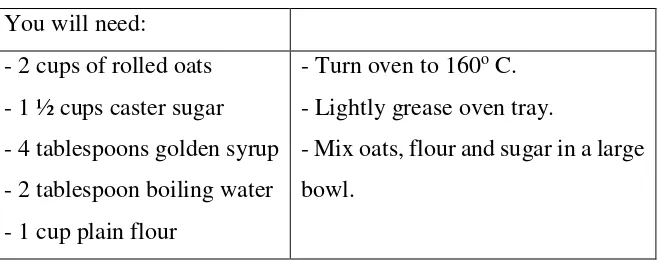
Table 2.1
Table of Procedure “Anzac biscuits”
You will need:
- 2 cups of rolled oats - 1 ½ cups caster sugar - 4 tablespoons golden syrup - 2 tablespoon boiling water - 1 cup plain flour
- Turn oven to 160oC. - Lightly grease oven tray.
14 - 250 grams butter
- 1 teaspoon baking soda
- Melt butter and golden syrup in a pan.
- Mix baking soda and boiling water in a cup.
- Add this mixture to melted butter and golden syrup.
- Add this to the oats mixture in the large bowl, mix together well. - Rolls tablespoonfuls of the mixture into balls. Put on tray 5 cm apart.
- Press lightly on top of each with a fork.
- Bake for 20 minutes.
i. Report: a piece of text that presents information about a subject, the purpose is to classify, describe or to present information about a subject.
j. Exposition: a piece of text that present one side of an issue and the purpose is to persuade the reader or listener by presenting one side of an argument.
3. Notion of Good Writing
15
a. Content: writing must convey the main idea or an attentive reader should be able to grasp the writer purpose. The substances of the writing; the idea expressed.
b. Form: writing should contain logical or associative connection and transition that clearly express the relationship of the idea described. The organization of the content.
c. Grammar: writing should adhere to the rules of grammar related to the tenses with the sequence of time, the employment of grammatical forms and syntactic pattern.
d. Style: writing should engage its reader through original insight and precise. Haris (1969: 69) say that style: the choice of structures and lexical items to give a particular tone or flavor to the writing. e. Mechanic: writing must use good spelling, punctuation, and tidy
and clean writing (Haris, 1969: 69).
4. Evaluation of Writing
Table 2.2
Components of Evaluation Writing
17
18
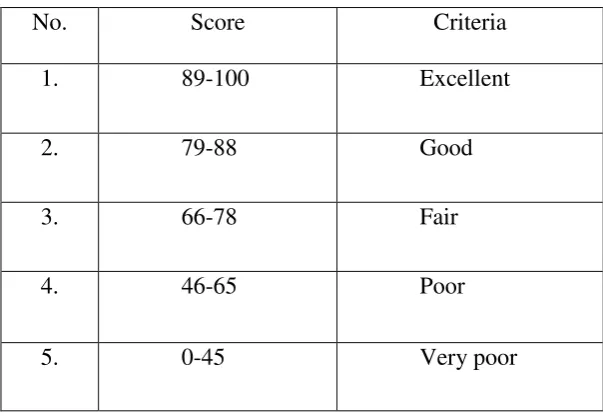
Table 2.3 Criteria of Scoring
5. Indicators of Students’ Good Writing
Carroll (1990: 1) states that good writing is something they believe they will never be able to achieve, because they not only identify good writing with proper spelling and grammar, but they are governed by the self-serving and false notion that they can’t learn how to spell correctly or how to construct grammatically correct sentences.
There are five indicators of the students know: a. How to construct a sentence properly.
b. Subjects and verbs must agree in number(singular subjects require singular verbs, plural subjects require plural verbs)
No. Score Criteria
1. 89-100 Excellent
2. 79-88 Good
3. 66-78 Fair
4. 46-65 Poor
19
c. The reference of pronouns should not be ambiguous
d. There should be consistency of person and tense in writing (no shift from first to third person writing or from present tense to past tense writing, unless there is a very good reason to do so), and
e. Correct spelling, punctuation, capitalization and word usage are required.
C. Outdoor Activity
1. Definition of Outdoor Activity
According to Miskimmin (2005: 1), states the outdoor activity are an exciting means of providing opportunities for huge learning and personal growth. While Hornby (2003: 291), the outdoor activity is an activity done outside a house or building. Outdoor activity mean student‘s activities that are done outside the classroom, whether in the school yard, the town park, the zoo, the industry, or any other place. Outdoor activities usually mean activities done in nature away from civilization.
20
outdoor play, heritage education, environmental education, experimental education, and agricultural education.
From the definition above, the researcher can conclude that outdoor activity is an activity to learn that some students study in outdoor classroom so that they are not bored and they need give motivation from experiences.
2. Outdoor Activity Strategies
These strategies emphasize on interaction other people, project, and discussion. Outdoor activity strategies help the students connect what they already know to what they are expected to learn, and to construct new knowledge from the analysis and synthesis of this learning process. There are four types of techniques that included in this strategies, those are:
a. Problem-based learning
21
weigh possible solutions, then select and defend what they think is most appropriate (D’Agostino, 1997) as quoted by (Smith, 2010: 27).
b. Project-based learning
Project-based learning is an in-depth investigation of a real-world topic worthy of children’s attention and effort (Katz &
Chard, 2000) as quoted by (Smith, 2010: 28). Project-based learning can involve an individual teacher or teams of teachers from different disciplines working together to assist students in producing real-world products or projects (Harwell, 1997) as quoted by (Smith, 2010: 27), and can span a number of class periods, several weeks or even an entire semester.
c. Inquiry-based Learning
It involves making observations; posing questions; examining books and other sources of information to see what is already known in light of experimental evidence; using tools to gather, analyze, and interpret data; proposing answers, explanations, and predictions; and communicating the results (National Committee on Science Education Standards and Assessment, 1996) as quoted by (Smith, 2010: 29).
d. Cooperative Learning
22
other’s learning (Johnson, Johnson, & Holubec, 1993) as quoted by (Smith, 2010: 29). It is a successful teaching strategy in which small teams and use a variety of learning activities to improve their understanding of a subject. Each member of the team is responsible not only for learning, but also for helping teammates learn.
3. Teaching Writing by Outdoor Activity
Before the class begins, the teacher gives an instruction clearly the topic, then make a group work to interaction with another friends. After the students understood it, the teacher ask to go to out classroom. At out classroom the students asked by the teacher study in there about the topic in English and the students are listen it. When the lesson is over the students go back to the class together with the teacher.
This activity is strategy to create “study community” in which
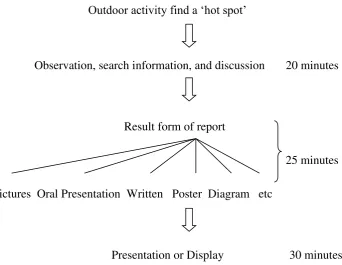
communication with other friend, helping, and study to find information. Then, the result of discussion from each group will be explained by speaking or writing form of report. (Suyanto, 2010: 97), for example:
Times “NEIGHBOURHOOD WALK”
All of groups get explanation in class
23
Outdoor activity find a ‘hot spot’
Observation, search information, and discussion 20 minutes
Result form of report
25 minutes Pictures Oral Presentation Written Poster Diagram etc
Presentation or Display 30 minutes
Figure 2.2: Suyanto’s process writing model y outdoor activity
4. Strengths and Weaknesses of Outdoor Activity
According to Siti Asiah and Mintohari (2014: 4), there are several the strength and weakness of outdoor activity:
a. Strengths of outdoor activity are as follows: 1) The students can understand of the subjects 2) The students can develop a curiosity
3) The students used to work as systematically 4) The students can process through observation
24
6) The students can compare of the result with other students b. Weakness of outdoor activity are as follows:
1) The students like to gad in the outclass
2) The students cannot concentration and unless How does the ways to cope this weakness:
1) The teacher gives extra attention for the student and making group activity
2) The teacher have to be smart to choose the area place as enjoy as to learn
3) The teacher makes a schedule from the place, time, and action
4) The teacher have to know that the area can invite and cannot invite for the students
5. Kinds of the Outdoor Activity
According to Rickinson (2004: 16) there are three kinds of the outdoor activity are as follows:
a. Fieldwork and Outdoor visits
25
Focus on outdoor adventurous activities often (but not always) in settings a considerable distance from students’ everyday
environments, and usually with the primary aim of promoting personal and/or interpersonal growth.
c. School Grounds and Community-Based Projects
CHAPTER III
RESEARCH METHOD
A. Research Method
1. Setting of the Research
The subject of this research is the students of first grade especially in class XA of SMA N 01 Suruh in the academic year of 2016/2017. The researcher chooses the first grade students because the age level of these students supposed to be able to write out the English language as a means of communication. The researcher chooses this school because she was ever there as a practice teacher. Many students have interest to learn English better, but they got difficulty to understand the materials and to write procedure text in English. Therefore, the researcher uses her strategy to solve the problem in class.
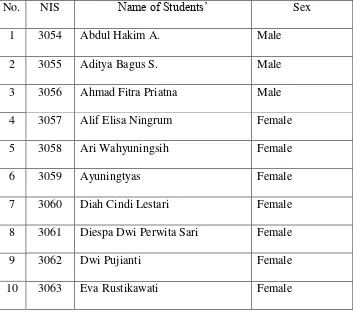
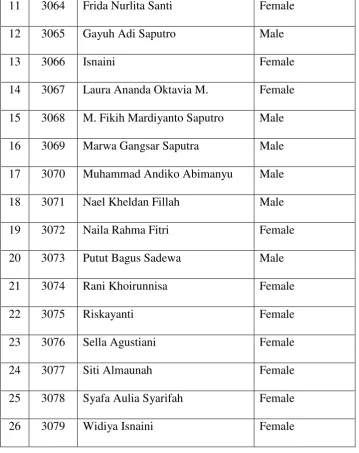
Table 3.1
List of XA Class of SMA N 01 Suruh in the Academic year of 2016/2017
No. NIS Name of Students’ Sex
1 3054 Abdul Hakim A. Male
2 3055 Aditya Bagus S. Male
3 3056 Ahmad Fitra Priatna Male
4 3057 Alif Elisa Ningrum Female
5 3058 Ari Wahyuningsih Female
6 3059 Ayuningtyas Female
7 3060 Diah Cindi Lestari Female
8 3061 Diespa Dwi Perwita Sari Female
9 3062 Dwi Pujianti Female
11 3064 Frida Nurlita Santi Female
12 3065 Gayuh Adi Saputro Male
13 3066 Isnaini Female
14 3067 Laura Ananda Oktavia M. Female 15 3068 M. Fikih Mardiyanto Saputro Male
16 3069 Marwa Gangsar Saputra Male
17 3070 Muhammad Andiko Abimanyu Male
18 3071 Nael Kheldan Fillah Male
19 3072 Naila Rahma Fitri Female
20 3073 Putut Bagus Sadewa Male
21 3074 Rani Khoirunnisa Female
22 3075 Riskayanti Female
23 3076 Sella Agustiani Female
24 3077 Siti Almaunah Female
25 3078 Syafa Aulia Syarifah Female
26 3079 Widiya Isnaini Female
Table 3.2
Time Schedule of the Research of SMA N 01Suruh in the Academic year of 2016/2017
Cycle 1 5 August 2016
B. Method of the Research
The method to be used in making this research is Classroom Action Research. Action research is designed to enhance and improve current practice within a specific classroom, school, or district (Marguerite, 2006: 17). According to Carr and Kemmis (McNiff, 991) in Suyadi says that Action Research is:
“Action research is a form of self-reflective enquiry undertaken by participants (teachers, students or principals, for example) in social (including educational) situation in order to improve nationality and justice of their own social or educational practices, their understanding of this practices, and the situation (and institution) in which the practices are carried out.”(Suyadi, 2010:21-22)
According to Arikunto (2006: 2), classroom action research is coming from three words they are:
a. Research is in activity to find out accuracy some subject using methodology which interest and important for the writer.
c. Class is a group of students in the same time, have same lesson from teacher.
According to Kunandar (2010: 45), there are three elements or concepts of action research, they are: a) research is an activity to observe the definite object through scientific methodology by collecting data and analyzing to finish the problem. b) action is an activity that does intentionally with certain purpose in the form of cycle to increase quality of teaching learning process. c) class is a group of students who get similar lesson from teacher in the same time.
According to Arikunto (2009:6-9) there are some principles of action research as follows:
a. The real activities in routine situation b. The awareness for recondition work ability c. SWOT as research foundation
SWOT is summary of Strength, Weakness, Opportunity, and Threat. Strength and weakness are used to identify researcher and it is subject. The opportunity and threat are identified out of the teacher or researcher and students.
d. Empiric and systematic endeavor e. Using SMART principle in planning
The meaning of SMART is: S = Specific
A = Acceptable or Achievable R = Realistic
T = Time-bound
From the definition above, the researcher, conclude that classroom action research is the research that be done by the teacher in teaching learning process to understand the situation and to improve the skill of the students in learning process.
The classroom action research conducted in SMA N 01 Suruh which aims to the implementation of using outdoor activity strategy to improve students’ writing performance in procedure text.
C. Procedure of the Research
The researcher would take two cycles, every cycle consists of two meetings. After the first cycle is done, the second cycle follows the first cycle and hope it can improve the activities of the first cycle. The designs of activities that will be done by researcher according Kemmis and Mc Taggart, 1988: in (Hopkins, 2011: 92) are as follows:
a. Planning
The activities in the planning session would be present below:
1) Preparing materials: making and designing the steps in doing action.
3) Preparing teaching aids.
4) Preparing sheets for classroom observation (to know the situation of teaching and learning process when the method, technique or strategy is applied).
5) Preparing a test (to know whether the students’ writing performance improve or not).
b. Action
In action activities, as an implementation of the planning, the researcher presents them in the following:
1) Giving pre-test 2) Explain the materials 3) Giving post-test
4) Giving occasion to the students to ask any difficulties or problem.
c. Observation
d. Reflection
Based on the result of the observation, the researcher makes an evaluation to the students during teaching learning process. It is important action if the researcher finds the problem of the students in first cycle. The researcher will do better in the next cycle like the first cycle.
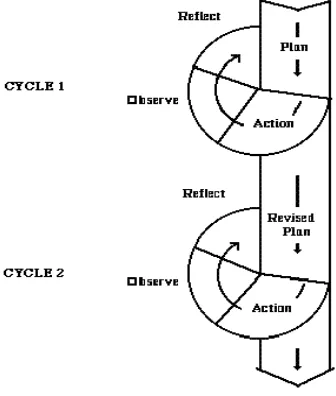
The model, which is used in implementation of this research, is as follows:
Table 3.3
Model of the Research
Source: Kemmis and McTaggart (1988) in David Hopkins (1993:48)
D. Technique of Collecting Data
a. Test instrument
The test instrument is important role to collect data. Test is arrange the question with other tools to measure a skill, intelligent knowledge or talent that someone have (Arikunto, 2010: 193). In this research, there are two kinds of test, they are pre test and post test. The researcher uses test in order to measure the students’ to
improve writing skill. Pre test is used to know how far students’
competence before use an outdoor activity strategy. Then, post test is used to see how far the students’ competence after using outdoor activity.
b. Observation
Observation is an activity through sight, hearing, smelling, touching, taster (Arikunto, 2010: 199). The researcher would do observation in class with classroom action research. The researcher not only observe just one time, but also in every meeting. The function of observation is to know how far the action that they achieved. The researcher observed the students by analyzing the results of field note and observational checklist which is made by the observer (Ayusi Setyowati).
c. Documentation
learning in the class. So, the researcher knows about the learning activity of the students in the class.
E. Technique of Data Analysis
The researcher uses statistical technique to know the influence of the students’ writing skill from the pre test and post test. The steps of this
technique are: a. Mean
Mean is formula to know the average of the students’ score. The
formula is: M = ∑𝑋
𝑁
Explanation:
M = Mean of the student’s score
ΣX = the sum of student’s score
N = the total number of students b. SD (Standard Deviation)
SD = √∑ DN − (2 ∑ DN ) 2
Explanation:
D = difference between pre test and post test N = the number of observation
c. T- test Calculation
T-testis formula to know the significant differences between pre test and post test. The formula is:
To
=
(∑𝐷𝑋 )
𝑆𝐷 √𝑁−1
Explanation:
CHAPTER IV DATA ANALYSIS
This chapter focuses on analyzing the collected data. The researcher gives the details of the findings. The findings consist of the results of the cycle I and cycle II. The two cycles are treatment of the implementation of outdoor activity in writing skill especially in procedure text.
A. Implementation of Classroom Action Research (CAR) a. Cycle 1
In this part, the writer carried out series of action namely planning the action and implementing the action which included two meetings.
1. Planning
a. Making lesson plan (RPP), and designing the steps in doing action using RPP,
b. List of students’ name,
c. Preparing sheet for classroom observation, d. Teaching aid (e.g. blank paper, camera), e. Test Instrument ( pre-test and post-test), f. Preparing Materials
2. Action
Action was the implementation of the activities that had arranged before. The first meeting was conducted on Friday, August 05th, 2016. The researcher started the class with Mr. Solikin, S.Pd who helped the researcher to introduce herself and her friend (Ayusi Setyowati) in front of the class. Then, Mr. Solikin, S.Pd asked the researcher to begin the lesson. Before the lesson, she introduced herself to the students in front of the class.
the topic, the teacher gave pre test to the class for about 10 to 15 minutes. When the students were doing the test, she walked around the class to check the students’ test. After the
students have finished the pre-test, she collected the students’ test and began to teach.
Then, the researcher gave explanation about procedure text clearly and she asked the students who want to be a volunteer to read about the topic. After that, she asked the students, “Did you understand class?” “Yes”, they answered. Then, she divided into fifth group and a group consists of five to six students. Then the teacher gave an instruction to doing post test how to make a procedure text through outdoor activity. They were very excited, enthusiastic and they enjoyed it because the students made a procedure text in real situation that in canteen. After the students had finished the post test, the researcher asked them to submit it and she gave a feedback material. The time was over, the researcher continued the meeting in the next day on Saturday.
3. Observation
In the first cycle, the researcher and her partner observed the teaching process. By monitoring the students’
most of the students are enthusiastic in teaching learning process, but some of the students who had a little difficulty to answer the question from the teacher. Some students had difficulties to begin or to make the idea because they had a limited vocabulary in English. The condition in the classroom is so noisy but the researcher had handled it.
Furthermore, the researcher shows the data presentation of pre-test and post-test to analyze the students’ improvement in learning writing.
The score of test in cycle I
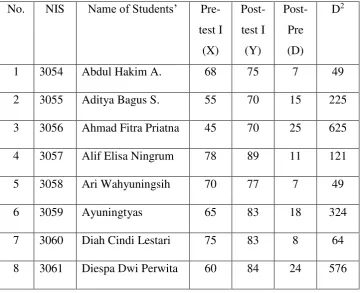
Table 4.1
The score of students’ pre-test and post-test in cycle I
No. NIS Name of Students’ Pre-test I
(X)
Post-test I
(Y)
Post-Pre (D)
D2
1 3054 Abdul Hakim A. 68 75 7 49
2 3055 Aditya Bagus S. 55 70 15 225
3 3056 Ahmad Fitra Priatna 45 70 25 625
4 3057 Alif Elisa Ningrum 78 89 11 121
5 3058 Ari Wahyuningsih 70 77 7 49
6 3059 Ayuningtyas 65 83 18 324
7 3060 Diah Cindi Lestari 75 83 8 64
9 3062 Dwi Pujianti 60 77 17 289
10 3063 Eva Rustikawati 70 75 5 25
11 3064 Frida Nurlita Santi 70 84 14 196
12 3065 Gayuh Adi Saputro 58 70 12 144
13 3066 Isnaini 73 75 2 4
14 3067 Laura Ananda O. 73 84 11 121
15 3068 M. Fikih Mardiyanto 78 77 -1 1
16 3069 Marwa Gangsar S. 60 77 17 289
17 3070 M. Andiko A. 61 80 19 361
18 3071 Nael Kheldan Fillah 60 77 17 289
19 3072 Naila Rahma Fitri 65 89 24 576
20 3073 Putut Bagus S. 55 70 15 225
21 3074 Rani Khoirunnisa 65 77 12 144
22 3075 Riskayanti 60 77 17 289
23 3076 Sella Agustiani 80 89 9 81
24 3077 Siti Almaunah 75 80 5 25
25 3078 Syafa Aulia S. 63 75 12 144
26 3079 Widiya Isnaini 60 75 15 225
JUMLAH 1702 2039 337 5461
1. The calculation of mean and standard deviation a. Mean of Pre-test 1
M = 1702
Mean of pre-test < than mean of post-test
There is an improvement of writing skill through outdoor activity in writing procedure text between pre test I (before the action) and the post test I (after the action). c. Calculating of Standard Deviation
To =(
T calculation is 10
T-table < t-calculation = 2, 06 < 10
The calculation result of t-test = 10 and t-table with DF= N-1, DF=25, level of signification 5% in t-table = 2, 06. The result of t-test is 10 > 2, 06. So, t-test calculating is greater than t-table.
Based on the result, it means that there is a significant difference between pre test and post test.
The improvement is also can be calculated in percentage by calculating students’ pre-test and post-test score. The calculation can be shown below:
P= 9, 007 %
The calculation which shows the class percentage of students who pass the KKM (the minimum of passing
It means there are 84, 61% of students’ who pass the standardized score (the minimum of passing criteria). Only the 22 students who pass the KKM. It indicates that the successful of cycle I should be improved. Finally, the researcher take the second cycle so that 85% students are able to pass the KKM.
2. Students’ Observation Sheet Table 4.2
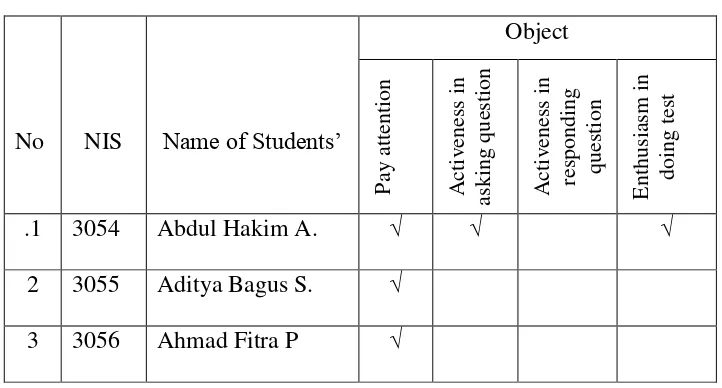
Result of the observation sheet in cycle I
4 3057 Alif Elisa Ningrum √ √ √
5 3058 Ari Wahyunigsih √ √
6 3059 Ayuningtyas √ √
7 3060 Diah Cindi Lestari √ √ √
8 3061 Diespa Dwi Perwita
√ √ √
9 3062 Dwi Pujianti √ √
10 3063 Eva Rustikawati √ √ √ √
11 3064 Frida Nurlita Santi √ √ √
12 3065 Gayuh Adi Saputro √
13 3066 Isnaini √ √ √
14 3067 Laura Ananda O. √ √
15 3068 M. Fikih Mardiyanto
√ √
16 3069 Marwa Gangsar S. √ √
17 3070 M. Andiko A. √ √ √
18 3071 Nael Kheldan Fillah
√ √
19 3072 Naila Rahma Fitri √ √
20 3073 Putut Bagus S. √
21 3074 Rani Khoirunnisa √ √ √
22 3075 Riskayanti √ √
23 3076 Sella Agustiani √ √ √ √
25 3078 Syafa Aulia S. √ √ √
26 3079 Widiya Isnaini √ √
4. Reflection
Based on the result of cycle 1, the researcher found the improvement after learning through outdoor activity in teaching learning. The first was the improvement of writing procedure text. It happened in the process of writing, especially in writing procedure text by used in real situation. The second, the improvement of students’ participation
could be seen in during of process teaching and learning in the classroom.
Based on the observation, there is improvement on students writing score, but it still did not pass the passing grade of 75. So, researcher conducted the cycle II. In next cycle II, the researcher emphasized the grammar, generic structure and language feature more deeply.
b. Cycle II
Based on the result of cycle I, it is necessary for the researcher to continue the next level:
1. Planning
In cycle II the teacher would only emphasize the generic structure, language feature and grammar more deeply to solve the weaknesses occurred in cycle I, in cycle II the teacher would stimulate students to be more active in exploring their idea.
The researcher prepared the instruments of research, such as:
a. Making lesson plan (RPP), and designing the steps in doing action using RPP,
b. List of students’ name,
c. Preparing sheet for classroom observation, d. Teaching aid (e.g. blank paper, camera), e. Test Instrument ( pre-test and post-test), f. Preparing Materials
2. Action
with the cycle I. She continued the lesson with the same material but different theme.
The teacher greeted the students ”Assalamu’alaikum Wr.Wb. and good afternoon students?” and the students said “Wa’alaikum Salam Wr.Wb. and good afternoon”. Before the teacher began the learning, she asked the leader to start pray together and any students appoint to Adul to lead it. Then she checked their attendance list.
After the teacher called their name one by one and asked the student to say “present”. Before the teacher explained about the topic, the teacher gave pre test to the class for about 10 to 15 minutes. When the students were doing the test, she walked around the class to check the students’ test. After the students have finished the pre-test, she collected the students’ test and began to teach.
3. Observation
In the second cycle, such as in the first cycle, the researcher get field note from the observer which has been written in above. The teacher can see that the students could understand the procedure text through outdoor activity, it show with some of students have no difficulty in understanding the text that has been learned but many students difficult in make a sentence and they were shy and difficult to speak in English because had limited in vocabulary.
The score of tests in cycle II Table 4.3
The score of students’ pre-test and post-test in cycle II
8 3061 Diespa Dwi Perwita 41 80 39 1521
9 3062 Dwi Pujianti 49 92 43 1849
10 3063 Eva Rustikawati 55 90 35 1225
11 3064 Frida Nurlita Santi 42 92 50 2500
12 3065 Gayuh Adi Saputro 22 75 53 2809
13 3066 Isnaini 44 84 40 1600
14 3067 Laura Ananda O. 34 84 50 2500
15 3068 M. Fikih Mardiyanto 40 86 46 2116
16 3069 Marwa Gangsar S. 26 80 54 2916
17 3070 M. Andiko A. 10 65 55 3025
18 3071 Nael Kheldan Fillah 30 86 56 3136
19 3072 Naila Rahma Fitri 47 92 45 2025
20 3073 Putut Bagus S. 12 75 63 3969
21 3074 Rani Khoirunnisa 40 84 44 1936
22 3075 Riskayanti 55 80 37 1369
23 3076 Sella Agustiani 45 92 35 1225
24 3077 Siti Almaunah 40 86 46 2116
25 3078 Syafa Aulia S. 55 80 25 625
26 3079 Widiya Isnaini 57 90 33 1089
JUMLAH 984 2171 1187 56539
M = ∑ 𝑋
c. Calculating of Standard Deviation
To= 45,659,5
5
To = 45,65 1,9
T o= 24, 02
In the second cycle, the result shows that the students’
writing skill increase significantly. The calculation result of t-test = 24, 02 and t-table with Df = N-1, Df = 25, level of signification 5% in t-table = 2, 06. The result of t-test is 24, 02 > 2, 06. So, arithmetical t-test was greater than t-table. Based on the result, it means that there is a significant difference between pre test and post pest in cycle II.
From analysis above, the researcher concluded that score mean of pre-test and post-test was a significantly difference, by which post-test (83, 5) was greater than pre-test (37, 8). It shows that using outdoor activity gave improvement to the students’ writing skill especially in writing procedure text.
The improvement is also can be calculated in percentage by calculating students’ pre-test and post-test score. The calculation can be show below:
P= 𝑀2−𝑀1
𝑀1+𝑀2 x 100% P= 83,5−37,8
37,8+83,5 x 100% P= 45,7
The calculation which shows the class percentage of students who pass the KKM (the minimum of passing criteria) is:
P= 𝐹
𝑁 x 100% P= 24
26 x 100% P= 92, 30%
It means that 92, 30%students pass the KKM. There are 24 students who pass the KKM. Meanwhile, 2 student does not pass the KKM. It concludes that the improvement of students’ writing
performance in procedure text is good enough. 2. Students’ Observation Sheet
Table 4.4
Result of the observation sheet in cycle II
8 3061 Diespa Dwi Perwita
√ √ √
9 3062 Dwi Pujianti √ √
10 3063 Eva Rustikawati √ √ √ √
11 3064 Frida Nurlita Santi √ √ √
12 3065 Gayuh Adi Saputro √ √
13 3066 Isnaini √ √ √
14 3067 Laura Ananda O. √ √
15 3068 M. Fikih Mardiyanto
√ √
16 3069 Marwa Gangsar S. √ √
17 3070 M. Andiko A. √
18 3071 Nael Kheldan Fillah
√ √
19 3072 Naila Rahma Fitri √ √ √
20 3073 Putut Bagus S. √ √ √
21 3074 Rani Khoirunnisa √ √ √
22 3075 Riskayanti √ √
23 3076 Sella Agustiani √ √ √ √
24 3077 Siti Almaunah √ √
25 3078 Syafa Aulia S. √ √ √
26 3079 Widiya Isnaini √ √
After analyzing the result of cycle I and II, it can be concluded that learning through outdoor activity could improve students to active in learning writing in the out-classroom. They could practice language optimally especially in writing procedure text and express their idea through writing directly, even though there were many limited vocabularies and error grammatical. But now, they could express their idea, increased their vocabulary and wrote their idea directly.
B. Discussions
From the result of analyzing in cycle I and cycle II. There is significant improvement on the students’ writing skill. That will be explained in the table below:
Table 4.5
The Mean and T-calculation of Students’ Score Cycle I and
Cycle II
No Analyze Cycle I Cycle II
1 Mean Pre-test Post-test
65, 45 78, 42
37, 8 83, 5
2 t-table N=26 2, 06 2, 06
3 t-calculation 10 24, 02
Table 4.6
The Students’ Mean Score in Percentage
Category Cycle 1 Cycle 2
<75 15, 39% 7, 7%
>75 84, 61% 92, 30%
There are 92, 30% who pass KKM (the minimum of passing criteria) and 7, 7% students who not pass on it. The score of pre test cycle II is 37, 8 which is less than pre test of cycle I is 65, 45. Meanwhile, the score of post test cycle II is 83, 5 which is higher than post test cycle I is 78, 42. In addition, the students look more confident and have a good idea to write English in the class.
Based on the field note and observational checklist conducted when the outdoor activity was applied, the researcher analyzed that there were many improvement in many aspect, they are the improvement of students mastery of writing procedure text through outdoor activity, other improvement was grammar and vocabulary.
Based on the result among T-test of cycle I and cycle II, the implementation of outdoor activity on writing performance is successful to improve students’ writing skill especially in procedure
The implementation of using outdoor activity can improve the students understanding in learning writing procedure text. The improvement can be examined from the results of the students answers tests in the pre-test and post-test. Before the strategy was implemented, the students encountered many difficulties in understanding of procedure text and have difficulties on express their ideas. They could not tell the generic structure of the text correctly and confused to determine the language feature of the text.
CHAPTER V CLOSURE A. Conclusions
The title of this research is “IMPROVING STUDENTS’ WRITING
SKILLS THROUGH OUTDOOR ACTIVITY (A Classroom Action Research for the First Grade Students of SMA N 01 Suruh in the Academic Year of 2016/2017)”. The finding of the research of writing skill to improve students’ writing skill through outdoor activity especially in procedure text in SMA N 01 Suruh are as follows:
1. The implementation of Outdoor Activity can improve writing skills for the first grade students of SMA N 01 Suruh in the academic year of 2016/2017. It is relevant with the data of mean score pre test and post test in each cycle. Mean score of pre test cycle II is 37, 8 which is less than pre test of cycle I is 65, 45. Meanwhile, the score of post test cycle II is 83, 5 which is higher than post test cycle I, 78, 42. In addition, the students look more confident and have a good idea to write English in the class.
2, 06. The increasing percentage students who pass in writing test from cycle I and cycle II are: 84, 61% and 92, 30%. The decreasing percentage students who not pass in writing test are: 15, 39% and 7, 7%. The finding show that the improvement of the students writing skill is significant after applying outdoor activity especially in procedure text for the first grade students’ of SMA N 01 Suruh in the academic year of 2016/2017.
B. Suggestions
Based on the result of the study and conclusion that regarding to teach writing by the use of outdoor activity, the writer would like to suggest as follows:
1. For the English Teacher
a. Writing mostly known as difficult subject. English teacher should be able to develop their strategy to teach the students in order to make them interest in learning the subject. The use of outdoor activity in teaching and learning process can attract students’ interest and enjoy in teaching and learning process.
a. The students have to give more attention, keep their attitudes when the teacher explained the lesson and teach them. In addition, students have to study English harder to reduce their difficulties of English learning.
b. To improve writing skill, students have to develop their knowledge and do many exercises in order to get a better achievement in producing written text.
c. For the Other Researcher
It has been know that learning English through outdoor activity can improve students writing performance, so that the other researchers or the readers could use the outdoor activity when they are want to develop their writing skill. They should read this research clearly, so they can understand how to practice outdoor activity to improve their writing skill especially in writing procedure text.
REFERENCES
Anderson, Mark & Kathy Anderson.1998. Text Types in English 1. Australia: MacMillan
Anderson, Mark & Kathy Anderson. 1998. Text Types in English 2. Australia: MacMillan
Arikunto, S. 2006. Penelitian Tindakan Kelas. Bandung: Bumi Aksara Arikunto, S. 2009. Penelitian Tindakan Kelas. Jakarta: Bumi Aksara Arikunto, S. 2010. Prosedur Penelitian Suatu Pendekatan Praktik.
Jakarta: Rineka Cipta
Asiah, S and Mintohari. (2014). JPGSD Vol. 2 No.3: Penerapan Metode Outdoor Activity dalam Pembelajaran IPA untuk meningkatkan Hasil Belajar Siswa Sekolah Dasar
Brown, H. D. 2004. Language Assessment Principle and Classroom Practices. America: Person Education, Inc
Carroll, R. T. 1990. Student Success Guide Writing Skills. United States: Internasional Copyright Law
Gelb, I. J. 1952. A Study of Writing Revised Edition. Chicago & London: The University of Chicago Press
Hariyanti, S. and Naim Musyafik. (2003). Jurnal Ilmu Manajemen, REVITALISASI, Vol. 2, No. 2: Pengaruh Penerapan Metode CTL (Contextual Teaching and Learning) terhadap Peningkatan Mutu Pendidikan pada The Naff Elementary School
Harlow. 2008. Advanced American Dictionary. New Edition. Harlow, England: Pearson Education Limited
Hopkins, D. 1993. A Teacher’s Guide to Classroom Research. Buckingham: Open University Press
Hornby, A. S. 2003. Oxford Advanced Learner’s Dictionary of Current English. London: Oxford University Press
Kunandar. 2011. Langkah Mudah Penelitian Tindakan Kelas Sebagai Pengembangan Profesi Guru. Jakarta: PT. Raja Grafindo Persada
Miskimmin, P. 2005. Outdoor Activities Guidelines for Leader. New Zealand: Garth Gulley
Haris, P. D. 1969. Testing English as a Second Language. New York: Mc Graw-Hil
Protheroe, N. and Suzanne Clarke. 2008. Learning Strategies as a Key to Student Success. Arlington, VA: Educational Research Service.
Smith, B. P. (2010). Journal of Family & Consumer Sciences Education. Vol. 28, No. 1: Instructional Strategies in Family and Consumer Sciences: Implementing the Contextual Teaching and Learning Pedagogical Model
Spratt, M., Alan Pulverness, and Melanie Williams. 2005. The TKT Teaching Knowledge Test Course. Cambridge: Cambridge University Press
Sudijono, A. 2010. Pengantar Statistik Pendidikan. Jakarta: PT. Raja Grafindo Persada
Suharmi, S. 2015. Improvng Student’s Writng Skill in Descriptive Text by Using Outdoor Activty (A Classroom Action Research) of the Second Year of MTs Sudirman Kopeng, Getasan in Academic Year 2015 /2016. Salatiga: IAIN Salatiga
CURRICULUM VITAE
A. Personal Identity
Name : Artanti Isnaeni Farida
Place, Date of Birth : Kab.Lampung Utara, August 8th 1993
Mobile : 085 713 436 536
Email address : [email protected]
Home addres : Ds. Karangasem Rt 02 Rw 05 Kec. Suruh Kab.
Semarang
Sex : Female
Marital Status : Unmarried
B. Educational Background
Suruh 01 Elementary School (SD N 01 Suruh), Central Java, graduated in 2006
Suruh 01 Junior High School (SMP N 01 Suruh) , Central Java, graduated in 2009
Mathematic and Natural Science Program of Madrasah Aliyah Negeri (MAN) Salatiga, Central Java, graduated in 2012
RENCANA PELAKSANAAN PEMBELAJARAN (Lesson Plan)
Satuan Pendidikan : SMA Negeri 1 Suruh Mata Pelajaran : Bahasa Inggris
Kelas/Semester : X/1
Pertemuan : 1
Alokasi waktu : 2 x 45
Skill : Writing
Standar Kompetensi : 6. Mengungkapkan makna dalam teks tulis fungsional pendek esei sederhana berbentuk recount, narrative, dan procedure dalam konteks kehidupan sehari-hari
Kompetensi Dasar : 6.2. Mengungkapkan makna dan langkah-langkah retorika secara akurat, lancar dan berterima dengan menggunakan ragam bahasa tulis dalam konteks kehidupan sehari-hari dalam teks berbentuk
procedure
Indikator :
1. Siswa dapat mengidentifikasi atau mengetahui makna dari procedure text.
2. Siswa mampu mengetahui generic structure dari procedure text.
3. Siswa dapat menggunakan kalimat imperative dalam membuat sebuah resep atau petunjuk. 4. Siswa mampu menulis teks berbentuk procedure
text A. Tujuan pembelajaran:
1. Siswa dapat mengikuti pelajaran dengan baik.
2. Siswa mampu memahami atau mengetahui isi dan informasi dari teks. B. Materi Pembelajaran:
1. Definition of procedure text
2. The purpose of procedure text is to tell the reader how something can be done
3. Generic structure
a. Goal : give information about purpose of procedure text. b. Materials : list of materials that needed to make a something. c. Steps : the rule have to do to get the goal, because the goal
followed by a series of steps oriented to achieving the goal 4. The features of procedure text
a. Use simple present tense (S+V1) b. Often imperative sentence
c. Use action verb (make, boil, mix, cook,)
d. Use temporal conjunction (first, then, next, after that, last) 5. Example of procedure text
How to Make Tomato Soup
To make a bowl of tomato soup, you must prepare all ingredients below:
small clove garlic
¼ teaspoon of butter
Here are the steps to make a bowl of tomato soup:
1. Cut tomatoes, onions, and garlic into small pieces. 2. Fry them in a pan with butter for five minutes. 3. Add water, spices, salt and pepper.
4. Heat until the water boils.
Turn down the heat and cover with lid. Cook gently for one hour.
C. Metode pembelajaran: Outdoor Activity
D. Kegiatan Pembelajaran: