PERCEPTUAL LEARNING STYLE PREFERENCE IN
LEARNING ENGLISH OF THE INTERNATIONAL CLASS
PROGRAM STUDENTS IN THE ACADEMIC YEAR 2015/2016
A GRADUATING PAPER
Submitted to the Board of Examiners as a Partial Fulfillment of the Requirements for the Degree of Sarjana Pendidikan (S.Pd)
English Education Department of Teacher Training and Education Faculty State Institute for Islamic Studies (IAIN) Salatiga
By:
Atina Vina Muna
11312031
ENGLISH EDUCATION DEPARTMENT
TEACHER TRAINING AND EDUCATION FACULTY
STATE INSTITUTE FOR ISLAMIC STUDIES (IAIN)
v
MOTTOS
Learn everything you can, anytime you can, from anyone you can – there will
always come a time when you will be grateful you did.
(Sarah Caldwell)
The future is belongs to those who believe in the beauty of their dreams.
vi
DEDICATIONS
This graduating paper is sincerely dedicated to:
My beloved superheroes, Mrs. Munawarotul Akhlaqiyah and Mr. H. Tibyan,
thank you for the endless love, support, prayer, and everything you give to me.
My beloved sisters and brother, M. Nudia M. M., Yaqutun Nafis, and Khurin ‘Ain
who always cheer up my days.
My partner of life, Salasun Ahmad Kholiq Yasin, thank you for widens my
perspective of life.
vii
ACKNOWLEDGEMENTS
Bismillahirrahmanirrahim,
In the name of Allah, the Most Gracious and the Most Merciful, the Lord
of the entire universe. Because of Him, the researcher is able to finish this
graduating paper as one of the requirements for Sarjana Pendidikan (S.Pd) of
English Education Department of Teacher Training and Education Faculty of
State Institute for Islamic Studies (IAIN) Salatiga
Peace and salutation always be given to our prophet Muhammad SAW
who has guided us from the darkness to the lightness. However, this success
would not be achieved without those support, guidance, advice, help, and
encouragement from individual and institution. It is an appropriate moment for the
researcher to the deepest gratitude for:
1. Dr. Rahmat Haryadi, M.Pd. as the Rector of State Institute for Islamic
Studies (IAIN) of Salatiga.
2. Suwardi, M.Pd. as the Dean of Faculty of Teacher Training and
Education, State Institute for Islamic Studies (IAIN) of Salatiga.
3. Noor Malihah, Ph. D. as the Head of English Education Department of
Teacher Training and Education Faculty State Institute for Islamic
Studies (IAIN) of Salatiga.
4. Rr. Dewi Wahyu Mustikasari, M.Pd. as the Secretary of English Education Department of Teacher Training and Education Faculty
ix
ABSTRACT
Muna, Atina Vina. 2016. “PERCEPTUAL LEARNING STYLE
PREFERENCE IN LEARNING ENGLISH OF THE
INTERNATIONAL CLASS PROGRAM STUDENTS IN THE ACADEMIC YEAR 2015/2016”. Graduating Paper. English Education Department, Faculty of Teacher Training and Education, State Institute for Islamic Studies of Salatiga. Advisor: Rr. Dewi Wahyu Mustikasari, M.Pd.
Keywords: perceptual learning style, English learning
x
TABLE OF CONTENTS
TITLE ... i
DECLARATION ... ii
ATTENTIVE CONSELOR NOTES... iii
PAGE OF CERTIFICATION ... iv
MOTTOS ... v
DEDICATIONS ... vi
ACKNOWLEDGEMENTS ... vii
ABSTRACT ... ix
TABLE OF CONTENTS ... x
LIST OF TABLES ... xii
LIST OF CHARTS ... xiii
CHAPTER I INTRODUCTION A. Background of the Research ... 1
B. Problems of the Research ... 4
C. Objectives of the Research ... 4
D. Limitation of the Research ... 5
E. Clarification of the Key Terms ... 5
F. Significances of the Research ... 8
G. Organization of the Graduating Paper... 8
xi
B. Perceptual Learning ... 14
C. Learning Styles... 16
D. Perceptual Learning Styles ... 17
E. Perceptual Learning Style Preference ... 19
CHAPTER III RESEARCH METHODOLOGY A. Research Setting ... 20
B. Research Design ... 21
C. Population and Sample ... 22
D. Technique of Data Collection ... 23
E. Technique of Data Analysis ... 24
CHAPTER IV FINDINGS AND DISCUSSIONS A. Perceptual Learning Style Preference of the Students of International Class Program of Teacher Training and Education Faculty of State Institute for Islamic Studies (IAIN) Salatiga ... 27
B. Dominant Perceptual Learning Style Preference of the Students of International Class Program of Teacher Training and Education Faculty of State Institute for Islamic Studies (IAIN) Salatiga ... 43
C. Discussion ... 45
CHAPTER V CLOSURE A. Conclusions ... 48
B. Suggestions ... 50
xii
LIST OF TABLES
Table 3.1 Research Schedule ... 20
Table 3.2 Population of the Research ... 22
Table 3.3 Data Codes ... 25
Table 4.1 Number of Occurrences of Visual Learning Style Preference in the
Questionnaire ... 27
Table 4.2 Number of Occurrences of Tactile Learning Style Preference in the
Questionnaire ... 30
Table 4.3 Number of Occurrences of Auditory Learning Style Preference in the
Questionnaire ... 33
Table 4.4 Number of Occurrences of Kinesthetic Learning Style Preference in the
Questionnaire ... 35
Table 4.5 Number of Occurrences of Group Learning Style Preference in the
Questionnaire ... 38
Table 4.6 Number of Occurrences of Individual Learning Style Preference in the
Questionnaire ... 40
xiii
LIST OF CHARTS
Chart 4.1 Preferred Ways of How the Visual Students’ Learn ... 29
Chart 4.2 Preferred Ways of How the Tactile Students’ Learn ... 32
Chart 4.3 Preferred Ways of How the Auditory Students’ Learn ... 35
Chart 4.4 Preferred Ways of How the Kinesthetic Students’ Learn ... 37
Chart 4.5 Preferred Ways of How the Group Style Students’ Learn ... 40
Chart 4.6 Preferred Ways of How the Individual Style Students’ Learn ... 42
CHAPTER I
INTRODUCTION
A. Background of the Research
There are so many definitions of learning. According to Schunk (2012:5)
“learning is recalling what exists in the mind. Information acquired with the
senses by observing, listening, tasting, smelling, or touching constitutes raw
materials rather than ideas”. It can be meant that learning is remembering the
information that the students have already obtained. It is not new ideas that
come up in their minds. They got the information from observing, listening,
tasting, smelling, or touching. It cannot be done just in a few hours, days,
months or years. Learning is a long life experience.
Learning is obtaining information from observing, listening, tasting,
smelling, etc. However, it has medium to transfer the information through
learning. The students use their eyes, hands, feet, and their entire body to do
activity dealing with learning. Some of the students prefer listening to absorb
the information. Some of the students easily get the information through
watching. While the other students like to do experiment to understand the
information. On the other words, the students have their own preferred ways of
learning. Felder and Henriques (1995:21) states that “the ways in which an
individual characteristically acquire, retains, and retrieves information are
2
Dunn (1979:239) points out that “…when students taught through
methods that complemented their learning characteristics, students at all levels
became increasingly motivated and achieved better academically”. It means
that method and the students’ learning characteristics should be matched in
order to achieve good score. The teachers often unaware of the way they teach.
They use the same way and the same assessment to all of the students. Some of
the students get the higher score than the others through the same way of
teaching. It may occur because of the unmatched between method of teaching
and the students’ learning style. The teachers teach the students without
considering the students’ learning style.
Some researchers have developed several instruments to assess the
students’ learning style. Some instruments help in identifying visual,
kinesthetic, auditory, tactile, group, and individual style as well as many other
classifications of styles in the students. The instruments also explore the
learning styles with the objective of improving the learning and teaching
processes. “It is obvious that people learn in many different ways: people who
learn primarily with their eyes are called visual learners; or with the ears –
auditory learners; whereas some people prefer to learn in groups” (Obralic and
Abrarov, 2012:31).
Soureshjani and Naseri (2012:71) state that “language learning styles are
amid factors that play significant role in determining how well learners learn a
language”. This is meant that learning style is important factor for determining
3
students influences their language capability. For instance, the students with
tactile preference may have good capability in writing a language. Learning
style build the students’ learning behavior.
International Class Program of Teacher Training and Education Faculty
of State Institute for Islamic (IAIN) Salatiga is a program of the university that
expected to create students with language capability better than the other
students from regular classes. There are some different students with some
different majors in the class. They are divided into three majors: Islamic
Education Department, Arabic Education Department, and English Education
Department. The lecturers of this class use English and Arabic Language as the
medium of instruction.
English as the medium of instruction become the crucial problem for the
students who can not understand it. It is difficult for the students to understand
the materials if they do not understand the language. It is important for the
students to master English language and to have effective teaching learning
process while learning English language. The teachers should have enough
knowledge about their students’ style preference in order to provide the needed
instruction.
Therefore, the purpose of the research is to determine the perceptual
learning styles preference in learning English. The subject of this research is
the students of International Class Program of Teacher Training and Education
Faculty of State Institute of Islamic Studies (IAIN) Salatiga. This research is a
4
questionnaire in order to determine the Perceptual Learning Style (PLS) in
Learning English among students using Perceptual Learning Style Preference
Questionnaire (PLSPQ) research instrument. Those are represented in the
PERCEPTUAL LEARNING STYLE PREFERENCE IN LEARNING
ENGLISH OF THE INTERNATIONAL CLASS PROGRAMS’ STUDENTS
IN THE ACADEMIC YEAR 2015/2016.
B. Problems of the Research
Based on the background of the research above, the problems of this
research can be formulated as follows:
1. What are the perceptual learning style preferences in learning English
among the students of International Class Program of Teacher Training
and Education Faculty State Institute for Islamic Studies (IAIN) Salatiga?
2. What is the dominant perceptual learning style preference in learning
English among the students of International Class Program of Teacher
Training and Education Faculty State Institute for Islamic Studies (IAIN)
Salatiga?
C. Objectives of the Research
In relation to the research questions, already stated that the purpose of
5
1. To describe the perceptual learning style preference in learning English
used by the students of International Class Program of Teacher Training
and Education Faculty State Institute for Islamic Studies (IAIN) Salatiga.
2. To describe the most dominant perceptual learning style preference in
learning English used by the students of International Class Program of
Teacher Training and Education Faculty State Institute for Islamic Studies
(IAIN) Salatiga.
D. Limitation of the Research
The target of this research is investigating the perceptual learning style
preference in learning English among the students of International Class
Program of IAIN Salatiga. It is known that there are so many types of learning
style. This research focuses on analyzing the perceptual learning style of the
students which is divided into six styles: visual learning style, tactile learning
style, kinesthetic learning style, auditory learning style, group learning style
and individual learning style. Furthermore, the researcher only uses Perceptual
Learning Style Preference Questionnaire (PLSPQ) by Reid (1987) to gather the
data.
E. Clarification of the Key Terms 1. English learning and teaching
According to Brown (2000:5) standard definition of language is “a
6
that enable members of a given community to communicate intelligibly
with one another”. In simpler word, language is medium of
communication through vocal, written or gesture. The function of
language is to communicate.
To know language, people do learning activities. Brown (2000:7)
states that search in contemporary dictionaries defined “learning is
acquiring or getting of knowledge of a subject or a skill by study,
experience, or instruction”. It can be meant that learning is an effort to
gain knowledge by study or experience that people get alone and it may be
instruction that someone else ask to do. Learning is experience of getting
knowledge.
Teaching and learning cannot be defined separately. Teaching is
helping someone to learn, while learning is to make self-understanding.
Brown (2000:7) states that teaching may be defined as “showing or
helping someone to learn how to do something, giving instructions,
guiding in the study of something, providing with knowledge, causing to
know or understand”.
“Learning a second language is a long and complex undertaking”
(Brown, 2000:1). English is a second language and a foreign language for
some non-native speakers. In Indonesia, English becomes a foreign
language. Learning a second language or a foreign language is not short
process. Adjusting words in foreign language to native language take long
7
be effective teaching and learning process in order to completely master
the language.
2. Perceptual Learning Style
Renou (2009:2) claims that “sensory or perceptual learning style has
to do with the physical environment in which we learn, and involves using
our senses in order to perceive data”. It can be meant that perceptual
learning style is the students’ way of obtaining information by connecting
their senses and the environment. In the teaching learning process, the
teachers give the students some materials by using some method. The
method is used to create appropriate environment in the classroom. With
the appropriate environment, the students can get the information
effectively through their senses.
“Perceptual learning style refers to Auditory, Visual, Tactile,
Kinesthetic, Group, and Individual learners. These kinds of learners refer
to those who learn a language more effectively by hearing, seeing,
hands-on, learning with others and learning alone respectively” (Khamkien,
2012:63). On the other hand, perceptual learning style is student’s
preference of four basic perceptual modalities (visual, auditory,
kinesthetic, and tactile) and two social interaction factors (individual or
group). This is how the students absorb information through perceptual or
sensory channels (eyes, ears, and hands). As every student is different,
they have their own preferred way of learning with which they feel most
8 F. Significances of the Research
The result of the research is formulated to give significances to English
teaching and learning, the significances are:
1. Theoretically, the result of this research is expected to enrich the
cognizance of one aspect of individual differences in English as Foreign
Language (EFL) Classroom
2. Practically,
a. For the researcher
The result of this research can be beneficial for the researcher as step
stone to deepen comprehend such individual differences dealing with
perceptual learning style in English as Foreign Language (EFL)
teaching
b. For the students
The result of this research can help the students especially the students
of International Class Program to know their learning styles. Thus, the
students can manage their learning activity optimally
c. For the English teacher
The result of this research can be beneficial for the English teacher to
manage both the class and the teaching grounded on the students need
G. Organization of the Graduating Paper
This research is divided into five chapters and each chapter explains
9
Chapter I is introduction that consists of the background of the research,
which mentions the researcher’ reasons why the researcher chooses the topic as
a research topic. Then, the problems of the research, it explains the problems of
the research that are observed by the researcher. Next is limitation of the
research, which mentions the specific problems that the researcher explains.
Furthermore, it includes the objectives of the research that consists of the aims
of the research, significances of the research that describe the advantages of the
research, and then the clarification of the key term. The last is the organization
of the graduating paper.
Chapter II is the theoretical framework. It presents the review of related
literature of the research such as theoretical foundation which includes
theoretical reviews of perceptual learning, learning styles, perceptual learning
style, and perceptual learning style preference.
Chapter III is the research methodology. It tells about why and how this
study uses qualitative research as the type of the research. It elaborates the
methodology of the research including research setting, research design,
population and sample, technique of data collection, and technique of data
analysis.
Chapter IV is the findings and discussion of the research. It consists of an
analysis of Perceptual Learning Style Preference of The students of
International Class Program of Teacher Training and Education Faculty of
10
Chapter V is closure. It is the last chapter of the research. It ends of the
research, and the researcher states the conclusions and suggestions. For the
11
CHAPTER II
THEORITICAL FRAMEWORK
A. Previous Researches
Within this chapter, the researcher presents the previous researches that
were related with this research. Related research showed that the students differ
in learning language. They have their own preferred style of learning language
especially English. Helty (2009) had done a research about students’ learning
style in English Department and their achievement in vocabulary. The aims of
the research were to describe the students learning style in English department
and their achievement in vocabulary at the first semester of IAIN Sultan Thaha
Saifuddin Jambi. The research was categorized as descriptive evaluative. The
techniques used to collect the data were observation, documentation, and
questionnaire. The finding of the research was the first year students of English
Department of Tarbiyah Faculty of State Institute for Islamic Studies of
Sulthan Thaha Saifuddin Jambi can be grouped into four learning style types
based on they preferred ways of going about learning. These four learning style
types were concrete learners, analytical learners, communicative learners, and
authority-oriented learners. Each type of learners might be potential to propose
enriching vocabulary.
Similar to Helty (2009), Obralic and Akbarov (2012) reported a research
about learning style. However their research was different from the previous
12
preference. Their paper aimed to determine the learning styles of students at
University of Sarajevo. Another objective was the influence of the students’
gender and ethnicity in the learning style. Data were gathered using Perceptual
Learning Style Preference Questionnaire (PLSPQ) research instrument. The
method that they used was a quantitative and qualitative research method. They
concluded that there had been significant differences between learning styles
favored by Bosnian and Turkish. The data showed that the most outstanding
learning style in which the students worked without any difficulty was the
visual learning style. There was no significant difference between male and
female students regarding their study preferences.
The next research was also about perceptual learning style preference.
Khamkhien (2012) aimed his research to identify Thai learners’ English
learning style preferences and to determine the impact of three variables:
gender, field of study and learning experiences on preferred learning styles.
The researcher used quantitative method and the data collected from the
questionnaire. The Perceptual Learning Style Preference Questionnaire
(PLSPQ) was administered to get the information. The results of the research
indicated that Thai EFL learners preferred auditory learning most, followed by
kinesthetic, group, tactile, visual and individual learning. Among three
variables, field of study was the most significant factor affecting the choice of
learning styles. However, he also found that no statistically significant
13
The previous researches reported that Turkish students and Bosnian
students preferred the visual learning style while Thai students preferred the
auditory learning style the most. Soureshjani and Naseri (2012) has done
research for Iranian English students to see does the ability level of EFL
language learners significantly affect their learning styles and to investigate the
learning styles which are preferred and common among beginning,
intermediate, and advanced-level learners. The instruments that used to get the
data are TOEFL test and a learning style questionnaire. The results of the
research revealed that first, the proficiency level of learners have a significant
impact on learners' learning style preferences. The research also revealed that
sensory styles are the most preferred learning styles for beginning learners
especially the kinesthetic learning style. It followed by personality styles for
intermediate learners, and finally, degree-related styles for advanced-level
learners.
The last previous research was conducted in Taiwan. Fang-Mei Tai
(2013) has done research about preferred learning style and motivation of adult
English as a Foreign Language (EFL) student. The objectives of his research
were to explore what learning styles of adults EFL students (School of
Continuing Education) prefer in order to better understand what impact and
shape the language learning process and to help determine to design curriculum
and instruction for classroom practice for higher achievement and increased
motivation for learning. This was quantitative research study, the instrument
14
Questionnaire (PLSPQ). The findings of this research were the adult students
who learn EFL expressed preferences for kinesthetic, tactile, and other styles
and especially showed significantly relationship on motivation in English
learning. The most preferred learning style was computer assisted learning
styles followed by the auditory learning style.
From those previous researches, the researcher believes that this research
is different from those researches, dealing with the objective, theme, and
subjects. Moreover, this research only focuses on the student perceptual
learning style preference and which is the most dominant perceptual learning
style preference. The subject of this research is the students of international
class program of State Institute of Islamic Studies (IAIN) Salatiga. Thus, it is
clear that this research is different from Helty (2009), Obralic and Akbarov
(2012), Khamkhien (2012), Soureshjani and Naseri (2012) and Fang-Mei Tai
(2013) work.
B. Perceptual Learning
Gibson (1969) as cited in Adolph and Kretch (2015:130) “perception is a
process of information pick-up that happens over time”. Human brain is
actively works almost all of the time in order to get the information from the
environment. The information is gained through human physical senses. While
perceptual learning can be defined as “an increase in the ability to extract
information from the environment, as a result of experience and practice with
15
2015:130). First, the brain gets the information without understanding the
information. By the time, the information processes inside the brain. Then, the
information constructs new understanding. As the children when they learn to
walk. Their mothers try to teach them how to walk. It cannot be done just once
or twice. The children continue to practice walking until they can walk.
According to Kellman and Garrigan (2009:53) “perceptual learning is
experience induced changes in the way perceivers extract information”. It can
be meant that from the experience, the perceivers may get different
understanding of any information. It can caused different way of extracting
information.
“Perceptual learning is among types of learning that seem to operate
from the beginning of life, and it plays an important role in natural kind
learning, language acquisition, and transactions with many kinds of objects
and events” (Kellman and Massey, 2013:147). Our brain progressively
arrange information in any field. With appropriate practice, people can adjust
and over time they become selective and fluent. For example when children
taught by several words that divided into several kinds: noun, adverb, verb,
and modal, at first they can not differentiate between them but by the time
they can differentiate it. The ability to extract the information is called
16 C. Learning Styles
Felder and Henriques (1995:21) state that "students learn in many ways,
by seeing and hearing; reflecting and acting; reasoning logically and
intuitively; memorizing and visualizing". Some of the students tend to see
object in order to learn. Some of the other students tend to listen to an audio in
order to extract information. There are no two students consider as the same.
Every student has different individual characteristics.
Humans’ brain is unique. It works in different way, so that everyone
learns differently. The students have their own characteristics on the way they
learn. This distinct is called learning style. Reid (1995:8) as cited in Fang-Mei
Tai (2013:162) states that learning styles were defined as “individual’s natural,
habitual and preferred way(s) of absorbing, processing, and retaining new
information and skills”. The students naturally tend to particular way of
learning. How the students extract and gain new information is different. Their
skills are also different. Some of the students can easily understand new
information. On the other hand, some of the students have difficulty in
understanding new information.
Generally, the theory of learning styles state that people have different
approaches to learn. Learning styles are the general approaches to learn
particular items. Some of the students will learn more effectively than others
17 D. Perceptual Learning Styles
Reid (1995) as cited in Renou (2009:2) claims that “three majors
categories of learning styles are widely recognized and relevant to the field of
foreign language learning: sensory or perceptual learning styles, cognitive
learning styles and affective/temperament learning styles”. Researcher only
focuses on sensory or perceptual learning styles. Perceptual learning styles are
sensory based. The students’ senses naturally take the information from the
resources that stimulate them. For example when the teachers give them a
picture about grammar in English, the students’ eyes naturally catch the
material through seeing. The more interaction between sensory channels and
resources, the better chance for the students learn from the resources.
James and Galbraith (1986:20) define some perceptual modalities as
follows:
1. Visual
A person who is visually oriented learns best through observation.
People who like to see visual stimuli such as pictures, slide, graphs, tables,
demonstrations, etc. Probably are visual learners.
2. Aural or Auditory
A person who is aurally oriented generally learns best through
listening. People who usually do not talk much and who feel that they
learn best when the information is presented verbally may be aural
learners. Individuals who like lectures because they remember what is said
18 3. Haptic
Individuals who learn best through the sense of touch are generally
haptic learners. A haptic person is someone who has to feel objects or to
touch as many things as possible. Haptic person assimilate information
through a “hands on” approach to learning. This is similar to “tactile”.
However, tactile refers only to touch through the fingers while haptic
implies touch through the entire hand.
4. Kinesthetic
A person who is kinesthetically oriented learns best while moving.
People who generally have to move around or have to move some part of
their body while processing information probably are kinesthetic learner.
Someone who is in constant motion while reading or listening may be a
kinesthetic learner.
Reid (1995) as cited in Zokaee et al. (2012:139) states two social
interactions: group learning style and individual learning style “a group learner
is the one who learns more effectively through working with others. An
individual learner is someone who learns more effectively through working
alone”. The group learner prefers group interaction and classwork with the
other students. They complete work successfully when they work with other. In
the opposite, the individual learner prefers learn new material alone. They
remember new information that they learn by themselves.
Those are the basic learning style of a student. The way the students learn
19
socially (group and individual). Based on those learning styles, the teachers can
deliver some materials through many ways to stimulate the students’ senses.
The compability between the students’ learning style and the teachers’ teaching
style, hopefully make the teaching learning process become effective.
E. Perceptual Learning Style Preference
Perceptual learning style preference refers to the perceptual channels by
which students prefer to learn. Based on above explanation, perceptual learning
style can be classified as: visual (reading and studying charts), tactile
(hands-on, doing lab experiments), auditory (listening to lectures and tapes),
kinesthetic (experiential, total physical involvement), and interactive (group or
individual learning). They were measured using the Perceptual Learning Style
Preference Questionnaire. Perceptual Learning Style Preference Questionnaire
by Reid (1987) used by many researcher in their research as the instrument for
20
CHAPTER III
RESEARCH METHODOLOGY
A. Research Setting 1. Research Location
The research was taken place in the International Class Program of
Teacher Training and Education of State Institute for Islamic Studies
Salatiga, located in Campus III IAIN Salatiga.
2. Research Schedule
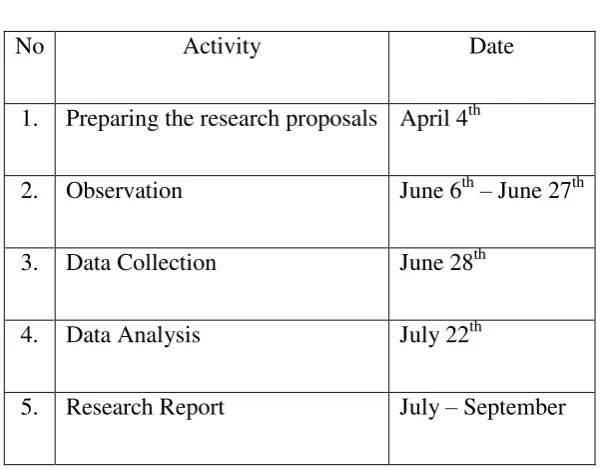
The sequences of data collection and the data analysis are as follows:
Table 3.1 Research Schedule
No Activity Date
1. Preparing the research proposals April 4th
2. Observation June 6th– June 27th
3. Data Collection June 28th
4. Data Analysis July 22th
21 B. Research Design
This research was conducted to get description about the students’
perceptual learning style preference in International Class Program of Teacher
Training and Education of State Institute for Islamic Studies Salatiga in
academic year from 2012 to 2015.
This research categorized as descriptive research. Williams (2007:66)
claims that “the descriptive research approach is a basic research method that
examines the situation, as it exists in its current state”. It can be meant that the
result of descriptive research is description of the data at the moment.
Therefore, this research called descriptive because it is describe what the
perceptual learning styles of International Class Program of Teacher Training
and Education of State Institute for Islamic Studies (IAIN) Salatiga from
academic year 2012 to academic year 2015 is.
According to Glass and Hopkins (1984) as cited in Knupfer and
McLellan (1996:1197) “descriptive research involves gathering data that
describe events and then organizes, tabulates, depicts, and describes the data
collection”. The data collection from the research is raw. To make the data
understandable, the researcher presents the data in the manageable form. After
collecting the data, the researchers use visualization such as graph or table to
distribute the data and describe it.
Knupfer and McLellan (1996:1197) state that “descriptive research can
be either quantitative or qualitative”. In this research, the researcher used
22
research method is the social phenomenon being investigated from the
participant’s viewpoint”. This is meant that the data for this research is taken
from the participant. Then, the researcher interprets the data to answer the
research problems. One way to gather the data is survey. The survey research
method is used for sampling data from respondents that are representative of a
population and uses a closed ended instrument or open-ended items.
“Qualitative research is especially effective in obtaining culturally
specific information about the values, opinions, behaviors, and social contexts
of particular populations” (Mack et al, 2005:1). It can be meant that qualitative
research is used to get information from specific population. The data is
gathered to find the social context of specific people.
C. Population and Sample
The population of this research was all of the students of international
class program of teacher training and education faculty of state institute for
Islamic studies (IAIN) Salatiga. They were distributed into four classes. Each
class consists of three majors: Islamic Education Department, English
Education Department, and Arabic Education Department. The data of this
research was taken from 70 students that distributed into four academic years
as follows:
Table 3.2
Population of the Research
23
The researcher use this technique because total population of the International
Class Program was below 100.
D. Technique of Data Collection
Technique of collecting data in this research was questionnaire.
According to Siniscalco and Auriat (2005:3), questionnaire is:
“Questionnaire is a survey instrument used to collect data from individuals about themselves, or about a social unit as a household or a school. A questionnaire is said to be standardized when each respondent is to be exposed to the same questions and the same system of coding responses”.
This is meant that questionnaire is a method of collecting data by using
some questions. The questions for each respondent are the same in order to see
24
research was to get the data information about the student’s perceptual learning
style in learning English of all students of International Class Program of IAIN
Salatiga.
The data from questionnaire was used to answer research questions. The
questionnaire is adopted from Perceptual Learning Style Preference
Questionnaire (PLSPQ) by Joy Reid (1987). The questionnaire consists of 30
items based on four learning styles and two social styles. Those were randomly
arranged. The statement of the questionnaire set out in the following way:
statement 6, 10, 12, 24, 29 deals with visual learning styles, statement 11, 14,
16, 22, 25 deals with tactile learning style, statement 1, 7, 9, 17, 20 deals with
auditory learning style, statement 2,8,15,19, 26 deals with kinesthetic learning
style, statement 3, 4, 5, 21, 23 deals with group learning style, and statement
13, 18, 27, 28, 30 deals with individual learning style. There were five
alternative categories: strongly agree, agree, undecided, disagree, strongly
disagree. The perceptual learning style preference questionnaire (PLSPQ) is
one of the popular instruments used by researchers to examine English as a
foreign language that related to present research.
E. Techniques of Data Analysis
In this research, to analyze the data, the researcher used descriptive
method. In the descriptive method, Suryana (2010:16) states that “descriptive
method begins from collecting the data, analyze the data, and interpret the
25
questionnaires that had filled by the respondents. Then, the researcher
classified and analyze the data in order to get the answer of this research
questions. Aitken et al. (2003:95) claim that “typically, data are collected as
qualitative or quantitative responses, which are coded into a specified set of
classifications according to given rules. The data we are coding could be in
several forms: paper questionnaire; scanned form…” In order to make it easier
to count the data from the questionnaire, the researcher made a code to each
answers of the questionnaire. Therefore, the researcher can get the needed data.
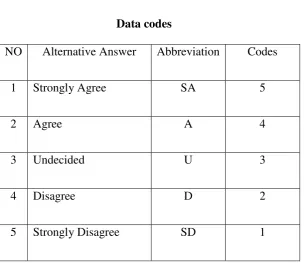
The codes are as in the following table:
Table 3.3 Data codes
NO Alternative Answer Abbreviation Codes
1 Strongly Agree SA 5
2 Agree A 4
3 Undecided U 3
4 Disagree D 2
5 Strongly Disagree SD 1
The data from the questionnaire presented in the table form. Therefore,
the reader can easily understand the contents of this research. In the last step,
26
The procedure of data analysis can be seen as follows:
1. Preparation
a. Preparing the questionnaire.
b. Ask for permission to conduct the research.
c. Arrange the time with the students.
2. Operation
a. Distributing the questionnaires to be filled by the students.
3. Analysis
a. Analysis of the data of the questionnaire result.
b. Coding
c. Interpreting the result of analysis.
27
CHAPTER IV
FINDINGS AND DISCUSSION
A. Perceptual Learning Style Preference of the Students of International Class Program of Teacher Training and Education Faculty of State Institute for Islamic Studies (IAIN) Salatiga
Perceptual Learning Style Preference Questionnaire (PLSPQ) indicates 6
perceptual learning styles. They are visual learning style, tactile learning style,
kinesthetic learning style, auditory learning style, group learning style and
individual learning style. Furthermore, the following tables show the data of
number occurrences and percentages of types of perceptual learning style
preference.
In the following table the researcher shows the number of the
occurrences of the visual learning style preference in the questionnaire. There
are five statements that indicate the visual perceptual learning style. Each of
the statements has 5 alternative answers. It is presented in the table below.
Table 4.1
Number of Occurrences of Visual Learning Style Preference in the Questionnaire
NO Perceptual Learning Styles SA A U D SD Total
Answer
28
textbooks than by listening to
lectures. 11 30 20 9 0 70
6
I learn better by reading what
the teacher writes on the
chalkboard. 19 26 18 7 0 70
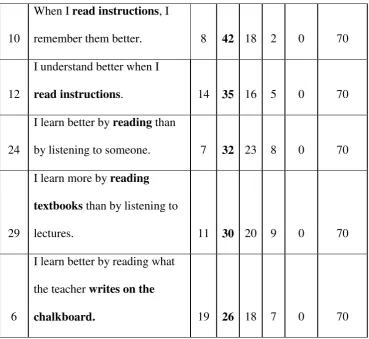
Table 4.1 shows the number of the occurrences of the visual learning
style preference in the questionnaire. According to Perceptual Learning Style
Preference Questionnaire (PLSPQ), the visual students are more comfortable to
read visual stimulation while learning. Majority of the students retrieve
relevant knowledge from long term memory by read the instructions. As can be
seen on the table, the statement number 10 which is “When I read the
instruction, I remember them better”. There are 42 out of 70 students agree of
the statement. The students also can construct the meaning from written
instruction. It is proven by 35 out of 70 students agree with the statement
29
listening, the students prefer reading. They specifically like to read textbook. It
shows from total number occurrences of the statements number 24 (32 out of
70 total answers) and the statement number 29 (30 out of 70 total answers).
Those statements are “I learn better by reading than by listening to someone”
and “I learn more by reading textbooks than by listening to lectures”. The least
occurrences are in the statement number 6 which has 24 out of 70 total
answers. The statement is “I learn better by reading what the teacher writes on
the chalkboard.” The students do not like to much written materials in the
chalkboard.
Based on the analysis above, it can be meant that in the visual learning
style, the students like to read. The majority of the students prefer teachers to
prepare written instruction than any other visual stimulation. The second stage
is the usage of textbooks and the last stage is written text on the chalkboard.
The preferred way of how the visual students learn can be seen in the chart as
follows:
Chart 4.1
Preferred Ways of How the Visual Students’ Learn
30
Next, the following table shows the number of the occurrences of the
tactile learning style preference in the questionnaire. There are five statements
that indicate the tactile perceptual learning style. Each of the statements has 5
alternative answers. It is presented in the table below.
Table 4.2
31
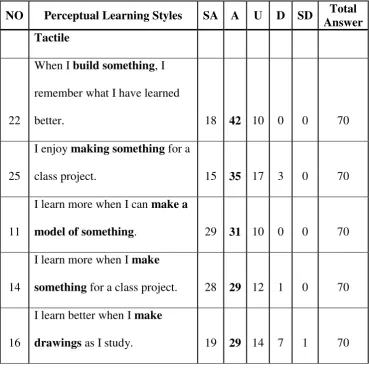
The table above presents the number of the occurrences of the tactile
learning style preference in the questionnaire. Overall, it can be seen that the
tactile students like to use their hands to make and to build something in class.
When the students build something, they can memorize what they have learned
well. As is observed from the table, the statement number 22 which is “When I
build something, I remember what I have learned better” earns 42 agrees out of
70 total answers. There are 35 students out of 70 students agree with the
statement number 25 which is “I enjoy making something for a class project”.
It is evident that the students get pleasure when they can make something for a
class project. The students retain more knowledge when they can make model
of something. It proven by the statement number 11 which is “I learn more
when I can make a model of something” that gets 31 agrees out of 70 total
answer. There is similarity between the statement number 14 and the statement
number 16. They have same number occurrences of agree answer (29 out of 70
total answers). It is meant that the students absorb more and better knowledge
when they make something for a class project and when they make drawings as
they study.
It is clearly seen that in the tactile learning style, the students interested
in building and making something in class. In general, majority of the students
like to make something for a class project. Although they like to make model
of something, they prefer to build something than to make a model of
32
preference. In order to make the reader easy to understand the preferred ways
of the tactile students’ learn, the researcher provided it in a chart as follows:
Chart 4.2
Preferred Ways of How the Tactile Students’ Learn
After the previous tables the researcher shows the number of the
occurrences of the auditory learning style preference in the questionnaire.
There are five statements that indicate the auditory perceptual learning style.
Each of the statements has 5 alternative answers. It is presented on the table
below. 0 10 20 30 40 50 60 70
The Preferred Ways of Learning
To Make Something
To Build Something
To Make a Model of Something
33 Table 4.3
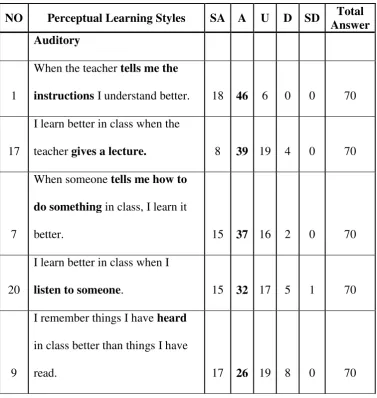
Number of Occurrences of Auditory Learning Style Preference in the Questionnaire
NO Perceptual Learning Styles SA A U D SD Total Answer Auditory
1
When the teacher tells me the
instructions I understand better. 18 46 6 0 0 70
17
I learn better in class when the
teacher gives a lecture. 8 39 19 4 0 70
I learn better in class when I
listen to someone. 15 32 17 5 1 70
9
I remember things I have heard in class better than things I have
read. 17 26 19 8 0 70
The table above illustrates the number of the occurrences of the auditory
learning style preference in the questionnaire. As is observed from the given
table, the auditory students absorb the information by hearing someone. The
34
them. It is proven by the statement number 1 which is “When the teacher tells
me the instructions I understand better” that gets 46 out of 70 agree answer
from the students. The students retain new knowledge by listening to the
lecture. It is seen from the table that the statement number 17 that is “I learn
better in class when the teacher gives a lecture” obtains 39 agrees out of 70
total answers. The statement number 7 which is “When someone tells me how
to do something in class, I learn it better” and the statement number 20 that is
“I learn better in class when I listen to someone” tell that when the students
listen to someone in class, especially when someone tells them how to do
something, they can learn better. The statement number 7 earns 37 agrees out
of 70 total answers, while the statement number 20 earns 32 agrees out of 70
total answers. A few of the students recalls relevant knowledge better when
heard someone than when they read a book. As can be seen on the table, the
statement number 9 “I remember things I have heard in class better than things
I have read” gets just 26 agrees out of 70 total answers.
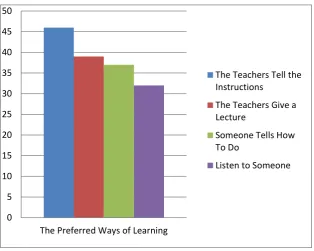
It can be concluded that in the auditory learning style, the students prefer
the teacher to tell them the instruction and give a lecture. Moreover, the
students learn better when listening to someone and when someone tells them
how to do something. Some of the students prefer hearing than reading in order
to remember something. The chart below depict the students preferred way of
35 Chart 4.3
Preferred Ways of How the Auditory Students’ Learn
In the following table, the researcher shows the number of the
occurrences of the kinesthetic learning style preference in the questionnaire.
There are five statements that indicate the kinesthetic perceptual learning style.
Each of the statements has 5 alternative answers. It is presented in the table
below.
Table 4.4
36
I understand things better in class
when I participate in
role-I enjoy learning in class by doing
experiments. 24 33 11 2 0 70
The data from the table above shows the number of the occurrences of the
kinesthetic learning style preference in the questionnaire. Based on the table, the
kinesthetic students like lots of movement. They like to do something in class.
More than half of the students prefer to do something in class. It is proven by the
number of the occurrences of the statement number 8 and 2. The statements are
“When I do things in class, I learn better” with 38 agrees out of 70 total answers
and “I prefer to learn by doing something in class” with 37 out of 70 total
answers. The students comprehend the materials better when they participate in
role playing. It can be seen from the table that statement number 19 which is “I
37
out of 70 total answer. The statement number 26 which is “I learn best in class
when I can participate in related activities” obtains similar number. The statement
earns 35 agrees out of 70 total answer. It can be meant that the students also can
learn better when they participate in related activities. Moreover, it is also
pleasure for the students to do experiment in class. It is proven by the statement
number 15 which is “I enjoy learning in class by doing experiments” gets 33
agrees out of 70 total answers.
According to the analysis above, the kinesthetic students prefer to learn by
doing things in class. They also like to participate in related activities of learning.
The teachers can also provide role playing activities in order to make the children
understand better. Furthermore, the children also enjoy to do experiment. The
preferred way of how the kinesthetic students’ learn can be seen in the chart
below.
Chart 4.4
Preferred Ways of How the Kinesthetic Students’ Learn
38
In the next table the researcher shows the number of the occurrences of
the group learning style preference in the questionnaire. There are five
statements that indicate the group perceptual learning style. Each of the
statements has 5 alternative answers. It is presented in the table below.
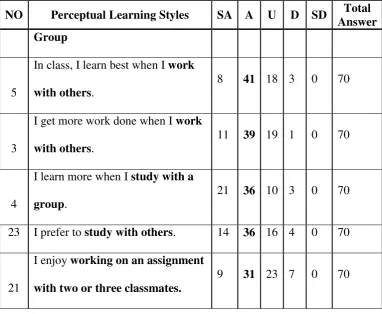
Table 4.5
Number of Occurrences of Group Learning Style Preference in the Questionnaire
I enjoy working on an assignment
with two or three classmates.
9 31 23 7 0 70
The given table presents the number of the occurrences of the group
39
questionnaire, the group style students prefer learning in group or work with
others. The students process the information better and get more work done by
working with others. As can be seen on the table that the statement number 5
which is “In class, I learn best when I work with others” and the statement number
3 which is “I get more work done when I work with others” get the highest
number of the occurrences. There are 41 agrees out of 70 total answers for number
5 and there are 39 agrees out of the 70 total answers for number 3. The students
receive more information by studying with a group and more than half of the
students prefer study with others. It is proven by the number of the occurrences of
the statement number 4 and the statement number 23. There are 36 agrees out of
70 total answers. In addition, it is pleasure for the students to work on assignment
with two or three classmates. It can be seen from the table that the last statement
which is “I enjoy working on an assignment with two or three classmates” earns
31 agrees out of 70 total answers.
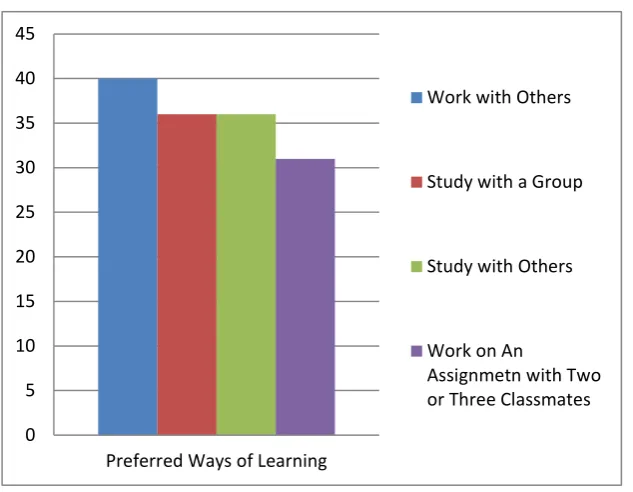
By looking at the analysis above, it can be seen that the group style
students like to work with others while learning. They also like to study with a
group. When doing an assignment, they prefer to do with two or three classmates.
40 Chart 4.5
Preferred Ways of How the Group Style Students’ Learn
In the following table the researcher shows the number of the
occurrences of the individual learning style preference in the questionnaire.
There are five statements that indicate the individual perceptual learning style.
Each of the statements has 5 alternative answers. It is presented in the table
below.
Table 4.6
41
I prefer working on projects by
myself. 14 22 27 5 2 70
13
When I study alone, I remember
things better. 24 24 18 4 0 70
The provided table above shows the number of the occurrences of the
individual learning style preference in the questionnaire. According to the
questionnaire, the students that have individual learning style prefer to work and
study alone. The data on this table are different from the previous data that have
been presented. Majority of the students choose “undecided” than the other
alternative answers. Sometimes the students prefer to work alone. In some cases
they prefer to work and study alone. There is only little different number between
the statements number 27, 18, and 30. The statement number 27 “In class, I work
better when I work alone” gets 31 “undecided” out of 70 total answers. There is a
similar number between the statement number 18 which is “When I work alone, I
learn better” and 30 which is “When I study alone, I remember things better”. The
statements earn 30 “undecided” out of 70 total answers. On some occasion, the
students also like to work on project by themselves. It is seen from the table that
42
27 “undecided” out of the total answers. In contrast, the statement number 13
which is “When I study alone, I remember things better” gets the same number of
the occurrences for the answer “strongly agree” and “agree”. It is 24 out of 70
total answers. It can be meant that some of the students memorize the information
better when they learn alone.
In conclusion, it can be seen from the table that the individual style
students prefer to learn and work alone. Sometimes the students learn better when
they work and study alone. On some occasion, the students like to work a project
alone. Some of the students remember the information better when they learn
alone. The chart below depicts the preferred way of how the individual students
learn.
Chart 4.5
Preferred Ways of How the Individual Style Students’ Learn
43
B. Dominant Perceptual Learning Style Preference of the Students of International Class Program of Teacher Training and Education Faculty of State Institute for Islamic Studies (IAIN) Salatiga
After classified the students’ perceptual learning style preference, the
researcher tried to find out the dominant style of the students. There are six
categories of perceptual learning style: visual, tactile, auditory, kinesthetic, group,
and individual learning style. The result of the analysis of the students’ dominant
style is presented in the following table:
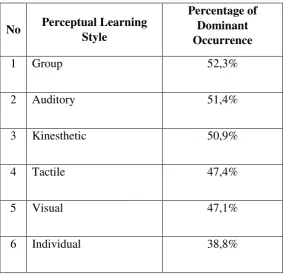
Table 4.7
Dominant Perceptual Learning Style Preference
No Perceptual Learning Style
Percentage of Dominant Occurrence
1 Group 52,3%
2 Auditory 51,4%
3 Kinesthetic 50,9%
4 Tactile 47,4%
5 Visual 47,1%
44
Table 4.7 shows the dominant perceptual learning style preference in
learning English among the students. Majority of the students learn more
effectively through working with others. The general tendency of the distribution
showed that 70 students prefer group learning style. As can be seen on the table,
the group learning style ranked first (52,3%). It is evident that the students prefer
to work with others or study in a group. The teachers can divide the students into
groups, so that they can work with others. The students also can absorb the
information better. The second stage is auditory learning style (51,4%). The
students like to listen to the teachers. When the teachers give lectures, they
remember what is said. The teachers can use audio tapes or other stimuli for
auditory students. The kinesthetic learning style is in the third stage (50,9%).
Generally, the students have to move around while processing information. The
teachers can prepare some movement activities that related to the materials. The
fourth stage is the tactile learning style (47,4%). The kinesthetic students like to
make something in class. They like to use their hand to assimilate information.
The teachers can provide experiment project for the students. The individual
learning style gets the lowest percentage (38,8 %). In opposite to the group
learning style, the individual style students remember the information better when
they study alone.
Based on the table above, the students like to learn with others the most. It
does not mean that they dislike the other perceptual learning styles. They also like
45
some occasion the students also like individual learning. The percentages of each
perceptual learning style are almost similar. They just have a little different.
The chart below depicts the percentage of each learning style preferred by
the students.
Chart 4.7
Students’ Perceptual Learning Style Preference
C. Discussion
Davidson (1990) as cited in Fang-Mei Tai (2013:162) states that “The
students preferred to use the style as it was familiar and made it easier to learn”.
Understanding the students’ preferred way of learning makes the teaching
learning process become more effective. The students easy to understand what the 0 10 20 30 40 50 60
Group Learning Style Auditory Learning Style Kinesthetic Learning Style Tactile Learning Style Visual Learning Style Individual Learning Style
Percentage (%)
46
teachers taught because the teachers provide appropriate instruction. The
instruction is matched with the students’ style.
The findings above demonstrate that all of the perceptual learning styles
categories, the International Class Program students are agree with almost all of
the learning style preference. Khamkien (2012:70) indicates that “a better
understanding of learning styles can be beneficial to both teachers and students,
when in an English classroom”. The teachers of the International Class Program
students may have the students learn English from visual stimulation, auditory
stimulation, tactile stimulation, and kinesthetic stimulation. Regarding the
findings above, the visual students mostly prefer to read instruction from the
teachers. The students can remember and understand better when they read
instruction. Otherwise, the tactile students prefer to make something while
learning a material. It is enjoyable for them and they can learn more. For the
auditory students, the teachers do not have to prepare anything. The students
prefer to listen to the teacher to understand the instruction. The kinesthetic
students learn better when they do things in a class. The teachers may prepare
some activities dealing with the materials. Majority of the International Class
Program students prefer group learning than individual learning. They learn best
when study with others. In some occasion they like to study alone.
Ranked percentages of the research indicate that the International Class
Program students’ most preferred style is group learning style while individual
learning style is ranked as the least preferred style. Slaats et al. (1999) as cited in
47
the opportunities to modify their teaching materials and classroom practices
according to the learning preferences to achieve optimum results”. It means that
the matches between teaching materials and the students’ preference can make
optimum the results of the study. As mentioned, most of the students would like
group learning. It is possible that the students can benefit from learning or
48
CHAPTER V
CLOSURE
A. Conclusions
Based on the findings and discussions from the previous chapter, the
researcher draws conclusions as follow:
1. The students’ perceptual learning style preference in learning English
In the questionnaires which filled by the students, there are 6
perceptual learning style. They are the visual learning style, the tactile
learning style, the kinesthetic learning style, the auditory learning style,
the group learning style and the individual learning style. It is spread out
in the 30 statements. There are 5 alternative answers: strongly disagree,
agree, undecided, disagree, and strongly disagree. Majority of the
students are agree with all of the statements. Only the individual learning
style statements that the most frequent occurrences’ answer is undecided.
For the group learning style statements, the students mostly choose the
statement number 5 which is “in class, I learn best when I work with
others”. The students prefer to study with a group because they can
understand better. For the auditory learning style statements, the students
mostly choose the statement number 17. The statement is “I learn better
in class when the teacher gives a lecture”. The students prefer to listen to
the teachers’ lecture in order to obtain the information. “When I do things
49
style statements. The students prefer to do things in class to learn better.
For the tactile learning style, the most frequent agree answer is the
statement number 22 which is “when I build something, I remember what
I have learned better”. The students prefer to build something to
remember what they have learned better. For visual learning style,
mostly, the students choose statement number 10 which is “when I read
instruction, I remember them better”. The students prefer to read the
instruction that given by the teachers in order to remember better. The
students mostly undecided with the individual learning style statements.
Majority of the students choose the statement number 27 which is “in
class, I work better when I work alone”. The students sometimes prefer
to work alone in class to work better. It means that the students can
manage their sense adapted to the teaching style of the teacher, because
the students mostly agree with all of the statements except the individual
statements.
2. The students’ dominant perceptual learning style preference
In the questionnaire, there are 30 statements which indicate 6
perceptual learning styles. The most dominant perceptual learning style is
group learning style with 183 agrees or 52,3% of the total occurrences.
The second rank is auditory learning style with 180 agrees or 51,4% of
the total occurrences. It is followed by kinesthetic learning style with 178
agrees or 50,9% of the total occurrences. Then, tactile learning style with