• Tidak ada hasil yang ditemukan

Correlations between the factors characteristic of competitive sports and the dark triad

N/A
N/A
Protected

Academic year: 2017

Membagikan "Correlations between the factors characteristic of competitive sports and the dark triad"

Copied!
4
0
0

Teks penuh

(1)

Journal of Physical Education and Sport

®

(JPES), 17(2), Art 80, pp. .533 - 536, 2017 online ISSN: 2247 - 806X; p-ISSN: 2247 – 8051; ISSN - L = 2247 - 8051 © JPES

---533 Corresponding Author: YUKI UENO, E-mail: [email protected]

Original Article

Correlations between the factors characteristic of competitive sports and the dark

triad

YUKI UENO1, TADAHIRO SHIMOTSUKASA2, SATOSHI SUYAMA3, ATSUSHI OSHIO4

1

Research Fellow of the Japan Society for the Promotion of Science (PD), JAPAN

2

Graduate School of Letters, Waseda University, JAPAN

3

Faculty of Sports Science, Nippon Sport Science University, JAPAN

4

Faculty of Letters, Arts and Sciences, Waseda University, JAPAN

Published online: June 30, 2017 (Accepted for publication May 27, 2017) DOI:10.7752/jpes.2017.02080

Abstract:

Correlations between the factors characteristic of competitive sports, such as the type of athletic event and competitive level, and the dark triad were investigated. A questionnaire survey was conducted with 506 Japanese university athletes (217 male and 289 female, mean age = 19.9, SD = 0.8). A three-way ANOVA indicated significant and marginal significant main effects of gender (male/ female), type of athletic event (record-style events/ game-style events), and competitive level (low-competitive group/ high-competitive group) on total dark triad score and its sub-scale scores, including Machiavellianism, psychopathy, and narcissism, as well as marginally significant two-way and three-way interactions among their specific combinations. These results are suggestive of correlations between the dark triad and gender, type of athletic event, and competitive level. It is suggested that future studies should investigate causal relationships between the strength of the dark triad and the processes of exhibiting performance and problem behaviors in athletes.

Key words: dark triad, type of athletic event, competition level, gender, athletes.

Introduction

In recent years, problem behaviors in athletes, such as violence, delinquency, and drug dependence, among others, have been increasing (e.g., Anderson, Albrecht, McKeag, Hough, & McGrew, 1991; Pappas, McKenry & Catlett, 2004). Such tendencies are not only considered as personal problems of athletes, but as having a significant effect on society at large, because athletes are regarded as public role models. The dark triad is normal personality traits that tend to cause problem behaviors. The triad consists of Machiavellianism; characterized by manipulation and exploitation of others, psychopathy; characterized by interpersonal and emotional qualities such as selfishness and remorselessness, as well as behavioral features such as impulsivity, as well as narcissism; characterized by seeking status and fame, and competitive and aggressive attitudes towards others (Jonasan & Webster, 2010; Tamura, Oshio, Tanaka, Masui, & Jonason, 2015). To date, only a few studies have been conducted in internationally on the role of the dark triad in competitive sports. One of the few studies has reported that people participating in competitive sports have higher scores for the dark triad compared to nonparticipants (Strout & Carter, 2015). From the perspective of evolution theory, the dark triad is considered as socially maladaptive responses. However, it could have adaptive functions in specific settings and occupations (Jonason et al., 2009; Paulhus & Williams, 2002). It would be useful to conduct research on athletes with high dark triad scores to understand the multiple functions of the triad in sports. Furthermore, it is necessary to investigate adaptive and maladaptive effects of the dark triad on athletes, including the development of athletic abilities, and psychological effects such as the inhibition of problem behaviors, and adaptation to groups, in order to provide psychological support to athletes in the future.

This study investigated correlations among the dark triad and gender (male/ female), type of athletic event (record-style events/ game-style events), and competitive level (low-competitive group/ high-competitive group). Previous studies have indicated that the dark triad is more adaptive in interpersonal settings (e.g., Furnham, Richards, & Paulhus, 2013; Jonason et al., 2009; Paulhus & Williams, 2002). Therefore, we compared game-style athletic events, such as football, baseball, and badminton, in which athletes with high dark triad are expected to show an evolutionary advantage and record-style athletic events, such as track-and-field, gymnastics, and swimming in which personal records are important.

Material & methods

Participants and Period of Study

(2)

YUKI UENO, TADAHIRO SHIMOTSUKASA, SATOSHI SUYAMA, ATSUSHI OSHIO

---

JPES

®

www.efsupit.ro

534

enrolled in physical education universities located in Tokyo (217 male and 289 female, mean age = 19.9, SD = 0.8). The total number of events performed by participants was 42, including record-style events, such as track-and-field, swimming, gymnastics, and speed skating (n = 22, performed by 142 participants) and game-style events, such as baseball, basketball, football, and badminton (n = 20, performed by 364 participants). Athletes’ competitive levels were as follows: international leagues (n = 26), national leagues (n = 175), regional leagues (n = 281), and less than regional leagues (n = 24).

Procedures

Questionnaires were administered using the collective survey method. The survey was conducted before the beginning of lecture classes conducted by the third author of this study. The study followed the ethical guidelines of the declaration of Helsinki, such that the survey was conducted anonymously, responses to the questionnaires were voluntary, and prior to the survey, participants were provided information about the purpose of the survey, as well as about the protection of personal information. Furthermore, approval of the ethics committee of the institutional affiliation of the third author was obtained before commencing the study.

Questionnaire Sheet

Personal attributes of athletes including gender and age, athletic events in which each athlete had participated, and best results in the four competition levels described above, 1) international competition, 2) national competition, 3) regional competition, and 4) others, were inquired in the face sheet of the questionnaire.

Athletes’ dark triad was assessed using the Dark Triad Dirty Dozen-Japanese version (DTDD-J), which is a Japanese translation (Tamura et al., 2015) of the Dark Triad Dirty Dozen (Jonasan & Webster, 2010). This scale consists of three sub-scales; Machiavellianism,psychopathy,and narcissism, assessed by 12 items. The reliability and validity of the scale have been established previously (Tamura et al., 2015). Responses to this scale are made on a five-point scale anchored between 1 (not at all) and 5 (very true).

Statistical Analysis

Correlations among DTDD-J scores, gender, type of athletic event, and competitive level were examined using a three-way analysis of variance (ANOVA) with gender (male/ female), type of athletic event (record-style events/ game-style events) and competitive level (low-competitive level group: lower than the national level/ high-competitive level group: higher than the national level) as independent variables and total DTDD-J score and sub-scale scores for Machiavellianism, psychopathy, and narcissism as dependent variables. Data were analyzed using IBM SPSS Statistics Ver. 22.0, which is statistical analysis software.

Results

(3)

YUKI UENO, TADAHIRO SHIMOTSUKASA, SATOSHI SUYAMA, ATSUSHI OSHIO

---

JPES

®

www.efsupit.ro

535 Mean SD Mean SD Mean SD Mean SD Mean SD Mean SD Mean SD Mean SD

_

Note. Male/ Female: Gender, Record-style events/ Game-style events: Type of athletic event, Low/ High: Competitive level

2.95

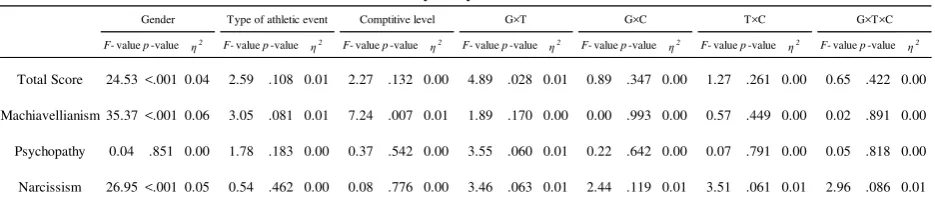
Note. G: Gender (Male/ Female),T: Type of athletic event (Record-style events/ Game-style events),C: Competitive level (High-comptitive level group/ Low-competitive level group) .347

Table 2 Three-way Analysis of Variance Results

G×C T×C G×T×C

Gender Type of athletic event Comptitive level G×T

Discussion

The results indicated main effects and two-way as well as three-way interactions among the total dark triad scores, as well as its sub-scale scores for Machiavellianism, psychopathy, and narcissism, and characteristics factors of competitive sports. In general, male participating in game-style events showed high total dark triad scores and high psychopathy scores. Male participating in game-style events in the high-competitive group had higher Machiavellianism and narcissism scores. Dark triad, which tends to cause problem behaviors might have adaptive effects, depending on individual attributes, such as gender, type of athletic event, and competitive level. An increasing number of athletes would do anything to win games and achieve good results, including fouls, participating in over aggressive and dangerous behaviors, hurting opponents, and doping. These behaviors are strongly correlated with the dark triad (e.g., Paulhus & Williams, 2002; Jonason et al., 2009; Furnham et al., 2013). Fundamental findings regarding the dark triad obtained in the present study would be useful for understanding athletic and psychological characteristics of athletes with high dark triad scores. Fundamental findings regarding the dark triad obtained in the present study would be useful for understanding athletic and psychological characteristics of athletes with high dark triad scores. Furthermore, such athletes have personality traits that contradict social expectations. It is necessary to investigate evolutionary functions of the dark triad in athletic settings from multiple perspectives, by examining how athletes adapt themselves to competitive sports and demonstrate high performances.

There are certain limitations to the current study. First, this study was conducted with Japanese athletes, and cultural differences have not been examined. Secondly, there are various types of game-style events, such as one-to-one, two-to-two, and group-to-group events. Correlations with dark triad should be examined separately for these types. Thirdly, the results of this study should be carefully examined because the p-value and effect size of statistical analysis were small. Additional testing is required with different samples.

Conclusion

These results of this study showed correlations between the dark triad and gender, type of athletic event, and competitive level. It is suggested that further research should be conducted to understand characteristics of athletes with high dark triad scores, by taking the above limitations into consideration. Moreover, investigating events that athletes could adapt to in an evolutionary sense and providing support for improving the competitive abilities of athletes and psychological well-being are future tasks for research on the dark triad.

Acknowledgement

This study was supported by a Grant-in-Aid JSPS Fellows (No.16J00972).

References

(4)

YUKI UENO, TADAHIRO SHIMOTSUKASA, SATOSHI SUYAMA, ATSUSHI OSHIO

---

JPES

®

www.efsupit.ro

536

Furnham, A., Richards, S. C., & Paulhus, D. L. (2013). The Dark Triad of personality: A 10 year review. Social and Personality Psychology Compass, 7, 199-216.

Jonason, P. K., Li, N. P., Webster, G. D., & Schmitt, D. P. (2009). The dark triad: Facilitating a short-term mating strategy in men. European Journal of Personality, 23, 5-18.

Jonason, P. K., & Webster, G. D. (2010). The dirty dozen: A concise measure of the dark triad. Psychological Assessment, 22, 420-432.

Paulhus, D. L., & Williams, K. M. (2002). The dark triad of personality: Narcissism, Machiavellianism, and psychopathy. Journal of Research in Personality, 36, 556-563.

Pappas, N. T., McKenry, P. C., & Catlett, B. S. (2004). Athlete aggression on the rink and off the ice athlete violence and aggression in hockey and interpersonal relationships. Men and Masculinities, 6, 291-312. Strout, S. L., & Carter, G. L. (2015). Playing in the Dark: The dark triad and competitive sports. Ninth Annual

Conference on the Evolutionary Behavioral Sciences, 23-14.

Gambar

Table 1 Fundamental Statistics

Referensi

Dokumen terkait

Profil lulusan kursus dan pelatihan Kamerawan TV pada dunia kerja dapat9. memperlihatkan kemampuan kerja, penguasaan pengetahuan

[r]

[r]

This international seminar on Language Maintenance and Shift 6 (LAMAS 6 for short) is a continuation of the previous LAMAS seminars conducted annually by the

Diajukan Untuk Melengkapi Tugas Akhir Guna Memenuhi Syarat Penulisan

ditetapkan sebesar 80%. Seiring dengan perbaikan pelaksanaan Siklus II yakni memperbaiki pelaksanaan metode resitasi secara lengkap maka KKM yang ditetapkan sebesar

Kajian ekonomi pembangunan mencakup lebih luas, selain berkaitan dengan pengalokasian sumber daya produktif yang langka secara efisien dan keberlangsungan pertu,buhan sumber daya

Sebelum diterapkan untuk karakterisasi limbah radioaktif cair, simulasi pertama dilakukan untuk sumber standar yang digunakan dalam pengukuran pembanding yaitu