Full Terms & Conditions of access and use can be found at
http://www.tandfonline.com/action/journalInformation?journalCode=vjeb20
Download by: [Universitas Maritim Raja Ali Haji] Date: 11 January 2016, At: 20:49
Journal of Education for Business
ISSN: 0883-2323 (Print) 1940-3356 (Online) Journal homepage: http://www.tandfonline.com/loi/vjeb20
The Characteristics and Motivations of
Contemporary Entrepreneurship Students
Nathalie Duval-Couetil, Chad M. Gotch & Soohyun Yi
To cite this article: Nathalie Duval-Couetil, Chad M. Gotch & Soohyun Yi (2014) The Characteristics and Motivations of Contemporary Entrepreneurship Students, Journal of Education for Business, 89:8, 441-449, DOI: 10.1080/08832323.2014.933156
To link to this article: http://dx.doi.org/10.1080/08832323.2014.933156
Published online: 04 Nov 2014.
Submit your article to this journal
Article views: 197
View related articles
View Crossmark data
The Characteristics and Motivations
of Contemporary Entrepreneurship Students
Nathalie Duval-Couetil
Purdue University, West Lafayette, Indiana, USA
Chad M. Gotch
Washington State University, Pullman, Washington, USA
Soohyun Yi
Purdue University, West Lafayette, Indiana, USA
Entrepreneurship is among the fastest growing curricular areas at universities. The rationale for delivering entrepreneurship education to students is well understood; however, minimal research has examined the characteristics, motivations, and attitudes of those choosing to enroll. The authors examine data collected across 5 years from 2,664 students enrolled in a multidisciplinary entrepreneurship course offered at a major university in the United States. It highlights why demographic characteristics, career intentions, and what is termed
entrepreneurial maturity should be taken into consideration in course and program
development. The study provides valuable baseline data that can inform entrepreneurship education research, pedagogy, and assessment.
Keywords: assessment, career, entrepreneurship education, family business, gender, pedagogy
Over the past two decades, there has been significant growth in the availability of entrepreneurship courses offered to a broader population of undergraduate students enrolled at uni-versities across the country, and increasingly the world (Kur-atko, 2005; Solomon, Duffy, & Tarabishy, 2002). Factors driving this trend are changes in the economy which have led to fewer jobs and lower salaries for college graduates (Ram-pell, 2011), as well as growing consensus across governments and educational institutions that entrepreneurship is an impor-tant driver of future economic growth, innovation, and job cre-ation (Audretsch, 2002; Thurik, Stam, & Audretsch, 2013). According to Matlay (2006), “It has become fashionable to view entrepreneurship and entrepreneurship education as the panacea for stagnating or declining economic activity both in developed and developing countries” (p. 704). Consequently, given the important role universities play in economic devel-opment, an increasing number are offering courses and
programs designed to foster entrepreneurial behaviors and out-comes among students.
Although the intentions of universities are well under-stood, minimal research has focused on the students who choose to enroll in entrepreneurship courses. As a result, lit-tle is known about their characteristics, motivations, atti-tudes, and specific interests related to entrepreneurship education and careers. In general, there is a relatively lim-ited amount of educational assessment taking place at either the student or program level within the area of entre-preneurship (Fayolle, Gailly, & Lassas-Clerc, 2006; Pitt-away, Hannon, Gibb, & Thompson, 2009), which is reflective of business-related fields in general (Pfeffer & Fong, 2002). The purpose of this research is to more closely examine the characteristics and career intentions of entre-preneurship students to understand the manner in which these data can inform the design of more effective curricu-lum, pedagogy, and assessment initiatives.
BACKGROUND
Economic trends mean that significant numbers of current and future college graduates will pursue entrepreneurial
Correspondence should be addressed to Nathalie Duval-Couetil, Pur-due University, Department of Technology Leadership and Innovation, BDMCE/MRGN, 1201 State Street, West Lafayette, IN 47907, USA. E-mail: [email protected]
ISSN: 0883-2323 print / 1940-3356 online DOI: 10.1080/08832323.2014.933156
careers either by necessity or choice. Globalization, techno-logical advances, and organizational efficiencies suggest that many jobs that previously existed may not return (Thurik et al., 2013). Higher unemployment rates mean more graduates are competing for fewer jobs, particularly in nontechnical fields (Rampell, 2011). A labor force shift away from full-time jobs toward freelance and contract work means graduates will increasingly need entrepreneur-ial skills to compete and thrive in the professional world (Revell, Bigda, & Rosato, 2009). To be competitive, even large companies need employees with an entrepreneurial mindset, often referred to as intrapreneurs, who are able to identify new opportunities, understand customer needs, commercialize new products, and who possess the commu-nication and leadership skills necessary to advocate for their ideas (Antoncic & Hisrich, 2001).
Demand for students with the entrepreneurial knowledge and skills valued in the contemporary economy has led to a proliferation of courses, majors, minors, certificate pro-grams, and experiential learning opportunities being offered at an estimated 3,000 institutions in the United States (Kur-atko, 2011). Approximately 2,000 university entrepreneur-ship centers have boosted student involvement in business plan competitions, internships, consulting projects, and mentoring programs. Historically embedded in business schools, today entrepreneurship courses and programs are being developed for students in a broad range of disciplines, such as engineering, science, and the arts (Morris, Kuratko, & Cornwall, 2013; Solomon et al., 2002; Streeter & Jac-quette, 2004). This is driven by the realization that many entrepreneurs come from majors outside of business, and a belief that interdisciplinarity is essential to venture creation and economic growth (Hill & Kuhns, 1994; Laukkanen, 2000; Streeter & Jacquette, 2004).
Minimal research has taken a holistic look at the inten-tions, characteristics, motivainten-tions, and attitudes of under-graduate students who choose to enroll in entrepreneurship courses. More commonly, research has focused on evaluat-ing potential interest in, and attitudes toward, entrepreneur-ship across broader populations of students. For example, Shinnar, Pruett, and Toney (2009) examined potential demand for entrepreneurship education through a survey of 317 undergraduate students and found that more than half of nonbusiness majors expressed interest in taking an entre-preneurship course and less than 8% had a definite plan to start a business. As part of developing entrepreneurship cur-riculum, Li~nan, Rodrıguez-Cohard, and Rueda-Cantuche (2011) conducted a study of 354 senior-level undergraduate business and economic students to examine whether demo-graphic characteristics, personality traits, or the intention to become an entrepreneur, had the most influential role in shaping the personal decision to start a firm. The study found that perceived desirability and feasibility associated with being an entrepreneur were the main factors explain-ing the intention to become an entrepreneur, and concluded
that these factors should be stimulated through entre-preneurship education programs.
Other studies have examined student characteristics and attitudes upon program completion to measure the impact of entrepreneurship education. A number have found that entrepreneurship education influences current and future career intentions of students (Kolvereid & Moen, 1997; Noel, 2001). A study of approximately 500 business school alumni found that entrepreneurship education had a signifi-cant positive impact on the creation of new ventures, exist-ing firm growth, income, and job satisfaction (Charney & Libecap, 2000). Studies within the field of engineering edu-cation have found significant differences in entrepreneurial knowledge, self-efficacy, and the intention to become an entrepreneur among engineering students who have taken entrepreneurship courses (Duval-Couetil, Reed-Rhoads, & Haghighi, 2012; Miller, Walsh, Hollar, Rideout, & Pittman, 2011). A major challenge in the field of entrepreneurship education research is defining appropriate learning out-comes for courses or programs, which can include venture creation, business literacy, professional skill development, and employability (Duval-Couetil, 2013).
Demographic Variables and Entrepreneurship Education
Gender and family entrepreneurial background are charac-teristics often examined in studies of entrepreneurs in the United States, as they have been shown to impact entrepre-neurial self-efficacy (De Noble, Jung, & Ehrlich, 1999; McGhee, Peterson, Mueller, & Sequiera, 2009) or entrepre-neurial intention (Kolvereid, 1996; Souitaris, Zerbinati, & Al-Laham, 2007). A study of teenagers’ career interests showed that girls were almost 30% less likely than boys to aspire to entrepreneurial careers (Wilson, Marlino, & Kickul, 2004). Studies of college students have found that male students were more likely to have higher overall entrepreneurial self-efficacy and higher entrepreneurial intentions than female students (Wilson, Kickul, & Marlino, 2007). Reasons put forward to explain these find-ings are similar to those proposed in fields that are consid-ered to be predominantly male, including that women have fewer personal experiences with being successful entrepre-neurs and a lack of female role models (Coleman & Robb, 2012; Scherer, Brodzinski, & Wiebe, 1990).
The importance of role models, parents in particular, in starting a business has been discussed by many researchers (Brockhaus & Horwitz, 1986; Scherer, Adams, Carley, & Wiebe, 1989; Scherer et al., 1990). Entrepreneurial families encourage behaviors that are important to entrepreneurial success and developing positive attitudes toward entre-preneurship (Van Auken, Fry, & Stephens, 2006). The pres-ence of a parent in an entrepreneurial career appears to increase entrepreneurial self-efficacy (Scherer et al., 1989). It has been shown that individuals with higher
442 N. DUVAL-COUETIL ET AL.
entrepreneurial self-efficacy have higher entrepreneurial intentions (Chen, Greene, & Crick, 1998; De Noble et al., 1999) and that exposure to entrepreneurship through self-employed family members, working in a small business, and taking an entrepreneurship course contribute to a more agreeable view of entrepreneurship among students (Frazier & Niehm, 2008).
Implications of Understanding Student Characteristics on Teaching and Learning
Understanding student backgrounds and motivations related to entrepreneurship education and careers can be valuable to the development of courses and programs. To develop rele-vant curriculum and measure the extent of changes in learn-ing or attitudes that can be attributed to entrepreneurship education, a point of departure has to be established (Falk & Alberti, 2000). This requires understanding the characteris-tics of students in order to “customize content, assessment, [and] teaching methodologies more specific to student requirements (Hynes, 1996, p. 12). Hynes described a pro-cess model of entrepreneurship education, the first compo-nent of which describes inputs (i.e., students) which is essential to develop content and teaching methods to arrive at outputs or learning objectives. These inputs are student characteristics, including prior knowledge, motivation, per-sonality, interests, attitudes, parental influence, self-esteem, values, and work experience.
Understanding inputs is critical to an important concept in educational pedagogy and assessment, which is the degree to which content is relevant to students. Keller (1983) defined relevance as a perception of personal needs being met by instructional activities, or in other words “we perceive something as being relevant if we perceive it as related to our personal needs (e.g., needs for affiliation, control, or achievement) or our personal goals (e.g., career goals)” (Frymier, 2002, p. 103). To enhance relevance, edu-cators must know something about students, their skills, and their past experiences. Studies have shown that relevance can be positively associated with a motivation to study and with learning behaviors and empowerment (Frymier, 2002; Frymier, Houser, & Shulman, 1996). One challenge is, the more diverse the skills and interests of students are, the more difficult it is to choose a strategy that will help all per-ceive the content as relevant (Frymier, 2002).
PURPOSE AND RESEARCH QUESTIONS
Given the number of and diversity of students participating in entrepreneurship education, the purpose of this study is to examine a number of student characteristics, attitudes, and interests which have not been examined to a great extent in previous research. The research questions are the following:
Research Question 1(RQ1): Why are students enrolling in an entrepreneurship course?
RQ 2:How do students rate their perceived knowledge of, and level of interest in, various entrepreneurship-related topics?
RQ3: What are entrepreneurship students’ professional goals postgraduation?
METHOD
Data were collected through an entrepreneurship program entry survey, which is administered to students who enroll in an introductory entrepreneurship course that is part of a five-course sequence necessary to receive an educational credential in entrepreneurship similar to a minor. The sam-ple consists of 2,664 undergraduate students from a variety of academic majors at a large, land grant university, which shares similarities with other public research universities in the United States. Enrollment in the introductory entre-preneurship course over the 5-year period was comprised of students from the colleges of technology (22%), manage-ment (21%), engineering and liberal arts (both 13%), con-sumer and family sciences (10%), agriculture (8%), and science (4%). Overall, the demographic characteristics of students enrolled in the entrepreneurship course aligned reasonably well with those of the general undergraduate population at the university during the 2010–2012 aca-demic years (Purdue University Data Digest, 2010). Less than one third of the students (31%) were women, which was lower than the general population at the university (42%). However, because the entrepreneurship program drew heavily from the colleges of management, technology, and engineering, which had high percentages of men (64.5%, 86.3%, and 81.6%, respectively), the female popu-lation in the program was likely in line with the colleges from which it drew. Forty-two percent of students had a family member who was an entrepreneur and 40% reported having a parent who was an entrepreneur. It is not known how this compares with the general population of students, because the university does not collect or report this data in a way where comparisons can be made.
The survey was developed with the input of entre-preneurship faculty and assessment experts for the purpose of informing course and program development. It included sixty-five items organized into several categories, includ-ing: demographics, work experience, postgraduation goals, reasons for taking an entrepreneurship course, interest in entrepreneurship-related topics, and perceptions of ability and knowledge. Students were asked to complete the survey during the first week of classes. To examine differences across the key demographics variables, response patterns for each item were analyzed usingttests. For select items, frequency distributions are provided in order to highlight the distribution of responses.
RESULTS
RQ1: Why Are Students Enrolling in an Entrepreneurship Course?
Students were asked to indicate the degree to which they agreed or disagreed with a number of statements represent-ing reasons they might be interested in takrepresent-ing an entre-preneurship course, with responses rated on a 5-point Likert-type scale ranging from 1 (strongly disagree) to 5 (strongly agree). Table 1 shows that more than 95% of stu-dents agreed or strongly agreed that they enrolled in an entrepreneurship course because they had a general interest in entrepreneurship (MD4.43,SDD0.66) and to broaden
career prospects and choices (M D 4.41, SD D 0.83).
Approximately 74% of students agreed or strongly agreed they wanted to become an entrepreneur, while only 4% of students reported that they did not (MD4.13,SDD0.89). Approximately 60% of students not majoring in business took an entrepreneurship course because they were inter-ested in business classes, while 23% disagreed with this statement (MD3.18,SD D1.38). Student responses were
mixed when asked about the extent to which earning an additional credential was a reason for taking an entre-preneurship course (M D3.77, SD D 1.07). For approxi-mately half of the respondents, having a specific business or product idea in mind was a reason for taking an entre-preneurship course (MD3.54,SDD1.09).
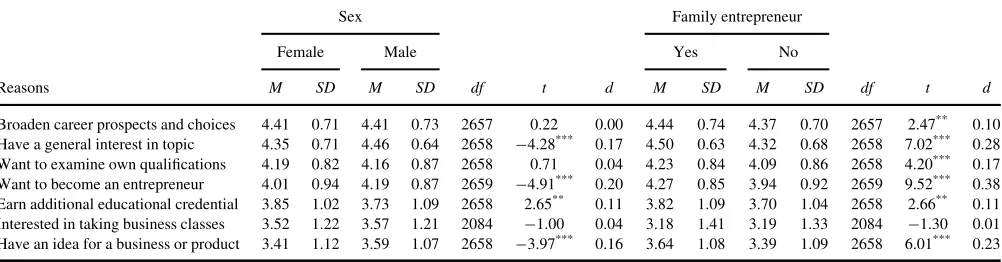
Female and male students differed significantly on four reasons for enrolling in an entrepreneurship course (Table 2). Male students were more likely to strongly agree that they wanted to become an entrepreneur, t(2659) D
–4.91,p<.001, and had an idea for a business or product,
t(2658) D –3.97, p < .001. Female students responded
more positively to its value as an additional educational cre-dential, t(2658) D 2.65, p < .01. Significant differences
were found between the responses of students with entre-preneurs in the family and those without across all the state-ments but one (Table 2). Students from entrepreneurial families more strongly agreed with each reason than those who did not. The lone nonsignificant exception was among nonbusiness majors and their interest in taking business classes. Effect sizes (d) among the significant results ranged from 0.11 to 0.38.
TABLE 2
Students’ Levels of Agreement With Reasons for Enrolling in an Entrepreneurship Course by Sex and by Whether a Family Member Is an Entrepreneur
Sex Family entrepreneur
Female Male Yes No
Reasons M SD M SD df t d M SD M SD df t d
Broaden career prospects and choices 4.41 0.71 4.41 0.73 2657 0.22 0.00 4.44 0.74 4.37 0.70 2657 2.47** 0.10 Have a general interest in topic 4.35 0.71 4.46 0.64 2658 ¡4.28*** 0.17 4.50 0.63 4.32 0.68 2658 7.02*** 0.28 Want to examine own qualifications 4.19 0.82 4.16 0.87 2658 0.71 0.04 4.23 0.84 4.09 0.86 2658 4.20*** 0.17 Want to become an entrepreneur 4.01 0.94 4.19 0.87 2659 ¡4.91*** 0.20 4.27 0.85 3.94 0.92 2659 9.52*** 0.38 Earn additional educational credential 3.85 1.02 3.73 1.09 2658 2.65** 0.11 3.82 1.09 3.70 1.04 2658 2.66** 0.11 Interested in taking business classes 3.52 1.22 3.57 1.21 2084 ¡1.00 0.04 3.18 1.41 3.19 1.33 2084 ¡1.30 0.01 Have an idea for a business or product 3.41 1.12 3.59 1.07 2658 ¡3.97*** 0.16 3.64 1.08 3.39 1.09 2658 6.01*** 0.23
Note:For reason 5 (interested in taking business classes), sample size is different from other cells due to subtracting the number of students in manage-ment:nD1,203 for students with family entrepreneur,nD891 for students without family entrepreneur. Cohen’sdindicates the statistical power: 0.2–0.3 is a small effect, 0.5 is medium effect, and above 0.8 is a large effect (Cohen, 1988).
*p<.05. **p<.01. ***p<.001.
Table 1
Students’ Levels of Agreement With Reasons for Enrolling in an Entrepreneurship Course
Reasons for enrolling in an entrepreneurship course
Disagree or strongly disagree Undecided Agree Strongly agree
M SD
n % n % n % n %
Have a general interest in topic 42 2 83 4 939 45 1,043 50 4.43 0.66
Broaden career prospects and choices 42 2 125 6 855 41 1,064 51 4.41 0.83
Want to examine own qualifications 125 6 167 8 1022 49 772 37 4.17 0.85
Want to become an entrepreneur 83 4 459 22 647 31 897 43 4.13 0.89
Earn additional educational credential 292 14 355 17 897 43 542 26 3.77 1.07
Have an idea for a business or product 375 18 626 30 585 28 480 23 3.54 1.09
Interested in taking business classes 480 23 355 17 751 36 501 24 3.18 1.38
Note:For reason 5 (interested in taking business classes), sample size is different from other cells due to subtracting the number of students in manage-ment:nD2,086.
444 N. DUVAL-COUETIL ET AL.
RQ2: How Do Students Rate Their Level of Interest in, and Perceived Knowledge of, Various
Entrepreneurship-Related Topics?
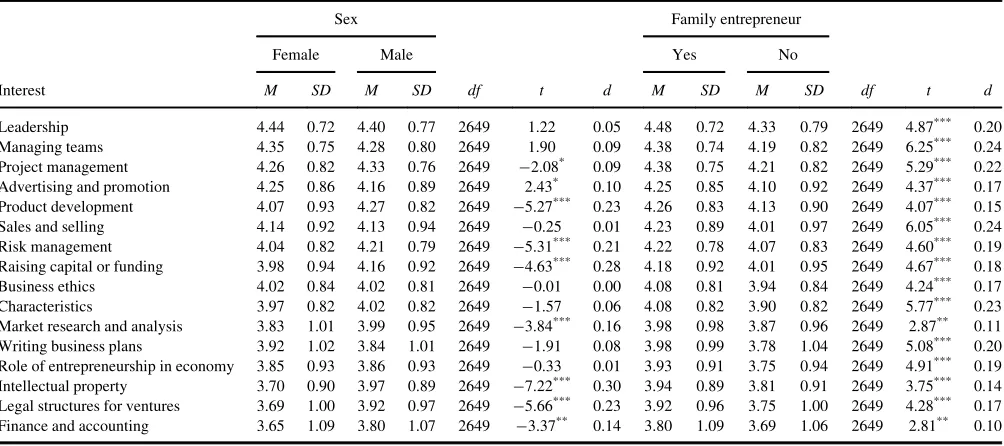
To examine entrepreneurial interests, students were asked the degree to which they were interested in a number of broad topic categories commonly addressed in entre-preneurship courses, with responses rated on a 5-point Lik-ert-type scale ranging from 1 (not interested at all) to 5 (very interested). Students reported the highest degree of interest in learning about leadership, project management, and managing teams. Topics such as finance and account-ing, legal structures for ventures, the role of entrepreneur-ship in the economy, and writing business plans garnered less interest. Comparisons by gender indicated that men were significantly more interested than were in topics more closely aligned with entrepreneurship education specifi-cally, including risk management, t(2649) D –5.31, p <
.001 (Table 3); legal structures for ventures, t(2649) D
–5.66,p<.001; intellectual property,t(2649)D–7.22,p<
.001; product development, t(2649) D –5.27, p < .001; product management, t(2649) D –2.08, p < .05; raising capital or funding,t(2649)D–4.63, p<.001; finance and accounting,t(2649)D–3.37,p<.01; and market research,
t(2649) D –3.84, p < .001. These significant differences were associated with effect sizes (d)of 0.09–0.30. Looking at family background, students with an entrepreneurial fam-ily member indicated significantly more interest in all topics,trangeD2.81–6.25,psD.05 to<.001, with
signifi-cant differences corresponding to effect sizes (d) 0.10–0.24.
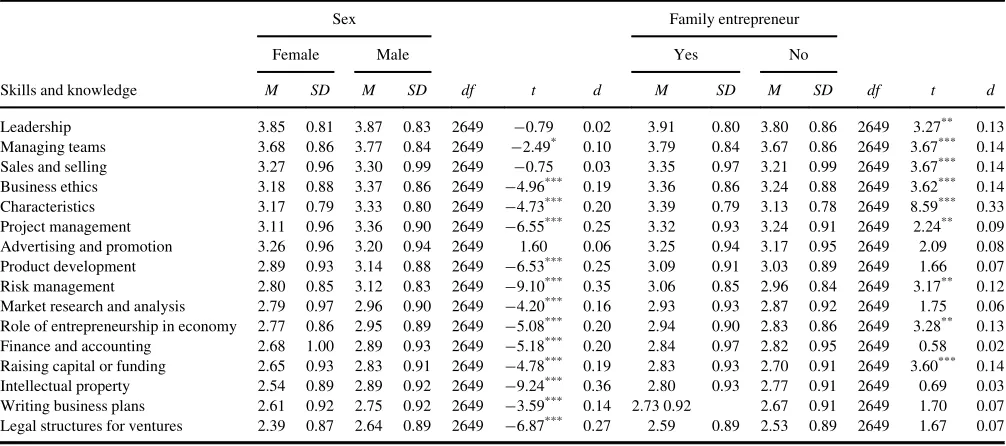
Students were also asked to rate their skill and knowl-edge related to these same topics, with responses rated on a 5-point Likert-type scale ranging from 1 (poor) to 5 ( excel-lent). Not surprisingly, because these students had never taken an entrepreneurship course, they rated their skills highest in areas not exclusive to entrepreneurship, such as leadership and managing teams. Students rated their skill and knowledge less positively on topics more exclusive to entrepreneurship, such as legal structures for ventures, writ-ing business plans, and raiswrit-ing capital or fundwrit-ing. Men rated their abilities more favorably than women in 13 of 16 topics, trange D –2.49 to –9.24; ps D .05 to < 0.001
(Table 4). Significant differences across gender were asso-ciated with effect sizes (d) of 0.10–0.36. The only topics where there were no significant differences were leadership, advertising and promotion, and sales. Comparisons based on family background resulted in significant differences across nine topics. Students with an entrepreneur in the family were generally more likely to rate their abilities as above average than students without. Effect sizes(d) among significant differences ranged from 0.09 to 0.33.
RQ3: What Are Entrepreneurship Students’ Professional Goals Postgraduation?
To examine the extent to which students were interested in pursuing entrepreneurship as a career, they were asked to rate their level of interest, with responses rated on a 5-point Likert-type scale ranging from 1 (not interested at all) to 5
TABLE 3
Students’ Level of Interest in Entrepreneurship-Related Topics by Sex and by Whether a Family Member Is an Entrepreneur
Sex Family entrepreneur
Female Male Yes No
Interest M SD M SD df t d M SD M SD df t d
Leadership 4.44 0.72 4.40 0.77 2649 1.22 0.05 4.48 0.72 4.33 0.79 2649 4.87*** 0.20 Managing teams 4.35 0.75 4.28 0.80 2649 1.90 0.09 4.38 0.74 4.19 0.82 2649 6.25*** 0.24 Project management 4.26 0.82 4.33 0.76 2649 ¡2.08* 0.09 4.38 0.75 4.21 0.82 2649 5.29*** 0.22 Advertising and promotion 4.25 0.86 4.16 0.89 2649 2.43* 0.10 4.25 0.85 4.10 0.92 2649 4.37*** 0.17 Product development 4.07 0.93 4.27 0.82 2649 ¡5.27*** 0.23 4.26 0.83 4.13 0.90 2649 4.07*** 0.15 Sales and selling 4.14 0.92 4.13 0.94 2649 ¡0.25 0.01 4.23 0.89 4.01 0.97 2649 6.05*** 0.24 Risk management 4.04 0.82 4.21 0.79 2649 ¡5.31*** 0.21 4.22 0.78 4.07 0.83 2649 4.60*** 0.19
Raising capital or funding 3.98 0.94 4.16 0.92 2649 ¡4.63*** 0.28 4.18 0.92 4.01 0.95 2649 4.67*** 0.18
Business ethics 4.02 0.84 4.02 0.81 2649 ¡0.01 0.00 4.08 0.81 3.94 0.84 2649 4.24*** 0.17
Characteristics 3.97 0.82 4.02 0.82 2649 ¡1.57 0.06 4.08 0.82 3.90 0.82 2649 5.77*** 0.23
Market research and analysis 3.83 1.01 3.99 0.95 2649 ¡3.84*** 0.16 3.98 0.98 3.87 0.96 2649 2.87** 0.11
Writing business plans 3.92 1.02 3.84 1.01 2649 ¡1.91 0.08 3.98 0.99 3.78 1.04 2649 5.08*** 0.20
Role of entrepreneurship in economy 3.85 0.93 3.86 0.93 2649 ¡0.33 0.01 3.93 0.91 3.75 0.94 2649 4.91*** 0.19
Intellectual property 3.70 0.90 3.97 0.89 2649 ¡7.22*** 0.30 3.94 0.89 3.81 0.91 2649 3.75*** 0.14 Legal structures for ventures 3.69 1.00 3.92 0.97 2649 ¡5.66*** 0.23 3.92 0.96 3.75 1.00 2649 4.28*** 0.17 Finance and accounting 3.65 1.09 3.80 1.07 2649 ¡3.37** 0.14 3.80 1.09 3.69 1.06 2649 2.81** 0.10
Note:Cohen’sdindicates the statistical power: 0.2–0.3 is a small effect, 0.5 is medium effect, and above 0.8 is a large effect (Cohen, 1988). *p<.05. **p<.01. ***p<.001.
(very interested) in a number of postgraduation career options. Interest was strongest for starting a business or being self-employed, attending graduate school, and work-ing for a large corporation (Table 5). Students were least interested in working for the government or working for a nonprofit. Comparisons by gender found that female stu-dents were significantly less interested than males in starting a business, t(2656) D –4.73, p < .001. Conversely, men were less interested than women in working for nonprofit organizations,t(2652)D11.23,p<.001, and medium-sized companies,t(2653)D3.10,p<.01. Table 5 also presents a
comparison of responses from students with an entrepreneur
in their family and those without. Students with an entrepre-neurial family member were more likely to be very inter-ested in starting a business or being self-employed,t(2656)
D5.51,p<.001. In contrast, students without an entrepre-neurial family member were more likely to be interested in a wider variety of career options, including working for large corporation,t(2655)D–3.00,p <.01; working for a non-profit organization,t(2652)D–2.23, p<.05; working for the government, t(2651) D–2.86, p <.01; and attending graduate or professional school,t(2655)D–2.46,p<.05. Statistically significant differences were associated with effect sizes (Cohen’sd) of 0.11–0.47 standard deviations.
TABLE 5
Student Interest in Postgraduation Options by Sex and by Whether a Family Member Is an Entrepreneur
Sex Family entrepreneur
Female Male Yes No
Postgraduation option M SD M SD df t d M SD M SD df t d
Start own business 4.23 1.02 4.43 0.94 2656 ¡4.73*** 0.20 4.50 0.77 4.31 0.94 2656 5.51*** 0.22 Large-sized corporation 3.87 1.13 3.83 1.07 2655 0.86 0.04 3.74 1.14 3.88 1.06 2655 ¡3.00** 0.13 Graduate school 3.73 1.27 3.71 1.20 2655 0.30 0.02 3.62 1.27 3.75 1.20 2655 ¡2.46* 0.11 Medium-sized business 3.68 0.89 3.56 1.00 2653 3.10** 0.13 3.56 1.00 3.62 0.95 2653 ¡1.29 0.06 Small-sized business 3.24 1.06 3.26 1.13 2654 ¡0.47 0.02 3.29 1.15 3.24 1.10 2654 1.01 0.04 Nonprofit organization 2.99 1.18 2.45 1.11 2652 11.23*** 0.47 2.54 1.12 2.65 1.17 2652
¡2.23* 0.10
Government 2.63 1.22 2.65 1.24 2651 ¡0.27 0.02 2.54 1.22 2.69 1.23 2651 ¡2.86** 0.12
Note:Cohen’sdindicates the statistical power: 0.2–0.3 is a small effect, 0.5 is medium effect, and above 0.8 is a large effect (Cohen, 1988). **p<.01. ***p<.001.
TABLE 4
Students’ Perceived Skills and Knowledge Related to Entrepreneurship-Related Topics by Sex and by Whether a Family Member Is an Entrepreneur
Sex Family entrepreneur
Female Male Yes No
Skills and knowledge M SD M SD df t d M SD M SD df t d
Leadership 3.85 0.81 3.87 0.83 2649 ¡0.79 0.02 3.91 0.80 3.80 0.86 2649 3.27** 0.13 Managing teams 3.68 0.86 3.77 0.84 2649 ¡2.49* 0.10 3.79 0.84 3.67 0.86 2649 3.67*** 0.14 Sales and selling 3.27 0.96 3.30 0.99 2649 ¡0.75 0.03 3.35 0.97 3.21 0.99 2649 3.67*** 0.14 Business ethics 3.18 0.88 3.37 0.86 2649 ¡4.96*** 0.19 3.36 0.86 3.24 0.88 2649 3.62*** 0.14 Characteristics 3.17 0.79 3.33 0.80 2649 ¡4.73*** 0.20 3.39 0.79 3.13 0.78 2649 8.59*** 0.33 Project management 3.11 0.96 3.36 0.90 2649 ¡6.55*** 0.25 3.32 0.93 3.24 0.91 2649 2.24** 0.09
Advertising and promotion 3.26 0.96 3.20 0.94 2649 1.60 0.06 3.25 0.94 3.17 0.95 2649 2.09 0.08 Product development 2.89 0.93 3.14 0.88 2649 ¡6.53*** 0.25 3.09 0.91 3.03 0.89 2649 1.66 0.07
Risk management 2.80 0.85 3.12 0.83 2649 ¡9.10*** 0.35 3.06 0.85 2.96 0.84 2649 3.17** 0.12
Market research and analysis 2.79 0.97 2.96 0.90 2649 ¡4.20*** 0.16 2.93 0.93 2.87 0.92 2649 1.75 0.06
Role of entrepreneurship in economy 2.77 0.86 2.95 0.89 2649 ¡5.08*** 0.20 2.94 0.90 2.83 0.86 2649 3.28** 0.13
Finance and accounting 2.68 1.00 2.89 0.93 2649 ¡5.18*** 0.20 2.84 0.97 2.82 0.95 2649 0.58 0.02
Raising capital or funding 2.65 0.93 2.83 0.91 2649 ¡4.78*** 0.19 2.83 0.93 2.70 0.91 2649 3.60*** 0.14 Intellectual property 2.54 0.89 2.89 0.92 2649 ¡9.24*** 0.36 2.80 0.93 2.77 0.91 2649 0.69 0.03 Writing business plans 2.61 0.92 2.75 0.92 2649 ¡3.59*** 0.14 2.73 0.92 2.67 0.91 2649 1.70 0.07 Legal structures for ventures 2.39 0.87 2.64 0.89 2649 ¡6.87*** 0.27 2.59 0.89 2.53 0.89 2649 1.67 0.07
Note:Cohen’sdindicates the statistical power: 0.2–0.3 is a small effect, 0.5 is medium effect, and above 0.8 is a large effect (Cohen, 1988). *p<.05. **p<.01. ***p<.001.
446 N. DUVAL-COUETIL ET AL.
DISCUSSION
The purpose of this research was to more closely examine the characteristics and career intentions of students who choose to enroll in entrepreneurship courses. A key finding of this study is that students study entrepreneurship for a variety of reasons. Almost three quarters of those surveyed reported interest in becoming entrepreneurs. Half had ideas for specific businesses or products. Many also looked at entrepreneurship as a means to broaden their career pros-pects and choices (91%), see if they had what it takes to be an entrepreneur (86%), and earn an additional educational credential (69%). Nonbusiness students viewed it as a way to take business classes (56%). These data support the wide variety of potential learning outcomes associated with entrepreneurship education that have been described previ-ously in the literature, and the challenges associated with addressing and assessing their breadth within specific courses or programs.
To examine career intentions, students were asked about their interest in various postgraduation options. Entre-preneurship students were most interested in starting their own company; however, many were also interested in working for large companies. While these results appear contradictory, they may not be, given the population sur-veyed. Many students were working toward bachelor’s degrees in areas such as science, engineering, agriculture, and management, at a well-ranked university where the prevalent expectation continues to be that graduating stu-dents will accept a job offer over starting a business. Given their career options, many students are likely to associate significant opportunity costs with choosing the entrepre-neurial career path immediately after graduation, particu-larly if they are interested in fields where a deep understanding of an industry is critical to the launch of new ventures. The value of experience is supported by research on successful company founders indicating that fewer than one quarter start companies within five years of leaving col-lege and most had significant industry experience before starting their own ventures (Wadhwa, Aggarwal, Holly, & Salkever, 2009).
This study is also unique in that it explored students’ level of interest in a wide range of entrepreneurship-related topics. Overall, students were most interested in topics that were not exclusive to entrepreneurship such as leadership, managing teams and project management. Such measures can provide clues into how serious individual students are about choosing the entrepreneurial path in the short term. For example, a stronger interest in legal structures for ventures, writing busi-ness plans, product development, and raising capital or fund-ing would suggest a stronger short-term interest in venture development than would interests in more general topics such as leadership and project management.
These findings suggest that students enrolling in entre-preneurship courses may have varying levels of what may
be termed entrepreneurial maturity, which can be defined as (a) the degree to which they have formed specific venture ideas and (b) the immediacy with which they intend to develop or pursue them. This reinforces the need to develop, particularly within large multidisciplinary pro-grams, a variety of courses and cocurricular activities that align with the range of student interests. For example, courses focused on real product or venture development might be suited for students with a high level of entrepre-neurial maturity and such courses may require more delib-erate screening and recruiting of students. Or, if the objective of an entrepreneurship program is to engage a broad group of students with varying levels of entrepre-neurial maturity, then consideration should be given to sup-plementing courses with experiential learning or mentoring opportunities for those who are serious about advancing their venture ideas in the near term. The fact that many stu-dents are likely to work in existing businesses after gradua-tion suggests that educators should devote attengradua-tion to demonstrating the manner in which entrepreneurial skills can generate value in nonstartup environments (i.e., intrapreneurship).
While many differences across demographic variables were deemed statistically significant, associated effect sizes were mostly small. Nevertheless, being aware of these dif-ferences can enhance teaching and learning. A large per-centage (40%) of students in the sample had parents who were entrepreneurs. Consistent with prior research, these students had a more intense interest and perceived ability for entrepreneurship. They also indicated a stronger interest in starting their own businesses or being self-employed. The large percentage of students with entrepreneurs in their families suggests that there may be opportunities to inte-grate these experiences into class discussions or projects. There could also be significant demand for courses or events that address family business specifically.
Gender differences identified in prior research hold true for students studying entrepreneurship. Male students indi-cated a stronger interest in becoming an entrepreneur, were more likely to have an idea for a business or product, and were more confident in their overall entrepreneurial ability. This research is unique in that it also explored interest in and perceived ability for specific curricular topics associ-ated with entrepreneurship. Comparisons by gender revealed that men rated their ability higher than women for all topics that aligned strongly with entrepreneurship. Women were more confident in areas that were not as exclusive to entrepreneurship, including advertising, pro-motion, and sales, likely reflecting socially constructed gen-der career stereotypes. Again, it is worth noting that while these differences were statistically significant, effect sizes were fairly small and male and female response patterns were very similar. Nevertheless, these findings highlight the ongoing need to develop entrepreneurship curricula that are gender neutral and diverse. Entrepreneurship is often
male-centric and some have encouraged educators to draw from a more inclusive set of entrepreneurial protagonists representing more diverse industries, niches, and strategic choices in both businesses and nonprofits (Gatewood, Brush, Carter, Greene, & Hart, 2004). This requires deliber-ate effort by faculty and administrators to identify curricu-lar materials, case studies, and female entrepreneurs who can serve as speakers and role models.
A limitation of this study was that it relied on data col-lected at one institution. It is clear that student entrepre-neurial backgrounds and interests can vary greatly based on an institution’s program offerings, culture, region, faculty expertise, and entrepreneurial ecosystem. Nonetheless, it provides analysis on a dataset of students that is larger and more diverse than in previous studies. It is also unique in that it focuses on a population of undergraduates who have elected to study entrepreneurship. As a result, it provides valuable baseline data that can be used in entrepreneurship research, program development, assessment and research across contexts and cultures.
CONCLUSION
This study provides a profile of contemporary students from diverse majors who are increasingly representative of those enrolling in entrepreneurship courses at universities across the United States. Results show that undergraduate students recognize value in entrepreneurship education beyond ven-ture creation. They perceive it as a way to prepare them-selves to work in a variety of contexts and obtain skills valued by employers. While most students studying entre-preneurship intend to be entrepreneurs, many are interested in working for existing companies and pursuing graduate school, suggesting they recognize the value of gaining addi-tional experience and have varying timelines for pursuing the entrepreneurial career path. How and when entrepreneur-ship education will be manifested in the career of a graduate highlights the complexities associated with measuring its effects, which can range from increased self-efficacy and career preparedness in the short term, to venture develop-ment and wealth creation in the long term. It is clear that students studying entrepreneurship today are not a homoge-nous group given their varying characteristics, disciplines, previous experiences, and interests. In view of the growth in entrepreneurship education, more research is necessary to understand the degree to which it should follow a one-size-fits-all approach or be tailored to specific student interests or academic disciplines. Collectively, the results from this study provide new insights for the creation of entrepreneur-ship education programs. Specifically, this study shows the value of conducting educational assessment at the start of a course or program as a way to inform curriculum develop-ment and assessdevelop-ment of desired outcomes.
REFERENCES
Antoncic, B., & Hisrich, R. D. (2001). Intrapreneurship: Construct refine-ment and cross-cultural validation.Journal of Business Venturing,16, 495–527.
Audretsch, D. (2002). The dynamic role of small firms: Evidence from the U.S.Small Business Economics,18(1–3), 27.
Brockhaus, R., & Horwitz, P. (1986). The psychology of the entrepreneur. In D. Sexton & R. Smilor (Eds.),The art and science of entrepreneur-ship(pp. 25–48). Cambridge, MA: Ballinger.
Charney, A., & Libecap, G. (2000).Impact of entrepreneurship education. Kauffman Research Series. Kansas City, MO: Ewing Marion Kauffman Foundation.
Chen, C., Greene, P., & Crick, A. (1998). Does entrepreneurial self-efficacy distinguish entrepreneurs from managers?Journal of Business Venturing,13, 295–316.
Coleman, S., & Robb, A. (2012).A rising tide: Financing strategies for women-owned firms. Stanford, CA: Stanford University Press.
De Noble, A. F., Jung, D., & Ehrlich, S. B. (1999). Entrepreneurial self-efficacy: The development of a measure and its relationship to entrepre-neurial action.Frontiers of Entrepreneurship Research, 1999, 73–87. Duval-Couetil, N. (2013). Assessing entrepreneurship education programs:
Challenges and approaches.Journal of Small Business Management,51, 394–409.
Duval-Couetil, N., Reed-Rhoads, T., & Haghighi, S. (2012). Engineer-ing students and entrepreneurship education: Involvement, attitudes and outcomes.International Journal of Engineering Education,28, 425–435.
Falk, J., & Alberti, F. (2000). The assessment of entrepreneurship education.Industry & Higher Education,14, 101–108.
Fayolle, A., Gailly, B., & Lassas-Clerc, N. (2006). Assessing the impact of entrepreneurship education programmes: A new methodology.Journal of European Industrial Training,30, 701–720.
Frazier, B., & Niehm, L. (2008). FCS students’ attitudes and intentions toward entrepreneurial careers.Journal of Family and Consumer Scien-ces,100(2), 17–24.
Frymier, A. (2002). Making content relevant to students. In J. L. Chesebro & J. McCroskey (Eds.), Communication for teachers (pp. 93–103). Boston, MA: Allyn and Bacon.
Frymier, A., Houser, M., & Shulman, G. (1996). The development of a learner empowerment measure. Communication Education, 45, 181–199.
Gatewood, E. J., Brush, C. G., Carter, N. M., Greene, P. G. & Hart, M. M. (2004).Women entrepreneurs, growth and implications for the class-room. Coleman Foundation whitepaper series for the USA Association for Small Business and Entrepreneurship. Chicago, IL: Coleman Foundation.
Hill, R., & Kuhns, B. (1994). Experiential learning through cross-campus cooperation; simulating and initiating technology transfer.Simulation and Gaming,25, 14.
Hynes, B. (1996). Entrepreneurship education and training: Introducing entrepreneurship into non-business disciplines. Journal of European Industrial Training,20(8), 10–17.
Keller, J. M. (1983). Motivational design of instruction. In C. M. Reigeluth (Ed.),Instuctional design theories: An overview of their current status. (pp. 383–434). Hillsdale, NJ: Erlbaum.
Kolvereid, L. (1996). Organizational employment versus self-employment: Reasons for career choice intentions. Entrepreneurship Theory and Practice,20(3), 23–31.
Kolvereid, L., & Moen, O. (1997). Entrepreneurship among business graduates: Does a major in entrepreneurship make a difference?Journal of European Industrial Training,21, 154–160.
Kuratko, D. (2005). The emergence of entrepreneurship education: Devel-opment, trends, and challenges.Entrepreneurship Theory & Practice, 29, 577–598.
448 N. DUVAL-COUETIL ET AL.
Kuratko, D. (2011, September).Entrepreneurship education challenge: Preparation, determination, and inspiration. Presentation presented at the the Experiential Classroom, Tulsa, OK.
Laukkanen, M. (2000). Exploring alternative approaches in high-level entrepreneurship education: Creating micromechanisms for endogenous regional growth.Entrepreneurship & Regional Development,12, 25–47. Li~nan, F., Rodrıguez-Cohard, J., & Rueda-Cantuche, J. (2011). Factors affecting entrepreneurial intention levels: A role for education. Interna-tional Entrepreneurship and Management Journal,7, 195–218. Matlay, H. (2006). Researching entrepreneurship and education.Education
CTraining,48, 704–718.
McGhee, J. E., Peterson, M., Mueller, S. L., & Sequiera, J. M. (2009). Entrepreneurial self-efficacy: Refining the measure.Entrepreneurship: Theory & Practice,33, 965–988.
Miller, T., Walsh, S., Hollar, S., Rideout, E., & Pittman, B. (2011). Engi-neering and innovation: An immersive start-up experience.Computing Now, 24–32.
Morris, M., Kuratko, D., & Cornwall, J. (2013).Entrepreneurship pro-grams and the modern university. Cheltanham, England: Edward Elgar. Noel, T. (2001). Effects of entrepreneurial education on intent to open a
business.Frontiers of Entrepreneurship Research, 2001.
Pfeffer, J., & Fong, C. T. (2002). The end of business schools? Less suc-cess than meets the eye.Academy of Management Learning & Educa-tion,1, 78–95.
Pittaway, L., Hannon, P., Gibb, A., & Thompson, J. (2009). Assessment practice in enterprise education.International Journal of Entrepreneur-ial Behaviour & Research,15, 71–93.
Purdue University Data Digest. (2010).Purdue University Data Digest. Retrieved from http://www.purdue.edu/datadigest/
Rampell, C. (2011, May 18). Many with new college degree find the job market humbling.The New York Times. Retrieved from http://www. nytimes.com/2011/05/19/business/economy/19grads.html
Revell, J., Bigda, C., & Rosato, D. (2009, June 11). The rise of Freelance Nation.Money Magazine.
Scherer, R. F., Adams, J. S., Carley, S. S., & Wiebe, F. A. (1989). Role model performance effects on development of entrepreneurial career preference.Entrepreneurship: Theory & Practice,13(3), 53–71. Scherer, R. F., Brodzinski, J. D., & Wiebe, F. A. (1990). Entrepreneur
career selection and gender: A socialization approach.Der Einfluß des Geschlechts auf die Berufswahl bei Unternehmern.,28(2), 37–44. Shinnar, R., Pruett, M., & Toney, B. (2009). Entrepreneurship education:
Attitudes across campus.Journal of Education for Business,84, 151–159. Solomon, G. T., Duffy, S., & Tarabishy, A. (2002). The state of
entre-preneurship education in the United States: A nationwide survey and analysis.International Journal of Entrepreneurship Education,1, 21. Souitaris, V., Zerbinati, S., & Al-Laham, A. (2007). Do entrepreneurship
programmes raise entrepreneurial intention of science and engineering students? The effect of learning, inspiration and resources.Journal of Business Venturing,22, 566–591.
Streeter, D., & Jacquette, J. (2004). University-wide entrepreneurship edu-cation: Alternative models and current trends.Southern Rural Sociology, 20(2), 44–71.
Thurik, A. R., Stam, E., & Audretsch, D. B. (2013). The rise of the entrepreneurial economy and the future of dynamic capitalism. Techno-vation,33, 302–310.
Van Auken, H., Fry, F. L., & Stephens, P. (2006). The influence of role models on entrepreneurial intentions.Journal of Developmental Entre-preneurship,11, 157–167.
Wadhwa, V., Aggarwal, R., Holly, K., & Salkever, A. (2009).The anatomy of an entrepreneur: Family background and motivation. Kansas City, MO: Kauffman Foundation.
Wilson, F., Kickul, J., & Marlino, D. (2007). Gender, entrepreneurial self-effi-cacy, and entrepreneurial career intentions: Implications for entrepreneur-ship education.Entrepreneurship Theory and Practice,31, 387–406. Wilson, F., Marlino, D., & Kickul, J. (2004). Our entrepreneurial future:
Examining the diverse attitudes and motivations of teens across gender and ethnic identity. Journal of Developmental Entrepreneurship, 9, 177–197.