CHAPTER I
INTRODUCTION
Introduction is the first chapter in which the readers and researcher begin their understanding of this thesis. The introduction starts from the background of the research as the reason why the researcher chooses the topic of the research. Then, several purposes and the scope of the research will be presented to strengthen the background of the study. After that, the underlying theory will be presented to help the readers understand the basic of this thesis. This thesis is based on the theory by Trosborg. That theory, then, is combined with methodology of the research to analyze and discuss data research. Finally, the organization of the thesis will be presented to show the overall of writing systematically.
A. Background of the Research
To specify the choosing of research media, the researcher only points the newspaper, actually, the newspaper which is published at the website via internet. It is called as cyber-news. In this category of cyber-news, Kompas is the most popular website of news in Indonesia. The next reason, those functional texts are easily often found inside that cyber-news, especially in Reader’s Letter (Surat Pembaca) column. In that column, readers are permitted to share their ideas by
writing an announcement, criticism, complaint, and response. It means people or institutions to whom the criticism or complaint are addressed can respond the senders by writing in the same column. That condition is called two-way communication. Other reason, without intricate administration of institutions, the researcher achieves the responses letter which may be in private cases. In that responses letter, the researcher is interested to find out and to discuss some apology strategies.
B. Purposes of the Research
In the light of the reasonable arguments, it should be clear that there are objectives of the research. Firstly, the researcher is interested in figuring out the apology strategies pattern which is used in the responses of complaint on Reader’s Letter in Kompas daily cyber-news. Secondly, the researcher is eager to identify the kinds of sentences used in those strategies.
C. Scope of the Research
This research focuses on strategies of apology which are used by the complainee in the responses of complaints on Reader’s Letter in Kompas daily cyber-news issued from January to September 2009. It means that these apology strategies are used out of politeness basic where people do apologizing for being polite. The researcher analyzes and classifies them into five basic types of using apology strategies which are proposed by Trosborg.
D. Underlying Theory
The main theory is specific theory of apology which is stated by Trosborg. Trosborg stated in her book Interlanguage Pragmatics: request, complaint, and apologies (1994) that people can restore a complaint by performing direct and
strategies, direct strategies, and remedial support. Of course, they have some sub-strategies which make the researcher easier in classifying the sub-strategies.
E. Methodology of the Research
This research is classified into qualitative research. It does not deal with the testing of a theory or hypothesis, but it deals with understanding of theory (Hadi, 2001:23). In this research, the theory focuses on apology strategies therefore the content of this theory has to be understood clearly by the researcher. Other research classification, this research is classified into descriptive research. It is the study in which the researcher needs to collect and analyze data to get conclusion. It does not deal with numeric data or variable and its relationship (Hadi, 2001:17). From that theory, the researcher describes a linguistic phenomenon: the strategies of apology at responses on Reader’s Letter.
The population of this research is all the responses which are found in Reader’s Letter of Kompas in digital form of cyber-news. By using total sampling methods, the researcher analyzes all the samples. In collecting the data, the researcher uses one instrument of data collection, namely documentation. It is conducted by classifying the written materials that are related to the problem of the study (Soehartono, 1999:70). Then, the researcher uses informal method in presenting the data analysis.
F. Organization of the Thesis
CHAPTER II
REVIEW OF LITERATURE
Review of Literature is a chapter which has very important role in this thesis that mainly supports some theories as the basic law of data analysis and of result decision. This chapter contains theories which consist of main theory and supporting theory. In this chapter, the supporting theories are written previously as the introduction. The supporting theories include Speech Act Theory and Speech Act Apology. Preceding theory is the main theory by Trosborg. The researcher attempts to simplify the understanding of some theories thereof by paraphrasing and simple explanation.
A. Speech Act Theory
“Aspek tutur lainnya, selain konteks sebagaimana diungkapkan di depan, meliputi penutur dan lawan tutur, tujuan tutur, tuturan sebagi kegiatan tindak
The theory of speech act was originally introduced by Austin in 1955. In the speech act, utterance could be divided into constative utterances and performative utterances. Constative utterances are connected in some ways with events in possible world in which such position can be said to be true or false. Likewise, Austin in his well-known work How to Do Things with Words gives rise to a new point of view on language especially the term of performative utterances. He argues that in using performative utterances, a speaker is not just saying something, but he is also doing something. For supporting those statements, the researcher serves a theory from Austin; he claims “to say something is to do something, or in saying something we do something, and even by saying something we do something” (1955:90). All what we utter actually has
a power which can change words, diction, and intonation into a movement. The idea is able to create the movement of speech organ, then, the speech organ which produce sound of utterances is able to make movement of both the speaker itself and the hearer.
Started from Austin’s theory of performative utterances, Searle (1975) developed a hypothesis that is not only performative verb which contains act meaning, but also all of utterances exactly have. Besides, developing his hypothesis, Searle divides the speech act into three different names; utterance act or locutionary act, illocutionary act, and perlocutionary act. Nadar speaks,
dapat dikatakan sebagai tindak terpenting dalam kajian dan pemahaman tindak tutur. Jenis tindak tutur yang lain adalah tindak perlokusioner, yaitu tindakan untuk mempengaruhi lawan tutur seperti memalukan, mengintimidasi, membujuk, dan lain – lain” (2009:14-15).
Examples of locution, illocution, and perlocution below could explain clearly: Locution
1. He said to me, “Shoot her!” meaning by “shoot” shoot and referring by
“her” to her.
Illocution
2. He urged (or advised, ordered, etc.) me to shoot her.
Perlocution
3. He persuaded me to shoot her.
In the classification of speech acts, Searle (in Trosborg, 1994:14-16) divides illocutionary acts into five kinds, namely representatives, directives, commissives, expressives, and declarations.
1. Representatives
The aim of speaker in performing representative illocutionary act is to commit him or herself to the belief that the propositional content of the utterance is true. The researcher shows some examples of representatives; blaming, admitting, informing, reporting, asserting, and telling.
2. Directives
suggesting, advising, warning, commanding, questioning, proposing, recommending, et cetera.
3. Commissives
There are some various degrees to some future course of action as the speaker’s commitment him or herself. It takes account of promising, threatening, swearing, accepting, committing, et cetera.
4. Expressives
Here, the speaker wants to express the speaker’s psychological state of mind about some attitude prior to action or state of affairs. Thanking, apologizing, complaining, and requesting are examples of expressive.
5. Declarations
Declarations need extra institutions of linguistic for their performance. It takes a priest to christen a baby, a judge to sentence a defendant, etc. For one thing, Ibrahim states that he divides the illocutionary acts into six categories; effectives, verdictives, constantives, directives, commissives, and acknowledgments; the two first are conventional not communicative and the four last are appropriate to the explanation of Austin and Searle (1993:14-15). The Searle’s classification is mentioned above and Austin’s classification is expositives, exercitives, commissives, and behabitives.
the formal system); a speech act is a pragmatic unit referring to a stretch of speech with a communicative function, and the speech act is considered the minimal unit of communication. In order to distinguish between linguistic elements which are context independent abstract notions and structure actually produced in speech situation, a distinction has been made between sentence and utterance (Habermas, 1981 in Trosborg, 1994:19). Sentences are linguistic units consisting of formal elements, whereas utterances are situated sentences, i.e. pragmatic units of communication. It is possible for two or more sentences to make up a single illocution, e.g. a number of sentences can form a single a statement or piece of communication and a recommendation, or a piece of advice can be so complicated that it is difficult to express in a single sentence (Trosborg, 1994:19). That phenomenon also happens at the response of complaint. Often, the complainer alleges the complaint which is difficult to solve, needs more explanation, requires some evidences, and wants future commitment and decision. In that situation, complainee has to accomplish the complaint which is alleged to make a good condition or normal relation.
B. Speech Act of Apology
“Dan acknowledgment mengekspresikan perasaan mengenai mitra tutur atau dalam kasus – kasus dimana ujaran berfungsi secara formal, kehendak penutur bahwa ujarannya memenuhi kriteria harapan sosial untuk mengekspresikan perasaan dan kepercayaan tertentu seperti itu” (1993:15).
Ibrahim also argues that acknowledgment has specific function for expression; expression of the speaker feeling about the hearer both in formal and informal situation. The expression thereof is not about limitations so as to people can share out all they feel. Yule says, “Expressives are those kinds of speech acts that state what the speaker feels. They express psychological states and can be statements of pleasure, pain, likes, dislikes, joy, or sorrow” (1996:53). It means that apologizing can be uttered in the response as the reaction of complaint.
Otherwise, in our life, we use apology not only when we make a mistake, but also when we are going to do a polite activity. Trosborg points out,
“The apologizer’s response has, therefore, a twofold aim: He/she must placate the complainer to restore social harmony and he/she must restore his/her own social status. A conflict between these two aims is likely to arise. Consequently, a complaint is not always followed by an apology. In turn, the recipient of an apology may or may not have been complaining” (1994:374-375).
In other words, apology is needed whether someone makes mistake or not because someone deals with others who might have been offended by our attitudes. It is assumed that we have two kinds of apology; apology for solving the complaint and apology for politeness. Holmes (1990) explains that apologies are different from compliment. Compliment focuses on the addressee’s positive face wants, whereas apologies focus on face redress associated with face threatening acts (FTA) or offences which have damage the addressee’s face in some respect. For apology strategies, Brown and Levinson call it as negative politeness strategies.
the researcher has to know which of the sentences or utterances that include the data needed and has to understand how to analyze them.
C. Apology Strategies
Intentionally the researcher takes this long theory to make clearance of the basic theory of apology which the researcher uses. In her book Interlanguage Pragmatics: request, complaint, and apologies, Trosborg states,
“The restoration of a complainable may be perform directly by means of an explicit apology utilizing one of the verbs directly signaling apology (apologize, be sorry, excuse, etc.), or it can be done indirectly by taking on responsibility or giving explanations. A potential apologizer may find reasons to minimize the degree of offence. If the offence in question is a grave one, a verbal apology may be insufficient to restore the damage relationship.
Remedial strategies can take the form of verbal recompensations (apologies, explanations, etc.), or in more severe cases in which verbal remediation is insufficient, strategies attempting a remedy of the complainable may be required. An offer of repair is often required in cases in which a verbal apology is felt to be insufficient to restore social harmony. A promise for of forbearance relates to future behavior, and the strategy of expressing concern for the hearer server as an additional attempt to placate the complainer.
Although an apology is the act by means of which a complainee can restore his/her own social standing, the complainee maw refrain from performing this act. If the complainee apologizes, he/she accept the complainer’s criticism to the effect that he/she is o non – responsible social member, which is implied if not explicitly stated in all complaints. Instead, the potential apologizer may choose to deny responsibility” (1994:376-377).
weak complainee. The potential complainee may deny the responsibility of complaint, but the weak complainee will accept the complaint then it will be called an apologizer. Specific to this first strategy below, the researcher proclaims that it is surely used by potential complainee. That is written only to show the differences of potential complainee from weak complainee theoretically. The other strategies are used by weak complainee or apologizer.
1. Opting Out
This strategy is used if the complainee or an apologizer denies the responsibility because that person fells not guilty.
a. Explicit Denial of Responsibility
Explicitly, the complainee denies all of complainer’s statements and doesn’t take a responsibility.
(1) e.g. “I know nothing about it.”
b. Implicit Denial of Responsibility
The complainee may try to evade responsibility by ignore the complainer’s statements or talking about new topics.
(2) e.g. “I don’t think that’s my fault.”
c. Justification
The complainee gives some arguments to give certainty if the complainee can not be blame.
(3) e.g. “I’ve already finished my job yesterday, so there’s no reason I could
d. Blaming Someone else
In real, the complainee blames someone else both the third party and the complainer.
(4) e.g. “It wasn’t me, may be you do it by yourself in purpose.”
e. Attacking the Complainer
The complainee attack the complainer seriously, in a pity, there is the complainer lacks of the defense.
(5) e.g. “I’m warning you! You can’t blame me for this trouble.”
2. Evasive Strategies
a. Minimizing the Degree of Offence
The complainee commits his responsibility, but the complainee tries to minimize his fault by giving some arguments, querying preconditions, and blaming someone else. Blaming someone else here is different from strategy at 1d. Here, the complainee does not admit responsibility and the complainer just is the third party.
1) Minimizing
(6) e.g. “Oh, what does that matter, that’s nothing?”
2) Querying Preconditions
(7) e.g. “What is love then?” (In responding, “You don’t love me”)
3) Blaming Someone else
(8) e.g. “I believe another person also responsible to this problem.”
3. Indirect Apologies
In these indirect strategies, the complainee does not express at appearance his apologizing to the complainer. Below, from low to high, the researcher presents the strategy level of blaming intensity which is accepted by the complainee.
1) Implicit Acknowledgement
(9) e.g. “Perhaps I shouldn’t have done it.”
2) Explicit Acknowledgement
(10) e.g. “I’ll admit I forgot to do it.”
3) Expression of Lack of Intent
(11) e.g. “I didn’t mean to.”
4) Expression of Self Deficiency
(12) e.g. “You know I’m bad at…”
5) Expression of Embarrassment
(13) e.g. “I feel so bad about it.”
6) Explicit Acceptance of the Blame
(14) e.g. “You’re right to blame.”
b. Explicit or Account
“justification” the complainee does not acknowledge that an offence has occurred (1994:380-381).
1) Implicit Explanation
(15) e.g. “Such things are bound to happen.”
2) Explicit Explanation
(16) e.g. “Sorry, I’m late, but my car broke down.”
4. Direct Apologies
The apologizer expresses the apology to the complainer directly. According to Searle (1969) in Trosborg (1994:381) that the IFID for the act of apologizing is also taken to be the verbs [Sic!] apologize, rather than expression involving the word sorry. Owen (1983:115) in Trosborg (1994:381) stated that historical evidence warns us against setting up apologies as illocutionary acts in their own rights, with expressions of regret, requests for forgiveness, and so on, regarded as “indirect”, i.e. in some sense subsidiary and derived ways of performing the same act. From those theories, the researcher gets three direct apologies.
a. Expression of Regret
(17) e.g. “I’m sorry.”
b. Offer of Apology
(18) e.g. “I apologize.”
c. Request for Forgiveness
5. Remedial Support
From that phrase remedial support, the researcher knows that these strategies are used by the complainee when the situation cannot be controlled anymore. It means the complainee commits the responsibility and has no defense. In addition, the complainer attacks the complainee by some strong and factual arguments.
a. Expressing Concern for Hearer
The complainee tries to express his concern to the complainer’s condition, make a complainer’s certainty, and give fast answer appropriately.
(20) e.g. “I know this is very inconvenient, but I’ll let you know when it’s
done.”
b. Promise of Forbearance
From strategy 5a, the researcher assumes that it contains a future acts; the acts solving which will be given at the future. In Trosborg (1994:383), Owen (1983:119) also stated that when apologizing the speaker takes responsibility by expressing regret, and he / she will be expected to behave in a consistent fashion and not immediately to repeat the act for which he / she has just apologized.
(21) e.g. “It won’t happen again, I promise.”
c. Offer of Repair
1) Repair
(22) e.g. “I will pay for the cleaning.”
2) Compensation
CHAPTER III
RESEARCH METHODS
This chapter deals with the research methods which are used by the researcher during the process of doing this research. It is the device for collecting and analyzing the data. Djajasudarma stated that research method is a means of procedure and technique chosen to conduct research and it refers to the purpose of research (1993:3). Djajasudarma statement helps the researcher to point of view and to conduct this research in pragmatics research by its complete devices. This chapter will be organized into five parts: type of the research, method of data collection, population and sample, method of data analysis, and research procedures.
A. Type of The Research
This research includes qualitative research. It does not deal with testing of a theory or hypothesis, but it deals with an understanding of a theory. It focuses more specifically on the process of research than the outcomes of that process. In this research, the theory focuses on various strategies which are used on responses in Reader’s Letter. For example, it gives more attention to “how a notion develops to be a common sense” rather than “what the meaning of a common sense is” (Hadi, 2001:16-17). In other words, Mahsun says “Hal sebaliknya, terjadi dalam penelitian kualitatif yang mendasarkan diri bukan pada paradigm metodologis
deduktif, tetapi induktif” (Eng: The other hand, it happens in qualitative research
explanation to the general case which has main hypothesis. Therefore, this research can be identified as the qualitative research is because it has some characteristics. Bodgan and Blinken (1982) mention,
“Some characteristics of qualitative research;
a. Qualitative research has the natural setting as the direct source of data and researcher is the key instrument.
b. Qualitative research is descriptive. The data collected is in the form of words of pictures rather than number.
c. Qualitative research is concerned with process rather than simply with outcomes or products.
d. Qualitative research tends to analyze their data inductively.
e. “Meaning” is of essential to the qualitative approach.” (in Sugiyono, 2008:21)
From that mentioned characteristics thereof, this thesis has those four important characteristics of qualitative research. It can be overviewed along this thesis about the data took and the researcher itself. Then, this thesis, over the data results and the outcomes, is focused not on the number, but in the form of words and simply process which explain descriptively. Next, when the data are analyzed and discussed in every chapter related, the researcher does it inductively. The researcher also pays his attention to the meaning of research as the essential of qualitative research.
or variable and its relationship. In this research, it describes a linguistic phenomenon, the apology strategies which are usually used by complainee on response in Reader’s Letter.
B. Method of Data Collection
The word “data” is the plural form of word “datum”. Data can be defined as fact, event, or information which is collected by researchers while doing a project in research. Sudaryanto (1990:3) argues, “Data tidaklah sama dengan objek penelitian (atau Gegenstand)” (Eng: Data is not same as the research object
(or Gegenstand)). From reading and paraphrasing that theory, the researcher explain that data can be identified as modal for research and does not as research object. Here, there are not just original data, but data which are achieved by any studies process.
C. Population and Sample
Population is the total number of research data (Soehartono, 1999:57). The population in this research is all the utterances which contain strategies of apology at the responses of complaint on Reader’s Letter of Kompas daily cyber-news which have been taken by the researcher. There is fifty three (53) data from 23 letters.
In a research, the researcher usually takes sample to be analyzed. It is part of population that represents the population (Arikunto, 1996:117). The technique which is used to get the sample is called sampling (Soehartono, 1999:58). In this research, however, the researcher takes the population as the sample. Thus, the researcher uses total sampling to analyze all samples. The samples are listed in the appendix.
D. Method of Data Analysis
There are two methods of analyzing the data proposed by Sudaryanto (1993:13-15). They are Metode Padan (Eng: Identity Method) and Metode Agih (Eng: Distributional Method). The differences between those methods are their decisive factor. In Identity Methods, the decisive factor is its language outside while in Distributional Methods, the decisive factor is part of language itself.
researcher identifies and classifies them into the categories of apology strategies derived from Trosborg’s theory.
E. Research Procedures
There are some research procedures to analyze the data, those are:
1. Compiling the letters which their title relates to apologizing because of complaint. They are taken from Kompas cyber-news and re-checked by its original newspaper at the Regional Library of Central Java to compare the originality and the sameness of the texts.
2. Explaining the content of each representative sample based on the theories which have been defined.
3. Describing the content of each letter after shorting them based on the date. 4. Explaining those utterances into apology strategies and their sub-strategies
CHAPTER IV
DATA ANALYSIS
Data finding and discussion are clearly deserved in this chapter which is the core of the chapter that describes the result of the research. The readers are going to be welcomed by properly two tables as the introduction and the finding of data research. By discussing each letter of response, the researcher attempts to answer the problem and reaches the purposes of research.
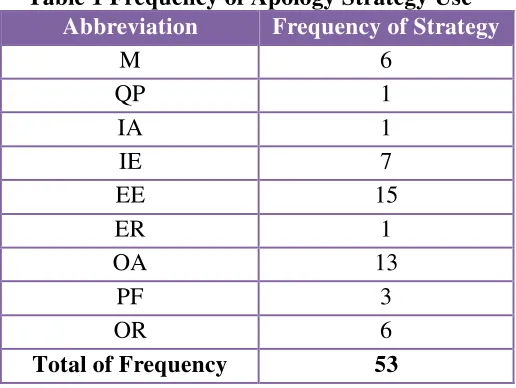
Before entering the discussion detail, it is better to observe table 1 which is provided just to show the abbreviations and the amount of apology strategies from 23 Apology Letters. Strategies and their sub-strategies are stated in 53 utterances of apology strategies.
Table 1 Frequency of Apology Strategy Use
Abbreviation Frequency of Strategy
M 6
QP 1
IA 1
IE 7
EE 15
ER 1
OA 13
PF 3
OR 6
Total of Frequency 53
name abbreviation of strategies and sub-strategies in apologizing case which is derived from the initial of their names. Second column contains the amount of strategies use. From table 1, some statements have properly reason to be explained. Complainee uses point Explicit Explanation and Offer of Apology in high frequency. Both of them include the real strategy of apology: Indirect and Direct Apologies; the real apology strategies which are used by the complainee to admit the mistake. The researcher states that they are the two first strategy which are usually used when the complainee admit the mistake.
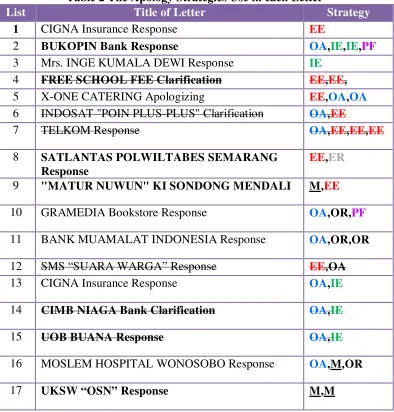
Table 2 The Apology Strategies Use in each Letter
List Title of Letter Strategy
1 CIGNA Insurance Response EE
2 BUKOPIN Bank Response OA,IE,IE,PF
3 Mrs. INGE KUMALA DEWI Response IE
4 FREE SCHOOL FEE Clarification EE,EE,
5 X-ONE CATERING Apologizing EE,OA,OA
6 INDOSAT "POIN PLUS-PLUS" Clarification OA,EE
7 TELKOM Response OA,EE,EE,EE
8 SATLANTAS POLWILTABES SEMARANG
Response
EE,ER
9 "MATUR NUWUN" KI SONDONG MENDALI M,EE
10 GRAMEDIA Bookstore Response OA,OR,PF
11 BANK MUAMALAT INDONESIA Response OA,OR,OR
12 SMS “SUARA WARGA” Response EE,OA
13 CIGNA Insurance Response OA,IE
14 CIMB NIAGA Bank Clarification OA,IE
15 UOB BUANA Response OA,IE
16 MOSLEM HOSPITAL WONOSOBO Response OA,M,OR
18 SMS Response IA, OR
19 SANTO BORROMEUS HOSPITAL Response OA, EE,M,PF 20 WAHANA TATA Insurance Response EE,EE
21 OCBC NISP Response IE
22 SMS Response M,OR
23 SMS WARGA Response QP,EE
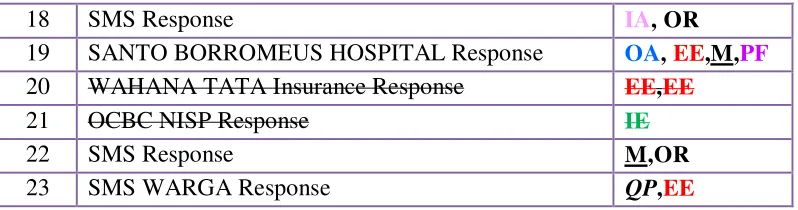
Title of letters and what strategies obtained inside are shortly explained in table 2 above. The researcher intentionally modifies the form of table and colored letter in order to make the researcher and the readers easier in understanding this research. The red color for EE, blue for OA, green for IE, purple for PF, grey for ER, black for OR, and pink for IA. Additionally, there is underlined black letter for M and the italic black letter for QP. Furthermore, the researcher crosses some items of them to minimize the sameness of combination or strategies use by other complainee. From the names or title of the letters, we could identify that the letters include semi-formal and formal apology letters. It means that the letter sent from some official private department, governmental department, non-governmental department, and very important person, such as the famous book author and indigenous leader.
word or expression which indicates the apologizing, the condition which establishes and develops the case can be used as the indication of apologizing.
Continue to the discussion of apology strategies to convey full explanation by each letter. The following inside will be discussed the pattern of strategy used include what strategy used and how the strategy used is, means in single used or combine used in the expression to account the complainer. Then, the second point of discussions is going to be kind of sentence in apology strategy. Many of strategies are going to be found in combination and few in single. Because of same pattern of strategy used, not all of letters are going to be discussed.
A. Pattern of Strategy Use
1. CIGNA Insurance Response
a. Context
Mr. Tonny Hatmoko previously a premium refund will be given if cancellation policies are still in the warranty period.
Mr. Tonny Hatmoko sends the complaint to the CIGNA Insurance because of unsatisfactorily service by CIGNA Insurance. In custom, that professional Insurance has to make apologizing unless CIGNA Insurance lost the customer. In other position, CIGNA Insurance tries to keep its prestige in front of the customer.
b. The Use of Strategy by Complainee
Complainee of this letter only uses single strategy to answer criticism from complainer. It is Explicit Explanation. There are no other strategies which accompany the explicit explanation strategy. By doing this strategy, the problem has been completed. It can be said expressly to observe the word 'explain'.
Kami telah menjelaskan kepada Bapak Tonny Hatmoko bahwa pembatalan polis adalah hak dari para pemegang polis dan tidak ada pengembalian untuk premi yang telah dibatalkan sebelumnya. Alasannya, polis asuransi milik Bapak Tonny Hatmoko adalah murni untuk perlindungan tanpa adanya nilai investasi. Pengembalian premi yang dimaksud dalam pasal yang dikutib dalam surat keluhan Bapak Tonny Hatmoko sebelumnya merupakan pengembalian premi yang diberikan jika pembatalan masih dalam masa garansi polis.
(We have explained to Mr. Tonny Hatmoko that the cancellation policy is the right of all policyholders and there is no refund for the premiums that have been canceled before. The reason for this is that insurance policies owned by Mr. Tony Hatmoko are purely for protection without any investment value. Refund of the premium discussed in the article derived from the previous letter of complaint by Mr. Tonny Hatmoko is a premium refund that can be given if the cancellation is still within the warranty period.) (Appendix, xviii:EEa)
considering the context of apology. After the word 'menjelaskan' (explain), written description such long description that describes the settlement of a problem. Insurance party mention the right of customer, the refund agreements, the status of polis insurance, the article which relates to that premium refund, and the rule of using that premium insurance. This is done to reduce the fluctuation of problems that occurred between CIGNA Insurance and its customers.
2. BUKOPIN Bank Response
a. Context
BUKOPIN Bank staff respond to a letter which was submitted by Mrs. Esti Wulandari in Kompas February 4, 2009 edition. BUKOPIN Bank conveys apologies for any inconvenience experienced by Mrs. Esti about bank service. BUKOPIN Bank has revised the bill so that the calculation will not increase the number of next bills. In addition, banks have also been contacted by Mrs. Esti to explain the problems that can be well received. BUKOPIN Bank also promised to improve its service.
b. The Use of Strategy by Complainee
Kami menyampaikan permohonan maaf atas ketidaknyamanan yang dialami ibu mengenai layanan Kartu Kredit Bank Bukopin.
(We deliver an apology for any inconvenience suffered by the mother on the services of Credit Card Bank Bukopin.) (Appendix, xxiii:OAa)
The word “apology” which becomes a clause “We deliver an explanation. Explanation here is not widely explains all points which has to be given to the complainer, but generally explanation only. It means that not all of information needed is given. For example, people just saying “I have explained it to the complainer”, but what points of explanation not appear. As the same example below;
Terkait dengan adanya tagihan meterai yang kemudian terhitung sebagai late payment dan dikenakan denda, kami telah mengoreksi sehingga tidak akan terhitung dalam tagihan berikutnya.
(Related to the bill and then seal payment counted as late and subject to fines, we have corrected so it will not count to the next bill.) (Appendix, xvii:IEa)
Selain itu, kami telah menghubungi Ibu Esti Wulandari baik melalui telepon maupun surat untuk menjelaskan permasalahan yang terjadi dan dapat diterima dengan baik.
(In addition, we had contacted Mrs. Esti Wulandari either by phone or letter to explain the problems that occur and be well received.) (Appendix, xvii:IEb)
include the steps of problem solving, the date of process, and the nominal. BUKOPIN Bank staff only mention the result of problem solving; “tidak akan dihitung pada tagihan berikutnya” (not account to the next bill) and “dapat diterima dengan baik” (be well received), more information are not mentioned then. To complete the response, BUKOPIN Bank Staff serve its commitment for repairing and energizing the bank service. Statement of that effort is showed by the example below;
Kami akan selalu mengupayakan peningkatan pelayanan demi kepuasan nasabah dan kami berterima kasih atas kesediaan Ibu Esti Wulandari menggunakan Kartu Kredit Bukopin Visa.
(We will always strive for improvement of service to the satisfaction of our customers and are grateful for the willingness of Mrs. Esti Wulandari in using Bukopin Visa Credit Card.) (Appendix, xxiv:PFa)
Statement which is represented by this clause “kami akan selalu mengupayakan peningkatan pelayanan” (we will always strive for
improvement of service) is the sign that statement is Promise of Forbearance Strategy. It means the bank party is going to do its commitment for real soon after. This statement Promise of Forbearance includes one of action; illocutionary act.
3. Mrs. KUMALA DEWI Response
a. Context
BII follows up on feedback which is submitted by Mrs. Inge Kumala Dewi in Kompas newspaper. From the letter, BII states that the Credit Card BII trouble has been completed.
Single strategy is used in this letter; Implicit Explanation Strategy. Actually, Implicit Explanation Strategy can be used in single way. There is no supporting strategy which can strengthen the reason which is served by BII party. The example as follow;
Kami sampaikan bahwa kami telah menyelesaikan hal tersebut dengan yang bersangkutan.
(We report that we have completed it with the join people.) (Appendix, xvii:IEc)
We do not know how the problem which faced by Mrs. Kumala Dewi is completed. We do not know the step and the requirement to do the resolution of that problem. We do not know the nominal of currency that may needed in that process of problem solving. BII party only says “kami telah menyelesaikan hal tersebut” (we have completed it).
4. X – ONE Catering Apologizing
a. Context
The Operational Management and owner of X-One Catering apologize to Bantul Regency Government, Telkomsel, and Swaragama Radio for the delay. Then, they explain the cause of that lack service. They lack control over the sub-transportation, so the problem with their vehicle clutch is out of system.
b. The Use of Strategy by Complainee
and its customers. It is better if this case is explained by these examples;
Namun, kami terlambat datang sehingga konsumen kurang nyaman dengan pelayanan kami. Hal itu karena kami kurang mengontrol sub- transportasi, sehingga kendaraan kami bermasalah pada sistem kopling (kopling lepas).
(However, we were running late so that consumers felt less comfortable with our service. That's because we lack control over the sub-transport, so our vehicle faced a problem with clutch system (clutch out).) (Appendix, xviii:EEd)
X-One catering gives the reason to get an apology from its customers. It explains the cause of problems which make it unable to do its service. The cause is at un-normal clutch system. X-One catering mechanic does not do the regular checking on it. It influences the transportation; when the car has not a good condition of clutch or broken clutch, the car could not run stably even the machine is off stage. Then, the catering service is not on time. The result is unsatisfied customers. To complete its apologizing, it offers the apology to its customers. Here the example;
Atas nama Manajemen Operasional dan pemilik X-one Catering mohon maaf kepada Pemkab Bantul, Telkomsel, dan Radio Swaragama atas keterlambatan kami.
(On behalf of the Operational Management and owner of X-One Catering apologize to Pemkab Bantul, Telkomsel, and Radio Swaragama for our delay.) (Appendix, xxiii:OAb)
Demikian permintaan maaf kepada semua pihak secara terbuka dari kami.
(That is apologies to all of our party directly.) (Appendix, xxiii:OAc)
Those sentences of expression which contain phrase “demikian permintaan maaf” (that is apologies) and “X-One catering mohon
maaf” (X-One catering apologize) indicate that they are Offer of
Apology Strategy.
a. Context
Causation Factor Satlantas Polwiltabes Semarang criticism of Mr. Andi Dwi Hatmoko. Andi Dwi Handoko about illegal payments made by one member of Causation Factor Satlantas Semarang. Causation Factor Satlantas thanked the community for its concern about the smoothness of traffic and the actions of the police members who are not in accordance with the regulations. Satlantas also apologized for the incident. In response to these criticisms, Satlantas Causation Factor explains the provisions of articles that apply at that time.
b. The Use of Strategy by Complainee
A different combination of Explicit Explanation Strategy is Explicit Explanation Strategy and Expression of Regret Strategy.
Benar bahwa Sdr Andi Dwi Handoko pada hari Minggu, tanggal 19 April 2009, telah melanggar batas marka jalan belok kiri jalan terus di perempatan lampu merah sebelum Kota Lama/Simpang Jalan Raden Patah Semarang. Oleh anggota patroli Sat Lantas Semarang, yang bersangkutan telah diberikan tilang dengan nomor registrasi tilang 04100514 A dengan barang bukti SIM C atas nama Andi Dwi Handoko. (Appendix, xix:EEi)
license or other letter of that vehicle. The police officer also explain directly about the nominal of payment; 40.000 rupiah. At last, the police officer explains the mechanism of payment and court process. To maintain the police prestige, the police officer expresses the regret by saying “sorry” as the example below;
Mohon maaf apabila anggota saya terdapat kekeliruan dalam menyampaikan keterangan.
(Sorry if my officer has some mistakes in conveying information.) (Appendix, xxiii:ERa)
That sentence of expression uses “mohon maaf” (sorry) to do apologize. The word “sorry” include expression of regret as mentioned at the theory in the chapter before.
6. “MATUR NUWUN” KI SONDONG MENDALI
a. Context
Interpreter Ki Bangunjiwa gets a reprimand from Ki Sondong Mendali about the alleged plagiarism which is made by interpreting. Interpreter Ki Bangunjiwa does not recognize fully if he has made plagiarism from books that have been published. He only recognizes that there is some writing that was inspired by him, but not copied in literally. He also rejected allegations by arguing various reference books as sources of inspiration he wrote his work.
b. The Use of Strategy by Complainee
saya” (coloring some of my writing). From that cropping, we know
that Ki Bangunjiwa achieves that complain, but he tries to deny the complaint also because he feels intentionally no plagiarism in his writing. Pay attention at this example;
Oleh karena itu, memang tidak bisa dimungkiri banyak wacana beliau mewarnai beberapa tulisan saya.
(Therefore, it cannot be denied many of his discourse coloring some of my writing.) (Appendix, xv:Ma)
From the group of word “meamang tidak bias dimungkiri” (it cannot be denied), it is real evidence that Ki Bangunjiwa achieves the complaint. His achieving only to make the problem becomes not complicated anymore.
7. GRAMEDIA Bookstore Response
a. Context
Mr. Solikin gives criticism to the Gramedia Scholastic Bookstore for recklessness cashier about the customer queue. Gramedia Bookstore apologize for any inconvenience Mr. Solikin the attitude of the cashier service, Sri Mundiati, which ignored the customer queue. Gramedia staff that it was not enacted specific targets to the cashier. The provisions that apply when it is fixed based on the customer service line. The cashier who made the mistake had been given strict punishment.
The next combination of Offer of Apology is actually it combines with Offer of Repair Strategy and Promise of Forbearance Strategy. The researcher serves best example from the data;
Kami mohon maaf atas ketidaknyamanan Bapak atas sikap pelayanan petugas kasir kami Sdri Mundiati yang tidak menghiraukan antrean pelanggan.
(We apologize for any inconvenience you of our cashier attendant’s attitude, Ms. Mundiati, in servicing which are not ignoring customer queues.) (Appendix, xxiii:OAf)
Actually the example above is known as Offer of Apology Strategy that is used by Gramedia Bookstore management. A sign which shows that strategy is at the group of word “kami mohon maaf” (we apologize). This is regular sign of that strategy which must be used in every expression of it. To support its apologizing, Gramedia Bookstore management tries to complete its response by more action which shows the seriousness of this case, Gramedia bookstore gives the punishment to the cashier attendant.
Kepada petugas yang bersangkutan telah kami berikan sanksi karena lalai melakukan tugasnya.
(To the officer concerned has been given some sanctions for failing to do its job.) (Appendix, xxv:ORa)
The explicit expression by cropping clues of the sentence “telah kami berikan sanksi) (have been given some sanctions) indicates that
this is Offer of Repair Strategy; repairing the unexpected attitude by the sanctions.
Semoga kejadian tersebut di atas tidak terjadi lagi di kemudian hari.
(Hopefully the above events do not occur again in the future.) (Appendix, xxiv:PFb)
the customers in the end of letter. Indication which shows that this is a Promise of Forbearance Strategy is the sentence of expression itself. By word “semoga” (hopefully) and the content of the sentence, the researcher get the conclusion that this is Promise of Forbearance Strategy.
8. MUAMALAT INDONESIA Bank Response
a. Context
Mrs. Nirmala from Purwokerto is disappointed in Services Muamalat Indonesian Bank Branch Purwokerto. He was disappointed because the queue is not regular. Therefore, the Muamalat Indonesia Bank Branch Purwokerto thanks for the information provided and delivered an apology for the incident. The bank is committed to continuously improve and provide the best service to customers. To avoid similar incidents, the Muamalat Indonesian Bank Branch Purwokerto will provide the automatic line machine.
b. The Use of Strategy by Complainee
If the points before discussed Offer of Apology Strategy in complex combination, here the Offer of Apology is only combined with Offer of Repair. It is better by using these examples to discuss the two strategies.
(We thank you for the information provided and we would like to apologize for - the amount for any inconvenience our services at the time of the incident.) (Appendix, xxiv:OAg)
Of course, “kami sampaikan permohonan maaf” (we would like to apologize) becomes regular indication that shows Offer of Apology Strategy. The strategy is in the same name, but Muamalat Indonesia Bank Branch Purwokerto has different ways to express and to use specific word. To be different, Muamalat Indonesian Bank Branch Purwokerto uses Apology Strategy combines with this Offer of Repair Strategy as the example below;
Kami berkomitmen untuk terus memperbaiki dan memberikan pelayanan terbaik kepada nasabah.
(We are committed to continuously improve and provide the best service to customers.) (Appendix, xxv:ORb)
Dan untuk menghindari kejadian serupa, insyaAllah dalam waktu dekat ini Kantor Bank Muamalat Cabang Purwokerto akan menyediakan mesin antrean otomatis.
(And to avoid similar incidents, in the near future by the name of Allah Muamalat Indonesian Bank Branch Purwokerto will provide an automatic line machine.) (Appendix, xxv:ORc)
First, it says “kami berkomitmen” (we are committed) for the beginning of action in improvement. Next, the next action of commitment is providing an automatic line machine “Kantor Bank Muamalat Cabang Purwokerto akan menyediakan mesin antrean
otomatis”. These are the reparations that must be paid by Muamalat
Bank in satisfying the customer. The reason why Muamalat Bank must do this action or reparation is to get more customers and to avoid the losing of customer.
9. CIGNA Insurance Response
Mr. M. Saidin disappointed at CIGNA Insurance and Bank Mega. Insurers and banks are sorry for the inconvenience. They have been trying to track data and the status of the policy Mr. M. Saidin, but unfortunately there is incomplete data. Then the insurance company and the bank ask for an office that directly connects more clearly and quickly resolved.
b. The Use of Strategy by Complainee
Meet again with Offer of Apology Strategies, but now is different combination. It combines with Implicit Explanation Strategies.
Pertama – tama, kami mohon maaf atas ketidaknyamanan yang Bapak rasakan.
(First of all, we apologize for the inconvenience that you feel.) (Appendix, xxiv:OAi)
CIGNA Insurance responses its customer’s complaint only uses two strategies which combine in simplicity. From the example above; “kami mohon maaf” (we apologize) is the indication or sign to decide that it is Offer of Apology Strategy. Because “apologize” is the favorite word of Offer of Apology Strategy, it will be found at these all combinations in this discussion. This famous strategy combines with the sentence of expression below as the Implicit Explanation Strategy.
Kami telah berusaha melacak data dan status polis Bapak, tapi sayang kami tidak dapat menemukan data lengkap Bapak.
It could be called as the Implicit Explanation Strategy because there is only stated “berusaha melacak” (have been trying to track). There is no the way how to track the data, what data that is tracked, the steps of tracking, the date of tracking, and the nominal which is needed for tracking. As the result, they just say “kami tidak dapat menemukan data lengkap Bapak” (we could not find complete data
for you).
10. MOSLEM HOSPITAL WONOSOBO Response and Clarification
a. Context
Islamic Hospital Wonosobo responds to criticism made by a citizen to first say thank you and beg forgiveness because it is considered to have an oversight in the care of his wife. For the avoidance of libel, the hospitals are asking patients to come directly to the hospital and discuss the problems occurred. With hopes, they will find a way out together.
b. The Use of Strategy by Complainee
The researcher knows that Offer of Apology Strategy often appears in this discussion, but for presenting most various combinations of it, it should be done trying to explain more about the combination of Offer of Apology Strategy. As the following example;
Apabila selama kami merawat dan memberikan pelayanan kesehatan terhadap isteri bapak dianggap ada kekhilafan, kami mohon maaf.
The last clause of that sentence of expression shows the indication of Offer of Apology Strategy; “kami mohon maaf” (we apologize). Moslem Hospital Wonosobo accepts the complaint that it has a mistake in patient caring.
Namun demikian, demi kebaikan semua pihak dan untuk menghindari fitnah, jika memerlukan klarifikasi lebih lanjut, kami persilakan bapak untuk dating ke RSI Wonosobo.
(However, for the good of all parties and to avoid libel, if it needs further clarification, we invite the father to come to the Islamic Hospital (RSI) Wonosobo.) (Appendix, xv:Mb)
Moslem Hospital Wonosobo is trying to do little bit refuse the complaint by minimizing. The use of word “untuk menghindari fitnah” (to avoid libel) produces a guessing that all complaints which
are delivered to Moslem Hospital Wonosobo are not fully true. For that reason, Hospital party invites the patient and family come to the hospital office to get more information and clarification. Then what the compensation of hospital missing is giving the information and clarification that the patient and family want and need.
Kami siap untuk memberikan penjelasan lengkap sesuai data yang kami miliki.
(We are ready to give a full explanation according to the data we have.) (Appendix, xxv:ORd)
This is the Offer of Repair Strategy by ready in giving all data and information if the patient and family need.
11. UKSW “OSN” Response
a. Context
problem mainly to lack of sleep for the contingent of the National Science Olympiad (OSN). UKSW role is only to provide teaching staff and laboratories. UKSW has confirmed that several contingents OSN trusted to prepare high school level in Central Java.
b. The Use of Strategy by Complainee
Continue to the second strategy; Minimizing Strategy.
Peran UKSW dalam persiapan kontingen Jateng untuk OSN adalah memberikan bantuan dalam hal penyediaan staf pengajar untuk empat mata pelajaran, yaitu Kimia, Astronomi, Ekonomi, dan Biologi. Selain itu, UKSW menyediakan tempat praktik bagi mata pelajaran tertentu yang memerlukan fasilitas laboratorium.
(UKSW Role of Central Java in preparation for the OSN contingent is to provide assistance in providing teaching staff for the four subjects, namely Chemistry, Astronomy, Economics, and Biology. In addition, UKSW provide a place for the practice of certain subjects that require lab facilities.) (Appendix, xv:Mc)
Perlu kami sampaikan juga, UKSW telah beberapa kali dipercaya untuk mempersiapkan kontingen OSN tingkat SMA di Jateng.
(We would like to also, UKSW have some time been trusted in preparing a contingent of OSN for the high school level in Central Java.) (Appendix, xv:Md)
To minimize complaint and case, UKSW mentions its role in that OSN, such as providing teacher assistance in four subjects, laboratory which use for research during OSN, and the most important is the prestige of UKSW that has some time been trusted in preparing a contingent for this OSN.
rights are given by parents, families, communities, governments and countries. Is not solely the responsibility of Social Service of Men Power and Transmigration Department Yogyakarta. In the event of such incidents in the area that Keparakan, Social Service of Men Power and Transmigration Department Yogyakarta appealed to the public and city administration devices, sub-district and village levels to better supervise the children. Those concerns can be realized through a partnership approach incorporated in them District and Village Governmental, which will be able to reconcile their assistance through the program of activities, whether conducted by the Social Services DIY Province, through the Social House of Youth Development, which handles child children dropping out of school, or through a nursing program outside activities, or program activities of the Social Service Manpower and Transmigration of Yogyakarta.
b. The Use of Strategy by Complainee
Dalam undang-undang itu dinyatakan bahwa hak tersebut diberikan oleh orangtua, keluarga, masyarakat, pemerintah, dan negara. Sehubungan dengan hal tersebut, apabila terjadi kejadian seperti di wilayah Keparakan itu, maka tentu saja diperlukan adanya kepedulian dari masyarakat, bisa lewat stakeholders, seperti RT, RW, dan tokoh-tokoh yang berwenang,…….
(Appendix, xvi:IAa)
Social Department of Manpower and Transmigration add some alerts to the stakeholder, RT, RW, and authority figure, social house of youth development, nursing program, and other programs. That department does not accept the big responsibility itself, but it wants someone or other institution take also that responsibility. So, it is true if that statement is Implicit Acknowledgment. Continue to the second strategy; Offer of Repair Strategy. Offer of Repair Strategy has specific indication; the action that should be done after the commitment for getting better and for making a normal condition between complainer and complainee. Please, take a look at the example served;
Sementara itu, program razia dilaksanakan oleh Dinas Ketertiban Kota Yogyakarta.
(Meanwhile, the raid program is implemented by the Office of City Orderliness of Yogyakarta.) (Appendix, xxv:ORe)
The reparation which is done by the Social Department of Manpower and Transmigration is commanding its officer to watch children and teenagers who make a violent, hanging out around the street, drunk, and drugs.
13. SANTO BOROMEUS HOSPITAL Response
Hospital of Saint Boromeus clarifies the rules regarding all the luggage and patient comfort. It is not willing to bear the losses if customers suffer losses due to material that the hospital did not heed the rules. Hospital of Saint Boromeus will further enhance the monitoring and supervision of visitors.
b. The Use of Strategy by Complainee
As the discussion before, this letter from Santo Boromeus Hospital also has Offer of apology in its response. Especially in this letter, Offer of Apology is combined with Explicit Explanation Strategy, Minimizing Strategy, and Promise of Forbearance. This is the second complete of all the researcher’s letters has. Serving some goods example is one of professional writer requirements;
Kami mohon maaf untuk ketidaknyamanan yang dialami Ibu dan keluarga selama menjalani perawatan di RS Santo Borromeus.
(We apologize for any inconvenience experienced by mother and family during treatment at the Hospital of St. Borromeus.) (Appendix, xxiv:OAm)
Sign which are usually used in other letter of response that indicates Offer of Apology Strategy is word “apologize” as in this letter. Santo Boromeus Hospital party realizes that it has a mistake or unsatisfied service which is felt by the patient over the caring. For that reason, it apologizes to the patient. Then, to complete its apologizing in order to minimize the complaint, it uses Explicit Explanation Strategy is like the example below;
It explains the information of the written rules; firstly, there is no jewelry, mobile phones, laptops, etc. If that rule does not accept by the patient or its family, it will be the responsibility of the visitors themselves. Secondly, the peacefulness condition in that hospital should be kept. All of explanation above is used to support the Minimizing Strategy as follow;
Perlu diketahui, RS Santo Borromeus selalu meningkatkan keamanan dan kenyamanan bagi pasien.
(Please note, Hospital Santo Borromeus always improve the security and comfort for patients.) (Appendix, xv:Me)
Minimizing is done by giving a statement of achievement prestige of satisfaction which is got by the hospital party along the time by caring. That Minimizing is added the commitment as Promise of Forbearance Strategy for example;
Kami akan lebih meningkatkan pemantauan dan pengawasan terhadap pengunjung.
(We will further enhance the monitoring and supervision of visitors.) (Appendix, xxv:PFc)
The word “will” is the sign of that strategy. The hospital party has a commitment to improve the security in the hospital environment.
14. SMS Response
a. Context
Sleman District Government Public Relations Party appealed to the local community to assist in environmental monitoring.
b. The Use of Strategy by Complainee
Actually, all two statements below are the result of Sleman District Government explanation which is related to the Location of Wastage Recycling. The District Government also strengthen its statement that the location in the process of cleaning or dredging of garbage. After the government explains in the first number, it continues its response by Minimizing in the second number;
Kedua, mengingat adanya keterbatasan aparat dalam melakukan pengawasan, Pemkab Sleman berharap masyarakat berperan aktif untuk mengawasi lokasi agar tidak digunakan lagi untuk membuang sampah.
(Second, given the limitations in monitoring apparatus, Sleman District Government expects society to actively monitor the location in order not to be used again to take out the garbage.) (Appendix, xvi:Mf)
Sleman District Government does not want take the responsibility fully. It wants the public also active in taking that case so that the mistake not only from the government, but also from the public. The result, the government’s burden of complaint is not too heavy.
Ketiga, jika ada pihak yang masih menggunakan lokasi tersebut untuk pembuangan sampah dengan interest pribadi, diharapkan masyarakat melaporkan kepada Pemerintah Kabupaten Sleman.
(Third, if there are parties who still use the site for disposal of waste with a personal interest, the public is expected to report it to the Government of Sleman District.) (Appendix, xxv:ORf)
cause result of “diharapkan masyarakat melaporkan kepada pemerintah Kabupaten Sleman” (the public is expected to report it or
the Government of Sleman District).
15. SMS WARGA Response
a. Context
Residents ask the market officers to confirm the illegal parking collectors and market officers which are deliberately raising the parking rates. Residents felt the parking rate is not appropriate by reference to the parking time. In essence, parking rates for motorcycle should be differentiated from parking rates for car. Then the local government of Yogyakarta; information section, responds by asking the specific parking area in question. Later sections describe in detail the information area parking rates prevailing at that time.
The next response is for the problem of monument construction as an additional tourist attraction in the area around the city park. This was responded to by local information section by explaining the subject of land ownership, functions, constraints, and other public order disturbances if the monument should be built there.
b. The Use of Strategy by Complainee
Preconditions is often marked by punctuation “?”. The example as follow;
Kami ingin menanyakan, parkir Beringharjo yang Anda maksud itu letaknya di mana?
(We would like to ask, where is the location of Beringharjo parking lot that you mean?) (Appendix, xvi:IAa)
Complainee uses this strategy to reduce the responsibility from complaint of this case. It implies the idea of complainee that the complainer could be mistaken in complaining because there are many parking areas.
Perlu kami informasikan, tarif parkir di Pasar Beringharjo adalah sebagai berikut: parkir roda dua di Jalan Lor Pasar/depan onderdil, parkir roda dua timur pendapa pasar, parkir roda dua di Jalan Penghubung bawah Kantor Dinas Pengelolaan Pasar, parkir roda dua dan roda empat di lantai III Pasar Beringharjo. Mengenai tarif: kendaraan roda dua Rp 500. Kendaraan roda empat Rp 1.500. Berlaku untuk 2 jam pertama, selebihnya dikenakan 50 persen dari tarif.
(Keep us informed, parking rates at Beringharjo market are as follows: two-wheel parking on Jalan Lor Pasar / front parts, two-two-wheel parking on eastern of market’s pendapa, two-wheeler parked on the street under the Liaison Office of Market Management, parking two wheels and four wheels in III floor Beringharjo market. Regarding tariff: Rp 500 for two-wheel vehicles, Rp 1500 for four-wheeled vehicles, valid for two first hour, the remaining 50 percent of the tariff charged.) (Appendix, xxii:EEo)
By the explanation from the local government Yogyakarta, the problem of complain is closed. The local government Yogyakarta explains clearly each area and the cost of parking inside.
B. Kinds of Strategy Sentence
strategies. From those strategies which are used in complainee’s letters, the researcher tries to clarify by this discussion as follow.
Same as any other sentence, the phrase used in the proposed strategy and does not raise the demand apologies also have the same type; declarative, interrogative, imperative, and appeal.
1. Declarative
Declarative sentences are used if the speaker wants to express something completely at the time he wanted the language to convey information to your opponent. Usually, intonation decrease or ended with the sentence punctuation point on the pad. Examples in sentences of apology strategies;
- Abonemen Speedy paket Personal dengan kuota 1 Gbyte per bulan tanpa diskon Rp 220.000. Biaya over kuota per Mbyte-nya Rp 500. (Speedy Personal subscription package with a quota of 1 GByte per month without any discount is Rp 220 000. Its cost over quota per Mbyte is Rp 500.)
Those sentences can be identified as the apology strategy in declarative sentence because that sentence is previous by expression with code OAe so as to the context becomes an apology condition and that example has the characteristic of declarative sentence.
2. Interogative
Frequently, asking questions using words like how, where, why, how, and when.
- “Kami ingin menanyakan, parkir Beringharjo yang Anda maksud itu letaknya di mana?”
(We would like to ask, where is the location of Beringharjo parking lot that you mean?)
Beside it has the characteristic of interrogative sentence, that example can be classified into apology strategy because of the apology context. One of Yogyakarta civil sends him a complaint which relates to unclearly parking cost. The researcher compares that example and its context to Trosborg’s example, and then those examples meet the categories of querying precondition strategies sentence. This strategy is closely relates to the strategies in which the complainee fails to take on responsibility. The difference lies in the fact that the complainee does not deny responsibility. Instead, he/she seeks to minimize the degree of offence, either by arguing that the supposed offence is not important, in fact is “hardly worth mentioning”, or by querying the preconditions on which the complaint is grounded. Finally, the complainee may be only partly responsible.
3. Imperative
- Ketiga, jika ada pihak yang masih menggunakan lokasi tersebut untuk pembuangan sampah dengan interest pribadi, diharapkan masyarakat melaporkan kepada Pemerintah Kabupaten Sleman. “
(Third, if there are parties who still use the site for disposal of waste with a personal interest, the public is expected to report it to the Government of Sleman District.)
- Atas nama Manajemen Operasional dan pemilik X-one Catering mohon maaf kepada Pemkab Bantul, Telkomsel, dan Radio Swaragama atas keterlambatan kami.
(On behalf of the Operational Management and owner of X-One Catering apologize to Pemkab Bantul, Telkomsel, and Radio Swaragama for our delay.)
- Kami mohon maaf untuk ketidaknyamanan yang dialami Ibu dan keluarga selama menjalani perawatan di RS Santo Borromeus.
(We apologize for any inconvenience experienced by mother and family during treatment at the Hospital of St. Borromeus.)
The three examples above are apology strategy because explicitly they contain word “apologize” and the context of them surely in apologizing. Besides, the first example shows the strategy of apology which indicates the Offer of Repair. Indeed, in our custom, those sentences are heard as not apology strategy because mostly we use apology by saying sorry or apologize me.