Consumer Innovativeness Model of Indonesian Young People
in Adopting Electronic Products
Reza Ashari Nasution and Novika Candra Astuti*
It is important for marketers to understand how innovators respond to the introduction of new prod-ucts. This paper investigates consumer innovativeness (CI) from meta-analysis study as suggested by Nasution and Garnida [2011] and examines the simultaneous impacts of CI on new product adoption. Nasution and Garnida [2010] proposed three different perspectives in conceptualizing the CI model. First, the generalist stream that represents a generalized personality trait that engenders consumers to adopt new
product. Second, the particularist stream that focuses on product adoption behavior within a specific do -main of interest. Third, the integrator perspective that proposes to integrate these two streams by putting
domain-specific innovativeness as a mediating factor in relationship between general trait innovativeness
and new product adoption. A structural equation model is used to test hypotheses using empirical data from 607 respondents in electronic products adoption. The result shows that the integrator perspective
pro-vides the best model in representing the empirical data. The finding of the integrator perspective reveals that domain specific CI mediates the relationship between general trait innovativeness and new product adoption. Specifically, subjective knowledge and hedonic-idea shopping enhances the actuality of new products. The findings provide an explanation to the less than consistent relationship between consumer
innovativeness and new product adoption. However, a single research context of electronic products and student sample may become one of the limitations and future studies need to replicate the perspective of
CI in different research contexts for greater generalizability and the use of non-student sample. The find -ings have implications for the innovation adoption theory, for managers involved in the introduction of new products, and for future research on innovation adoption.
Keywords: Consumer Innovativeness, innovation, electronic, adoption
Terkait dengan pengenalan produk baru, penting bagi para pemasar untuk memahami bagaimana inovator meresponnya. Penelitian ini menyelidiki konsumen innovativeness (CI) mengunakan pendekatan meta-analisis seperti yang disarankan oleh Nasution dan Garnida [2011] dan menganalisis dampak simultan CI pada adopsi produk baru. Nasution dan Garnida [2010] mengusulkan tiga perspektif berbeda dalam pembuatan konsep Model CI. Pertama, aliran generalis yang mewakili ciri kepribadian umum yang mendorong konsumen untuk mengadopsi produk baru. Aliran kedua partikularis berfokus pada perilaku adopsi produk dalam satu wilayah ketertarikan tertentu. Aliran ketiga, perspektif integrator yang mengintegrasikan dua aliran tersebut diatas yang berlandaskan wilayah innovativeness tertentu sebagai faktor mediasi yang menghubungkan antara ciri
innovativeness umum dan adopsi produk baru.Model persamaan struktural digunakan untuk menguji hipo
-tesis menggunakan data empiris dari 607 responden dalam adopsi produk elektronik. Hasilnya menunjukkan
bahwa perspektif integrator merupakan model terbaik dalam mewakili data empiris. Dari temuan perspektif
integrator terungkap bahwa domain CI yang spesifik memediasi hubungan antara ciri umum innovativeness dan adopsi produk baru. Secara khusus, pengetahuan subjektif dan idea hedonis belanja telah meningkatkan aktualisasi dari produk baru. Temuan-temuan tersebut menjelaskan kurang konsistennya hubungan antara innovativeness dari konsumen dengan adopsi produk baru. Namun, konteks tunggal penelitian ini yang men-gambil sample tentang produk-produk elektronik dan mahasiswa mengandung keterbatasan. Oleh karena itu, untuk mendapatkan kesimpulan yang lebih umum, dibutuhkan penelitian lain dimasa depan yang mereplikasi penggunaan perspektif CI dalam konteks penelitian yang berbeda serta sampel bukan mahasiswa.
Temuan-temuan dari penelitian berimplikasi pada teori adopsi inovatif, pada manajer yang terlibat pada pengenalan
produk baru dan untuk penelitian adopsi inovasi ke depan.
Kata kunci: konsumen innovativeness, inovasi, elektronik, adopsi
Introduction
Research on consumer innovativeness has encompassed several terms of measurement factors, e.g. [Baumgartner and Steenkamp 1996], [Goldsmith, 1990], [Goldsmith and Ho-facker 1991]; [Midgley and Dowling 1993], [Roehrich 2004], [Venkrataman 1991]; its rela-tionship with new product adoption or other be-havioral constructs, e.g.[ Foxall 1998], [Gold-smith and Flynn 1995], [Hirschman 1980], [Manning, et al. 1995], [Midgley and Dowling 1993]; and its relationship with antecedents constructs, including personal and demographic characteristics, e.g. [Im, et al. 2003], [Midgley and Dowling 1993], [Steenkamp, et al. 1999], [Venkrataman 1991]. As a consequence, the concept of consumer innovativeness remains weak or inconsistent results and give complex-ity as one could be dispute in evidence about those issues. Findings in previous studies could be become complicated for researchers and practitioners to understand the concept of con-sumer innovativeness.
Nasution and Garnida [2010] recognized three different perspectives in conceptualizing
the consumer innovativeness model. The first
one is generalist which perceives consumer innovativeness as a generalized personality trait that engenders consumers to adopt new products which are applicable across different product categories. The second one is particu-larist which sees consumer innovativeness as
category-specific predisposition, which is not
transferrable to other categories. The third one is integrator which combines the two previous perspectives by taking the general characteris-tic of individual in the innovation adoption and
category-specific factors that will moderate the
role of general innovativeness in the adoption process as integrator. A meta-analysis study was also conducted by Nasution and Garnida [2011], which obtained results in an integrated consumer innovativeness model. This meta analysis study reveals that antecedent con-structs that characterize general trait innova-tiveness are seeking behaviour, product evalu-ation, price sensitivity, product knowledge, and hedonic; outcome constructs are time of adop-tion, trial behaviour, and spending behavior;
and domain specific innovativeness as mediator
between antecedents and outcomes.
We refined the result of the meta analy -sis study conducted by Nasution and Garnida [2011] by revisiting key literature on general
trait innovativeness, domain-specific innova -tiveness, new product adoption behavior and their relationship. It was found that only
vari-ety seeking, hedonic-idea shopping, subjective
knowledge as the general trait innovativeness. Time of adoption and spending behavior are constructs used to measure actual behavior of
new product. Domain-specific innovativeness
is used as a mediator between the general trait innovativeness and new product adoption be-havior.
Then, we generated three alternative mod-els that describe relationship between those constructs. We further empirically tested and validated those alternative models. We selected consumer electronic product category as a re-search context – electronic products intended for everyday use by consumers. Researchers and practitioners should pay greater attention to young consumers because of their enormous buying power. The current study focuses on college-aged or “generation Y” consumers be-cause they tend to be high-tech. Therefore, it is important to capture phenomena of consumer innovativeness of Indonesian young people in adopting electronic products category.
Literature Review
In this study we discuss about general trait
innovativeness, domain-specific innovative -ness and new product adoption behavior.
General trait innovativeness
The general trait perspective focuses on identifying innovative consumers based on their ‘innate innovativeness’ [Hirschman 1980] or ‘innovative predisposition’ [Midgley and
Dowling 1993], which is similarly defined as
way [Hilgard, et al. 1975]. The concept of inno-vativeness represents a highly abstract and gen-eralized personality trait [Im, et al. 2003], thus it is free from the context or domain in which consumers are located [McCarthy, et al. 1999]. It is the nature of innovativeness trait that en-genders consumers to adopt new product, rather than other variables such as situational effects or communicated experience of others [Midg-ley and Dowling 1978].
In the innovation adoption literature, charac-teristics of the (potential) adopter and perceived characteristics of the innovation are found to be
major drivers of innovation adoption [Gatignon
and Robertson 1985; Meuter, Bitner, Ostrom, and Brom 2005; Rogers 2003; Tornatzky and Klein 1982]. The number of different variables used to capture adopter characteristics is par-ticularly large, as a lot of research has been
devoted to finding traits of consumers that are
likely to adopt innovation. Adopter character-istics capture the personal traits that describe the (potential) adopter of an innovation, which can be divided into socio-demographic and psychographics. A wide range of socio-graphic characteristics have been used in research, e.g. [Gatignon and Robertson 1985], [Rogers 2003], [Tornatzky and Klein 1982]. Many studies particularly focus on consumers’ age, level of education and income. Adopter psychograph-ics including innovativeness, hedonic
motiva-tion, subjective-knowledge, variety seeking is
among the variables used to explain adoption. General trait innovativeness refers to the attri-butes consumers use to adopt an innovation.
Domain-Specific Innovativeness
Even though innovativeness was originally assumed to remain constant over a person’s lifetime, the particularist views that
innovative-ness is socially influenced [Hirschman 1980],
therefore, it would seem more plausible that it is not a constant [Hynes and Lo 2006]. For instance, a person may show a high degree of innovativeness in one product category (e.g. computer) but he or she may show little interest in other product category (e.g. clothing) [Hynes and Lo 2006].
Domain-specific is the dimension of con
-sumer innovativeness that reflects the tendency
to learn about and adopt innovations within a
specific domain of interest and taps a deeper construct of innovativeness more specific to an
area of interest [Citrin, et al. 2000].
Domain-specific innovativeness captures the individu -al’s predisposition toward the product class and refers to the tendency to acquire new products
or related information within a specific domain
[Goldsmith and Hofacker 1991] and explains
the human behavior within a person’s specific
interest domain [Midgley and Dowling 1993], e.g. in product categories, countries [Sczmign and Carrigan 2000].
Innovative behavior: New product adoption behavior
Innovative behavior is best presented by a process of multiple stages through which an
indi-vidual passes, from first awareness to continued
use of the innovation [Rogers 2003]. Previous research has focused on new product adoption behavior as innovative behavior i.e., “actual-ized innovativeness,” or the acquisition of new ideas and products [Hirschman 1980; Midgley and Dowling 1978]. New product adoption behavior is the extent to which consumers are relatively early in adopting new products than other members of their societies [Rogers 2003]. There are two ways to operationalize innova-tive behavior using this behavioral perspecinnova-tive. First, is by measuring the relative time of
adop-tion of a specific new product compared with
the adoption times of other consumers [Rogers and Shoemaker 1971]. This approach, which uses a single product, has been criticized as sus-ceptible to recall biases [Midgley and Dowling 1978]. Second, one may use a cross-sectional ownership method in which respondents indi-cate which new products from a preset list they have bought [Goldsmith, Freiden, and Eastman 1995]. It extends beyond a single product and refers to more general adoption behavior. This approach suffers less from recall bias. Another measurement to investigate actual behaviour is
num-ber of years since adoption) relative spending behavior ( i.e., amount of money spent to buy products). We followed formula as suggested by Im et al [2007] to measure relative time of
adoption and we modified their formula to mea -sure relative spending behavior.
Hypothesis development
After revisiting key literature review we
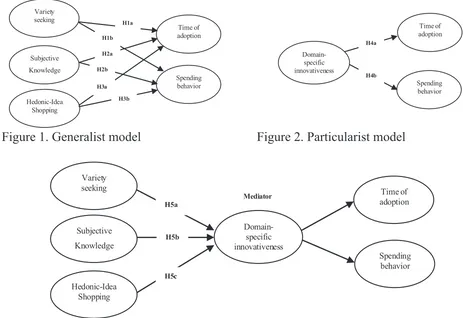
found that variety seeking, subjective knowl -edge, and hedonic-idea shopping as general trait innovativeness constructs that engenders consumers to adopt new product. We next in-vestigate three different perspective of consum-er innovativeness model by capturing the rela-tionship between general trait innovativeness and new product adoption behavior (Figure 1);
the relationship between domain-specific inno -vativeness and new product adoption behavior
(Figure 2); and domain-specific innovativeness
as mediator between general trait innovative-ness and new product adoption behavior (Fig-ure 3).
Variety-seeking tendency is rooted in need for a change in an attempt to resolve the bore-dom associated with a brand and a product [Van, et al., 1996]. As Rogers [1979] argued, “… a tendency to avoid variety may coexist with the tendency to seek variety”. Consumers
might fluctuate between inertia behavior (brand
loyal) and variety-seeking (brand switching) behavior. Consumers try to increase stimula-tion in such situastimula-tions by seeking something different or new relative to their previous choice [McAlister and Pessemier, 1982; Menon & Kahn, 1995; Van et al., 1996]. The concept of an optimal stimulation level (OSL) is cen-tral to theories postulated to explain variety-seeking tendencies in consumers (Steenkamp
& Baumgartner, 1992. Raju [1980] illustrated
that high-OSL individuals are characterized as having a higher degree of exploratory tenden-cies (i.e., exploring the environment) driven by variety seeking, curiosity, and risk taking). The Steenkamp and Baumgartner [1992] compre-hensive review of OSL literature and empirical
study confirmed the relationship between OSL
and consumer behaviors driven by variety seek-ing, intrinsic curiosity, and risk taking. OSL was positively correlated with exploratory tendency
factors of innovativeness (i.e., brand switching for change or novelty, eagerness to know about or try new products or services, and selecting products that involve perceived risk). One im-portant outcome of the variety seeking drive in the context of consumer choice would be the desire for new or novel products manifested by purchase exploration (i. e., switching/innovat-ing). Thus, we hypothesize that:
H1a: General trait innovativeness, variety
seek-ing will be positively associated with new product adoption behavior (time of adop-tion).
H1b: General trait innovativeness, variety
seek-ing will be positively associated with new product adoption behavior (spending be-havior).
Blackwell, Miniard, and Engel [2001] define
knowledge as “the information stored within memory”. Consistent with that perspective, Park et al. [1994] view knowledge assessment
as a judgment process in which consumers scan
memory for cues in order to help them evaluate their product-related experiences. Research of
consumer knowledge: (a) objective knowledge,
that is, factual knowledge (for example, that which can be measures by an impartial third
party); and (b) subjective knowledge, that is,
perceptions of knowledge, representing what the consumer thinks she/he knows [Brucks 1985; Park, et al. 1994]. We have restricted
our analysis to focus solely on the subjective
dimension of knowledge, for several reasons.
First, subjective knowledge can be measured on
a standardized scale [Brucks 1985]. Second, al-though Park and Lessig [1981] admit that both
subjective and objective knowledge measures validity, they submit that subjective measures
may better capture consumer strategies and heuristics because these measures are based on perceptions, that is, what the consumer thinks
he or she knows. Thus, measures of subjective knowledge can indicate self-confidence levels
in addition to knowledge levels [Brucks 1985].
Moreover, Raju et al. [1993] found that sub
consum-ers tend to use more internal information than non-knowledgeable consumers during the pur-chasing decision making process. Consumers
with high levels of subjective knowledge of a
product will perceive a high level of
familiar-ity and have a high level of confidence which
is higher than their actual knowledge would produce. The adoption speed and success of innovation depend on the adopter’s character-istics as well as the charactercharacter-istics of innova-tion [Gatignon and Robertson 1985; Moore and Benbasat 1991; Premkumar, Ramamurthy and Nilakanta 1994; Roger 2003; Tornatzky and Klein, 1982]. Consumer knowledge has been considered to be one of the more critical factors
influencing the new technology adoption pro
-cess [Gatignon and Robertson 1985; Mahajan,
Muller and Bass 1995; Moreau, Markman, and Lehmann 2001; Sheth 1981]. People with more knowledge about technology are more likely to adopt technology. Hence, we hypothesize that:
H2a: General trait innovativeness, subjective
knowledge will be positively associated with new product adoption behavior (time of adoption).
H2b: General trait innovativeness, subjec -tive knowledge will be posi-tively associ-ated with new product adoption behavior (spending behavior).
Roehrich [1994] defines his hedonic inno -vativeness dimension as the drive to adopt
in-novations for hedonic reasons, such as to enjoy
the newness of the product. Focused on hedo-nistic shopping motivations, Arnold and Reyn-olds [2003] developed an 18-item scale and
identified six dimensions of hedonic motiva -tion shopping: “Adventure shopping” referred to experiencing a variety of sights, sounds and
smells while shopping; “Gratification shop -ping” involved shopping to relax and to offer a special pleasure to oneself; “Role shopping” revealed the satisfaction of shopping for oth-ers; “Value shopping” involved looking for dis-counts, low prices and sales; “Social shopping” was associated with the satisfaction of
social-izing; and finally, “Idea shopping” was related
with the searching for trends and innovations. In this study we only focus on hedonic-idea
shopping which influences innovative behavior.
Hence, we hypothesize that:
H3a: General trait innovativeness,
hedonic-idea shopping will be positively associated with new product adoption behavior (time of adoption).
H3b: General trait innovativeness, hedonic-idea
shopping will be positively associated with new product adoption behavior (spending behavior).
As the first attempt, Goldsmith and Hofack
-er [1991] launch the idea of domain-specific
innovativeness (i.e., innovativeness within a
specific product domain of interest). Domain-specific measures of innovativeness have yield -ed useful pr-edictions as far as the adoption of innovations by consumers is concerned [Foxall and Bhate 1991; Goldsmith and Newell 1997].
Citrin, et al.[1982] found that domain-specific
innovativeness is a more accurate predictor of consumer adoption behavior than a more open ended characteristic. Hence, we hypothesize that:
H4a: Domain-specific innovativeness will be
positively associated with new product adoption behavior (time of adoption).
H4b: Domain-specific innovativeness will be
positively associated with new product adoption behavior (spending behavior).
The integrator perspective proposes an
in-termediary level of product category specific
innovativeness between abstract personality trait and actual innovative behavior. The extant
literature suggests that domain-specific innova -tiveness may mediate the relationship between general innovativeness and innovative behav-ior [Goldsmith, et al. 1995; Midgley and
Dowl-ing 1978]. Domain-specific innovativeness is
probably a consequence of the interaction be-tween general trait innovativeness and strong interest in product category [Goerlich 1996]. Hirunyawipada and Paswan [2006] found that
H5a: Domain-specific innovativeness will
mediate the relationship between variety seeking and new product adoption ior (time of adoption and spending behav-ior).
H5b: Domain-specific innovativeness will me
-diate the relationship between subjective
knowledge and new product adoption havior (time of adoption and spending be-havior).
H5c: Domain-specific innovativeness will me -diate the relationship between hedonic-idea shopping and new product adoption behavior (time of adoption and spending behavior).
Methods
Research setting, sample, and procedure
This research refers to quantitative approach. The type of survey used in this study is self-administered questionnaires. Population in this study is undergraduate students in the Bandung Institute of Technology. The sampling frame in this study is faculties in the Bandung Institute
of Technology. The unit elements in this study are undergraduate students in six-faculties in the Bandung Institute of Technology who have interest and experience with four electronic products (handphone, laptop, digital camera, and tablet). We selected those products because they are fast product life cycles and more per-sonal owned by college-aged students.
Before distributing questionnaire in large sample, we conducted a pre-test to 40 respond-ents in an attempt to know their understand-ing about questionnaires items. The minimum sample size for a particular Structural Equation Modelling (SEM) is when the number of fac-tors is larger than six, some of which have few-er than three measured items as indicators, and multiple low communalities are present, sample size requirements may exceed 500 [Hair, et al. 2006]. We used two-stage cluster sampling to
ensure representation from all major academic
area within the university. Cluster sampling produces imprecise samples in which distinct,
heterogeneous clusters are difficult to form. The final questionnaires were administered
to 657 respondents. Of the total returned ques-tionnaires, 50 responses were found incomplete,
Variety seeking
Subjective Knowledge
Hedonic-Idea Shopping
Time of adoption
Spending behavior
H1a
H1b
H2a
H2b
H3a
H3b
Figure 1. Generalist model
Variety seeking
Subjective Knowledge
Domain-specific innovativeness
Hedonic-Idea Shopping
Time of adoption
Spending behavior
H5a
H5b
H5c
Mediator
Figure 3. Integrator model
Domain-specific innovativeness
Time of adoption
Spending behavior
H4a
H4b
resulting in 607 final usable questionnaires. The
participants were male 49.8 percent and female 50.2 percent with a mean age of 18.85 years old (minimum age was 16 and maximum age was 24 years old). 19.6 percent were from School of Electrical Engineering and Informatics depart-ment, 18.6 percent were from School of Phar-macy department, 18.1 percent were from Fac-ulty of Civil and Environmental Engineering, 17.1 percent from Faculty of Earth Science and Technology, 15.2 percent from School of Busi-ness and Management and 11.4 percent from Faculty of Art and Design. Almost 44.8 percent of respondents had an annual income between $1,200 and $2,400. Respondents who had an an-nual income less than $1,200 are 44.5 percent, between $2,400 and $3,600 are 7.4 percent, and more than $3,600 are 3.3 percent. Almost 98.8 percent respondents owned handphone which support camera and able to access internet; lap-top was owned by 92.3 percent respondents; camera digital was owned by 36.2 percent, and tablet was only owned by 6.9 percent respond-ents. The length of time respondents having handphone, laptop, and camera digital between 1 and 2 years is 38.3 percent, 32.8 percent, and 34.9 percent. Almost 50 percent respondents owned tablet less than 1 year. 41.3 percent re-spondents spent money in the range of $100-$200 for handphone; 31.7 percent respondents spent money in the range of $300-$500 for lap-top; 46.6 percent spent money in the range of $200-$500 for camera digital and 47.6 percent respondents spent money more than $600 for tablet. We differentiated number of samples for different models because of data cleaning after
eliminated outliers with mahalanobis D2
meas-ure. The final sample size comprised 571 (for
the generalist model), 575 (for the particularist model), and 568 (for the integrator model).
Measures
We obtained instruments of questionnaires from collecting literature review of seeking behavior, hedonic, price sensitivity, product
knowledge, and domain-specific innovative -ness. We divided seeking behavior into infor-mation seeking and variety seeking. Because of lack of literature review about product
evalua-tion as general trait and to make accurate judg
-ments about the key constructs to be included in the empirical study, it was necessary to conduct a focus group discussion (FGD). There were nine undergraduate students in the FGD. The process was recorded and then transcribed. The purpose of the FGD was to ask about opinions of evaluation process for the products, to
con-firm about the measurement of items related to
consumer innovativeness, and also to ask the participants to list private electronic products they have and mention the price of each prod-uct.
The survey instrument was originally de-veloped in English and then double-blind-translated into local language (Indonesia) for
respondents who were not fluent in English. To
achieve comparability, the issue of equivalence of meaning was carefully noticed during trans-lation. The initial 73 measurement items from the literature review of consumer innovative-ness were drawn. We next asked an expert from a psychology department to verify the face va-lidity of the questions. The expert proposed to eliminate seven items. After conducting a pre-test, we revisited key literature review and ex-amined relationship between those constructs.
We further tested and refined these measure -ment scales before administering the survey on
the total sample. The result of refinement, we
eliminated four variables (information seeking, product evaluation, price sensitivity, global in-novativeness) and also eliminated 13 items of hedonic.
The final measure consisted of variety seek
-ing (VS), subjective knowledge (SK), hedonic-idea shopping (HE), domain-specific innova -tiveness (DSI), relative time of adoption (RTA), and relative of spending behaviour (RSB). The
variety seeking scale developed by Raju [1980], the subjective knowledge constructs are meas -ured with items adapted from Park, et al. [1994] and Oliver and Bearden [1983], and hedonic-idea shopping items are adapted from Arnold and Reynolds [2003]. To measure
domain-specific innovativeness we used the instrument
developed by Goldsmith and Hofacker [1991].
With the exception of subjective knowledge
with nine-point Likert scale, all items were
measured with five-point Likert scales. Finally,
Data analysis
We followed the two-step procedure recom-mended by Anderson and Gerbing [1998] to es-tablish measurement and structural model. The
Confirmatory Factor Analysis (CFA) was used
to analyse the convergent validity and discrimi-nant validity of all items of construct using maximum likelihood estimation in Lisrel 8.70 in the analysis.
Result and Discussion
Table 1 shows overall fit indices for each of
models after eliminating items load less than 0.5. We can see that the integrator perspective
model reveals the best model fit with data. The
integrator model is able to generate general trait
innovativeness, domain-specific innovative -ness, and new product adoption behavior in a model.
Here, we explain about the integrator mod-el. According to the CFA results of integrator,
the chi-square test was statistically significant, χ2 (71) = 225.352, p < 0.05, suggesting a lack of satisfactory model fit (i.e. the hypothesized
model was incongruent by researchers because this statistical test is known to be sensitive to the sample size [Bearden, et al. 1982]. We
fur-ther assessed the model fit through variety of
model indexes, GFI =0.946 (>0.9); CFI = 0.951 (>0.9); NFI=0.930 (>0.9); AGFI=0.920 (>0.9); RMSEA = 0.062 (<0.08). Thus, it is
conclud-ed that the CFA model fits the data reasonably well based on latter fit indices considered in this
study.
Table 1. Fit indices
Model fit indices Generalist model Particularist model Integrator model
1) χ2
2) degree of freedom 3) P-value
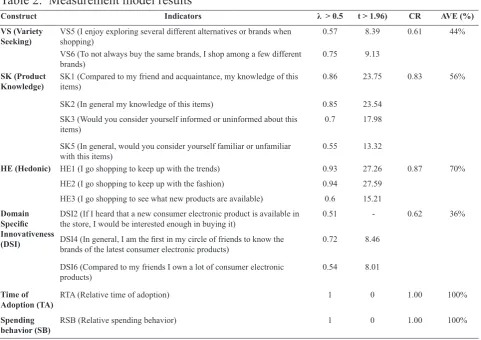
Table 2. Measurement model results
Construct Indicators λ > 0.5 t > 1.96) CR AVE (%)
VS (Variety Seeking)
VS5 (I enjoy exploring several different alternatives or brands when shopping)
0.57 8.39 0.61 44%
VS6 (To not always buy the same brands, I shop among a few different brands)
0.75 9.13
SK (Product Knowledge)
SK1 (Compared to my friend and acquaintance, my knowledge of this items)
0.86 23.75 0.83 56%
SK2 (In general my knowledge of this items) 0.85 23.54
SK3 (Would you consider yourself informed or uninformed about this items)
0.7 17.98
SK5 (In general, would you consider yourself familiar or unfamiliar with this items)
0.55 13.32
HE (Hedonic) HE1 (I go shopping to keep up with the trends) 0.93 27.26 0.87 70%
HE2 (I go shopping to keep up with the fashion) 0.94 27.59
HE3 (I go shopping to see what new products are available) 0.6 15.21
Domain Specific Innovativeness (DSI)
DSI2 (If I heard that a new consumer electronic product is available in the store, I would be interested enough in buying it)
0.51 - 0.62 36%
DSI4 (In general, I am the first in my circle of friends to know the brands of the latest consumer electronic products)
0.72 8.46
DSI6 (Compared to my friends I own a lot of consumer electronic products)
0.54 8.01
Time of Adoption (TA)
RTA (Relative time of adoption) 1 0 1.00 100%
Spending behavior (SB)
Table 2 displays standardized loading above
0.5 and all lambda coefficients for the observed variables are significant (t > 1.96). We eliminat -ed six items of variety seeking, one item of
sub-jective knowledge, and three items of domain-specific innovativeness that have standardized
loading less than 0.5. The values obtained in
the composite reliability coefficient are above
0.6. The values of the extracted variance analy-ses (EVA) are above 50 percent, except variety
seeking (44 percent), and domain-specific inno -vativeness (36 percent). In addition, the model
fits relatively well. The reliability estimates be -tween 0.6 and 0.7 is acceptable provided that other indicators of a model’s construct validity are good to demonstrate the internal consistency of the measurement model [Hair et. al., 2006: 778]. The average variance extracts (AVEs) ranged from 29 to 61 percent, which meet mini-mum requirement [Chin 1998]. Therefore, all the items are retained at this point and adequate evidence of convergent validity is provided.
Discriminant validity among the constructs was also assessed by examining whether the square correlation between two constructs was lower than the average variance extracted for each construct [Fornell and Larcker 1981]. Re-sults revealed that these conditions were met, and therefore the constructs investigated in the
study were distinct from each other, confirming
discriminant validity.
Structural model
After the measurement model was
con-firmed, structural equation modelling was then
performed to test the hypothesized
relation-ships. The model fit statistics revealed a χ2of
168.792 with degree of freedom of 51 at p <
0.05, χ2 /df of 3.3,GFI of 0.927; CFI of 0.957;
NFI of 0.941; AGFI of 0.927; RMSEA of 0.064, suggesting that the hypothesized structural
re-lationships fit the data well. Subjective knowl -edge and hedonic-idea shopping explained
30.36 percent of variance in domain-specific innovativeness and domain-specific innova -tiveness explained 1.93 percent of variance in time of adoption and 1.45 percent of variance in spending behavior.
Hypothesis testing
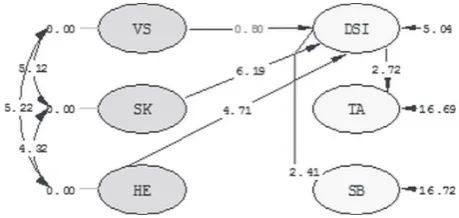
Each hypothesized relationship was
exam-ined based on path significance. We can see from figure 5 and figure 6 that show the di -rection path and magnitude of the paths of the structural model of generalist and integrator perspective model. The focus of the assessment
of the structural path is in the significance of the
path can be measured by critical ratios, or sta-tistics, which is greater than 1.96 [Chin, 1998]
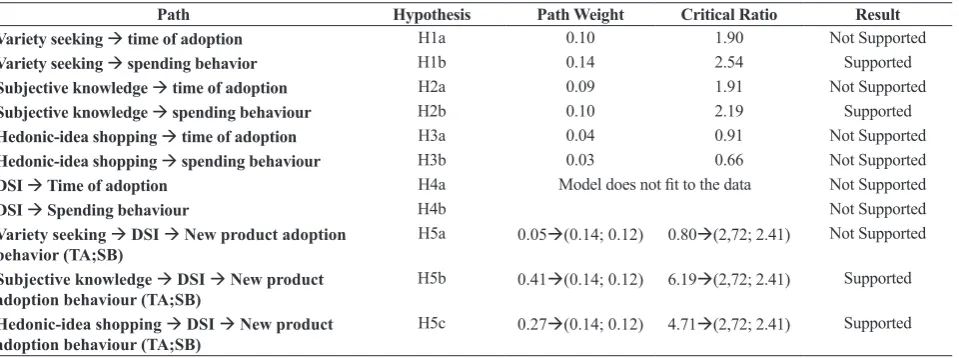
at p < 0.05. The result of path coefficients and
t-statistics is illustrated in Table 3.
Conclusion
Through this study, we successfully test empirically and compare three perspectives of consumer innovativeness in electronics product category by modifying model as suggested by Nasution and Garnida [2010; 2011]. First, the re-sult shows that the generalist perspective model provides support only two hypotheses. Variable
variety seeking influences time of adoption but it does not influence spending behavior. Subjec
-tive knowledge influences spending behavior but does not influence time of adoption. Hedon
-ic-idea shopping does not influence both time of
adoption and spending behavior. Because this perspective does not support all hypotheses, we
conclude that the generalist perspective model is less able to describe phenomena of consumer innovativeness in adopting electronic products. Second, the particularist perspective model is not able to represent the empirical data. There-fore, this perspective also could not explain the phenomena of consumer innovativeness in adopting electronic products. Third, the
inte-grator perspective provides the best model fit
represent empirical data than the other perspec-tives. Therefore, the integrator perspective can be used to capture the phenomena of innova-tiveness among young consumers in adopting electronic products.
This conclusion has limitation, only three
in-dicators of Goldmith and Hofacker’s DSI scale
which are reliable to measure domain-specific
innovativeness. From SEM, it is revealed that
Domain-specific innovativeness explains only
1.93 percent variance in time of adoption and 1.45 percent in spending behaviour, implying
that domain-specific innovativeness may not be
a good predictor of new product adoption be-havior in the adoption of consumer electronic products. Researcher argues that it is caused by different level of product representation in
the two constructs. Domain-specific innova -tiveness is at the category level, meanwhile the new product adoption behavior is at the product level.
At the theoretical level, this study has dem-onstrated the development of theoretical model into the relationship between consumer inno-vativeness and innovation adoption. This study
may provide to consistent findings in prior
study literature [Cacioppo and Richard 1982] – general trait innovativeness as personality trait
is not successfully enough to predict new prod-uct adoption behavior because consumer inno-vation may be more on the domain or product
specific, and less on the individual personal -ity characteristic. However, the results of this study explain that general trait innovativeness remains important for predictive purpose. This
present study finds that domain-specific inno -vativeness is unable consistently to predict the innovation adoption directly without using gen-eral trait innovativeness. However, the predict-ability of the personality trait (general trait inno-vativeness) can be heightened by incorporating
domain-specific innovativeness. This finding
related with previous study by Hirunyawipada
and Paswan [2006] that domain-specific inno -vativeness plays an important role in hierarchi-cal perspective of consumer innovativeness, by becoming the mediating factors in the relation-ship between general trait innovativeness and new product adoption.
This research also supports prior study
[Ri-jsoever and Donders, 2009], the use of time of
adoption as a measure for actualized innova-tiveness provides more information than only measure the ownership of an electronic prod-uct. It also allows the products that are not in-novative at the present to be still included in the measure, thus providing an image actual-ized innovativeness throughout a longer period of time. A condition for using time of adop-tion as a measure is that all respondents should have equal chances in the past to easily adopt new product.The use of spending behavior as a measurement for actualized innovativeness also provides real information how early adopt-ers and late adoptadopt-ers behave in spending money
Table 3 Hypothesis testing
Path Hypothesis Path Weight Critical Ratio Result
Variety seeking time of adoption H1a 0.10 1.90 Not Supported
Variety seeking spending behavior H1b 0.14 2.54 Supported
Subjective knowledge time of adoption H2a 0.09 1.91 Not Supported
Subjective knowledge spending behaviour H2b 0.10 2.19 Supported
Hedonic-idea shopping time of adoption H3a 0.04 0.91 Not Supported
Hedonic-idea shopping spending behaviour H3b 0.03 0.66 Not Supported
DSI Time of adoption H4a Model does not fit to the data Not Supported
DSI Spending behaviour H4b Not Supported
Variety seeking DSI New product adoption behavior (TA;SB)
H5a 0.05(0.14; 0.12) 0.80(2,72; 2.41) Not Supported
Subjective knowledge DSI New product adoption behaviour (TA;SB)
H5b 0.41(0.14; 0.12) 6.19(2,72; 2.41) Supported
Hedonic-idea shopping DSI New product adoption behaviour (TA;SB)
for buying electronic product than only mea-sure their reaction to price levels. This empiri-cal report related with Gatignon and Robertson [1985] study that innovators are likely to spend more in a category than non-innovators.
The findings of this study provide several
managerial contributions for the adoption of electronic products among young consumers.
Consumers are influenced by different elements
of innovativeness. To market new products suc-cessfully, marketers should realize the impact of general trait innovativeness and
domain-specific innovativeness on innovation adop
-tion. The findings of this study suggest that subjective knowledge, hedonic-idea shopping, and domain-specific innovativeness make up
the best potential combination of determinants
to innovation adoption.This finding has inter -esting implication for segmentation decisions. This also indicates that marketers need to ap-propriately manage the marketing-mix so that
subjective knowledge, hedonic-idea shopping, and domain-specific innovativeness are target -ed. This study provides evidence that the higher
the domain-specific innovativeness consum -ers have the faster when they adopt electronic products and also spend more money than those
with lower domain-specific innovativeness. Measuring subjective knowledge can indi
-cate self-confidence levels and a better predic
-tor of purchasing behavior [Bruck 1985; Raju
1980]. Focusing on how to increase consumers’
subjective knowledge could help increase op -portunities for consumers to adopt more new products. Hedonic-idea shopping motivation is related with the satisfaction of person’s desires and it is an expression of experiential consump-tion. When hedonistic values are preferred by
individuals, they will positively influence the
acceptance of new products whose consump-tion gives excitement and pleasure to the adop-ter. They tend to quickly adopt new products, to show interest in those products, to have more
extensive exposure to this kind of information, to be better able to communicate information about new products. Therefore, individuals who have high level of hedonistic value give positive reaction toward new products in the launching stage.
Thus, there is a need for marketers to focus
on subjective knowledge, hedonic-idea shop
-ping, domain-specific innovativeness related
to electronics products category when targeting young consumers. The more marketers know about early adopters, the better able they will be to reach and communicate with them with the intention of informing and persuading them to buy new products through skilfully designed marketing strategies.
Like any research effort, some limitations of the current study should be noted. The gen-eralizability of the results may be limited be-cause the current study uses a student sample. Future research needs to be replicated this model with non-student sample. The study is conducted in a single context – consumer elec-tronic products. Future study should consider
more diversified product domains. We suggest
that future research use measurement of inno-vations characteristics in the technology ac-ceptance model [TAM; Davis 1989] to relate
between domain-specific innovativeness and
new electronic products adoption (general trait
domain specific
innovativeness-innovation characteristics-new product adop-tion behavior) to expand the external validity
of the findings. We also recommend changing domain-specific innovativeness scale with per -sonal innovativeness in the domain of IT (PIIT) which proposed by Rogers’s work [1996 2003]
and Agarwal and Prasad [1998], defined as
“willingness of individual to try out any new information technology”. Therefore, future re-search should be conducted to pinpoint the rea-son for this issue and seek a correction.
References
Argawal, R., and Prasad, J. (1998). A conceptual and Operational Definition of Personal Innovative -ness in the Domain of Information Technologies. Decision Sciences, 28(3), 557-694.
Baumgartner, Hans and J.B.E.M. Steenkamp (1996). Exploratory consumer buying behavior: con-ceptualization and measurement,” International Journal of Research in Marketing, vol 13 (2), pp. 121-137, 1996.
Blackwell, R.D., Miniard, P.W.,and Engel, J.F. (2001). Consumer behavior (9th ed.). New York: Har-court College Publishers.
Brucks, M. (1985). The effects of product knowledge on information search behavior. Journal of Consumer Research. 12(June), 1-16.
Cacioppo, J.T. and Richard E. Petty (1982). The Need for Cognition . Journal of Personality and So-cial Psychology, 42, 116-131.
Citrin, A.V., Sprott, D.E., Silverman, S.N., and Stem, D.E. (2000). Adoption of Internet Shopping: The Role of Consumer Innovativeness. Industrial Management and Data Systems, Vol. 100, No 7, pp.294-300, 2000.
Chin, W.W. (1998). Desired and Perceived Identities of Fashion Retailers. European Journal of Mar-keting, 42 (5/6), 682
Davis, F.D. (1989). Perceived Usefulness, Perceived Ease of Use, and User Acceptance of Informa-tion Technology. MIS Quarterly, 13(3), 319-339.
Gatignon, H. and Robertson, T. S. (1985). A propositional inventory for new diffusion research, Journal of Consumer Research, 11 (March), 849-867.
Goldsmith Ronald.E. (1990). The validity of scale to measure global innovativeness. Journal of Ap-plied Business Research, Vol. 7 (2), pp. 89-97, 1990.
Goldsmith, R.E. and Hofacker, C.F. (1991). Measuring consumer innovativeness. Journal of the Academy of Marketing Science, vol. 19 no. 3, pp. 209-21, 1991.
Goldsmith, R.E., Freiden, J.B., and Eastman, J.K. (1995). The Generality/Specifity Issue in L.V. Sha -vinina (Ed.). The International Handbook on Innovation (pp. 321-330). Kidlington, Oxford, UK: Elsevier.
Hair. et al. (2006). Multivariate Data Analysis. Sixth Edition.USA:Prentice Hall International, Inc. Hirschman, E.C.(1980). Innovativeness, Novelty Seeking, and Consumer Creativity. Journal of
Con-sumer Research, Vol.7 No 3, pp. 283-95.
Hirunyawipada , Tanawat and Audhesh K. Paswan (2006). Consumer innovativeness and perceived risk: implications for high technology product adoption. Journal of Consumer Marketing, 2006. Hynes, Niki and Stanley Lo (2006). Innovativeness and consumer involvement in the Chinese
mar-ket. Singapore Management Review, pg. 31, 2006.
Im, S., Bayus, B.L. and Mason, C.H. (2003). an Empirical Study of Global Consumer Innovativeness, Personal Characteristics, and New-Product Adoption Behavior. Journal of Academy of Marketing Science, Vol. 31 No. 1, pp. 61-73.
Im, S., Mason, C.H., and Houston, M.B. (2007). Does Innate Consumer Innovativeness Relate to New Product/ Service Adoption Behavior? The Intervening Role of Social Learning Via Vicarious Innovativeness.
Kirton, M. (1976). Adoptors and Innovators: a Description and Measure. Journal of Applied Psychol-ogy, Vol.61 No.5, pp. 622-9.
Meuter, Matthew L., Mary Jo Bitner, Amy L. Ostrom, and Stephen W. Brown (2005). Choosing Among Alternative Service Delivery Modes: An Investigation of Consumer Trial of Self-Service Technologies. Journal of Marketing, 69 (April), 61-83.