Open Journal of Forestry 2013. Vol.3, No.4B, 1-3
Published Online October 2013 in SciRes (http://www.scirp.org/journal/ojf)
Copyright © 2013 SciRes. 1
Current Status of Reproductive Management in
Buffalo in West Sulawesi Province, Indonesia
Muhammad Yusuf, Sudirman Baco, Muhammd Nasir Karim
Department of Animal Production, Faculty of Animal Science, Hasanuddin University,Makassar, Indonesia Email: [email protected]
Received July 2013
The aim of this study was to know the application of reproductive management of buffalos in West Sula- wesi Province. This study was conducted during a period from July to August 2012 in three different sub-districts; Mehalaan, Messawa, and Nosu. Purposive sampling was used to choose the location where the study was taking place with consideration that those sub-districts have different population of buffalos ranging from highest to smallest. Data collection both primary and secondary data was done through ob- servation and interview to obtain both quantitative and qualitative data. The results of this study showed that mating system of buffalos in this area were two different methods; natural mating without any help and natural mating with the help of the farmers, while artificial insemination (AI) method for mating the buffalos did not apply yet. A total of 85% farmers/respondent did mating system for the buffalos with the help of the farmers, while the remaining 15% of the farmers did mating system without any help. This study also showed that most of the farmers had good knowledge about estrus (98.3%) and the remaining 1.7% farmers had poor knowledge about estrus. Most of them were capable to identify buffalos in estrus by observing their behavior.
Keywords: Buffalo; Reproductive Management; Mating System
Introduction
Buffalo is a triple purpose animal that provides milk, meat and mechanical power to mankind (Pasha & Hayat, 2012) and has been an integral part of livestock agriculture in Asia for over 5000 years in producing draft power, milk, meat and hides (Nanda & Nakao, 2003). Furthermore, they stated that the buf- falo did not receive the attention of the policy makers and the researchers in accordance with its merits, which resulted in buffalo population decline in several eastern Asian countries. On the other hand, the pivotal role of buffalo in overall social development through their contributions has been well re- viewed (Nanda & Nakao, 2003). In Indonesia the population of buffalo has also been declined for a few recent years. The pop- ulation of buffalo in 2007 was 2,085,779 heads and decreased to 1,305,011 heads in 2011. Likewise, the population of buffalo in West Sulawesi Province decreased from 14,833 to 8112 heads during the same period. The causes of this problem were not fully understood. Most probably, the causes are multifactor that is including the reproductive management of this animal. Dobson and Kamonpatana (1986) stated that the reproductive performance of buffalo remained much lower than in cattle. Therefore, the aim of this study was to describe the current status of reproductive management of buffalo in West Sulawesi Province, Indonesia.
Materials and Methods
Animals and Management
This study was conducted between June and August 2012 in three different sub-districts in Mamasa Regency, West Sulawesi
Province, Indonesia. The study enrolled 60 farmers with the total of buffalo were 158 heads. The buffalo were raised in a small holder system without any modern technology involved. The housing system for the animals was in the simple house during nighttime and free during daytime for grazing without any additional feeds such as concentrate, mineral, and feed additive. The buffalo are usually sent out in the morning time to the field for grazing and return back in the late afternoon. Dur- ing grazing, some owners of buffalo sometimes observe their animals for estrous signs. Animal showed signs of estrus were naturally mate with the buffalo bull if available at the time of estrus. Otherwise, the owner will seek for the buffalo bull of the other farmer.
Data Collection
In order to know the reproductive management and the de- velopment of buffalo population, both primary and secondary data were used in the study. Primary data was collected with the help of a questionnaire to the 60 farmers that included the num- ber of buffalo, raising management, and reproductive manage- ment. While secondary data was collected from related institu- tion such as local government and livestock service.
Statistical Analyses
M. YUSUF ET AL.
Copyright © 2013 SciRes. 2
Results and Discussion
Herd Size and Population
A total of 60 farmers were interviewed in the present study. The average buffalo owned by each farmer were only (±SD) 2.63 ± 1.77 heads, ranging from 1 to 10 heads. The median and mode were 2 and 1, respectively. This indicated that mostly farmers owned very small number of buffalo (1 to 2 heads) and very few farmers owned 5 or greater of buffalo. Basically, the role of buffalo in this area is for draft, however the farmers also using the buffalo as life saving. Nanda and Nakao (2003) noted that for more than 5000 years, buffalo have been used for draft, that are particularly suited to work on wet fields with a strong body, broad hooves, flexible pastern and fetlock joints. Fur- thermore, Pasha and Hayat (2012) stated that buffalo products and their contribution as a triple purpose animal that provide milk, meat and mechanical power to mankind. They also stated that among different products obtained from buffalo, milk, meat and hides are more important. However, in this study, the pur- pose of buffalo is mainly used for draft operations in agricul- ture.
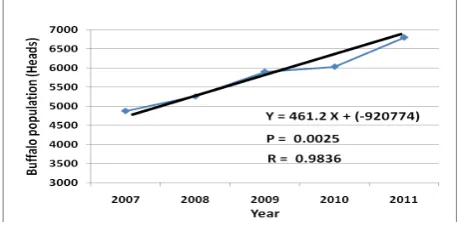
Figure 1 shows the trend of buffalo population in Mamasa Regency during a period from 2007 to 2011. The data of this population was obtained from local government as a secondary data of this study. Buffalo population in this region linearly increased significantly (P = 0.0025) by year. On the primary data, we calculated that calving rate of buffalo was 30.9%. No attempt was made in the present study to calculate the number of buffalo sent out from this area.
Reproductive Management in Buffalo
In the present study, reproductive management was focused to ascertain the mating system applied, knowledge of the far- mers regarding estrus, the use of any reproductive technology such as estrous induction or estrous synchronization, and future prospect for application of artificial insemination (AI). Figure 2 shows that all mating in buffalo in this area were conducted naturally (natural mating system). However, this mating system was mainly guided by the farmers; approximately 85% farmers gave attention to their animals for mating after estrus was de- tected. The remaining 15% farmers did not have any special attention to their animals especially for mating. Such these far- mers simply let their animals for mating as naturally. No effort was made by the farmers to the animals for mating.
In Figure 3 shows that the proportion of farmers regarding their knowledge about estrus was much better than expected before the study was conducted. Approximately 98% farmers
Figure 1.
Buffalo population in Mamasa Regency for last five years.
Figure 2.
Proportion of mating system in buffalo in Mamasa Regency.
Figure 3.
Proportion the farmers based on their knowledge about estrus in buffalo.
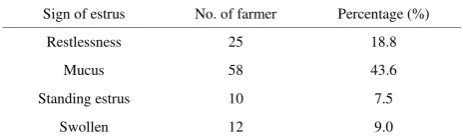
have a good knowledge about estrus and the remaining 2% of the farmers do not have any understanding about estrus. Table 1 shows the signs of estrus that farmers usually recognized. Mainly farmers recognized the animals in estrus if they are showing mucus. This sign is believed that the animals should be breed and after breeding the farmers also believed that the animal would become pregnant.
In the present study,the use of any reproductive technology such as estrous induction or estrous synchronization did not applied yet. No one respondent has been used this technology to improve their buffalo reproduction. Basically, the farmers knew that in case the buffalo have prolonged the time to be- come pregnant, so it means that the problem occurs in the ani- mal. This is due to that some limitations to apply this technol- ogy such as farmers’ knowledge about estrous induction or estrous synchronization and the cost for this treatment were the main reasons for application this technology. However, it is still a future prospect for application of artificial insemination (AI) in this area. The farmers would accept this technology in order to improve their buffalo reproduction. They would make their animals become pregnant and produce a lot of offspring during her life period. This indicates that the farmers in this area have potential to be improved from the nature of raising buffalo to more effectively and efficiently of raising buffalo. Therefore, provision of appropriate extension services for these farmers will improve the productive and reproductive performance of buffalo (Warriach et al., 2012).
M. YUSUF ET AL.
Copyright © 2013 SciRes. 3
Table 1.
Knowledge of the farmers regarding the signs of estrus.
Sign of estrus No. of farmer Percentage (%)
Restlessness 25 18.8
Mucus 58 43.6
Standing estrus 10 7.5
Swollen 12 9.0
sion of estrous, seasonality in breeding and low conception rate) limit the productivity of buffalo. For the future use of AI in this area, the weakness of estrus symptoms and variability of estrus length would be expected as the limitation of this technology. This problem has been experienced and stated in the study of Pasha and Hayat (2012). As buffalo are polyestrous and are capable of breeding throughout the year (Perera, 2011), how- ever, in many countries a seasonal pattern of breeding activity, and consequently calving is one of the limiting factors for buf- falo reproduction.
The present study concluded that the reproductive manage-
ment in buffalo was very poor; nonetheless, most of the farmers had good knowledge about estrus and were capable to identify buffalo in estrus by observing their behavior.
REFERENCES
Nanda, A. S., & Nakao, T. (2003). Role of buffalo in the socioecono- mic development of rural Asia: Current status and future prospectus. Journal of Animal Science, 74, 443-455.
Pasha, T. N., & Hayat, Z. (2012). Present situation and future perspec- tive of buffalo production in Asia. The Journal of Animal and Plant Sciences, 22, 250-256.
Perera, B. M. A. O. (2011). Reproductive cycles of buffalo. Animal Reproduction Science, 124, 194-199.
Terzano, G. M., Vittoria, L. B., & Borghese, A. (2012). Overview of reproductive endocrine aspects in buffalo. Journal of Buffalo Science, 1, 126-138.