C O N T E N T
Foreword
i
Preface
ii
Content
iv
Section 1
The English Language Curriculum
1
The Year One English Syllabus
17
Section 2
Listening and Speaking
19
Reading
65
Writing
128
Language Arts
168
Section 3
Sample Lesson 1
212
Sample Lesson 2
233
Sample Lesson 3
253
Sample Lesson 4
283
Sample Lesson 5
Sample Lesson 6
Section 4
Lesson Structure
300
Suggested Weekly Plan
304
Foreword
The new Malaysian English Language Curriculum for Primary Schools will be introduced in stages beginning 2011. This guidebook is a resource for teachers to implement the new curriculum.
It consists of suitable teaching and learning strategies as well as activities for teachers. It also gives teachers ideas for lesson organization in order to help them organize their daily lessons.
CDD believes the contents of this book will guide Year One English Language teachers to get accustomed to the changes in the new English Language Curriculum and act as a valuable teaching resource. However, teachers are also required not to rely solely on this guidebook when planning their lessons.
CDD hopes teachers will use their own initiatives to plan enjoyable and stimulating lessons for their pupils.
CDD would like to take this opportunity to acknowledge the contributions of the panel of English teachers involved in making this guidebook a reality.
ALI BIN AB. GHANI AMN
Director
Curriculum Development Division
P R E F A C E
**USING THE TEACHER’S GUIDEBOOK IN THE CLASSROOM**
This teacher’s guidebook serves as a guide to teachers with regard to the learning standards that should be achieved. It covers some aspects of the language skills, language arts as well as the suggested word list required to be taught in Year One. The guidebook is divided into four sections; section 1 gives an overview of the English
Language Curriculum. Section 2 of the teacher’s guidebook deals with language skills as
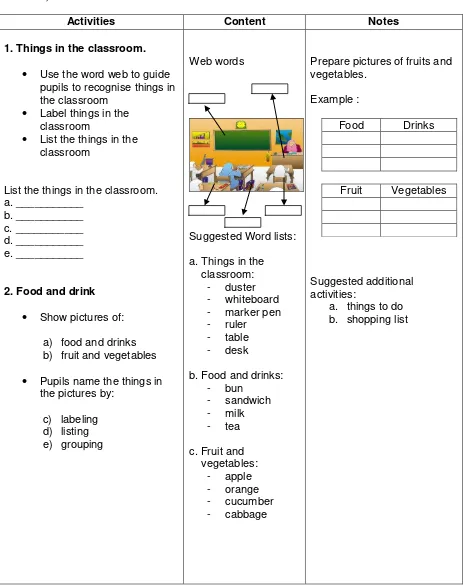
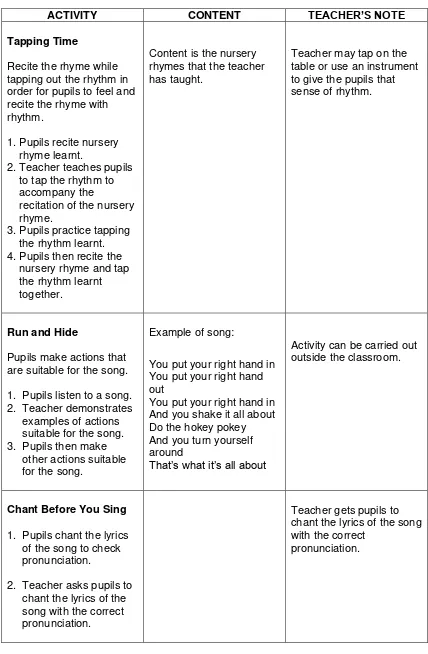
well as language arts. Each component consists of suggested activities. This is materialized in 3 columns. The first column is the activity column. These are suggested activities for teachers, which include explanations, teaching points and examples of activities. The second column is the content column. The suggested word list and
teaching points are stated here. The third column is the teachers’ notes column, which
includes teaching aids/materials and other instructions for teachers.
Section 3, consists of examples of complete lessons. In this section, teachers will be able to observe how the different language skills and language arts modules are presented for each week based on one particular theme and topic in a coherent and cohesive manner. Finally, Section 4 provides teachers with examples on how their weekly lessons can be organised. Lesson structures for Listening and Speaking, Reading, Writing skills as well as Language Arts are provided to help teachers plan effective and enjoyable lessons.
The guidebook provides suitable and practical suggestions of teaching methods via the materials provided. However, teachers are in a better position to make appropriate and
relevant decisions when planning their lessons. There is no single „best way’ and
teachers have to use their pedagogical content knowledge, experience, skills and creativity to plan their lessons in order to help their pupils learn better. Teachers should decide on a theme/topic and then select suitable listening and speaking, reading, writing and language arts activities to be used for teaching that topic. Teachers are also encouraged to use activities from the MOE Teaching courseware, the textbook and other suitable resources when planning their lessons.
The list of words suggested for Year One is based on a sample of common words and high frequency words in relation to the phonemes to be taught in Level One. This word list can be used in different contexts and topics and further increased if pupils demonstrate that they are capable of receiving more.
Good time management is also essential. Keeping in mind the time allocated for teaching English in SK and SJK schools is different; lessons should be organized in a manageable form in order to give pupils every opportunity to take part in language activities.
In order to facilitate and maximize learning, language skills must be repeated and used constantly. Some activities have been suggested in this document. However, teachers are encouraged to set more creative and challenging tasks and activities based on the needs and interests of pupils. This is important so that appropriate activities and materials are used with pupils of different learning profiles with the intention to realize their full potential and enable them to gradually develop the ability, knowledge and confidence to use the language effectively. In addition, elements of Science and Mathematics, moral values, patriotism, environmental education, health education and entrepreneurship should also be infused through the selection of appropriate materials and activities. Sample lessons are provided in Section 3 of this guidebook to demonstrate further how the lessons are cohesively and coherently linked.
Assessment is an important aspect of the teaching-learning process. Continuous formative evaluation is used as a means of gaining essential feedback and to keep track
of pupils’ progress. Awareness of pupils’ capabilities will enable teachers to plan
activities for further development. Teachers should set school based assessments for learning standards dealt with in the classroom. Some ideas of assessment are provided in Section 3 of this document.
This Teacher’s Guide provides some suggestions for the attainment of the language
CURRICULUM OVERVIEW
ENGLISH LANGUAGE CURRICULUM FOR PRIMARY SCHOOLS
AIMS
The English Language Curriculum for Primary Schools aims to equip pupils with basic language skills to enable them to communicate effectively in a
variety of contexts that’s appropriate to the pupils’ level of development.
OBJECTIVES
By the end of Year 6, pupils should be able to:
i. communicate with peers and adults confidently and appropriately in formal and informal situations;
ii. read and comprehend a range of English texts for information and enjoyment;
iii. write a range of texts using appropriate language, style and form through a variety of media;
iv. appreciate and demonstrate understanding of English language literary or creative works for enjoyment; and
v. use correct and appropriate rules of grammar in speech and writing.
FOCUS
Primary education is divided into two stages: Stage One refers to Years 1, 2 and 3, and Stage Two, Years 4, 5 and 6.
English language learning is developmental. The focus in Years 1 and 2 is on basic literacy. This is done by building a strong foundation in basic literacy skills namely reading through phonics, penmanship and basic listening and speaking. Activities are contextualized and fun-filled with integration of language skills in meaningful contexts.
CONTENT ORGANISATION
The curriculum is modular in design and this is reflected in the organisation of the content and learning standards.
In Years 1 and 2, the English language curriculum emphasizes the development of basic language skills so that pupils will have a strong foundation to build their proficiency in the language. In this initial stage, there will only be four modules; namely:
1. Listening and Speaking 2. Reading
3. Writing
4. Language Arts
From Year 3 onwards, where pupils build on the skills they have acquired in Years 1 and 2, a fifth module, Grammar, is added to the above four modules. Therefore, the modules for this stage are:
1. Listening and Speaking 2. Reading
3. Writing
4. Language Arts 5. Grammar
English is a second language for pupils, it is believed prudent and pedagogically sound to defer the learning of grammar to a later stage. Pupils’ awareness of grammar is developed in their first language lessons and this awareness may then be exploited when English grammar is introduced. This approach will reduce the load and stress of learning in the early years where the emphasis is on learning through fun and play.
In the initial stages of learning English, pupils will have the opportunity to listen to meaningful English input, in the form of stories or oral descriptions by teachers based on graphic texts. Through listening, pupils will become familiar with words that will be introduced later in the early reading and writing lessons. The emphasis in the initial stages will be on vocabulary acquisition.
The modularity of the English Language Curriculum Standards for Primary Schools is a modularity of focus. By organizing the curriculum standards under five modules (four for Years 1 and 2), pupils will be able to focus on the development of salient language skills or sub-skills under each module through purposeful activities in meaningful contexts. This modular approach does not exclude integration of skills. However, skills integration is exploited
strategically to enhance the pupils’ development of specific and specified
language skills as described in the content and learning standards in a module.
Three broad themes have been identified in the curriculum.
1. World of Self, Family and Friends; 2. World of Stories; and
3. World of Knowledge.
The following diagram shows the conceptual framework of the curriculum model.
Fig.1The Modular Configuration
The approach taken in this curriculum stresses the need for pupils to develop all the four language skills: listening, speaking, reading, and writing. Pupils will, for example, learn how to interact with peers, listen attentively, express themselves orally or in writing with confidence, read with comprehension, and write with minimal grammatical errors.
LISTENING AND SPEAKING
READING
WRITING
LANGUAGE ARTS
GRAMMAR
STAGE TWO (YEARS 4-6) STAGE ONE
LISTENING AND SPEAKING SKILLS
Content Standards
By the end of the six-year primary schooling, pupils will be able to:
1.1 pronounce words and speak confidently with the correct stress, rhythm and intonation.
1.2 listen and respond appropriately in formal and informal situations for a variety of purposes.
1.3 understand and respond to oral texts in a variety of contexts.
Overview
Listening and speaking are seen as core skills of early literacy. As such, pupils should be taught how to listen carefully as well as feel encouraged to speak from the basic level of sound, word, phrase and move on to structural sentences in various situational contexts. At every stage, the stress, rhythm and intonation patterns need to be used correctly. In addition, pupils are also encouraged to recognise, understand and use not only verbal but also non-verbal communication. Oral communication practice by means of repeating, responding, understanding and applying what the pupils have heard sensitises their senses to be ready for communication.
Relationships are established through the ability to communicate by listening first then speaking thoughts, ideas and feelings. Pupils should aim at becoming confident speakers who can communicate clearly, appropriately and coherently in any given context using language to explore the possibilities and opportunities. Pupils need to listen carefully and respond to what others say and think about the needs of their listeners. Social conventions in listening and speaking such as turn taking, politeness and courtesy need to be observed. These are crucial especially in-group discussions where viewpoints and opinions are exchanged.
Teaching and Learning Strategies
Years 1 and 2
Activities within the classroom need to encourage full and active participation by all pupils, irrespective of ability. Due to the fact that there will be pupils who
do not have any exposure to the English language, a „flooding’ of English
sounds and words need to take place. This is where teachers have to realise
that the language they use in the classroom will affect the pupils’ language
As a start, pictures, posters, photos, stories, songs and a whole lot of other resources come in handy. Teachers need to just talk about a picture or story and pupils listen. As the teacher does this, there will be words, phrases and sentence structures that will be repeated and pupils listen attentively to words being used in different contexts.
Slowly but surely, speaking will begin to take place as pupils build their curiosity and start asking questions or volunteering answers. An encouraging strategy here is to get the pupils to work in pairs and progressively talk in a speaking especially from their own effort.
Listening and speaking in Years 1 and 2 should be full of fun and play. Multi-sensory approaches should be adopted where pupils can do action songs for movements, smell spices in a story, touch surfaces in a rhyme, see insects through a poster or taste foods while talking about experiences. Making funny sounds, shaping their mouths, looking at the mirror while forming and producing sounds are great strategies for pupils to start being aware of their own voices and how they sound. Instead of listening to the teachers, they should listen to themselves. Recording their voices is a helpful mechanism for self-evaluation and improvement.
Years 3, 4, 5 and 6
From Year 3, pupils are taught listening and speaking skills that will eventually build their self esteem to respond to and speak confidently. In Years 3 and 4, pupils will still be playing around with sounds through poems, tongue twisters and songs with particular emphasis on pronunciation, rhythm and intonation. At this stage, pupils will also be expected to do more talking with guidance from stimuli before they move into more clear, accurate, confident and independent speech on a variety of topics.
In addition, pupils should be able to think through their conversation. This is where critical and creative thinking are implanted. Pupils are required to sequence, support, predict, evaluate and conclude what they have heard or on what they are going to say. Eventually, at the end of Stage 2, the Year 6 pupils should be able to hold a meaningful and thoughtful conversation on various topics with different kinds of people.
Assessment
Pupils listen and speak every day, the assessment carried out for the listening and speaking skills can be an on-going process where progress is regularly recorded and monitored. Teachers need to assess the listening and speaking skills of every pupil against the Content Standards and Learning Standards that they are teaching. With the modular approach, teachers will be able to provide specific comments and feedback on the progress of the pupils with regards to the specific standards.
Assessment need not be in a formal situation all the time. Besides assessing pupils through activities in the classroom such as through role-play and group discussions, pupils should also be given the opportunity to participate in other possible listening and speaking situations. Perhaps pupils can speak during the school assembly, put up a performance in front of an audience, and watch a puppet show or listen to a storytelling session. Talking about these events
and the contents afterwards can help teachers assess the pupils’ listening and
speaking skills.
READING SKILL
Content Standards
By the end of the six-year primary schooling, pupils will be able to:
2.1 apply knowledge of sounds of letters to recognize words in linear and non-linear texts.
2.2 demonstrate understanding of a variety of linear and non-linear texts in the form of print and non-print materials using a range of strategies to construct meaning.
2.3 read independently for information and enjoyment.
Overview
before progressing to sentence recognition and reading at the paragraph level. The teaching of reading in Years 1 and 2 will focus on basic literacy with the use of phonics. Gradually, pupils are also taught to extract specific information from a text and to respond to a text with their own ideas and opinions.
Teaching And Learning Strategies
Years 1 and 2
In Years 1 and 2, pupils’ phonemic awareness will be developed by means of phonics. Phonemic awareness (that involves knowledge of the alphabetic code and an understanding of the principles underpinning the way the code is used in reading), blending (which is the ability to build words from their constituent phonemes to read) and segmenting (which constitutes the ability to break down words into phonemes in order to spell) comprise the three main features of the use of phonics.
Moving incrementally from the simple to the more complex aspects of phonics, pupils will be given ample opportunities to apply the phonic skills they have acquired and mastered, and this will enable them to increase the pace of their reading, and equally, assist them to comprehend a text more effectively and efficiently.
However, it must be emphasised that adhering to the sequence of phonic content of the reading programme is essential. Teachers and schools should bear in mind the importance of following the sequence of the phonics programme consistently from start to finish. This approach will most likely
secure optimum progress in pupils’ acquisition of phonic knowledge and skills,
whereas mixing parts of different sequences can slow their progress.
The reading aloud strategy is also encouraged in the first two years of primary education. Teacher reads aloud a text to pupils. Implementing this strategy allows teachers to model reading. Here, articulation and pronunciation of words by the teacher have to be as precise as possible in order for pupils to efficiently imitate and reproduce correctly. This strategy may effectively engage pupils in a text that may be too difficult for them to read on their own, and pupils sit back and enjoy the story.
Years 3, 4, 5 and 6
Reading from Year 3 onwards includes understanding text for a purpose. This involves extracting specific information from a text, as well as knowing how to skim and scan for specific information in a text. Progressively, pupils are also taught to respond to a text with their own ideas and opinions. At the same time, engaging in reading of a variety of texts will enable pupils to see how grammar is used correctly.
The use of dictionaries will be emphasized in order to expand and extend vocabulary. The use of the internet as well as other electronic media is encouraged in order for pupils to inculcate enjoyment and pleasure in seeking information and knowledge beyond the realm of the classroom and the reading modules. This will eventually enable them to become independent and efficient readers, who have acquired the ability to recognise words; read expressively, correctly and fluently; understand the meaning of words through contexts; and respond to various text types such as factual and non-factual texts, as well as poems, songs and plays. Teachers should also encourage pupils to read by themselves or with partners, choose their own texts, and
employ strategies that they’ve learned through other reading activities.
In this stage, the use of metacognitive strategies helps pupils to "think about their thinking" before, during, and after they read. Questions that trigger and activate thinking about a particular subject in a text before it is being read would not only facilitate the effectiveness and efficiency of the reading but also increase comprehension as to what is being read. Teachers should encourage pupils to make predictions and explore possibilities that may become apparent while reading the text, and stimulate pupils to think about and guess what they are about to read before attempting the act of reading. This may be achieved through the use of riddles, visual stimulus such as the illustrations on the book cover or even the title of the story.
During reading, teachers may instruct pupils to verify their predictions and check for inaccurate guesses. Pupils could also be asked to identify information that is new to them. By asking pupils to subvocalise connections, corrections, and collections while reading, pupils will find enjoyment and fun in the very process of interacting with the text read.
After reading, comprehension of the text may be obtained through questions answered orally or in written form, or through non-linear forms such as mind-maps, tables, charts, illustrations or pictures.
Assessment
Some recommended tasks that may be used to assess reading comprehension are answering questions, comprehension activities such as using graphic, semantic organizers, story maps, question generation and summarization.
WRITING SKILL
Content Standards
By the end of the six year primary schooling, pupils will be able to:
3.1 form letters and words in neat legible print including cursive writing.
3.2 write using appropriate language, form and style for a range of purposes.
3.3 write and present ideas through a variety of media.
Overview
It is expected by the end of Year 6, pupils will be able to express their ideas clearly on paper in legible handwriting or to communicate via the electronic
media. The focus on writing is on developing pupils’ writing ability beginning
at the word and phrase levels and progress to the sentence and paragraph levels. For pupils who are capable, they must be encouraged to write simple compositions comprising several paragraphs. Attention is also paid to penmanship so that even from a young age, pupils are taught to write clearly and legibly including in cursive writing. In writing simple compositions, pupils are taught the various steps involved such as planning, drafting, revising, and editing. In the process the genre approach to writing is also applicable where they are taught to use appropriate vocabulary and correct grammar to get their meaning across clearly. Hence all pupils are encouraged to write for different purposes and for different audiences. Although much of the writing at this level is guided, the amount of control is relaxed for pupils who are able and proficient in the language. Spelling and dictation are also given emphasis.
Teaching and Learning Strategies
Years 1 and 2
At the letter-writing level, pupils learn that each letter has a shape and a name, and makes sounds. When knowledge of these three qualities is secure, it should have a positive effect on the skills of reading, writing, and spelling later. From this, they will be taught to identify the initial sounds in words such as their name, and learn how to replicate sounds by writing letters. The ability of the eyes to track and coordinate the movements of the body and hands, and to inform the body where and how to move, is a very important skill called the hand-eye coordination.
At the word level pupils need to practice the skills of writing and spelling words to consolidate an awareness of the structure and make-up of English words. Word games and activities such as pictograms will have the added benefit of increasing vocabulary. However pupils do not need a huge vocabulary to enjoy being creative with words. By the end of Year 2, pupils should be able to write simple sentences correctly by using a variety of media.
Years 3, 4, 5 and 6
By this stage, pupils would have been writing individual words and short sentences, perhaps about themselves, or writing greeting cards. Some pupils may have progressed to writing several sentences, which put together, make paragraphs about topics which are familiar to them such as family, school, friends, or holidays.
However, pupils at this stage need a lot of support when creating an original piece of text. It is important to use a structured approach by working on the
The more pupils’ write, the more they focus on print and the ways in which
print can be used to fulfil their needs. Independent writing opportunities should be provided in order to expose pupils to a range of contexts so that they may have many opportunities to write for their own purposes and audiences. The enthusiasm of the teacher is crucial to the success of any writing programme, as pupils need to see the teacher as a skilled writer who models the writing process by demonstrating a variety of writing skills.
Before writing independently, it is often useful for pupils to participate in the shared writing of a text in the new form. It is useful for the teacher to model to the pupils and if further practice is required pupils can be guided to jointly construct a text having seen an adult model the process.
their final versions. The use of the word processor reinforces this drafting process. Hence desktop publishing should be encouraged to provide the
output of children’s work by mixing text and pictures.
Grammar is the „nuts and bolts’ of a language as it helps to give structure and
to hold it together. However, rigorous learning of rules is counter-productive, as young pupils cannot grasp formal, abstract grammar. Pupils should be immersed in activities, which practise grammar in meaningful contexts
Assessment
As writing is a productive skill, it can be assessed through tests, exams and class exercises. In assessing writing in primary schools, teachers may focus on the following issues:
Organization (sentences/paragraphs order)
Grammar (correct use of nouns, pronouns, verbs)
Syntax (writing clear and coherent sentences)
Punctuation
Capitalization
Spelling
Vocabulary (using correct word given situation)
LANGUAGE ARTS
Content Standards
By the end of the six year primary schooling, pupils will be able to:
4.1 enjoy and appreciate rhymes, poems and songs through performance.
4.2 express personal response to literary texts.
4.3 plan, organize and produce creative works for enjoyment.
Overview
The rationale behind Language Arts is to steer the continuous growth and
development of pupils’ thinking and language abilities. The standards for
will also be able to use English for both functional as well as aesthetic purposes, confidently and competently.
Teaching and Learning Strategies
Years 1 and 2
Pupils will enjoy learning to play with language where rhymes and songs are constantly utilised. Here, the teacher is the model for pupils. Pupils develop their oracy skills through listening to nursery rhymes, action songs and jazz chants, using and interpreting nonverbal actions to demonstrate understanding. In this stage, they will be infused with the love to read books starting with analyzing book covers and pictures in Year 1 and gradually the story content in Year 2. In this stage, pupils will produce simple creative works based on the nursery rhymes, action songs jazz chants and the fairy tales learnt with teachers guidance.
Years 3, 4, 5 and 6
The use of diversified materials of varied genres which include poems, stories and plays help pupils respond to texts through discussions, writing, implemented whereby pupils can demonstrate their understanding by describing an event in a story, characters, setting or main ideas. They can also draw or create their own poems, stories, songs, and artworks on what they understand of a text. Teachers may want to encourage pupils to be creative as they can use whatever means to present their understanding of the texts learnt.
Language Arts creates ample opportunities for pupils to speak in English in a very relaxed atmosphere. Due to the fun elements of language arts, it is
hoped pupils’ presentations or dialogues spoken in role-plays help to increase
pupils’ confidence in using the English language.
Assessment
Assessment and evaluation in the language arts module should foster lifelong learning and critical thinking by providing pupils with constructive feedback and by encouraging them to reflect upon their own learning.
Assessment should be broad and flexible enough to include and accept all activities conducted in school (i.e. drama, choral speaking, public speaking, speech day, school bulletin). Assessment should also provide pupils with opportunities to self-assess using known criteria and to have input into the evaluation process. Teachers should utilize a variety of assessment
techniques to monitor their pupils’ language growth and development. Some
of the key techniques are:
Observations
Checklists
Anecdotal Records
Interviews
Retelling and Journals
Inventories and Running Records
Performance Tasks and Demonstrations
Folders and Portfolios
GRAMMAR
Content Standards
By the end of the six year primary schooling, pupils will be able to:
5.1 use different word classes correctly and appropriately.
5.2 construct various sentence types correctly.
Overview
The grammar component is introduced from Year 3 onwards. Salient and basic language rules are learnt through meaningful contexts to enable pupils to communicate accurately and effectively. By the end of Year 6, pupils will be able to use these basic rules of English grammar in speech and writing.
The second content standard teaches pupils knowledge of sentence types and to use these varied sentences in their communication. Pupils should know how to construct declarative, interrogative and imperative statements and use them effectively. When dealing with this content standard, more situational contexts are required. Grammar teaching should not take place in isolation. Situational contexts make learning fun and purposeful for the pupils. Therefore, the grammar component requires teachers to be able to weave their knowledge of grammar items and pedagogical approaches in the classroom.
Teaching And Learning Strategies
Years 1 and 2
In Years 1 and 2, pupils’ L1 will take care of their basic knowledge of
grammar. The schemata formed in the first language would prepare pupils to learn grammar in the second language from Year 3.
Years 3, 4, 5 and 6
Communicative drills are encouraged for pupils to connect form, meaning, and use. In communicative drills, pupils respond to the grammar point under consideration, but providing their own content. For example, to practice questions and answers in the past tense, teacher and pupils can ask and answer questions about activities concluded the previous day. Teachers should have knowledge of managing games, technologies and available resources in the classroom so that the teaching of grammar becomes enjoyable, exciting and meaningful. Repetition of words, phrases and sentences can be a useful strategy to help pupils remember. Drilling can be made fun by incorporating repetition of sentence patterns, for example, in nursery rhymes.
A more conventional approach such as the substitution table for teaching a sentence pattern can still be applied to allow for more practice as reinforcement after a grammar game. Pupils need to be actively engaged in the classroom so that learning becomes more exciting for them. The teacher can also use word cards to teach grammar. Inclusion of punctuation marks can also be made here.
Newspapers and magazines can also be used to encourage pupils to read and familiarise themselves with spelling and sentence structures. The teacher can carry out a lot of group work activities by working with headlines, sentence structures and pictures in the newspapers. Gap-filling and sentence completion exercises can also be incorporated when working with these resources.
Assessment
Ongoing process of assessing of all class work and homework should be continued. The main purpose of this is to provide immediate feedback to the pupils in guiding, motivating, correcting and refocusing their efforts. In formal exams, grammar items could be tested in cloze passages, gap-filling items and short essays.
WORD LIST
The list of words selected for teaching is based on common words and high frequency words that can be used repetitively in different contexts. The suggested word list can be expanded upon if pupils demonstrate an ability to acquire more words.
EDUCATIONAL EMPHASES
Educational emphases reflect current developments in education. These emphases are infused and woven into classroom lessons to prepare pupils for the challenges of the real world. In this respect, moral education, citizenship education, patriotism, thinking skills and entrepreneurship are incorporated where appropriate and relevant in lessons.
Thinking Skills
Critical and creative thinking skills are incorporated in the learning standards to enable pupils to solve simple problems, make decisions, and express themselves creatively in simple language.
Learning How to Learn Skills
These skills are integrated in the learning standards and aim to enable pupils to take responsibility for their own learning. These skills incorporate study skills and information skills to equip them to become independent life-long pupils.
Information and Communications Technology (ICT) Skills
Multiple Intelligences
The learning outcomes also reflect the incorporation of the theory of Multiple Intelligences. For example, interpersonal intelligence is reflected when pupils are taught the polite forms of language expression so as not to offend the people they communicate with. In getting pupils to role-play or dramatise sections of a text, their kinesthetic intelligence is nurtured. When pupils sing songs, recite poems and chant jazz chants either individually or in chorus, their musical intelligence is developed.
Knowledge Acquisition
In teaching the language, content is drawn from subject disciplines such as science, geography and environmental studies. Content is also drawn from daily news items as well as current affairs.
Preparation for the Real World
The learning standards prepare learners to meet the challenges of the real world by focusing on language use in society. It is also achieved by making use of real-life issues for classroom activities and project work. Whenever the opportunity presents itself, pupils are encouraged to meet with people outside of the classroom that they learn to operate in real-life situations.
Entrepreneurship
W
hat’s in store for Year One pupils?
T
he
Y
ear
O
ne
E
nglish
L
anguage
S
yllabus
THE LISTENING AND SPEAKING SKILL
The listening and speaking skills are taught together for effective communication, as these skills are inter-related and dependent on each other.
In Year One, pupils need to be exposed to good language with the teacher being the role model. Teacher uses a variety of materials or media to enable pupils to acquire the receptive skill of listening and the productive skill of speaking. The main objective of this language component would be to expose pupils to rich language input in accordance to Standard British English (SBE) as well as getting pupils to talk and communicate effectively.
The listening and speaking lessons would enable pupils to familiarize with the sounds around them. In these lessons pupils need to:
a) tune into sounds (auditory discrimination),
b) listen and remember the sounds (auditory memory and sequencing), and c) talk about the sounds (developing vocabulary and language comprehension). These can be attained through fun language activities conducted in or outside the classroom that include nature walks, using musical instruments, songs, chants, rhymes, body percussion and even listening to a story.
The suggested activities recommended in this section could be used in a variety of lessons by adapting and adopting them in order to teach the sounds of the English language. This skill is the onset of providing a broad and rich language experience for pupils to learn language by engaging in enjoyable learning activities.
THE READING SKILL
In Year One the reading component aims to develop progressively pupils’ ability to
read and comprehend a paragraph of 3 - 5 simple sentences. In the beginning,
pupils’ phonemic awareness will be developed by means of phonics. They will be trained to apply knowledge of letter sounds to recognize words in reading texts. The ability to recognize letter sounds is an essential and useful early reading skill. However, in a second language context, it is appropriate for teachers to begin phonics instruction by first letting pupils listen to rich language input in English. This can be done during Listening and Speaking lessons. The guiding principle in using phonics to teach reading is for pupils to enjoy the activities selected. Hence the use of songs, rhymes, poems, stories, pictures and games to make phonics instruction more enjoyable is encouraged.
provide practice finding the phonemes in word contexts. For early practice, teachers could help pupils to recognize the phoneme at the beginning of words, progressing to having them recognize the phoneme elsewhere in the word. For this, illustrations may be very useful. Teachers are encouraged to be creative and to explore ways of language play available to help pupils become familiar with the phonemes. The benefits of language play are numerous. Language play involves having fun with the sounds of words, creating new words, and exploring and creating language patterns through rhymes, chants, alliteration and repetitions.
THE WRITING SKILL
The writing skill for Year One begins with motor control skills for pupils to have good coordination. They begin by handling objects and manipulating them and moving their hands and fingers using writing apparatus. Basic penmanship is taught after coordination activities are done in the classroom. Pupils have to be taught the correct way of holding their pencils regardless if they are right or left handed. Teachers will have to guide pupils the correct posture and pen hold grip when they are engaged in writing activities.
Before pupils begin writing the letters of the alphabet, pre-writing activities is a prerequisite. Activities such as scribbling in clockwise and anti-clockwise movements, drawing simple strokes up and down as well as drawing lines from left to right and reinforced by drawing patterns should be conducted in the classroom. correctly as well as complete other writing tasks by matching, rearranging words and completing lists and messages. When pupils are ready, more difficult writing tasks can be incorporated such as writing sentences with the correct spelling and punctuation. This activity can be conducted in the classroom by introducing parallel writing and then moving on to constructing simple sentences. Pupils are also taught to create simple non-linear texts using a variety of media.
LANGUAGE ARTS
In Year One, pupils will be able to enjoy and appreciate language using stories, poetry, rhymes and plays. The introduction of the language arts module encompasses the production aspect of the skills learnt during the listening and speaking, reading and writing modules.
All these skills are interconnected in order for pupils to sing songs, chant rhymes or even tell stories with correct pronunciation and rhythm. Emphasis should be on
encouraging pupils’ response where they are able to perform a song or rhyme or role
LISTENING & SPEAKING
READING
WRITING
THE READING SKILL
At the end of primary education, pupils should be able to apply
knowledge of sounds of letters to recognize words in order to
begin reading and then move on to the more complex skill using a range of strategies
to construct meaning from the text read. The ultimate goal of the reading component
in primary school is to produce pupils who will be able to read independently for
information and enjoyment.
The standards covered in Year 1 are as follows:
CONTENT STANDARD LEARNING STANDARD
2.1 By the end of the 6-year
2.1.1 Able to identify and distinguish the shapes of the letters in the alphabet. 2.1.2 Able to recognise and articulate initial, medial and the final sounds in single syllable words within given context:
2.1.3 Able to blend two to four phonemes into recognizable words and read them aloud.
2.1.4 Able to segment words into phonemes to spell. 2.2 By the end of the 6-year
2.2.1 Able to read and apply word recognition and word attack skills by matching words with:
The content of this section covers learning standards 2.1.2, 2.1.3, 2.1.4, 2.2.1 (a) &
(b) and 2.2.4. Although, this module does not provide suggested activities for the
other learning standards, it is hoped that teachers would be able to plan lessons and
activities on their own for the other Learning Standards.
In Year One, reading should be taught in a fun learning environment using phonics.
First, pupils are taught to articulate the phoneme(s) (/s/, /æ/, /t/, /p/, /ɪ/, etc) and then to recognize the grapheme(s) (s, a, t, p, i, etc).
Note : A phoneme is a unit of sound in a language.
A grapheme is a letter or group of letters that represents a phoneme.
Example :
The sound /s/ is represented by the letter „s’ which is called “ess”.
The English sounds to be learnt in Year One, have been divided into consonants and
vowels; the following are the phonemes which pupils need to learn in Year One as
stipulated in the standard document. Possible actions are suggested for teachers to
use in the classroom to help pupils remember the phonemes. Children then become
aware of the phonemes learnt and then to the letter sound correspondence. They
can be introduced using various teaching strategies such as singing songs, telling
stories, reciting rhymes, playing games as well as drilling in order to reinforce the
learning of these phonemes.
Grapheme Phoneme Possible actions
s
ss
c
/s/
(voiceless)
1. Form a cobra head with
your hand.
2. Trace the letter „s’ in the air
and, say s…
t / t /
(voiceless)
Tap two fingers on the desk
and say t…
P /p/
(voiceless)
Place four fingers in front of
your mouth and say p…
n /n/
(voiced)
Touch the tip of your nose and
m /m/
(voiced)
Lick an ice-cream and say m…
d
/d/
(voiced)
Drumming action and say d…
g /g/
(voiced)
1. You are cold, clutch your
hands and shiver
2. Say ggg
c
k
ck
/k/
(voiceless)
Action of flying a kite and say k
r /r/
(voiced)
h /h/ (voiceless)
1. Place your palm in front
of your mouth
2. Laugh haha
b /b/
(voiced)
Action of balloon bursting and
say b…
f
ff
/f/
(voiceless) Action of bird flying and say f…
l
ll
/l/ (voiced)
Raise both arms upright and
v /v/ (voiced)
Show the peace sign and say
v.
w /w/
(voiced)
Join two peace signs and say
w.
x
/ks/ (voiceless)
Cross your hands and say ks..
/gz/ (voiceless)
Slash „x’ and say gz..
y /j/
(voiced)
z
zz
/z/ (voiced)
Trace „z’ in the air and say z..
q /kw/
(voiced)
Action of a duck flapping its
wings once and say qua
ch /tʃ/
(voiceless)
1. Action of a moving train
with both arms
2. Say ch.
sh /ʃ/
(voiceless)
/ð/ (voiced)
Point with the thumb and say
th.
ng /ŋ/
(voiced)
Action of mosquito buzzing
around ears and say ng….
The short vowels are as follows :
Grapheme Phoneme Possible actions
a
/æ/
Imagine a spider crawling
up your arm and say eh…
/ә/
1. Cross your arms on your
chest and lift your
shoulders.
i / ɪ/ Show your teeth and say e.
o
/ɒ/ Draw a small circle (anti clockwise) in the air and say o
e /e/
Walk like an elephant and say
eh
u /
ʌ
/Look up and say uh
The long vowels are as follows :
Grapheme Phoneme Possible actions
a /a:/
Open your mouth wide and say
aaa…
a
o
/ɔ:/
Draw a big circle (anti
clockwise) in the air and say
or…
e /i:/ Show your teeth and say ee..
Note : These phonemes are to be taught in sequence as stipulated in the learning
Word List for Year 1 and 2 (according to phonemes learnt)
Grapheme
Phoneme
Suggested Words
ə
/
ɔ
ɪ
/
ʒ/
ɔ
ɔ
Grapheme
Phoneme
Suggested Words
ʒ/
ʃ
ʃ
/
θ
ŋ/
ɪ
/
ɪ
/
ə
ʊ
/
Grapheme
Phoneme
Suggested Words
ɔ
ɜ
a
ʊ
/
/
ә
ʊ
/
ɪ
ə/
ə/
ʊ
ә
ɜ
ɪ
/
a
ʊ
/
a
ɪ
/
ɔɪ
ɜ
ɔ
Grapheme
Phoneme
Suggested Words
e
ɪ
ɪ
ə
ʊ
Learning Standard
2.1.2 Able to recognize and articulate initial, medial and final sounds in single
syllable words within given context.
Teachers can use a variety of activities to teach the phonemes listed in the
standard document. Here is a list of activities arranged from basic to advance which
can be adapted to teach any phoneme. In this section, the first part will guide
Activity Content Teacher’s Notes Naming the objects
1. Put some objects that start with the phoneme /s/ in a big bag. 2. Pick an object and name it aloud, stressing the phoneme /s/ as the word is said.
3. Pupils repeat the word individually or in groups.
4. Repeat steps (1,2,3) to introduce other objects.
Suggested Objects :
suit, soap, sand, six, sock
e.g.
Teacher : Soap. Please repeat after me.
Pupils : Soap .
Materials: big bag objects
Follow up with Step 3 , to
reinforce pupils’ thinking skill and
to identify the objects with the phoneme /s/. banana, elephant, ball
2 big attractive boxes
e.g..
two big attractive boxes
No No Yes
Activity Content Teacher’s Notes Sticky Fingers
1. Show „sticky fingers’.
2. As the fingers are spread out, say /ɪ / slowly.
3. Pupils repeat aloud.
4. Pupils stick the letter cards on the
teacher’s fingers.
5. Pupils may try out the „sticky
fingers’ too.
Grapheme „i’ How to prepare „Sticky fingers’1. Teacher prepares slime or glue (made from tapioca flour)
2. Teacher dips her fingers into the slime/glue.
Material : Letter cards (ten)
I Spy With My Eyes
3. The activity continues until all the
„i’ cards are in the „i’ bank.
Grapheme „i’ and other
Activity Content Teacher’s Notes you must keep quiet.
Be My Mirror
1. Sing the song.
2. Sing with actions by using fingers or body to form the letter
„g’ for ggg.
3. Pupils sing the song with actions.
Song ( tune of Brown Girl in the Rain by Boney M)
Ghost Train Drill
Activity Content Teacher’s Notes Mickey Listen and Repeat
1. Put on Mickey Ears 2. Show a picture card.
3. Read the word aloud and stress the phoneme /g/.
4. Say /g/ and shiver as if feeling cold.
5. Pupils listen and say /g/ and shiver as if feeling cold.
Example: g g g goat bag g g g
Suggested word list: goat
colourful and attractive Mickey ears
strips with the „ck’ letters
Word Cards :
strips with the „ck’ letters.
Here comes the duck now Duck now duck now Here comes the duck now Quack quack quack
Tick, tock, tick, tock goes the clock. Tick, tock, tick, tock
it’s four o’clock
Activity Content Teacher’s Notes
Mirror! Mirror!
1. Show 3 picture cards. 2. Identify the pictures. 3. Say /dʒ/.
4. Distribute sharpeners with mirrors. 5. Pupils say /dʒ/ while looking into
the mirror.
6. Pupils write the letter „j’ in the air
and on their friend’s back. 7. Pupils pronounce the words shown correctly. picture cards word cards
little round sharpeners with mirrors
3. Pupils sing in pairs with action. 4. Distribute sharpeners with mirrors to pairs (optional) or ask pupils to face each other.
5. Pupils sing while looking at the mirror or facing each other.
Grapheme : „ch’
London Bridge tune sung as chchchchch
Materials: mirrors
Echo
1. Divide pupils into groups. 2. Get pupils to stand in rows.
Activity Content Teacher’s Notes Where is My Match?
1. Prepare picture cards and word cards.
2. Put the word cards face-down on the table.
3. Display the picture cards on the board.
4. A pupil picks a word card.
5. The pupil reads and matches it to the picture on the board.
3. Show pictures, say the phoneme /h/ and do the action.
4. Give pupils picture cards. 5. Say aloud a word emphasizing the /h/ sound.
6. The pupil with the correct picture will show the card.
7. Pupils read the word aloud.
This activity can be carried out with the other phonemes as listed in the word list.
Baby
1. Prepare picture and word cards. 2. Get pupils to say the words
Read and Colour Me
1. Distribute worksheets.
2. Pupils look at pictures in column
Help Birdy Bird Fly To His Nest.
1. Distribute worksheets.
2. Pupils colour the path that has Baby boy gives the ball
Activity Content Teacher’s Notes
puppet/ soft toy sentence strips
Stir, Seek and Read
1. Prepare word cards and a set of
5. Pupils complete the chant.
Jazz Chant :
Siti sees a silly snake. She points to the snake. On the sand. (2x) The snake hisses
S…..s…..s….. (2x)
Chart A
__iti __ees a __illy snake. She point__ to the snake. On the __and.
The snake hi__ __ e __ __..__..__...
Materials : jazz chant chart
letter cards with „s’
There is a fox on the box. Put the fox in the box.
Activity Content Teacher’s Notes Let’s Circle
1. Sing the song.
2. Teacher says aloud the phoneme and word. 3. Distribute worksheet.
4. Pupils listen, repeat and circle the words in the maze.
5. Check answers with pupils. 6. Sing the song again. Goody likes the rag in the bag g g
3. Explain to pupils that the letter „c’
and „k’ in the word list are
draw to pupils’ attention that
grapheme c and grapheme k has the same sound
Catch My Name
cards with pupils’ names
Instructions:
1. Arrange the cards on the desks.
Activity Content Teacher’s Notes catch, Siva, rat, mat, and Jazz Chant :
Siva has a small cat, (2x) His cat is sad, it is sad (3x) It sits on the mat
And sees a rat
It can’t catch it. (2x)
It is sad. (2x)
Activity Content Teacher’s Notes
4. Continue playing in this manner by allowing all the pupils to
4. Pupils find the letters according to the numbers and stick below
Activity Content Teacher’s Notes Cut and Sort
1. Divide pupils into groups. 2. Distribute worksheets.
3. Pupils cut out the words and sort them into three sets according to their final letters.
4. Groups read out sets of words in front of the class.
Focus on words with the phoneme /ff/, /ss/ and /ll/
Refer to R7
Put The Pieces Together
1. Prepare puzzles and put them
blend phonemes to form more words, for example sit, pin, mat, pan, tap, sap, sat
and sand.
However, for the word sand, the teacher needs to explain that the phoneme
/n/ and /d/ are joined together to form the final blend /nd/. As blends and digraphs
are introduced, the teacher needs to explain to pupils that the sounds differ in the
words being taught.
The second part will deal with the blending of these phonemes to teach pupils
to form words mainly CVC words. Blending can be taught in various ways in order to
Learning Standard
2.1.3 Able to blend two to four phonemes into recognisable words and to
read them aloud.
Activity Content Teacher’s Notes
Jam Them Up!
1. Say the phonemes aloud /t/, /æ/ and /p/.
2. Move each card closer to form a word.
_____ _____ _____
3. Say the phonemes aloud as you blend the word.
4. Pupils repeat after teacher. 5. Repeat the steps for each word on the list.
6. Pupils do the activity in groups or pairs.
Word List : sap
sat tap pat
Materials : letter cards picture cards
This activity can be used to teach other words in the word list.
t a p
t a p
pat
sat
Activity Content Teacher’s Notes Secret Code
1. Place the picture card face down. Show the letter cards of the picture.
2. Pupils blend the sounds and guess the picture.
3. Show the picture to confirm the picture cards
This activity can be used to teach other words in the word list. Teacher : Who can guess this picture?
Teacher : These are the clues. Say the sounds correctly.
Pupil : /t/ / æ/ /p/ Teacher : Say the word Pupil : tap
Teacher turns over picture card to confirm the answer.
Activity Content Teacher’s Notes 4. Pupils find the missing letter in the box.
Words which could be formed from the learnt phonemes.
Materials :
Activity Content Teacher’s Notes
flannel board or magnetic board.
Use lamp shade (improvise) with the letters
The word list is a combination of phonemes learnt in Year 1.
Getting Closer!
1. Put up the letter cards on the board.
2. Pupils say the phonemes aloud. 3. Move the letter cards closer and
pupils say the phonemes . 4. Call out three pupils (according
to the number of letters in the word) to hold the letter cards. 5. The three pupils stand apart and
say the phonemes. Other pupils repeat.
6. The three pupils move closer together and say the phonemes. The other pupils repeat.
This activity can be carried out for all the other phonemes learnt.
Roll and Make a Word
1. Distribute activity sheet and two cubes to each group. 2. Pupils take turns to roll each
cube.
3. Pupils blend the onset and rimes from both cubes to form a word. (e.g. „ch’ + „ick’ = chick)
4. Ask pupils to write the words formed (nonsense or real) under the appropriate columns.
5. Carry on with the activity listing down all possible words. 6. Ask pupils to read the words in
Blend Them Right!
Activity Content Teacher’s Notes
5. Pupils read the words aloud.
Possible Words : bin ten sun
The third part will give teachers’ ideas on segmenting and how to teach pupils
to segment words to spell. Basically segmenting is the reverse of blending which is
the process of splitting up whole spoken words into individual phonemes, i.e. /k/, /æ/
and /t/.
If pupils are learning the word „frog’, they need to know that it consists of a
blend /fr/, /ɒ/ and /g/. If pupils are learning the word „blue’, then they need to know that it is segmented in the following manner, /bl/ and /u:/.
When learning the word „clock’, the teacher needs to tell pupils that it is
segmented in the following manner /kl/, / ɒ /, /k/ and the diagraphs „c’ and „k’ is
pronounced as /k/ in the word „clock’. Learning Standard:
2.1.4 Able to segment words into phonemes to spell.
Activity Content Teacher’s Notes
Split Up
3. Pupils repeat after the teacher. 4. Repeat the steps with each word on the list.
Word List : Materials :
sets of letter cards and pictures for each group
This activity can be used to teach other words learnt.
Activity Content Teacher’s Notes Spell It Right
1. Say aloud the word on the board and pupils repeat.
2. Put a dot under each letter and say the phonemes aloud. Pupils repeat after teacher.
3. Separate the letters and say the phonemes individually. Pupils repeat after teacher.
4. Call out pupils (according to the number of phonemes in the word) to hold the letter cards. They stand close together and say the word together. All the other pupils follow.
5. The three pupils stand slightly apart and say the phonemes aloud individually. Other pupils repeat.
6. The three pupils stand far apart and the rest of the class say the phonemes aloud.
7. Teacher can follow steps 4 – 6 for all the other words.
Word List :
hat, hut, head, hand, hop, hot
bag, bat, boy, bed, web, fan, fish, huff, puff, off
lamb, love, pail, ball, wall grass, glass, kiss, miss
Materials: word cards letter cards
This activity can be carried out for all the other focus phonemes.
Moving Charts
4. Teacher demonstrates segmentation of a word. large word cards
c. say the phonemes
3. Pupils repeat after the teacher. 4. Pupils sit in groups.
Activity Content Teacher’s Notes
3. Form the letters with their bodies. 4. The other groups will try to guess
Suggested minimal pairs : pin – bin
pat –bat cat – rat
Materials:
phoneme cards of rhyming words picture cards
Minimal pairs are two words that differ in only one sound.
E.g. pat and mat
p i n b i n
pin
The fourth part of this section will give teachers ideas on how to teach pupils
to read fluently. First, pupils are taught the phonemes and then they learn to blend
as well as segment words. This is further enhanced by the introduction of rhyming
words and phrases in order to get pupils to read phrases. Phrases can be introduced
through rhymes and chants as well as songs.
Examples of rhyming words (1 – 4 words):
pat a cat a rat and a cat
a cat on a mat a hat on a mat
a rat on a cat cats and dogs
Examples of phrases (1 – 5 words)
to huff and puff a bear in a box
a fat cat and a fat rat an egg in a cup
a dog in a pot hop on the bus
When pupils are ready, the teacher can then introduce simple sentences
through stories for them to begin reading. During this stage, a lot of reading
materials should be made available in the form of picture books and big books.
Below is a list of activities which teachers can use or adapt to build pupils vocabulary.
Learning Standard :
2.2.1 Able to read and apply word recognition and word attack skills by matching
Activity Content Teacher’s Notes Look and Read
1. Put up five pictures on the board. 2. Show word cards to the pupils. 3. Pupils read the words aloud. 4. Call pupils individually to match the word cards to the pictures. picture cards
Read and Colour
Activity Content Teacher’s Notes Hidden Objects
1. Distribute worksheets.
2. Pupils read the word shown by the teacher.
3. Pupils identify the correct object hidden in the picture.
4. Repeat the steps for the other objects.
5. The teacher can also ask the pupils to colour an object with a particular colour.
(eg. colour the chair brown)
Word List : pen
bag bin book chair
Prepare a composite picture (worksheet) with the hidden objects.
Learning Standard:
2.2.1 Able to read and apply word recognition and word attack skills by matching
words with:
(b) spoken words
Activity Content Teacher’s Notes
Listen and Match
1. Divide pupils into groups.
2. Distribute five word cards to each group.
Hear Them Right
1. Divide pupils into groups.
2. Distribute a pair of word cards to
Learning Standard :
2.2.4 Able to read a paragraph of 3 – 5 simple sentences.
Activity Content Teacher’s Notes
Read and Draw
Instructions to do a spin wheel: Draw a circle.
Divide the circle into 8 parts. Colour and cut the circle.
Push a toothpick in the center of the circle.
Spin the circle.
Materials :
manila cardboard marker
Read and Do
1. Show directions with actions : left, right, front.
2. Demonstrate the actions : turn to the left, turn to the right,
Activity Content Teacher’s Notes What Am I?
1. Put up a chart containing riddles. 2. Pupils repeat the sentences after the teacher.
People wake up when I crow. What am I ?
riddles on manila card.
Teacher can also prepare a power point presentation.
Match and Read
1. Put up a picture series on the board.
2. Pupils talk about the pictures. 3. Put up a chart containing parts of sentences on the board.
4. Pupils read the sentence parts in groups / as a class.
5. Pupils read the sentence parts and match them accordingly in their groups.
6. Pupils read the complete sentence in groups/individually.
A B
An ant falls A bird helps A hunter wants The ant bites The bird flies
away.
Prepare the picture series and the chart containing the sentence parts.
Refer to R12
Refer to MOE Teaching Courseware English Year 1(B) SK
Activity Content Teacher’s Notes
3. Pupils exchange their sentence strip with another group.
4. Pupils read the sentences.
Materials : sentence strips
Choral Reading Competition
1. Put up a chart containing a
4. Pupils practise to read the
Chart
One, two, touch your shoe. Three, four, sweep the floor. Five, six, pickup sticks. Seven, eight, sit up straight. Nine, ten, hold a pen.
Materials : Score sheet :
Pronunciation / 30 Stress /
Intonation
/ 10 Presentation / 10