Full Terms & Conditions of access and use can be found at
http://www.tandfonline.com/action/journalInformation?journalCode=cbie20
Download by: [Universitas Maritim Raja Ali Haji] Date: 18 January 2016, At: 19:19
Bulletin of Indonesian Economic Studies
ISSN: 0007-4918 (Print) 1472-7234 (Online) Journal homepage: http://www.tandfonline.com/loi/cbie20
Determinants of Indonesian rural secondary
school enrolment: gender, neighbourhood and
school characteristics
Kazushi Takahashi
To cite this article: Kazushi Takahashi (2011) Determinants of Indonesian rural secondary school enrolment: gender, neighbourhood and school characteristics, Bulletin of Indonesian Economic Studies, 47:3, 395-413, DOI: 10.1080/00074918.2011.619053
To link to this article: http://dx.doi.org/10.1080/00074918.2011.619053
Published online: 16 Nov 2011.
Submit your article to this journal
Article views: 556
ISSN 0007-4918 print/ISSN 1472-7234 online/11/030395-19 © 2011 Indonesia Project ANU DOI: 10.1080/00074918.2011.619053
DETERMINANTS OF INDONESIAN RURAL SECONDARY
SCHOOL ENROLMENT: GENDER, NEIGHBO
U
RHOOD AND
SCHOOL CHARACTERISTICS
Kazushi Takahashi*
Institute of Developing Economies, Chiba, Japan
In recent years the school enrolment rates of children aged 13–15 and 16–18 years have increased sharply in Indonesia, not only in urban but also in rural areas. Us -ing various data sets spann-ing the years from 1993 to 2007, this paper investigates changes in factors associated with the enrolment of secondary school aged
chil-dren in rural areas. It sheds light on the roles of gender and of neighbourhood and school characteristics, which have rarely been examined in the Indonesian context. The study inds that the disappearance of a gender gap in secondary enrolments between 1993 and 2007 contributed signiicantly to the rise in the overall enrol
-ment rate. The indings also show that children living in wealthier communities
and communities with a high proportion of enrolled children are more likely to attend school. Finally, various school characteristics are shown not to be strongly or consistently correlated with school enrolment.
Keywords: schooling investment, gender, rural development
INTRODUCTION
It has been recognised that investment in child schooling is an effective pathway to breaking the vicious circle of poverty over generations. This is true not only in urban areas but also in rural areas, where land has traditionally played a decisive role in income generation. While the term ‘rural’ was once considered synonymous with ‘agricultural’ (Lanjouw and Lanjouw 2001), recent studies (for example, Rear-don, Delgado and Matlon 1992; De Janvry and Sadoulet 2001; and Otsuka, Estudillo and Sawada 2009) have increasingly stressed the importance of non-farm activities in rural livelihoods. Corresponding to the increased role of non-farm income, land has been declining in importance relative to schooling as a determinant of rural income, because human capital acquired through schooling helps rural workers ind better non-farm jobs in rural areas as well as in cities (Beegle, De Weerdt and
* [email protected]. This paper is a product of a research project undertaken at
the Institute of Developing Economies – Japan External Trade Organization (IDE–JETRO). I am grateful to the editor and two anonymous referees for useful comments and sugges
-tions. I also wish to acknowledge the inancial support provided by IDE–JETRO. The views
expressed in this paper are the sole responsibility of the author and do not necessarily
relect the views of IDE–JETRO.
396 Kazushi Takahashi
Dercon 2008; Otsuka, Estudillo and Sawada 2009). Such improvements in living standards are greater for rural workers with secondary or higher levels of education (Takahashi and Otsuka 2009). Despite its potential high returns, it is less common for households to invest in secondary or higher education than in primary educa-tion. Although it is no exaggeration to stress the importance of primary schooling, it seems equally valuable to explore factors affecting progression to secondary school, especially for countries that have achieved near-universal primary education.
Indonesia is one such country. As in other developing countries, universal pri -mary education was a key policy goal in Indonesia in the 1970s, when the pri-mary school enrolment rate was only about 70%. To improve this situation the Indo -nesian government in 1973 initiated the Sekolah Dasar Inpres (Primary School Presidential Instruction) program, which aimed to improve access to schooling by ensuring that each community (desa) had at least one primary school. This led to a massive increase in the number of primary schools, resulting in a substantial rise in the primary school enrolment rate (Dulo 2001). In 1984 came the declaration of six years of compulsory primary education.
After achieving the target of universal primary education in 1988 (Government of Indonesia 1998; Suryadarma, Suryahadi and Sumarto 2006), the government shifted its emphasis to expanding educational opportunities at the secondary level. In addition to the mandatory six years of primary schooling, three years of junior secondary education were deemed to be a part of basic education in 1989, and became compulsory in 1994. This was followed by the enactment of Law 20/2003 on the National Education System and the introduction of a basic education policy calling for nominally free junior secondary schooling by 2005. In that year, the government issued a law on teachers and lecturers (Law 14/2005), aimed at raising the quality of teaching by making teachers’ salaries comparable with those of other professionals (Arze del Granado et al. 2007).
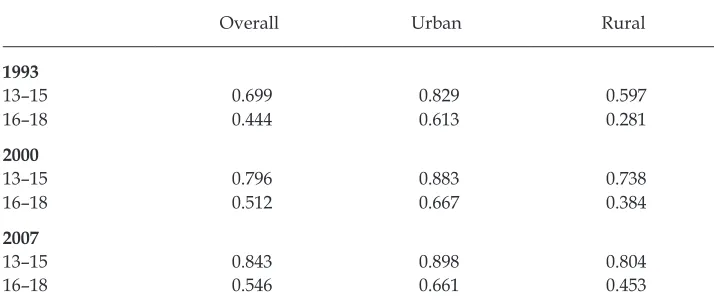
The overall enrolment rate of secondary school aged children has been increas-ing since 1994. Moreover, even though the enrolment gap between urban and rural areas remains signiicant, it has narrowed rapidly. For example, in 1993 the enrolment rate of children aged 13–15 years, who comprise the bulk of junior secondary school enrolments, was only 60% in rural areas and 83% in urban areas. The corresponding igures in 2007 were 80% and 90%, narrowing the gap between urban and rural areas by 13 percentage points. Identifying the factors behind this rapid improvement in rural school enrolment would be helpful in formulating effective policies for Indonesia and other countries struggling to raise enrolment rates.
To this end, the study explores changing contributions to the enrolment of sec-ondary school aged children in rural Indonesia in 1993, 2000 and 2007. By simultane -ously including relevant supply-side (school), demand-side (child and household) and environmental (community and regional) characteristics in the estimation, I try to avoid serious omitted variable bias. Two of the three years chosen for analysis correspond to the important changes in educational policy in Indonesia discussed above: 1993 was the year just before junior secondary education became compul -sory and 2007 was the year after junior secondary education became free and the law on teachers and lecturers was enacted to enhance teacher quality. The third year chosen, 2000, is mid-way between these two points. Although direct evaluation of the impact of these policy changes is beyond the scope of this paper, it is possible to
infer the extent to which the policies have had an impact on household behaviour by using these three years for the analysis.
The primary data used in this paper are drawn from the Indonesia Family Life Survey (IFLS); these are complemented by data from the National Socio-Economic Survey (Susenas) and the Village Potential Survey (Podes). Using these data sets, the study aims to contribute to the empirical literature on the determinants of school enrolment in Indonesia in the following three ways. First, inspired by the work of Estudillo, Sawada and Otsuka (2009) on the rural Philippines and Kajisa and Palanichamy (2010) on rural India, it emphasises changes over time in the correlates of secondary school enrolment. By estimating differential correlates for the years 1993, 2000 and 2007, it is possible to obtain insights into how the con-straints to enrolment have changed, and how the rapid expansion of school enrol-ment has been achieved in rural Indonesia. Second, the study provides evidence on the closing of the gender gap. Existing studies of Indonesian school enrolment have shown mixed gender effects. Chernichovsky and Meesook (1985) and Surya-darma, Suryahadi and Sumarto (2006) ind lower enrolment rates for females, while Filmer (2000) shows virtually no difference in enrolment between males and females. These studies rely on cross-sectional data at a particular point in time, however, and do not investigate in what environments gender gaps occur, and whether these gaps, if any, have been widening or narrowing over time in the face of a changing environment. The present study contributes concrete ideas on these dynamics. Third, this paper attempts to explore the impact of several fac-tors that have largely been neglected in the previous literature. One is the ‘neigh-bourhood effect’, and another is school characteristics. The study uses IFLS and Susenas data to assess how the enrolment of neighbouring children affects indi-vidual enrolment behaviour, a subject still relatively rare in the education litera-ture, especially in the context of rural Indonesia. Meanwhile, the rich information available on school characteristics in the IFLS allows investigation of the extent to which factors other than school construction, such as teachers’ salaries and work effort, have an impact on enrolment rates.
OVERVIEW OF EDUCATION IN INDONESIA The education system
Contemporary Indonesian formal education consists of six years of primary edu -cation, three years of junior secondary education and three years of senior gen-eral secondary education or senior vocational secondary education, followed by a variety of forms of higher education in institutions such as academies, polytech-nics and universities. Primary education usually starts at age six or seven and, if there is no grade repetition, children aged 13–15 will normally be enrolled in junior secondary school and those aged 16–18 in senior secondary school.
General education consists of two large parallel streams. The irst is the secular system operating under the Ministry of National Education, while the second is the Islamic system (madrasah), operating under the Ministry of Religious Affairs.1
1 In addition, there are smaller numbers of other religious schools, such as Christian and
Buddhist institutions.
Although religious subjects are much emphasised in the madrasah stream, both major streams commonly provide children with similar skills at each grade, including reading, writing, mathematics, sciences and knowledge of various cul-tures. Senior vocational secondary education aims to provide more speciic skills to meet the demands of the industrial and commercial sectors.
The above streams can be further divided into public and private sub-streams. While almost all children enter public institutions at the primary level, the per-centage of children entering private institutions is large at the secondary and ter-tiary levels. In terms of quality, there is no consensus on whether the public or the private sector is superior: some authors claim that public schools provide higher-quality education (Lanjouw et al. 2001; Newhouse and Beegle 2006), whereas oth -ers hold the opposite to be true (Bedi and Garg 2000).
Number of secondary schools and enrolment rates
Table 1 presents the total and average numbers of junior and senior secondary schools in Indonesia at the local government level2 between 1993 and 2008.3 The igures cover general and vocational schools under both the secular and Islamic systems, and include public and private institutions.
The total number of junior secondary schools in Indonesia more than doubled, and that of senior secondary school almost tripled, during this 15-year period. The average number of junior secondary schools per local government area increased from 66 to 97, and that of senior secondary schools from 27 to 45, between 1993 and 2000. On the other hand, by 2008 the average number of schools had fallen to 88 at junior secondary level despite the increased number of such schools in the country, whereas it had increased further to 50 at senior secondary level.
2 The highest unit of Indonesian local administration is the province (propinsi), followed by the district and municipality (kabupaten and kota, respectively, referred to collectively as ‘local governments’), then the sub-district (kecamatan) and inally the community or village (desa).
3 The igures presented in table 1 are from the Podes data set, and differ from the number
of schools reported by the Ministry of Education and Culture. Podes does not include data
for this study’s target year of 2007, so I use 2008 Podes data to relect school numbers in
2007.
TABLE 1 Number of Secondary Schools in Indonesia
1993 2000 2008
Junior secondary schools 19,889 30,477 40,820
Senior secondary schools 8,187 14,260 23,400
Mean number of schools per local government area
Junior secondary schools 65.6 97.1 87.8
Senior secondary schools 27.0 45.4 50.3
Number of local governments 303 314 465
Source: Podes (Village Potential Survey), 1993, 2000 and 2008.
The decline in the average number of junior secondary schools per local govern-ment area is due mainly to the proliferation of local governgovern-ments that occurred under the decentralisation process that began in 2001. The number of provinces increased from 26 to 33 and the number of local governments from 314 to 465 between 2000 and 2007.4
Table 2 shows school enrolment rates by age and urban–rural location from 1993 to 2007. In 1993 around 70% of children aged 13–15 (the main target group for junior secondary schooling) and 44% of those aged 16–18 (the main target group for senior secondary schooling) were enrolled in school. At that time there were large enrolment gaps between urban and rural areas. While 83% of children aged 13–15 and 61% of children aged 16–18 in urban areas were enrolled, the cor -responding igures were only 60% and 28% for rural areas. These indings suggest that living in a rural area was a severe constraint on progression between levels of schooling in 1993.
Over time, however, along with overall growth in enrolment rates, the enrol-ment gaps between urban and rural areas narrowed considerably. In 2007, 90% of children aged 13–15 in urban areas were enrolled, compared with 80% in rural areas, indicating that the gap for this age group had decreased from 23 to just under 10 percentage points between 1993 and 2007. A similar story holds for chil-dren aged 16–18: the enrolment gap between urban and rural areas for these chil -dren decreased sharply from 33 to 21 percentage points over the same period. These observations indicate that, while enrolment gaps between urban and rural areas remain signiicant, they decreased markedly between 1993 and 2007.
ANALYTICAL FRAMEWORK AND SCOPE OF STUDY
In order to understand the factors underlying the rapid expansion of secondary school enrolment in rural Indonesia, it is useful to consider how the demand for schooling is determined. In classical human capital theory, education is regarded
4 In 1993 there were 27 provinces and 303 local governments.
TABLE 2 School Enrolment Rate by Age Group and Location
Overall Urban Rural
1993
13–15 0.699 0.829 0.597
16–18 0.444 0.613 0.281
2000
13–15 0.796 0.883 0.738
16–18 0.512 0.667 0.384
2007
13–15 0.843 0.898 0.804
16–18 0.546 0.661 0.453
Source: BPS (Central Statistics Agency), Susenas (National Socio-Economic Survey), 1993, 2000 and 2007.
as an investment in maximising one’s lifetime earnings (Becker and Tomes 1986). Additional schooling increases the low of income over the life-cycle, while at the same time it involves costs – not only direct costs, such as tuition and fees, but also opportunity costs, such as the forgone value of production and domestic work while children are in school. If credit constraints are not binding, investment will continue until the marginal beneits of schooling are equal to its marginal costs (all measured in present values), given the cost of borrowing. If households cannot borrow, or if borrowing is costly, household wealth also affects schooling decisions. In either case, the optimal schooling level is an increasing function of beneits and a decreasing function of costs.
This study classiies possible factors affecting the demand for schooling into four categories: child characteristics; household characteristics; regional charac -teristics; and school characteristics.
Among child characteristics, an important determinant of enrolment identi-ied in the literature is gender (Strauss and Thomas 1995). Being female is widely regarded as a constraint on school progression in most countries, presumably because the expected returns to schooling are lower for females than for males, while the opportunity costs of schooling are higher for females. Returns to school-ing, at least as perceived by parents, will be lower for females than for males if there is discrimination against females in the labour market or if females leave home after marriage.5 The opportunity costs of female schooling will be higher if girls are expected to help with domestic work (Kajisa and Palanichamy 2010). Recent studies in the rural Philippines ind that female education in rural areas increases substantially with economic growth, however, because the expansion of non-farm sectors increases the expected returns to female schooling (Quisumbing, Estudillo and Otsuka 2004; Takahashi and Otsuka 2009).6 Since the signiicance of non-farm income in rural livelihoods has been emphasised increasingly in Indo -nesia in recent years (Kusago 2002; Gibson and Olivia 2010), it is likely that the enrolment rate of females – relatively low in the past – has been catching up with that of males in the course of modernisation.
Another critical determinant highlighted in the literature is household wealth (Behrman and Knowles 1999). Most studies in Indonesia show that this posi -tively affects secondary school enrolment (Pradhan 1998; Suryadarma, Suryahadi and Sumarto 2006), suggesting that credit constraints are binding. The binding credit constraint will, then, intensify implicit resource competition among sib-lings (Morduch 2000). Thus, as the number of sibsib-lings increases, the probability of enrolment will decline, given the availability of cash at hand. An emphasis of this study is placed on whether, and to what extent, the need to allocate available
5 Kevane and Levine (2003) ind, however, that Indonesian parents treat sons and daugh -ters roughly equally in schooling investment and that the investment level is not affected by whether daughters move away from the original household.
6 Quisumbing, Estudillo and Otsuka (2004) argue that recent increased investment in fe
-male schooling in the rural Philippines relects judgments about the comparative advan
-tage of males and females: males are relatively well suited to farming, and thus receive
more farm land from their parents, while females are relatively better suited to non-farm activities, and so receive more investment in schooling.
household resources among siblings was inluential in investment in schooling after free education was introduced at the junior secondary school level in 2003.
It is also widely believed that individuals in the same group tend to behave similarly, and that socio-economic outcomes improve if one lives close to aflu -ent rather than disadvantaged households (Manski 1993). Such neighbourhood effects are often argued in the context of schooling decisions, too (Case and Katz 1991; Bobonis and Finan 2009). Similar enrolment behaviour by different house-holds in a given community is likely to be observed if the househouse-holds concerned have similar backgrounds and inancial circumstances. In addition, it is expected that in a region where sending children to secondary school is essentially a social norm, parents tend to behave as others do because of peer effects. Further, if the value of schooling lies not only in acquiring skills and knowledge from teachers, but also in exchanging ideas and information with friends, then the more friends attend school, the greater the perceived value of schooling will be. In such envi -ronments, children may wish to attend school to avoid being alienated from their friends.
Many studies focus on individual and household characteristics, with only a limited number explicitly examining how school characteristics inluence school -ing decisions. The extent to which school characteristics might affect enrolment rates is a critical issue in the Indonesian context. Better school quality is likely to raise the value of schooling, leading in turn to higher enrolment rates. Among the factors likely to enhance school quality, the role of improvements in teachers’ abilities and incentives have been hotly debated in Indonesia, resulting in the enactment of the law on teachers and lecturers in 2005. Using school and teacher characteristics, the study investigates empirically whether such new policies are effective in enhancing educational attainment.
Reduced-form schooling demand functions are estimated separately for chil-dren aged 13–15 and those aged 16–18, and separately by year. These functions can be expressed as:
Eihjt= f X( it,Hht,Cjt,Sjt)+eihjt (1)
where Eihjt is binary, taking the value of 1 if child i in household h in region j is enrolled in school at time t and 0 otherwise, whereas eihjt is a mean zero error term. There are four sets of factors in function f(), pertaining to child characteris-tics X; household characteristics H; regional characteristics C; and school charac-teristics S.
The child characteristics are (1) a dummy equal to 1 if the child is male; (2) a set of age dummies; and (3) a dummy equal to 1 if the child’s religion is Islam.
The household characteristics are (1) a gender dummy for the household head (1 if the head is male); (2) the household head’s age and age squared; (3) com-pleted years of education of the household head and the spouse of the household head;7 (4) the number of dependants (deined as household members equal to or younger than six years, or older than 65 years), and the number of school aged members (deined as those between seven and 22 years old, regardless of whether
7 If there is no spouse, the years of spouse education are set at zero.
they are actually in school); and (5) the (log) value of farm land.8 The value of farm land is used as a proxy for household wealth; I avoid use of more direct measurements of wealth, such as per capita consumption, because unobservable household characteristics are highly likely to affect both enrolment decisions and household consumption, causing an endogeneity problem.
The regional characteristics used in the study are (1) the number of junior and senior secondary schools in the sub-district; (2) a road dummy (1 if the main road in the community is paved with asphalt); (3) a bank dummy (1 if there is a bank in the community); (4) a factory dummy (1 if there is a factory in the community); (5) (log) average per capita consumption in the community; and (6) the propor -tions of enrolled children aged 13–15 and 16–18 at the sub-district level. As will be explained in the data section, I use data at the community (desa) and sub-district (kecamatan) levels, depending on the level at which data are available for each var-iable. The existence of neighbourhood effects is assessed by two variables: (log) average per capita consumption in the community; and the proportion of enrolled children aged 13–15 and 16–18 at the sub-district level. The irst relects similar -ity in affordabil-ity of education between a household and its neighbours, while the second relects education-related peer effects among parents and children in the same community or in the same sub-district. Since identifying the exact route of each effect is a formidable task, I examine the existence and the extent of such effects only in reduced form.9
The school characteristics are (1) average years of experience of teachers, and experience squared, in the sub-district; (2) average teacher hours of work per week at junior and senior secondary schools in the sub-district; and (3) (log) aver-age monthly salary of teachers at junior and senior secondary schools in the sub-district. I speculate that the average monthly salary of teachers captures incentive effects for them, whereas average experience of teachers and hours of work cap-ture their ability and effort, and thus school quality.
DATA Data sources
This study relies mainly on data from the IFLS, collected by the RAND Corpora -tion in collabora-tion initially with the Demographic Institute of the University of Indonesia in Jakarta and later with the Center for Population and Policy Studies of Gadjah Mada University in Yogyakarta. The IFLS was a multi-purpose panel survey, launched in 1993 and subsequently conducted in 1997, 2000 and 2007. The irst wave covered a group of 13 provinces that accounted for approximately 83% of the total population. A unique feature of this data set is that, in the follow-up
8 Because there are households with no farm land, I convert this variable to log (value of
farmland + 1).
9 Additional controls such as the factory and bank dummies are selected because they are thought likely to affect expected returns to child education and costs of schooling, and thus
inluence current school enrolment. The factory dummy, for example, will capture the op
-portunity cost of schooling: having a factory in a community may increase the op-portunity
cost, and thus reduce current enrolment. On the other hand, having a bank in the commu-nity may increase the availability of credit, and thus have a positive impact on enrolment.
surveys, researchers have attempted to trace not only the original households but also all members who moved out of the original households either as a result of out-migration in search of employment or to establish a new family. The number of respondent households increased year by year: a total of 7,224 households were interviewed in 1993, and 13,535 in 2007. Moreover, around 90% of the original target households were re-interviewed as late as 2007, an exceptionally high pro-portion by the standards of longitudinal surveys.
The IFLS data contain detailed information on each household member, house -hold living standards and the surrounding community. Community character-istics include information on a wide range of facilities such as health, education and other important infrastructure. Direct interviews with school staff are under-taken, which enhances the credibility of the school data. In addition to the number of schools and the quality (physical condition) of each school facility, the IFLS also collects data on teacher characteristics including age, gender, teaching experi-ence, hours of work per week and monthly salary. In order to construct a data set for this study I merged individual information with household, community and school characteristics.
The sample was restricted to the rural population. To capture dynamic trends within ixed seven-year intervals, I used data only for 1993, 2000 and 2007. The IFLS does not include data on the number of schools in each community, so I used the Podes survey, conducted almost every three years by the Central Statistics Agency (BPS). Podes is a census survey, covering all communities in the coun-try, and this study used the Podes data for 1993, 2000 and 2008 to represent the number of schools at junior and senior secondary levels in 1993, 2000 and 2007, respectively. Since the IFLS does not provide village codes, I merged the IFLS and Podes data at the sub-district level.
Finally, I used Susenas data to construct a variable pertaining to the average enrolment rate of children aged 13–15 and 16–18 at the sub-district level. Susenas is a nationally representative, repeated cross-sectional survey, conducted annu-ally by BPS. It collects basic information on household members’ characteristics and living standards, and covers almost 200,000 households. While the average enrolment rate variable could have been constructed from the IFLS data set, I refrained from doing this in order to avoid estimation bias due to reverse cau-sality. It is possible that whether each child is enrolled in school is highly cor -related with the rate of enrolled children in the region if the latter is computed using the former observation. This is because an individual’s school attendance increases the average enrolment rate in the region. Since individual enrolment is the dependent variable and the rate of enrolled children is one of the independent variables in the speciication, it is important to circumvent such a simultaneity problem. I argue that the use of another and larger data set effectively mitigates the simultaneity problem, because in computing the rates of average enrolment in the region I do not directly use the individual observation in question. Moreover, as the number of observations in the region increases, the marginal contribution of an individual to the average decreases: whether or not any one individual is enrolled in school does not signiicantly affect the average enrolment rate.10 To
10 Another possible solution is to construct the average enrolment rate excluding the indi-vidual observation in question.
further increase the number of observations in each region, I converted average rates of enrolment from community level to sub-district level.
Descriptive statistics
After the above data are combined and observations with missing variables are dropped, there are 1,155, 1,088 and 858 observations for junior secondary schools and 882, 953 and 749 observations for senior secondary schools in 1993, 2000 and 2007, respectively.
Table 3 shows selected socio-economic characteristics of sample households from 1993 to 2007. Real per capita consumption was calculated using the con-sumer price index as the delator (with 2000 as the base year). Spatial price differ -ences in the cost of living were adjusted for through use of the rates of difference in the province-speciic poverty lines (Jakarta base) set by BPS.
Because of the Asian crisis in 1997–98, which severely damaged the entire econ-omy, real per capita consumption increased only slightly between 1993 and 2000. After recovering from the effects of the crisis, economic growth accelerated, and rural living standards had improved remarkably by 2007.
Average household size decreased from 6.0 to 5.0 persons between 1993 and 2007. The household head was predominantly male in all years, with an age age of around 48 years. Completed education of the household head aver-aged four years in 1993 and ive years in 2007, whereas that for the spouse of the household head was much lower, at only 2.5 years in 1993 and 3.6 years in 2007. This indicates a signiicant gender gap in education among the older generations. By contrast, for household members aged 15–25 who were neither the household head nor the spouse thereof, the average years of education were 7.3 years for males and 6.4 years for females in 1993, rising to 8.1 years for males and 8.3 years for females in 2007. These observations suggest that there have been considerable improvements in access to education over generations, but that this is especially so for females: the male–female gaps that existed in the past have narrowed over time and were even reversed slightly by 2007.
Table 4 shows the enrolment rates of the target children, disaggregated by gen-der. Three patterns are worth noting. First, enrolment rates generally decreased with age in all years. Second, overall enrolment rates increased rapidly between 1993 and 2007, regardless of gender. Third, while there was a gender gap in favour
TABLE 3 Socio-Economic Characteristics of Study Households
1993 2000 2007
Log real per capita consumption (Rp ‘000) 11.8 12.0 12.5
Household size (persons) 6.0 5.5 5.0
Head of household is male (% of households) 87.4 88.2 85.4
Age of household head (years) 47.7 48.0 48.6
Completed years of education, household head 4.0 4.3 5.0 Completed years of education, spouse of household head 2.5 3.1 3.6 Average completed years of education, 15–25 years old, male 7.3 7.9 8.1 Average completed years of education, 15–25 years old, female 6.4 7.7 8.3
Source: IFLS (Indonesia Family Life Survey), 1993, 2000 and 2007.
of males in 1993, female enrolment rates rose much faster than those of males. Thus, by 2007 the average enrolment rates of female children in both the 13–15 and 16–18 age groups were higher than those of males, a result that is consistent with previous indings (Filmer 2000).
These descriptive tables are suggestive, but each determinant of enrolment cannot be identiied accurately unless other possible inluences on enrolment are held constant. To investigate these determinants, I performed regression analyses, and discuss their results in the next section.
ESTIMATION RESULTS
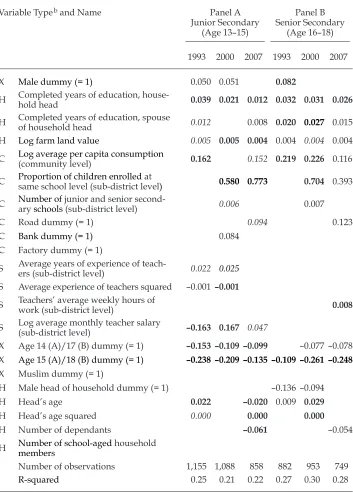
Table 5 provides a summary of estimation results by year. Panel A corresponds to the junior secondary school age group and panel B to the senior secondary school age group.11To control for unobserved regional ixed characteristics, I included provincial dummies in the regressors.12 Because of the incidental
11 As explained, the dependent variable takes the value of 1 if a child was enrolled in school at the time of survey. Because grade repetition and delayed enrolment were not negligible
in rural Indonesia, children aged 13–15 were not necessarily in junior secondary school and children aged 16–18 were not necessarily in senior secondary school. I conirmed that the key indings remained the same, however, if the sample children were restricted to those who
graduated from primary school (in panel A) and from junior secondary school (in panel B).
12 Ideally, household ixed effects would be included in the estimation model to control
for time-invariant unobserved household characteristics. To do this, however, one needs
to have multiple observations of the same age categories (13–15 and 16–18 years) from the same household over the three survey rounds. This signiicantly reduces the number of observations and makes estimation less eficient. Therefore, I estimated the functions separately by year, treating the data as repeated cross-section observations. I also tested whether estimated coeficients differ signiicantly across years, by pooling all three time
periods and interacting year variables of the survey with each of the covariates. Some of these results are explained in the main text.
TABLE 4 School Enrolment Rates of Sample Children by Age and Gender (%)
1993 2000 2007
Age Male Female Male Female Male Female
13 72.4 68.0 89.6 84.0 91.9 89.0
14 60.0 48.4 77.3 74.0 78.4 78.7
15 42.9 43.5 71.0 59.6 74.1 73.7
16 36.1 21.6 53.9 54.4 59.6 63.1
17 37.2 29.8 48.2 41.2 44.7 50.2
18 23.4 11.9 26.8 21.0 26.8 33.4
13–15 58.3 53.8 79.7 73.0 80.8 81.1
16–18 32.5 21.7 42.8 39.7 43.7 50.3
Source: IFLS (Indonesia Family Life Survey), 1993, 2000 and 2007.
406 Kazushi Takahashi
TABLE 5 Factors Associated with Secondary School Enrolmenta
Variable Typeb and Name Panel A Junior Secondary
(Age 13–15)
Panel B Senior Secondary
(Age 16–18)
1993 2000 2007 1993 2000 2007
X Male dummy (= 1) 0.050 0.051 0.082
H Completed years of education, house-hold head 0.039 0.021 0.012 0.032 0.031 0.026
H Completed years of education, spouse of household head 0.012 0.008 0.020 0.027 0.015
H Log farm land value 0.005 0.005 0.004 0.004 0.004 0.004
C Log average per capita consumption (community level) 0.162 0.152 0.219 0.226 0.116
C Proportion of children enrolled at
same school level (sub-district level) 0.580 0.773 0.704 0.393
C Number of junior and senior
second-ary schools (sub-district level) 0.006 0.007
C Road dummy (= 1) 0.094 0.123
C Bank dummy (= 1) 0.084
C Factory dummy (= 1)
S Average years of experience of
teach-ers (sub-district level) 0.022 0.025 S Average experience of teachers squared –0.001 –0.001
S Teachers’ average weekly hours of work (sub-district level) 0.008
S Log average monthly teacher salary (sub-district level) –0.163 0.167 0.047
X Age 14 (A)/17 (B) dummy (= 1) –0.153 –0.109 –0.099 –0.077 –0.078
X Age 15 (A)/18 (B) dummy (= 1) –0.238 –0.209 –0.135 –0.109 –0.261 –0.248 X Muslim dummy (= 1)
H Male head of household dummy (= 1) –0.136–0.094
H Head’s age 0.022 –0.020 0.009 0.029
H Head’s age squared 0.000 0.000 0.000
H Number of dependants –0.061 –0.054
H Number of school-aged household
members
Number of observations 1,155 1,088 858 882 953 749
R-squared 0.25 0.21 0.22 0.27 0.30 0.28
a Bold, italic, and regular fonts indicate 1%, 5% and 10% signiicance levels, respectively. Statistically insigniicant coeficients are not shown.
b Variable types: X = child characteristics; H = household characteristics; C = regional characteristics; and S = school characteristics.
parameter problem inherent in maximum likelihood estimation with ixed effects (Wooldridge 2002), I estimated these equations using the linear probability model. Additionally, since the linear probability model suffers from heteroscedasticity, I employed Huber–White robust standard errors. For the purpose of readability, table 5 gives only the coeficients that are statistically signiicant. Bold, italic and regular type indicates the 1%, 5% and 10% signiicance level, respectively.13
The main indings are as follows. First, while enrolment was signiicantly lower for females than for males in the past, the gap has been eliminated during the period under study. In panel A, the estimated coeficient of the male dummy was positive and signiicant in the earlier years, but insigniicant in the latest year. In terms of magnitude, males were about 5% more likely than females to be enrolled in junior secondary school in 1993 and 2000, but the gap was not statistically different from zero in 2007. A similar trend was observed for senior secondary school aged children. Importantly, the coeficient on the male dummy was already insigniicant in 2000, indicating that the gender enrolment gap at this level had vanished earlier than at the junior secondary level. Further detailed tests (not reported here) reveal that the coeficients for the gender dummy in 1993 and 2007 were statistically different from zero at the 5% level for both junior and sen-ior secondary school levels.As expected, the results show marked changes in gen-der effects in favour of females, presumably because returns to female education increase as modernisation proceeds. This may also relect a change in parental cultural attitudes to education for females, towards a view that daughters should be treated equally with sons in being allowed to pursue their desired life path.
Second, the household head’s education had generally positive and signiicant effects on enrolment, with the magnitude of the coeficient generally being larger for senior than for junior secondary school enrolment. The positive impact of the head’s education always outweighed that of the spouse’s education, even though the absolute magnitude of the coeficient on the head’s education declined for both junior and senior secondary school enrolment over the study period. The larger impact of the head’s education than of the spouse’s education may partly relect an indirect effect through income: a better-educated head earns a higher income, which raises the probability of enrolment. Meanwhile, the declining impact of the head’s education over time is probably due to the reduced impor-tance of income as a determinant of investment in schooling, especially at the junior secondary school level, owing to the introduction in 2005 of free education at that level. Further estimation suggests that these trends are robust, regardless of whether a child is male or female.14 The fact that parental education matters implies that the increasing enrolments of the current generation will have a long-term impact and spill over to subsequent generations, thus potentially reducing inter-generational mobility over time.
Third, the wealth of the household, represented by land value, was positively and signiicantly associated with enrolment, although the magnitude of the coeficient was small. A 1% increase in the value of farm land was associated with a 0.004–0.005% increase in the probability of enrolment in junior and senior
13 The full estimation results are available from the author upon request.
14 I estimated the effect of the education of the head and the spouse interacted with the male dummy, and found that the interaction terms were statistically insigniicant.
secondary school throughout the study period. Somewhat unexpectedly, this held true even for junior secondary school enrolment in 2007. An a priori expecta-tion in the study was that if the free educaexpecta-tion system was effective, the impact of the value of farm land would diminish at junior secondary school level, while remaining signiicant in 2007 at senior secondary school level, where school -ing was still costly. One plausible explanation for these results, consistent with the interpretation of the results for the head’s education, is that income effects were not perfectly eliminated by the introduction of free junior secondary edu-cation. Another possible reason is that private junior secondary schools, which can charge fees, mitigate the extent of the reduction in importance of income for school progression. Thus, although free education has been implemented, dif-ferential enrolment by level of household wealth remains obvious even at the junior secondary level.
Fourth, among the regional characteristics, average per capita consumption and the proportion of local children enrolled were found to be signiicant correlates of enrolment.15 As seen in table 5, panel A, the presence of afluent neighbours, as indicated by log average per capita consumption, was positively associated with individual enrolment in junior secondary school in 1993 and 2007. Also, the pro-portion of enrolled children at junior secondary school in a sub-district was posi-tively associated with individual enrolment in 2000 and 2007. These results imply that households have similar schooling investment behaviour to their neighbours in the same community. Additionally, it could be that, owing to peer effects, the more neighbourhood children are enrolled in school, the higher the incentive of each household to ensure that its children attend school. Similarly, panel B shows that afluent neighbours and the proportion of enrolled children in senior second -ary school in a sub-district had positive correlations with individual child enrol-ment at that level. In the earlier periods, the correlation appeared to be stronger with neighbours’ wealth, while in later periods it was stronger with enrolment of children in the same age group. The increased importance of the latter effect is consistent with the results for junior secondary school enrolment, and is presum-ably due to increasing peer effects among parents and children.
By contrast, the number of schools, the quality of roads and the existence of a local bank or a local factory turned out to be of little importance.16The number of junior and senior secondary schools in a sub-district had a positive and signii -cant impact on enrolment in 2000, but this effect had disappeared by 2007. Rural
15 These neighbourhood characteristics are potentially endogenous, because unobserved
parental attitudes toward child education can be correlated with the choice of neighbours:
parents who want their children to have a good education may move to communities where rich neighbours live and enrolment rates are high. To eliminate this potential endogeneity
bias, one might use the instrumental variable (IV) method. However, the IV approach was
not feasible in this study, owing to the lack of appropriate instrumental variables, so the
reduced-form estimation was maintained. As a robustness check, I also attempted to esti -mate the schooling demand functions without these two potentially endogenous variables,
and found that all other coeficients yielded qualitatively similar results to those presented
in table 5.
16 It would have been better to include in the estimation a variable representing proximity
to the nearest school, to indicate the opportunity cost of travel. However, this was not
pos-sible because the IFLS does not capture such data.
infrastructure, represented by the road dummy, which is equal to 1 if the main road is paved with asphalt, became a signiicant correlate of enrolment only in 2007. I further tested whether the decreasing role of the number of schools and the increasing role of improved road quality indicate that they are substitutes, by interacting these two variables. The interaction term was not statistically signii -cant in any year for either junior or senior secondary schools, however. The bank dummy, which was included to capture credit accessibility, was insigniicant except in the case of junior secondary school enrolment in 2000. This suggests that credit availability did not matter in most cases, presumably because banks are unlikely to allow borrowing against expected increased future earnings from schooling. The factory dummy, which was intended to capture the opportunity cost of children attending school rather than entering the workforce, turned out not to be signiicant.
Fifth, there is little convincing evidence that school characteristics consistently affect enrolment. Teacher experience was signiicant for junior secondary school -ing in 1993 and 2000, but its effect had disappeared by 2007. After the introduc-tion of free educaintroduc-tion, it is likely that the importance of teacher quality declined, at least with regard to enrolment. Teacher effort levels, represented by average hours of work, mattered only for senior secondary schooling in 2007, but the magnitude of the impact was not large. The level of teacher salaries, used as a proxy for teacher incentives, was associated with enrolment for junior second-ary schools in all three years. Yet the sign was inexplicably negative in 1993, and became positive thereafter. Moreover, teacher salaries did not matter at all for senior secondary enrolment in any year. While higher teachers’ salaries may enhance the welfare of teachers and attract more qualiied teachers to schools, my results suggest that they do not lead to signiicantly higher enrolment, espe -cially at the senior secondary level.17
Sixth, as expected, the age dummies were negative and signiicant, with the magnitude being larger for older cohorts. The reference groups are children aged 13 for junior secondary and those aged 16 for senior secondary school. In 1993, relative to children aged 13, those aged 14 were 15% less likely to be in school, and those aged 15 were 24% less likely to be in school. However, these negative age effects have been declining, at least at junior secondary school level, probably because of the spread of compulsory schooling.
Religion, captured by the Muslim dummy, had no impact on enrolment levels in any year. In addition, children in households with a female head were not dis -advantaged in relation to junior secondary enrolment, and were even -advantaged for senior secondary enrolment in 1993 and 2000. This is presumably because female heads, who are usually single parents, consider education as crucial to moving their children out of poverty. An increase in the number of dependants had signiicantly adverse effects on enrolment, but only in 2007. In contrast, the coeficient for the number of school aged children in the household was not
17 A possible reason for the weak signiicance of teacher salaries is that this variable does
not capture ‘incentive’ effects well, in that salary levels are not well tied to performance.
Even so, the indings show that raising salaries alone, as was attempted by the 2005 law,
may not be effective in increasing enrolment rates.
statistically signiicant in any year, indicating that implicit resource competition among siblings is not a problem in schooling progression in rural Indonesia.
DISCUSSION
In recent years the enrolment rates of children aged 13–18 have increased rapidly in rural Indonesia. Using IFLS data, combined with those obtained from Susenas and Podes, this paper has attempted to identify a variety of correlates of enrol-ment of secondary school aged children in rural Indonesia in 1993, 2000 and 2007. From the descriptive statistics, the study found that gender gaps in enrolment existed in the past, but have been eliminated over time. Regression results con-irmed that, when other factors were held constant, there were enrolment gaps between males and females in 1993, but that these no longer existed in 2007 at junior or senior secondary level. Such gaps disappeared even faster at senior sec-ondary level. In all likelihood, compulsory education with nominally free tuition, and the increasing importance of non-farm income in rural livelihoods (which would enhance expected returns to female education), contributed to the narrow-ing of the gender gap.
Given the overall narrowing of the gender gap demonstrated in the results, should we view Indonesia’s accomplishments as exceptional or typical? Accord -ing to Grant and Behrman (2010), who examine household surveys from 38 coun -tries, the gender gap in enrolment in favour of males still exists globally over different age groups, although it is narrowing substantially with the expansion of mass education. However, the achievement of gender parity like that seen in Indonesia is still uncommon in rural areas worldwide. I believe that the increased participation of females in the labour market will enhance schooling investment in females in Indonesia, as is also found in rural Philippines (Estudillo, Sawada and Otsuka 2009), rural India (Kajisa and Palanichamy 2010) and rural Bangla -desh (Hossain, Rahman and Estudillo 2009).
Given the closing gender gap, the effects on enrolment of differential socio-economic and regional characteristics warrant greater attention (Knodel and Jones 1996). My regression results have shown that parental education is an important correlate of enrolment at junior and senior secondary schools, implying that inter-generational socio-economic mobility is declining. Moreover, the positive correla-tion of enrolment rates with household wealth (represented by land value) was found to be statistically signiicant in all years at both junior and senior secondary school levels. This result suggests a risk that inequality in land-holding will be transmitted into inequality in education. It is therefore tempting to argue that the government might resolve this by making educational opportunities more equal across economic classes through the provision of scholarships to children from poor households. The appropriateness of such policies should be judged on the basis of rigorous impact evaluation, however. Scholarship programs imple-mented in Indonesia at the time of the Asian crisis were effective in reducing drop-out rates for junior secondary school, but not for senior secondary school (Cameron 2002). Given the small coeficients on household wealth evidenced by this study, scholarships are not likely to generate much gain. Furthermore, while individual targeting can be potentially pro-poor, identifying poor households is a complex exercise involving substantial costs (Paqueo and Sparrow 2006).
In all likelihood, geographical targeting would be less costly and might be ben -eicial to poor households. My results show that the presence of wealthy neigh -bours and a high proportion of children enrolled in secondary school in the region in question positively affect individual enrolments. This inding implies that poor households in a rich community are more likely to extend the investment in their children’s education than those in a poor community, even if household living standards are the same in both cases. To narrow enrolment gaps across regions, an effort should be made to identify why enrolment levels in particular commu-nities are relatively low, with a view to trying to rectify whatever problem exists. Also, by contrast with current regional funding arrangements, which focus on the arbitrarily estimated ‘iscal needs’ of regional governments (Law 34/2004 on Fiscal Balance, art. 28), iscal transfers from the centre should be relatively higher in per capita terms for communities that have relatively low per capita incomes.
Finally, the study found that the number of schools, and various other school characteristics such as teachers’ salaries and experience, were not inluential in enhancing enrolment rates. In particular, no school characteristic used in the study was signiicantly and consistently correlated with senior secondary school enrol -ment. The results therefore cast doubt on whether, and to what extent, improved teacher compensation and qualiications are relevant to improving enrolment rates in Indonesia. Given the country’s limited inancial resources, it may be more eficient to correct spatial enrolment inequality than to try to improve school char -acteristics in an effort to raise overall enrolment rates. However, this is not to deny the possibility that improved teacher compensation and qualiications may result in better student performance. For example, Grant et al. (2011) show that while school characteristics have a negligible impact on enrolment rates in rural Malawi, they have a substantial impact on student test scores. I was not able to test whether this also applies in Indonesia, because the data available for the pre -sent study do not include appropriate measures of student performance. This is an important question for future research.
REFERENCES
Arze del Granado, Javier, Fengler, Wolfgang, Ragatz, Andrew and Yavuz, Elif (2007)
‘Investing in Indonesia’s education: allocation, equity, and eficiency of public expendi -tures’, Policy Research Working Paper 4329, World Bank, Washington DC.
Becker, Gary S. and Tomes, Nigel (1986) ‘Human capital and the rise and fall of families’, Journal of Labor Economics 4 (3): S1–39.
Bedi, Arjun S. and Garg, Ashish (2000) ‘The effectiveness of private versus public schools: the case of Indonesia’, Journal of Development Economics 61 (2): 463–94.
Beegle, Kathleen, De Weerdt, Joachim and Dercon, Stefan (2008) ‘Migration and economic
mobility in Tanzania: evidence from a tracking survey’, Policy Research Working Paper 4798, World Bank, Washington DC.
Behrman, Jere R. and Knowles, James C. (1999) ‘Household income and child schooling in Vietnam’, World Bank Economic Review 13 (2): 211–56.
Bobonis, Gustavo J. and Finan, Frederico (2009) ‘Neighborhood peer effects in secondary
school enrollment decisions’, Review of Economics and Statistics 91 (4): 695–716.
Cameron, Lisa A. (2002) ‘Did social safety net scholarships reduce drop-out rates during
the Indonesian economic crisis?’, Policy Research Working Paper 2800, World Bank,
Washington DC.
Case, Anne C. and Katz, Lawrence F. (1991) ‘The company you keep: the effects of fam -ily and neighborhood on disadvantaged youths’, NBER Working Paper 3705, National Bureau of Economic Research, Cambridge MA.
Chernichovsky, Dov and Meesook, Oey Astra (1985) ‘School enrolment in Indonesia’, Staff Working Paper 746, World Bank, Washington DC.
De Janvry, Alain and Sadoulet, Elisabeth (2001) ‘Income strategies among rural households in Mexico: the role of off-farm activities’, World Development 29 (3): 467–80.
Dulo, Esther (2001) ‘Schooling and labor market consequences of school construction in Indonesia: evidence from an unusual policy experiment’, American Economic Review 91
(4): 795–813.
Estudillo, Jonna P., Sawada, Yasuyuki and Otsuka, Keijiro (2009) ‘The changing
determi-nants of schooling investments: evidence from villages in the Philippines, 1985–89 and
2000–09’, Journal of Development Studies 45 (3): 391–411.
Filmer, Deon (2000) ‘The structure of social disparities in education: gender and wealth’, Policy Research Working Paper 2268, World Bank, Washington DC.
Gibson, John and Olivia, Susan (2010) ‘The effect of infrastructure access and quality on non-farm enterprises in rural Indonesia’, World Development 38 (5): 717–26.
Government of Indonesia (1998) Petunjuk Pelaksanaan Wajib Belajar Pendidikan Dasar Sem-bilan Tahun [Guide to the Implementation of Compulsory Nine-year Basic Education],
Government of Indonesia, Jakarta.
Grant, Monica J. and Behrman, Jere R. (2010) ‘Gender gaps in educational attainment in
less developed countries’, Population and Development Review 36 (1): 71–89.
Grant, Monica J., Soler-Hampejsek, Erica, Mensch, Barbara S. and Hewett, Paul C. (2011) Gender differences in school effects on learning and enrollment outcomes in rural
Malawi, Paper presented at annual meeting of the Population Association of America, Washington DC, 1 April.
Hossain, Mahabub, Rahman, Mahfuzur and Estudillo, Jonna P. (2009) ‘Income dynamics,
schooling investments, and poverty reduction in Bangladesh, 1988–2004’, in Rural Pov-erty and Income Dynamics in Asia and Africa, eds Keijiro Otsuka, Jonna P. Estudillo and
Yasuyuki Sawada, Routledge, London: 94–117.
Kajisa, Kei and Palanichamy, N. Venkatesa (2010) ‘Schooling investments over three
dec-ades in rural Tamil Nadu, India: changing effects of income, gender, and adult family
members’ education’, World Development 38 (3): 298–314.
Kevane, Michael and Levine, David (2003) ‘Are investments in daughters lower when
daughters move away?’, World Development 31 (6): 1,065–84.
Knodel, John and Jones, Gavin W. (1996) ‘Post-Cairo population policy: does promoting girls’ schooling miss the mark?’, Population and Development Review 22 (4): 683–702. Kusago, Takayoshi (2002) ‘Regional disparity in accessibility to non-farm economic
involve-ment among rural Indonesian households’, ASEAN Economic Bulletin 19 (3): 290–301.
Lanjouw, Jean and Lanjouw, Peter (2001) ‘The rural non-farm sector: issues and evidence
from developing countries’, Agricultural Economics 26 (1): 1–23.
Lanjouw, Peter, Pradhan, Menno, Saadah, Fadia, Sayed, Haneen and Sparrow, Robert
(2001) ‘Poverty, education and health in Indonesia: who beneits from public spend
-ing?’, Policy Research Working Paper 2739, World Bank, Washington DC.
Manski, Charles F. (1993) ‘Identiication of endogenous social effects: the relection prob -lem’, Review of Economic Studies 60 (3): 531–42.
Morduch, Jonathan (2000) ‘Sibling rivalry in Africa’, American Economic Review 90 (2): 405–9. Newhouse, David and Beegle, Kathleen (2006) ‘The effect of school type on academic
achievement: evidence from Indonesia’, Journal of Human Resources 41 (3): 529–57. Otsuka, Keijiro, Estudillo, Jonna P. and Sawada, Yasuyuki (eds) (2009) Rural Poverty and
Income Dynamics in Asia and Africa, Routledge, London.
Paqueo, Vic and Sparrow, Robert (2006) Free basic education in Indonesia: policy scenarios
and implications for school enrolment, World Bank, Washington DC, mimeograph. Pradhan, Menno (1998) ‘Enrolment and delayed enrolment of secondary school age
chil-dren in Indonesia’, Oxford Bulletin of Economics and Statistics 60 (4): 413–30.
Quisumbing, Agnes R., Estudillo, Jonna P. and Otsuka, Keijiro (2004) Land and Schooling: Transferring Wealth across Generations, Johns Hopkins University Press, Baltimore MD and London.
Reardon, Thomas, Delgado, Christopher and Matlon, Peter (1992) ‘Determinants and
effects of income diversiication amongst farm households in Burkina Faso’, Journal of Development Studies 28 (2): 264–96.
Strauss, John and Thomas, Duncan (1995) ‘Human resources: empirical modeling of house -hold and family decisions’, in Handbook of Development Economics,Vol. 3A, ed. Hollis
Chenery and T.N. Srinivasan, Elsevier Science, Amsterdam and New York NY: 1,883–
2,023.
Suryadarma, Daniel, Suryahadi, Asep and Sumarto, Sudarno (2006) ‘Causes of low second
-ary school enrolment in Indonesia’, SMERU Working Paper, Jakarta.
Takahashi, Kazushi and Otsuka, Keijiro (2009) ‘Human capital investment and poverty
reduction over generations: a case from the rural Philippines, 1979–2003’, in Rural Pov-erty and Income Dynamics in Asia and Africa, eds Keijiro Otsuka, Jonna P. Estudillo and
Yasuyuki Sawada, Routledge, London: 47–68.
Wooldridge, Jeffrey M. (2002) Econometric Analysis of Cross Section and Panel Data, MIT Press, Cambridge MA.