The Effect of Magnetic Field on the Phase Transition of
Swollen Liquid Crystal Elastomers
Warsono1,2), Yusril Yusuf 1), Pekik Nurwantoro1) , Kamsul Abraha1)
1)
Department of Physics, Faculty of Mathematics and Natural Science, Gadjah Mada University, 55281 Yogyakarta, Indonesia
2)
Department of Physics Education, Faculty of Mathematics and Natural Science, Yogyakarta State University, 55281 Yogyakarta, Indonesia
Abstract
The effect of magnetic fields on the swelling of liquid crystal elastomers (LCE) dissolved in liquid crystal (LC) solvent have been studied. The Flory-Huggins model used to calculate the free energy of an isotropic mixing and the Maier-Saupe model used to calculate the free energy of a nematic mixing. Numerical integration method used to calculate the order parameter and the total free energy of system (consists of : nematic free energy, elastic free energy, isotropic mixing free energy and magnetic free energy) and the calculation results graphed as a function of temperatures for various magnetic fields and as function of magnetic fields for various of temperatures. We find that the magnetic field shifts the transition points towards higher temperatures, increases the energy transition, and induces an isotropic phase to paranematic phase.
Key words : Magnetic field, swollen liquid crystal elastomers, Flory-Huggins and Maier-Saupe models, free energy, order parameter, numerical integration
1. Introduction
Liquid crystal elastomers (LCE) are hybrid materials composed of liquid crystals (LC) and elastomers. Elastomers are crosslinked polymer chains that have elastic properties and liquid crystals are mesogenic materials that have orientational order properties, so LCE have combination properties of both substances [1, 2, 3, 4, 5]. The coupling between strain and alignment of mesogenic unit, and the responsiveness to the external stimuli such as temperature, electric field, magnetic field, UV light, cause the LCEs materials promise to be suitable for construction of actuators and detectors, and for various application, ranging from micro-pump to artificial muscles [6,7,8]. However, there are some drawbacks of dry LCE in responding to the external fields, for example, it requires a high electric field to induce electromechanical effects. Therefore, one way to increase the responsiveness to the external field is by dissolving LCE in LC solvent. Amazing, the result shows that swollen LCE requires an electric field 200 times lower than the dry LCE to produce electromechanical effects [9]. Accordingly, the swollen LCE could be a good candidate to observe measurable shape changes at low voltages. Based on this, we also sure that the swollen
LCE responsiveness to the magnetic fields. By applying a magnetic field, the behavior of swollen LCE will be known, so it can be applied to many applications.
In this paper, we theoretically study the influence of magnetic field on the phase transition of swollen LCE. The phase behavior of the swollen LCE can be seen from the graph of the relationship between free energy and order parameter with the applied magnetic field. We used the Flory Huggins model to calculate the free energy of isotropic mixing and used the Maier-Saupe model to calculate the free energy of nematic mixing.Furthermore, the order parameter is calculated using numerical integration methods. Through analyzing the graph, it can be seen the influence of magnetic field on the phase transitions of swollen LCE.
2. Theoretical Model
2.1.Free Energy
In this paper, we assume that swollen LCE is binary mixture systems, with the LCE as solute and LC as solvent. The total free energy of swollen LCE can be expressed as a sum of free energy of isotropic mixing Fmix, free energy of nematic ordering Fnem, and free
energy due to elasticity of nematic network Fel, as follows:
(1)
el
nem
mix
F
F
F
F
If the swollen LCE under magnetic field, the total free energy expressed as follow:
)
2
(
mag
el
nem
mix
F
F
F
F
F
tot
The first term Fmix shows the free energy of isotropix mixing. According to the Flory Huggins theory, the free energy is given by [10,11,12,13]:
where
φ
1
andφ
2
1
φ
1
are volume fraction of solute molecules (LCE) and solvent molecules (LC),1
N
is number of monomer in polymer chains,χ
is Flory-Huggins interaction parameter,N
t
is total number of unit cells,k
B
is the Boltzman constant,T
is absolute temperature andf
mix
is free energy density of isotropic mixing. The Flory-Huggins interaction parameterχ
depends on the temperature through the following relationship:(5)
χ
1
1
T
B
A
where
A
1
andB
1
are constants that depend on polymer blend [11].The second term
F
nem
in Eq.(2) shows the free energy of binary nematic mixtures. Using the Maier-Saupe model, the free energy of nematic mixtures expressed as [14]:
1 2 21 1 2 2 2 11 1 1
2 2 2
1
22 2 2 12 1 2 1 2
(6)
nem tF
S
N kT
S
S
(
7
)
φ
φ
ν
φ
ν
φ
ν
φ
φ
2
1
2
1
12
2
2
2
2
22
2
1
2
1
11
2
1
2
2
1
1
S
S
S
f
2
1
nem
Σ
Σ
where
Σ
1
andΣ
2
represent the entropy of mesogenic group in solute (LCE) and in solvent (LC), respectively,11
ν
andν
22
are the nematic (Maier-Saupe) interaction parameter of the pure component,ν
12
represents the cross-interaction parameter between dissimilar mesogens, andf
nem
is free energy density of nematic mixture.The nematic interaction parameters,
ν
11
,ν
22
and12
ν
, have a relationship with temperature with the following equation [15,16] :) 10 ( ν ν ν ) 9 ( 541 4 ν (8) 541 4 ν 22 11 12 2 22 1 11 c T T . T T . NI NI
where
T
NI
1
andT
NI
2
are the temperature of nematic-isotropic phase transition of the component1 and the component 2,c
is proportionality constant. The entropy of component 1 and 2 can be deduced as [15, 17]:where
Z
1
andZ
2
are the partition function of the component 1 and the component 2,m
1
andm
2
are dimensionless mean field parameter characterizing the strength of potential fields, andS
1
andS
2
are the orientational order parameter of the component 1 and the component 2, respectively.The elastic free energy
F
el
of swollen LCE can be derived from classical rubber elasticity theory as follows [10, 11, 18, 19]:2 2 2 1
2
3
el xx yy zz
F
nkT
where n is number of strand between crosslink,
λ
xx
,yy
λ
, andλ
zz
are deformation factor in the x, y, and zdirections. If the deformation factors associated with the order parameter of the components of swollen LCE,
1
S
andS
2
, and the volume fraction of LCE,φ
, then the equation of the elastic free energy can be expressed in Eq.(11). ) 2 (1 φ φ (11) φ φ 1 1 3 1 4 1 1 2 3 1 1 3 1 4 1 1 2 3 N A N c f N A N c kT N F t el t el where A
12S1
1S1
2and 3 2 2 3 t c
.
The final term
F
mag
in Eq.(2) shows the free energy due to the magnetic field. When the magnetic field H is applied to the mesogen having positive diamagneticΔ
χ
χ
||
χ
with the director n, the magnetic free energy is given by [20, 21, 22]:1
1 2 2 1 2 1
1
1 2 2 1 2 1
ln
ln
(3)
ln
ln
(4)
t B
mix
F
N k T
N
f
N
mix 1 1 1 1
2 2 2 2
ln
ln
Z
m S
Z
m S
1 2
(12)where
n
ˆ
H
H
cos
θ
,h
Δ
χ
H
2
/
k
B
T
is the dimensionless parameter of the magnetic field, and
cos
θ
1
2
S
3
1
2
. If this is applied to the swollen LCE, which has two kinds of mesogen with different volume fraction, then the total energy is the sum of each component as follows :
φ
1
2
φ
1
2
(14)
(13)
2
1
φ
2
1
φ
2
2
3
1
1
1
3
1
2
1
2
2
3
1
1
1
3
1
2
1
2
1
S
S
h
f
S
S
h
T
k
N
F
F
F
F
mag
B
t
mag
m
m
mag
2.2.Order Parameter
Orientational order is the most important feature of liquid crystals. The average directions of the long axes of the rod-like molecules are parallel to each other. Because of the orientational order, liquid crystals possess anisotropic physical properties; that is, in different directions, they have different responses to external fields such as an electric field, a magnetic field, and shear [23, 24]. In mixtures of liquid crystals, the molecules of different components may possess different degrees of nematic
ordering. In the mixture, the order parameter expressed by [25, 26]:
where
3
1
2
1
2
x
x
P
is the second Legendrepolynomial,
θ
i
is the angle between a reference axis and the director of a mesogen belonging to component i (i=1 for solute and i=2 for solution), andθ
θ
π
2
sin
d
d
Ω
i
. The functionf
θ
i
is the normalized orientation distribution function which may be expressed by:
θ
1
θ
(17)
T
k
V
exp
Z
f
B
i
i
i
where
Z
i
is partition function defined as:
θ
18
π
0
d
T
k
V
exp
Z
i
B
i
i
Ω
and
V
θ
i
is the potential field describes intermolecular interaction. In the Maier-Saupe model, the potential
i
V
θ
expressed by:
)
21
(
α
)
20
(
1
θ
θ
(19)
1
θ
α
θ
2
2
3
2
2
3
T
k
S
m
cos
T
k
m
V
cos
S
V
B
i
i
i
B
i
i
i
i
i
where
α
is orientational interaction constant andm
i
is dimensionless mean field parameter. Substitution Eqs.(17), (18), (19), and (21) into Eq.(16), we obtain :
2 2 0 2 0 2 2 0 2 0cos
cos
exp
sin d
cos
exp
sin d
cos
exp
cos
sin d
3
exp
cos
sin d
i i
i
i
i i
i i i
i i i
S P
P
kT
S
S P
kT
P
m P
S
m P
22
2
The order parameter
S
i
can be obtained by
numerically solving of Eq.(23). The average
value of order parameter
S
in binary mixture is
given by [27]:
)
4
(2
φ
φ
1
S
1
2
S
2
S
where
S
1
is order parameter of mesogen in solute and2
S
is order parameter of mesogen in solvent.2.3.Phase Transition under Magnetic Field
One way to determine the phase transition in the swollen LCE is to calculate the value of the order parameter. The order parameter
S
1
,S
2
, andS
as function of temperature calculated numerically by Eqs.(23) and (24). Under magnetic field, the dimensionless mean field parameterm
1
andm
2
obtained by minimizing the total free energy with respect to the order parameterS
1
and2
S
as follow:
2
2 0
cos
(15)
cos
(16)
i i
i i i i
S
P
S
P
f
d
φ
26
φ
3
φ
ν
φ
ν
0
φ
φ
3
φ
ν
φ
ν
φ
0
5
2
0
3
1
4
1
1
1
2
2
12
1
1
11
1
3
1
4
1
1
1
1
2
2
12
1
1
11
1
1
1
h
A
N
A
S
-1
S
c
S
S
m
h
A
N
A
S
-1
S
c
m
S
S
kT
N
S
F
F
F
F
S
F
1
1
t
1
1
t
m ag
el
nem
m ix
tot
28
φ
ν
φ
ν
0
φ
ν
φ
ν
φ
0
7
2
0
1
1
12
2
2
22
2
2
1
1
12
2
2
22
2
2
2
h
S
S
m
h
m
S
S
kT
N
S
F
F
F
F
S
F
t
m ag
el
nem
m ix
tot
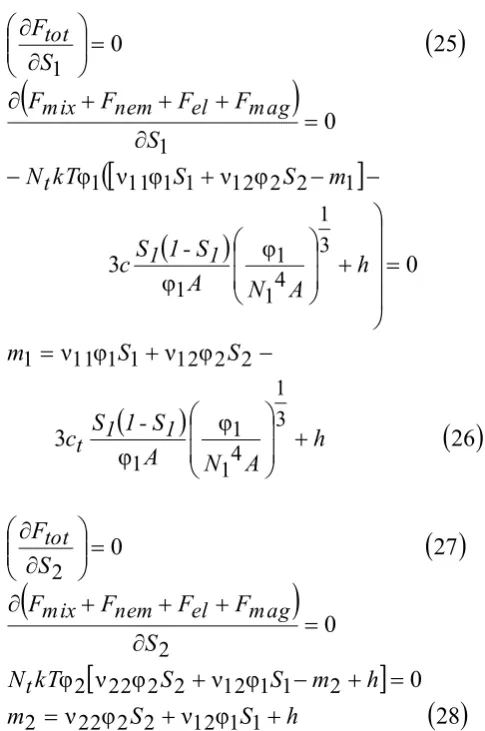
Substitution of Eqs.(8) and (9) into Eq.(26) and Eqs.(9) and (10) into Eq.(27), we get
m
1
andm
2
as function of temperature T and magnetic field h as show in Eqs.(29) and (30).
φ
29
φ
3
φ
φ
541
4
3
1
4
1
1
2
2
2
1
1
1
1
1
h
A
N
A
S
-1
S
c
S
T
T
T
c
S
T
T
.
m
1
1
t
NI
NI
NI
(30)
φ
φ
541
4
1
2
1
2
2
2
2
h
S
T
T
T
c
S
T
T
.
m
NI
NI
NI
Substitution of Eqs.(29) and (30) into Eq.(23), and then the results substitute to the Eq. (24) and to the free energy equations, we get the relationship between
S
,mix
F
,F
nem
,F
el
,F
mag
, andF
tot
with temperature T under magnetic field h.3. Result and Discussion
In this section, we calculate the average order parameter
S
, the free energy density of isotropic mixingf
mix
, the nematic free energy densityf
nem
, the elastic free energy densityf
el
, the magnetic free energy densityf
mag
, and the total free energy densitytot
f
of the swollen LCE as a function of temperature Tand magnetic field h. In these calculations, all the quantities are set as follows:
200
1
N
,φ
1
φ
0
.
5
,T
NI
1
70
o
C
,C
[image:4.612.55.298.67.433.2]T
NI
2
60
o
,c
1
,A
1
0
.
103
andB
1
43
. Figure 1 shows the order parameterS
as a function of temperatureT
and volume fractionφ
without applying of magnetic fieldh
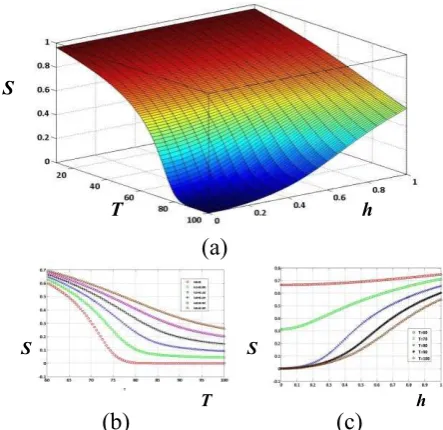
. The phase diagram of Nematic-Isotropic transition is first order transition.The effect of magnetic field on order parameter is shown in Figure 2. By applying a magnetic field, the order inside the system is considerably changed. At the same temperature, the increase in the magnetic field causes the increase of the order parameter, which means that the regularity of the system increases [28]. If the magnetic field is increased, the phase transition occurs at a higher temperature and the transition points shift towards higher temperatures. Applying magnetic field in the isotropic region (S=0) cause the order parameter increase up to the zero values (S>0), see Fig.2(b). It means that the magnetic field induce isotropic phase to paranematic phase [21,29].
S
T
[image:4.612.58.290.513.687.2]At low temperatures, the increase in the magnetic field does not significantly affect to the increase of the order parameter because the mesogenic molecules already in the high regularity. In contrast to the high temperature (greater than the transition temperature), changes in the magnetic field caused the order parameter increase drastically as shown in Fig.2(c).
Figure 3, Figure 4, Figure 5, Figure 6, and Figure 7 show the effect of magnetic field on the nematic free energy density
f
nem
, the free energy density of isotropic mixingf
mix
, the elastic free energy densityf
el
, the magnetic free energy densityf
mag
, and the total free energy densityf
tot
of the swollen LCE.nem
f
T h
nem
f fnem
T h
(a)
(b)
(c)
Fig. 3. The relationship between fnem, T and h (a). fnemas function of T and h, (b). fnem as function of T for various value
of h, and (c). fnem as function of h for various value of T
mix
f
T
h
(a)
(b)
(c)
T h
mix
[image:5.612.66.288.76.291.2]f fmix
Fig.4. The relationship between fmix, T and h (a). fmixas function of T and h, (b). fmix as function of T for various value
of h, and (c). fmix as function of h for various value of T
el
f
T
h
(a)
(b)
(c)
T h
el
[image:5.612.337.559.111.365.2]f fel
Fig.5. The relationship between fel, T and h (a). felas function of T and h, (b). fel as function of T for various value of h, and
(c). fel as function of h for various value of T S
T h
(a)
S S
T h
(b)
(c)
Fig. 2. The relationship between S, T and h (a).S as function of T and h, (b).S as function of T for various value of h, and
[image:5.612.327.551.479.704.2] [image:5.612.67.290.536.747.2]Based on these graphs, the magnetic field effect on the nematic free energy density
f
nem
, the elastic free energy densityf
el
, and the magnetic free energy densityf
mag
, but has no effect to the free energy density of isotropic mixingf
mix
. It can be explained that in addition to the free energy density of the isotropic mixture, each of the free energy contains the order parameters as presented in the Eq.(7), Eq.(12), and Eq.(14).In general, if the magnetic field is increased, the free energy of the system will increase include the free energy of the phase transition.
4. CONCLUSION
We have studied the effect of magnetic field on the phase transition of the swollen liquid crystal elastomers. Combining the Flory-Huggins model for isotropic mixing and the Maier-Saupe model for nematic mixing of two kinds of mesogens, we used numerical integration method to calculate the order parameter and the free energy of the systems as function of temperature and magnetic field. We find that the magnetic field shifts the transition points towards higher temperatures, induces an isotropic phase to paranematic phase, and increases the free energy transition.
References
1.M. Warner and E.M. Terentjev, Liquid Crystal Elastomers, Revised Edition, Oxford University Press, Oxford (2007). 2.K. Urayama, Electro-Opto-Mechanical Effects in Swollen
Nematic Elastomers, in: W.H. de Jeu, Liquid Crystal Elastomers : Materials and Applications, Springer-Verlag, Heidelberg, p.119-145, (2012).
3.M. Lavric, R. Podgornik and Z. Kutnjak, Liquid Crystal Elastomers, Faculty of Mathematics and Physics University of Ljubljana, Ljubljana (2011).
4.G. Skačej and C. Zannoni, External field-induced switching in nematic elastomers : Monte Carlo case study, The European Physics Journal E. Vol.20 (2006), p.289-298.
5.T. Ikeda, J-I. Mamiya, Y. Yu, Photomechanics of Liquid-Crystalline Elastomers and Other Polymers, Angew. Chem. Int. Ed., Vol. 46 (2007), p. 506 – 528.
6.P. Pasini, G. . Skačej and C. Zannoni, A Microscopic Lattice Model for Liquid Crystal Elastomers, Chemical Physics Letters., Vol. 413 (2005) , p. 463 – 467.
7.D. Jayasri, V.S.S. Sastry, and K.P.N. Murthy, Effect Of Cross-Link Density On The Nematic–Isotropic Phase Transition In Liquid Crystal Elastomers, Computational Materials Science. Vol.44 Issue 1 (2008), p. 185-189. 8.W. Zhu, M. Shelley, and P.P. Muhoray, Modeling and
Simulation of Liquid Crystal-Elastomers, Physical Review E 83, (2011), p. 051703-1 - 051703-11.
9.Y. Yusuf, J-H Huh, P.E. Cladis, H.R. Brand, H. Finkelmann, and S. Kai, Low-Voltage-Driven Electromechanical Effects of Swollen Liquid-Crystal Elastomers, Physical Review E 71,(2005), p. (061702-1)- (061702-8).
10.P.J. Flory, Principles of Polymer Chemistry, Cornell University Press, Ithaca, NY (1953).
11.M. Rubinstein, and R.H. Colby, Polymer Physics, Oxford University Press, Oxford (2003).
12.I. Teraoka, Polymer Solutions : An Introduction to Physical Properties, John Wiley & Sons, Inc., Pub, New York (2002).
mag
f
T h
(a)
(b)
T(c)
hFig.6. The relationship between fmag, T and h (a). fmagas function of T and h, (b). fmag as function of T for various value
of h, and (c). fmag as function of h for various value of T
mag
f fmag
tot
f
T h
(a)
(b)
T(c)
hFig.7. The relationship between ftot, T and h (a). ftotas function of T and h, (b). ftot as function of T for various value of h, and
(c). ftot as function of h for various value of T
tot
13.S. Enders and B.A. Wolf,Editors, Polymer Thermodynamics : Liquid Polymer-Containing Mixtures, Spinger, Heidelberg (2011).
14.F. Brochard, J. Jouffroy, and P. Levinson, Phase Diagrams of Mesomorphic Mixtures, J. Physique 45, (1984), p.1125 - 1136,
15.H.-W.Chiu and T. Kyu, Equilibrium phase behavior mixtures, Journal of Chemical Physics, Vol. 103, No.17 (1995), p. 7472-7481.
16.K. Urayama, Y. Okuno, T. Nakao, and S. Kohjiya, Volume Transition of Nematic Gels in Nematogenic Solvents, Journal of Chemical Physics, Vol. 118, No.6 (2003), p. 2903-2910.
17. H.-W. Chiu, Z.L. Zhou, T. Kyu, L.G. Cada, and L.-C Chien, Phase Diagram and Phase Sparation Dynmics in Mixtures of Side-Chain Liquid Crystalline Polymers and Low Molar Mass Liquid Crystals, Macromolecules, Vol. 29, No. 3, (1996), pp. 1051-1058.
18.L.R.G. Treloar, The Physics of Rubber Elasticity 3rd Edition, Clarendon Press, Oxford (1975).
19.J.E. Mark, Physical Properties of Polymers Handbook 2nd Edition, Springer Science + Business Media LLC, New York (2007).
20.P.G. de Gennes and J. Prost, The Physics of Liquid Crystals, 2nd, Clarendon Press, Oxford (1993).
21.I.-C. Khoo and J. Prost, The Physics of Liquid Crystals, 2nd, John Wiley & Sons, Inc, Hoboken (2007).
22.K. Urayama and T. Kato, Volume Phase Transitions of Nematic Gels under An External Field, Journal of Chemical Physics, Vol. 114, No. 8 (2001), p.3818-3822. 23.D.-K. Yang and S.-T. Wu, Fundamental of Liquid Crystal
Devices, John-Wiley & Sons, Ltd, Chichester (2006). 24.R.H. Chen, Liquid Crystal Displays Fundamental Physics
and Technology, John-Wiley & Sons, Ltd, Hoboken (2011).
25.D. Demus, J. Goodby, G. W. Gray, H.-W. Spiess, and V. Vill, Handbook of Liquid Crystals Vol.1 Fundamentals, Wiley-VCH, New York (1998).
26.S.V. Pasechnik, V.G. Chigrinov, and D.V. Shmeliova, Liquid Crystals : Viscous and Elastic Properties, WILEY-VCH Verlag GmbH & Co, Weinheim (2009).
27.A. Matsuyama, Nematic Ordering in Mixtures of Polymers and Liquid Cystals, Res. Rep. Fac. Eng. Mie Univ., Vol. 27 (2002), p.9-22.
28.[28] J. Aramaki, Magnetic field-induced stability of a specific configuration and the asymptotic behavior of minimizers in nematic liquid crystals. Turkish Journal of Mathematics, Vol. 13 (2013), p.1001-1021.