Indo. J. Chem., 2006, 6 (1), 75 - 78
Sri Atun,et al.
75
* Corresponding author.
Email address : [email protected] (Sri Atun)
BALANOCARPOL AND HEIMIOL A, TWO RESVERATROLS DIMER FROM STEM BARK
Hopea mengarawan (Dipterocarpaceae)
Sri Atun
a,*, Nurfina Aznam
a, Retno Arianingrum
aand Masatake Niwa
ba
Chemistry education, Faculty of mathematic and science, Universitas Negeri Yogyakarta, Karangmalang, Yogyakarta, 55281, Indonesia
b
Faculty of Pharmacy, Meijo University, Tempaku, Nagoya, Japan
Received 2 January 2006; Accepted 16 January 2006
ABSTRACT
Isolation and structure elucidation of two resveratrols dimer, namely balanocarpol (1) and heimiol A (2) from stem bark of Hopea mengarawan had been done. The isolation of those compounds was carried out by chromatographic method and structure elucidation was performed by interpretation of spectroscopic data, including UV, IR, 1H and13C NMR 1D and 2D, and FABMS.
Keywords:Balanocarpol; Heimiol A; Dipterocarpaceae.
INTRODUCTION
Hopeais one the main genus of Dipterocarpaceae, consisting of approximately 100 species and widely distributed in Indonesia specially in Kalimantan [1,2] and until now only few species have been investigated. This family of plant is known to produce a variety of resveratrol oligomer [3-16]. These structures are very interesting and showed interesting biological activity, such as antibacterial, anticancer, antihepatotoxic, and anti-HIV [3-16]. Thus Dipterocarpaceae plants are very potential for chemical research in natural product and pharmaceutical industry. In our continuing phytochemical study of the Dipterocarpaceae family occuring in Indonesia, we have examined resveratrol oligomer constituents ofH. mengarawanMiq. This plant is widely distributed in tropical rain forest of Sumatra, Malaysia, until Andaman islands, and it is locally known as “ merawan hitam “ or ‘ pengarawan” [3]. This paper will report our first investigation of two resveratrols dimer from stem bark ofH. mengarawan, namely balanocarpol (1) and heimiol A (2). The structure of this compound based on the analysis spectrum of UV, IR, MS and NMR included ID and 2D NMR (1H-1H COSY, HMQC, HMBC and NOESY).
EXPERIMENTAL SECTION
General Experimental Procedure
UV and IR spectra were measured with varian cary 100 Conc and Shimadzu 8300 FTIR respectively. 1
H and13C NMR spectra were recorded with Jeol JNM A-5000 spectrophotometers, operating at 600.0 MHZ (1H) and 150.0 MHZ (13C) using residual and deuterated solvent peaks as internal standards. MS
spectra were obtained with a JMS-AM 20
spectrometer, using the mode FAB. Vacuum liquid chromatography (VLC) was carried out using Merck Si
gel Merk 60 GF254 (230-400 mesh), column
chromatography using Si-gel Merk 60 (200-400 mesh), and TLC analysis on precoated Si gel plates Si-gel Merk Kieselgel 60 F2540.25 mm, 20 x 20 cm.
Plant Material
Samples of the stem bark of H. mengarawan
were collected in Desember 2003 from the
Experimental Garden in Carita, Banten, Indonesia. The plant was identified by the staff at the Herbarium Bogoriense, Kebun Raya Bogor, Bogor, and a voucher specimen had been deposited at the Herbarium.
Balanocarpol (1) Heimiol A (2)
O
OH
H H HO
OH
HO
OH
OH H
H
A1
A2
B1 B2
1a 4a
7a 8a
1b
4b 7b 8b
12b
O HO
OH
OH
OH
HO OH
H
H H
H
A1
A2
B1 B2
1a 4a
7a
8a
10a
12a
1b
4b 7b
8b 9b
14b 12b
9a
Indo. J. Chem., 2006, 6 (1), 75 - 78
Sri Atun,et al.
76
Table 11H and13C NMR data of compound1in acetone-d6
No H (mult., J in Hz) C HMBC (HC)
1a - 133.7
-2a,6a 7.48 (d, 8.8) 131.5 C-1a; C-4a; C-7a; C-3a 3a,5a 6.95 (d, 8.8) 116.4 C-1a; C-4a;
4a - 159.2
-7a 5.70 (d, 9.5) 93.5 1a; 2a; 9a; 8a; C-11b;
8a 5.16 (d, 9.5) 52.5 C-9a; C-11b; C-10b; C-1a; C-7a; C-14a; C-10a
9a - 142.8
-10a - 120.5
-11a - 157.4
-12a 6.09 (d, 2.2) 102.0 11a; 10a; 14a; C-13a
13a - 156.9
-14a 5.96 (d, 2.2) 106.8 C-13a; C-12a; C-10a;
1b - 133.4
-2b,6b 6.75 (d, 9.5) 132.0 C-1b; C-4b; C-3b 3b,5b 6.42 (d, 9.5) 114.1 C-4b; C-1b;
4b - 155.8
-7b 4.89 (br. s) 50.2 C-1b; C-2b; C-8b; C-11a; C-10a; C-10b; C-9b; 8b
OH
5.39 (br s) 4.32 (d, 4.4)
73.2 C-7b; C-10a; C-9b; C-10b; C-9b; C-10b; C-7b
9b - 140.8
-10b - 113.9
-11b - 159.2
-12b 6.20 (d, 2.2) 95.1 11b; 10b; 13b; C-14b
13b - 159.7
-14b 6.25 (d, 2.2) 104.5 C-12b; C-13b; C-10b
Extraction and Isolation
The milled dried stem bark of H. mengarawan (5 kg) was extracted exhaustively with acetone. The acetone extract on removal of the solvent under reduced pressure gave a brown residue (400 g). A portion (40 g) was then subjected to fractionated by VLC (silica gel GF 60 Merk 250 g;: 10 cm, t = 10 cm), using hexane, n-hexane-EtOAc, EtOAc, Me2CO, and MeOH of increasing polarity as eluents to give twenty fractions. These fractions were combined to give two major fractions A (31.8 g) and B (7.05 g). Fraction A (31.8 g) was repeatedly separated and purified by column chromatography. From this method we obtained two resveratrols dimer, namely balanocarpol (1) (300 mg) and heimiol A (2) (200 mg).
Balanocarpol (1) was obtained as a pale yellow powder, m.p. 230 oC, UV (MeOH) λmax. (log ε) : 227
(5.6); 283 (3.76) nm, IR (KBr) υmax. : 3384; 1608; 1405; 1350; 1240; 1132; 1037; 995; 833 cm-1, 1H and 13C NMR (Me2CO-d6, 600.0 and 150 MHz) see Table 1. FABMSm/z470 [M+] (C28H22O7).
Heimiol A (2) was obtained as a pale yellow powder, m.p. 240 oC, UV (MeOH) λmax. (log ε) : 225 (6.01); 230 (sh 4.83); 282 (3.65) nm, IR (KBr) υmax. : 3352; 1606; 1512; 1450; 1234; 1141; 1068; 954; 835 cm -1
, 1H and13C NMR (Me2CO-d6, 600.0 and 150 MHz) see Table 2. FABMSm/z471 [M+H]+(C28H22O7).
Table 21H and13C NMR data of compound2in acetone-d6
No H (mult., J in Hz) C HMBC (HC)
1a - 136.8
2a,6a 6.90 (d, 8.4) 127.9 C-7a 3a,5a 6.69 (d, 8.4) 115.3 C-7a; C-1a
4a - 157.2
-7a 5.57 (br s) 81.5 C-8a; C-1a; C-2a; C-9a 8a 4.24 (br. s) 46.9 7a; 14a; 10a;
C-9b; C-9a; C-13b
9a - 147.4
-10a 6.41 (d,2.6) 107.4 C-12a
11a - 157.1
-12a 6.16 (d, 2.6) 102.0 C-11a; C-10a; C-13a
13a - 154.6
-14a - 116.0
-1b - 136.9
-2b,6b 7.14 (d, 8.4) 130.0 C-7b; C-4b 3b,5b 6.72 (d, 8.4) 115.5 C-1b; C-4b
4b - 157.2
-7b 4.32 (d, 3.3) 50.9 8b; 14a; 2b; C-1b; C-9a; C-13a 8b 4.97 (d, 3.3) 81.4 7a; 14b; 10b;
C-9b
9b - 142.6
-10b 6.48 (d, 2.2) 104.8 C-8b; C-12b
11b - 158.1
-12b 6.21 (d, 2.2) 102.1 C-14b; C-10b; C-11b
13b - 156.2
-14b - 117.0
-DISCUSSION
Indo. J. Chem., 2006, 6 (1), 75 - 78
Sri Atun,et al.
77
2H (ring B1). The 1H NMR spectrum also showed two sets of meta-coupled aromatic protons signals atδ 6.09 (d, J = 2.2 Hz) and 5.96 (d, J = 2.2 Hz) ppm, each 1H (ring A2), and atδ 6.20 (d,J = 2.2 Hz) and 6.25 (d,J = 2.2 Hz) ppm, each 1H (ring B2). Additionally, the 1H NMR spectrum exhibited signals for a set of aliphatic proton atδ5.70 (d,J= 9.5 Hz) and 5.16 (d, J= 9.5 Hz), each 1H, characteristic for trans -2,3-diaryl-dihydrobenzofuran moiety, and signals assignable two coupled aliphatic protons atδ4.89 (br. s) and 5.39 (br s) ppm, each 1H. These spectral data indicated that compound1has a dimeric stilbene skeleton as part of its structure.
The HMQC spectrum supported complete
assignment of all proton-bearing carbon signals of compound1 (Table 1). Further support for the structure
1 was obtained form HMBC measurement (Figure 1).
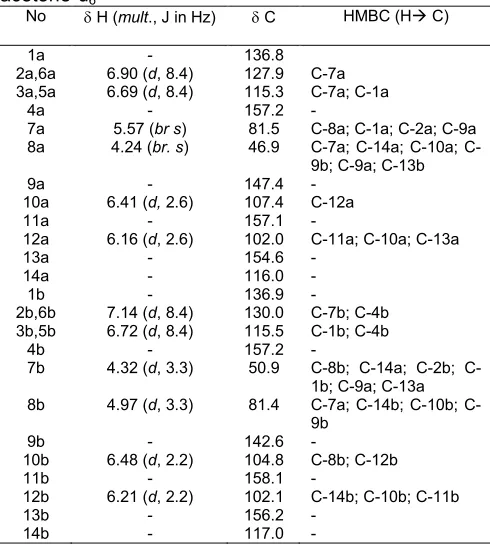
The HMBC spectrum of 1 showed long-range
correlations between H-7a/C-1a, H-7a/C-2a, H-8a/C-7a, H-8a/C-1a, H-8a/C-10a, and H-8a/C-10b, indicating the presence of trans-2,3-diarildihidro-benzofuran moiety. Long-range correlation were also observed for the methine proton between 7b/C-10a, 7b/C-1b,
H-7b/C-8b, and H-8b/C-9b, indicating that A2 and B2 ring attached with sikloheksan ring. The relative stereochemistry of 1 was identified by means of NOESY spectrum. The NOE interactions between H-7a/H-14a indicated that the relative configuration of both methine protons of the dihydrofuran ring were trans-configuration.The NOESY experiments also showed the interation between H-8a/H-7b and H-7b/H-8b, indicated that the relative configuration of both methine proton H-7b and H-8b werecis-configurations. Further evidence for the structure assigned to compound 1 came from comparison of the NMR data to that reported for balanocarpol Therefore, it may be conclude that1is balanocarpol [14].
Compound 2 was obtained as a light brown powder, maxima of absorption were observed at 225; 230 sh; 282 nm in the UV spectrum attributable to the phenol rings. The IR spectrum exhibited hydroxyl group (3352 cm-1), C=C aromatic (1606; 1512; 1450 cm-1), and monosubtituen benzene (835 cm-1 ). Its molecular formula of C28H22O7 was establisehed by FABMS, showing a [M+H]+ ion at m/z 471, together with its NMR spectral data, suggesting that 2 was O
Fig 1Significant HMBC (a) dan NOESY (b) correlation of1
a
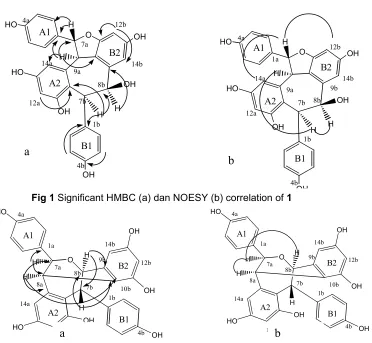
Fig 2Significant HMBC (a) and NOESY (b) correlations of2
Indo. J. Chem., 2006, 6 (1), 75 - 78
Sri Atun,et al.
78
resveratrol dimer. The 1H NMR (Table 2) and 1H-1H COSY spectra showed two sets of AA’BB’ system of aromatic protons assignable to two independent 4-hydroxyphenyl groups at 6.90 (2H, d, J = 8.4 Hz) and 6.69 (2H, d, J = 8.4 Hz) (ring A1), and 7.14 (2H, d, J = 8.4 Hz) and 6.72 (2H, d,J = 8.4 Hz) (ring B2), two sets ofmeta-coupled aromatic protons at 6.41 (1H,d,J = 2.6 Hz) and 6.16 (1H,d, J = 2.6 Hz) (ring A2), 6.48 (1H,d, J = 2.2 Hz) and 6.21 (1H, d, J = 2.2 Hz) (ring B2) assignable to two units 1,2,3,5-tetrasubstituted benzene group. They also displayed two set of copuled benzyl methine protons at 5.57 (1H, br s) (7a), 4.24 (1H,br. s) (8a), 4.32 (1H, d, J = 3.3 Hz) (7b), 4.97 (1H, d, J = 3.3 Hz) (8b). The 13C NMR spectrum showed that C-7a (81.5 ppm) and C-8b (81.4 ppm) indicated that they might both be attached to benzylic carbons bearing an oxygen atom. The connection between protons and their corresponding carbons was established by HMQC. Further support for the structure 2 was obtained form HMBC measurement (Fig 2). The HMBC spectrum (Fig 2) of 2 showed long-range correlations between H-2a with C-7a (81,5 ppm) confirmed that a 4-hydroxyphenyl group is attached to an oxygen bearing carbon. Long-range correlation were also observed for the methine proton between H-8b/C-7b, H-7b/C-10b, and H-8a/C-10b
showed to a fused benzopyran-benzo-oxepane
structure, in the same pattern with those of heimiol A[18]. The relatif configuration of 2 was established on the basis of the NOESY spectra (Figure 2). The NOE correlation showed that the H-8a and H-8b are in asyn configuration, deduced from the NOE correlations between H-8b/H-7a/H-8a, as well as H-7b does not show any correlations. Therefore, it may be concluded that the2is heimiol A, a resveratrol dimer.
CONCLUSION
From the non polar fraction extract acetone stem bark ofH. mengarawancan be isolated two resveratrols dimmer, namely balanocarpol (1) and heimiol A (2).
ACKNOWLEDGEMENT
This work was supported by competitive grant XII-2004, Directorate General Higher Education, Republic of Indonesia. The authors are grateful to the experimental Garden in Carita, Pandeglang, Banten, Indonesia and Herbarium Bogoriensis for supported the sample and identification of the plant specimen.
REFFERENCES
1. Cronquist, A, 1981, An Integrated System of Classification of Flowering Plants, Columbia, New York.
2. Newman, M,F, 1999,Pedoman Identifikasi Pohon-Pohon Dipterocarpaceae, Prosea, Bogor.
3. Dai, J.R., Hallock, Y.F., Cardellina, J.H., and Boyd, M.R., 1998,J. Nat. Prod.61, 351-353.
4. Diyasena, M.N., Sotheswaran, C. S.,
Surendrakumar, S.S., Balasubramain, S., Bokel, M., and Krans, W.,J. Chem. Soc., 8, 1807-9. 5. Eun-Kyoung, Chai S. H., Constant, H.L.,
Santisuk, V.R., Vichai, R., Christopher, W.W., Farnsworth, N.R., Cordell, G.A., Pezzuto, J.M., and Kinghron, A.D.,1999, J. Org. Chem., 64, 6976-6983.
6. Hota, R. K., and Bapuji, M.l., 1993, Phytochem., 32 ( 2), 466-468.
7. Ito, T., Tanaka, T., Ido, Y., Nakaya, K., Linuma, M., and Riswan, S., 2000, J. Chem. Pharm. Bull. 48 (7), 1001-1005.
8. Ito, T., Tanaka, T., Ido, Y., Nakaya, K., Iinuma, M.,
Takashi, Y., Naganawa, H., Ohyama, M.,
Nakanishi, Y., Bastow, K.F., and Lee, K.H., 2001, Tetrahedron, 57, 7309-7314.
9. Sotheswaran, S., Sultanbawa, M.U.S.,
Surendrakumar, S., and Bladon, P.,1983,J. Chem. Soc.,(4), 699-702.
10. Sotheswaran, S., Sultanbawa, M.U.S.,
Surendrakumar, S., and Bladon, P.,1985, J., Chem. Soc. (4), 159-162.
11. Sultanbawa, M.U.S., and Surendrakumar, S., 1980,J. Chem. Soc., 619-620.
12. Sultanbawa, M.U.S., Surendrakumar, S., and Bladon, P., 1987,Phytochem., 26 (3), 799-801. 13. Sultanbawa, M.U.S., Surendrakumar, S., and
Wazeer, M., 1981,J. Chem. Soc. 1204-1206. 14. Tanaka, T., Ito, T., Ido, Y., Son, T. K., Nakaya, K.,
Linuma, M., Ohyama, M., and Chelladurai, V., 2000, Phytochemistry, 53, 1015 –1019.
15. Tanaka, T, Ito, T., Nakaya, K., Linuma, M., and Riswan, S., 2000, Phytochemistry, 54, 63-69. 16. Ohyama, M., Tanaka, T., Linuma, M., and Burandt,
C.l., 1998,J. Chem. Pharm. Bull., 46 (4), 663-668. 17. Sotheeswaran, S. and Pasupathy, V., 1993,
Phytochemistry, 32,5, 1083-1092.
18. Weber,J.F., Wahab, I.A., Marzuki, A., Thomas, N. F., Kadir, A.A., Hadi, A.H.A., Awang, K., Latiff,A.A.,
Richomme, P., and Delaunay, J., 2001,